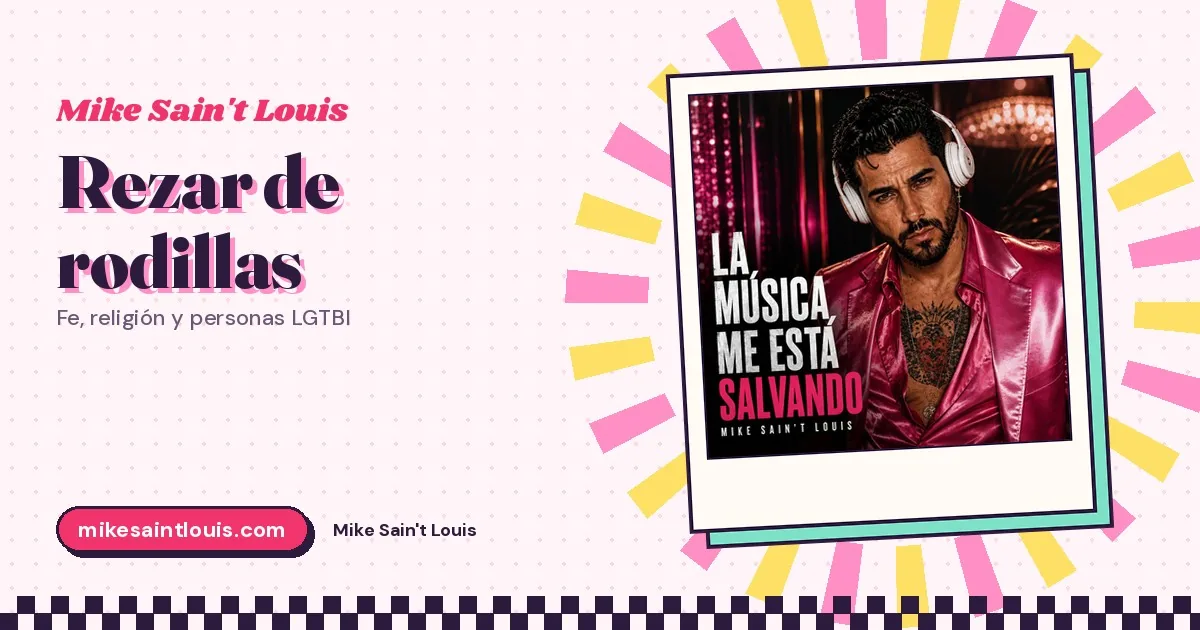
By Mike Sain't Louis ·
Praying on your knees: faith, religion and LGBTI people in my lyrics
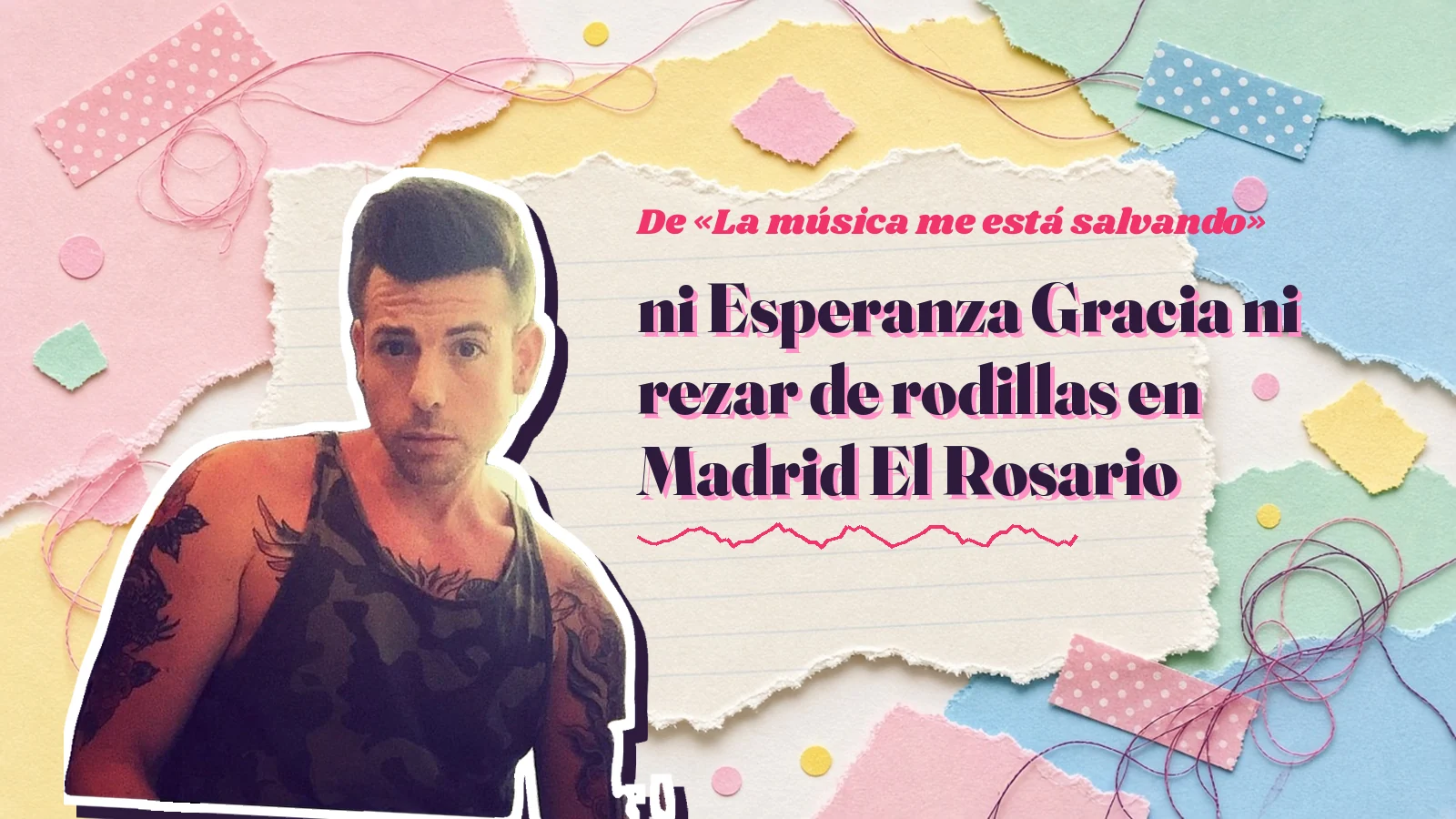
«ni Esperanza Gracia ni / rezar de rodillas en Madrid El Rosario»
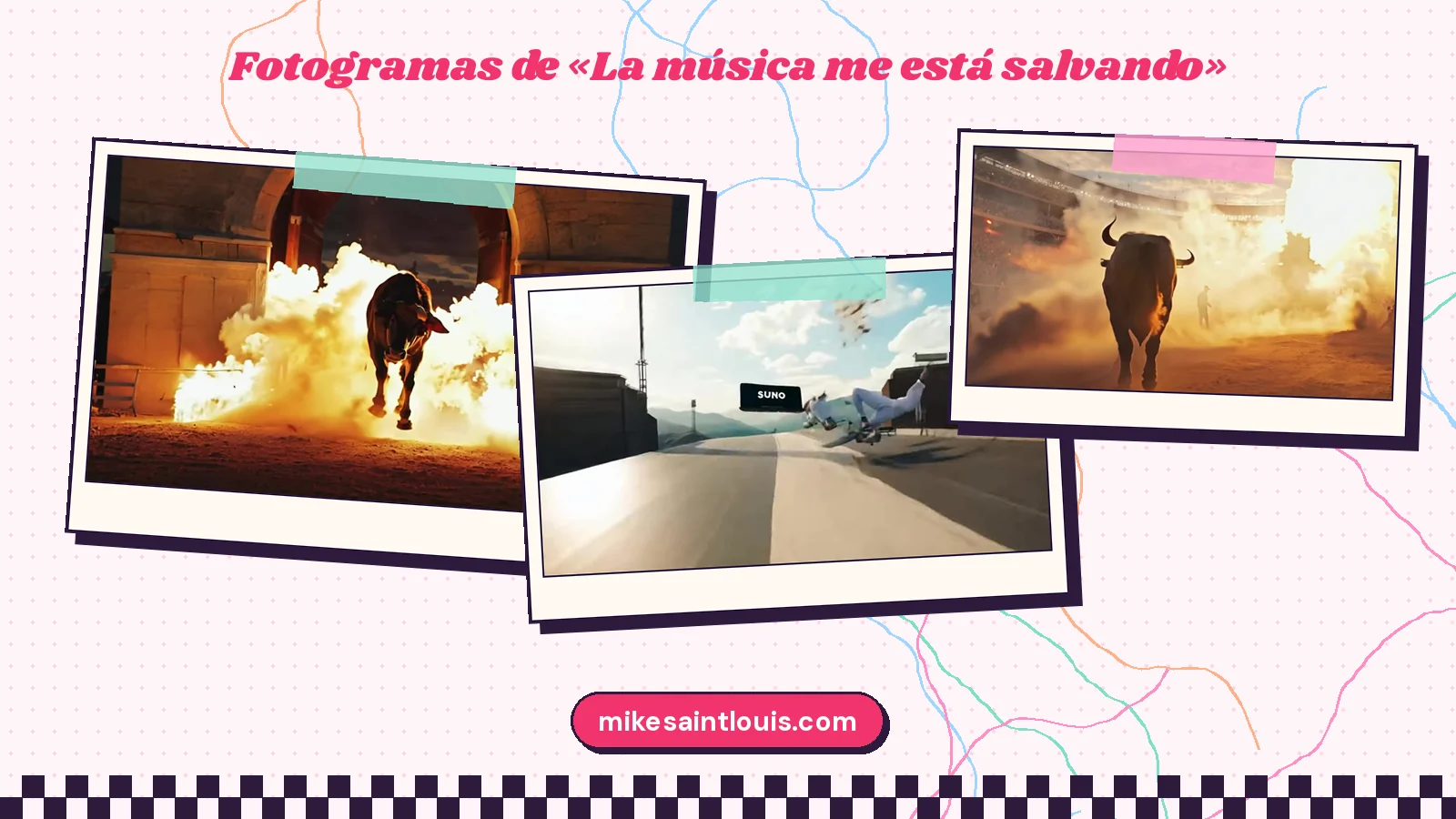
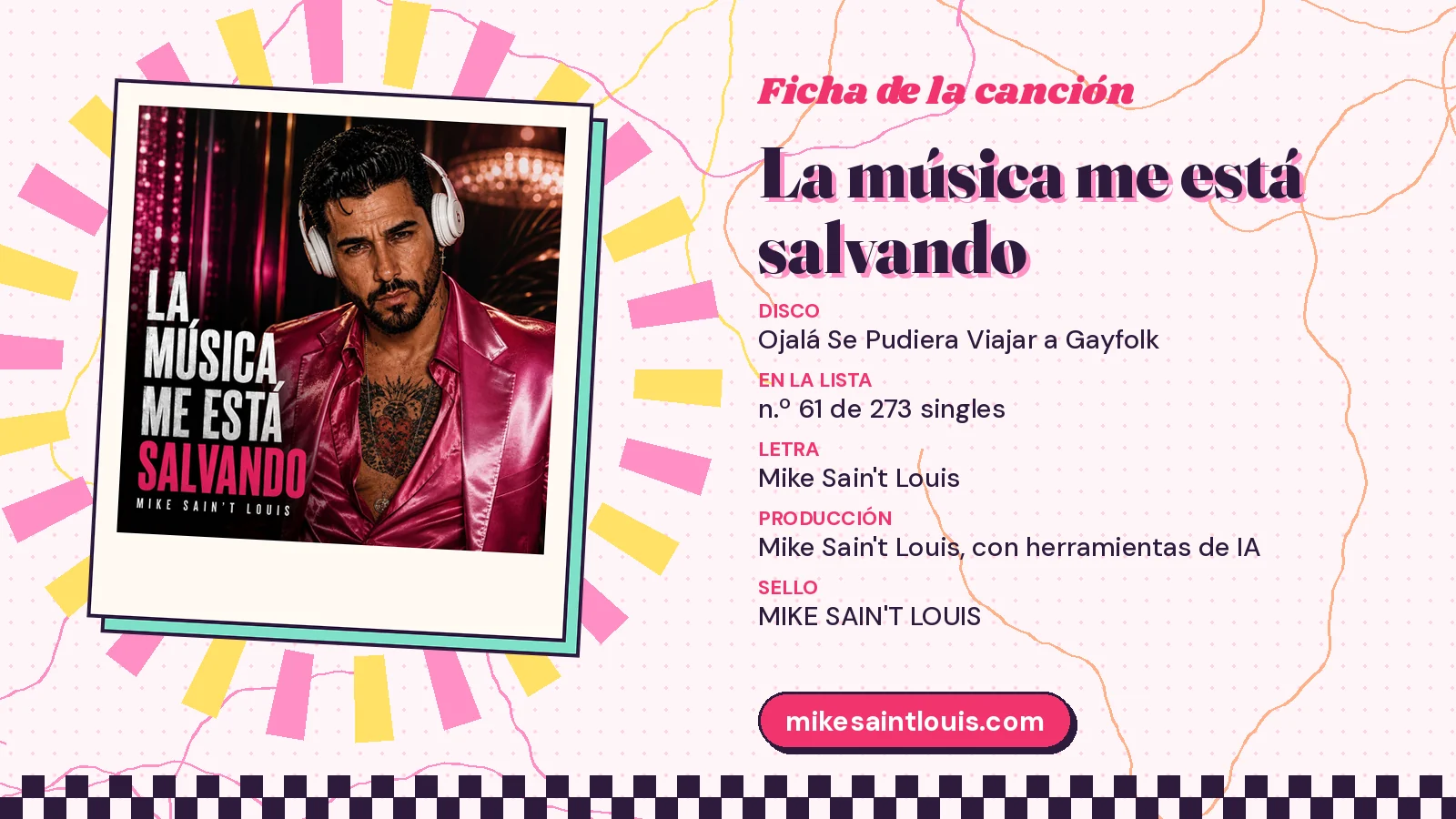
Not the TV horoscope, not praying the rosary on your knees in Madrid. That's how the longest list in «La música me está salvando» (Music is saving me) ends, a song from «Ojalá se pudiera viajar a Gayfolk», the second album of the GAYFOLK trilogy. (The full lyrics are on gayfolkplanet.com.) Before getting there, the narrator has crossed out almost everything that's supposed to help: «Ni psicólogos, ni amigos, ni hermanos, / Ni psiquiatras, ni médicos, ni novios.», no psychologists, friends, siblings, psychiatrists, doctors or boyfriends. Not the horoscope, not the rosary, not the fasting, not the politicians. Only one thing is left standing, and he shouts it in the chorus.
The song exaggerates on purpose. It's the anger of someone who has just left a bad place and doesn't want to owe anyone anything. It isn't a treatise against therapy; in fact, I thanked my psychologist in «Gracias a mi psicóloga». Nor is it a manifesto against faith. But the rosary line gave me an excuse to write about something the scene touches rarely and badly: what happens when you're LGBTI and you believe, or used to, or were raised believing.
On your knees in the list
I'm interested in where the lyrics place prayer. Praying appears in the same list as doctors and friends. That is, as one of the things people turn to when they're having a hard time. To me that's the most honest thing about the line: it recognises that for millions of people praying is a way of asking for help.
That the narrator rules it out at that moment says nothing about those who do pray. There are LGBTI people for whom faith is where they find peace, and others for whom it was precisely where they were told they were a mistake. Both experiences are real and fit in the same community.
Believing and being LGBTI isn't a contradiction
There's a widespread cliché that LGBTI people are, by definition, atheist or anticlerical. The data don't say that. In a survey published in 2025 by the Pew Research Center, 48% of LGBT adults in the United States identified with a religion: Christian, Jewish, Muslim or another. The other half, 52%, had no religious affiliation, a much higher figure than for the population as a whole.
In other words, LGBTI people drift away from religion far more often than everyone else. But almost half don't. And among those who drift away, many keep a spirituality of their own, pray in their own way or miss a community that pushed them out. Thinking of faith as something alien to the community leaves a great many people out.
What the Catechism says
In Spain the majority religion is still Catholicism, so it's worth knowing what it says. The Catechism of the Catholic Church devotes three paragraphs to homosexuality. Number 2357 states that homosexual acts are «intrinsically disordered» and can't be approved under any circumstances. Number 2358 says people with homosexual tendencies must be accepted «with respect, compassion and sensitivity» and that «every sign of unjust discrimination» against them should be avoided. Number 2359 calls them to chastity.
Read from outside, it's a contradictory message: we respect you, but what you do with your body and your love is disordered. Read from inside, by a fourteen-year-old at catechism class, it can be devastating. Nobody needs to insult you for a sentence like that to stay with you for a long time.
From «who am I to judge» to Fiducia supplicans
In July 2013, on the flight back from Rio de Janeiro, Pope Francis answered a question about gay priests with a phrase that went round the world: «If a person is gay and seeks God and has good will, who am I to judge?». In January 2023, in an interview with the AP agency, he said that «being homosexual isn't a crime» and called laws that punish it unjust, though he kept the distinction between crime and sin.
On 18 December 2023 the Dicastery for the Doctrine of the Faith published the declaration «Fiducia supplicans», which allows priests to bless same-sex couples spontaneously. With conditions: the blessing can't be liturgical, can't look like a wedding and doesn't bless the union as such, but the people. For some it was a historic step; for others, a door left ajar that doesn't let anyone through. Both have a point.
Other churches, other paths
Christianity isn't a single block. The Church of Sweden, which is Lutheran, decided in 2009 to marry same-sex couples and has done so since 1 November that year. The Church of England began using, on 17 December 2023, prayers of blessing for same-sex couples, the «Prayers of Love and Faith», though it still doesn't allow them to marry in its churches. Other Protestant denominations, in Europe and in the Americas, have celebrated equal weddings for years.
In Judaism, Islam and other religions there are also communities that welcome LGBTI people and others that reject them. My point is simple: when someone tells you «religion» condemns LGBTI people, they're talking about a part, not the whole.
A history that weighs
To understand why the relationship between faith and sexual diversity is so loaded in Spain, you have to look back. Under Franco, the Catholic Church and the State walked hand in hand; the 1953 Concordat put it in writing. In that framework, homosexuality wasn't just a sin: it was also persecuted by law. The 1970 Law on Social Danger and Rehabilitation included «acts of homosexuality» among the grounds for being deemed dangerous, and that reference wasn't removed until the reform at the end of 1978.
Many older people in the community grew up with those two voices telling them the same thing, one from the pulpit and one from the police station. It's no surprise that linking religion with punishment has stayed with them all their lives. Nor is it surprising that some of them, now older, have returned to a parish that treats them differently. Both reactions make sense once you know the history.
The words that stay
Some words from the religious vocabulary slip into anyone's life, believer or not: sin, guilt, penance, temptation, forgiveness. Many LGBTI people were taught them just as they were starting to find themselves, and they stuck to desire like a label. That's why it's sometimes so hard to feel pleasure without also feeling you're doing something wrong.
In my songs those words often appear with irony. The church shows up in «El anillo de casado» as the place the groom «has been through» before going back to the narrator's bed, something I discussed in «La supuesta heterosexualidad». And sainthood appears as a comparison in «Santa por comparación». Irony isn't contempt. It's a way of taking away those words' power to hurt and keeping what's beautiful in them: forgiveness, compassion, community.
Crismhom: praying in Madrid without hiding
Since 2006 Madrid has had Crismhom, a civil association and ecumenical Christian community that welcomes LGBTIQ+ people of any Christian denomination and straight people who want to share a safe place. It's officially recognised as a public-interest association and is based on Plaza Puerta del Ángel, in the Latina district. According to its website, every Thursday at 20:30 it holds an ecumenical community prayer open to anyone.
I think it matters that a place like this exists, even if I'm not the one who needs it. Because for many people the alternative isn't a calm choice between faith and the closet, but losing one of the two by force. Crismhom offers a third option: praying without having to hide who you love.
Religious harm
The other side has to be named too. Many LGBTI people carry wounds from their religious upbringing: guilt, fear of hell, the feeling that their desire is a test they must pass. Some went through groups that promised to «cure» homosexuality through prayer and discipline. I wrote about those practices in «No hay pastilla que cure lo que no es enfermedad», and about what the law says about them.
In English people sometimes speak of «religious trauma» to describe that harm. It isn't an official diagnosis, but the experience is real. If it sounds familiar, you're not exaggerating or being a bad believer. You deserve someone who listens without trying to convince you of anything, neither to believe nor to stop.
The secularism that protects us
Article 16 of the Spanish Constitution guarantees freedom of ideology, religion and worship, and its third section states that «no religion shall have a state character». Thanks to that, marriage between people of the same sex could be passed in 2005 with Law 13/2005 without asking any church for permission. It's a civil marriage: the State doesn't force any denomination to celebrate it, and no denomination can stop the State recognising it.
I like to think of secularism as an agreement to live together. It protects the believer who wants to pray in peace and the LGBTI person who wants to marry at a registry office. What it doesn't protect is the claim that some people's faith should dictate other people's lives.
It's worth remembering when someone frames LGBTI rights as an attack on believers. Two men marrying at a Madrid registry office doesn't force any parish priest to change his liturgy. And a priest preaching what his doctrine says doesn't force any couple to listen. Living together means each person can live by their convictions without imposing them on those who don't share them, and that the common laws, the ones that apply to everyone, don't depend on any catechism.
Freedom to believe, freedom to be
Religious freedom is a fundamental right, and so is equality. When they clash, the debate gets complicated: a religious state-funded school, a public service, a dismissal. I won't resolve it here. But I do want to be clear that in Spain Law 15/2022 on equal treatment and Law 4/2023 on equality for trans people and LGBTI rights ban discrimination based on sexual orientation and gender identity in areas such as employment, education and healthcare. Nobody's faith is an excuse to break that.
And the other way round too: there's no point mocking those who believe. The LGBTI community has asked for decades that people be respected for who they are. That respect includes those who pray.
A community you choose
One of the things people who leave a church miss most isn't the doctrine, but the people. Coffee after Mass, the youth group, the aunt who saves you a seat on the pew, summer camps. Religions are, among other things, very powerful support networks. When someone leaves one for being LGBTI, they often lose that network just when they need it most.
That's why I value so much what the community has built on its own: associations, groups of friends, choirs, sports teams, Christmas dinners for those who can't go home. They don't replace a faith for those who have one, but they serve a similar purpose: that nobody is alone when things go wrong. And some inclusive faith communities, like the one I described above, do both at once.
If you've lost a community, you don't have to wait for life to offer you another. You can look for one. It might be an association in your neighbourhood, a reading group, a workshop, a Thursday prayer or a dance floor. What matters is that you don't have to leave part of yourself outside to get in.
If your family is religious
Many comings-out play out in homes where grace is said and Mass is attended on Sundays. If that's you, some ideas that have helped others:
- You don't have to convince your family of anything on day one. First reactions often change over time.
- It may help to know that within their own religion there are welcoming voices. Groups like Crismhom have experience supporting families.
- If you're not safe at home, find somewhere you are before telling them. I wrote about growing up under watchful eyes in «El qué dirán», and about needing a roof of your own in «Un techo propio».
- If you're a minor and fear for your safety, Fundación ANAR listens on 900 20 20 10.
If you're a believer and LGBTI
You don't have to choose. There are people who live both at once and do it in peace, even if it cost them. Look for a community that doesn't ask you to split yourself in two. Read what LGBTI theologians and believers have written. And if there's no room in your parish, your congregation or your mosque, that says something about that place, not about you.
You can also live a spirituality without a church, or change communities, or take some time. Faith, for those who have it, is a relationship, and relationships change.
Some people say the hardest part wasn't accepting their orientation but accepting they could keep believing without asking permission. If you're at that point, give yourself time. Nobody demands a final answer from you today: not your community, not the LGBTI scene, not you.
If you've stopped believing
Some people come out of the closet and out of church in the same move. It can be a liberation and, at the same time, a grief: you lose the rituals, the hymns of childhood Sundays, the feast days, sometimes some of your people. It's not unusual to miss it even if you don't want to go back.
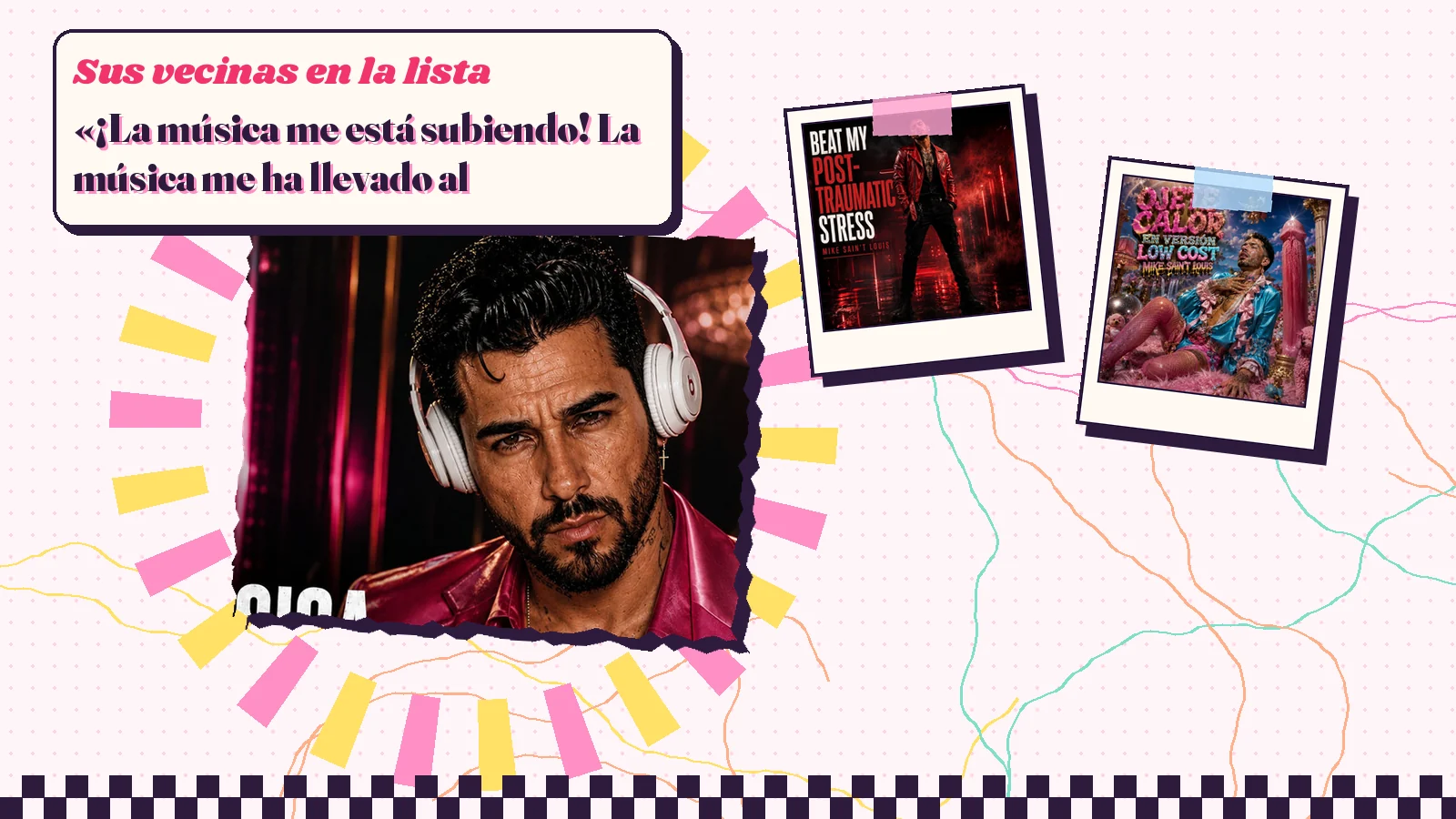
That grief deserves space. Some people find other rituals: the community of the scene, music, Pride, a table of friends. For the song's narrator, the new ritual is a dance floor and a pair of headphones.
When your friend prays
If you have an LGBTI friend who's a believer and you aren't, you may find it hard to understand them. That's normal. What helps is not turning their faith into a debate every time you meet. Don't ask how they can belong to an institution that rejects them as if they hadn't asked themselves a thousand times. Listen when they want to talk about it, respect their rituals and, if one day they have a hard time in their community, stand by them without saying «I told you so».
And if you're the believer and your friend mocks your faith, you can ask for the same respect you give them. Friendships in the community have survived far harder things than a difference in beliefs.
Music as liturgy
The chorus works almost like a repeated prayer: «¡La música me está salvando! / ¡La música me está elevando!», music is saving me, music is lifting me. There's something religious in that repetition, in that way of rising. I don't mean it as criticism: many forms of popular music come from church, from gospel to the saetas of Holy Week, and it's no accident that a song about climbing out of a hole ends up talking about reaching heaven.
I've already written about this song's gerunds in «Me está salvando, no me ha salvado» and about the anxiety behind it in this other piece. Here I'll keep one idea: everyone needs something that lifts them. For some it's praying; for others, a song. What matters is that nobody takes yours away or imposes theirs.
Where to find help
Maybe what weighs on you is the guilt you were taught, that your parish has turned its back on you or that at home they don't accept the person you love. You don't have to sort it out on your own. I checked each of these contacts on its organisation's website:
- FELGTBI+'s Línea Arcoíris answers anonymously, confidentially and free of charge on 913 604 605 and by WhatsApp on 676 78 58 30.
- In Madrid, COGAM offers LGBTI information on 91 523 00 70.
- Crismhom, if you're looking for a Christian community that welcomes you as you are, has a contact form on its website.
- Fundación ANAR, for minors and those around them, on 900 20 20 10.
- 112, in any emergency.
There are nights when guilt weighs so much that someone starts thinking about dying. If that happens to you, in Spain dial 024: it's free, it doesn't judge and it answers at any hour. If you're in another country, look up its crisis line or call its emergency number. Asking for help works; I explain it in «Hablemos del suicidio sin tabú», and there are more resources in the index of my mental-health series.
What's left standing
The song crosses out almost everything and leaves one thing standing. I think it's a good image to end on. When life squeezes, each person holds on to what they can: a therapist, a friend, a rosary, a record. None of those things is ridiculous if it holds you up.
What isn't needed is any faith, or any lack of faith, used to tell another person their love is worthless. In my songs, music is the counterweight. Others find it in praying on their knees. That there's room for both, in Madrid and anywhere else, is what I ask of the planet I invented.
Frequently asked questions
Can you be a believer and LGBTI? Yes. According to the Pew Research Center (2025), 48% of LGBT adults in the United States identify with a religion. There are Christian, Jewish, Muslim and other communities that welcome LGBTI people, such as Crismhom in Madrid.
What is Fiducia supplicans? A declaration by the Dicastery for the Doctrine of the Faith published on 18 December 2023. It allows Catholic priests to bless same-sex couples spontaneously, without a liturgical rite and without anything resembling a wedding.
What is Crismhom? A civil association and ecumenical Christian community in Madrid, founded in 2006 and recognised as a public-interest association, which welcomes LGBTIQ+ people of any Christian denomination. It holds an open ecumenical prayer every Thursday at 20:30.
Can a church stop equal marriage in Spain? No. Article 16.3 of the Constitution states that no religion has a state character, and Law 13/2005 recognises civil marriage between people of the same sex. Denominations aren't required to celebrate it, but they can't prevent it either.
What is «La música me está salvando» about? Someone who, after a bad relationship, lists everything that hasn't helped and holds on to music as the one thing that lifts them. It's a song from «Ojalá se pudiera viajar a Gayfolk», the second album of the GAYFOLK trilogy.
Who writes these songs? Mike Sain't Louis, lyricist, composer and music producer from Madrid, who presents himself as the first AI songwriter. The vocals and music of his songs are made with artificial intelligence.