By Mike Sain't Louis ·
I don't care if it's a girl, a boy, trans or neutral: trans children and the families who support them
«me da igual, si es chica chico trans o neutral»
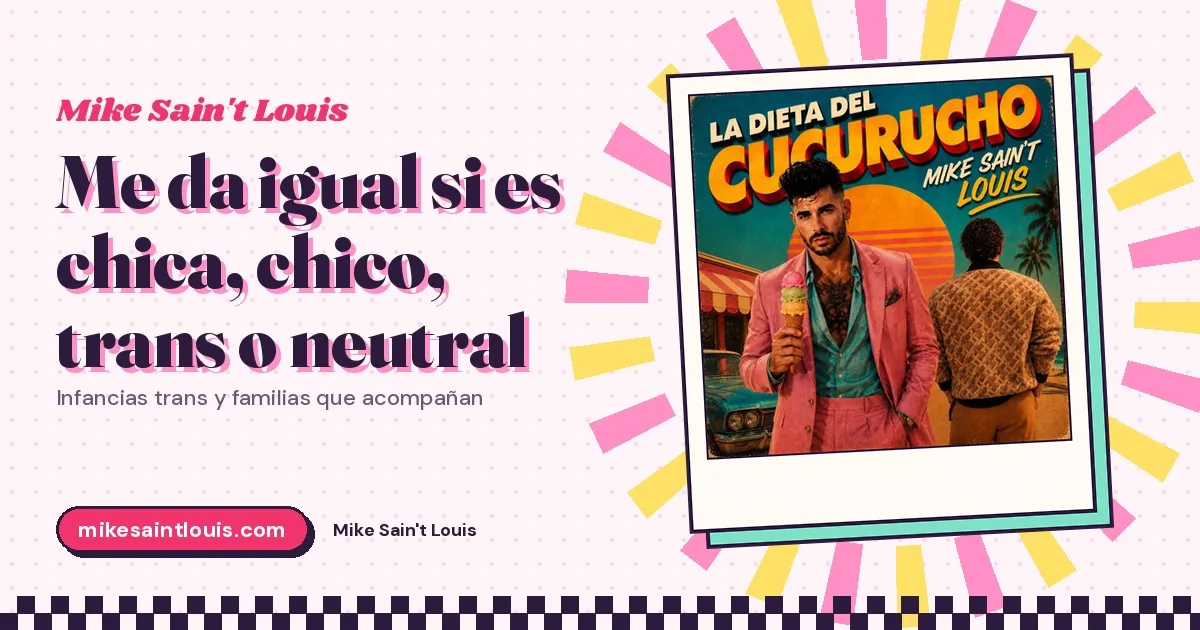
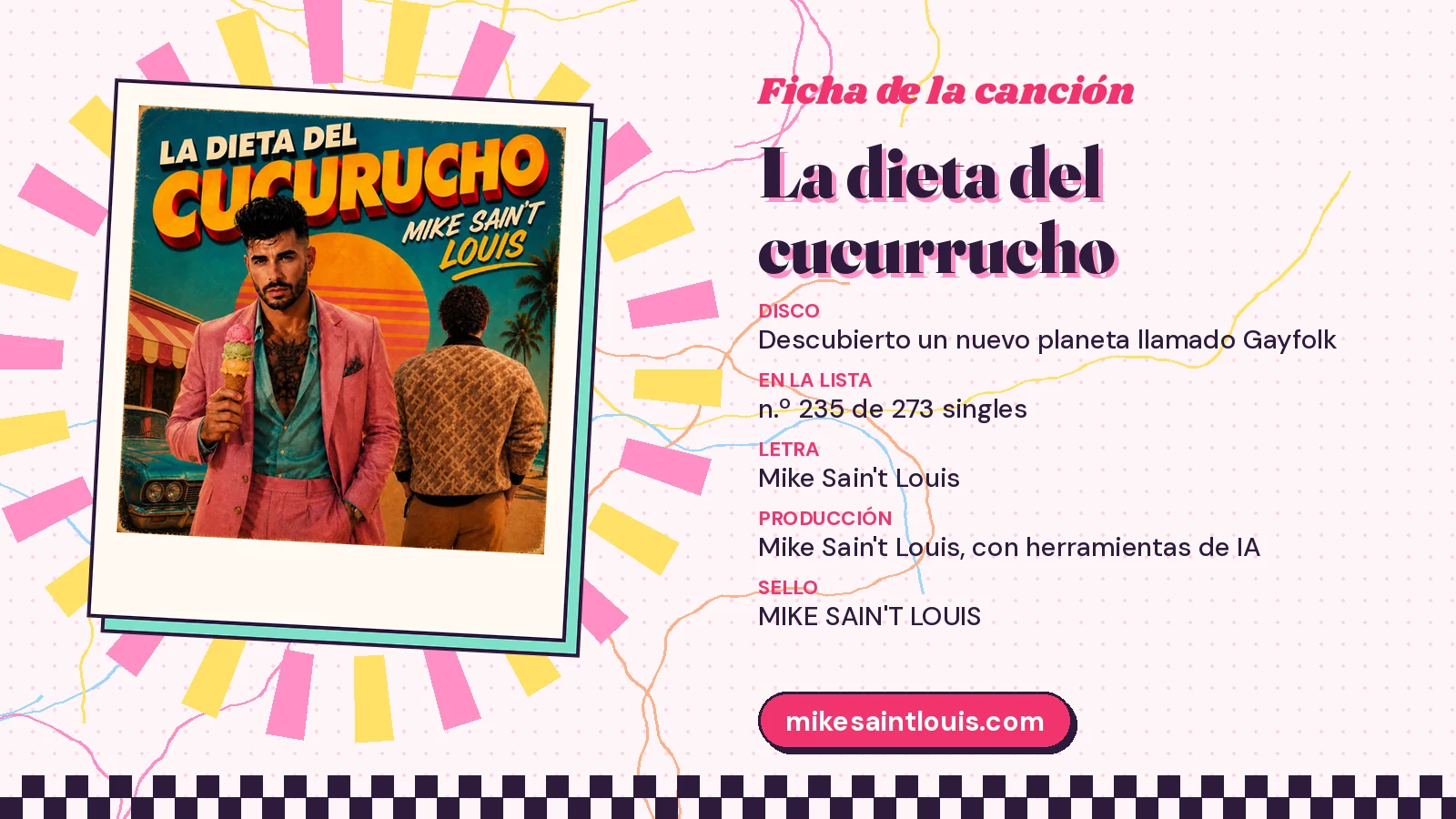
I don't care if it's a girl, a boy, trans or neutral. It's a line that slips in almost unnoticed in the middle of «La dieta del cucurrucho», a song from «Descubierto un nuevo planeta llamado GAYFOLK», the first album of the GAYFOLK trilogy. (If you want to read it all, here are the lyrics.) The song is a comedy of jealousy: a couple who had been calm for two years blows up because one of them has confessed how much he likes an actor's eyes. And the narrator, in full delirium, starts fantasising about the child he'd have with that actor and the ridiculous names he'd give it.
In the middle of that absurd fantasy the line appears. «Así nuestro hijo será», so our son will be, he says first. And straight away he corrects himself: I don't care what it is. A girl, a boy, trans or neutral. I wrote it as one more joke in a song made of jokes, but every time I hear it I realise that line says something many real families take years to say. That the son or daughter you imagine doesn't have to look like the one who arrives. And that it doesn't matter.
I've already written about the celebrities I greet in that song in «Hola, Paco León», and in «Todas y todes» I wrote about grammatical gender in my lyrics. Today I want to take the line seriously and talk about something that isn't a joke: trans children and teenagers, and the families who decide to stand by them.
Before I start, an honest note. I'm a gay man, I'm not a trans person and I don't have children. I'm writing from the outside, with respect, with the facts I've been able to check and with the feeling that this is a subject with too much noise and too little listening. If you're a trans person, or the mother or father of a trans child, your experience is worth more than anything I can say here.
A line written as a joke
The lovely thing about the line is that it doesn't make a speech. The narrator explains nothing, asks no permission, gives no lecture. He simply lists possibilities and puts them all on the same level. Girl. Boy. Trans. Neutral. None of them comes after an «even» or a «although». None is the bad option accepted grudgingly.
That's often how important things work in songs: they're said in passing. If I'd written a solemn ballad about gender identity, I'd probably have ended up with a pamphlet. Instead, in a song where the air is «cargado de tensión», charged with tension, because of a fit of jealousy, the line lands the way it lands in real life: in an ordinary conversation, in the middle of something else.
Because that's how many families find out. Not in a solemn moment with music in the background, but on a Tuesday afternoon, when their daughter or son says something they didn't expect. And what happens in the following minutes, weeks and months matters enormously.
What it means to be a trans person
It's worth starting with the basics, because there's a lot of confusion. A trans person is someone whose gender identity doesn't match the sex they were assigned at birth. A trans girl is a girl who was registered as a boy at birth. A trans boy is a boy who was registered as a girl. And a non-binary person is someone who doesn't identify entirely, or at all, as a man or a woman.
Gender identity isn't the same as sexual orientation. Being trans says nothing about whom you like to love or want to sleep with. There are lesbian trans girls, gay trans boys, bisexual non-binary people and heterosexual trans people. Mixing the two up is one of the most common mistakes, and also one of those that causes the most confusion in families.
Nor is it the same as gender expression, which is how you dress, move or do your hair. A boy who loves dresses or a girl who only wants to play football aren't necessarily trans. They may simply be children who don't fit the stereotypes. I wrote about camp and its volumes in «Exagerada me llamaron a mí». The difference is marked by the child, when they say, persistently, who they are.
What the law says in Spain
In Spain the legal framework changed significantly with Law 4/2023, known on the street as the «trans law», although its official title also covers LGBTI rights in general. It was published in the Official State Gazette on 1 March 2023 and came into force the following day.

Its best-known change is gender self-determination for changing the sex recorded in the Civil Registry. Since that law you no longer need a medical or psychological report, nor to have undergone any hormonal or surgical treatment. The procedure consists of two appearances: in the first the person states their disagreement with the registered sex and chooses, if they wish, a new name; within a maximum of three months they're called back to confirm their decision, and the registry then decides within a month at most.
Things used to be very different. Law 3/2007 allowed the registry change only for adults, and required a medical diagnosis and, as a general rule, two years of treatment. For many trans people that meant having to prove to a professional that their identity was «real», as if it were an illness that had to be certified.
By age: from 12 to 16
For minors, article 43 of the law sets up a step-by-step system:
- From 16, the person can request the change on their own.
- Between 14 and 16, they can request it themselves, assisted by their legal representatives, usually their mother, father or both. If those disagree with each other, or with the minor, a judicial defender is appointed.
- Between 12 and 14, prior judicial authorisation is needed, through a voluntary jurisdiction procedure.
- Under 12 the recorded sex can't be changed, but the name in the registry can.
That last point matters. Article 48 of the law recognises trans minors' right to change their name, and a 2023 instruction from the Directorate General for Legal Certainty and Public Faith made clear that their legal representatives can request it without first having to prove the child already used that name. It sounds like a bureaucratic detail, but for an eight-year-old, being called by their name in class and at the doctor's changes daily life enormously.
The law also allows someone who has changed their registered sex to go back to the previous one, after six months, through the same procedure. I mention it because it's one of the arguments most used to spread fear, and it's worth knowing the law itself provides for it.
The road to here
This change didn't fall from the sky. There was a key ruling before it: Constitutional Court judgment 99/2019 of 18 July. The Supreme Court had raised a question about a boy who had asked to change his name and sex when he was just over twelve. The Constitutional Court declared the 2007 law unconstitutional insofar as it barred the change for minors «with sufficient maturity» in a «stable situation of transsexuality». It said that ban clashed with the free development of personality and the right to privacy.
And before the judges, there were families. Families who found no answers in schools, health centres or laws, and who decided to look for them together.
Chrysallis: families who found each other
One of those networks is Chrysallis. As the association itself explains on its website, it was born nationwide on 1 July 2013 in Madrid. In the preceding months, several families from different parts of Spain had been finding each other through social media and associations of trans adults. They had one thing in common: a trans daughter or son, and a lot of unanswered questions.
In December 2021 they changed their name to Chrysallis, Association of Families of Trans Children and Youth. They work through peer support: the families themselves, as volunteers, advise others on family, school, health and legal matters. They have branches in many regions, and they also train professionals.
I find it a beautiful way to organise. Not an institution talking down at you, but another mother or father who has already been through the first sleepless night and tells you: it's all right, you're not alone. Something like what I wrote about chosen family in «Mi gente o mi Patry», but here with the blood family deciding to rise to the occasion.
What the data shows
You have to be careful here, because it's a subject where many figures are thrown around without context. I'll stick to two specific studies I've checked.
The first is from 2016. Kristina Olson and her team published a study in the journal Pediatrics with 73 trans girls and boys aged 3 to 12 who had made a social transition, meaning they lived with the name, clothes and pronouns they identified with, supported by their families. They were compared with their siblings and with other children of the same age. Result: their levels of depression were at the population average, and their anxiety was only slightly higher, far from clinical levels. The authors themselves warn that it's an observational study and doesn't prove cause and effect, but the conclusion was clear: suffering isn't inevitable.
The second is the 2024 survey by The Trevor Project, a US organisation that works on suicide prevention among LGBTQ+ young people. 18,663 young people aged 13 to 24 took part, of whom just over 12,000 were trans or non-binary. 46% of those trans and non-binary young people had seriously considered suicide in the past year. It's a figure that hurts. But the same report shows the other side: among those who lived with people who respected all their pronouns, the share who had attempted to take their life in the past year was 11%; among those with nobody at home who respected them, 20%.
What protects
Those figures say something any mother or father can understand without statistics: what happens at home counts. Calling your daughter by her name. Using the pronouns your child asks for. Not turning every dinner into a trial. Standing up for them at school. Listening even if you don't fully understand what they're telling you.
None of that requires having all the answers. You can support someone with doubts, with fear and with mistakes. What hurts isn't getting a pronoun wrong one day, it's refusing to try. And what protects isn't having a perfect speech, it's the child feeling that home is a safe place.
In «Un techo propio» I wrote about LGBTI young people who lose their home when their family doesn't accept them. The other side of that story is the families who decide the roof still belongs to everyone.
Social transition isn't medicine
Another frequent confusion: when people talk about trans children, many imagine operations or treatments. Most of what happens in childhood has nothing to do with that. Social transition consists of things like changing name, clothes, haircut or pronouns. It's reversible by definition: if in a few years the person feels something else, they can change again.
Medical treatment in adolescence is another matter, and it's true there's an international debate. In the United Kingdom, the Cass Review, published in April 2024, concluded that the evidence on puberty blockers was insufficient, and the English public health service stopped prescribing them routinely to minors outside clinical trials. Other countries and medical societies keep different criteria. I'm not a doctor and I won't pretend to know everything. What I do know is that those decisions belong to each family with specialised professionals, case by case, and that the medical debate can't be used as an excuse to deny a girl her name in the playground.
Neutral: non-binary people
The line says «neutral», and I'm glad I wrote it, because non-binary people are often left out even of conversations that claim to be inclusive.
In Spain, Law 4/2023 didn't create a third option in the Civil Registry: the recorded sex is still male or female. Some countries have done so, with an «X» box or equivalent on documents. Here, a non-binary person can live as non-binary, but their papers don't reflect it.
In daily life, what is in our hands is language. Asking how they'd like to be referred to. Accepting a name with no marked gender. Understanding that not everyone fits into two drawers. I know «todes» brings some people out in a rash, and in my text on grammatical gender I explained why I use it when I do. But beyond grammar, the point is not to erase anyone.
What nobody should hear
There are sentences families of trans children hear again and again, even from people who love them. «It's a phase.» «It'll pass.» «It's because of social media.» «He's too young to know.» «You've influenced her.» Often they come from worry, not malice. But repeated without listening, they turn the child into a problem to solve instead of a person to get to know.
The most harmful version of that idea is thinking it can be «corrected». So-called conversion therapies, which claim to change sexual orientation or gender identity, are banned in Spain by Law 4/2023 itself. I wrote about them in «No hay pastilla que cure lo que no es enfermedad»: they don't work and they do a lot of harm. Gender identity is like orientation: you support it, you don't fix it.
Hoaxes and fear
In recent years trans people have become a favourite target of political campaigns across half the world. Invented stories are repeated about schools that «convert» children, about toilets, about sport. Many don't survive the slightest check, but they leave fear behind.
I suggest a simple rule: before sharing something about trans people, ask yourself whether you've ever heard a trans person talk about their own life. If the answer is no, start there. There are books, documentaries, interviews and profiles of trans people telling their experience in the first person. And there are figures who are part of our memory: I dedicated a song to La Veneno and wrote about her in «¿Y tú quién eres?». When a person stops being a talk-show topic and gets a face and a name, fear usually goes down.
I don't change and I don't hide
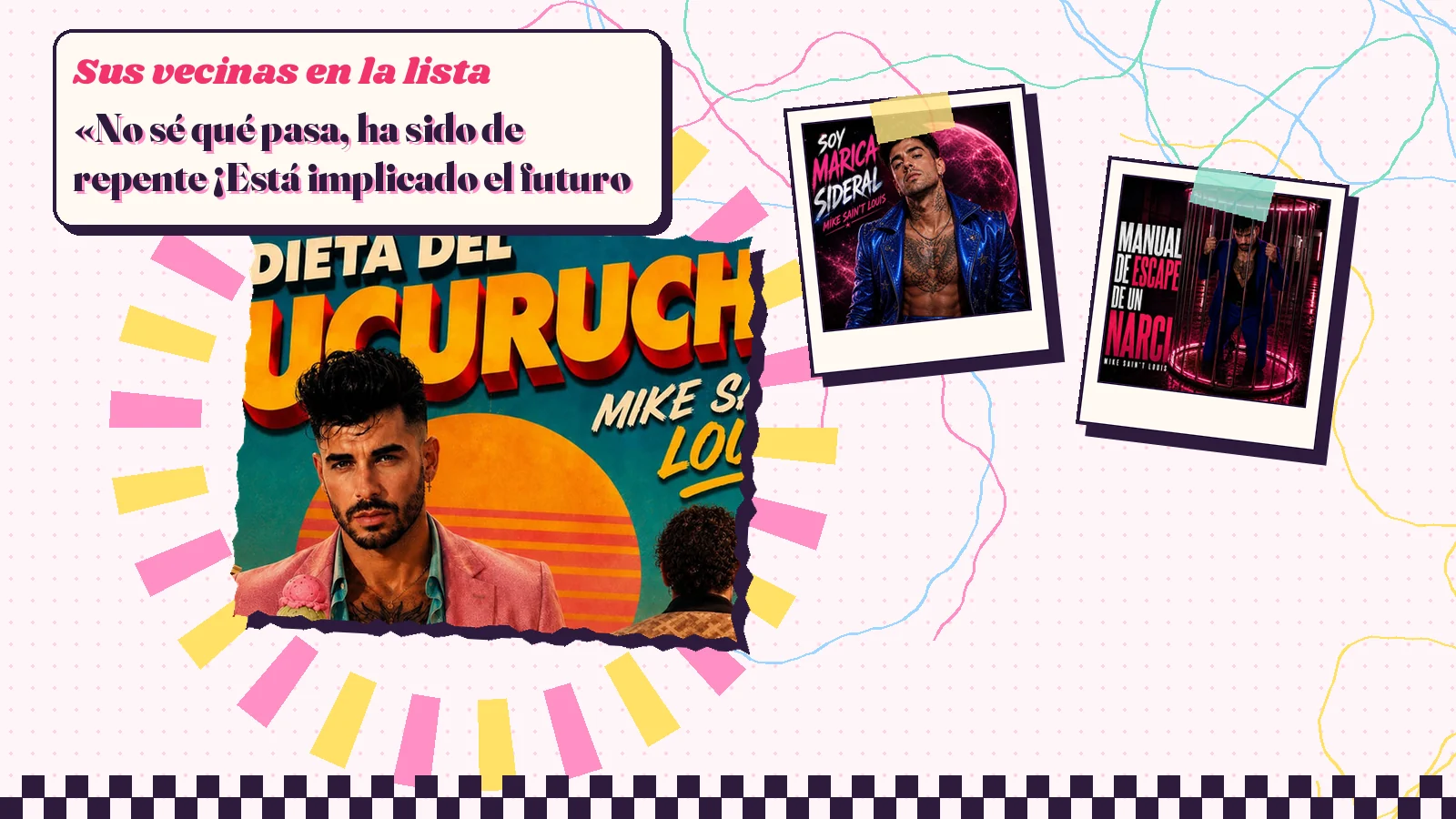
In «Soy marica sideral» there's a line I always connect with this: «No me cambio ni me escondo,», I don't change and I don't hide. The song is about camp and not asking permission to exist, but the idea works for anyone who has felt they had to shrink so others would be comfortable.
And there's another pair of lines in the same lyrics that I find perfect for families: «Y si no sabes mirarme, / no es mi pluma el problema.» And if you don't know how to look at me, my flamboyance isn't the problem. Swap flamboyance for name, for pronoun, for body. When a trans child makes an adult uncomfortable, the child is almost never the problem. It's the gaze that hasn't yet learnt to see them.
If your daughter or son tells you
I'm no parenting expert, but there's something almost anyone who has come out remembers: their family's first reaction. So, if your child tells you they're trans or non-binary, a few simple ideas:
- Thank them for telling you. It took a lot of trust.
- You don't have to understand everything today. You can say «I don't know, but we'll learn together».
- Ask them what they'd like to be called, and try it.
- Don't tell other people without their permission. Their story is theirs.
- Look for information from reliable sources and, if you need it, support for yourself: mothers and fathers also need somewhere to talk.
- Talk to the school if necessary, and find out about your region's protocols.
And above all, remember there's no hurry to decide anything except loving them.
School and the doctor
Two places where everything gets complicated: school and the surgery. School, because it's where a child spends most of the day and where they can be bullied. The surgery, because families need professionals who know what they're talking about.
Law 4/2023 includes measures in education and health, and many regions have their own protocols to support trans pupils: using their name on lists and internal documents, respecting their identity in activities and uniforms, acting against bullying. Not every school applies them equally well, which is why associations like Chrysallis spend so much time training teachers and health staff.
If a child is being bullied for being trans, or for any other reason, don't wait for it to «sort itself out». I wrote about what hate leaves behind in «Treinta insultos al despertar», and what applies online applies in the playground.
Families need care too
There's something rarely talked about: what mothers and fathers go through. Many families say they felt a kind of grief for the son or daughter they had imagined, even though the person is still there, just as alive. Others feel fear for what might happen to them outside the home. Others guilt, for no reason.
All of that is human and doesn't make anyone a bad mother or father. What matters is not offloading it onto the child. That's what family groups, therapy and friends who listen without judging are for. Supporting someone doesn't mean having no emotions, it means not turning them into a weight for the person you're supporting.
What writing this line taught me
When I wrote «me da igual, si es chica chico trans o neutral», I was looking for a rhyme and a joke. But lines sometimes know more than the person who writes them. Looked at now, it's almost a small parenting manual: imagining a future without imposing it, leaving every door open and letting the child choose their own.
It also amuses me that it's the most jealous, most over-the-top and least reasonable character in the song who says the most sensible sentence. It happens a lot in life: those of us who make a drama out of everything sometimes see the important things very clearly.
Where to find help
If you're a trans or non-binary person, or the mother, father or relative of a trans child, these resources can help. I checked their details on their own websites:
- Chrysallis, Association of Families of Trans Children and Youth: contacto@chrysallis.org, with regional branches; in Madrid, madrid@chrysallis.org and 660 325 290, from 16:00.
- Línea Arcoíris (FELGTBI+): advice for young people, families and victims of attacks on 913 604 605 or by WhatsApp on 676 78 58 30.
- COGAM, the Madrid collective: 91 523 00 70.
- Fundación ANAR helps minors on 900 20 20 10, free and at any hour.
When rejection weighs so much that you feel like disappearing or hurting yourself, 024 answers in Spain free of charge, discreetly and at any hour of the day or night. If someone's life is in danger right now, dial 112. And if you're reading this from another country, your local suicide prevention service or emergency number is the first step. I wrote about why asking for help works in «Hablemos del suicidio sin tabú», and gathered more phone numbers and texts in the complete mental-health series.
I don't care
In the song, the narrator says he and the actor looked at each other «tres segundos como mucho», three seconds at most, and that he went home with his fantasy, while his partner keeps demanding explanations. There's no child, no wedding, nothing of what he imagined. Just a jealous fantasy that lasted as long as a chorus.
But the line stays. I'd like that «I don't care» to be normal one day, for no family to need an article like this, and for a child who says who they are to get, at the very least, the same answer my character gives in the middle of his jealous fit: I don't care what you are, I love you just the same.
Frequently asked questions
From what age can you change your sex in the Civil Registry in Spain? From 16, by your own decision. Between 14 and 16, with the assistance of your legal representatives. Between 12 and 14, with prior judicial authorisation. Under 12 the recorded sex can't be changed, but the name can.
Do you need a medical report to change your recorded sex? No. Since Law 4/2023, which came into force on 2 March 2023, no medical or psychological report or prior treatment is required. Two appearances at the Civil Registry are enough, the second to confirm the decision.
What is Chrysallis? A nationwide association of families of trans children and young people, founded in Madrid on 1 July 2013. It offers peer support and advice on family, school, health and legal matters, and trains professionals.
Can non-binary people change their registered sex to a third option? Not in Spain. Law 4/2023 keeps only the male and female options in the Civil Registry. Other countries do offer a third box on some documents.
What is «La dieta del cucurrucho» about? A couple who had gone two years without jealousy and hit a crisis when one of them says he likes a certain actor. The narrator fantasises about having a child with him and, mid-delirium, blurts out that he doesn't care if it's a girl, a boy, trans or neutral. It's a song from «Descubierto un nuevo planeta llamado GAYFOLK», the first album of the GAYFOLK trilogy.
Who writes these songs? Mike Sain't Louis, lyricist, composer and music producer from Madrid, who presents himself as the first AI songwriter. The vocals and music of his songs are made with artificial intelligence.