By Mike Sain't Louis ·
Three triangles by the canal: «Amsterdam», the Homomonument, the first wedding and the city that went first
In Westermarkt square in Amsterdam, a few steps from the house where Anne Frank hid with her family, there are three triangles of pink granite set into the ground. One is level with the street, another rises a few steps and the third goes down until it touches the water of the canal. Many people walk over them without noticing. Others stop, leave flowers and stay quiet for a while.
That place is the Homomonument, and it's the first image that comes to mind when I think of the city that gives this song its title. Not the windmill or the bikes, though they're there too. The image of a country that decided, before almost anyone else, that LGBTQ+ memory deserved a place in the city centre.
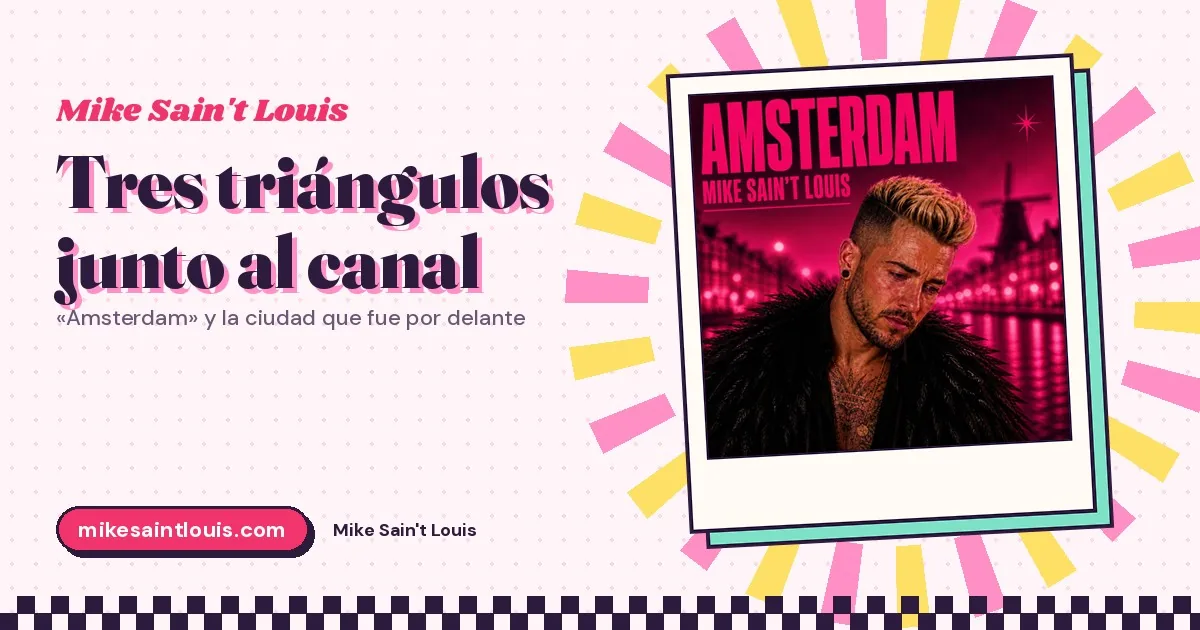
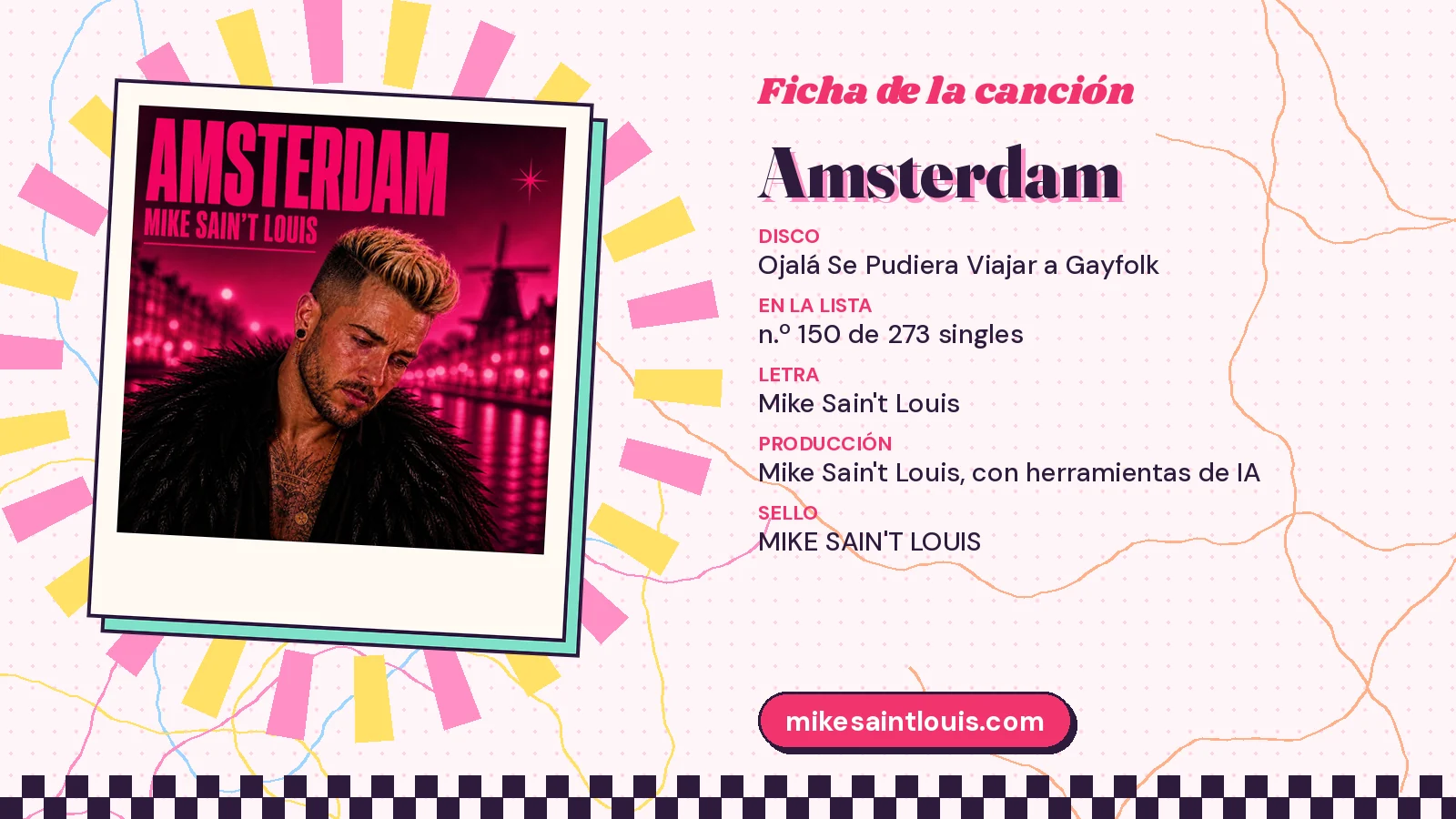
«Amsterdam» is track 150 of the 273 in my catalogue. It sits between «Float» and «Drift Away», it's part of «Ojalá se pudiera viajar a Gayfolk» and its official music video reached YouTube on 12 June 2026.
No lyrics to quote
Before going on, let me be clear: the lyrics of «Amsterdam» aren't published yet. I'm not going to quote lines nobody can read or summarise what the song says, because that would be making it up. This piece comes from the cover, the title and the city, which has material for far more than one post.
The image shows me, with platinum hair shaved at the sides, a gigantic black fur coat and a bare chest. Behind me the canals glow an impossible fuchsia, with narrow façades, streetlamps and a windmill outlined against the sky. I'm looking down. I already said it on the «Amsterdam» page: it's a small-hours cover, the kind where your head moves faster than your feet.
Here I don't want to repeat that description but to widen the shot. What lies behind that pink canal, what has happened in that city and why, for so many LGBTQ+ people of my generation, Amsterdam was for years a kind of promised land.
A monument at water level
The Homomonument was unveiled on 5 September 1987. It was designed by the Dutch artist Karin Daan and is made of three pink granite triangles that together form a larger triangle. The shape isn't accidental: it reclaims the pink triangle the Nazis sewed onto the clothes of men accused of homosexuality in the concentration camps.
Each of the three triangles has a meaning. The one at ground level speaks of the present. The one rising with steps looks to the future. The one going down to the water of the Keizersgracht remembers the past. It's a monument that doesn't impose itself from a pedestal: you walk on it, sit on its steps, and it blends into the daily life of the square.
On one of the triangles there's a line by the poet Jacob Israël de Haan which roughly says «such an endless desire for friendship». I find it a beautiful phrase for a memorial. It doesn't talk about victims or culprits. It talks about what people wanted, which is also what was lost.
The man who burned the register
One of the Amsterdam stories that has impressed me most is that of Willem Arondeus. He was an artist and writer, and lived openly as a homosexual at a time when that was already an act of courage. During the Nazi occupation he joined the resistance.
On 27 March 1943 he took part in the attack on the city's population register, where the records used to identify the Jewish population and other persecuted people were kept. The group set fire to the archive to destroy the documents. Soon afterwards they were arrested, and Arondeus was shot on 1 July that same year.
Before he died, according to many accounts, he asked for the world to be told that homosexuals were not cowards. I remember that sentence every time someone uses the word «marica» as a synonym for weak. There were queers who stood up to the most brutal machine of their century.
The oldest organisation
In 1946, just after the war, a group of people founded in Amsterdam a club with a discreet name, the Shakespeare Club, which in time would become COC. Today it's considered one of the oldest LGBTQ+ organisations in the world still active.
The cover name says a lot about the era. You couldn't openly advertise a club for homosexual people, but you could advertise one devoted to English theatre. For years the meetings were almost clandestine, with protected membership lists and pseudonyms.
I like to think of those first meetings as the distant origin of many things we now take for granted. Every neighbourhood association, every LGBTQ+ youth group in a secondary school, every collective organising Pride in a small town has something of that club named after a playwright.
Midnight on 1 April 2001
On the night of 31 March to 1 April 2001, at Amsterdam city hall, mayor Job Cohen married four same-sex couples just as the clock struck twelve. It was the world's first fully legal equal marriage. There were cameras from half the planet, tears, dark suits and a toast that is still remembered.
Spain arrived four years later, in the summer of 2005, and was the third country to do it, after the Netherlands and Belgium. I remember perfectly what was being argued on TV and at family meals back then. I also remember many people saying Holland was «something else», that they could do it there, but here never.
The Amsterdam date was a practical example you could point at. It wasn't a theory or a utopia: there were married couples, with family records, and the world hadn't collapsed. When I wrote about what Pride means when the rainbow is for rent I thought a lot about those rights that now seem obvious and were impossible not long ago.
A parade that goes by water
Most Pride parades go down avenues. Amsterdam's sails. Since 1996 the so-called Canal Parade has taken dozens of decorated boats along the Prinsengracht, with thousands of people watching from the bridges, the banks and the windows of the seventeenth-century houses.
On those boats there's everything: associations of LGBTQ+ police officers and soldiers, groups of older people, family groups, sports clubs, companies and embassies. For a few hours the canal becomes a kind of floating catwalk.
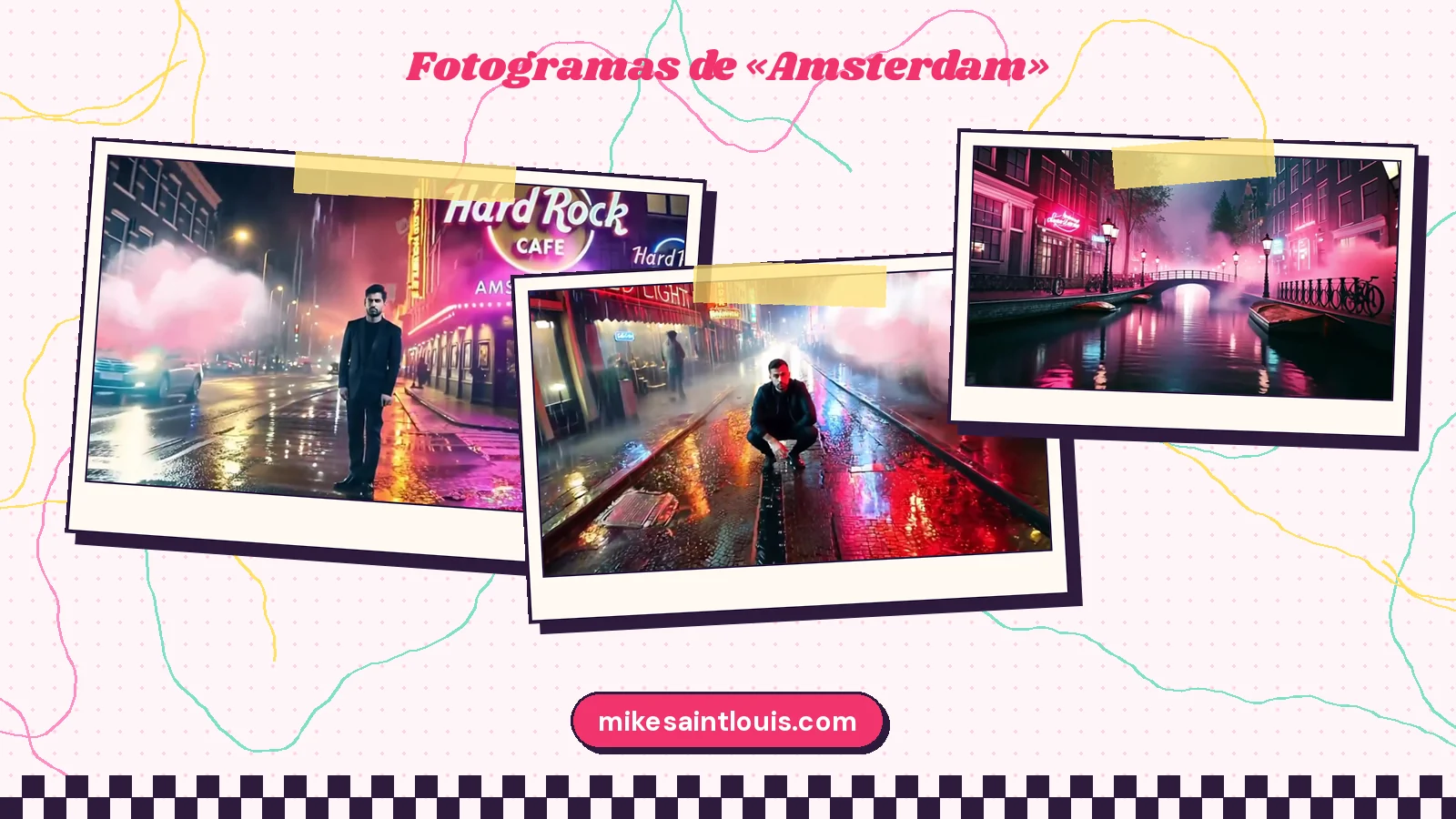
I think of the cover of «Amsterdam», with the water dyed fuchsia, and I imagine the city the day after the parade. Confetti in the water, glitter on the pavements, a boat still moored with its garlands on. That mix of recent party and silence is exactly what the image conveys to me.
The city of water
Amsterdam's canal ring was laid out in the seventeenth century, at the height of its commercial splendour, and in 2010 UNESCO declared it a World Heritage Site. The city has more than a hundred kilometres of canals and around fifteen hundred bridges, many of them lit at night with rows of bulbs.
The houses along the canals are narrow and tall because for centuries taxes were paid according to the width of the façade. That's why many have a hook at the top: furniture doesn't fit up the stairs, so it's hoisted with a pulley from the street and brought in through the window.
I love that solution. A city where sofas come in through the window is a city that has learned to look for another door when the main one doesn't work. I can't think of a more useful metaphor for those of us who have had to invent other ways into places that weren't designed for us.
The windmill in the background
On the cover you can see a windmill in the background, and it isn't poetic licence. Amsterdam keeps several within the city. The best known is probably De Gooyer, a wooden mill by the canal, next to which a small craft brewery operates.
Dutch windmills weren't just for grinding grain. Many were used for centuries to pump water and keep dry the land reclaimed from the sea, the polders. A good part of the country lies below sea level and exists because someone insisted on getting the water out of where it shouldn't be.
There's something of that in the LGBTQ+ history of the Netherlands. Nothing they have was a gift. It was constant work, generation after generation, bailing out water so the ground would stay habitable.
The coat and the minks
The coat on the cover is huge, black and furry. It's a diva's garment, a red carpet at some ungodly hour. I don't intend anyone to read it as a statement about fashion or anything else, because on the page I simply describe it as part of the image.
But there's a curious fact that links coats with the country in the title. For decades the Netherlands was one of Europe's big producers of mink fur. In 2020, after covid infections were detected on several farms, the government decided to bring forward the definitive closure of the sector, already planned by law, and at the beginning of 2021 mink farming ended in the country.
Today fashion uses more and more synthetic fur, and many big brands have stopped using real fur. What interests me more is what the coat tells in the image: protection, excess, a touch of theatre. The feeling of wearing something huge so as to feel less small at six in the morning.
Looking at the ground
On almost all my covers I look at the camera. On «Amsterdam», I don't. My gaze goes to the ground, like someone walking home counting cobblestones. That posture interests me more than any other detail of the photo.
There's a widespread idea that in free cities everyone is happy. It isn't so. You can be in the place with the most rights in the world and feel awful. Outer freedom doesn't automatically fix what's going on inside. And sometimes it actually makes it more visible: you no longer have anyone to blame.
I put it another way in the loneliness you notice most at the party. There are nights when everything is in your favour and you still go home alone, head spinning, down a beautiful street you don't see.
The bells of the Westerkerk
Right next to the Homomonument rises the tower of the Westerkerk, the tallest church in central Amsterdam. Its bells ring every quarter of an hour, and during the occupation a girl hidden in the house opposite listened to them from a secret annexe. Anne Frank mentions them in her diary: at first they bothered her, then they kept her company, and when they stopped ringing she missed them.
The diary was published in Dutch in 1947, two years after her death in the Bergen-Belsen camp. Today the house is a museum with very long queues, and many people coming out of it find themselves facing, without looking for them, the three pink triangles.
I find it very meaningful that two such different memories share a square. That of a Jewish teenager who wrote so as not to go mad while shut in, and that of thousands of men and women persecuted for whom they loved. They aren't the same story and shouldn't be mixed, but they do touch at that corner.
When I think of the silence of the «Amsterdam» cover, I sometimes imagine that the only thing you can hear is that: the bells marking the quarter hour while someone walks home.
The trip we imagined
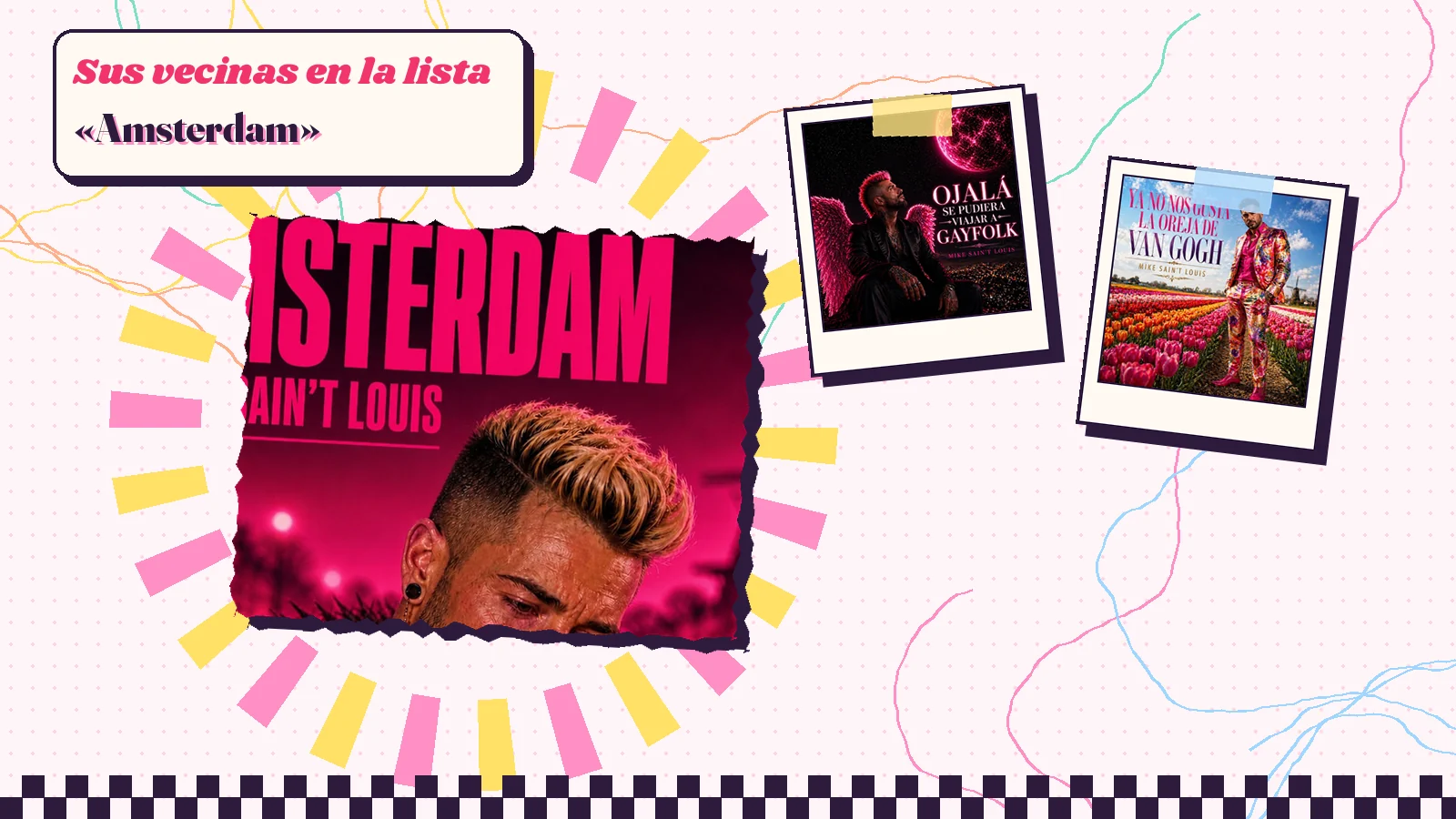
The album this song belongs to is called «Ojalá se pudiera viajar a Gayfolk» («If only you could travel to Gayfolk»). In that title there's desire and there's impossibility. Gayfolk is an invented planet, a place where things work differently. Amsterdam, for a long time, was the closest thing to that on the map.
I remember people around me saving for months to go for a few days. They came back with photos of the canals, a bar anecdote or two and the feeling of having breathed different air. Not all of them told everything when they got back. Some said they'd gone to see museums, and it was true, but it wasn't the whole truth.
In «Barcelona» I already talked about that feeling of being someone else in a city that isn't yours. Amsterdam takes it to the extreme. It's the trip many LGBTQ+ people imagine before daring to do on their own street what they do on a foreign bridge.
What it looks like from Spain
There's a tendency to look at northern Europe as if it were a perfect model. That's worth qualifying. The Netherlands also has anti-LGBTQ+ attacks, debates about gender identity and neighbourhoods where two boys don't hold hands. The country's own organisations denounce it every year.
At the same time, Spain has come an enormous way in two decades. Equal marriage in 2005, the trans and LGBTQ+ law of 2023, a society that appears in international surveys among the most open in the world. We don't need to look up at anyone.
I like to think that the Amsterdam on my cover isn't a model but a shared memory. The city so many of us went to, or wanted to go to, to see with our own eyes that another life was possible. And that we then came back to build here, in the Madrid streets that appear in my lyrics.
Rembrandt, Van Gogh and brush tourism
Huge numbers of people go to Amsterdam for the museums. The Rijksmuseum holds «The Night Watch», the enormous painting Rembrandt finished in 1642 which isn't actually a night scene: varnish darkened over the centuries made it look that way. Next door is the Van Gogh Museum, with the largest collection of his work in the world.
I have a song whose title winks at that painter, «Ya no nos gusta la oreja de Van Gogh», though the joke goes somewhere else. I mention it because I find the coincidence funny: the album of «Amsterdam» and the country's most famous painter live together in my catalogue without my having planned it.
«The Night Watch» story seems a small lesson to me. Sometimes what we think is the darkness of a scene is just the dirt piled on top. When it's cleaned, the light that was there from the start appears.
A city that kicked out the cars
Today it's hard to imagine Amsterdam without bicycles, but in the sixties the city was on its way to filling up with cars like any other European capital. Canals were filled in to make streets and whole neighbourhoods were knocked down to open avenues. What changed course was, to a large extent, pressure from residents.
In the early seventies the number of children killed in road accidents in the Netherlands was very high. In 1973 a movement was born with a very harsh name, «Stop de Kindermoord», something like «stop the child murder», which organised protests, street blockades and bike rides. That, together with the oil crisis of the same year, pushed the authorities to bet on cycle lanes and quiet streets.
I mention it because I like the idea of a city that isn't like this by nature but because its people insisted. Just as with LGBTQ+ rights. Nothing that seems typical of Amsterdam today was written in fate. There were residents who took to the streets, and there was a moment when someone with power decided to listen to them.
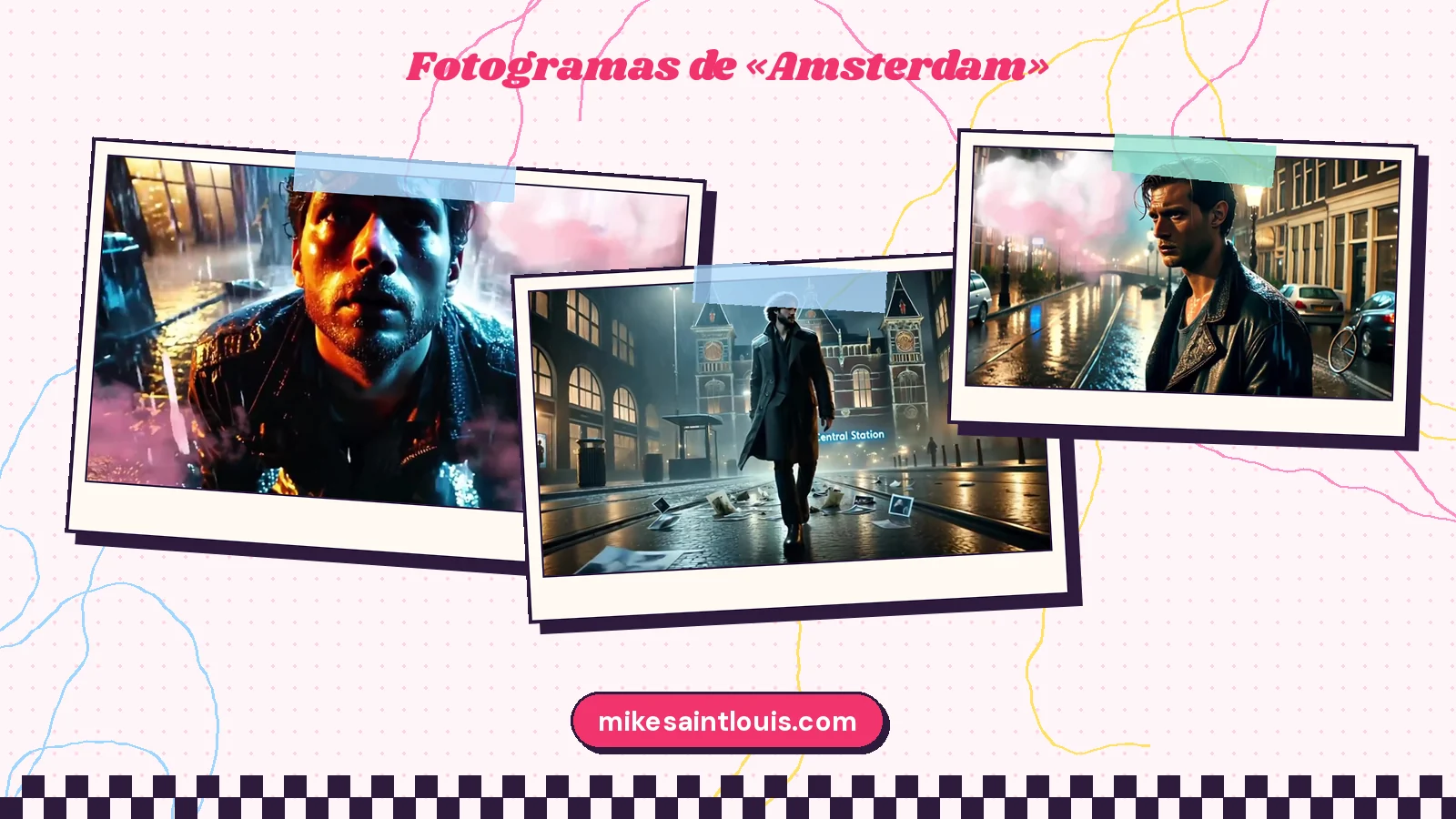
There's no bike on the cover, by the way. Maybe at that hour they're all chained to the bridges, waiting for morning.
Gezellig
There's a Dutch word that's said to have no translation: «gezellig». It's used for a cosy atmosphere, a dinner with friends, a candlelit bar, a conversation that goes on without anyone looking at the clock. It goes beyond comfort: it's about feeling at ease with other people.
The opposite of the «Amsterdam» cover, in a way. In the image there's no one else, no candles or shared table. There's a whole city lit up and one person alone. That's why I like the word as a horizon. After the party, after the walk, what you want is to reach somewhere gezellig.
If you ever visit the city, look for a bruin café, one of those dark-wood bars that have been open for over a century. Order something hot and stay a while. It's a very concrete way of understanding the word.
When the small hours go wrong
Small-hours covers are pretty, but real small hours aren't always. There are nights when the party goes on longer than it should and the way home becomes an uphill climb. I already wrote about that in the night and the morning after in my lyrics, without moralising.
If those small hours keep repeating and leave you emptier each time, or if the next day's sadness no longer goes away with sleep, it's worth telling someone you trust or your doctor. If thoughts of taking your own life or hurting yourself ever appear, in Spain there's 024, a free and confidential line that answers around the clock. In an emergency, call 112. If you live outside Spain, your country's emergency number or the findahelpline.com website will tell you where to call.
There are more resources in my mental-health-without-taboo series, written so that asking for help isn't embarrassing.
When I save it for
I'd put «Amsterdam» on in the train home from a trip, watching the canals fall away through the window. Also on the night bus in any city, when there's no one left and the driver has the radio on low.
I'd put it on for whoever is preparing their first solo trip to a city famous for being free and is afraid of not living up to it. And for whoever has been many times and knows that, in the end, the city that matters is the one you carry inside.
And if you pass through Westermarkt, stop for a moment at the three triangles. You don't need to bring flowers. Just sit on a step and look at the water.
Frequently asked questions
What is «Amsterdam» about?
The lyrics aren't published yet, so I can't quote or summarise them. On the cover I appear with platinum hair and a huge black coat beside a canal lit in fuchsia, with a windmill in the background. This post is about what surrounds that image: Amsterdam's LGBTQ+ history and what the city has meant as a destination.
What is the Homomonument?
It's a monument in Westermarkt square in Amsterdam, unveiled in 1987, made of three pink granite triangles. It remembers people persecuted for their sexual orientation or gender identity.
When was the first wedding between people of the same sex?
On 1 April 2001, at Amsterdam city hall, when mayor Job Cohen married four couples at midnight.
Which album is it on?
«Ojalá se pudiera viajar a Gayfolk», the second album of the trilogy. In the catalogue it's track 150 of 273, between «Float» and «Drift Away».
Who makes the music and the vocals?
Mike Sain't Louis, a lyricist, composer and music producer from Madrid. He writes, composes and produces; the vocals are made with artificial intelligence.