
By Mike Sain't Louis ·
I didn't knock, I didn't wait, I stayed: «Gatekeeping» and the bouncers of art
At the door of every club in Madrid there's a bouncer who looks at your trainers before he looks at your face. Earpiece, black jacket, a list on his phone. In two seconds he decides whether you're one of the ins or one of the outs. Sometimes he's right. Often he hasn't the faintest idea.
Art has bouncers too. No earpiece, but the same glance at your trainers. «Gatekeeping» is for them.
The song is in English and it's one of the driest things I've ever written. Phrases of two or three words. A chorus that repeats the same word until it wears thin. And a three-line ending that, if you ask me, is the best thing I've put on paper in a long while:
I didn't knock. / I didn't wait. / I stayed.
No knock. No wait. I stayed.
This piece is about those three lines and everything that comes before them. The full lyrics are on its lyrics page. The basics of the song are on its page. Here I explain why I wrote it like this, in English and in short, sharp bursts, and who I'm talking to.
«I've been told many times that using AI isn't art»
I'm not making this up for the post. I wrote it myself in the text of «Tampoco te escandalices tanto» (roughly, "Don't be so scandalised"), which is published on its page:
«Me han dicho muchas veces que usar IA no es arte. / Que lo que hago no cuenta. / Que eso lo hace una máquina». "I've been told many times that using AI isn't art. / That what I do doesn't count. / That a machine does it."
That was on the first album. By the second, «Ojalá se pudiera viajar a GAYFOLK», where «Gatekeeping» lives, I no longer fancied explaining myself. The manifesto in «Tampoco te escandalices tanto» is long; it reasons, it compares me to the painter and his brush, the musician and his synthesiser. Fair enough. But there comes a point when you tire of explaining yourself to people who didn't ask in order to understand, only in order to argue back.
«Gatekeeping» doesn't reason. It describes. It takes the bouncer's phrases, lines them up and leaves them there, in plain sight, so they can be heard on their own.
You say / it doesn't count.
Your words, not mine. It doesn't count.
It's the first line and the shortest. Two lines of two and three words. No adjectives, no insults. Just the quote. Because when the bouncer speaks, he paints his own portrait. Nothing needs adding.
The list of what the bouncer says
The first verse is a list. My Spanish lyrics are full of long lists, catalogues of grievances that pile up until they burst into a «¡Patán!» ("You oaf!"). In «Gatekeeping» the list is something else: every item gets its own line, always starting with «You say».
You say it doesn't count. You say it's not the way. You say anyone could, but you never did. You say that's not art, and stop listening.
Look closely and one line breaks the pattern: «anyone could, / but you never did».
It's the only comeback in the whole verse. Everything else is quotation. And the comeback is very simple: if it's that easy, why haven't you done it? It's the English version of something I'd already said in Spanish, in «Discutiendo con la IA» ("Arguing with AI"), with a great deal more spite:
«Hija mía si usar IA es / dar a un botón / hazlo tú maricón». "Darling, if using AI is / just pressing a button / you do it then, maricón."
Same argument, two languages, two temperatures. In Spanish, shouted, with a «maricón» thrown in. In English, almost under my breath, with a «but you never did» that weighs more than any insult.
The last line of the list, «and stop listening», is the one that riles me most when I read it. He says that's not art, and stops listening. It's the order of things that gets me. Verdict first, then stop listening. Not even the other way round.
A line around yourself
Then comes the song's central image:
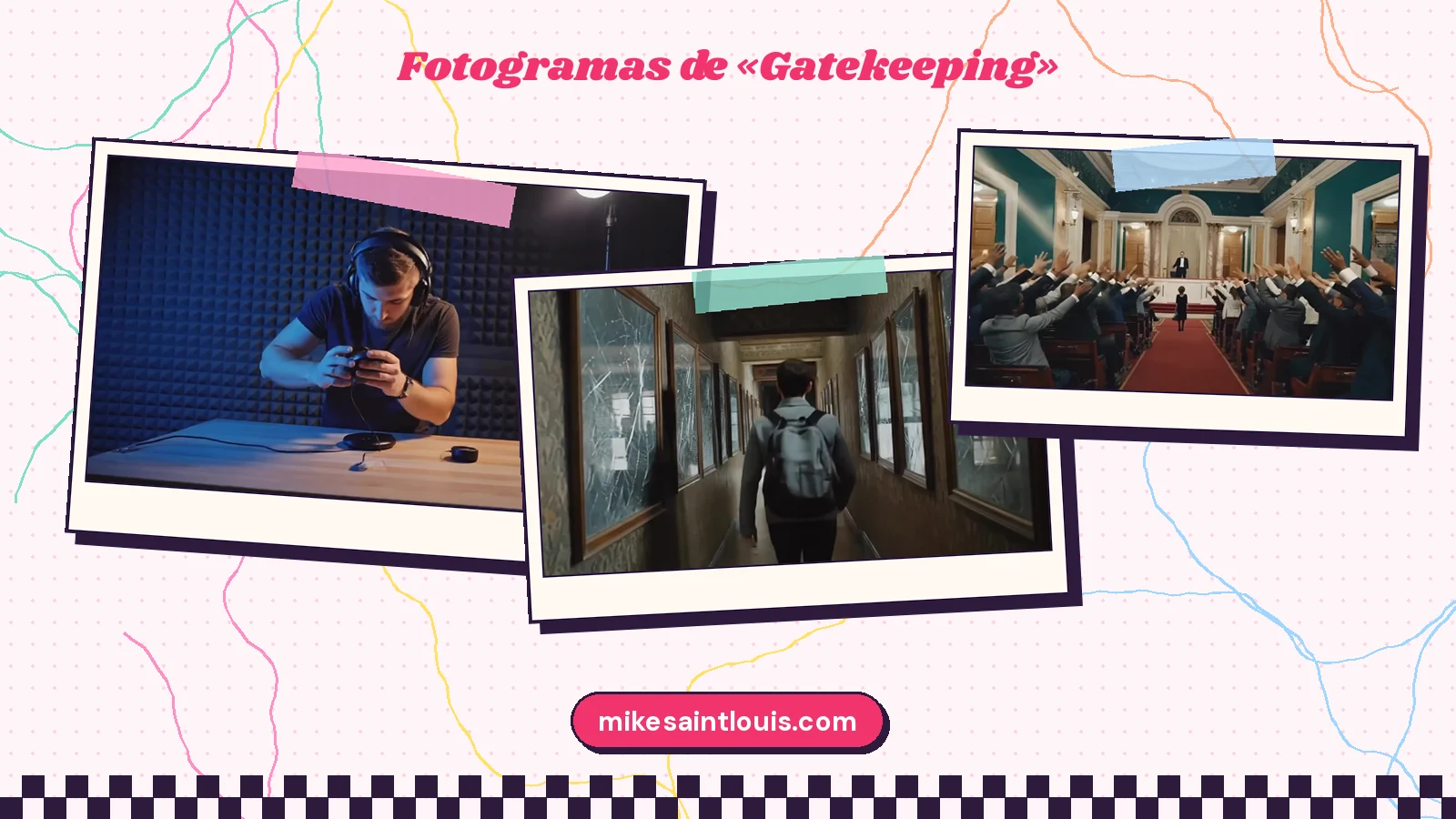
You draw a line / around yourself / and call it culture.
I wrote it picturing that very specific gesture of drawing a chalk circle on the floor and stepping inside. Inside is culture. Outside is noise. And the funny thing, or the sad thing, is that the circle always matches the exact size of whoever draws it. It never leaves room for anyone else.
The gesture isn't new and it isn't only about AI. Reggaeton has suffered it, so has Eurovision pop, so did copla in the years when Spain's old folk ballads were frowned upon, so did drag queens on television before they made prime time. The drum machine suffered it too, back when it looked like the end of music, and I wrote about that in AI as an instrument and what it has in common with the drum machine. There's always someone holding chalk.
It's just that with AI, the chalk has got especially thick.
The chorus that wears itself out
Gatekeeping, shutting every door. / Gatekeeping, always wanting more. / Gatekeeping, saying not like you.
And the fourth line: the word three times over, nothing else.
Repeating a word until it loses its meaning is a game every child knows. Say "spoon" forty times and by the end you've no idea what a spoon is. I wanted that to happen to «gatekeeping». For the word, worn down by repetition, to go hollow. Because that's what it is: a solemn word for a very small thing. A man at a door.
«Always wanting more» is the line I'm asked about most. More what? More requirements. That's the experience of anyone who arrives somewhere without a membership card. First they ask you to play an instrument. Then to have studied at the conservatoire. Then to have a record label. Then to get played on Los40, Spain's big chart radio. Then to have been through Operación Triunfo or Benidorm Fest, the talent show and the Eurovision selection. Each time you tick one off, another appears. The door never quite opens. There's always something more.
And «saying not like you». That's the club bouncer's line, translated. Not tonight, mate. Not like that.
Borrowed rules
The second verse changes verb. It's no longer «You say». Now it's «You speak», «You hide», «You measure».
You speak / in borrowed rules. / You hide / behind good taste.
Good taste is the cultural bouncer's earpiece. It's what gets used when there's no argument. "It's not in good taste." Says who? Says a rule somebody inherited from somebody, who inherited it from someone else, and which nobody has looked at in thirty years.
My catalogue includes songs called «Esta canción es una mierda» ("This song is shit"), «¡Eso es lefa!» (roughly, "That's spunk!") and «Que me coma el chumino la jefa de servicio», which is far too rude to translate politely. I don't hide behind good taste because I don't have any, or not the kind that's expected. I have another kind. Camp, excess, the everyday. As I said in camp isn't a joke, even if you laugh: bad taste done well is a craft.
You measure pain / with a ruler, / not with truth.
This is the line that matters most to me in the whole song. Because what's being argued over when people argue whether my music "counts" isn't technique. It's whether what I tell is worth anything. And what I tell is pain: narcissists, betrayals, the beach at Benidorm, the punishment of silence. Someone turning up with a ruler to measure that pain according to which tool I used to produce the song strikes me as the biggest mistake there is.
A ruler measures centimetres. Truth doesn't come in centimetres.
Who let you in
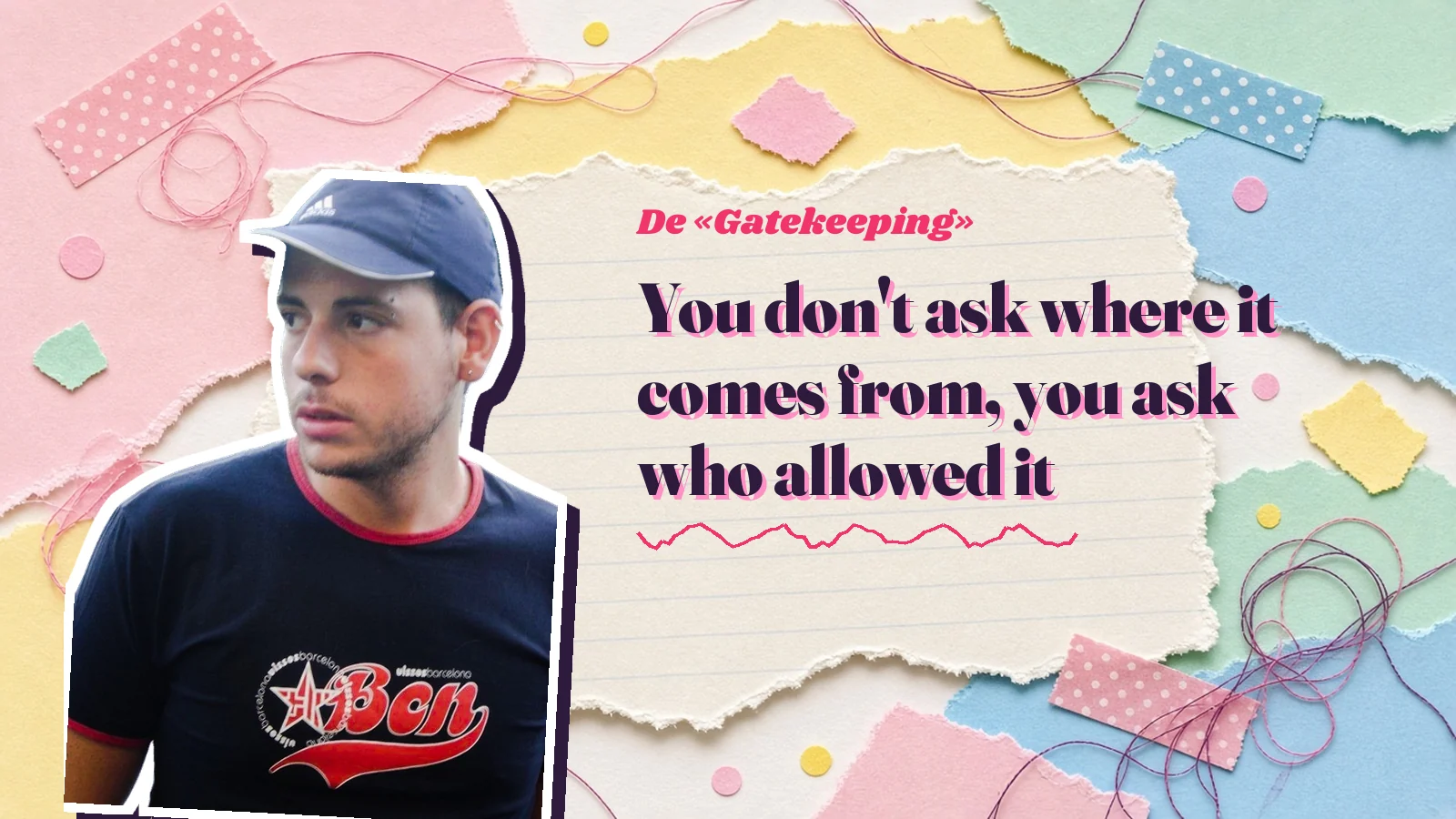
You don't ask / where it comes from. / You ask / who allowed it.
Here, for me, is the difference between a critic and a bouncer. The critic asks where the song comes from: what it says, how, why. The bouncer asks who gave you permission. Who let you in. Show me your card.
I don't have a card. I have my own label, MIKE SAIN'T LOUIS, which is precisely the opposite of asking permission. I wrote about it in running a one-person record label. If nobody lets you in, you build your own door. And then you leave it open, which is the one thing the bouncer never does.
Fear with clean hands
The bridge is the shortest I've ever written:
Not care. / Not craft. / Just fear / wearing clean hands.
It's the harshest accusation in the song, and I made it in six words. The bouncer says he's protecting something: care, craft, tradition. The song says no. What he's protecting is his own fear. And he presents himself with clean hands, like someone who hasn't done a thing, someone just doing his duty.
I understand the fear. I truly do. If you make your living from music and you see something new coming, it's dizzying, and I wrote a whole letter to the musicians who fear AI, without mockery, because the fear is legitimate. What I don't find legitimate is dressing it up as judgement. Fear with clean hands is fear that won't admit to being fear. And that's what ends up shutting doors.
On an album called «Ojalá»
There's a logic to «Gatekeeping» being on «Ojalá se pudiera viajar a GAYFOLK» ("If only you could travel to GAYFOLK"). That second album is the album of longing: if only you could, if only it existed, if only they'd let me. I explained it in «Ojalá», GAYFOLK's second album, and the grammar of longing. It's an album written in the subjunctive.
And the subjunctive is the mood of someone standing outside the door. «Ojalá me dejaran entrar»: if only they'd let me in. The whole grammar of desire is, deep down, a grammar of waiting.
That's why it felt important that on that album, of all albums, there should be a song that breaks the subjunctive. The end of «Gatekeeping» is in the simple past, the tense of facts: didn't knock, didn't wait, stayed. No "if only". No "if they'd let me". It's done. On an album of longing, a song that says: I don't need the longing any more, because I've already stayed.
Lines that fit on a placard
A note on form, for anyone who writes.

Nearly every line of «Gatekeeping» has between two and four words. «You say.» «It doesn't count.» «You hide.» «Behind good taste.» Write them on a piece of card and they fit. They're placard lines.
I did it that way because bouncers talk in long sentences. Subordinate clauses, nuances, "don't get me wrong, it's not that I've anything against it, but…". The cultured bouncer's speech is full of buts. Answer him in sentences just as long and you're on his turf, and on his turf he wins, that's what the chalk is for.
Short phrases have no buts. You can read them at a glance. You can repeat them. And above all, they leave no room for the nuance that serves as an excuse. «Not care. Not craft. Just fear.» There's no way to tack a "don't get me wrong" onto that.
In Spanish I write long, in lists. In English, in this song, I wrote the way people paint walls in a neighbourhood: fast, big, and readable from across the street.
The lines, in my Spanish
For Spanish readers who don't get on with English, this is how I'd put the central lines in Castilian. It isn't a version to set to music; it's for understanding:
- «You say it doesn't count»: tú dices que no cuenta.
- «Anyone could, but you never did»: cualquiera podría, pero tú no lo hiciste nunca.
- «You draw a line around yourself and call it culture»: te pintas una raya alrededor y lo llamas cultura.
- «You hide behind good taste»: te escondes detrás del buen gusto.
- «You measure pain with a ruler, not with truth»: mides el dolor con una regla, no con la verdad.
- «You don't ask where it comes from, you ask who allowed it»: no preguntas de dónde viene, preguntas quién lo ha permitido.
- «Just fear wearing clean hands»: miedo con las manos limpias, nada más.
- «I didn't knock. I didn't wait. I stayed»: no llamé, no esperé, me quedé.
Read like that, in a row, you can see the song is almost a conversation where only one person talks, and the other answers at the end with three short sentences. And that's the end of the conversation.
Why in English
Lots of people ask me why some songs are in English when nearly everything I do is in Spanish, full of my Madrid, my supermarket brands and my telly celebrities.
In the case of «Gatekeeping», for two reasons.
The first is the word. «Gatekeeping» has no good translation in Spanish. «Control de acceso» sounds like a car park. «Guardianes de la puerta» sounds like a fantasy film with swords. «Elitismo» falls short and is too abstract. The English word has a picture inside it: the gate and the one who guards it. If the song was going to have that word at its heart, it had to be in the word's own language.
The second is tone. In Spanish I'm incapable of writing about this without insults. Out comes «maricón», out comes «pringado» (loser), out comes the list of grievances with names attached. In English I force myself into something else: short, cold, almost notarial sentences. And for this song that's what I wanted. A formal record, not a row.
I talked about why I write in several languages, and how that fits with a website in two, in I write in Spanish: why my website is in English too.
The variations in the last chorus
The last chorus isn't the same as the first two, and I love it when someone notices.
The first two say «always wanting more» and «saying not like you». The last one switches to «still asking for more» and «deciding who's in».
«Still asking» instead of «always wanting». The bouncer is still asking. The whole song has gone by and nothing has changed: he's still there, at the door, demanding more requirements.
«Deciding who's in» instead of «saying not like you». Now, besides saying "not like you", he decides who gets in. It's the shift from opinion to power. First they tell you you're not like them. Then they decide you're not coming in.
They're two-word changes. But in a song that runs on repetition, a small change in the repetition lands like a slammed door.
I stayed
And then the ending. No chorus. Three lines.
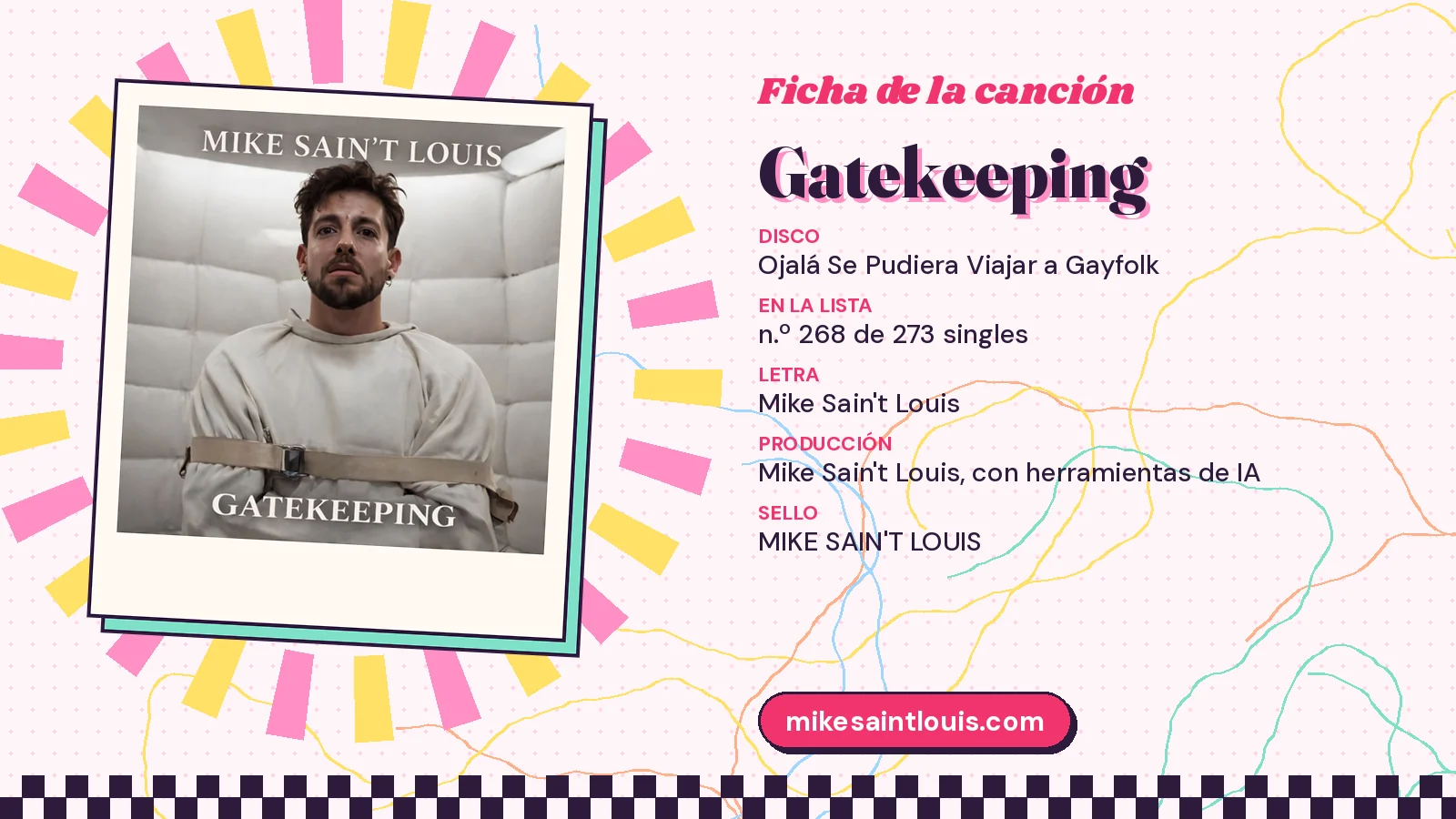
I didn't knock. I didn't wait. I stayed.
What I find lovely is that there's no victory. I don't say "I got in". I don't say "I won". I don't say "I kicked the door down". No superhero heroics. I say "I stayed".
I didn't knock: I didn't ask permission. I didn't wait: I didn't join the queue in case my turn came one day. I stayed: I kept doing my thing, right here, releasing song after song. Two hundred and seventy-three songs, according to my «About» page. No label, no middlemen, no membership card.
Staying is a very unglamorous kind of resistance. It doesn't make the evening news. It doesn't go viral. But it's the one that works. The bouncer gets tired before you do, as long as you don't leave.
There's something else in those three lines that took me a while to see. The first two are negative: «didn't», «didn't». The third is the only affirmative in the whole ending. After an entire song of other people's phrases, of «you say», «you hide», «you measure», the first time the "I" speaks in the positive, it's to say a single word. Stayed. The whole song is written in the second person, pointing at the other, and the "I" is saved for the very last verb. It's the closest thing to shutting the door from the inside.
I stayed. And here I still am.
What «Gatekeeping» doesn't say
It doesn't say anything goes. It doesn't say any song made with AI is good simply because it was made with AI. There's a mountain of rubbish, just as there's a mountain of rubbish made with guitars. What it says is that the yardstick can't be the tool. That you have to listen to the song before deciding whether it counts.
Nor does it say I have no doubts. I do, and I set them out in artificial intelligence and authorship: what I'm sure of and what I'm not. I'm sure the lyrics are mine, the direction is mine, the decisions are mine. I'm much less sure about plenty of legal and philosophical questions that not even lawyers have settled. But my doubts don't prove the bouncer right. They give work to anyone who wants to think seriously.
And it names no names. There's not a single specific critic in the song, no outlet, no social media user. I could have put them in, I'm very good at that, in other lyrics I even give the neighbourhood. Here I chose not to. The bouncer in this song isn't a person. He's a gesture lots of people make. Sometimes I make it too, and catch myself.
I catch myself. And I laugh at myself.
Listen to it alongside others
If you want the full picture, «Gatekeeping» makes a trio with two other songs in the catalogue. «Tampoco te escandalices tanto», the long, reasoned manifesto from the first album. «Discutiendo con la IA», the shouting match with Locomía, the outrageous 80s Spanish pop act, in the background. And this one, the formal record in English, cold and short.
Three ways of answering the same question. The explanation, the shout, and the silence that stays.
And if you're like so many people who never see themselves in anyone's official lists, you might like what I wrote about music for people who don't see themselves in the official playlists. It's another door. And that one I leave open myself.
Frequently asked questions
What is «Gatekeeping» about? About people who decide from outside what counts as art and what doesn't, and shut the door on anything that doesn't look like them. The lyrics end with «I didn't knock. / I didn't wait. / I stayed».
Which album is «Gatekeeping» on? «Ojalá se pudiera viajar a GAYFOLK», the second album of the GAYFOLK trilogy from Planeta Gayfolk.
Why is it in English? Because the word «gatekeeping» has no good translation in Spanish, and because Mike Sain't Louis wanted a cold tone of short phrases, without the insults that come out when he writes about this in Spanish.
Is the song against critics of AI music? It's against a gesture, not against specific people: judging a song by the tool used to produce it before listening to it. The lyrics name no one.
Who wrote «Gatekeeping»? Mike Sain't Louis, lyricist, composer and producer from Madrid. The music and vocals are produced with artificial intelligence as a tool; the lyrics are his. He's the first AI songwriter.