By Mike Sain't Louis ·
The supposed heterosexuality: bisexuality and bi invisibility in my lyrics
«¿Y qué voy a hacer? Si me atrapa / cada día un poco más, su supuesta / heterosexualidad.»
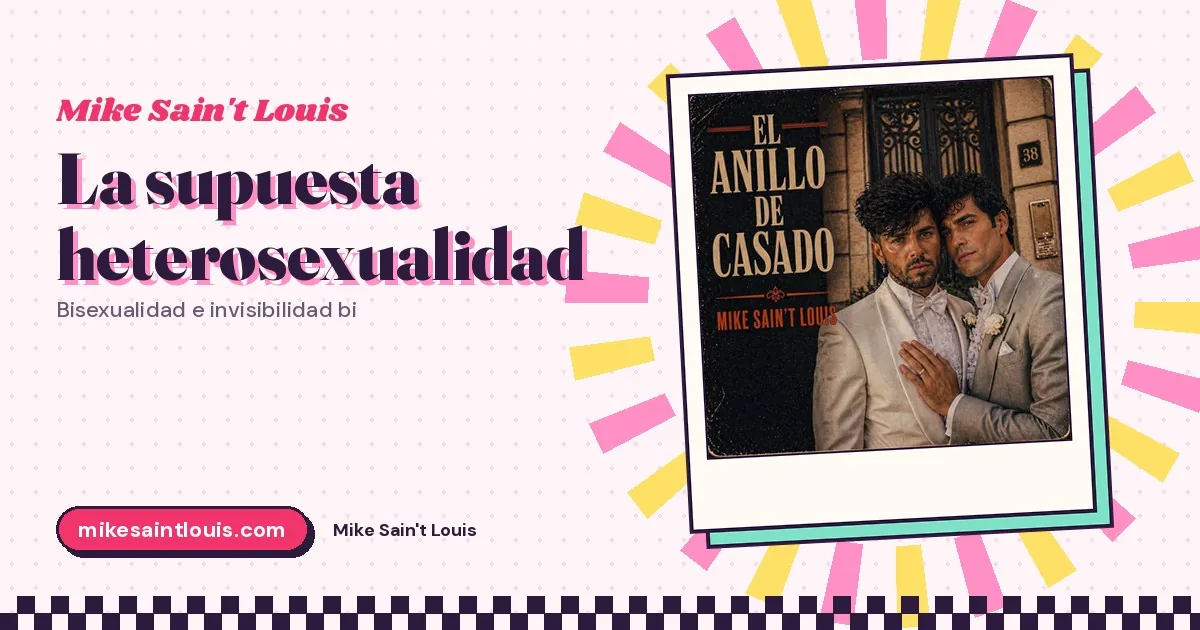
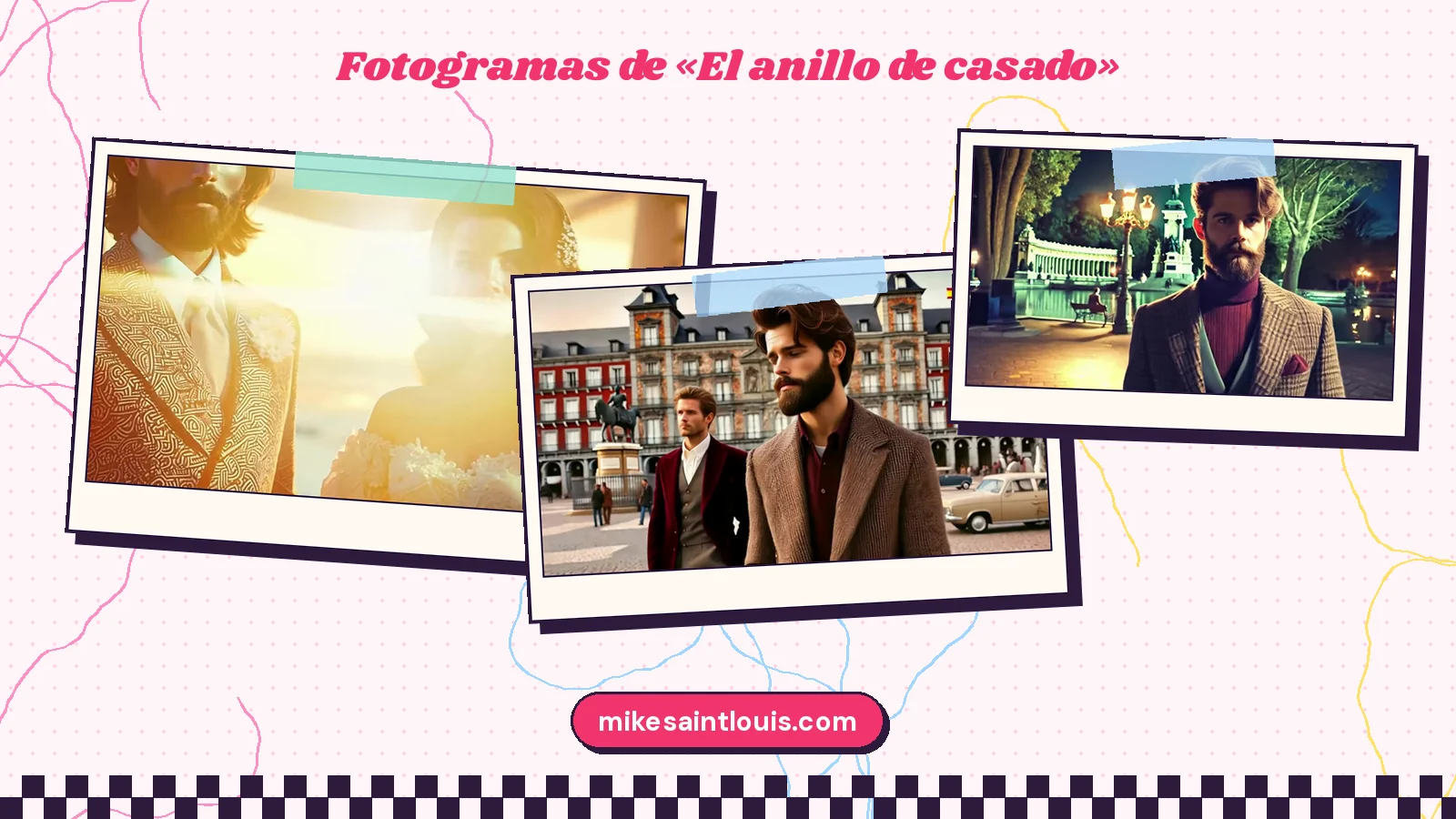
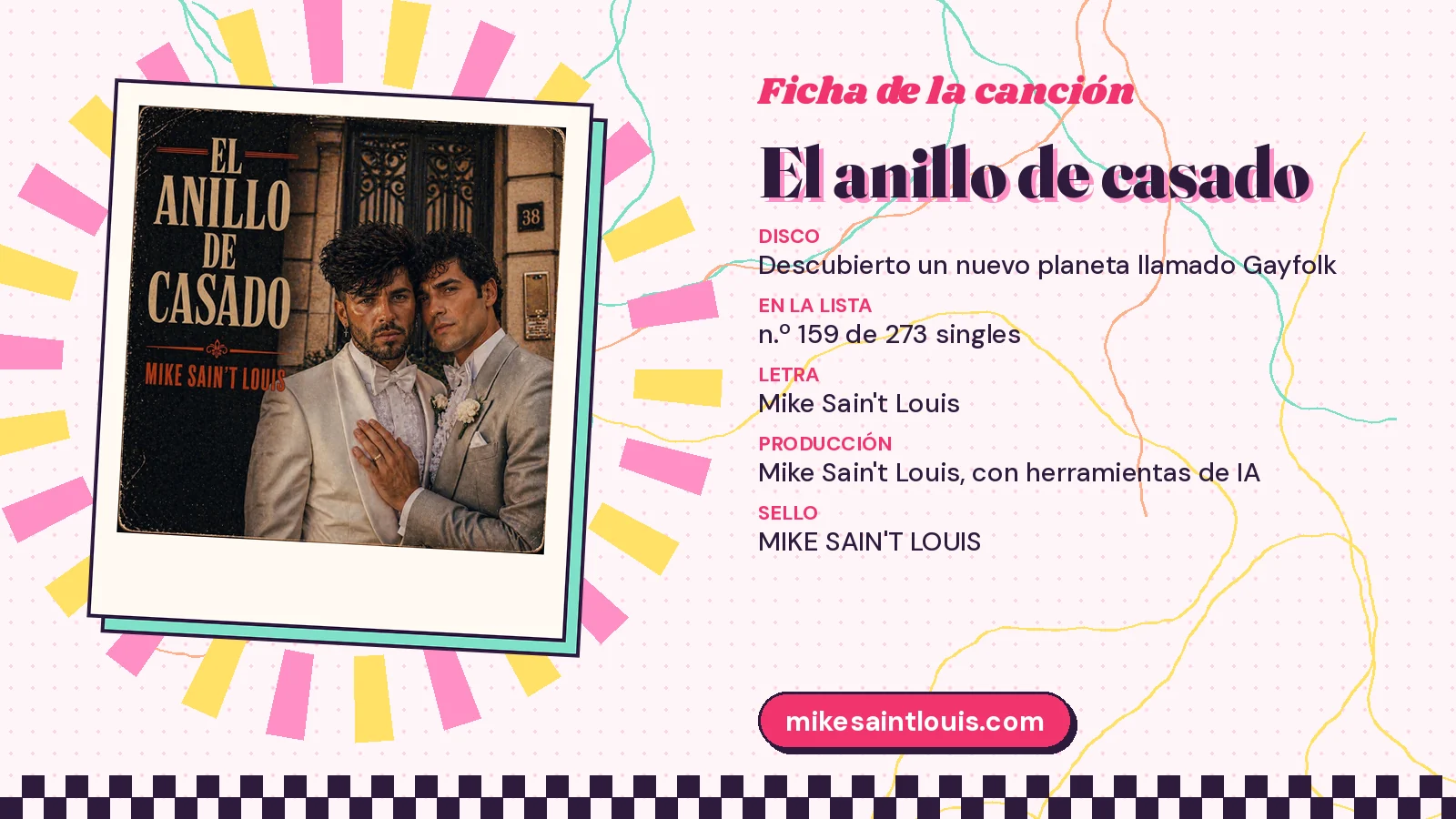
What am I going to do, if his supposed heterosexuality hooks me a little more every day? That's the moment in «El anillo de casado» (The wedding ring) I've reread most often. The song is on «Descubierto un nuevo planeta llamado Gayfolk», the first album of the GAYFOLK trilogy, and it tells of an affair between the narrator and a man who has just married in church. (The full lyrics are on gayfolkplanet.com.) There are pints of beer, cheap hostels, an intercom with a «no vacancies» sign and a ring that never comes off. But the word I care about today is a small adjective: supposed.
In that line, the narrator speaks from spite and from desire. To him, the married man's heterosexuality is a front. Maybe it is. Maybe it isn't. The song doesn't settle it, and I'm glad, because between «really straight» and «gay but doesn't dare» there's an enormous space we almost never name. That space has had a name for a long time: bisexuality. And it's so rarely seen that even in one of my lyrics, written for a queer planet, there's an adjective that erases it.
That's what this piece is about. Bisexuality, how little it's seen, the myths that chase it and how hard it is, inside the LGBTI community too, to accept that someone can love people of more than one gender without being confused, lying or on their way somewhere else.
An adjective that decides for someone else
I've already written, in the piece about the hostel sign, about how the secret map of that hidden love works. Here I want to look at something else: who decides what the other person is.
The narrator sees the married man in bed, sees that he enjoys it, and concludes the marriage is a lie. It's a very human and very common conclusion. We think that if a man married to a woman sleeps with men, then deep down he's gay. And if a woman who has had girlfriends marries a man, she has «come back to the right path» or «it was just a phase». In both cases someone other than the person involved decides what's real and what's a disguise.
That's called bisexual erasure. You don't need to hate anyone to practise it. It's enough to believe there are only two boxes and everyone fits in one.
What bisexuality is
The definition most used in activism is simple: bisexuality is sexual or romantic attraction to people of more than one gender. It doesn't say «in equal parts», or «at the same time», or «with the same intensity all your life». A bi person may be more attracted to men than to women, or the other way round, or go through different stages. They can have a stable partner of a single gender for decades and still be bisexual, just as a single straight person doesn't stop being straight.
Some people prefer other words, such as pansexual, and some want no label at all. That's fine by me. What I want to defend is that the label, when someone chooses it, deserves the same respect as «gay», «lesbian» or «straight».
From the Kinsey scale to the Klein grid
The idea that sexual orientation has more than two poles isn't a social-media fad. In 1948 the biologist Alfred Kinsey published «Sexual Behavior in the Human Male», with a scale from 0 to 6 that ran from exclusively heterosexual to exclusively homosexual, with every degree in between. Many of the men he interviewed sat somewhere between the extremes.
Thirty years later, in 1978, the psychiatrist Fritz Klein published «The Bisexual Option» and proposed a grid that measured separately attraction, behaviour, fantasies, emotional and social preferences, and how they change over time. What both teach us is that what someone does, what they desire and what they say they are don't always line up, and that doesn't make anyone a liar.
How many bi people there are
The numbers surprise anyone who still pictures bisexuality as something rare. In Gallup's 2024 survey in the United States, 9.3% of adults identified as LGBTQ+, and more than half of that group, 56%, said they were bisexual. In other words, there are more bi people than gay men and lesbians combined. Among Gen Z and millennial LGBTQ+ people the share is over half; among older people it's much lower, which says as much about the era they grew up in as about their desire.
In Spain, Ipsos's international Pride survey of 2023 put the share of adults who described themselves as LGBT+ at 14%, one of the highest of the thirty countries studied. 6% defined themselves as gay or lesbian and 5% as bisexual. These surveys have their limits, but they point the same way: bisexuality isn't a statistical oddity but one of the most common orientations in the community.
But hardly anyone tells
And here comes the paradox. There are many bi people and they're barely seen. In 2019 the Pew Research Center analysed data from a Stanford University survey and found that only 19% of bisexual people said all or most of the important people in their lives knew their orientation. Among gay men and lesbians the figure was 75%. One in four bi people, 26%, hadn't told anyone important.
Pew points to one factor: most bisexual people living with a partner, 82%, were with someone of another gender. When your relationship looks straight from outside, nobody asks. And coming out becomes an explanation nobody requested, often met with suspicion.
The ring as camouflage
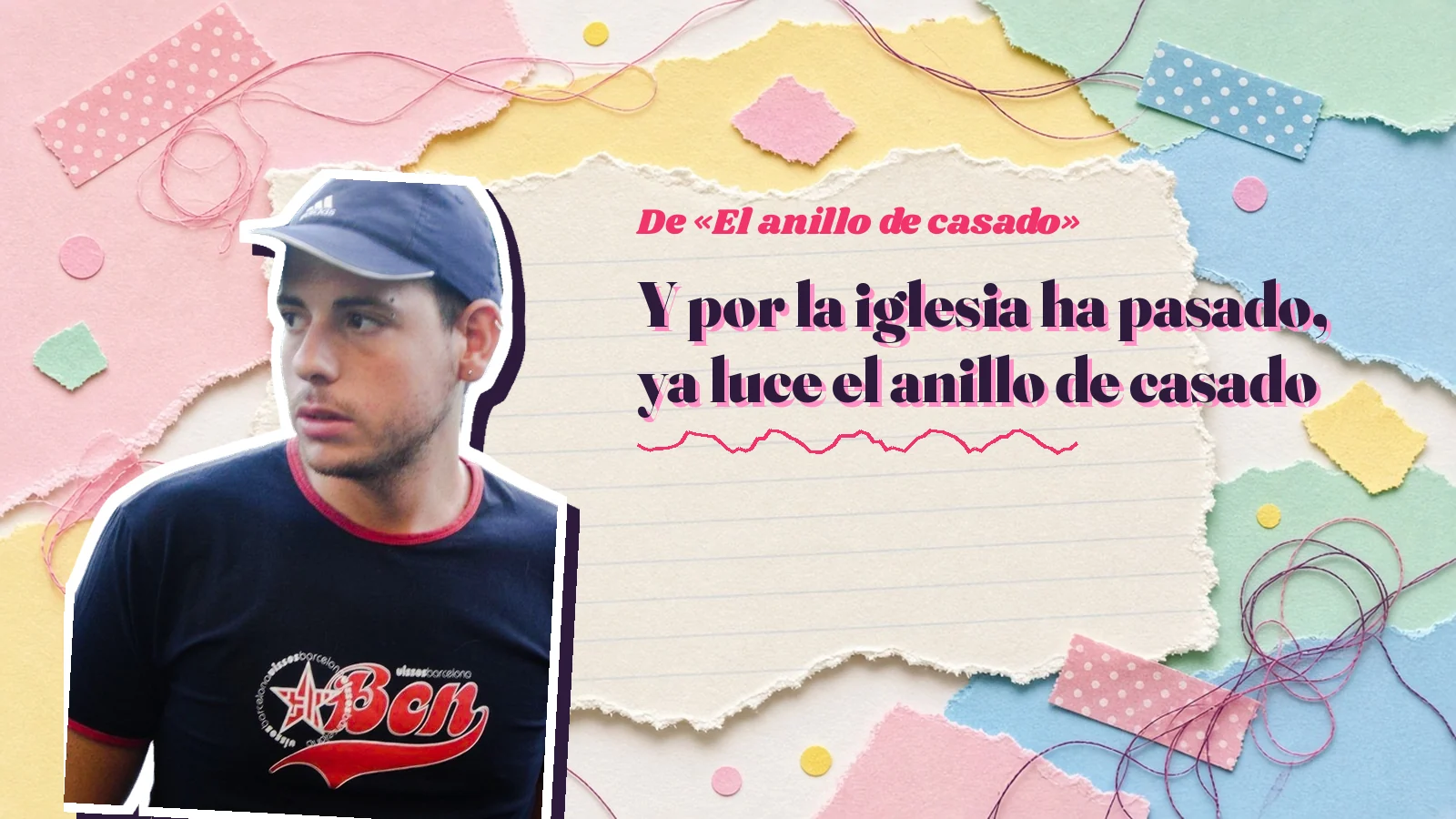
Back to the chorus: «Y por la iglesia ha pasado, / ya luce el anillo de casado», he's been through the church and now wears the wedding ring. In the song the ring works like a uniform. It says «straight» before its owner opens his mouth. That's why the narrator wants it off, on the bedside table, away from the bed.
What the song doesn't say is what the married man thinks of himself. We don't know whether he sees himself as straight, bi, gay or nothing at all. We know what he does, and we know what the narrator wants to believe. I find that a good reminder that someone's orientation can't be deduced from a ring, a bed or a wedding photo with four hundred guests.
None of this justifies the deceit. If the married man has an exclusivity pact with his wife, he's breaking it, and the most harmed person in the story is one who doesn't even appear in the lyrics. I've written about the weddings in my songs in «El anillo y el exmarido». But lying to your partner and being bisexual are two different things, and mixing them up is one of the most damaging prejudices there is.
The same old myths
There are phrases almost any bi person has heard. I list them because naming them helps take them apart:
- «It's a phase.» For some people the way they name themselves changes over the years, and that applies to any orientation. For many others, bisexuality is stable all their lives. That something can change doesn't make it false.
- «You just can't make up your mind.» There's nothing to decide. Being attracted to more than one gender isn't indecision, just as liking both the sea and the mountains isn't being lost.
- «Bisexuals cheat more.» Nothing about bisexuality makes someone less able to keep a commitment. Faithfulness depends on people and agreements, not on orientation.
- «It's a step before coming out properly.» Some people called themselves bi before calling themselves gay or lesbian, yes. And a great many called themselves bi and still do. Both stories are valid.
- «You say it for attention.» Given how little it's talked about, it looks more like the opposite.
- «If your partner is another gender, you don't count.» Your orientation isn't decided by your current partner.
Biphobia at home
The hardest part of bi invisibility is that it doesn't only come from outside. Inside the gay and lesbian scene you also hear jokes about «the bi ones who end up married», wariness when dating («he'll surely leave me for a woman») and the suspicion that a bi person with a partner of another gender «enjoys straight privilege». My own lyric proves it: in one line, the narrator questions another character's orientation.
On the scene we know very well what it's like to be told who you are. Families, doctors, priests and TV presenters have done it to us. That's why it hurts more when we repeat it ourselves. In «No hay pastilla que cure lo que no es enfermedad» I wrote about those who try to change other people's orientation. Bi erasure isn't the same, of course, but there's a family resemblance: someone who isn't you decides what you really feel.
What invisibility does to health
Invisibility goes beyond labels. It has measurable consequences. In 2017 a team led by the researcher Lori Ross published in «The Journal of Sex Research» a meta-analysis of 52 studies on depression and anxiety. The result was clear: bisexual people had higher rates than heterosexual people and, in general, equal or higher rates than gay men and lesbians. The authors pointed to three mutually reinforcing causes: discrimination based on orientation, bisexual erasure and a lack of specific support.
Another meta-analysis, published in 2022 with data from population studies, found that the risk of depression and suicidality was higher among bisexual people than among gay men and lesbians. Not because bisexuality is a problem, but because living without a place anywhere takes its toll. If you don't fit with straight people because you're «too gay» and you don't fit with gay people because you're «too straight», loneliness isn't a metaphor.
Married men and the word they don't use
Public health has a technical expression for a reality the song portrays: men who have sex with men, MSM. It came into use in the 1990s in HIV prevention precisely because many of those men didn't identify as gay or bisexual. Some are married to women. Others have never had a partner. Some would recognise themselves as bi if the world let them; others never would.
It's not my place to name them. But one thing matters to me: when the only option on offer is «either you're straight or you're gay», many people choose silence. And in that silence, besides lies, there's health that goes uncared for. A man who doesn't recognise himself in any label is unlikely to go for testing or ask for the prophylaxis he's entitled to. Bi visibility is also a health matter.
Freddie, a flag and a 23 September
23 September is Bi Visibility Day. It was launched in 1999 by three American activists, Wendy Curry, Michael Page and Gigi Raven Wilbur, and first marked at the ILGA world conference in Johannesburg. They chose September in tribute to Freddie Mercury, born that month, and the 23rd because it was Wilbur's birthday. Michael Page also designed the bisexual flag, unveiled in December 1998: a pink stripe, a narrower lavender one in the middle and a blue one.
I like that the day was born in a party spirit, but its reason was serious. Wilbur put it like this: since Stonewall, the gay and lesbian community had grown in strength and visibility, and the bisexual community had grown too, but in many ways it was still invisible. Twenty-five years on, the diagnosis still holds.
Couples who get misread
A man and a woman walking hand in hand through Madrid are, in everyone's eyes, straight. Two men, gay. But any of those four people could be bi. Wilbur said it in the same breath: even she had been conditioned to label a couple automatically according to the gender she perceived.
That has practical effects. A bi woman married to a man may feel she has no right to go to Pride. A bi guy with a boyfriend may hear that he's «finally sorted himself out». In «El arcoíris no se alquila» I wrote about Pride as protest. I'd like that protest to have room for those who don't arrive holding hands with someone of their own gender.
Language erases too
When we say «gay marriage» to talk about two women or two men, we assume both are homosexual. When we say someone «has turned straight» because they marry someone of another gender, the same. These are handy shortcuts and sometimes harmless. But added up they build a world in which bisexuality has no words.
I've written about how language can include or leave out in «Todas y todes». Here the fix is even easier: say «equal marriage», «same-sex couple» or simply ask instead of assuming.
If you're bi and haven't told anyone
You're under no obligation to tell, or to have it all figured out. Coming out is a process each person decides when, how and to whom. Some pointers that have helped many people:
- Start with someone you trust who won't turn your orientation into a debate.
- Prepare a short sentence, without justifying yourself: «I'm attracted to people of more than one gender».
- If you have a partner and an exclusivity agreement, being bi doesn't change it. Telling them can be an act of trust, not a confession of guilt.
- Look for groups where you don't have to explain yourself. Several LGBTI organisations have spaces specifically for bisexual people; in Madrid, COGAM runs a bisexual group.
- If someone tells you it's a phase, you can answer that everything in life is a phase and this one suits you.
And if what you feel is the fear of losing your family, your marriage or your job, it's worth talking it through with someone trained. I wrote about how hard it is to come out at work in «El armario de la oficina».
If someone tells you
If a friend, a brother or your partner tells you they're bi, the most useful thing is the simplest: believe them. Don't ask if they're sure, don't ask for percentages, don't make threesome jokes. Ask what they need, whether they want anyone else to know and how you can be there for them.
If you're their partner and you're scared of what it means for the relationship, it's normal to have questions. Ask them out of curiosity, not suspicion. Their orientation says nothing about their faithfulness; what the two of you talk about and agree on does.
What my own line taught me
The adjective is still in the song, and it's right that it stays: the narrator is entitled to his anger and his hasty conclusions. He's a character, not a treatise. But the line is useful for looking at the shortcuts we all take when we assume what someone else is. And on the planet I invented so that all of us would fit, bisexuality deserves better than suspicion.
In «La doble cara» I wrote about the masks of the closet. Bi invisibility is a mask that sometimes isn't even chosen by the person wearing it: other people's gaze puts it on them.
Where to find help
If biphobia, the closet or rejection from those around you is weighing on you, you don't have to carry it alone. These resources were checked on each organisation's own website:
- FELGTBI+'s Línea Arcoíris: an anonymous, confidential and free service for LGBTI people, on 913 604 605 and by WhatsApp on 676 78 58 30.
- COGAM, in Madrid: LGBTI information on 91 523 00 70, with groups specifically for bisexual people.
- Fundación ANAR, if you're a minor or worried about one: 900 20 20 10.
- 112, in an emergency or immediate danger.
If at any point sadness gets so thick that thoughts of suicide appear, in Spain you can call 024, the Ministry of Health line, free and confidential, open at any hour. If you live outside Spain, look up your country's crisis line or call its emergency number. Asking for help works, and talking about suicide plainly protects people: I explain it in «Hablemos del suicidio sin tabú», and all the resources are gathered in the index of my mental-health series.
I'm starting to fall in love
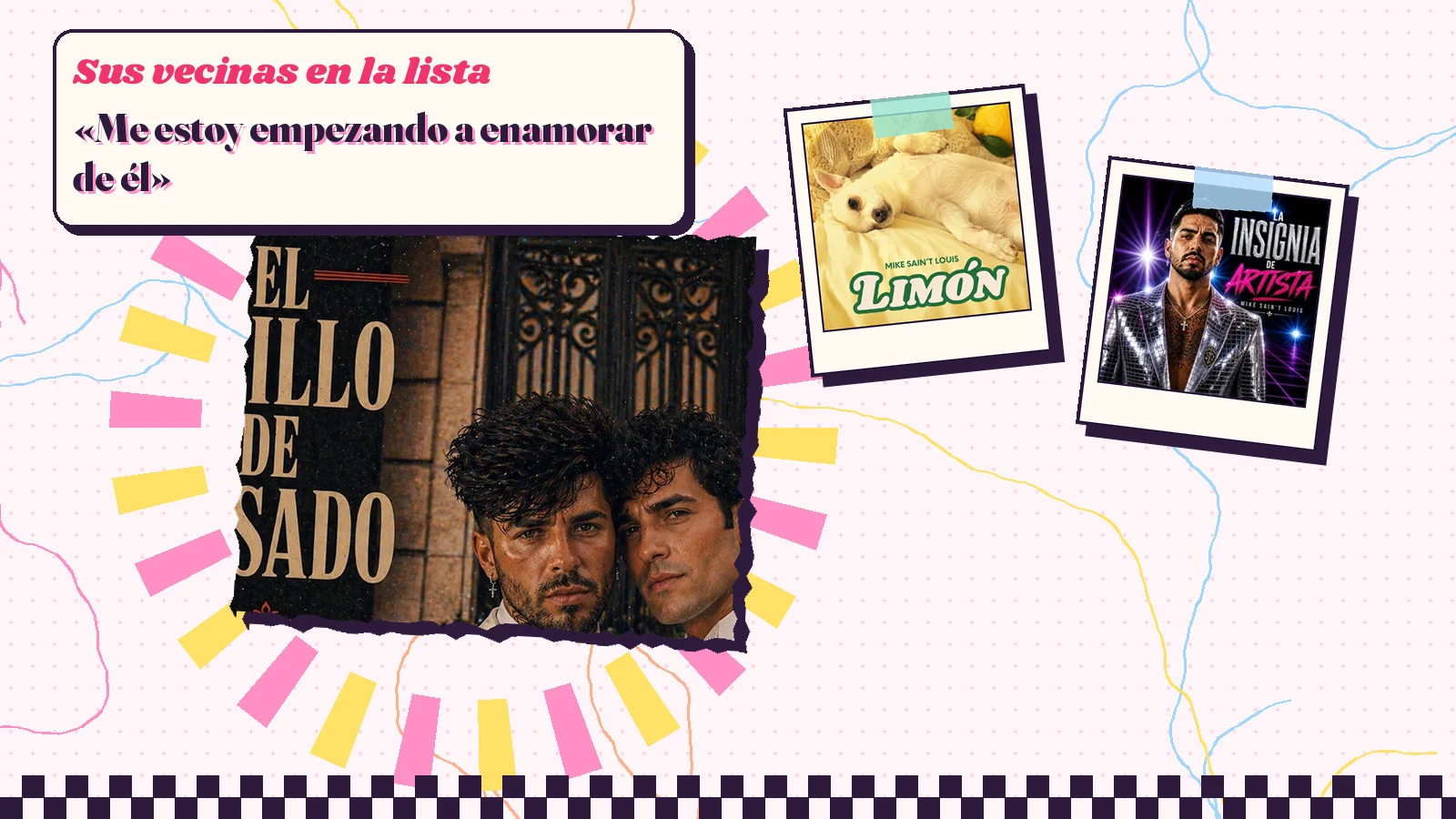
The lyrics have a line that changes everything: «Me estoy empezando a enamorar de él», I'm starting to fall in love with him. There the affair stops being a game. The narrator no longer wants just the bed; he wants the whole man, with his history, his wedding and whatever he feels for his wife. And to love him whole he'd have to accept something the supposed-heterosexuality line doesn't: that the other person may be more complicated than suits him.
Maybe that's the lesson for all of us. Loving someone, or simply respecting them, means not deciding for them what they are. Neither fake straight nor repressed gay: whatever they say, when they want to say it. And if they say bi, may the word cost them no more than anyone else.
There's something else I like about that ending: the narrator doesn't ask the married man to define himself. He asks to stay close. It's a clumsy and selfish way to ask, because there's a third person who knows nothing, but deep down it's what anyone who falls in love asks: that the other stays who they are while you learn to know them. Bisexual people are often asked for the opposite, to define themselves before anyone knows them. I'd like a world with fewer demands like that and more real conversations.
Frequently asked questions
What is bisexuality? Sexual or romantic attraction to people of more than one gender. It needn't be in equal parts or at the same time, and a person is still bisexual even with a stable partner of a single gender.
What is bisexual erasure? The tendency to deny or ignore bisexuality: assuming someone is straight or gay according to their partner, saying it's a phase or suspecting they're lying. Straight people, gay men and lesbians all do it.
When is Bi Visibility Day? 23 September. It was created in 1999 by Wendy Curry, Michael Page and Gigi Raven Wilbur and first marked at the ILGA world conference in Johannesburg. Michael Page also designed the pink, lavender and blue bisexual flag.
Are there more bisexual people than gay men and lesbians? According to Gallup's 2024 US survey, 56% of LGBTQ+ people identified as bisexual. In Spain, Ipsos (2023) found 5% of adults bisexual and 6% gay or lesbian.
What is «El anillo de casado» about? An affair between the narrator and a man who has just married in church, hidden away in Madrid hostels, and the moment the narrator starts to fall in love. It's a song from «Descubierto un nuevo planeta llamado Gayfolk», the first album of the GAYFOLK trilogy.
Who writes these songs? Mike Sain't Louis, lyricist, composer and music producer from Madrid, who presents himself as the first AI songwriter. The vocals and music of his songs are made with artificial intelligence.