
By Mike Sain't Louis ·
Putting you to the test: jealousy, phone control and violence in same-sex couples
«Y aun así te pongo a prueba usando BlueStacks.»
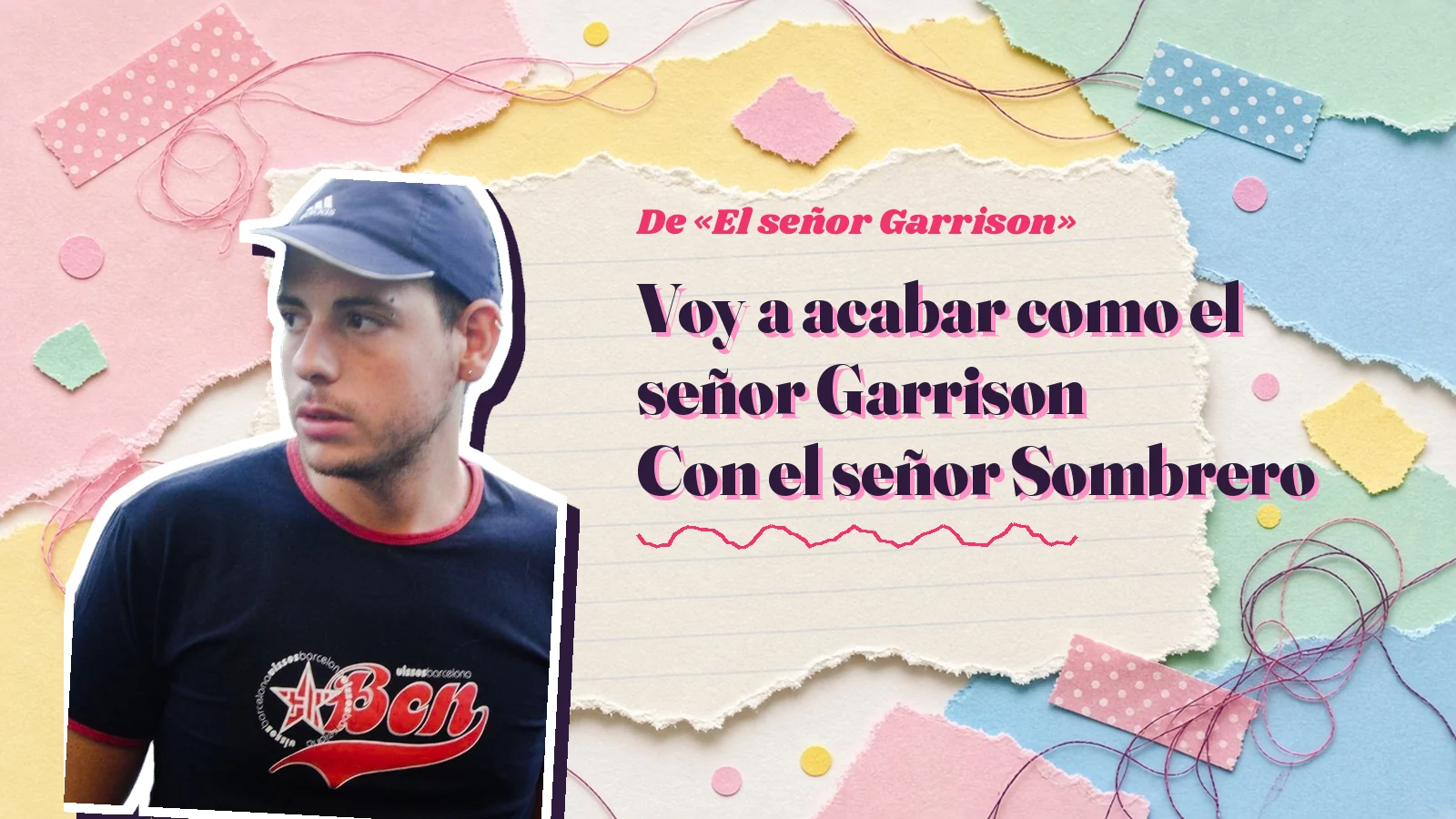
And still I put you to the test using BlueStacks. It's one of the most repeated lines in «El señor Garrison», a song from «Descubierto un nuevo planeta llamado Gayfolk», the first album of the GAYFOLK trilogy. (The full lyrics are published on gayfolkplanet.com.) BlueStacks is a program that lets you open phone apps on a computer. The narrator uses it, according to the lyrics, to put his boyfriend to the test, and I read that as a way of watching him. And he tells it with a strange mix of technical pride and shame: «¿Qué culpa tengo de ser un buen / programador?», is it my fault I'm a good programmer?
I've already written about this song from the side of comedy and the dummy in «El ventrílocuo y el detective». Today I want to do something else: take the detective seriously. Talk about jealousy, about checking your partner's phone, about control disguised as love and about violence in same-sex couples, which exists and is rarely talked about. I do it from a song in which the one watching isn't the film's villain, but the narrator himself. That strikes me as the most honest approach: control isn't always exercised by someone else.
The detective who hates himself
The lyrics don't paint the narrator as a hero. He literally asks himself: «¿Acaso es que tal vez soy masoquista? / O es que me gusta ser pesimista», could it be that I'm a masochist, or that I like being a pessimist. He knows what he's doing hurts him. He knows looking for evidence won't bring him peace. And still he does it, again and again, like someone scratching a wound.
That's the trap of jealousy. It promises calm: if I check, I'll be at peace. But checking is never enough. If you find nothing, you think you didn't look properly. If you find something, the fear is confirmed. Either way the relationship loses.
Today I caught you
In the song the suspicion is confirmed: «Hoy te he cazado, querido novio mío, / preparando una quedada con un tío», today I caught you, my dear boyfriend, setting up a meet with some guy. I don't want to downplay that. Being cheated on hurts, and the song doesn't trivialise it. But the verb is revealing: cazar, to hunt. The relationship has become a hunt, with prey and hunter.
When a couple reaches that point, the problem is no longer only infidelity. It's that trust has been replaced by surveillance. And surveillance, besides fixing nothing, can cross lines the law protects.
What the law says about spying on a phone
Reading another person's messages without permission, getting into their accounts, installing programs to track their location or intercepting their communications isn't a couple's prank. In Spain it can be the crime of discovery and disclosure of secrets. Article 197 of the Criminal Code punishes with one to four years in prison and a fine of twelve to twenty-four months anyone who, to discover another person's secrets or violate their privacy without consent, seizes their emails or any other documents, or intercepts their communications.
Being your boyfriend, your husband or your partner of ten years doesn't change that. Sharing a life doesn't mean sharing a password. And someone giving you their phone code one day doesn't authorise you to check it whenever you like.
There's also the crime of stalking in article 172 ter, which punishes anyone who insistently and repeatedly watches, follows or seeks proximity to another person, seriously disrupting their daily life. When the victim is or has been the stalker's partner, the penalty is higher.
Spy programs
Today there are apps sold openly to «protect your children» or «locate your phone» that are used to control a partner. They read messages, show location in real time, switch on the microphone, copy photos. This kind of program is called stalkerware. Cybersecurity companies have been warning about it for years, and in 2019 several organisations created the Coalition Against Stalkerware to fight it.

If you suspect someone is controlling your phone, some signs are that your partner knows things you haven't told them, that the battery drains strangely or that apps you don't recognise appear. INCIBE's 017, Spain's cybersecurity helpline, can advise you on how to check your phone without putting yourself at risk. If the person watching you might react violently on seeing that you've removed the program, it's best to ask for help before doing it.
Jealousy isn't love
Songs, films and soap operas have taught us that whoever is jealous loves. That a bit of jealousy is the spice of a relationship. That if they're not jealous, you don't matter to them. It's one of the most harmful ideas of romantic love, and it doesn't distinguish between heterosexual and same-sex couples.
Jealousy is a human emotion; feeling it doesn't make you an abuser. What matters is what you do with it. Talking about it, understanding where it comes from, accepting that the other person is free: that's taking care. Checking their phone, banning friendships, demanding their location, making scenes when they come home late: that's control. And control, when repeated, is a form of violence.
The violence with no name
In Spain, Organic Law 1/2004 on gender-based violence protects women from violence by their male partners or ex-partners. Violence between two men, between two women or in couples with trans or non-binary people falls outside that specific law. It's often called intragender violence.
That doesn't mean it goes unpunished. The Criminal Code punishes abuse, threats, coercion and injuries within a couple, including when the two people are the same sex: articles 153 and 173.2, for example, include anyone who «is or has been linked» to the victim «by an analogous relationship of affection». But the lack of a name of its own and of specific resources means many victims don't recognise themselves as such, or don't know which door to knock on.
What the data says
There aren't many figures in Spain. In 2011 FELGTB published one of the first national reports on intragender violence and found what is still true: specific resources were extremely scarce and most cases were referred to services not designed for those situations.
In the United States, the national survey of the Centers for Disease Control and Prevention (CDC) published its 2010 data by sexual orientation in 2013. 26% of gay men and 37.3% of bisexual men had at some point in their lives suffered rape, physical violence or stalking by a partner, compared with 29% of heterosexual men; among men, the differences weren't statistically significant. Among women, the figures were 43.8% for lesbians, 61.1% for bisexual women and 35% for heterosexual women. The conclusion is simple: partner violence isn't the business of just one kind of couple.
Why it's so hard to see
There are reasons why violence in same-sex couples is less visible. One is the myth of equality: if both are men, or both are women, there's supposedly a balance of strength and what happens are «fights». Another is the fear of giving ammunition to those who already attack us: saying that your boyfriend abuses you can feel like betraying the community. Another is loneliness: many LGTBI people have a small network, sometimes without a supportive family, and the partner is everything.
And there's a form of control that only exists in our relationships: the threat of outing you. Telling your family, your boss or your village that you're gay, lesbian, bi or trans if you don't do what you're told. That's blackmail, and it's violence.
Signs of a controlling relationship
These are some warning signs, whoever they come from:
- They check your phone, ask for your passwords or get angry if you don't give them.
- They want to know where you are at all times and demand your real-time location.
- They forbid you to see certain friends or sulk every time you go out without them.
- They make you feel guilty for their jealousy: «if you didn't give me reasons…».
- They insult you, humiliate you or laugh at you in front of others.
- They control your money, your clothes or what you post.
- They threaten to hurt themselves or to tell things about you if you leave.
- You're afraid of how they'll react.
I wrote about another form of manipulation, making you doubt your own memory, in my song «Gaslighting». And in «Dientes, dientes» I asked how you respond to someone who watches you.
If you're the one watching
I'm writing this part because the song asks me to. The narrator of «El señor Garrison» is the one watching. And he isn't a monster: he's someone with fear, with wounds, with the feeling that he'll end up alone, «casado / ¡Con un muñeco!», married to a dummy. Many people who control their partner don't see themselves as controlling. They see themselves as victims of their own jealousy.
If you recognise yourself in the detective, you don't have to carry shame forever, but you do have to stop. Some questions help: what do I expect to find? What would I do if I found it? What would I do if I didn't? If the answers always lead you to more surveillance, the problem isn't in the other person's phone. It's in an anguish that deserves professional attention. Talking to a psychologist about jealousy isn't overreacting; it's the quickest way to stop hurting yourself and the person you love.
And I've died more times than Kenny
Another line of the song: «Y he muerto más veces que Kenny en South Park», and I've died more times than Kenny in South Park. It's a joke, but it also describes a relationship in which one person breaks and pulls themselves together again and again. Kenny dies in every episode and comes back in the next as if nothing happened. Real life isn't like that. Every «death» leaves something behind.
There are relationships where the reconciliations are as intense as the fights, and that swing is addictive. After the scene come tenderness, apologies, the promise that it won't happen again. And it happens again. Many people take a long time to leave precisely because the good moments are very good. If that sounds familiar, it isn't that you're weak. It's that this cycle is designed, even if nobody designs it on purpose, to make leaving hard.
A word that's overused
In recent years the word «narcissist» has been used for everything. I've used it in many songs myself, and I devoted a text to when calling someone a narcissist helps and when it's too much. I bring it up here because you don't need a diagnosis to recognise control. You don't need to know whether your partner has a personality disorder. It's enough to know how you feel: if you're afraid, if you're watched, if you're isolated, that's already reason to ask for help.

In my mental health series I told how I learned to see what had happened in two relationships. Every story is different, but one thing repeats: almost nobody sees it clearly from the inside.
The phone as a battlefield
The phone is now where a lot of jealousy plays out. The blue double tick, last seen, the «typing…» that vanishes, the like on someone else's photo, the new follower. Every tiny piece of data becomes evidence. And dating apps, which many gay couples keep installed out of habit or by agreement, add another layer.
Every couple has the right to agree its own rules: exclusivity, an open relationship, whatever. What matters is that the agreement belongs to both, that it's talked about and respected, and that neither has to become the other's police officer for it to be kept. If a relationship only works with surveillance, it doesn't work. I also wrote about digital noise and what it does to us in «Treinta insultos al despertar».
Trust can't be checked
There's an idea that's been on my mind since I wrote about the liar's dictionary in my lyrics: trust can't be verified the way you verify an invoice. It's given or it isn't. It's built with time, consistency and uncomfortable conversations. And it can be lost, of course. But when it's lost, the solution isn't to install a surveillance system to replace it, but to decide whether it can be rebuilt or whether it's time to leave.
In the song, the narrator has caught the boyfriend. He has the proof. And yet he doesn't feel better; he keeps wondering whether he's a masochist. That's the bitter lesson: proof doesn't cure jealousy, it only moves the pain somewhere else. That's why the useful question isn't «is he cheating on me?» but «do I want to be in a relationship where I need to watch to feel calm?».
When it's your friend who's suffering
Often we notice it first from the outside. The friend who no longer comes to dinners, who looks at his phone anxiously every few minutes, who justifies his partner with phrases like «he's very jealous, but he loves me». The friend who has stopped posting photos, who asks permission to meet up.
If this happens with someone close, don't give them an ultimatum or insult their partner: it usually makes them close up. Tell them what you see, without judging. Remind them you're there, whatever happens and whatever they decide. Find out about resources so you can pass them on when they ask. And stay in touch even if they push you away at first; isolation is exactly what the controlling person needs, and your presence is what breaks it.
In «El abecedario de mi exnovio» I made an A to Z list of what hurts in a relationship. Sometimes naming each letter helps you see the whole picture. Helping a friend can be just that: helping them read their own alphabet.
Leaving
Leaving a controlling relationship isn't always as simple as packing your bags. There may be a shared flat, joint money, pets, mutual friends, fear. That's why it's worth preparing the exit with help: telling someone you trust, keeping evidence of threats or assaults, having documents and some money to hand, changing passwords from a safe device.
Afterwards, many people find it useful to cut all contact for a while, what's known in English as «No contact», the title of another song of mine. It isn't revenge. It's a way to stop reopening the wound.
Before it starts
Much of what I've described could be avoided if we learned earlier to love differently. Relationships and sex education in schools almost never talks about same-sex couples, let alone violence within them. Many LGTBI young people have their first relationships in secret, without role models, with nobody to ask whether what's happening to them is normal. In that silence, control can look like passion and jealousy like proof that you matter.

That's why I think it's important for these conversations to exist, in secondary schools, in associations, on social media and in songs too. A lyric that laughs at a jealous detective can help a sixteen-year-old think, for the first time, that what their boyfriend does with their phone isn't love.
Making amends
If you've controlled a partner and want to change, apologising is a first step, but not the last. Making amends means really stopping, accepting the consequences, including the possibility that the other person leaves, and seeking help to understand where that need comes from. It isn't about punishing yourself endlessly. It's about not repeating it.
Where to find help
If you're in immediate danger, call 112. If you've suffered assaults, threats or stalking from your partner or ex-partner, you can report it to the Policía Nacional, the Guardia Civil, the regional police or the duty court, whatever your partner's sex.
If you'd rather start by talking to people who understand LGTBI relationships from the inside, dial 91 360 46 05, FELGTBI+'s Línea Arcoíris. If you live in Madrid you also have COGAM, with psychologists on 91 523 00 70; the regional LGTBI support programme, on 91 701 07 88; and the city's service for victims of LGTBI-phobia, on 604 953 169. If the problem is that someone is spying on your phone, INCIBE's 017 gives cybersecurity advice. If you're under 18, the ANAR Foundation is on 900 20 20 10.
A relationship that watches and isolates you can wear you down to the point where it's hard to see a way out. If at any point you think about taking your own life, in Spain 024 answers free and confidentially, every day and at every hour. If you're outside Spain, call your country's crisis line or emergency number. Talking about suicide isn't taboo, and asking for help works; I explain it in «Hablemos del suicidio sin tabú». There are more resources in the index of my mental health series.
I'm going to end up like Mr Garrison
The chorus goes: «Voy a acabar como el señor Garrison / Con el señor Sombrero», I'm going to end up like Mr Garrison, with Mr Hat. It's a joke about loneliness: the fear of ending up talking to a puppet. And it is perhaps the root of all the control in the song. Whoever watches is usually afraid of being left alone.
That's what I'll keep at the end. Fear of loneliness is understandable. But it isn't cured by watching anyone. It's cured, little by little, by building a life in which being alone isn't so frightening: friendships, therapy if needed, things that excite you. A partner who loves you doesn't need you to put them to the test. And one who doesn't love you won't change because you watch them. Either way, the other person's freedom is yours too.
Frequently asked questions
Is it a crime to look at your partner's phone without permission? It can be. Article 197 of Spain's Criminal Code punishes with one to four years in prison and a fine anyone who, without consent, seizes another person's messages or intercepts their communications to discover their secrets or violate their privacy. Being a couple doesn't give you the right to do it.
What is intragender violence? It's violence within same-sex or same-gender couples: between two men, between two women or in relationships with trans or non-binary people. It isn't covered by Organic Law 1/2004 on gender-based violence, but abuse, threats and stalking within a couple are still punished under the Criminal Code.
Is jealousy a sign of love? No. Jealousy is a human emotion, but it doesn't prove love. When it leads to checking a phone, banning friendships or demanding someone's location, it becomes control, and repeated control is a form of violence.
Where can I get help if my same-sex partner abuses me? In immediate danger, 112. You can report it to the police or the duty court. FELGTBI+'s Línea Arcoíris answers on 91 360 46 05 and, in Madrid, COGAM on 91 523 00 70 and the regional LGTBI Programme on 91 701 07 88. If there are thoughts of suicide, 024.
What is «El señor Garrison» about? About a narrator who watches his boyfriend with a program on his computer, catches him setting up a meet with another man and fears ending up alone, like the South Park teacher with his puppet. It's a song from the first album of the GAYFOLK trilogy, «Descubierto un nuevo planeta llamado Gayfolk».
Who writes these songs? Mike Sain't Louis, a lyricist, composer and music producer from Madrid who introduces himself as the first AI songwriter. The music and vocals of his songs are made with artificial intelligence.