
By Mike Sain't Louis ·
Talent or cheque? Who hands out the artist's badges
Some questions contain their own answer, and some contain another question hidden inside. The two that open the chorus of «La insignia de artista», The artist's badge, belong to the second kind:
«¿Eres talento o talón? / ¿Eres revolucionario o eres talonario?» Are you talent or a cheque? / Are you a revolutionary or a chequebook?
They look like questions about art. They're questions about money. In Spanish a talón is a cheque, the kind you write out and sign, and a talonario is the little book of them. Whoever asks doesn't want to know whether you have something to say. He wants to know whether you can pay, or whether you'll bring money in. The wordplay makes it plain: in certain offices, talento and talón sound almost the same.
The page for «La insignia de artista» explains who the character is and how the chorus works as a verdict. Here I want to talk about gatekeepers in general, about the very idea of a badge someone can give you or take away, and about the most vulnerable part of the song, which isn't the bit about the judge but the bit about admiration.
Someone fairly important
The song never names the character. It introduces him like this: someone fairly important, with contacts in the music world. Then it keeps adding spheres of influence: production, pleading, exhaustion, the question.
I'm very fond of that "fairly". He isn't someone terribly important, or the boss of a multinational. He's fairly important. Enough to have a chair to sit in and judge from, not enough for his name to appear anywhere. He's the middle-man figure every industry has, the one who's never missing: the one with contacts, the one who knows someone, the one who might make a call if he takes a shine to you.
And the spheres added to his name are a little joke. Contacts in production, fine, that's reasonable. But in pleading and in exhaustion is something else. Those are his contacts with the people who beg him and the people worn out from knocking on his door. His power doesn't come from what he can do, but from what others need from him.
Anyone who has tried to make their way in a creative world knows this figure. He turns up in music, in film, in publishing, in theatre. He has an office, or a table in the right bar. He listens to your demo for three seconds. He tells you it's missing something. He can never tell you what. If he could, he'd have to explain it, and explaining would mean exposing himself. Far easier the vague verdict, the "it doesn't quite work", the "it lacks personality", which leaves you nothing to fix and everything to doubt.
The badge
Why a badge, and not a title, or recognition, or a prize?
A badge is an object. You wear it on your lapel, sew it onto a uniform, flash it at the door. It's given by those with the authority to give it: the army, the Scouts, the police, clubs. And above all, it can be taken back. A police officer can be stripped of his badge. A soldier can have his stripes torn off.
The idea that there's such a thing as an artist's badge strikes me as ridiculous in itself, which is why I put it in the title. As if being an artist were a rank. As if there were a tribunal that, having examined you, granted you the right to call yourself one. And as if that tribunal could, once it went off you, take the badge back and leave you out in the street without it.
The truth is there's no such tribunal, but plenty of people behave as if they were one. People who decide who's a real musician and who isn't, who's a writer and who's a hobbyist, who makes art and who makes something else. Those people need the badge to exist, because if it doesn't, their opinion is just one more opinion.
The algorithm
The chorus is built like a syllogism: if your music is an algorithm, then no heart. If your music is an algorithm, then no soul. If your music is an algorithm, then not different.
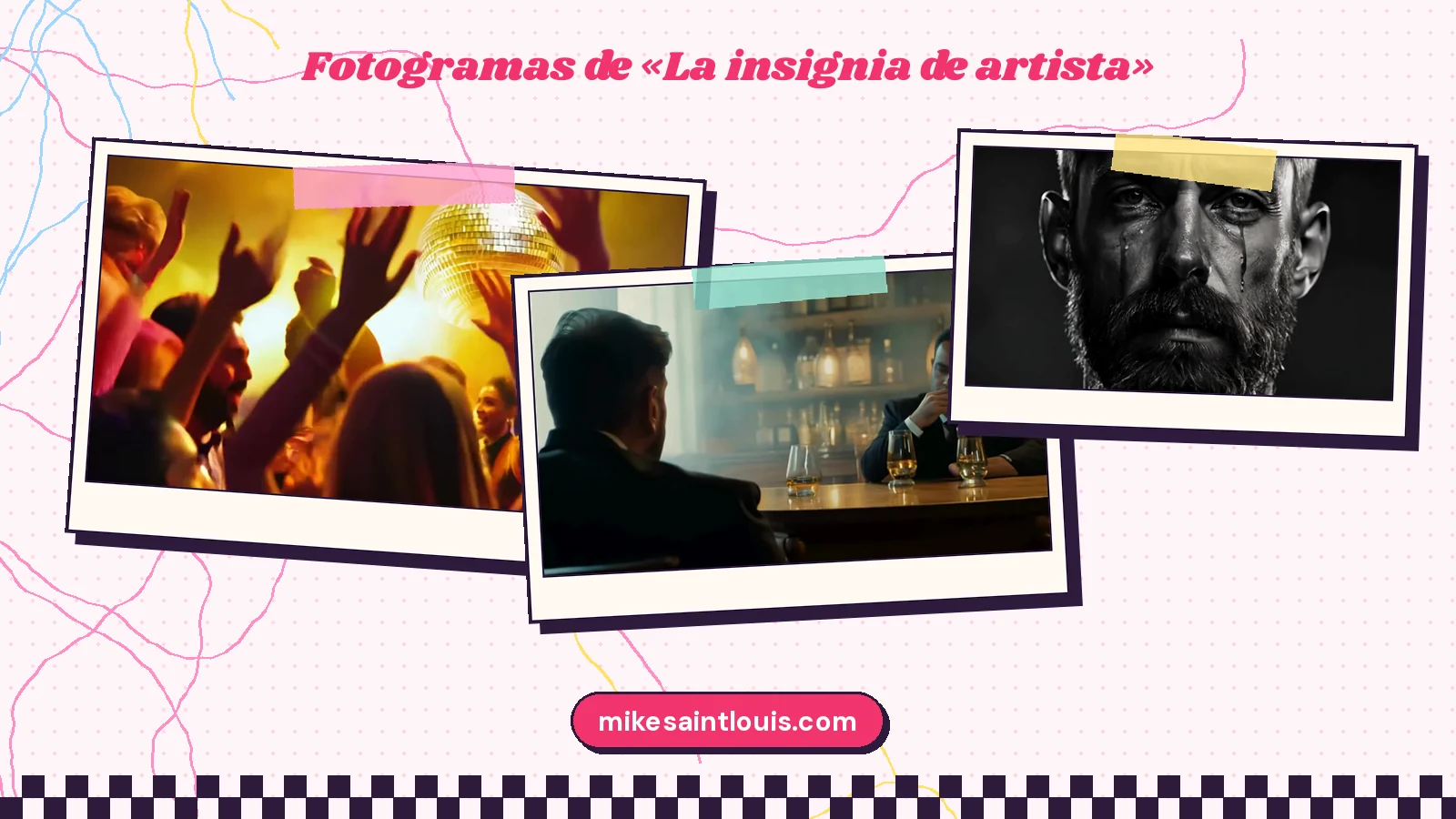
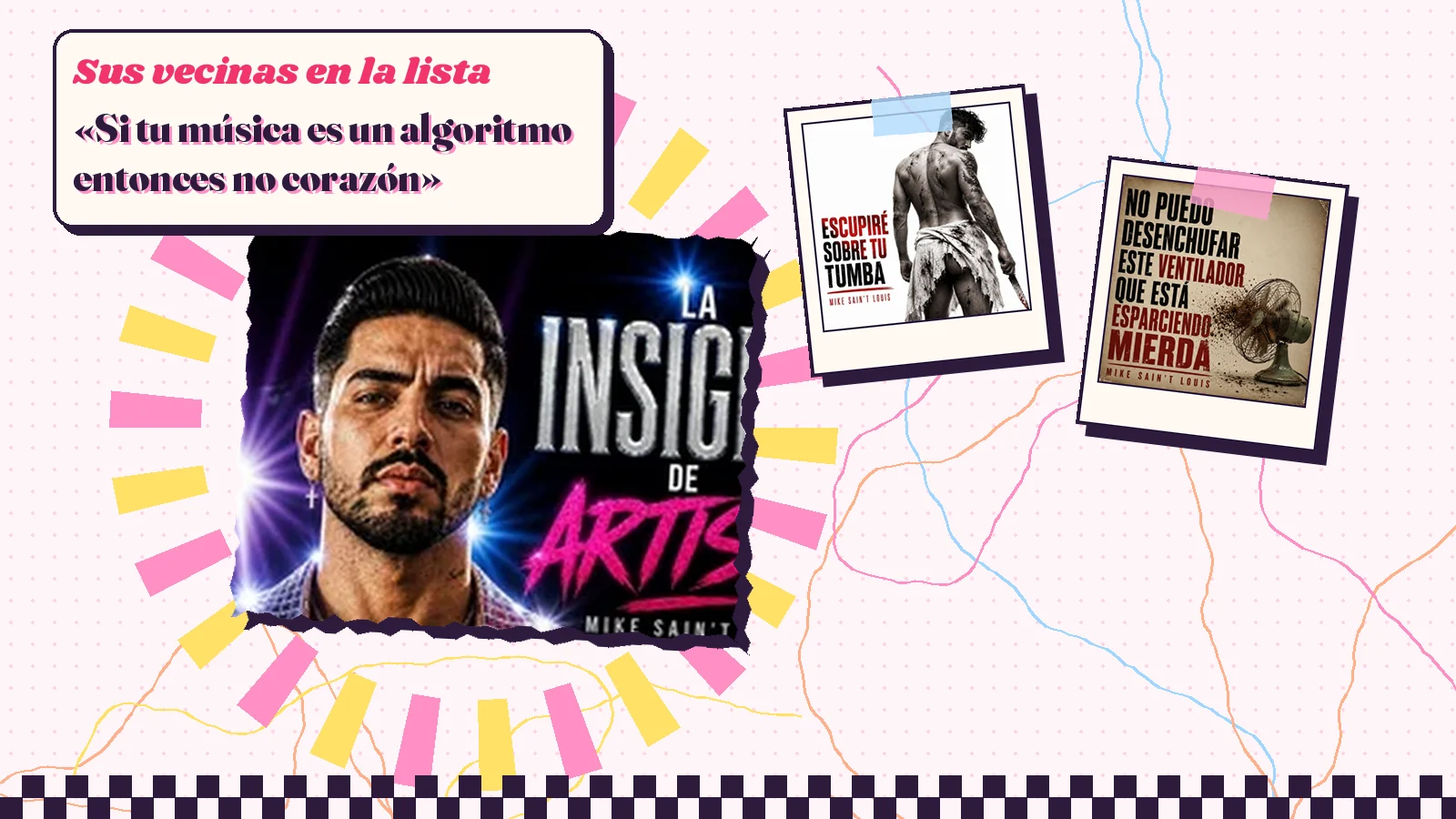
«Si tu música es un algoritmo / entonces no corazón». If your music is an algorithm / then no heart.
The grammar is broken on purpose. No verb in the second half. "Then no heart." It sounds like a machine talking, like a program that has reached a logical deduction. And what that reasoning says, precisely, is that machines have no heart. The irony is that the judge speaks like the very algorithm he despises.
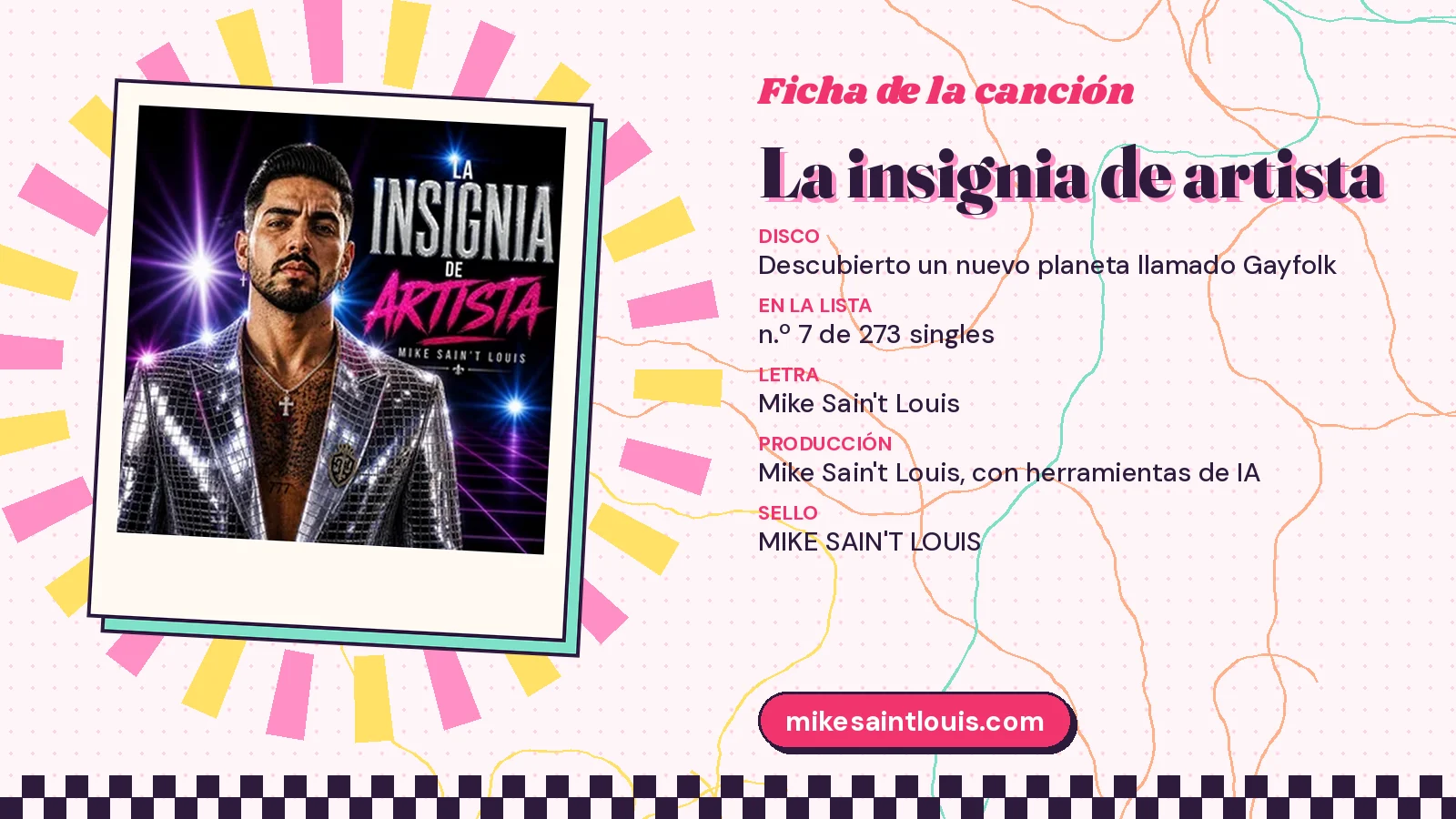
I make music with artificial intelligence. The lyrics are mine, and so are the composition, the production and the artistic direction; the music and vocals are generated with AI. I say so always, everywhere, because I believe listeners have a right to know. I explain why in telling the listener.
So this song isn't about an imaginary judge. It's about an argument I hear often. That music made with AI has no soul, can't be different, and that whoever makes it doesn't deserve to be called an artist. What I'm sure of and what I'm not about authorship I've set down calmly in artificial intelligence and authorship, and I won't repeat it here. What interests me here is something else: the shape of the argument.
Heart, soul, different
The judge's three criteria deserve looking at one by one, because they're not alike.
Heart and soul are big, vague words. Nobody knows exactly what they mean when applied to a song. If they mean the song moves you, that isn't decided by whoever makes it but by whoever hears it. There are songs made with all the suffering in the world that move nobody, and songs knocked out in an afternoon that make half a country cry. Heart isn't measured in the process. It's measured in the effect.
The third is different, and I say that with the pun fully intended. Whether music is different, whether it sounds unlike everything else, is a criterion you can actually argue about. And here I have to admit the worry has some basis: a tool that learns from what already exists may tend to repeat what already exists. If everyone uses the same tool the same way, everything may end up sounding the same.
But the tool doesn't decide what gets said. Whoever writes decides that. And what makes a song different, almost always, is the lyric, the point of view, the subject. No machine was going to suggest, off its own bat, a song called «Mitad Venezuela, mitad Pakistán», Half Venezuela, half Pakistan, or one about the nosy neighbour across the landing, or one about a boyfriend from Albacete. Those oddities come from me. I talk about titles like that in long, strange titles.
So of the judge's three criteria, two are smoke and the third is a legitimate question. The song lumps them together to mock them all at once. In this piece I'd rather pull them apart.
The shape of an old argument
The soulless-algorithm argument isn't new. The technology changes, but the structure is always the same: if you use this tool, what you make isn't real art.
It's been said of nearly every new tool to reach music. Of electric instruments, drum machines, synthesisers, samplers, home recording, editing software, pitch correction. Every time something new let people make music who couldn't before, someone popped up to say it didn't count. I wrote about the technical side of that history, the tools themselves, in AI as an instrument.
What interests me here is who says it. Almost never the audience. The audience listens, and if something moves them, it moves them, without asking how it was made. It's the gatekeepers who say it. Those who already had the badge, or those who hand it out. Because every new tool that opens the door to more people threatens their role as gatekeepers.
I'm not saying every criticism of AI comes from gatekeepers. There are serious criticisms, about rights, about musicians' livelihoods, about sameness. I listen to them and take them seriously. But "then no heart" isn't one of them. It's a verdict without evidence, taking for granted what it ought to prove.
Pleading and exhaustion
Back to those odd spheres in which the character has contacts: pleading and exhaustion. They're the two states the industry leaves you in when you're on the outside.
Pleading is the email you send to a contact list without knowing whether anyone will open it. It's the message to a radio programmer, a playlist curator, a journalist. It's asking, again and again, for someone to listen. And there's something in that asking that wears down your dignity, because it always puts you on the lower rung.
Exhaustion is what comes after a great deal of pleading. The tiredness of someone who's spent years knocking on doors, who's sent out hundreds of demos, who no longer knows whether what they make is good or whether nobody has simply listened.
The character has contacts in both worlds because he lives off them. His power feeds on other people's pleading. If nobody begged him, he'd have no power. And other people's exhaustion suits him, because worn-out people accept worse terms. That's where the chequebook comes back: some people end up paying to be heard, to be included, to be given a chance. And some people charge to give it.
First class and economy
The chorus closes with two rhymes that sound like slogans off a breakfast mug: I'm not a fatalist, I'm a realist. Me in first class and you in economy.
The second is the key. The judge isn't talking about art. He's talking about class. First and economy, as on a plane. He sits up front, legs stretched out, a glass of cava in hand. You sit at the back, knees against the seat in front. And he says it shamelessly, as if it were the natural order.
It's the confession that slips out of the gatekeeper. Behind all his rhetoric about heart and soul, what he's defending is his seat. His place on the plane. If anyone can make music, if the badge stops being scarce, his first class is worth less.
This ties back to the questions at the start. Talent or cheque, revolutionary or chequebook. In the end it all comes down to money and position. And I think it matters that the song drags that into the light, because debates about what counts as real art so often hide debates about who gets paid and who doesn't.
Vega
And in the middle of all this, suddenly, the song changes key. A proper name appears: Vega.
Vega is a Spanish artist many of us first met on the first series of «Operación Triunfo», Spain's big TV talent show, in the early 2000s, and who has since built a career of her own, with albums and songs she writes herself. In the lyric, the narrator says her songs have been with him all his life, that to him she's a diva. And then, with an almost shy doubt, that maybe she wouldn't like him using AI.
I don't know what Vega thinks about artificial intelligence. I don't know, and I won't make it up. Nor does the song, which is why it says "maybe". What the song tells is something else: the fear of disappointing someone you admire.
That's the most vulnerable moment in the whole lyric, and for me the most important. Because the judge at the start doesn't matter. He's a man with contacts, and his badges are worthless. But the opinion of someone whose songs have kept you company for years does carry weight. If that person told you what you do isn't art, it would really hurt.
The fan's fear
Everyone who makes something has someone they admire and whose approval they'd love. A writer has her favourite novelist. A painter has his master. A lyricist has the artists whose songs he's played on a loop for years.
And that longing for approval is, in a way, more dangerous than the gatekeepers' rejection. Because gatekeepers can be ignored; you can laugh at them in a song, as I do. But someone you admire you can't ignore. You hand them a power over you that you've given to nobody else.
The song doesn't resolve that fear. It leaves it there, in plain sight. And that seems honest to me. I'm not saying Vega's opinion doesn't matter to me. I'm saying I take it into account, that I care, that it frightens me. And that even so I carry on doing what I do.
I think that's the only healthy way to relate to your idols: admire them without asking their permission. Know they might not like what you do, and do it anyway.
The surrender
The song ends with a line that might sound defeatist: I don't know, I think I give up.
But the song's page puts it beautifully: it's a fake surrender. Someone who truly gives up doesn't release the song in which they give up. If you're hearing the line, the one saying it hasn't given up.
I like ending this way because it's theatrical. It's the diva's sigh, "I can't go on", before she's back on stage the next night. It's the "I'm retiring" of the old folclóricas, Spain's grand dames of copla, who then did ten farewell tours. Giving up out loud is a way of complaining, and complaining is a way of carrying on. The ones who really give up don't announce it. One day they simply stop turning up.
And there's some sincerity in it too, of course. There are days when you're tired of knocking on doors, of reading comments, of explaining over and over why you do what you do. Days when the temptation to give up is real. The song admits it. And then it keeps playing.
The door
There's the door, out of my sight: that's how the judge, in the chorus, sends off whoever doesn't deserve the badge.
What the judge doesn't know is that there are lots of doors. His was one. For decades, to make music and have someone hear it, you had to get through a handful of doors: record labels, radio stations, television shows. If those were shut to you, there were no others.
Now there are many more. Releasing on every platform without a label behind you is possible, and I tell how in releasing without a label. I have my own label, with my name on it, and I release what I decide to release. I don't need anyone to give me the badge to put my songs within reach of whoever wants to hear them.
That doesn't mean people will listen. That's another battle. But the door no longer belongs to one man. And that changes the power of his verdicts. When he says "there's the door", you can answer: thanks, but I've got others.
A thousand listeners
One of the things that has freed me most from gatekeepers is understanding that I don't need everyone. I don't need the industry's approval, or front covers, or the official charts. I need the people my songs say something to, however few.
I explain it in a thousand loyal listeners: niche fame is enough for me. It's a niche of queens, of people who laugh at themselves, of people who recognise themselves in odd songs. It isn't first class. It's a train carriage full of people who know each other. And I'd take that carriage a thousand times over a leather seat beside the judge.
Laughing at the judge
There are many ways to answer someone who denies you the badge. You can ignore him, argue with him, try to win him round. The song chooses another: put him on stage and let him make a fool of himself.
Everything the judge says in the song is his own words, or those of someone like him. I never answer him with arguments. I let him talk. I let him say his bit about first class and economy, fatalist and realist, the chequebook. And because the lines sound so solemn and so hollow at the same time, the listener draws their own conclusions.
It's a technique I use often. Putting someone else's words into a song, with music and a chorus, is a way of holding them up to the light. Plenty of phrases that sound important in an office sound ridiculous over a pop beat. And that's a small revenge, the kind that hurts no one in particular.
I wrote about how I learnt to live with criticism, the fair and the unfair, in what I learnt from negative comments. This song is, in part, the musical version of that lesson.
Who it's for
The song's page dedicates it to anyone who's been told "you're not enough" by someone with an office. I'd add anyone who hasn't been told it yet, but fears it.
Because fear of gatekeepers paralyses you before they even arrive. Some people don't show what they write because they imagine what the man with contacts would say. Some don't release because they haven't got the badge. Some call themselves amateurs for fear someone else will call them that first.
To those people I'd say what the song says, read backwards: there is no badge. Nobody hands it out. Those who claim to hand it out made it up to feel important. Fairly important. And if someone whose opinion truly matters to you says they don't like what you do, listen, learn what you can, and carry on.
Frequently asked questions
What is «La insignia de artista» about? About a character with industry contacts who decides who deserves to be called an artist, and about someone who uses AI and faces that judgement. The full lyrics are at gayfolkplanet.com/letras.
Why does Vega appear in the lyric? Because the narrator admires her and her songs have been with him all his life. The lyric expresses the fear that she might not like the use of AI, without attributing any opinion to her.
What does «talento o talón» mean? It's wordplay: a talón is a cheque. The question reveals that the judge cares more about money than art.
Who makes the song? Mike Sain't Louis writes the lyrics, composes, produces and directs the project. The music and vocals are made with artificial intelligence: he's the first AI songwriter.