
By Mike Sain't Louis ·
Lara-li, loora-li: writing an almost wordless song on the loudest album
«Lara-li, loora-li, Lai...»
Count the words that actually mean something in this song and you'll have fingers to spare on both hands. Serene. Veil. Dream. Shine. Myst. Hush. Glimmer. Fade. And a name. The rest is syllables, sighs, ahs and oohs.
This comes from the same man who wrote «Escupiré sobre tu tumba», I'll spit on your grave, «Carta de recomendación», Letter of recommendation, and «Narci de cutre culebrón», Narcissist from a tacky soap opera. The one with the lists of grievances, the insults with a postcode, the one who never leaves a gap unfilled by a supermarket brand. And suddenly, a song that says almost nothing.
I owe you an explanation. Or rather, I'll try to give you one without spoiling it.
A name, not a story
The page for «Lai» gives the essentials: the song bears my niece's name. I won't add details about her, because they're nobody's business and because the song doesn't give any either. It doesn't say her age, or what she's like, or what she loves. There are no anecdotes. There's a name, repeated the way you'd murmur it so as not to wake her.
That in itself is a writing decision. When I write about an ex, I pack him with detail. The hair, the gym, the city, the app he signed up to. Details are weapons, and in those songs I need weapons. Here I wanted no weapons. I wanted the opposite: for the person to be sheltered inside the song, with nobody able to point at her.
A name on its own is the purest form of affection I know. It needs no adjectives. Say someone's name in the right tone and you've said everything you feel.
Seven words in the air
Between turns of the chorus come those stray words in English. «Serene, serene... / Veil, veil...» Then dream, shine, myst, hush, glimmer, fade. They don't form sentences. No verb ties them together. They float.
I chose English because, to a Spanish ear, those words sound more than they mean. Serene has a hissing s. Hush is practically a finger to the lips. Glimmer glitters just from being pronounced. Had I written them in Spanish, sereno, velo, sueño, brillo, silencio, destello, the song would have turned into a textbook poem, and I wanted it to be more of a room than a poem.
What's more, one of the words doesn't exist as such: myst. In English it's spelt mist. With the y it becomes something else, somewhere between mist and mystery, an invented fairy-tale word. I like it that way. Children make up words all the time, and this song has something of a children's game about it.
Everything twice
Notice how the stray words arrive. None appears just once. «Serene, serene.» «Veil, veil.» And when they aren't repeated exactly, they come back with an adjective attached: «Dream, soft dream». «Shine, gentle shine.» «Myst, silent myst.» Even the glimmer comes in a pair, «glimmer, glimmer», before the «fade».
That doubling is a habit of lullabies everywhere. «Duérmete, niño, duérmete ya»: go to sleep, child, go to sleep now. «Arrorró, mi niño, arrorró», the Spanish hushaby. Whatever you say to someone on the edge of sleep, you say twice, as if to make sure it gets there, or the way you rock a cradle one way and then the other. There and back. One word for each sway.
And the version with the adjective is tenderer still, because it gently corrects the first: not just a dream, a soft dream; not just a shine, a gentle shine. It's what you do when you tuck someone in and then go back to straighten the blanket a little more, even though it was fine already.
There's no need to treat it as a rule. But read the lyric slowly and you'll see the whole song is made of that gesture: say something, then say it again, a little more quietly.
The language of lullabies
Lullabies are the first musical genre we ever know. Before we understand a single word, someone has hummed something into our ear that we didn't understand. And it worked.

Federico García Lorca gave a famous lecture on Spanish lullabies, and many people have kept one idea from it: that the lullabies of Spain are sad, that there's menace and sorrow in them, that the mother whispers her own griefs to the child. «Duérmete, niño, que viene el coco»: go to sleep, child, the bogeyman's coming. There's a lot of truth in that. Traditional lullabies are a strange place, where fear and tenderness mix.
«Lai» isn't a traditional lullaby. No bogeyman, no threat, no hidden sorrow. But it has something of that language from before words. Those «lara-li, loora-li» are what comes out when you love someone very small and don't know what to say, so you say sounds. We've all done it over a cot. Nobody talks to a baby in subordinate clauses.
La, la, la
In Spain there's an illustrious precedent for a wordless song turned hit: «La, la, la», with which Massiel won Eurovision in 1968. I mention it not because «Lai» resembles it, which it doesn't in the slightest, but because it proves something that interests me: that meaningless syllables can hold up a whole song if they're repeated with intent.
The difference is that that «la, la, la» was a party, to be chanted with arms in the air. My «lara-li» is for saying softly. The same syllables can be a stadium or a rocking chair. It depends on the tempo and the intent.
The loudest album
«Lai» lives on «El día de la liberación», Liberation day, the third album of the trilogy. It's the album at the end of the journey, the moment the ship finally lands on planet Gayfolk. I go into it in liberation day and the day after: it's an album of celebration, but also of hangover, of what do we do now that we're free.
And it's a loud album. There are score-settling songs, party songs, narcissist songs. Plenty of shouting and plenty of glitter. In the middle of it all, «Lai» is a room with the lights down low. Like walking out of a club at six in the morning and suddenly hearing the birds.
That was no accident. A whole album at full volume is exhausting. It needed places to breathe. The same album has other atmospheric songs in English that do a similar job, such as «Holy stillness» or «The northern lights». They're pauses. Landings on a very steep staircase. «Lai» is the smallest of them all, and so the most mine.
Ah, ooh
There's another layer to the song that looks like filler on the page and turns out to be half the song when you listen: the "ah"s and the "ooh"s.
On the lyrics page they stand alone, each on its own line, trailing three dots. «Ah...» «Ooh...» Read like that they seem almost a joke, as though someone had transcribed the sighs of a siesta. But they sit in very particular places: after the stray words, before the name returns, at the end of each block. They're the song's breathing. The places where the melody runs out of words because it doesn't need any.
In one of my usual songs, an "ooh" would be decoration, the backing line that fills the gap between verse and chorus. Here it's structure. Take them out and the stray words are left orphaned, with no air around them. It's like removing a page's margins: the text is still there, but you can't read it any more.
It tickles me that the lyricist of a thousand insults has a song in which the most repeated word, after the name, is a vowel.
Hush
Of the seven words, my favourite is hush. In English it's what you say to quieten someone kindly. It isn't "shut up", which is a slammed door. It's the "shh" you give a child drifting off who's been startled awake by a noise. With a hand on their back.
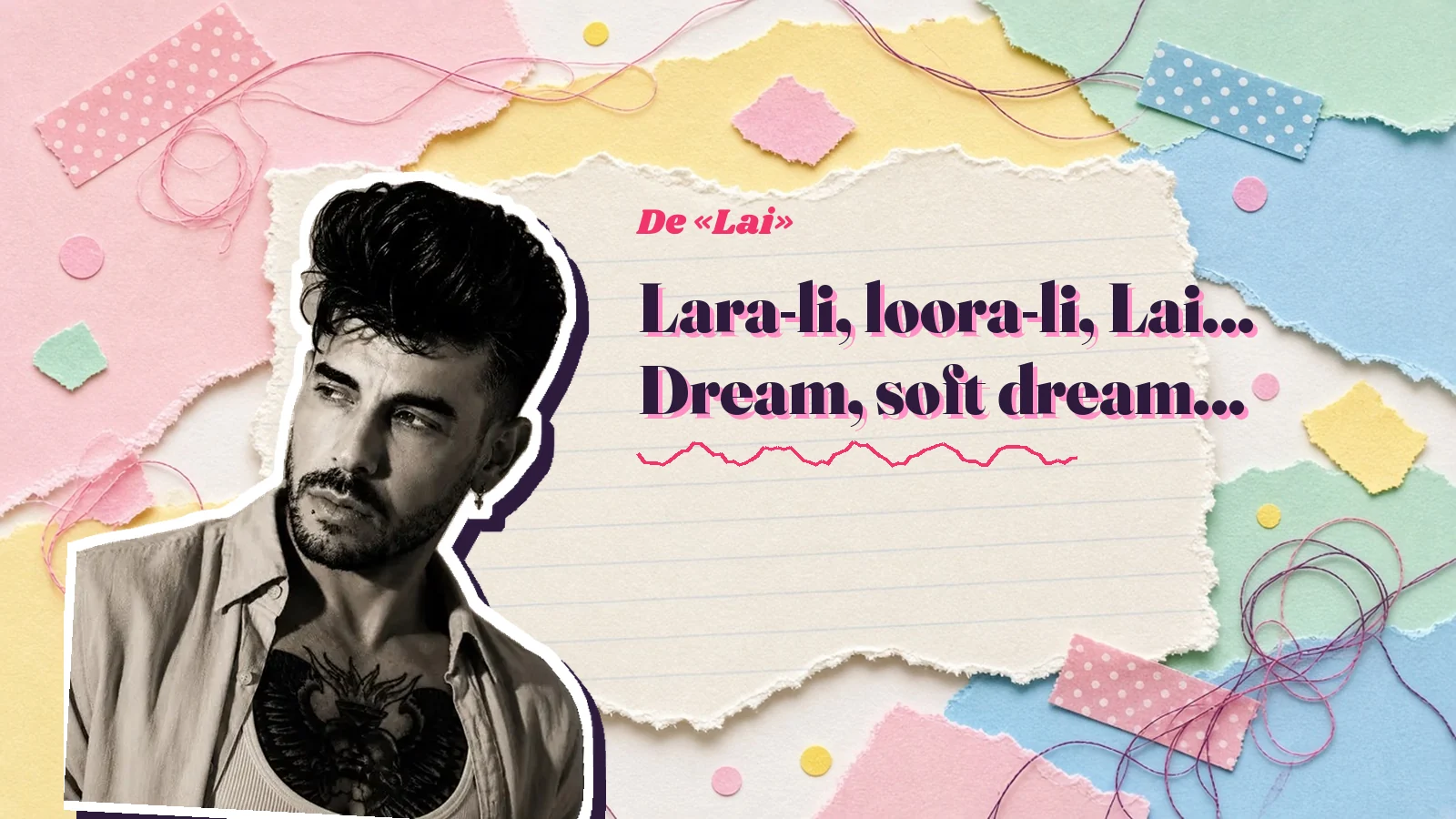
Hush stands alone, between «myst, silent myst» and the chorus. A word asking for silence in the middle of a song. There's a paradox in it, and I love it. It's like a "quiet, please" sign in a nightclub: it doesn't work, but it makes you smile.
Spanish has no word quite so exact. Chitón sounds like a cross grandmother. Calla is an order. Shhh isn't a word. Hence, once again, English. Some feelings have a name in one language and none in another, and when I write in several languages I do it, among other reasons, to borrow those names.
Glimmer, glimmer, fade
And the song's last stray word: fade. It arrives after «glimmer, glimmer», the repeated flicker, like a light blinking twice before it goes out.
It's a very precise way of describing what lullabies do: they dim. Not all at once, but little by little, like the light in a room when someone turns the dimmer. The song announces its own ending with that word and then, even so, carries on: the name comes back again and again, as though it didn't want to leave the room entirely.
That reluctance to end strikes me as the most honest part. When you settle someone you love to sleep, you never leave the first time. You linger a while longer at the door, watching. Just in case. The song does exactly that with its final chorus: it lingers at the door.
Madrid English
I write mostly in Spanish, and I explain why in I write in Spanish, so why is my site in English too. But the catalogue does have songs in English, French and Portuguese, and there's nearly always a specific reason.
With «Lai», the reason is almost physical. The English words I chose are short, one or two syllables, with soft sounds: s, l, v, a breathy h. In Spanish the equivalents are longer and have more hard consonants. Sereno has three syllables and a rolled r. Destello has a t in the middle that cuts. For a song that had to sound like cotton wool, English had the right texture.
It isn't native English, nor does it need to be. It's the English of someone from Madrid who picks words for how they sound, the way you'd choose fabrics by touch without looking at the label.
If you haven't got a niece
One last thing for anyone who arrives here without a niece, without children, without little ones about.
The song is still yours. We all have someone whose name we'd say softly if we could. A grandmother who's gone, a friend who lives far away, a dog asleep at the foot of the bed, a boyfriend who hasn't turned up yet. The name in the song is a particular one, but the gesture works for anyone.
Listen to it thinking of that name. And if you feel like it, when it's over, say the name out loud once. Nothing will happen. Nobody's watching. And if somebody is, they can put the song on too.
How hard it is to say nothing
I'll confess something anyone who writes knows: it's far harder to write a little than a lot.

When I write one of my usual songs, the twenty-line ones full of insults, I have ideas to spare. I have to cut. Drop the joke that repeats another, the brand that adds nothing, the rhyme that comes too easily. I explain it in the craft of discarding. With «Lai» the problem is the reverse. Any extra word spoils something. Any sentence with meaning would set the song explaining, and here there's nothing to explain.
What's left is what can't be taken away. The name. The name's syllables turned into melody. Seven or eight words that are more light than meaning. And the sighs.
Take anything more away and there's no song left. Add anything and it stops being this one.
A song for just being
There are songs for dancing, for crying, for bellowing in the car. «Lai» is for just being.
Put it on while you're doing something else: while you write, while you gaze out of the bus window, while you fold the washing. It demands no attention. No twist, no punchline, no moral. It's just there, like a lamp left on in another room that makes the house feel lived in.
On the blog I have a piece on songs for doing the washing-up, about the pop of small chores. «Lai» won't do for the washing-up, which needs more of a beat. It's for what comes afterwards: sitting down for five minutes with the house tidied and the afternoon light slanting in.
The sweetie castle
The cover is the very opposite of a room with the lights down low, and that amuses me no end.
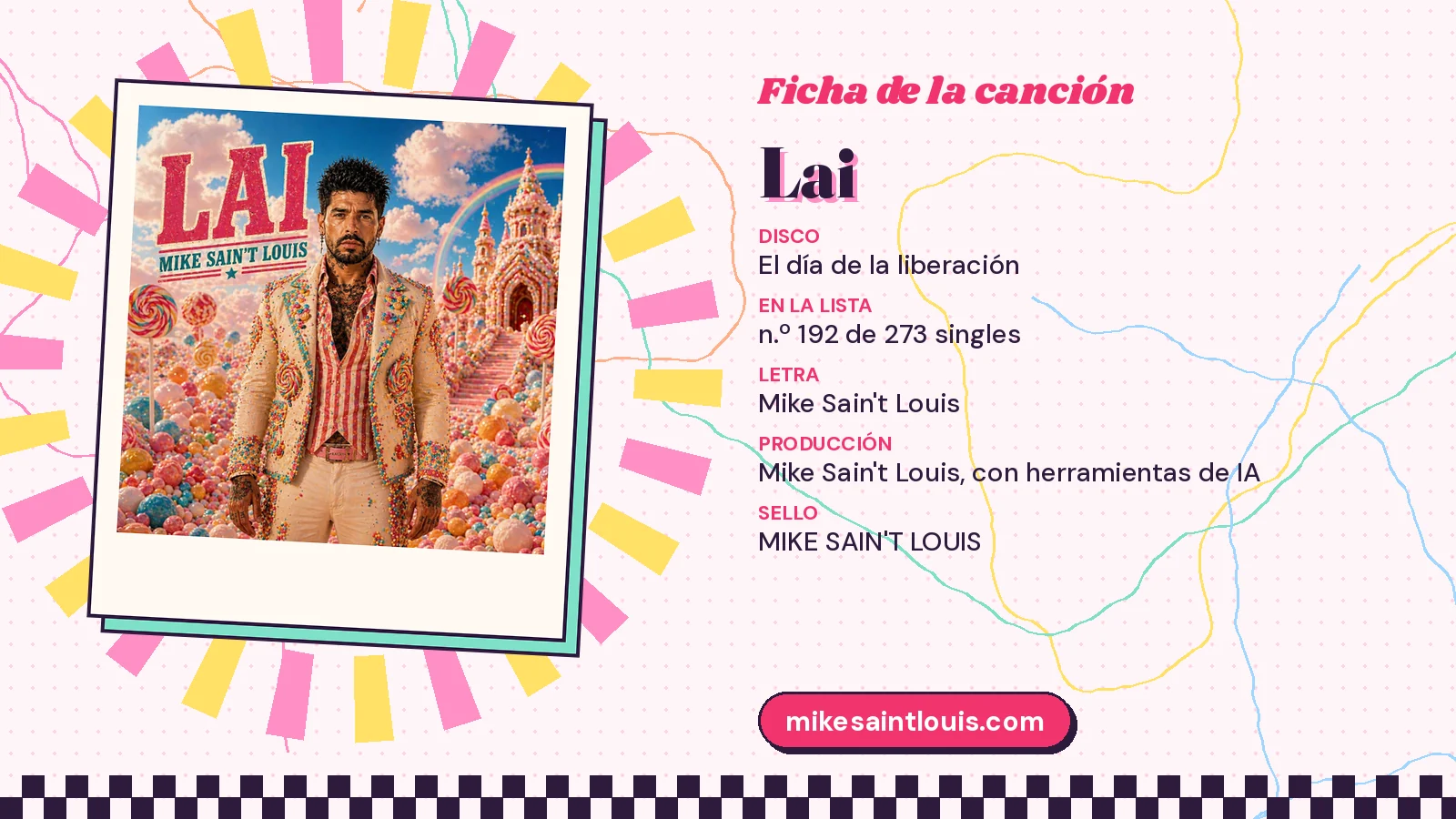
A young man stands there, bearded, hair swept back, in an old-fashioned embroidered jacket in pastel shades, pink, cream and gold, like a fairy-tale prince or a ringmaster at a very posh circus. Behind him, a landscape straight out of a sugar dream: giant spiral lollipops, coloured sweets heaped on the ground, a pink castle with pointed towers, a rainbow and candyfloss clouds. The title, «LAI», sits at the top in puffy pink letters.
It's the world as a child with a sugar fever would see it. Everything sweet, everything enormous, everything colourful. And in the middle, a grown-up in full dress, serious, like the uncle who came to visit and stayed on to live in the story.
I like to think the cover shows what the song keeps quiet. The song whispers; the cover shouts in bubblegum pink. The song is the lullaby; the cover is the dream that comes after it. Together they make a complete nursery.
In defence of the twee
I know what you're thinking. This is terribly twee.
Yes. And I'll defend it. I have a whole piece called in defence of the cursi, cursi being the Spanish for twee, mawkish, a little too sweet, and «Lai» is probably the song that illustrates it best. Tweeness gets a bad press because it's linked with the fake, with the greetings card bearing a Paulo Coelho quote. But there's a genuine tweeness, that of someone unashamed to love somebody out loud. That's the one I care about.
A man who spends his life laughing at his exes, at narcissists, at haters and at himself has the right to one song in which he laughs at nothing. Just one. No irony for a shield. The others have the joke as an alibi. This one has none.
Well, it has one: it's for my niece. No criticism stands a chance against that.
Repeat until it sounds different
The chorus repeats many times. A great many. Count them in the lyric and you'll see whole blocks of «Lara-li, loora-li, Lai» one after another, five in a row, separated only by an "ooh".
That repetition has a curious effect. The first few times, the name sounds like a name. By the tenth, it starts sounding like something else: a mantra, a background hum, breathing. The same thing happens when you say a word out loud over and over: there comes a point where it loses its meaning and turns into pure sound. Children adore that game. They say "spoon" forty times until the word breaks and they collapse into giggles.
The song does that with the name, but the other way round. It doesn't break it. It makes it bigger. By the end it's no longer a name: it's a whole room.
The names in my songs
I told you at the start that my catalogue is full of proper names. They nearly always turn up to settle scores: the ex with his city, the coordinator with his neighbourhood, the celebrity with his surname. Names are where my songs bite. And the names in those lyrics belong to invented characters.
«Lai» is the exception that proves the rule, and that's why I think it matters to have it. It shows that a proper name, which in other lyrics I use as a dart, can also be a gift. What changes isn't the word, but the intent. The same act of writing someone's name into a song can be revenge or a caress.
If I had to explain Planeta Gayfolk to someone who'd never heard of it, I'd play them a narcissist song and then this one. And I'd say: both are true. Both are mine.
Listening while you read
On the site I have a little guide on how to read a lyric while you listen. For «Lai» the advice is exactly the opposite: don't read it. There's nothing to read. Close your eyes, or look out of the window, and let the English words pass the way car headlights sweep across a bedroom ceiling at night.
If you still want to see the lyric, it's all at gayfolkplanet.com/letras. It's short. You can read it in a minute. And then listen to it for much longer.
A sister in the trilogy
There's another song of mine that's also a lullaby, though very different: «Limón», Lemon. That one does have words, and it talks to a little one who already belongs to someone, with great tenderness and plenty of "go to sleep". Play them one after the other and you'll see clearly how the way you love changes with whom you're talking to.
«Limón» is a lullaby with sentences, the kind you say perched on the edge of the bed. «Lai» is a lullaby without sentences, the kind you hum with your head resting on the side of the cot. Both fit on the same planet. On Gayfolk, people sleep too.
The silence afterwards
I'll end the way the song ends: with an "ooh" and a name.
I have no lesson to draw from this. Just an observation: sometimes, amid so much noise, the bravest thing you can release is something that says almost nothing. A song kept in a drawer is no use to anyone, as one of my house rules goes. This one had every chance of staying in a drawer for being too tender. It came out. And there it is, among the shouting of the third album, saying a name softly.
Lara-li, loora-li.
Frequently asked questions
What does «Lai» mean? It's a name: that of Mike Sain't Louis's niece, according to the song's page on his site. The chorus turns it into a formula of syllables: «Lara-li, loora-li, Lai».
Does the song have lyrics? Very few. Between choruses come stray English words such as serene, veil, dream, shine or hush, and plenty of "ah"s and "ooh"s. The full lyrics are at gayfolkplanet.com/letras.
Which album is it on? «El día de la liberación», the third album of the GAYFOLK trilogy.
Who made it? The lyrics, composition and production are by Mike Sain't Louis. The music and vocals are made with artificial intelligence: he's the first AI songwriter.