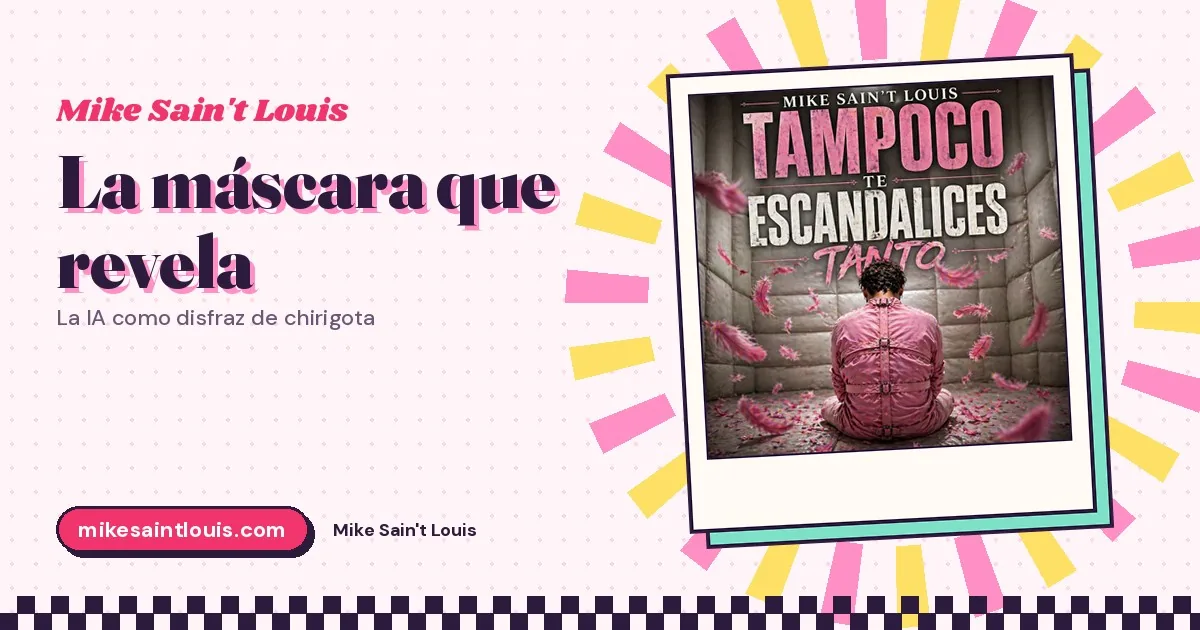
By Mike Sain't Louis ·
The mask that reveals: AI as carnival costume in «Tampoco te escandalices tanto»
🎭. That's how it begins. Before the title in capitals, before the first sentence, there are two theatre faces, one laughing and one crying, squeezed into an emoji like two aunties in a lift.
The lyric of «Tampoco te escandalices tanto», roughly "Don't be so scandalised", is a manifesto, written in prose and emojis, and the first image you meet is a mask. Many people skip it. They go straight to the text, read «el arte también se crea con IA», "art is also made with AI", get scandalised (exactly what the title asks them not to do) and close the tab. I want to go back to the emoji. Because there, in that little phone drawing, is everything that follows.
A theatre mask isn't for hiding. It's so you can be seen from the back row.
This piece is about that. About costumes that tell the truth. About the Cádiz chirigota, the Thursday-night drag queen, the Greek mask and the computer that makes the music for my songs. The song's page already explains what the manifesto stands for and why I titled it with that very motherly phrase. Here I'll stay with a single line, the one I think is the hinge of it all.
Hiding or revealing myself
I'll copy it in full, because without the "the difference is" it loses the tone of someone tired of explaining:
«La diferencia es que yo no uso la IA para esconderme, la uso para revelarme.» "The difference is that I don't use AI to hide myself, I use it to reveal myself."
Look at the two verbs. «Esconderme» and «revelarme». Both reflexive: the one who hides and the one who is revealed are the same person, me. The tool sits in the middle. The same object with two opposite uses, like a fan, which cools you down and also hides your face when your ex walks past the terrace.
What I'm accused of, when I'm accused, is the first. That I use artificial intelligence to hide. That behind the music made with Suno there's nobody, or somebody who won't show his face. It's exactly the other way round. I say everywhere what I do: that the lyrics are mine, written without AI, and that the music and vocals are made with AI tools. That I'm a lyricist, composer and producer, and the vocals aren't mine. There's a whole piece on this blog about why I say openly that I use AI. If I wanted to hide, I'd keep quiet. What the mask does, in my case, is let me say things that wouldn't come out the same barefaced.
That's the thesis. Now let's go to Cádiz.
What a *chirigota* knows
Every February, at the Gran Teatro Falla in Cádiz, groups of people dressed as anything at all take the stage: prisoners, firefighters, virgins, hamburgers, pensioners on a coach trip, whatever you can think of. These are the chirigotas, the satirical troupes of the Cádiz Carnival. They wear wigs, false noses, foam bellies. And from inside those costumes they tell the most outrageous truths of the year. About the mayor, about the Church, about housing, about the neighbour on the fifth floor.
Nobody in Cádiz thinks the chirigota is hiding behind its costume. Everybody understands that the costume is what gives it permission to speak. If you go on stage dressed as yourself and say the council is a shambles, you're a man complaining. If you go on dressed as a prawn in sunglasses and say it in a pasodoble, you're the carnival. And the carnival can say anything.
This is very old and very ours. The mask as licence. The costume as loudspeaker. And when I wrote that I don't use AI to hide but to reveal myself, I was thinking of something very similar, even if Cádiz didn't come to mind at the time. The tool puts a costume on me. The costume gives me permission.
Mind you, I'm not comparing myself to any of the Falla troupes, or they'd run me out of town. I'm comparing the mechanism. Only the mechanism.
The Thursday wig
Closer to home, in Madrid, the mask has another name and wears false eyelashes. Drag.

A drag queen doesn't hide. She's the opposite of hiding. She puts on three kilos of make-up, a metre-high wig, heels that could double as a dagger, and walks onto a stage in Chueca to be the most visible person of the night. And what she says from up there, mic in hand and sequins on, are things the boy underneath might never say in the queue at Mercadona.
There's a song about this in the trilogy, «La primera drag», and a piece on the blog about drag as a party, not a disguise. It argues that drag isn't a costume to conceal but a party to show. Same idea, more glitter. What people call a "costume", seen from inside, is a way of taking off your everyday clothes, the ones the world puts on you, to show something that was underneath.
A wig can be more honest than an ID card.
And when I say AI is my wig I'm not just being funny, or not only. I say it because it's the most accurate thing I can think of. There are things I write in a lyric that need music, rhythm, production I couldn't build on my own with two hands and a flat in Madrid. The tool puts that wig on me. And under the wig, the lyric is still mine, typos and outrages included.
Every image, every note, every line
The manifesto has a long sentence that many people read as brochure copy and which, for me, is a list of very concrete things. It says every image, every note, every line of the project is born from something felt before it was written, and lists them: loss, emotional abuse, rage, beauty, madness and hope.
Six things. Not three, which is the brochure number. Six, which is the number of an outpouring.
If I look at them through the idea of the mask, something curious comes out. None of those six can be put on by a machine. Loss can't be typed. Emotional abuse isn't generated at the press of a button. Rage doesn't come in a drop-down menu. All of that has to come from outside the tool, from a life. The machine dresses. It doesn't feel. And that's why the manifesto's next sentence is so short: AI doesn't invent that.
I like that sentence being short. After a long list, a sharp blow. It's how I talk when I'm really angry: first I ramble, then I land the punch.
I ask for respect for the process
Two lines in the manifesto follow one another and answer each other:
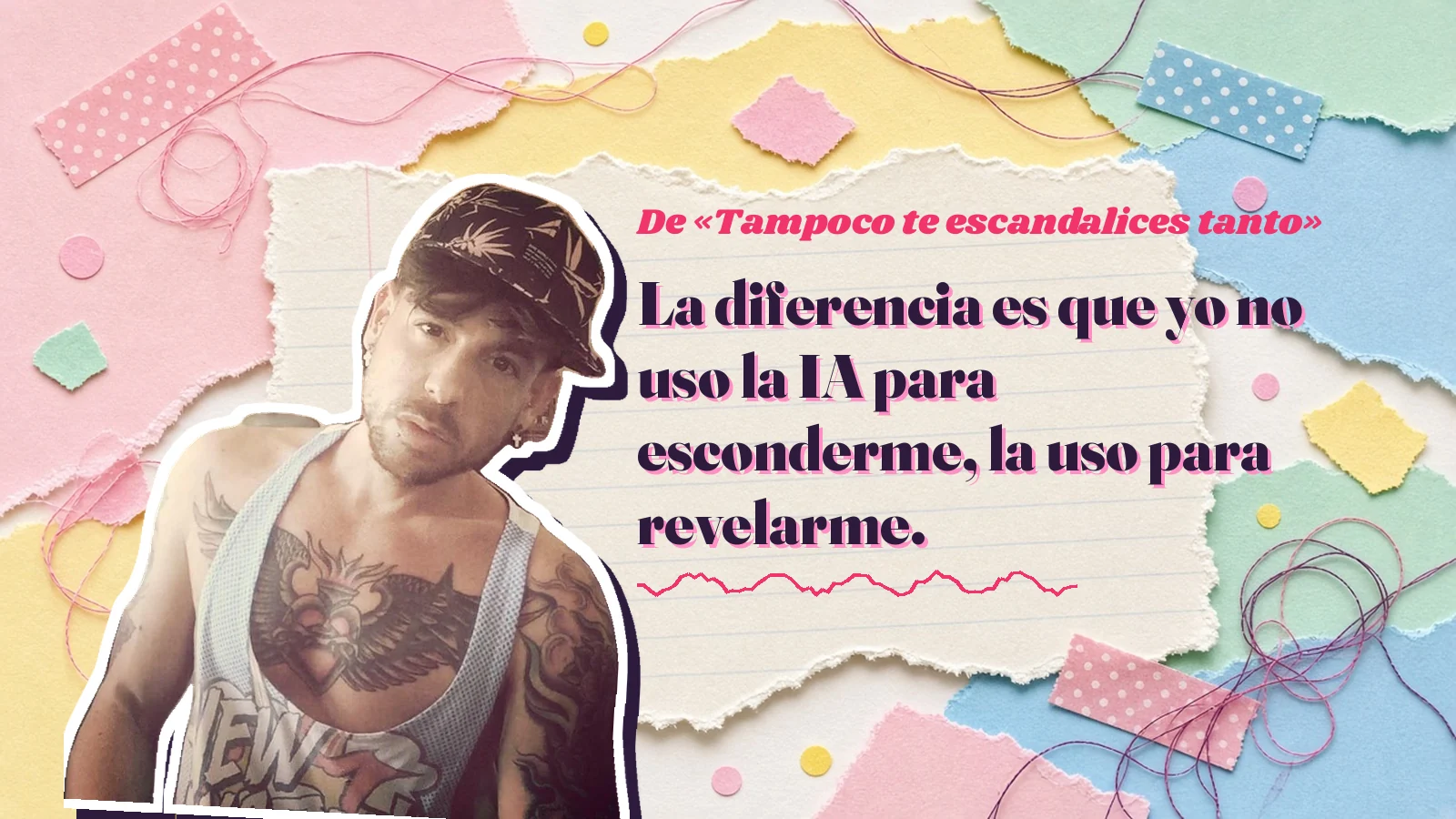
«Yo no pido permiso para crear. / Pido respeto por el proceso.» "I don't ask permission to create. / I ask for respect for the process."
Through the idea of the mask, this reads differently. A chirigota doesn't ask permission to go out dressed as a prawn. It just goes. But it does expect the audience to understand the rules of the game: that the costume is part of what's being said, that it isn't a trick, that underneath there's someone who has spent months writing those verses. That's respect for the process. Not applause. Understanding how what you're doing works before judging it.
With AI it's the same. Many people judge the result without knowing how it was reached. They see the costume and assume there's no one inside. And I, who have been inside since the first lyric, only ask that before getting scandalised, they ask. Or read. The website has an FAQ page that answers nearly everything I'm usually asked about this, and a piece on what's mine in a song made with AI that goes into detail.
I'm not asking for a prize. I'm asking not to be mistaken for the costume.
And I know there's something naïve in asking, like asking the afternoon chat-show pundit to read the book before giving an opinion. Spanish television has spent decades teaching us you can hold a ferocious opinion about anything without having seen it. The thing is, in a song, a ferocious opinion without looking shows more. Because the lyric is right there, published, line after line. Anyone can read it in two minutes. If after reading it you still think there's nobody inside, fine, that's your right. But read it first. That's all I ask, and it fits into a coffee.
Two faces in one emoji
Back to the 🎭. The theatre mask has two faces: comedy and tragedy. One smiles, the other's mouth turns down. They always come together; I've never seen just one.
If you ask why I started the manifesto with that emoji, I can give you the answer that comes to me now, looking at it from a distance: because that's what my songs are. A face that laughs and another that cries, in the same drawing. Croquettes on a cruise and a beach in Tenerife at forty. «Karma» with its extra a's and «Entre cuatro paredes» without a single joke. The same project with both faces on.
And AI, in that scheme, isn't a third face. It's the string that ties the mask to your head. You can't see it, it has no expression, but without it the mask falls off.
I'll leave it there, because if I carry on with the metaphor I'll get far too pleased with myself and have to give myself a clip round the ear.
Soul and intention
There's a stretch of the manifesto that, if I had to pick one for a market-stall T-shirt, would be this:
«Ojalá algún día entiendan que el alma no está en la técnica, / sino en la intención.» "I hope one day they understand that the soul isn't in the technique, / but in the intention."
Through the mask, that line says something very concrete. A mask has no soul. It's cardboard, latex, a nylon wig. The soul is in whoever puts it on and why. Put on a mask to rob a bank, and the mask is a weapon. Put it on to climb onto the Falla stage and say rent in Cádiz is daylight robbery, and the mask is free speech with sequins. Same object. Different intention.
That's why I find it absurd to talk about AI as if it had a morality of its own. Some people use it to churn out rubbish, to deceive, to upload a thousand songs a day under fake names and pocket a few cents from the platforms. And some use it to bring to life the lyrics they had in a drawer. The technique is the same. The intention isn't.
Mind you, I'm not saying my intention makes me better than anyone. I'm saying it's mine, and I own up to it.
Don't be so scandalised
The title, which comes from a phrase every Spanish mother has said at some point with a tea towel in her hand, is a mask too. It's a small, homely title for a text about art, technology and soul. As if, to say something enormous, I'd put on a housecoat.
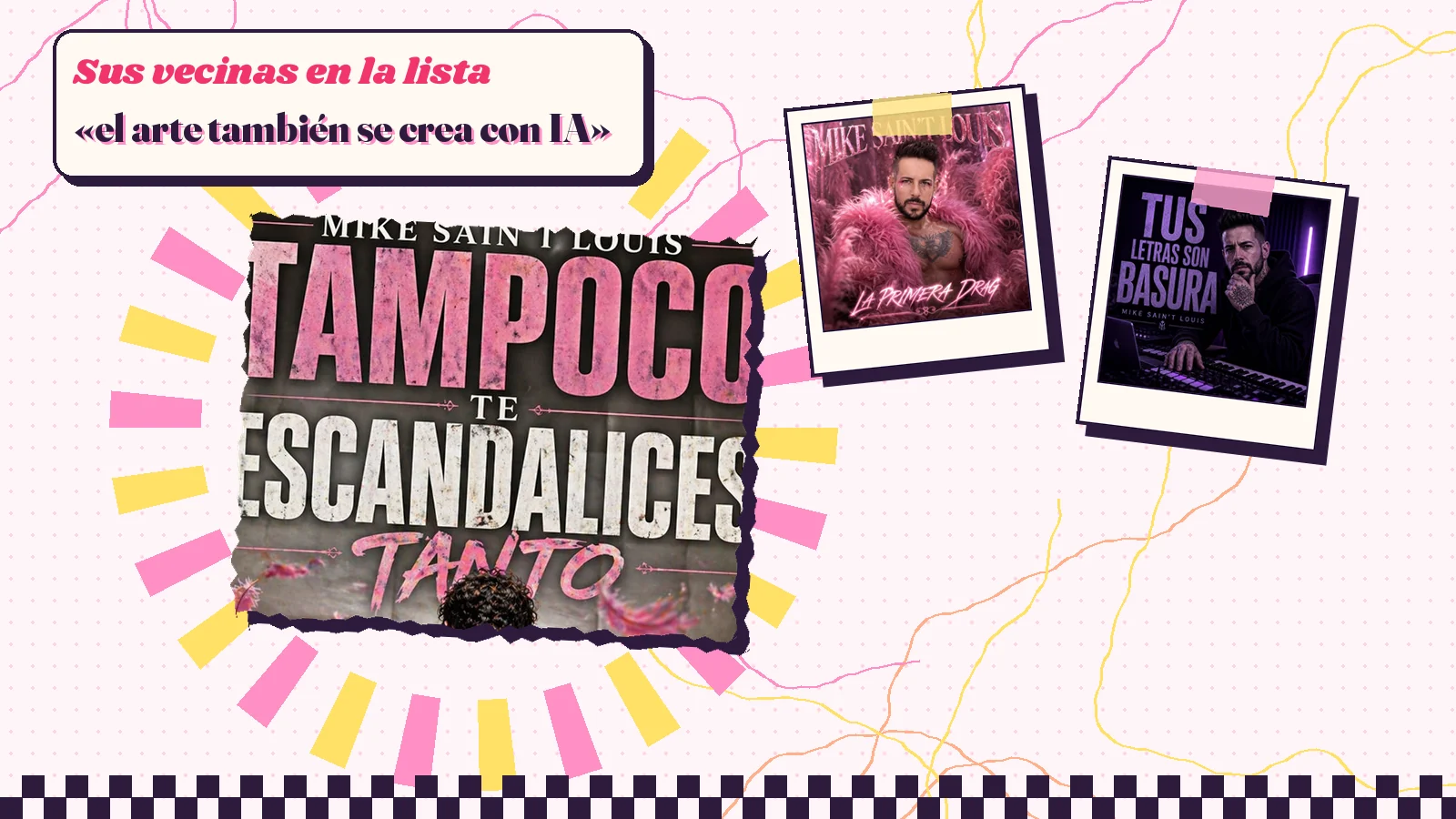
And it's the chirigota trick again. If I titled the manifesto "On the Legitimacy of AI-Assisted Creation in Contemporary Pop", not even my cousin would read it. Title it «Tampoco te escandalices tanto» and you picture a woman in a kitchen in Móstoles, on the edge of Madrid, telling her son to stop shouting, and you're already in. The humble form lets the big idea through.
There's a companion piece on the blog, AI as an instrument, which compares the tool to the drum machine. That one takes the path of the history of instruments. This one takes the path of theatre. Both arrive at the same place by different streets, like getting to the Puerta del Sol via Preciados or via Arenal.
The scandalised wear a mask too
Here's where I get a little cheeky, but with love.
The person who gets scandalised wears a mask too. The mask of purity. The one that says "I only listen to real music", as if real music hadn't spent decades passing through computers, samplers, pitch correction and producers who comp vocal takes syllable by syllable. It's a very comfortable mask because it doesn't look like a mask. It looks like a face.
I don't mind someone preferring other music. That's great. What amuses me is the outrage, the hands thrown up in horror, the long comment in capitals. There's a post on what I learnt from negative comments, and a whole song, «Tus letras son basura», to answer that. Here I'll say just one thing: if a theatre mask scandalises you that much, perhaps what bothers you is what it says, more than the cardboard it's made of.
And that, deep down, is a compliment. Thanks, gorgeous!
Dressed up as a label
There's another mask in my case that isn't the tool but a phrase: in Spanish, «el primer cantautor IA», which in English I put as "the first AI songwriter". I use it in inverted commas, and it's worth explaining why, because it's the perfect example of everything above.
Taken literally, the Spanish version is false on two counts. The word cantautor carries a performer inside it, the one who stands at the mic, and that, strictly speaking, isn't me. And the "first" is pure fairground swagger, like those vans that say "the best dance band in Castile". But as a costume it works wonders. It's a character's name. It's what's written on the dressing-room door. And like every good costume, it tells a truth underneath: that what I do is new, that it doesn't fit the usual boxes, and that I take it with a sense of humour.
There's a whole post on what it means to me to present myself as «el primer cantautor IA». I go into it calmly there. Here I only want to point out the likeness to the chirigota: an exaggerated costume fools nobody. Nobody at the Falla believes those men are actual prawns. And nobody who reads my website with a bit of attention believes I'm the one at the microphone. It says so very clearly: lyricist, composer and producer. The label is the carnival costume. The credits are the ID card.
What you say with your face covered
There's something anyone who has ever dressed up knows, even as a pirate at school: with your face covered you dare more. You dance more. You talk louder. You tell the girl in the row behind that you like her fringe.
It isn't cowardice. It's that shame, a very tiresome lady who goes everywhere with you, stays at the door when she sees she doesn't recognise you.
Something similar happens in my lyrics. Many of the things I write are things you don't say at dinner: insults named after villages, dick pics, saunas, narcissists who flick you away like a cigarette end. If I said them at dinner with my Tuesday face on, people would look at me funny. Said in a song, over an electropop beat with AI-made production, they become something else. They become a show. And a show, like carnival, has a licence.
I don't mean AI gives me courage. The courage, if there is any, is in writing the lyric. What the tool gives me is the stage where that lyric can be heard without the vocals having to be mine. For a lyricist who doesn't perform, that's the difference between a drawer and a theatre.
And as one of the house rules on the website says: a song kept in a drawer is no use to anyone.
What the mask doesn't do
So as not to come across as some visionary, a list of what the mask doesn't do. Five things, let's see if I manage:
- It doesn't write the lyric. I write it, without AI, and if there's a typo it's mine.
- It doesn't choose the subject. Nobody asks Suno to write about a Canarian ex or a cruise with sardines in the minibar; that comes out of my head.
- It doesn't decide which version is released. That's the craft of discarding, which also has a piece on the blog.
- It doesn't face the music when someone gets angry. I do, under my own name.
- It isn't moved when someone writes that a song has helped them. That part is mine.
The mask provides the music and the vocals. That's a lot, and I'm grateful. But what's inside still belongs to whoever wears it.
The digital brush
The manifesto ends with two lines that, of the whole text, I like most as an image: the emotion is still human even if the brush is digital. I'm paraphrasing, because I'd rather you read it whole in its own place.
Through the mask, the digital brush is another way of saying the same thing. A brush doesn't paint by itself. A mask doesn't talk by itself. An AI tool doesn't write a manifesto with emojis about why AI tools don't write manifestos. Someone writes it. Someone who, in my case, signs as Mike Sain't Louis and whose ID card says Miguel Ángel de León Guijarro.
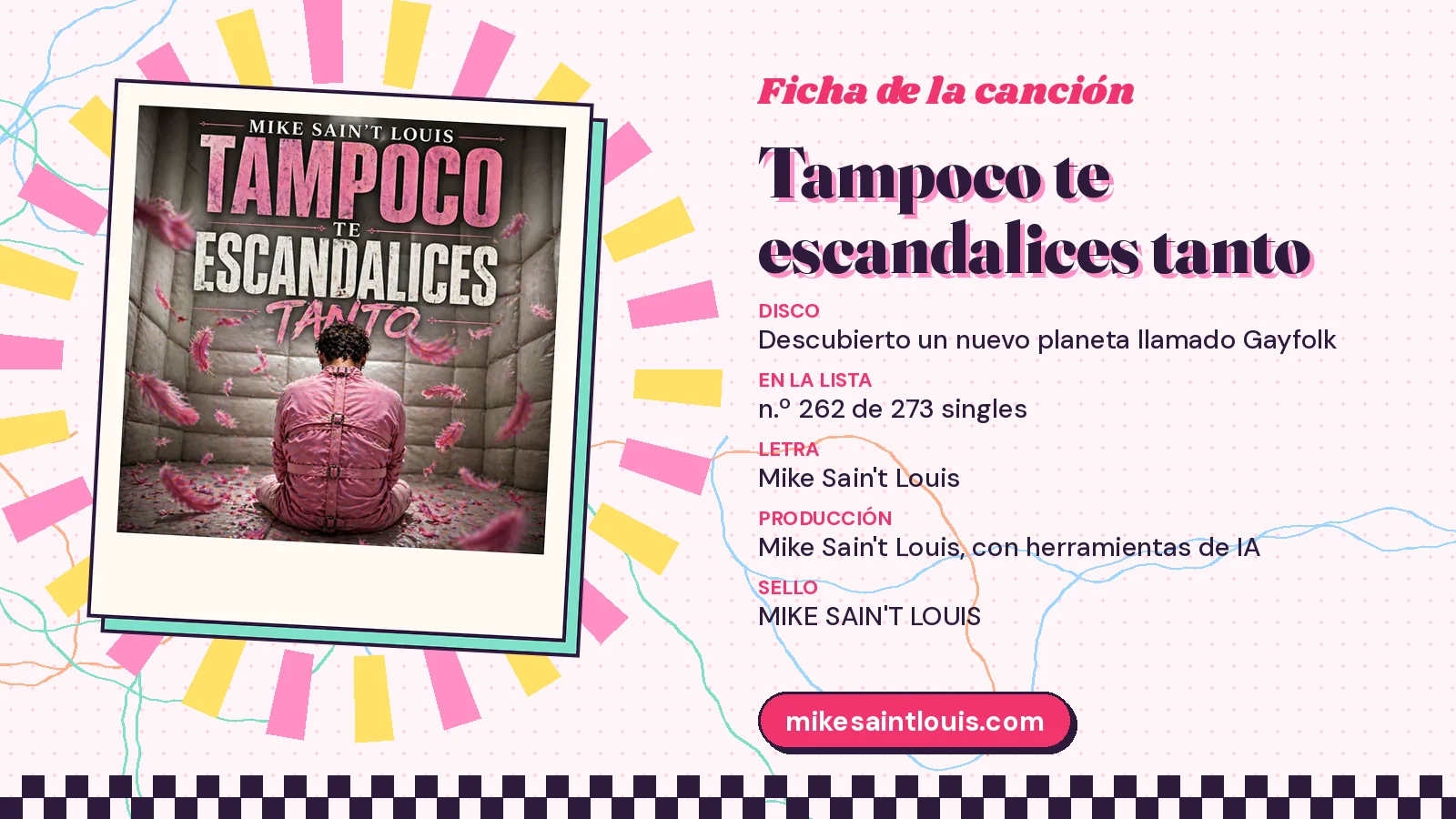
The manifesto is on the first album of the trilogy, *Descubierto un nuevo planeta llamado GAYFOLK*, and you can listen to it in the list of singles on this website. If you do, look at the emoji in the lyric before the music starts. The two faces. The one that laughs and the one that cries.
And underneath, someone.
Frequently asked questions
What is «Tampoco te escandalices tanto»? A manifesto by Mike Sain't Louis turned into a song, from the first album of the GAYFOLK trilogy. It argues that art can also be made with artificial intelligence and that the soul of a work lies in its intention, not its technique.
Does Mike Sain't Louis use AI to write the lyrics? No. The lyrics are his own and written without artificial intelligence. He is a Madrid lyricist, composer and music producer; the music and vocals are made with AI tools such as Suno, and he says so openly.
What does "I use it to reveal myself" mean? That the tool works like a theatre mask or a carnival costume: it doesn't hide the person wearing it, but gives shape and a loudspeaker to what they have written.
Where can I read the full manifesto? At gayfolkplanet.com/letras/tampoco-te-escandalices-tanto. The song page is at mikesaintlouis.com/blog/tampoco-te-escandalices-tanto.