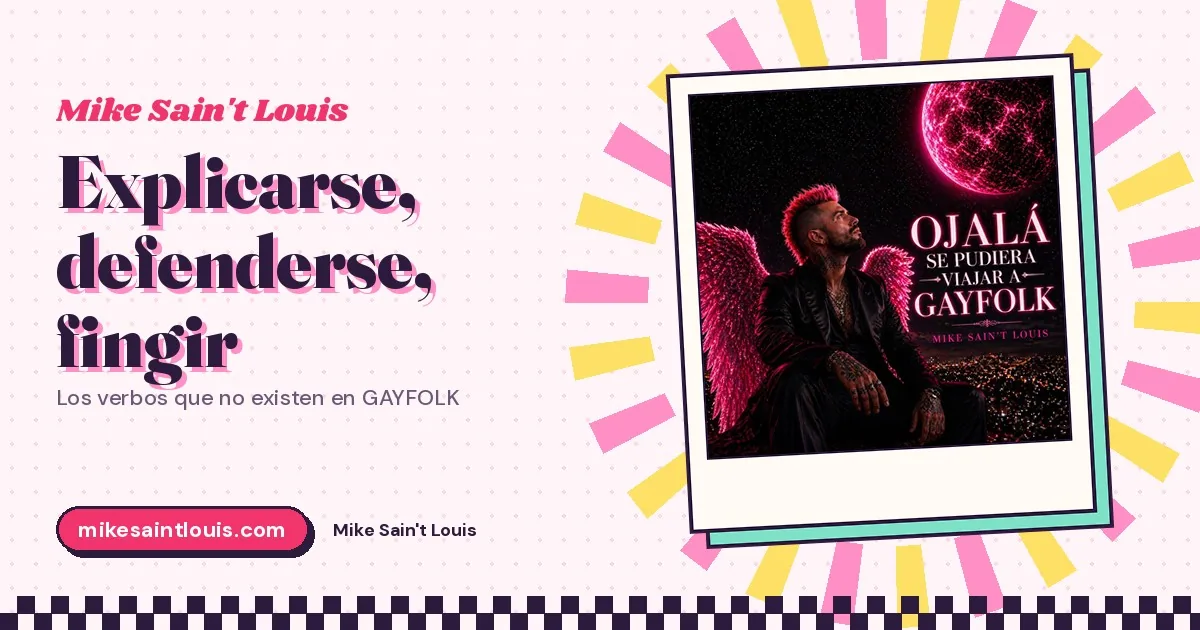
By Mike Sain't Louis ·
Explaining, defending, pretending: the three verbs that don't exist on GAYFOLK
Some planets are described by what they have. Rings, moons, methane storms, volcanoes the size of Aragón. GAYFOLK is described by what it lacks.
That's how I put it in the text for the song that gives the second album its title: «Hay días en los que uno desearía poder escapar a otro planeta… uno donde no hiciera falta explicarse, defenderse ni fingir». "There are days when you wish you could escape to another planet… one where you didn't have to explain yourself, defend yourself or pretend."
Three verbs. Explaining. Defending. Pretending. On GAYFOLK they aren't conjugated. The full text is on the song's page in Letras.
Any queer man of my generation, and of the one before, and I fear of today's, knows those three verbs by heart. He learns them before his times tables. He conjugates them in the school playground, at the Christmas Eve table, at the office, in the village bar in August. They're such everyday verbs that you don't even notice them. Until you imagine a place where they aren't needed.
This post is about those three verbs. The summary is on the song's page. Here I take them one by one, because they're the most precise definition I have of what the planet is.
A planet defined by subtraction
When you invent a world, the usual thing is to fill it. Fantasy novels have maps, languages, royal family trees, unpronounceable names for their cities. Tolkien invented whole languages. George Lucas, species with their customs and their bars.
I did the opposite. To invent GAYFOLK I didn't add: I took away.
It isn't that the planet has nothing. It has plenty, and the Planeta Gayfolk page tells its universe, with its albums and its colours. But what defines it, what makes it different from Earth, isn't what's there. It's what isn't.
I think it's the only honest way to imagine a better place. If I start describing a paradise with champagne fountains and boys in thongs serving croquetas, I end up with an advert for a gay cruise, and I've already said what I think of cruises in «Croquetas en el crucero»: that there are sardines in the minibar. A paradise stuffed with things is a catalogue fantasy. A paradise by subtraction is humbler and truer. I'm not asking for more. I'm asking for less of what hurts.
First verb: explaining
Explaining is the most tiring of the three.
You explain yourself when you come out, which is an endless explanation that never finishes, because every new person you meet needs their own chapter. You explain yourself when you say no, you haven't got a girlfriend, and no, it isn't that you haven't met the right girl. You explain yourself when they ask which of you is the man and which the woman, a question that still turns up at dinners in 2026, somewhere between the roast lamb and the turrón.
And, in my case, you explain yourself when you say you make music with artificial intelligence. That's another explanation that never ends, and I gave it a whole post: what people ask me when I say I make music with AI. I'm a man with two closets: the queer one and the AI one. I've come out of both. And at both doors they still ask me for explanations.
The exhausting thing about explaining isn't the explanation itself. It's that the explanation is taken for granted. Nobody asks a straight man to explain why he likes women. Nobody asks a guitarist to explain why he uses a guitar. Only the odd one out is required to explain.
On GAYFOLK there's nothing to explain. You arrive, and that's that. Nobody asks. Nobody needs to understand you in order to let you be.
Second verb: defending
Defending comes after explaining, when the explanation hasn't worked.

There's physical defence, the age-old kind. Crossing the street. Letting go of your boyfriend's hand as you pass a group of lads with beers in their fists. Glancing around before a kiss on the Metro. You wear that defence like a watch, without noticing you've got it on. There's a song of mine, «La despedida», with a line in capitals that says it better than I can: «CAMELA, LA PRIMERA VEZ QUE FUI YO SOLO CON MIEDO A CHUECA PENSANDO QUE ME IBAN A PEGAR». "CAMELA, THE FIRST TIME I WENT TO CHUECA ALONE, SCARED, THINKING THEY'D BEAT ME UP." (Camela being the Spanish pop duo on the stereo; Chueca, Madrid's gay quarter.)
Scared of Chueca. Of the one place that was supposed to be safe.
And there's verbal defence, subtler, the kind where you always have your reply ready. For the office joke. For the brother-in-law's remark. For "I've got nothing against it, but". For "I don't care what you lot do in your own homes". You live with your comeback loaded, like someone carrying an umbrella on a sunny day, just in case.
In my songs I defend myself a lot. I defend myself by attacking, which is what I'm best at: with creative insults, with real names, with «¡Patán!», "Oaf!". But defending wears you out, even when it's fun. On GAYFOLK there's no need. Nobody attacks. The comebacks stay in your pocket, and at the end of the day you realise you haven't used a single one.
Not one. The umbrella, bone dry.
Third verb: pretending
The third verb is the saddest.
Explaining and defending are things you do facing someone else. Pretending is something you do to yourself. Pretending the joke didn't hurt. Pretending you don't mind not being able to bring your partner to your cousin's wedding. Pretending you like football at the work lunch. Pretending you're just a good friend of that man you've been with for five years.
In the song's text, the next sentence drives it home: «donde los raros no tuviéramos que pedir perdón por serlo». "Where we odd ones didn't have to apologise for being odd." Pretending is the quietest way of saying sorry. An apology never spoken, simply worn. Every time you pretend, you're saying: sorry for being like this, I'll fix it, I'll hide a little.
And the worst thing about pretending is that it works. You learn it so well that in the end you can't tell where the disguise stops. Some people have pretended for so long that when they finally can stop, they don't know what their real face looked like. For them I once wrote a letter to anyone who hasn't told a soul yet. Not to tell them to come out right now, that's not my place. To tell them they aren't alone in pretending.
On GAYFOLK nobody pretends. That's what makes it such a strange planet: everyone goes about with their own face.
«Los raros»
Back to that word, because I chose it carefully. «Los raros no tuviéramos que pedir perdón por serlo.»
I didn't write "gay people", or "the community", or "LGBTI people". I wrote «los raros», the odd ones. And in the first person plural: «tuviéramos», "we". I put myself inside.
«Raro», odd, is the word I was called as a child before «maricón». It's the word that comes first. The one people use when they don't yet know exactly what's up with you, but know something is. "That boy's a bit odd." Many of us were odd before we were anything else.
«Raro» also lets more people in. On GAYFOLK there's room for the queers, of course, but also for the neighbour who talks to herself, the lad who paints his nails and then says he's straight, the seventy-year-old lady who's bought herself a motorbike, the one who cries at reality shows, the one who writes songs with AI. Odd, all of us. A planet without customs control.
The impersonal in the title
«Ojalá se pudiera viajar a GAYFOLK.»
The title doesn't say «ojalá pudiera», "if only I could". It says «ojalá se pudiera», with that impersonal se: "if only one could", "if only it were possible".
It's a small difference and I think it's enormously important. "If only I could travel" would be my wish, a private one, a Madrid bloke who wants to get away. "If only one could" is a wish for anybody. It's like saying: if only that ticket existed, if only there were a bus route, if only the coach company had a stop at GAYFOLK.
The impersonal turns the song into something anyone can say. It isn't my planet. It's a planet that ought to be available.
Then there's the verb. «Viajar», to travel, not «mudarse», to move. I don't say "if only one could live on GAYFOLK". I say travel. Go and, presumably, come back. I noticed after writing it and left it that way on purpose, because I think it's the most realistic part of the title. Nobody can go and live on an imaginary planet. But you can visit: three minutes of a song, an afternoon with friends, a night when nobody asks you for explanations. And then return to Earth with your suitcase full of something. A return trip, like the Imserso pensioners' coach outings, but without the bingo. Well, with bingo if you like. Nobody on GAYFOLK will judge you for bingo.
And the «ojalá», of course. The word that comes from Arabic and means, more or less, "God willing". We use it every day without realising it's a prayer. Ojalá it rains. Ojalá I win the lottery. Ojalá one could travel to GAYFOLK. It's the prayer of those who don't pray.
The three verbs, scattered through the catalogue
When I reread my lyrics, I find the three verbs loose all over the catalogue. GAYFOLK is the place where they don't exist, but on Earth, which is where the songs get written, they crop up all the time.
Explaining is in every song where I answer whoever tells me my work isn't worth anything. In «Discutiendo con la IA» the explanation ends with «hazlo tú, maricón», "you do it then, you queer", which is the quickest way I know of ending an explanation. In «Tus letras son basura», "Your lyrics are rubbish", the title is already the other person's line, the one that forces you to explain, put on the cover so everyone can see how absurd it is.
Defending is in the songs about clothes and money. In «¡Que no pienso decir que mis trajes son de Zara!» there's a line I find hilarious: «Los he comprado en SHEIN», "I bought them on SHEIN". It's defence in reverse. Instead of defending the brand, I knock it down myself before anyone else can. The defence of someone who knows the attack by heart and gets in first.
And pretending is in two texts that, placed side by side, frighten me a little. On the page for «Ya no te quiero» I wrote that the phrase "is the lie you keep telling yourself so you don't break completely". Pretending, turned inwards. And in «Hetero» there's a question that's still the hardest I've ever asked myself in a song: «¿sería más fácil ser hetero o simplemente más fácil no ser yo?». "Would it be easier to be straight, or simply easier not to be me?"
Easier not to be me. That's pretending taken to the limit. Wishing your own face were someone else's.
GAYFOLK is the planet where that question makes no sense. Where being yourself isn't the hard part. If anyone asks me what the planet is in one sentence, I now have the answer: the place where nobody wonders whether it would be easier not to be themselves.
For the newcomer
I also think about whoever hears this song at fifteen or sixteen. In a village in Teruel, a neighbourhood in Getafe, a gated estate in Marbella, it doesn't matter. Someone who's just starting to conjugate the three verbs and doesn't yet know they have names.

I'm not going to tell that person GAYFOLK exists, because it doesn't, and lying to a fifteen-year-old seems to me the worst thing you can do. I'd tell them something else. That the three verbs aren't compulsory for ever. That you learn them, yes, but you can unlearn them too. That there are days, and then weeks, and then years, when you use them less. And that lots of people write songs, make videos or simply live so that they're used even less.
A community's songs work like a shared diary, as I explained in songs as a community's diary. This is one page of that diary. The one that says: one day, ojalá, nobody will have to explain anything.
Escaping isn't running away
Some people have told me the song is escapist. That imagining another planet is a way of not facing this one.
I disagree, and I've given it thought.
The text does say "escape". But the planet isn't a place to hide. It's a measure. It's a way of knowing how much is missing here. If on GAYFOLK you don't have to explain yourself, then every time you have to on Earth, you know it shouldn't be that way. The imaginary planet serves as a ruler for measuring the real one.
The utopians of old did exactly the same. Thomas More invented an island, Utopia, and used it to talk about the England of his day. He didn't want to move to the island. He wanted people to see what England was missing.
I'm no Thomas More, nor do I claim to be, I've enough on my plate. But the trick is the same. GAYFOLK is an island for looking at Madrid.
My refuge and my revenge
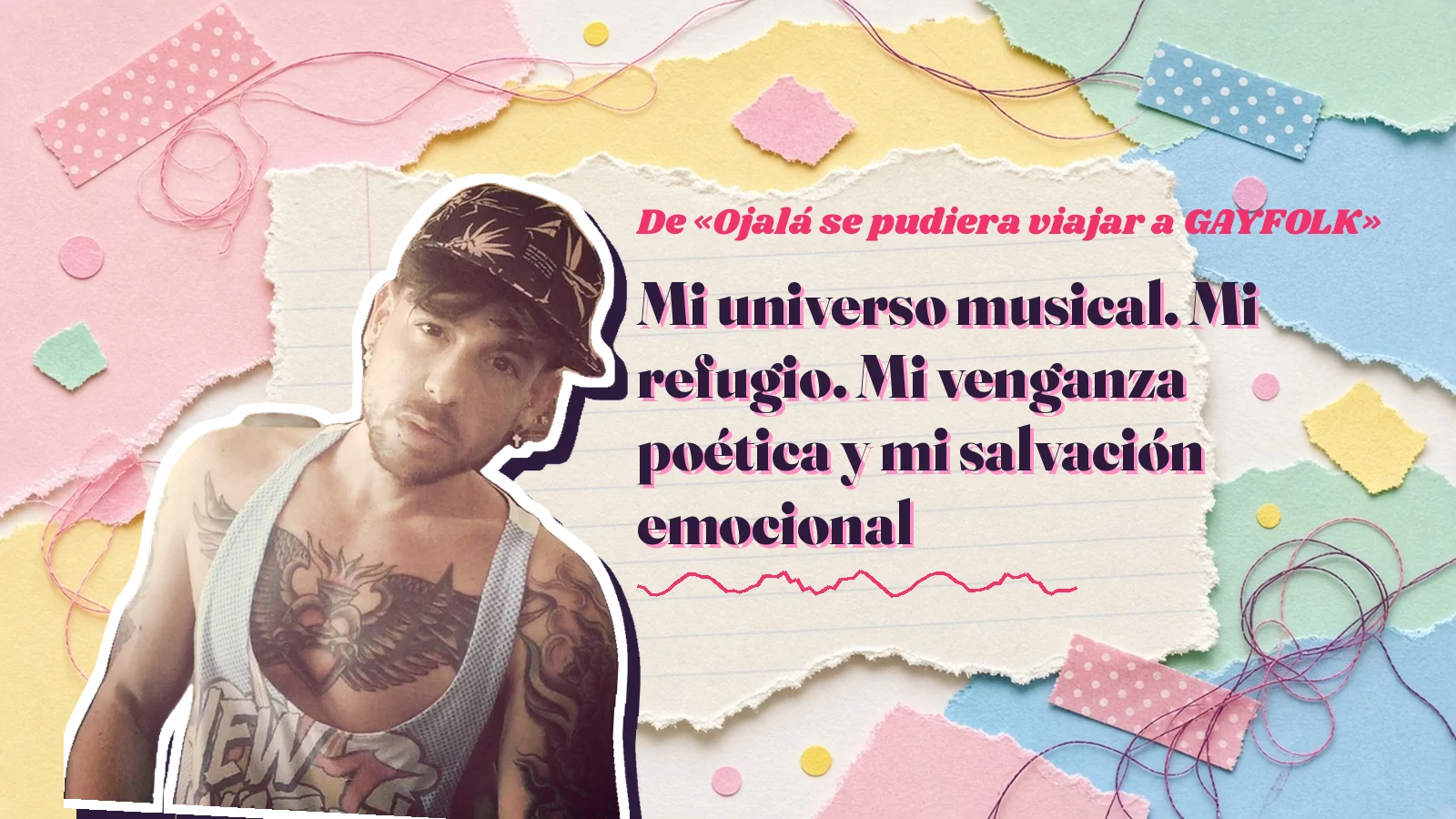
In the same text there's a list I'm very fond of, because it mixes things that don't match: «Mi universo musical. Mi refugio. Mi venganza poética y mi salvación emocional». "My musical universe. My refuge. My poetic revenge and my emotional salvation."
Refuge and revenge. Together. They look like opposites: a refuge is for hiding, revenge is for going out after someone. But in my catalogue they walk hand in hand.
The refuge is the planet itself, the place without the three verbs. The revenge is what I do from the planet: songs with names and surnames, digs at the ex, letters of recommendation for the next victim. You attack better from a safe place. It's the logic of every castle.
And I don't say "emotional salvation" lightly. There's a song called «La música me está salvando», "Music is saving me", and it isn't a metaphor. Without the planet, without the songs, without releasing one after another, I don't know what I'd have done with everything the lyrics tell. I'll leave it there. It needs nothing more.
The second album bears its name
The song gives its title to the second album of the trilogy. That's no accident.

The first, «Descubierto un nuevo planeta llamado GAYFOLK», "New planet called GAYFOLK discovered", announces that the planet exists, like a news item. The second, «Ojalá se pudiera viajar a GAYFOLK», is about longing to get there. The third, «El día de la liberación», "Liberation Day", is about finally arriving.
If you want to hear them in order, there's a guide for that: how to listen to the GAYFOLK trilogy from start to finish. And if you want to understand why the second is written in the mood of wishing, I explained it in «Ojalá», the second album, and the grammar of longing. Here I'll add just one thing: the title track hasn't a single joke in it. On an album with «Croquetas en el crucero», «Tan cateto» or «Me he tomado una pastilla gay», the title song is the serious one.
I suppose because longing, deep down, is never funny. You can laugh at anything except what you truly want.
What I've chosen not to put on the planet
There are things people ask me for that I leave off GAYFOLK.
There's no official flag. There are colours, of course, and a visual identity I direct myself, but no anthem, no constitution, no president. In «Vota Malena Gracia» there's a galactic election, yes, but it's to stop Donald Trump and Elon Musk buying the planet, which is another matter. A joke election against very real buyers.
There are no entry requirements. You needn't be gay, or young, or handsome, or on a diet, or have a six-pack. On Earth the gay scene has its own border controls, and sometimes they're worse than the ones outside. Dating apps are full of "no fats, no fems, no over-forties". On GAYFOLK that doesn't exist. If there were a bouncer, he'd be the first to go.
And there's no obligation to be happy. That matters. A planet without explaining, defending or pretending isn't a planet where everyone smiles. You can be sad on GAYFOLK. You can cry to «La Playa del Mal Pas». The only thing you needn't do is pretend you aren't crying.
The pride of ordinary days
I think about GAYFOLK a lot on Tuesdays. Not on Pride days, with their floats down Recoletos and their beer brands playing ally for a week. On Tuesdays in November, when nobody remembers anything and you still have to explain yourself at work.
I wrote about it in pride on a Tuesday in November. Real pride isn't July's. It's the pride of an ordinary day when, for whatever reason, you don't have to pretend.
Those days are little visits to GAYFOLK. They last a while. A dinner with friends where nobody asks. A Metro carriage where nobody stares. An afternoon at your mother's when, at last, your partner is your partner and not your flatmate.
Ojalá one could travel to GAYFOLK. Sometimes, for a while, one can. And when one can, it's worth writing the date down, the way you'd note a birthday.
How to get there
The closest thing I have to a ticket is the songs themselves. I give them away, literally: on the downloads page you can get them for free. And I explained why in why I give my albums away. It isn't generosity, or not only. It's that a planet with a toll would stop being GAYFOLK.
If a song is a spaceship, let the spaceship be free. No boarding pass, no checked luggage, none of the seat-selection surcharges the budget airlines sting you with. You climb aboard and that's it.
Frequently asked questions
What is GAYFOLK? It's the imaginary planet that gives its name to the Planeta Gayfolk trilogy, Mike Sain't Louis's project. The text for this song defines it as a place "where you didn't have to explain yourself, defend yourself or pretend".
Which album is «Ojalá se pudiera viajar a GAYFOLK» on? It's the title track of the trilogy's second album, «Ojalá se pudiera viajar a GAYFOLK».
Who are the "odd ones" it talks about? Everyone who has had to apologise for being who they are. The text uses the first person plural, so Mike includes himself.
Is the song escapist? Mike Sain't Louis thinks not: the imaginary planet works as a measure of what's missing in the real world, not as a hiding place.
Who writes the Planeta Gayfolk songs? Mike Sain't Louis, lyricist, composer and producer from Madrid, the first AI songwriter. The music and vocals are produced using artificial intelligence as a tool.