By Mike Sain't Louis ·
The only one on the dancefloor who doesn’t judge you: «Chihuahua» and dancing without irony
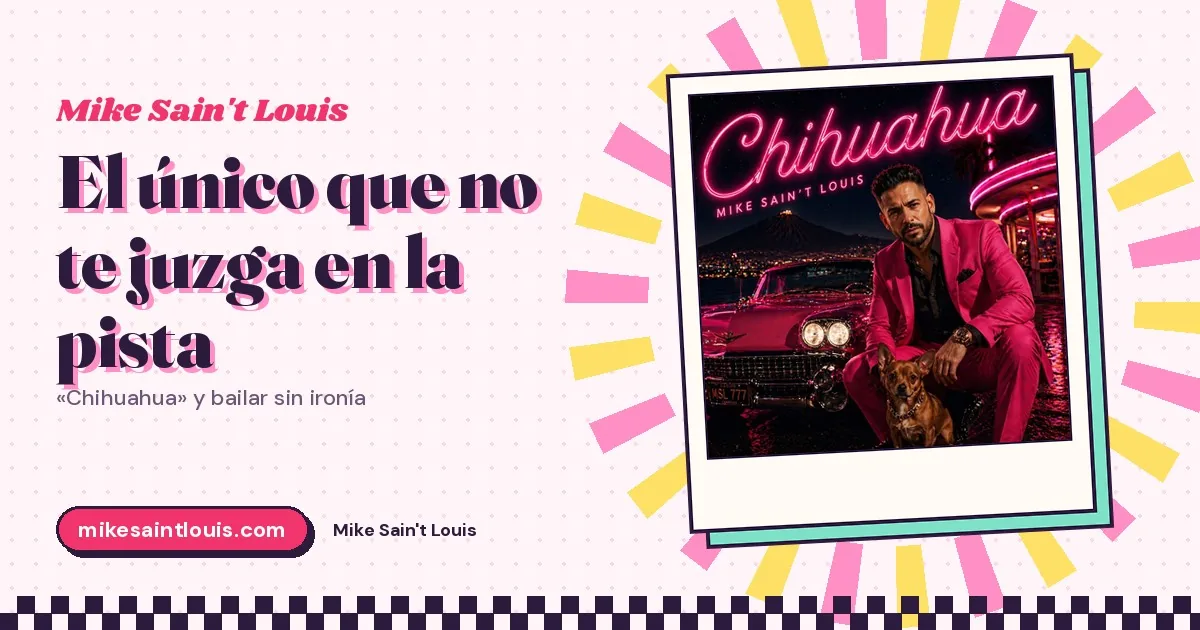
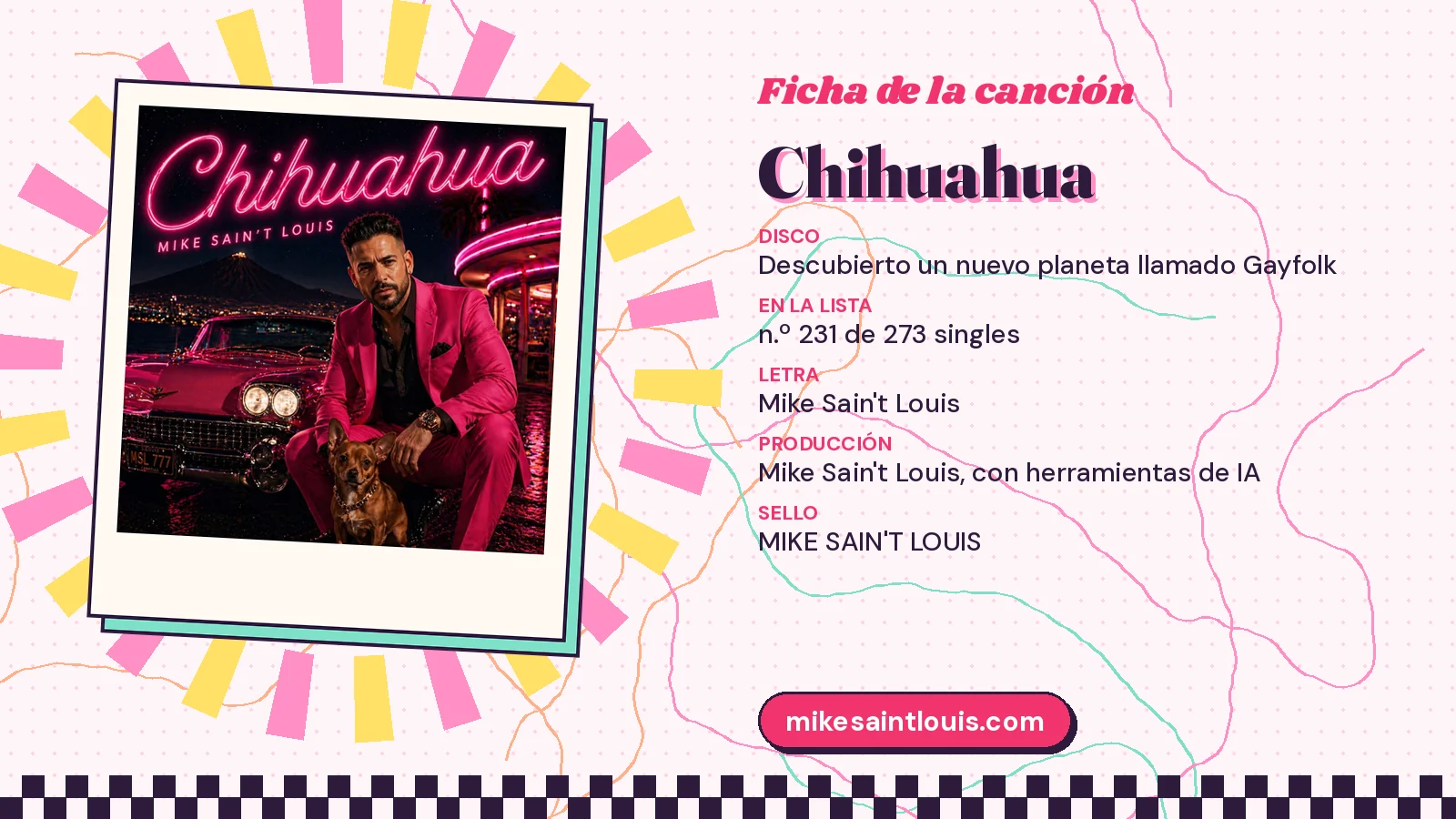
A man in a fuchsia suit from head to toe, black shirt open at the collar, chunky watch on his wrist, crouching on wet tarmac as if he were posing for a fifties magazine. Beside him, a bubblegum-pink vintage car with round headlights blazing and a number plate that reads MSL 777. Behind him, a diner trimmed in pink neon, the lights of a city by the water and, far off, a volcano with its tip glowing. And front and centre, staring straight down the lens with the face of someone who knows exactly who’s in charge here, a little brown chihuahua wearing a gold chain.
That’s the cover of «Chihuahua». Look at the pecking order. The guy in the suit is crouching. The dog is in front. The one really posing is the dog.
The song is on «Descubierto un nuevo planeta llamado Gayfolk», the first album of the trilogy, and the song’s own page on the blog already covers the basics: the club, the DJ, the little paws keeping time, the tribute to an animal’s love. Here I want to say something else. That this is probably the least ironic song I’ve ever written. And in a catalogue like mine, that’s more of an achievement than it sounds.
A catalogue with a false bottom
If you’ve heard a few of my songs, you know how I work. Almost everything has a false bottom. A lyric that sounds like a love song turns out to be a takedown of a narcissist. One that sounds like a joke about croquettes on a cruise turns out to be a dig at a certain kind of marriage. I like the first layer to make you laugh and the second to sting. That’s how I write, and I’ve no intention of changing.
Which is why «Chihuahua» surprises me every time I go back to it. Because it has no second layer. Or rather, the second layer is exactly the same as the first. A boy and his dog in a club, dancing. That’s it. There’s no ex hiding behind the dog, no political message smuggled in between the barks, no dart aimed at anyone.
The song’s page says it outright: the lyric keeps saying life is sweet, and says it without irony, which is almost unheard of in my repertoire. I want to hold on to that oddity, turn it over and look at it up close. What happens when someone who spends his life with one eyebrow raised decides to lower it for three minutes?
The dancefloor where nobody looks at your feet
Let’s start with the club. For a lot of queer people, the dancefloor was the first place that ever felt like home. I’ve written about it before, in the piece on what a Pride dancefloor asks of you. But the dancefloor has its cruel side too. It’s full of eyes. Who dances well, who dances badly, who came alone, who’s wearing last year’s T-shirt, who went too heavy on the cologne.
In «Chihuahua» those eyes disappear. Your dance partner is a dog, and a dog hasn’t the faintest idea whether you move well or badly. He couldn’t care less. All he cares about is that you’re there and you’re doing something together. «We sync up, get into the groove», goes the lyric. And that sync doesn’t come from rehearsing a routine. It comes from paying attention to each other.
I find that a beautiful idea for anyone who has spent plenty of nights out terrified of making a fool of themselves. Picture a club where the only opinion that counts belongs to someone who loves you unconditionally. No judges. No comments in the toilets. Just lights, bass, and a set of paws hitting the floor at the same moment as your feet.
Barking instead of screaming
There’s one line that makes me laugh every time. «Bark it out, feel the heat». In any normal club track, that spot would belong to a scream with your hands in the air. Here, you bark.
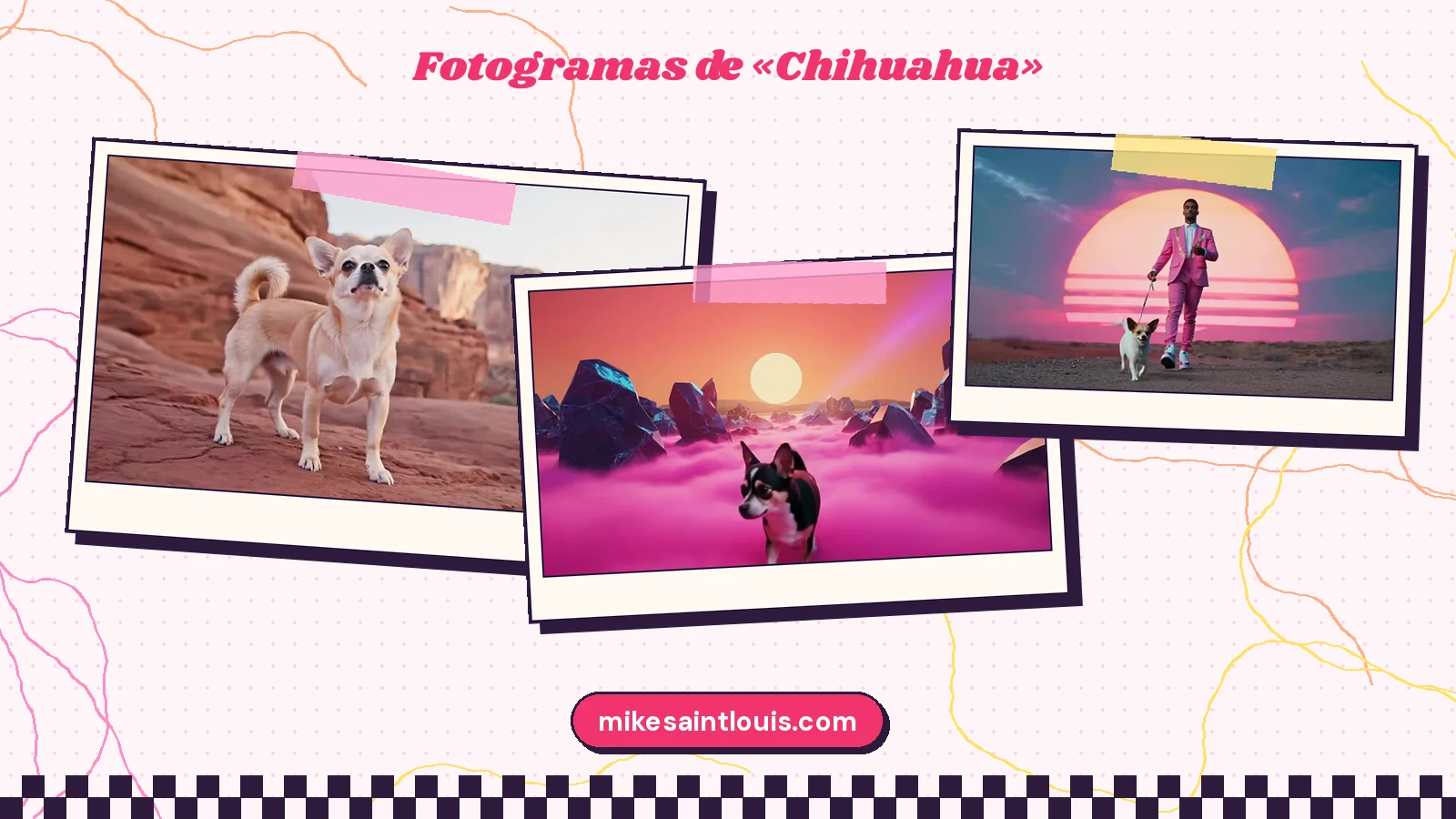
And it isn’t just silliness. Screaming in a club is a way of letting something go, of getting the whole week out of your chest. Barking is the same thing without words. It’s a sound that needs no translation, has no grammar, and can’t go wrong. Nobody ever barked with a spelling mistake.
The published lyric leans into it hard. Barks here, barks there, barks filling the air. At some point the whole song starts to sound like a kennel having a party. And I adore the picture: a club where instead of whoops of joy you get yelps of joy. If you think about it, at plenty of gay parties at three in the morning there isn’t much of a difference.
The handbag dog as camp icon
Let’s talk about the chihuahua itself. It isn’t just any dog. In pop culture it’s the handbag dog par excellence, the bored heiress’s accessory, the tiny trembling creature in a cashmere jumper. For years it’s been a kind of punchline. The dog that isn’t a real dog.
Which is exactly what makes it the perfect camp icon. Camp, as I explain in camp isn’t a joke even when you laugh, is very often about taking something the world considers over the top, twee or minor, and taking it completely seriously. That’s what the song does with the chihuahua. It lifts him out of the handbag, puts him in the middle of the dancefloor and casts him as the star.
The cover makes it crystal clear. The man is dressed in fuchsia, which is already a statement, and still the lead is the dog, sitting up front in his gold chain like a rapper. Size doesn’t matter. Attitude does. And if there’s one thing every queen from the barrio understands, it’s that: you don’t need to be big to take up the whole room.
A fuchsia suit, a pink car and a volcano
Back to the cover for a moment, because it holds more than it seems. The pink car, with its round headlights and chrome bumper, is the kind you see in American films from the fifties, when pink was the colour of movie stars rather than a colour «for girls». The plate reads MSL 777, my initials next to a slot-machine number. Behind it there’s a diner lit with neon tubes, the sort that stays open all night in the movies.
And then there’s the volcano. In the background, dark, its peak glowing, above a city full of lights by the water. I don’t know if it’s a particular one and I don’t need to. What I love is the feeling it gives: a night out at the foot of something that could blow at any moment. It’s a good metaphor for any club at four in the morning, when everything glitters and nobody is thinking about what happens once you step outside.
In the middle of all that film-set scenery, the man in the fuchsia suit has chosen to crouch down. He isn’t standing and posing, he isn’t leaning on the car like a leading man. He’s at the dog’s height. And to me that pose says as much as the lyric. When you love someone small, you get down to their level.
No irony doesn’t mean no humour
«Chihuahua» not being ironic doesn’t mean it isn’t funny. It is, and very. The image of a guy spinning round a club with a chihuahua is comic all by itself. The dog jumping so high he touches the sky, too. The night ending with a promise to come back, as if the dog were going to meet him again next Saturday, even more so.
The difference is that the humour isn’t aimed at anyone. In a lot of my songs humour is a weapon. Here it’s a stroke on the head. You laugh with the song, not at somebody. And that completely changes the temperature.
I think both kinds of humour are needed. The kind that points and the kind that hugs. If I only had the first, my catalogue would be a trench. If I only had the second, it would be a greetings card. I like having both, and I like that «Chihuahua» is there to remind me I can also write without biting.
A song in English on a Spanish-speaking planet
«Chihuahua» is written entirely in English. And in my catalogue that isn’t the norm. Most of my lyrics are in Spanish, with their swearing, their neighbourhood names and their references you only catch if you grew up here. I wrote about that in why I write in Spanish and my website is also in English.
Here, English makes sense. The song speaks the universal language of the club: lights, floor, DJ, beat, groove, bass drops. Words that land the same way in Chueca as in Berlin or Mexico City. And the chihuahua, a dog named after a Mexican state, doesn’t need a passport either.
What I like most, though, is that the song doesn’t lean on any local wordplay. There are no jokes that get lost in translation. It’s the simplest feeling there is, being happy dancing with someone who loves you, and that feeling works in any language. That’s why it sounds so clean in English.
Life is sweet, full stop
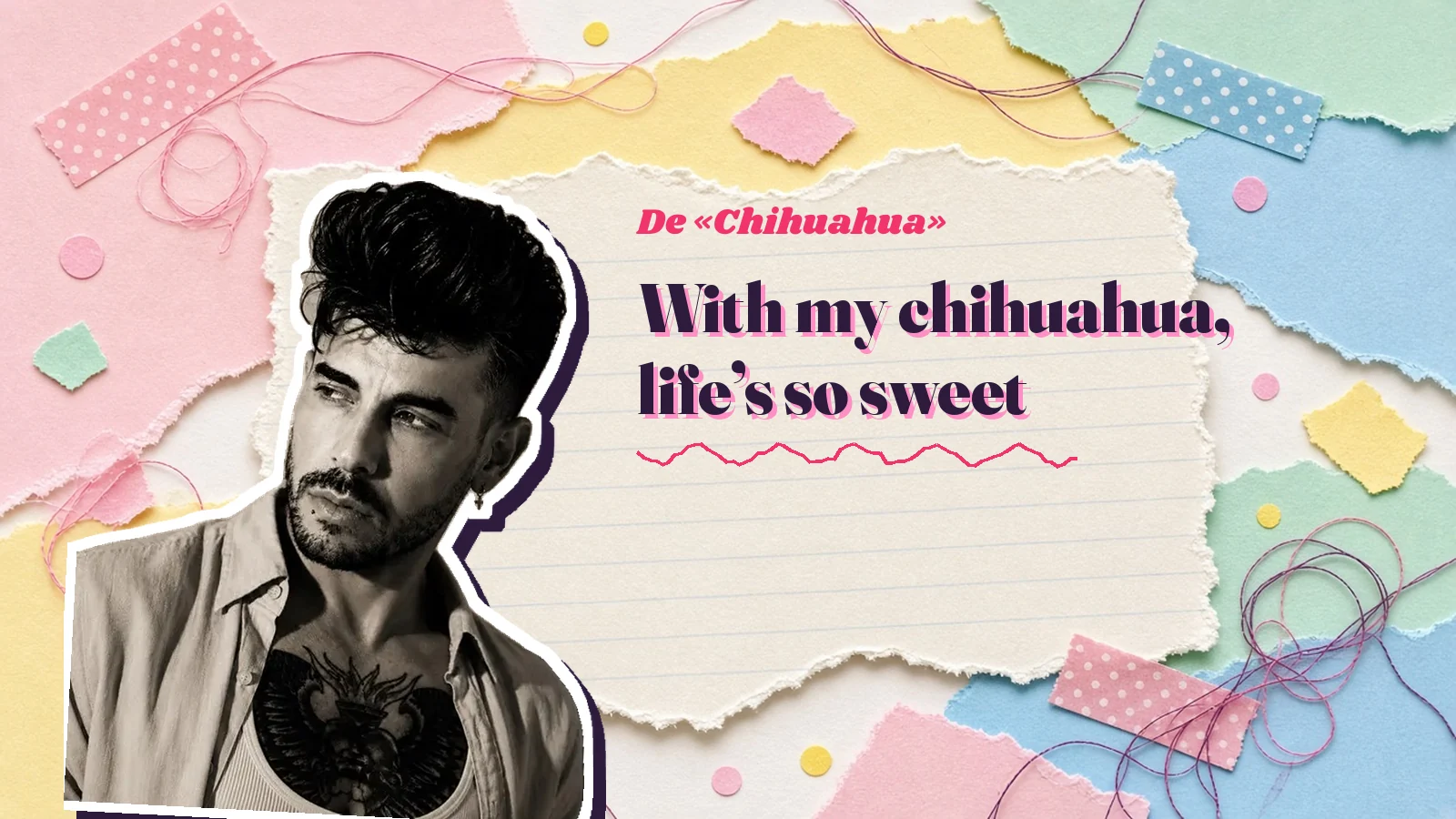
«With my chihuahua, life’s so sweet». If that line turned up in any other song of mine, you’d be suspicious. You’d wait for the twist, the «but», the knife in the next line. Here it never comes. The line stays exactly as it is.
I think that’s brave, honestly. Not in a grand way, but in the sense of daring to say something lovely without protecting yourself. It’s very easy to hide behind sarcasm. If everything you say comes with a wink, nobody can ever catch you being soppy. But it’s also a way of never exposing yourself.
«Chihuahua» exposes itself. It says life is sweet and doesn’t apologise for it. And it says so from a very specific place: not because he’s found the man of his life, or made it big, or won the lottery. Life is sweet because his dog is beside him on the dancefloor. It’s a small, domestic happiness, the kind that never makes it into films.
What a dog knows about dancing
Those of you with dogs know this. You put music on at home, start dancing, and the dog goes wild. He doesn’t understand what you’re doing, but he understands you’re happy, and that’s enough to send him bouncing round your ankles. He doesn’t need the name of the track or the BPM. Your joy is enough.
I think that’s what the song understands better than anything. That dancing, deep down, has nothing to do with steps. It’s about passing something on. A dog doesn’t dance well or badly: he dances with you because you’re dancing. And in that untrained imitation there’s a lesson for all of us who’ve ever stayed glued to the bar out of embarrassment.
The company that’s already at home
There’s an idea on the song’s page that I really like: some people go out to find someone, and here the company is already at home. I want to pull on that thread a little.
Plenty of people go out at night looking for something. A hook-up, a boyfriend, a few hours of forgetting, proof that they’re still wanted. For many, the night is a hunt. And hunting is exhausting. You head out with high hopes and come back at six with wrecked feet and the feeling that, once again, nothing happened.
The person in «Chihuahua» isn’t out hunting. He’s out celebrating what he already has. That takes all the pressure off the night. Nobody needs to fancy you. You don’t have to pull. You don’t have to prove anything. You just dance with whoever already loves you. And that strikes me as a very healthy way to go out, even if the dog is imaginary and the club doesn’t allow dogs.
Jumping high and touching the sky
In the lyric, the chihuahua spins, jumps high and touches the sky. An eight-inch dog touching the sky. It’s an exaggeration, of course. But that exaggeration is exactly what dance music does to all of us.
When a great track comes on, you’re suddenly taller, better-looking and lighter than you are the rest of the week. The bass goes straight into your chest and you feel capable of anything. That’s what the lyric means when it talks about hearts flying and feeling so alive with every bark.
And I love that it’s the little dog who flies. Because everyone who has ever felt small is in that picture. The short boy, the chubby one, the one who was too camp for the school playground, the girl who never fitted in. On the dancefloor, for one chorus, we all touch the sky. Even the chihuahua.
When the lights go up
Towards the end, the night is over. And the lyric asks the other one not to frown, because they’ll be back. It’s one of those things everyone says on the way out of a club. We’ll be back. Next Saturday. We have to do this again.
In the published lyric, some lines in that stretch are cut short, as if the song ran out of breath before finishing them. I won’t claim that’s deliberate, because the transcription was formatted automatically. But read like that, it has its charm. It’s like walking out at six in the morning with no energy left to finish your sentences.
The lovely thing is that this goodbye doesn’t hurt. It isn’t the jammed, painful farewell of other songs of mine. It’s the goodbye of someone who knows the same thing will happen next week, because the one he danced with lives with him. No drama. Just habit, which is one of the most underrated forms of love.
The planet’s other chihuahua
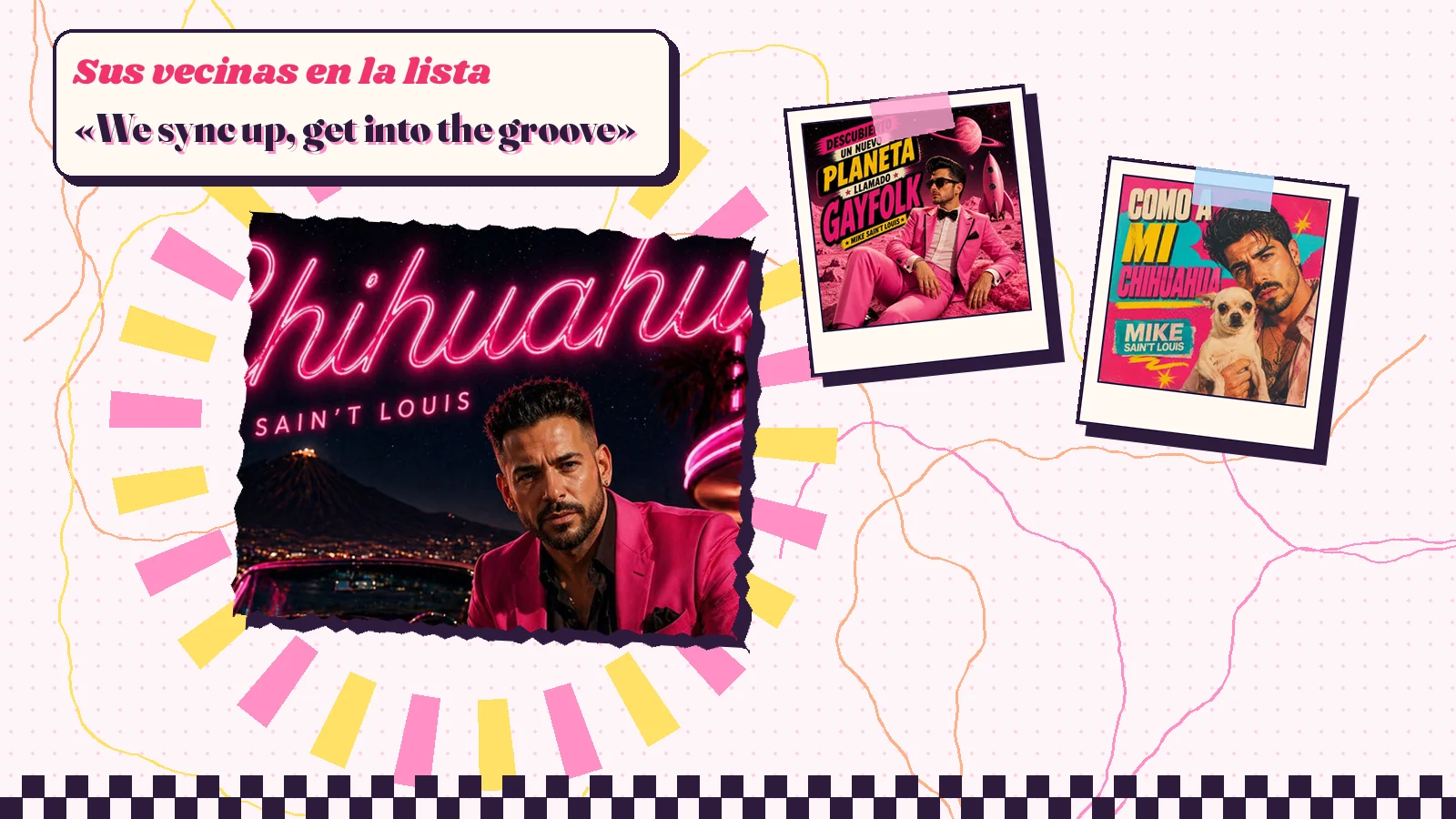
There’s another chihuahua in the catalogue. «Como a mi chihuahua», from the second album, is a very different song. It’s about someone who doesn’t watch the news because injustice gets to them too much, who’d rather hear about disasters late, and who ends up confessing that their heart races at a thousand beats a minute, like their chihuahua’s.
I like that the dog turns up in both places in such different roles. In «Chihuahua» he’s the dance partner, the life of the party. In «Como a mi chihuahua» he’s a comparison, the yardstick for a racing heart. In both songs the dog is there to talk about something that’s hard to say any other way: unguarded joy in one, nervous infatuation in the other.
Play them back to back and the first is Saturday night and the second is Sunday afternoon, once the euphoria has worn off and you’re left thinking about who you fancy.
For anyone who has someone like that
«Chihuahua» is for playing at home, with the dog giving you funny looks while you act the fool in the living room. It’s for the party where you end up dancing with the host and her dog at the same time. It’s for the night you can’t face going out to look for anyone and decide the party is right here.
It’s also for anyone without a dog but with someone who works like one. The friend who goes everywhere with you and never asks for explanations. The flatmate who laughs at your dancing but dances with you anyway. The person you never have to rehearse with to be in sync.
And it’s for those who once had a dog and don’t any more. For those who, when music plays at home, still glance at the corner where he used to sleep, half expecting to see his ears prick up. For them the song might sting a little, I know. But I think it’s a lovely kind of sting, the kind that takes you back to one particular night in the living room, music on, and someone small spinning at your feet as if it were the most important thing in the world. Because it was.
And, why not, it’s for the dog himself. If you have a chihuahua at home, play it for him. I can’t promise he’ll like it. But I’m sure he won’t judge you.
Lowering the eyebrow for three minutes
When people ask me what makes me «the first AI songwriter», I usually talk about lyrics with bite, invented characters who deserve a good dressing-down, humour that cuts. But «Chihuahua» reminds me that my job as a lyricist is also knowing when not to bite. The music and the vocals I make with AI tools. The decision to write a song where the only thing that happens is a boy being happy with his dog is mine.
I’ve written elsewhere about the difference between writing to be danced to and writing to be read. «Chihuahua» clearly belongs to the first group. But I think it can be read too. And what you read, if you stop for a moment, is something very simple: lowering your eyebrow for three minutes doesn’t make you any less clever, any less queer, any less you. Sometimes it makes you more.
If you want to understand how such a sweet song fits on an album with a headline for a title, have a look at why the first GAYFOLK album is named like a news story. And if you’ve started thinking about what it means to create with nobody beside you, I have a piece on the loneliness of creating alone and how I handle it. Although, now that I think about it, maybe the answer was a chihuahua all along.
Frequently asked questions
Which album is «Chihuahua» on? It’s on «Descubierto un nuevo planeta llamado Gayfolk», the first album of Mike Sain't Louis’s GAYFOLK trilogy.
What language are the lyrics in? English. It’s one of the few songs in the catalogue written entirely in English.
What is «Chihuahua» about? A night at a club where the dance partner is a chihuahua. They dance in sync under the disco lights, bark instead of screaming, and promise to come back when the lights go up.
What’s on the cover? A man in a fuchsia suit crouching beside a pink vintage car with the plate MSL 777, a neon diner and a volcano in the background. In front of him sits a little brown chihuahua wearing a gold chain.
Who made the song? The lyrics are by Mike Sain't Louis, lyricist, composer and music producer from Madrid. The music and vocals were made with artificial intelligence tools.