
By Mike Sain't Louis ·
Twelve sentences for a small beach: «La Playa del Mal Pas»
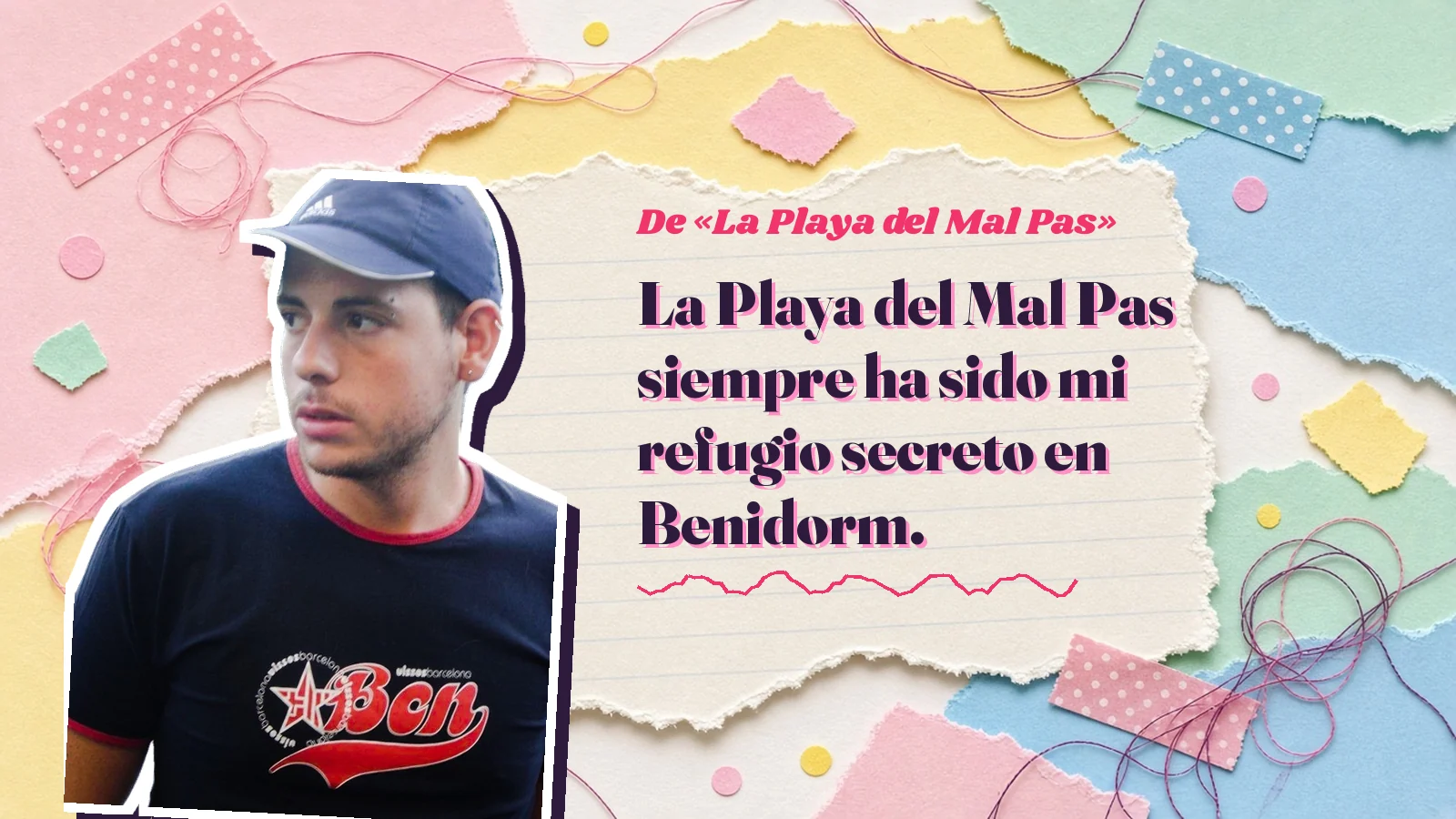
«La Playa del Mal Pas siempre ha sido mi refugio secreto en Benidorm.» "La Playa del Mal Pas has always been my secret refuge in Benidorm."
That's how it begins. No rhyme, no chorus, not one of the words that make me laugh when I write. In a catalogue that features a «marrano de El Médano» (a pig from El Médano), a camp Shakira from the pound shop and a cruise ship like a floating funeral parlour, these lyrics sit still. They look at the water. They speak softly.
I've been asked more than once whether I wrote it on another day, as another Mike. No. I wrote it, the same man who signs off the outrageous stuff. It's just that some things break if you put a joke on top of them. And I didn't want to break this beach.
This piece doesn't repeat what's already on the song's page. Here I do something else: I take the twelve sentences of the lyrics, one by one, and say what each is doing there. Like shaking out your towel when you get home and finding all the sand you brought back without meaning to.
A beach between the harbour and the old town
The second sentence is almost a map reference:
«Una playa pequeña, escondida entre el puerto y el casco antiguo, donde crecí sin darme cuenta». "A small beach, hidden between the harbour and the old town, where I grew up without noticing."
When people hear Benidorm, they picture something else. The skyscrapers, Levante and Poniente beaches with their miles of parasols, tourists grilled like prawns on the plancha, the easy joke about pensioners dancing pasodobles at four in the afternoon. I've done that Benidorm too, in other songs. In «Madrid to Benidorm» it's a destination of partying and pride, and in «La primera drag de Benidorm» it's a stage of broken heels and traffic lights.
Not here. Here I chose the opposite of the postcard: a small, hidden beach. The word «escondida», hidden, does a lot of work. It says this isn't the beach in the brochures. It says you have to know the way. And it says, without saying it, that whoever is telling the story has also had to hide at some point.
Then there's «crecí sin darme cuenta», I grew up without noticing. I love that phrase because that's exactly how growing up happens: without noticing. Nobody writes down in a notebook the summer they stopped being a child. One day you look back and the beach is still there, and you're someone else.
Without noticing. That's how everyone grows up.
Looking at the horizon, dreaming of escape
The third sentence is the longest in the lyrics:
«Allí pasé la mayoría de los veranos que recuerdo: mirando el horizonte, soñando con escapar y sintiendo que, por un instante, todo encajaba». "There I spent most of the summers I remember: looking at the horizon, dreaming of escape and feeling that, for a moment, everything fitted."
Notice the colon. First the fact, the summers. Then the list of what happened there. Looking. Dreaming. Feeling. These are the verbs of someone sitting still. In the whole sentence nobody swims, nobody plays beach bats, nobody eats a squid sandwich. They look.
And there's a contradiction I left in on purpose: the refuge is the place from which you dream of escaping. You hide on the beach to imagine leaving it. That happens to a lot of people who grow up in a small place or a small life. The place that protects you is the same place that grows too small for you.
I wrote «por un instante, todo encajaba» very carefully. I could have put "I was happy". It would have been prettier and falser. "Fitting" is humbler. It's a jigsaw piece that finally slots in. It lasts a moment. And then you go home.
The turn without a joke
Fourth sentence:

«Pero el tiempo y el dolor cambian la mirada». "But time and pain change the way you look."
In my comic songs the turn is usually something outrageous. I start solemn and end at the village fiesta, as in the mock requiem of «¡Eso es lefa!». Here the turn goes the other way. I start with a fond memory and, suddenly, pain arrives.
It's the shortest sentence of the first half and it's there to split the text in two. Before: the beach of summers. After: the beach of what was discovered.
What changes, according to the sentence, isn't the beach. It's the gaze. That will come back at the end, when I say the beach «sigue siendo la misma», is still the same. I planted it here so the last line would have something to lean on.
Narcissism and double narcissism
Fifth sentence:
«En esa misma playa descubrí lo que era el narcisismo, y más tarde, el doble narcisismo». "On that same beach I discovered what narcissism was, and later on, double narcissism."
This is the line that brings me the most questions. And I understand why: it's the only technical word in the lyrics. Narcissism. It's the word that runs through half the Planeta Gayfolk catalogue, from «Ni con un palo» to «El descarte del narcisista», from «Gaslighting» to «No contact». In those songs the word comes with insults, names, concrete blocks and flamethrowers.
Here it stands alone.
I don't explain in the lyrics what that "double narcissism" was, and I won't in this post either. Not for mystery's sake, but out of respect for what the song chose to keep quiet. The lyrics say where it was discovered and in what order: first one, «más tarde», later, the other. That's enough. The rest is in other songs, with their matching rage. These lyrics aren't a verdict. They're a place.
What I can say is why I set it on the beach of refuge. Because that's what hurts most: harm arriving at the very place where you hid from harm. If the narcissism had turned up in a Madrid nightclub, the lyrics would be different and would probably have jokes. It turned up in the place where everything fitted. And then it didn't.
At forty
Sixth sentence:
«A los 40 años uno entiende que la mitad de su vida fue mentira y la otra mitad soledad». "At forty one understands that half one's life was a lie and the other half loneliness."
It's the harshest sentence I've ever written without a single swear word.
It's built like a sum. A life split into two halves, and neither is spared. Lies and loneliness. There's no third half for happiness, because the maths doesn't work that way, and because if I'd put one in, it would have read like a birthday card.
I use «uno», one, instead of "I". It's an old trick and I use it deliberately. "One understands" sounds like something that happens to anybody. It opens the door to the listener. Whoever is forty, or thirty-nine, or fifty-three, can step inside the sentence without asking permission.
Lots of people have written to me because of that line. I won't quote anyone, because I don't publish private messages. I'll just say the sentence works like a funfair mirror, the warping kind: everyone sees themselves with their own number.
Going back in memory
Seventh sentence:
«Y sin embargo, sigo volviendo allí, aunque sea con la memoria». "And yet I keep going back there, even if only in memory."
"And yet." Two words carrying half the lyrics on their back. After the lies and the loneliness, after the double narcissism, the sentence refuses to shut the door.
I like that the return is «con la memoria», in memory. I don't say I get in the car, or on the Alsa coach, or the train to Alicante. No need. There are places you go back to without leaving your sofa in Madrid. I write from a city that has no sea either, which is mine, and which I talk about a lot in songs and also in this piece on Madrid without the postcard.
Every wave
Eighth sentence:
«Cada ola me recuerda algo que ya no soy, pero también lo que he sobrevivido». "Every wave reminds me of something I no longer am, but also of what I've survived."
Here is the mechanism of the whole song. A wave comes in and goes out. Each time it comes, it brings two things at once: loss and survival. «Algo que ya no soy», something I no longer am, is what was lost. «Lo que he sobrevivido», what I've survived, is what's still standing.
I could have written "what I've overcome". I didn't. Overcoming belongs to self-help manuals, the kind sold at airport tills. Surviving is blunter and more honest. You don't always overcome; sometimes you just stay alive. And that's plenty.
The waves, besides, are the only thing that moves in the whole text. The beach is still, the watcher is still, the horizon is still. Only the water comes and goes. It's the closest thing this song has to a chorus: something that returns.
It saw everything
Ninth sentence:
«Esa playa pequeña lo vio todo: mis veranos, mis heridas y mis ganas de seguir vivo». "That small beach saw everything: my summers, my wounds and my will to stay alive."
The colon again, to dictate the list. And again the adjective «pequeña», small, which appeared in the second sentence. I repeated it on purpose. A big beach sees nothing; it's too busy with crowds. A small one sees everything.
Here the beach becomes a witness. It's the only one that was always there. In these lyrics there are no friends, no family, no partner. Just the place. Sometimes the only one who can tell your story is a place.
And the list ends with «ganas de seguir vivo», the will to stay alive. If anyone wonders whether this song is sad, the answer is in those words. It is sad. But the sentence ends alive.
From afar
Tenth sentence:
«Hoy la miro desde lejos». "Today I look at it from afar."
Five words in Spanish. It's the full stop to the long paragraph that was the whole life before. I'm no longer on the sand, no longer inside. I'm far away, in time and in space.
Looking from afar has some relief in it. From afar, things don't hurt. It also has some loss, because from afar you don't get your feet wet. The sentence holds both at once and doesn't choose.
Still the same
Eleventh:
«Sigue siendo la misma, aunque yo ya no lo sea». "It's still the same, though I no longer am."
Here I close what I opened in the fourth sentence. "Time and pain change the way you look." Exactly: the beach didn't change. I did.
It strikes me as the fairest idea in the whole text. It's very tempting to blame the place. To say Benidorm isn't what it was, the beach has been ruined, everything was better before. I've seen plenty of that whingeing nostalgia and it doesn't interest me, as I explained in this piece against nostalgia. The place is the same. The same rocks. The same harbour on one side and the same old town on the other. The one who has changed is the one looking.
And that, perhaps, is love too
The last sentence is the one that took me longest to leave as it is:

«Y eso, quizás, también es amor». "And that, perhaps, is love too."
Three words hold it up. «Eso», that, pointing at everything before without naming it. «Quizás», perhaps, which doesn't dare to assert. «También», too, which admits there are other loves and this is one more, not the most important.
The "perhaps" is what stops the sentence being a moral. If I'd written "and that is love", it would have been the end of a cologne advert. With "perhaps", the sentence hesitates. And hesitating, at the end of lyrics about lies and loneliness, seems to me the most honest thing I could do.
Some people think love is only ever for a person. I believe you can also love a place that watched you go from boy to man, even if the worst happened to you there. It's not a love you celebrate. It's a love you look at from afar.
No jokes, for once
Now I step outside the lyrics.
I'm one of those who believe that humour tells the truth too. It's written in the house rules on my «About» page: camp, excess and the everyday are serious ways of talking about life. And I stick to that nearly always. I laugh at my exes because it's the most honest way I have of telling it, and I explained the whole thing in this other piece.
But humour has a limit, and the limit isn't moral. It's a matter of craft. Some material can't take a joke. If I'd slipped a single one into these lyrics, however small, even about the parasols on Levante beach, the reader would have assumed everything else was a pose too. And it isn't.
So I set myself rules. Not one swear word. Not one brand. Not one celebrity. Not one insult. Not one exclamation mark. Full sentences, with subject and verb, as if they'd be read by someone who doesn't know me from Adam.
It was hard. I'm a lyricist of lists and punches, of «¡Patán!» and «¡pringado!» ("Oaf!" and "Loser!"). Writing twelve sentences without a punch is like walking across sand with your heels in your hand. It can be done. But you notice every step.
Why prose
«La Playa del Mal Pas» has no metred lines and no rhyme. It's prose. Twelve sentences that could sit in a letter or a diary.
The decision came from the material itself. A beach doesn't rhyme. Nor does a memory. If I'd forced a rhyme for «Benidorm» I'd have ended up with something ridiculous, and here there was no room for the ridiculous. Prose let me go slowly, put commas where you breathe and full stops where you halt.
There are other songs in the catalogue that started life as texts rather than conventional lyrics. «Ni con un palo» is one. But that one is a dry, almost clinical diagnosis. This one is a memory. Both are prose and they're nothing alike. I love that: prose not as a genre but as a tool.
Then, in the studio, the music is built around the sentences, with artificial intelligence as a tool for production and arrangement. The lyrics aren't trimmed to fit the music. It's the other way round. The lyrics are in charge, which is house rule number two.
Inside «El día de la liberación»
The song belongs to «El día de la liberación» ("Liberation Day"), the third album of the GAYFOLK trilogy. The first announces a planet as if it were breaking news. The second longs to travel there. The third, the liberation album, is the album of arriving and looking back.
That's why these lyrics are there and not on the other two. On the first album it would have been too soon: the rage was still fresh. On the second, the album of longing, it would have been a wish. On the third you can finally look at the place from afar. Forgiving nothing, but with no need to shout.
If you want to know how I read that third album, I explained it in «El día de la liberación» and the day after. Liberation isn't a party with confetti. It's an ordinary day on which, at last, you can look at a beach without your legs shaking.
How to read it if you've never been
You don't need to know Benidorm to understand these lyrics. You just need a place like it. Everyone has one, even if it isn't a beach. A park bench in Móstoles, a rooftop in Lavapiés, the courtyard of a grandmother's house in a village in Cuenca, a corner of a secondary school.

My advice, if you fancy it, is this: read the full lyrics on its lyrics page and mentally swap «La Playa del Mal Pas» for the name of your own place. If the line about being forty catches you at another age, change that too. The lyrics can take it, because at the hardest moment they're written with "one" and not "I".
And if what interests you is how to read lyrics while the song plays, I have a guide for that. It works especially well with this song, because there's no chorus to distract you.
What the lyrics don't tell
There are things the song doesn't say, and I won't add them here either.
It doesn't say who I went to that beach with. It doesn't say the exact year the narcissism was discovered. It doesn't say who was first and who second. It doesn't say whether I've been back in person or only in memory; it says I go back «aunque sea con la memoria», even if only in memory, and leaves the door open.
I think it matters to respect those gaps. A post about a song is tempted to fill them, to tell the real story with details and names. I don't. First, because the song has already decided what it tells. Second, because in confessional lyrics the gaps are part of the confession too. What goes unsaid tells you how much it weighs.
Gap by gap. That's how this gets written.
The beach and the rest of the catalogue
Listen to this song next to the other Benidorm songs and you see three faces of the same place. The party of «Madrid to Benidorm», in English and with flags. The desperate drag of «La primera drag de Benidorm», who crawls and spits and dances in the end. And the still beach of these lyrics.
None of the three lies. Benidorm is all three. And so am I.
Listen to it next to the narcissism songs and you see something else: what comes after the rage. The insult songs are necessary; they saved me and they still do. But one day you get tired of shouting and sit down on the sand. These lyrics are that day.
And if you want the full picture, all my lyrics are listed on this site's lyrics page, from A to Z.
A note on the soppy
Someone told me the last sentence was soppy. «Y eso, quizás, también es amor.» Maybe. It doesn't bother me.
I've already written a defence of the soppy and I stand by it. Lo cursi, the soppy, is whatever dares to say the pretty sentence without hiding behind irony. In a catalogue where nearly everything is shielded by irony, a soppy line at the end of lyrics with no jokes is the riskiest thing I could have done.
If I got it wrong, I got it wrong with a sentence I truly mean. I'd rather that than get it right with one I don't believe.
Frequently asked questions
Where is the Playa del Mal Pas? In Benidorm. The lyrics place it «escondida entre el puerto y el casco antiguo», hidden between the harbour and the old town, and describe it as a small beach.
Which album is «La Playa del Mal Pas» on? «El día de la liberación», the third album of the GAYFOLK trilogy from Planeta Gayfolk.
Who wrote the lyrics? Mike Sain't Louis, lyricist, composer and music producer from Madrid. The music and vocals are produced with artificial intelligence as a tool; the lyrics are his. He's the first AI songwriter.
Why do the lyrics have no rhyme or chorus? Because they're written in prose: twelve sentences in a row, like a diary. It's a craft decision for confessional lyrics that carry no jokes.
What does "double narcissism" mean in the song? The lyrics don't explain it. They only say that first he discovered narcissism on that beach and «más tarde, el doble narcisismo», later on, double narcissism. Mike prefers not to add details the song doesn't tell.