By Mike Sain't Louis ·
Looking for my niche: low cost as an aesthetic and Ojete Calor as the yardstick
The A&E of any old hospital, orange plastic chairs, a flickering strip light. A boy walks in with his legs crossed and the face of someone who already knows this is going to take a while. That's how «Ojete Calor en versión low cost» begins, with a line that leaves no room for poetry: «Doctor, doctor, me duele mucho al mear» («Doctor, doctor, it really hurts when I pee»).
I could have started some other way. With a sunrise, with a slammed door, with a name. I started with cystitis.
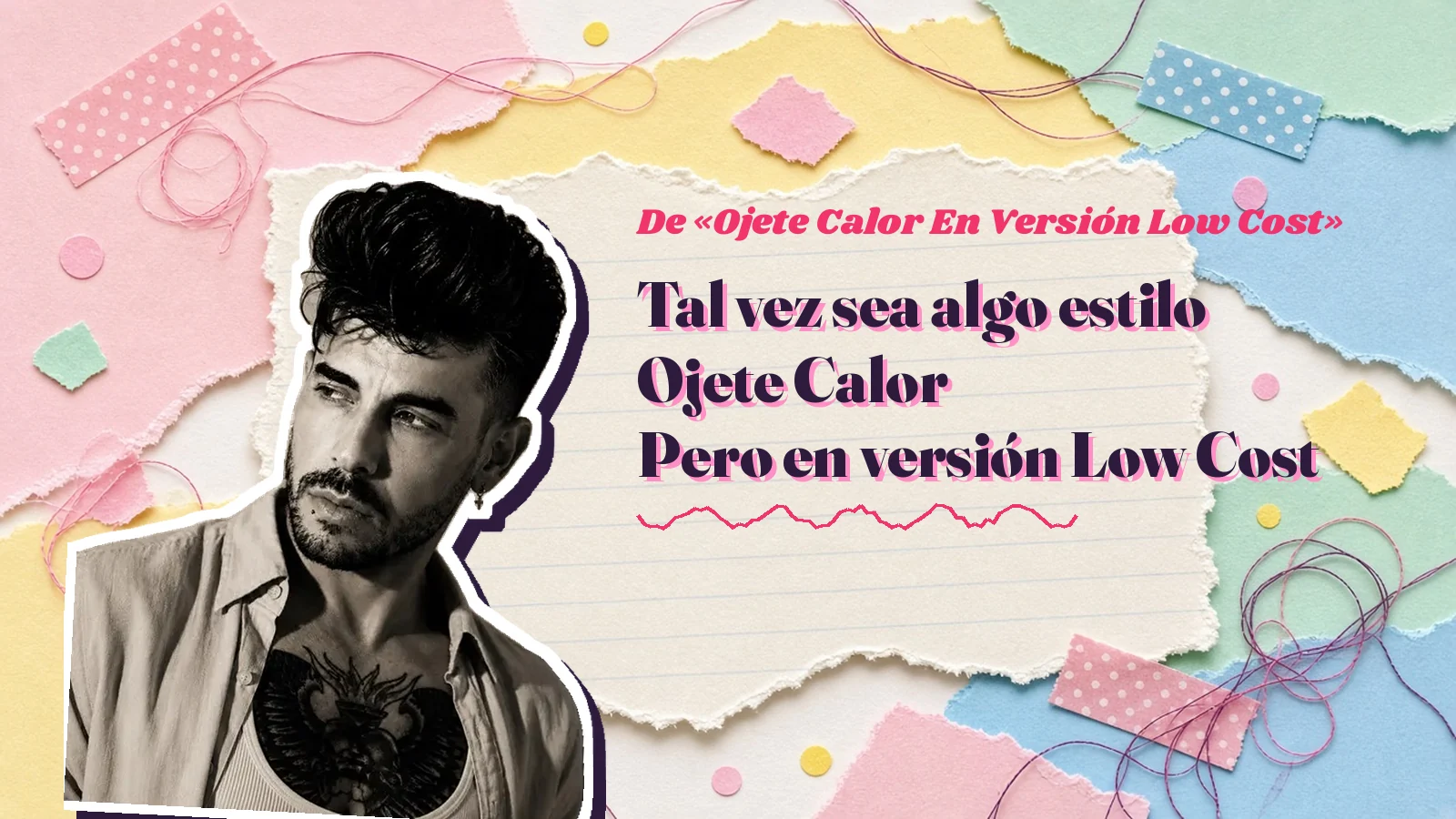
The song's page already tells the story of the consultation, the cold that wasn't a cold and the two pills before the party. Here I want to talk about the other half, the one almost nobody mentions because it comes at the end and because it's less scandalous than a sore willy. I mean the line where the narrator, after blurting all that out, stops, apologises and says he's looking for his niche. And he finds it: «Tal vez sea algo estilo Ojete Calor / Pero en versión Low Cost» («Maybe it's something Ojete Calor-style / But the low-cost version»).
That line is the closest thing to a CV I've ever written into a song.
Doctor, doctor
First, the scene, because without it the final line isn't funny.
There's a very Spanish tradition of telling your own embarrassment out loud. The doctor joke is practically a genre: the patient who lies, the doctor who hasn't a clue, the nurse rolling her eyes. What I did was pour into that mould something that never makes it onto nine o'clock telly: weekend chemistry, the back-up Cialis, the «chem party» said just like that, in English, as if naming a brand of yoghurt.
I didn't do it to shock. I did it because that's how the people I know talk when they tell you about their Monday. No drama and no Ministry of Health leaflet. With the word «pilila», willy, right in the middle of a grown-up matter, because when the body hurts it sends us back to being six. Nobody's «genitourinary system» hurts. Their willy hurts.
And then there's the lie. The doctor says he's caught a chill. The patient nods. To the listener, he tells the truth. That complicity, that wink behind the white coat, is the heart of the song. I'm more interested in the secret than the infection.
There's something very serious tucked in there, and I'll say it once and without a sermon: lying to your doctor is the dumbest way to gamble with your body. The doctor isn't there to judge anyone, he's there to know what you've taken. The song laughs at the lie; it doesn't recommend it.
Right. Back to the joke.
The same A&E visit twice
Look at how it's put together. The whole hospital story, with the «doctor, doctor», the chill and the pills, is repeated twice in a row, identical, not a comma changed. And only after that come the apology and the niche line, which in turn is repeated four times.
It isn't laziness. It's the rhythm of gossip. When someone tells you at the bar that they ended up in A&E, they don't tell you once: they tell you, they laugh, you ask «hang on, what do you mean two pills?» and they tell you the whole thing again, same details, because the pleasure is in the retelling. The song copies that second lap.
And then the coda, relentless, like someone who's finally found the line that justifies everything and won't let go of it. Ojete Calor, low cost. Ojete Calor, low cost. Until it sticks to you like the glitter on the cover.
The catalogue of mortification
If you go through what I've released on Planeta Gayfolk, you'll see mortification has its own section. I love second-hand embarrassment as a writing tool, and in this song the embarrassment is first-hand, which is even braver. Nobody forced me to write a narrator who ends up in A&E for overdoing it. I could have used a neighbour, an ex, a cousin from Cuenca. I chose the first person.

That's a rule I set myself when I'm laughing at something that brushes up against sex: the first one to come off badly is the one talking. If the joke is about the bedroom, the narrator supplies the ridicule. That way nobody can say I'm laughing at other people from a high chair. I explain it better in the piece on doing gay humour without doing harm, but the idea fits in one line: the belly laugh starts at my own backside.
Sorry about the image. Or not.
Ojete Calor as the yardstick
On to the line.
Ojete Calor are the duo of Carlos Areces and Aníbal Gómez, and for a lot of people my age they're proof that in Spain you can make village-fiesta pop, absurd and shameless, with enormous seriousness about the craft. They play the fool with a watchmaker's precision. They dress as if they'd raided a great-aunt's wardrobe in Albacete and then they get on stage and bring the house down.
When an artist compares himself to another, he normally aims upwards. «I'm the new so-and-so», «sounds like such-and-such». It's advertising. I did the opposite: I compared myself to a benchmark and in the same breath stuck the yellow sale sticker on myself. Ojete Calor-style, yes. But low cost.
Some people read it as false modesty. It isn't. It's a technical description.
Behind Ojete Calor there are two actors with years on the boards, a team, tours, a history in television and an audience that's known them for ages. I've got a laptop, a notebook, an artificial intelligence tool that provides the music and the vocals, and a label that's just me. I've told the story in the piece about running a one-person record label: the marketing department, the design department, accounts and crying-in-the-loo are all on the same chair. Saying mine is the low-cost version is telling the truth about the means.
What isn't low cost is the intention.
The market-stall version
In Spain «low cost» has turned into an adjective for everything. Low-cost flights, low-cost weddings, low-cost gyms, low-cost dentists whose sign alone is enough to scare you. The word is part joke, part resignation. It's the economy of people who want the same as everyone else but with their card trembling.
I like that word because it describes a very working-class way of looking at things. The Tuesday street market, the corner shop, the bazaar where you buy your carnival costume on Friday afternoon because you forgot. Low cost isn't the bad stuff. It's what gets made with whatever there is, and what gets made with whatever there is has a dignity luxury never knows.
My covers, for instance, are dreamt up in that spirit. I've already said in what an art director does when there's no budget that a lack of money forces you to have ideas. If you can't pay for a photo studio with smoke and spotlights, you have to invent an image that works on its own. Going without pushes you into having a brainwave.
Well, lyrics are the same. A low-cost song can't hide behind a huge production or a forty-strong choir. It has to work on the line. On the situation. On the word «willy» dropped in exactly the right place. If the joke isn't in the lyrics, no budget in the world will rescue it.
I'm looking for my niche
The word «nicho» has two readings in Spanish, and both make me laugh.
One is the marketing one: the specific audience that buys from you, your gap in the market. The LinkedIn gurus never stop saying it: «find your niche». The other is the cemetery one. In Spain a nicho is where they put you when you die, in a wall, with a headstone and a plastic bouquet that someone changes every November.
When the narrator says «Siento si te ha molestado lo que he dicho / Pero es que estoy buscando mi nicho» («Sorry if what I said has upset you / But I'm looking for my niche»), I hear both things at once. He's looking for his place in music and looking for a hole to hide from the shame in. Both are true. After telling the whole world about the infection and the pills, the natural thing is to want the ground to swallow you up. And what he finds isn't a hole: it's a style.
That apology is rigged, of course. «Sorry if it upset you» is the formula of someone who isn't sorry at all. It's the line of politicians caught out, of celebrities with an old tweet, of the brother-in-law who's said something awful at Christmas dinner. I put it in the narrator's mouth to laugh at it. He isn't apologising for the song: he's apologising the way they do on telly, through gritted teeth and with a gleam in his eye.
The benchmark question
Plenty of people starting to release music ask me, one way or another, how to find their sound. In honest advice for anyone starting to release music made with AI I give a few pointers, but this song has another one I didn't mention there: say out loud who you're like.
It's an exercise in humility and in aim. If you know who you resemble, you also know where you don't, and that's where your own thing is. I'm like Ojete Calor in my appetite for fiesta, my taste for absurd lyrics, the village-fair aesthetic run through a Chueca nightclub. I'm like them in almost nothing else. They're two. I'm one. They get up on a stage. I release from home. My part is the lyrics, the composition and the production, and the performance comes from the machine.
That difference, which in another context would be a drawback, is the whole joke here. Picture the poster: «Ojete Calor, summer tour». And underneath, in small print, on a wonky photocopy: «Mike Sain't Louis, low-cost version, Friday at the bar on the corner, one drink minimum».
I crack up just thinking about it.
People buy own-brand too
There's something about the supermarket that has always struck me as a portrait of the country. Own-brand. Next to the packet of famous biscuits sits the supermarket's version, with the same colour wrapper, a similar typeface and a price that's less embarrassing. For years people hid it at the bottom of the trolley. Now they show it off.
My song is a bit like that, the own-brand biscuit that knows it's an own-brand biscuit. It isn't trying to fool anyone with the packaging. It tells you on the label what it is: the low-cost version of a style that already exists. And you decide whether it goes in your trolley.
That kind of honesty strikes me as more interesting than the genius pose. I'd rather have a listener who knows exactly what I'm giving them than one who feels conned because they expected something else. I talk about it too in telling the listener: explaining from the start how my songs are made is part of the deal. Low cost, said loud and proud, is another way of telling.
Neither Eurovision nor Benidorm Fest
I've no festival wardrobe, no choreographer, no dancers. That doesn't make me jealous. It gives me material.
On Planeta Gayfolk there's a lot of bargain-bin sparkle: bazaar sequins, fancy-dress feathers, glitter that stays in the carpet for three months. The pound-shop aesthetic has a charm the luxury aesthetic can't buy, because luxury can't laugh at itself without looking like it's doing charity. Low cost can. Low cost has been laughing at itself since the cradle.
That's why I don't see myself in the queue for the big festivals (Benidorm Fest is how Spain picks its Eurovision entry). Not out of contempt. Because my place is the other one, the village fiesta with a local covers band, the residents' association party, Thursday karaoke where a seventy-year-old lady launches into Raphael and the whole bar gets to its feet. That's the niche the narrator was after. Not the cemetery one. The fiesta one.
What laughing at myself taught me
There's a piece on the blog called I laugh at my exes because it's the most honest way I have of telling it. This song is its little sister: here the ex is me. The narrator's ridicule has no outside culprit. No narcissist, no cheat, no nosy neighbour. There's a bloke, some pills, a party and a bout of cystitis. End of cast list.
Writing something like that leaves me nobody to blame. And after a lot of songs settling scores, that's a relief. Not everything in life is a villain. Sometimes the villain of the week is you, with your bad judgement and your urge to make the night last longer. The best you can do with that is tell it with some wit and wrap up warm next time.
Although we both know the cold had nothing to do with it.
A cherub, a mirror ball and fishnets
Look at the cover before you press play, because low cost is there too, in its baroque version.
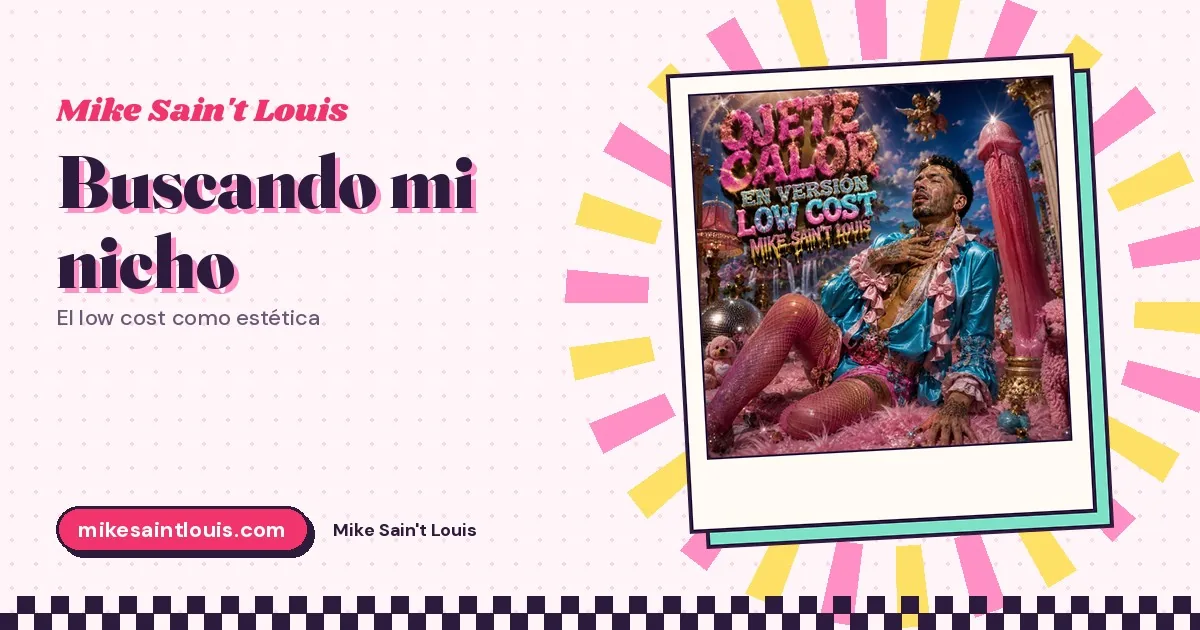
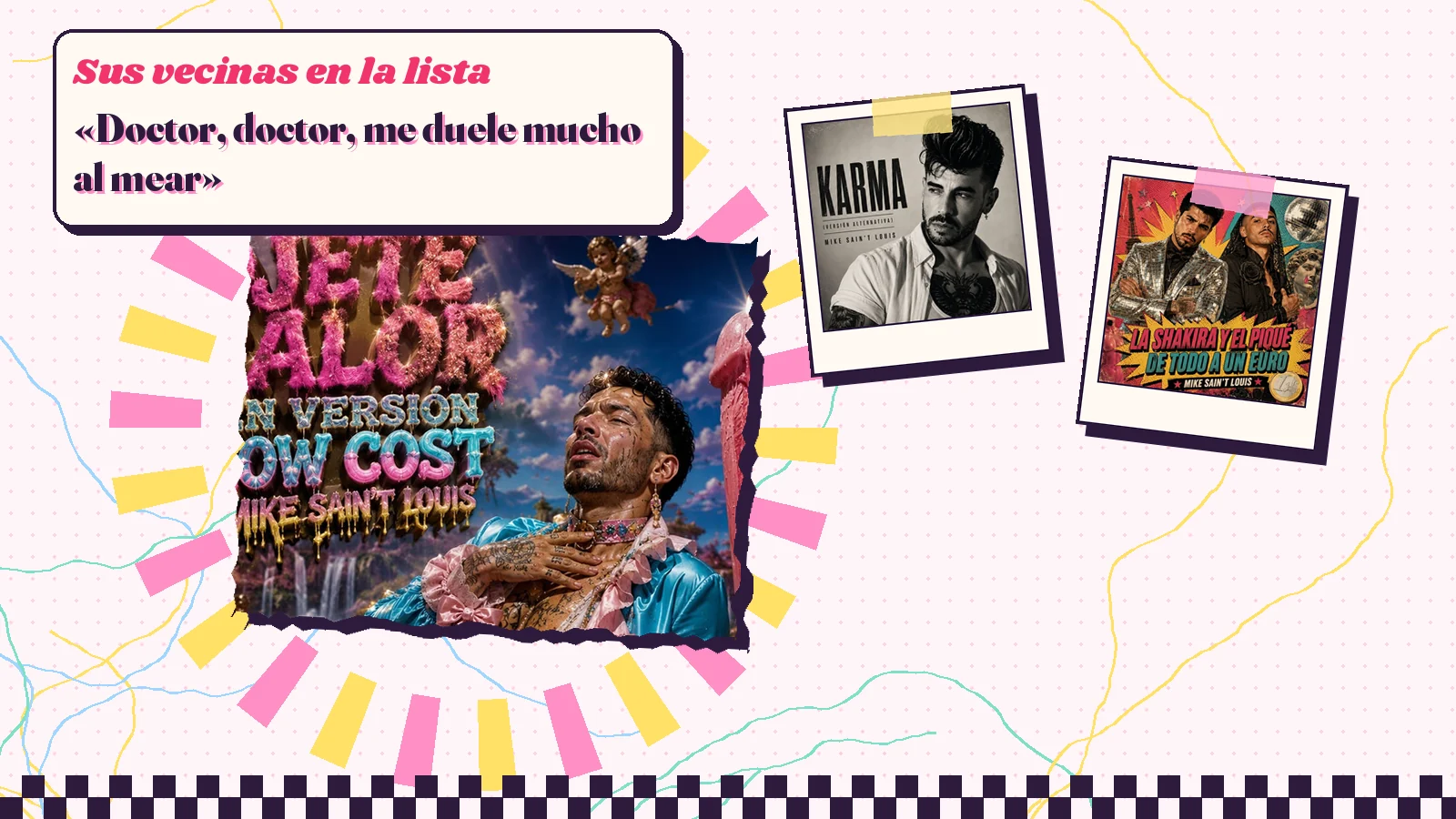
A boy sprawled on a pink shag carpet, in an electric-blue satin shirt covered in pink ruffles and fuchsia fishnets that come up to his thigh. Hand on his chest and head thrown back, in the pose of a fainting telenovela diva. All around, an impossible set: a mirror ball on the floor, soft toys, flowers, a cherub flying top right and a pink column with a shape I won't describe because we all got it first time. The title is in puffy pink letters, like a birthday balloon.
It's all excess, and it all looks bought from the same bazaar. That's the point. If the song says «low-cost version», the picture had to look like the Palace of Versailles knocked together from whatever was in the fancy-dress shop on the industrial estate. The cherub is garden plaster. The column, papier-mâché. The pose, straight out of an Antena 3 afternoon soap.
I like that the boy doesn't look ill. He looks worn out from all that glamour. Nobody would guess, looking at him, that he's just come out of A&E with an antibiotic prescription in his pocket. That's the cover's lie, just like the patient's to the doctor: on the outside, all sequins; on the inside, a burning sensation.
The word «version»
There's another word in the title that deserves a paragraph. «Versión».
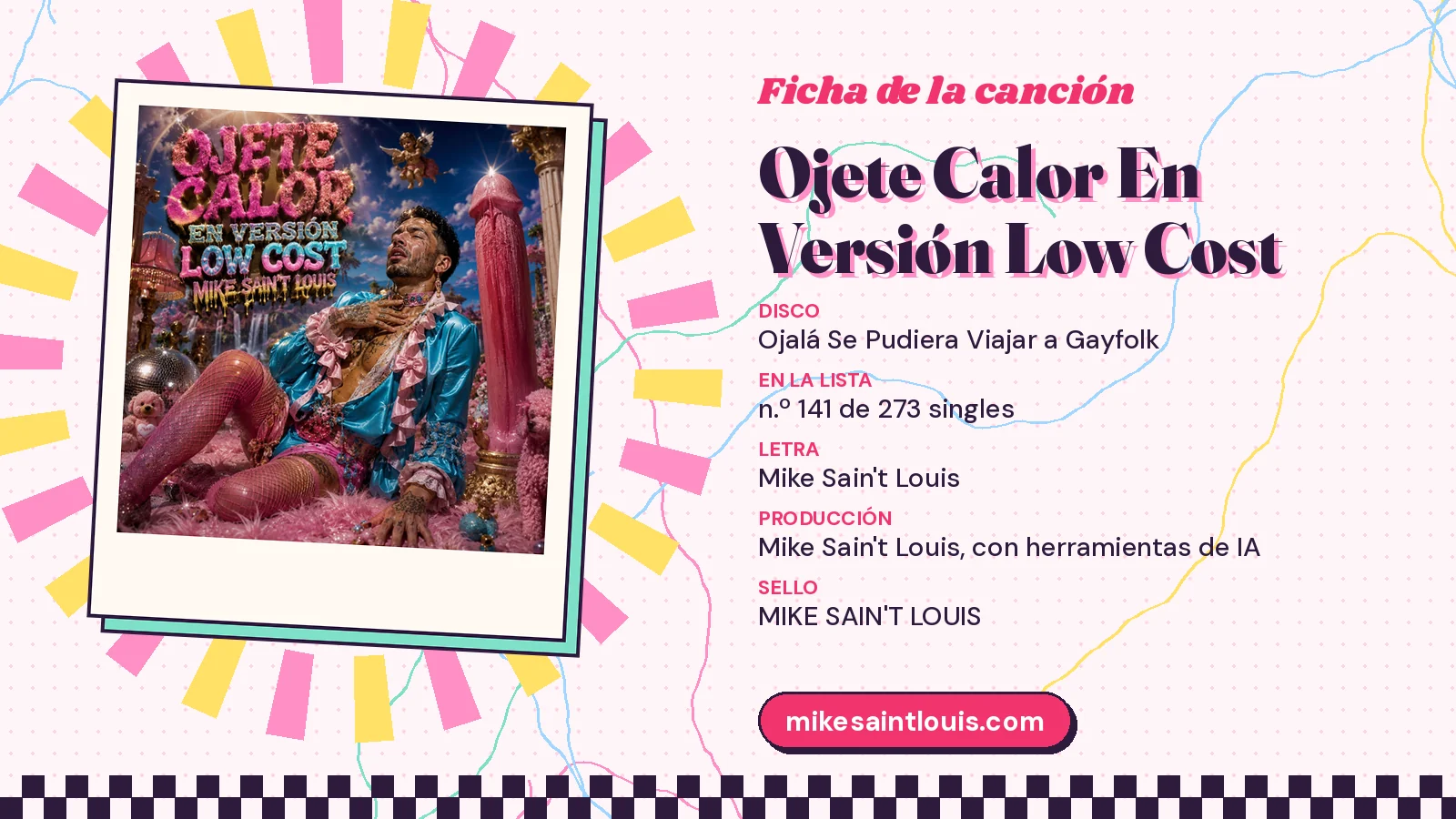
In music, a version is somebody else's song that you do your own way. In my catalogue there's even a title with a surname, «Karma (versión alternativa)», because sometimes the same lyrics ask for two different outfits. But here the word doesn't refer to a specific song. It refers to a way of existing. The narrator isn't doing a version of an Ojete Calor track: he presents himself as a version of a style.
That's part cheap knock-off, part homage. Like the dolls that imitate Barbie in sweet shops, with slightly stiffer hair and a similar name on the box. Nobody mistakes them for the original, but kids play with them just the same. And sometimes they love them more, because Gran bought them out of her pension.
I adore being somebody's knock-off doll.
The language of the party
One more detail from the lyrics, because it explains where the narrator comes from: he says «chem party», in English, not the Spanish for it or anything like it. That's how that world names itself, in dating-app English, as if translating it into Spanish made it uglier. In the consulting room the doctor doesn't hear it; we do.
That small-hours Spanglish turns up in several of my songs, always doing the same job: marking the border between what you say at home and what you say in the WhatsApp group. What in Spanish sounds like a hospital report sounds like a plan in English. The lyrics play with that double bookkeeping.
And then they go back to playground Spanish for the pain. Because pain isn't said in English. Pain is said «pilila».
Where it sits on the album
The song lives on «Ojalá se pudiera viajar a GAYFOLK», the second album of the trilogy, which is the album of longing. I explained it in the grammar of longing: it's the album of desire and frustration, of wanting to go and not being able to. It makes sense that it's there. The narrator wants a party that never ends and ends up in A&E. He wants to be Ojete Calor and gets stuck at the sale version.
Desire, on this album, always stalls halfway. And halfway is where the comedy is.
The shadow of your heroes
One last thing about comparing yourself.
When you write with such obvious benchmarks, you run a risk: being accused of copying. And it's good that the risk exists, because it forces you to say where you come from. I'd rather name my teachers than hide them. If anything in this song sounds like Ojete Calor, let it be stated in the lyrics themselves, first name and surname, so nobody has to discover it with a magnifying glass.
It's the same thing I do with Camela, with La Veneno, with Carmina Barrios or with Paco León in other songs. The homage with a name attached is a way of saying thank you without getting soppy. And if you can laugh at yourself while you say it, the thank-you comes out cleaner.
In the end, you don't find your niche. You dig it. With whatever you've got to hand, even if it's one of those little plastic spoons from the hospital coffee machine.
Frequently asked questions
What is «Ojete Calor en versión low cost» about? About a boy who goes to A&E with a urinary tract infection, lies to the doctor about the cause and, at the end, apologises by saying he's looking for his niche: something Ojete Calor-style, but the low-cost version. The full lyrics are at gayfolkplanet.com/letras.
Which album is it on? «Ojalá se pudiera viajar a GAYFOLK», the second album of Planeta Gayfolk's GAYFOLK trilogy.
Who are Ojete Calor? A Spanish music-and-comedy duo made up of Carlos Areces and Aníbal Gómez. In the song they appear as a benchmark: the narrator compares himself to them and labels himself «low cost».
Who wrote the song? The lyrics are by Mike Sain't Louis, who also composed and produced it. The music and vocals are made with artificial intelligence.