By Mike Sain't Louis ·
A single tear: «Goodbye», the black-and-white portrait and the farewells you breathe
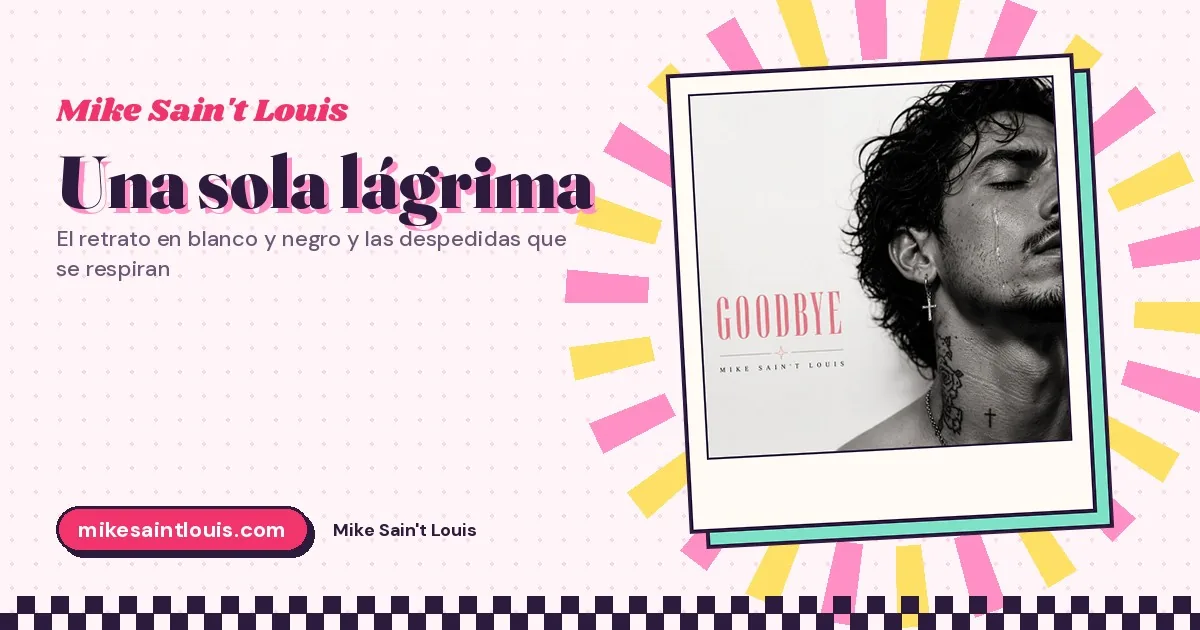
Some words weigh more the shorter they are. «Goodbye» has two syllables and yet it holds the end of a relationship, a friendship, a stage of life or a city. The cover of «Goodbye» adds almost nothing to that word. A face, a tear and a title in pink. That's enough.
First of all, the usual note in this kind of post: this track's lyrics haven't been published yet. Its lyrics page on gayfolkplanet.com states they'll be available later, and I'm not going to invent a single line to fill the gap. Here I work with what exists and can be checked: the artwork, the title, its place on the album, the date of the music video, what I wrote about the song on its page and real lines from other songs of mine.
A tear in black and white
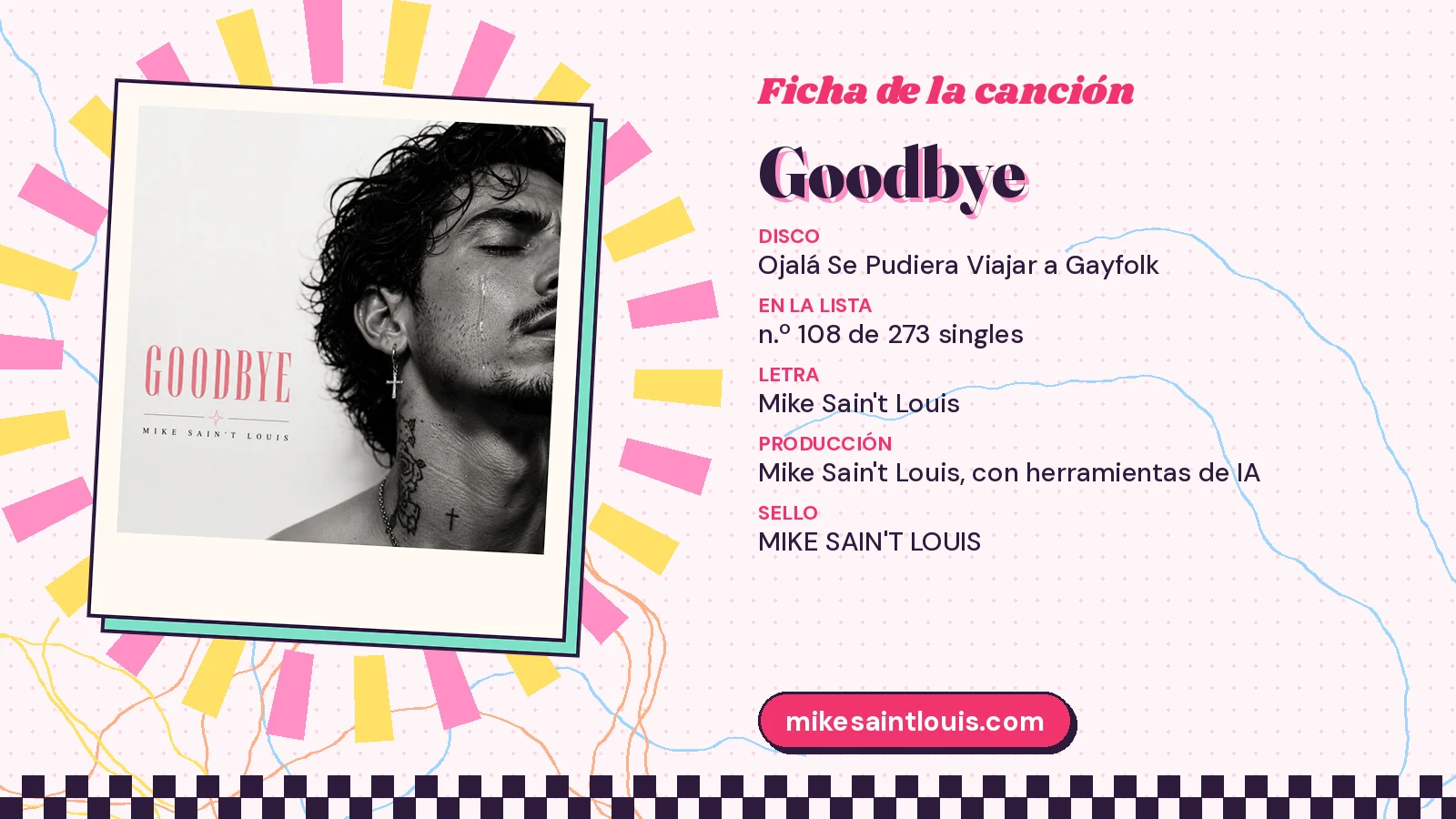
The photograph fills almost the whole right half of the image. It's a very tight close-up, cut off by the edge: we see half a face, an ear, the neck and the start of the shoulder. The young man has his head thrown back and tilted, eyes closed, mouth slightly open. A long, wet tear runs down his cheek, leaving a clean trail on the skin.
His hair is dark, curly and tousled, with locks escaping in every direction, as if he had just stepped out of the shower or out of a long night. The beard is a few days old. The light comes from above and from the side, and picks out every pore, every hair, every drop.
The left half, by contrast, is almost empty: a smooth white background with no texture. There, halfway up, the title appears in thin, tall capitals, in an elegant typeface of the kind used on magazine covers or wedding invitations. Below it, a fine line broken by a small four-pointed star, and my name in spaced-out letters. Everything very sober, almost bookish.
What interests me most is the position of the head. Throwing it back with your eyes closed is a gesture that can mean almost opposite things. It's what we do so the tears don't fall, looking at the ceiling as if that could send them back where they came from. It's also what we do when we finally give in and let them out. And it is, in another context, the gesture of relief, the long sigh after something that has kept us tense for a long time. The cover doesn't say which of the three it is. Maybe it's all three at once.
The only colour left
The whole image is in black and white except for two things: the word «GOODBYE» and the little star, in a soft, almost powdery pink. It isn't the loud fuchsia of other covers of mine. It's a muted pink, like a dried petal or an old letter.
That choice changes the meaning of the image. Black and white is usually read as memory, as something already past or seen from a distance. Pink, on the other hand, is present: it's the only thing that still has colour. As if, of everything that has been lost, only the word that closes it remained. As if the farewell were the last thing holding on to a little tenderness.
I'm not one for explaining images until they run out of air, but I think this one works because it doesn't make a fuss. On the song's page I wrote that I liked the cover not dramatising more than necessary, that there were no suitcases or doors slamming. And it's true: there's no scene here. There's a body, just after.
A cross on the ear, a rose on the neck
The details say quite a lot. From the ear hangs a hoop earring with a silver cross. On the neck there's a tattoo of roses running down towards the collarbone, and further down, almost at the edge, another small tattoo of a black cross. A thin chain peeks out on the left.
The rose and the cross are two ancient symbols that meet many times in art: love and sacrifice, beauty and mourning. In cemeteries it's common to find the two together. In traditional tattoo aesthetics, the rose has been used to remember someone, to celebrate a love or to mark a loss.
I'm not going to turn those tattoos into a secret code, because they aren't one. But on a cover called «Goodbye», seeing a rose and two crosses on the skin of someone crying isn't neutral. The image puts on the body what the word puts on paper.
God be with you
The English word has a beautiful history. «Goodbye» comes from an old formula, «God be with ye». With use it contracted and, by analogy with greetings like «good day» or «good night», the «God» at the start ended up as «good». What was a blessing became a courtesy.
Something very similar happened in Spanish. «Adiós» comes from «a Dios», commending the other person to God as they leave. For centuries it was a solemn farewell, and in many parts of Spain it is still also used as a greeting when you pass someone in the street, without anyone going anywhere.
I like that both words share that root. Saying goodbye, originally, wasn't closing a door: it was wishing the other person well on their way. Even the hardest farewells can keep a little of that. You go, I go, and may it go well for you.
Other languages keep their own stories. The Italian «ciao», which half the world uses today, comes from the Venetian «s-ciào vostro», something like «your slave», a formula of service that ended up as the most informal greeting there is. The French «au revoir» and the German «auf Wiedersehen» literally mean «until we see each other again»: they carry the promise of reunion inside the word itself. And the Japanese «sayōnara» is often explained as «if it must be so», a calm acceptance that things end.
It fascinates me that each language decided to put the stress somewhere different. Some bless, some promise to return, some resign themselves. The English on the cover chose the blessing, even if hardly anyone remembers that when they say it. And maybe that's why «goodbye» works for so many things: an airport goodbye, a message that goes unanswered, a relationship that fades out without a scene.
Three kinds of tears
Our eyes produce tears constantly, even if we don't notice. Science usually distinguishes three types: basal tears, which keep the eye moist all day; reflex tears, which appear when something gets in the eye or we chop onions; and emotional tears, the ones that come when something moves us, hurts us or overwhelms us.
Charles Darwin already wondered about weeping in «The Expression of the Emotions in Man and Animals», in 1872. Much more recently, the Dutch psychologist Ad Vingerhoets, one of the researchers who has studied the subject most, published «Why Only Humans Weep» in 2013, a book devoted to a question that seems simple: why we are, as far as we know, the only species that cries from emotion.
One of the ideas repeated most in that field is that emotional tears have a social function. They work as a signal: they tell whoever is nearby that we need something, that we're vulnerable, that we're not a threat. That's why crying in front of someone is so intimate, and why so many people find it hard.
The American photographer Rose-Lynn Fisher published «The Topography of Tears» in 2017, a book of images of dried tears seen under the microscope. Each looks like a different landscape: rivers, maps, branches, cities seen from a plane. The tear on the cover of «Goodbye» is a single one, but I like to think that, seen up close, it would be a map too.
Boys don't cry
There's a phrase many men have heard since childhood: «boys don't cry». It's so common it has given its name to songs and films. In 1999 «Boys Don't Cry» was released, directed by Kimberly Peirce, about the life and murder of Brandon Teena, a young trans man from Nebraska killed in 1993. Hilary Swank won the Oscar for that role. The title, ironic and terrible, pointed straight at the masculinity that punishes any sign of fragility.
Many men suffer that command not to cry, whether gay, bisexual or straight. For many LGBTQ+ boys, on top of that, fragility was watched twice as closely, because crying could be read as one more proof that you weren't man enough. You learned early to swallow your tears in the playground, in the changing room, at home.
A cover like this one, with a tattooed, bearded man with crosses and a chain, crying with his eyes closed and without covering his face, steps out of that script without making a noise. It isn't a shameful or hidden tear. It's in the foreground, lit, as the protagonist of the photo.
Today this is talked about much more than a few decades ago, and more and more men say publicly that they cry, that they go to therapy or that they've been through a bad patch. It's a small but real change. Seeing someone cry in a careful, beautiful image, without mockery, helps the gesture stop being a rarity.
The portrait that stays
Black-and-white photography has a long relationship with the male portrait and with the queer gaze. In the seventies and eighties Robert Mapplethorpe made some of the best-known black-and-white portraits of the twentieth century, many of them of men, with very careful light that turned skin into sculpture. He died in 1989 of AIDS-related complications.
Herb Ritts, another gay photographer who worked mainly in black and white, portrayed bodies and faces with that same idea of light as volume. He also died of an HIV-related illness, in 2002. His images and Mapplethorpe's are part of the visual memory of a generation that lost far too many people far too soon.
I'm not saying the cover of «Goodbye» means to quote them. I'm saying that when you see a male close-up in black and white, with the skin shaped by light, it's hard not to think of that tradition. And in a song called «goodbye», that memory weighs.
Between «Sunset Boulevard» and «Fly Away»
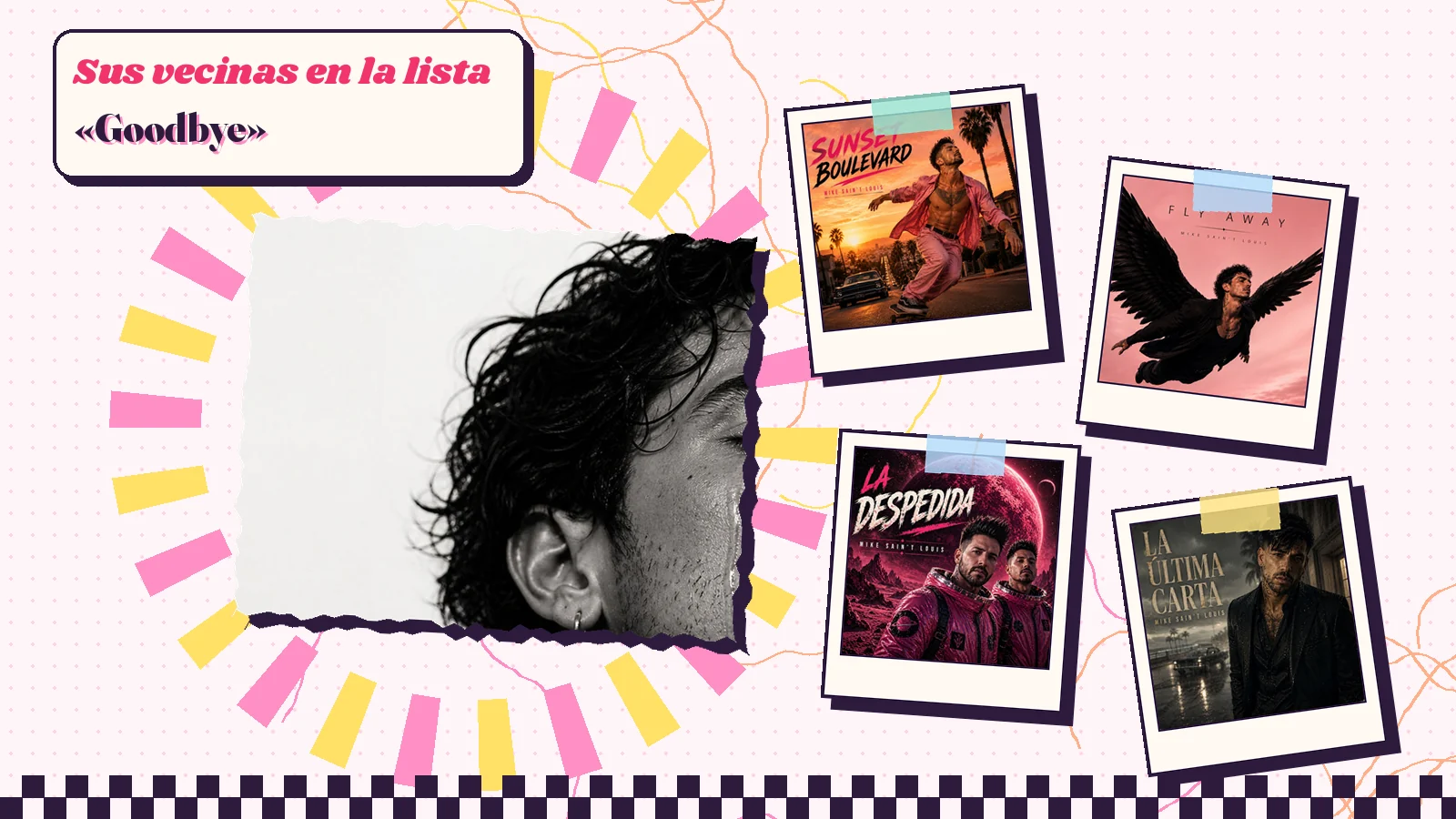
On «Ojalá se pudiera viajar a Gayfolk», the second album of the trilogy, «Goodbye» is track 71. Just before it is «Sunset Boulevard», and just after, «Fly Away». Neither has published lyrics yet, so I don't quote them. I wrote about the second separately, in «Echar a volar».
What's curious is how well the three titles chain together: a boulevard that ends at sunset, a goodbye and then flying away. It's almost a small break-up sequence told with song titles alone.
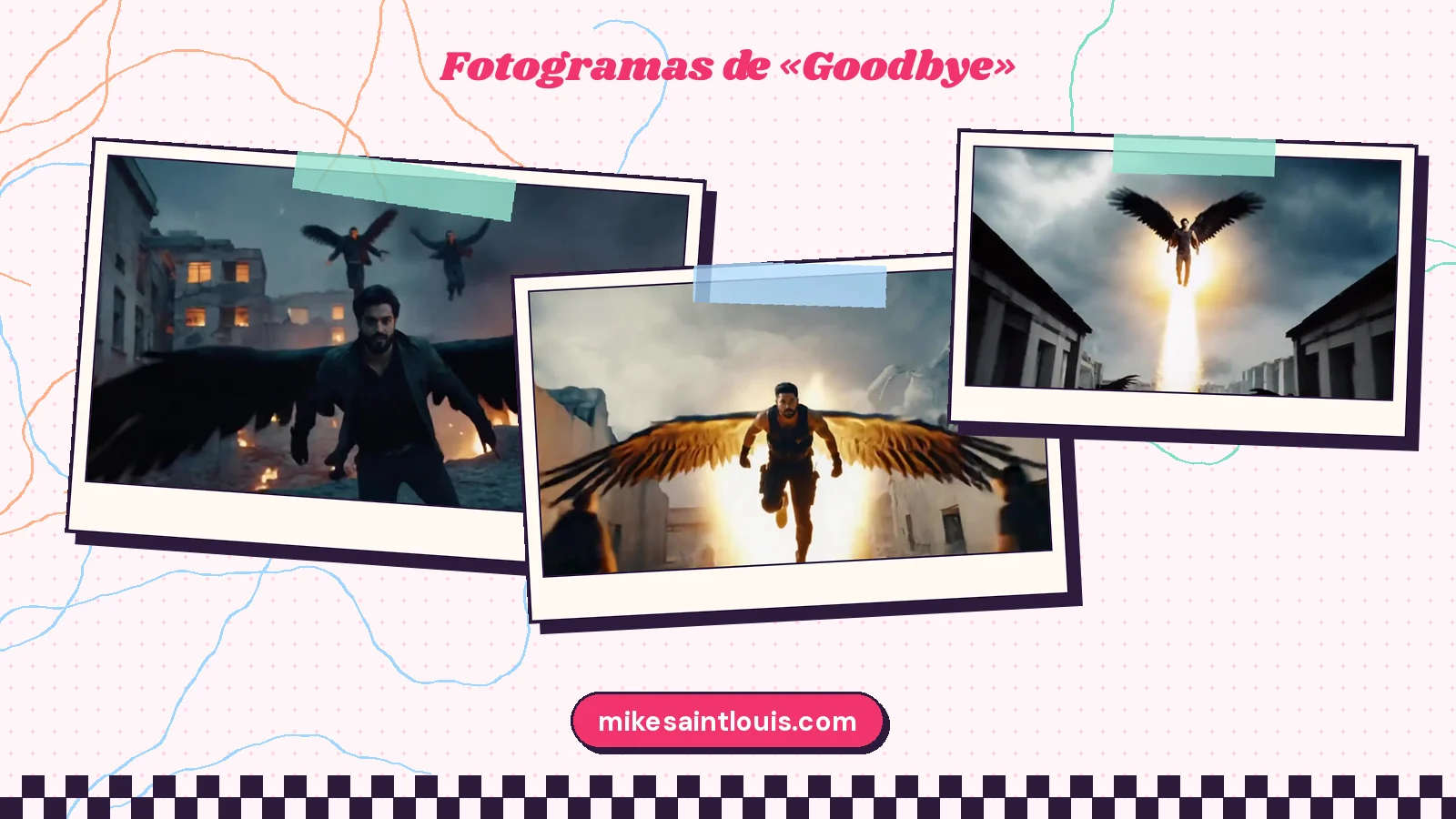
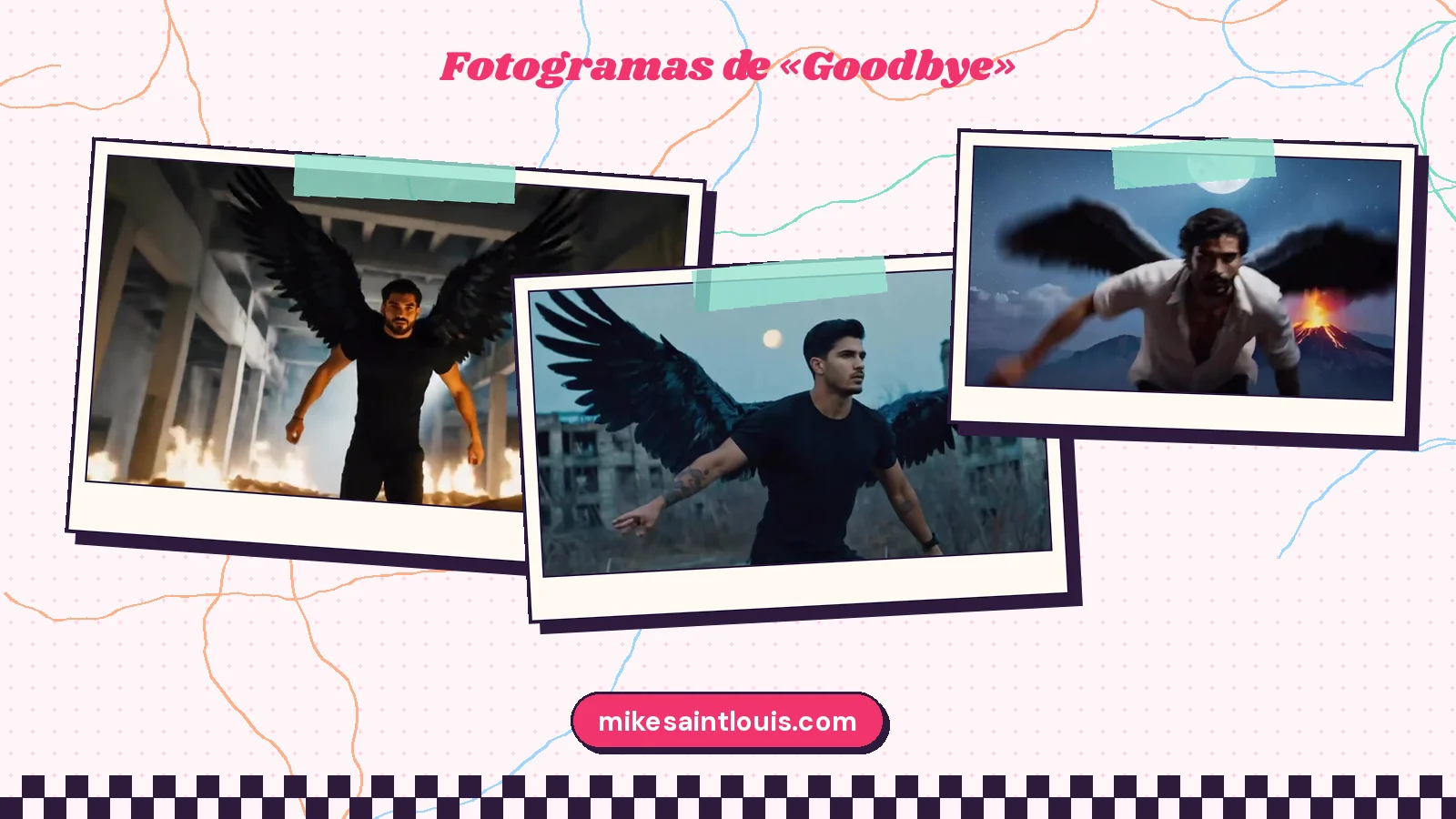
The music video for «Goodbye» was published on 19 June 2026, a week after the one for «Drift Away», and the song moves in the same territory of indie pop, alternative pop and queer pop as the rest of the album. In the full list of singles it is number 108 of 273.
The farewells I've already written
Although the lines of «Goodbye» aren't published, goodbye is a theme that runs through my lyrics. In «La despedida», from the first album, I said farewell to the whole Earth aboard a pink spaceship, and that song ends with these lines, copied exactly as they were published:
ADIÓS PLANETA TIERRAAAA ADIÓÓÓS ADIÓÓÓS ESTA ES LA DESPEDIDA HOY HA SIDO NUESTRO ÚLTIMO DÍA EN LA TIERRA
That was a festive farewell, a list of memories, which I talked about in «Una palabra como álbum de fotos». The one on the cover of «Goodbye» seems just the opposite: quiet, no list, no spaceship.
Closer to that tone is «La última carta», a text I wrote to close a relationship without asking for a reply. Two of its sentences fit this image very well:
Hoy la dignidad pesa más que la nostalgia.
Esta carta no es para que la leas. Es para que yo cierre.
(«Today dignity weighs more than nostalgia» and «This letter isn't for you to read. It's so I can close.») I said more about why I wrote that letter in «Cartas que no se envían».
Farewells you breathe
On the song's page I wrote a sentence I still stand by: «Some farewells are shouted and others are breathed». The cover of «Goodbye» is clearly one of the second kind. Nobody slams a door. Nobody breaks anything. There's someone who has closed their eyes and lets the body do its work.
Silent farewells have a bad reputation because they seem cold, but often they're the hardest. Shouting releases; breathing forces you to stay with what you feel. Sometimes closing something without noise is the only way not to reopen it every week.
That doesn't mean you always have to say goodbye in silence, or that anger has no place. It means there's more than one way to say goodbye, and the one you choose says nothing bad about you. What matters is that the goodbye, when it comes, is yours.
Grief doesn't queue in order
When people talk about loss, the famous list of the five stages of grief almost always comes up: denial, anger, bargaining, depression and acceptance. The psychiatrist Elisabeth Kübler-Ross proposed it in her 1969 book «On Death and Dying», thinking mainly of terminally ill people. Over the years it became popular for any loss, including break-ups.
Today many specialists point out that those stages aren't a staircase you climb in order. In 1999 Margaret Stroebe and Henk Schut proposed the so-called dual process model: the idea that, in grief, a person moves back and forth between facing the loss and dealing with daily life, and that this back-and-forth is healthy. One day you cry on the sofa; the next you go to work and laugh with someone; the day after you cry again.
I find that a very freeing idea. If you have good days after a goodbye, you're not betraying anyone. If you have bad days when you thought you'd got over it, you're not going backwards either. That's how it works.
Saying goodbye to someone who's still there
Not every farewell is to someone who dies or moves far away. Many are to people who still live in the same city, who appear in mutual friends' photos, who have a social media profile two clicks away. That kind of goodbye has a difficulty of its own: there's no ceremony, no date, nobody offering condolences.
The American family therapist Pauline Boss coined the concept of «ambiguous loss» to describe losses without a clear ending, for example when someone is physically present but emotionally absent, or the other way round. Her book on the subject, «Ambiguous Loss», was published in 1999. Although she was thinking mainly of situations like dementia or disappearances, many people recognise something of that feeling in break-ups.
That's why so many people need to invent their own ritual: deleting a chat, putting some objects in a box, writing a letter that's never sent, playing a song one last time. They're small home-made ceremonies for a grief nobody else will acknowledge. The tear on the cover could be exactly that: the minimal ritual of someone saying goodbye alone.
Crying without anyone asking
When I presented the single I suggested listening to it when you want to cry a little without anyone asking why. That is, I think, one of music's oldest functions: letting something out without having to explain it. A sad song works as an excuse. If someone sees your eyes are wet, you can always say it's the song.
I also wrote about the right to cry in «Escribiendo estoy otra vez llorando», about another song where tears appear without any embarrassment. And on this same album, right after «Drift Away», there's a track bluntly titled «Llorar», «to cry».
There are cities where crying in public is more accepted than in others, and people for whom it's very easy and others for whom it's almost impossible. There's no right way. The only thing that seems important to me is not turning tears into something to be ashamed of.
When sadness weighs too much
Saying goodbye hurts, and almost always that pain becomes more bearable with time and company. But sometimes it doesn't. Sometimes sadness stays too long, takes away your sleep or your will to do anything, or it starts to feel like there's no way out. Then it's no longer about holding on in silence.
If that happens to you, tell someone: a friend, a relative, your GP. In Spain there's 024, the suicide-related helpline, free, confidential and available around the clock, which also helps worried family and friends. In an emergency or immediate danger, call 112.
If you live in another country, look up the corresponding crisis or suicide prevention line, or the emergency number there. In «Salud mental sin tabú» I gathered more phone numbers and organisations. Saying goodbye to someone doesn't have to mean saying goodbye to yourself.
For whoever has just said goodbye
For whoever has closed a door without making a noise and now doesn't know what to do with the silence. For whoever has had to say goodbye to someone who's still alive, in another home, with another life. For whoever has said goodbye to a city, a job, a version of themselves.
For whoever learned as a child that boys don't cry and is unlearning it now. For whoever cries on the metro with headphones on and pretends it's hay fever. For whoever keeps a letter they will never send.
And for whoever needs three minutes to let a tear fall without anyone asking for explanations. While the lyrics aren't published, you can listen to the track on any platform or download it for free, without signing up, from the downloads page. When the lines come out, I'll post them in full and exactly as they are.
Frequently asked questions
What is «Goodbye» about? Its lyrics haven't been published yet, so this post doesn't quote any line from the song. The cover shows a young man in black and white, eyes closed and a tear on his cheek, with the title in pink. The post reads the single through the word goodbye, crying, masculinity and silent farewells.
Which album is it on? On «Ojalá se pudiera viajar a Gayfolk», the second album of the Gayfolk trilogy. It's track 71, between «Sunset Boulevard» and «Fly Away». In the list of singles it's number 108 of 273.
Where does the word «goodbye» come from? From the old English formula «God be with ye», which contracted with use. The Spanish «adiós» has a similar origin: «a Dios», «to God».
Why do we cry from emotion? Researchers believe emotional tears mainly have a social function: they let those nearby know we need support. Humans are, as far as we know, the only species that cries from emotion.
Where can I get help if a goodbye is too much for me? In Spain, 024 answers free of charge at any hour, and 112 in case of immediate danger. Outside Spain, look up your country's crisis line or call emergency services.
Who makes this song? Mike Sain't Louis, a lyricist, composer and music producer from Madrid who presents himself as the first AI songwriter. He writes the lyrics and directs the production; the music and the performances are generated with artificial intelligence.