
By Mike Sain't Louis ·
A song where nothing happens (and how hard it is to keep an ex out of it)
On the beach, María. Sun and breeze. And that's it.
Nobody has cheated on me. There's no haemorrhoid-grade narcissist, no pig from anywhere, no mother-in-law, no dick pic. No coffin, no vampire, no flamethrower. Nothing.
Well, there's a beach. And a María. And a feeling of peace that, within my catalogue, is almost suspicious.
«María María» is probably the shortest, calmest lyric I've ever released. The song's own entry already talks about its "-ía" rhyme and its postcard shape. Here I want to tell you something else: how strange it is, for someone like me, to write a song in which absolutely nothing happens. And why I think a few like it were needed among so much heartbreak and spite.
Ex-in-the-chamber syndrome
Let me confess a weakness. I have a problem: the moment I start writing, an ex turns up. It doesn't matter what the song is about. I start with a fried egg and by the third line the ex is eating the yolk. I start with a night out and by the second verse there's someone who lied to me about his age.
It's like an operating system that comes with a pre-installed app you can't uninstall. The ex comes as standard.
I say it half joking, but my catalogue is the proof. There are entire songs devoted to the narcissist's discard, to the silent treatment, to the harpy's empathy. There are nicknames that recur from album to album like characters in a five-hundred-episode Venezuelan telenovela. If anyone counted, they'd find I have more songs about people who hurt me than about anything else.
And then along comes a song like this one, with nobody to reproach for anything. And it's like taking your heels off after a wedding: a relief so great it almost hurts.
Leaf green
You can read the whole lyric in ten seconds. It's made of two-word phrases, noun and adjective, like labels on spice jars. White sand. Gentle waves. Free dreams. And in between, a pair of lines I'm especially fond of:
«Verde hoja, fantasía, / olas suaves, compañía.» ("Leaf green, fantasy, / gentle waves, company.")
No verb. No subject. Grammatically, nothing happens. And there's something charming in that, because a sentence without a verb is a sentence in which nobody acts, nobody does anything, nobody does anything to anybody. It's the language of the siesta.
My lyrics are usually full of violent verbs. You hit me, you cheated on me, you discarded me, I've thrown it all on the fire. Action verbs, verbs that punch, verbs that slam doors. And here, all of a sudden, I forget the verbs. As if the beach had carried them off with the tide.
As for "leaf green", I'll leave it there and let everyone think what they like. I'll get to the cover further down, which has a thing or two going on.
María, María, María
The chorus is the name three times and a five-word phrase:

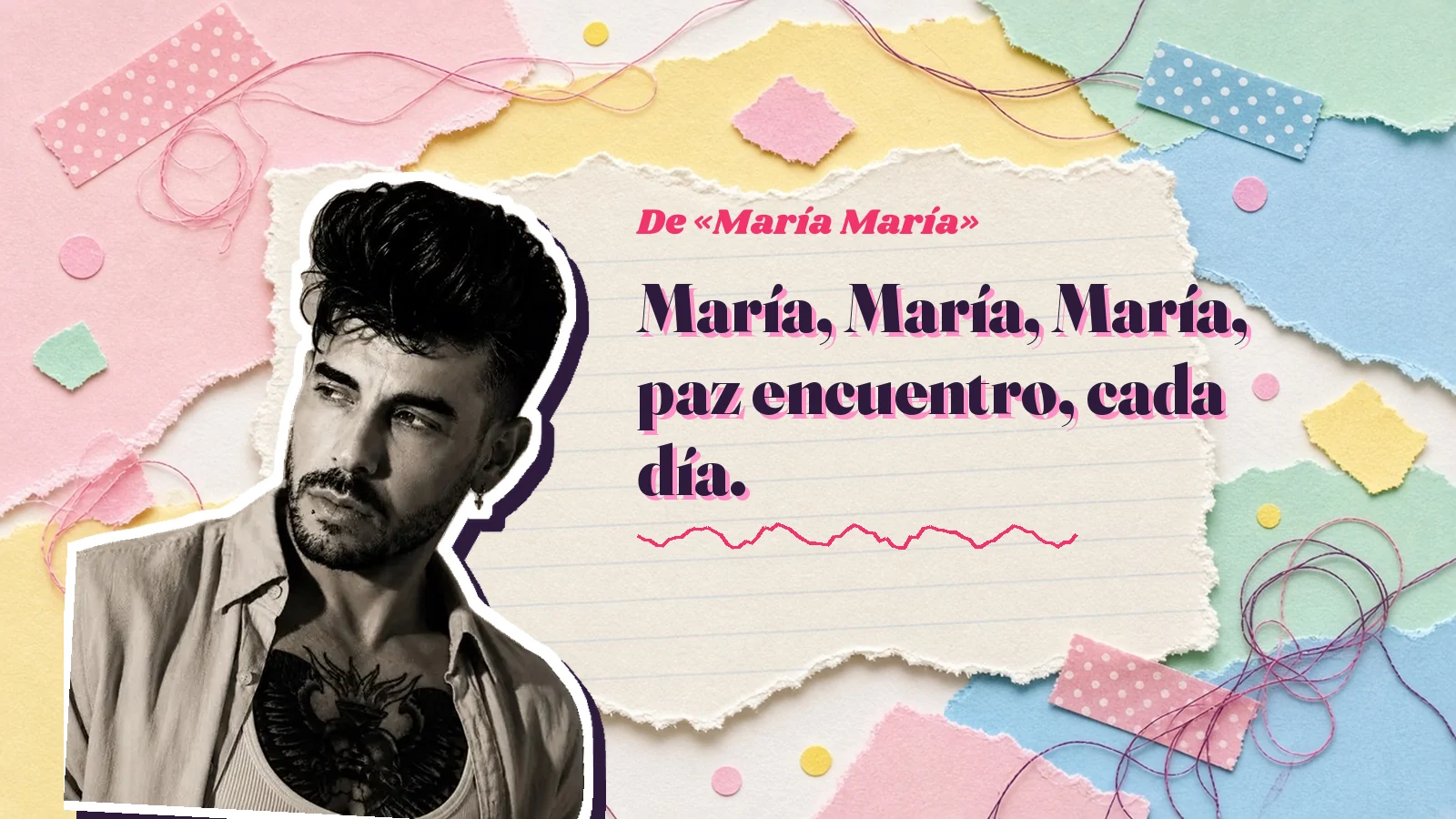
«María, María, María, / paz encuentro, cada día.» ("María, María, María, / peace I find, every day.")
«Paz encuentro», "peace I find", with the word order flipped, like in old proverbs or in coplas, where the verb drifts to the end because it lands better there. It's the word order of prayer. Of litany. Say it out loud several times in a row and it ends up sounding like a grandmother's prayer in the village church, the kind murmured without thinking while the rosary beads slip through her fingers.
And María, of course, is the most prayed-to name in Spain. The Virgin Mary, the Macarena, the Virgin of El Rocío, Our Lady of La Almudena here in Madrid. They're all María. Half of Spain has an aunt María, a grandmother María, a neighbour called María José and a colleague called María del Mar. It's the most repeated name on any eighties class register.
Repeating it three times is a bit like that: a pagan, beachy prayer, in swimming trunks. A prayer to a María we're not quite sure about. A woman? A friend? The beach itself? In the song's entry I said I'd rather everyone put in their own. And I stand by that.
And look how curious this is. In the complete gayfolkplanet.com catalogue, «María María» is track 219 of 273, and the one right before it is called «María Teresa de Calcuta», which has its own entry on this site. Two Marías in a row. If that's not a religious procession, I don't know what is. Right after, so we don't get too mystical, comes «Zee-Zee».
A nameless beach
There's another beach in my catalogue, and it's quite different. In «La playa del Mal Pas» the beach has a name, a history and weight. It's a beach seen from far away, years later, with the feeling that it's still the same and you aren't. It's one of the songs I write without jokes, with clean phrases, the kind that leave a lump in your throat.
The beach in «María María» has no name. No history. We don't know if it's in the Canaries, in Cádiz or in a dream. There's no memory, no past, no "twenty years ago". It's a beach in the present tense, a present so present it doesn't even have verbs.
I like having both. One beach to remember and another to be on. One with a proper name and another with a woman's name. If you listen to them back to back, you'll see they're almost opposites, and yet both are about the same thing: what the sea does to your head when your head is tired.
Mal Pas looks back. María's beach doesn't look anywhere. It's lying on its back with its eyes closed.
The benches at the fair
I sometimes think of my catalogue as a funfair. One of those village-fiesta fairs, with the Ferris wheel, the dodgems, the ghost train and the tombola where you always win an ugly cuddly toy. Some songs are the rollercoaster: they lift you, drop you and leave your stomach in your mouth. Some songs are the ghost train, with papier-mâché scares and a witch's broom that whacks you on the head. Some are the dodgems, all bumps and laughter.
And then there are the benches.
Nobody goes to a fair for the benches. Nobody posts an Instagram photo sitting on a fairground bench. But without benches you can't last the whole afternoon. You need to sit down, eat your candyfloss, watch everyone else scream on the Ferris wheel and get your breath back before the next ride.
«María María» is a bench. It's there so you can rest between a song about a narcissist and another about a neon coffin. And to me, the one who sets up the fair, benches are as important as the rollercoaster. They just make less noise.
The hard part of the easy part
It might seem that a lyric like this gets written in five minutes, lying on a towel. And maybe it does. But the hard part isn't writing it. The hard part is not ruining it afterwards.
Because my instinct, with such a simple lyric in front of me, is to stick something in. A joke. A twist. A final line that turns it on its head, that says "and then he showed up" or "but María stole my swimming trunks". My mind works like that: it hunts for conflict the way a dog hunts for a bone. And learning not to, learning to leave a song calm, truly calm, is a craft in itself.
I explain it in another piece, the craft of discarding. Very often, discarding isn't cutting bad lines. It's cutting good lines that don't belong. And in a song like this, any joke is one too many. If I put an ex in «María María», I kill it. It becomes another one of my usual songs, and I've got plenty of those.
There's a saying attributed to a thousand different people: perfection is reached not when there's nothing left to add, but when there's nothing left to take away. I don't know who said it first and I won't pretend I do. But I applied it to the letter in this song. I even took out the verbs.
In defence of the silly song
I know what some people think of songs like this. That they're silly. Filler. That they say nothing. That they're lift music, department-store muzak, the soundtrack of a four-star hotel spa in Benalmádena.
And I say: so what?
I've been defending the small, the domestic and the corny for a long time. I wrote in defence of corniness precisely because I'm tired of sweetness being looked down on just for being sweet. And I wrote about songs for doing the dishes, because life isn't made only of great dramas. It's made of Tuesday afternoons. Of lingering after lunch. Of stretches when nothing happens and, precisely because of that, everything feels fine.
A silly song is a song that asks nothing of you. It doesn't ask you to cry. It doesn't ask you to be outraged. It doesn't ask you to think about your ex, or text him, or block him. It asks you to just be. And these days, when everything is demanding something of you every hour of the day, that's almost a gift.
Besides, between us girls: after three minutes of «Escupiré sobre tu tumba», the body needs a María.
From the joke to the shoreline
And now, one serious line, because there's room for that in this song too.
There are seasons when peace isn't something ordinary. It's a luxury. When you come out of a relationship that has wrecked you, when you've spent months sleeping badly, when every phone notification makes you jump, the idea of lying on a beach thinking about nothing seems like science fiction. A fantasy. Literally, "leaf green, fantasy".
That's why this song is on the third album, El día de la liberación ("Liberation Day"), and not the first. On the first, it wouldn't have come out. I wouldn't have known how. I'd have put an ex in the second line, because the ex was still there, sitting on the next towel.
Peace I find every day, says the lyric. Every day. Not now and then. Not on holiday. Every day. It's an aspiration, not a description. But you have to write it down to start believing it.
The cover doesn't pretend
And now, finally, the cover.

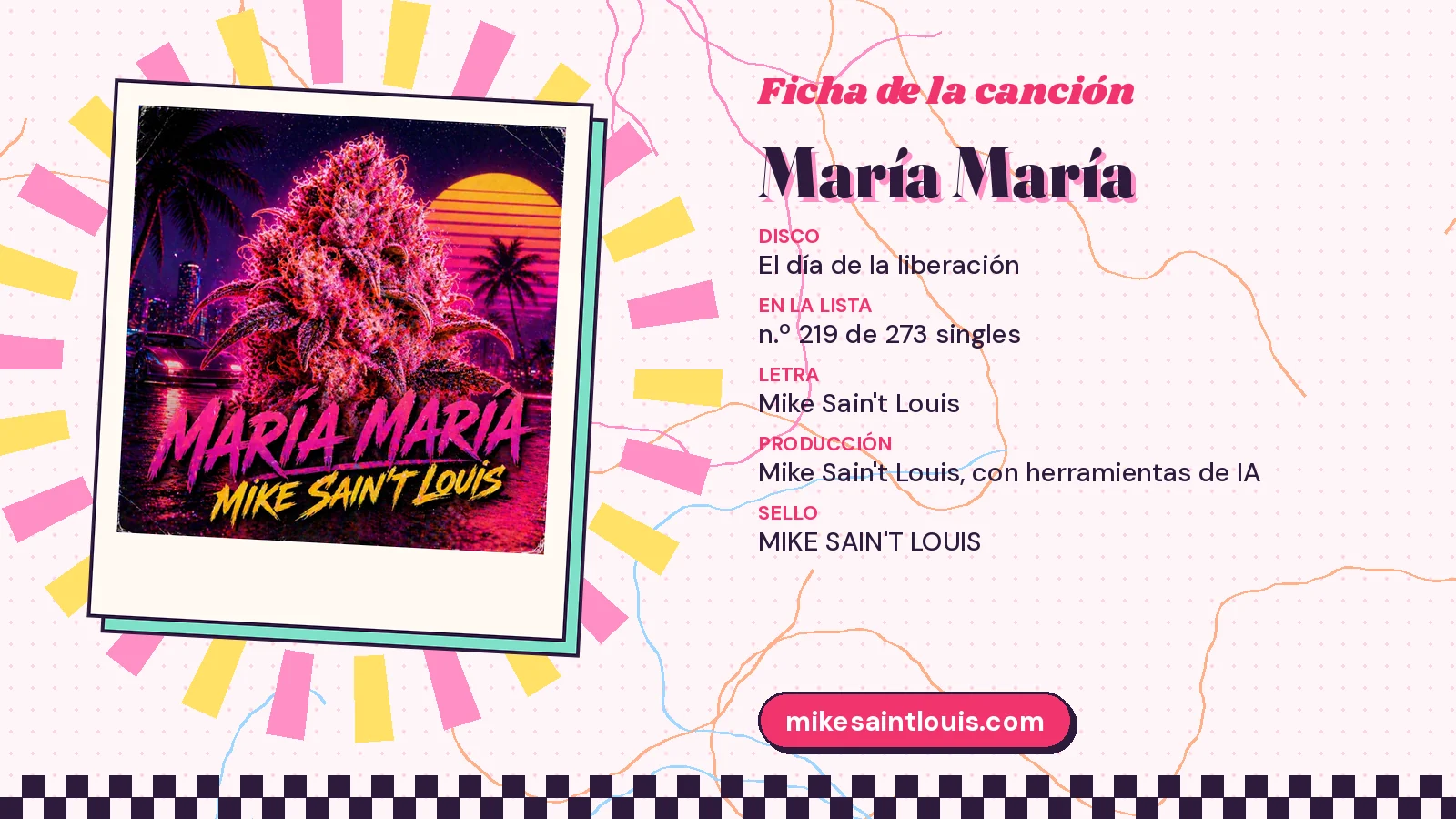
It's one of those retro-futurist sunsets, with a yellow-and-pink sun sliced into horizontal stripes, like eighties video games and cassette covers. Black palm trees silhouetted against a purple sky full of stars. And in the middle, taking up almost everything, an enormous pink-and-fuchsia plant, very, very fuzzy, that looks an awful lot like a bud of exactly what it looks like.
I won't say more. I already said I'd leave "leaf green" there. And in Spain, as everyone knows, «maría» has more than one meaning: it's also slang for weed. But let everyone put in their own María: the grandmother, the Virgin, the neighbour or the other one.
What I will tell you is that my catalogue doesn't hold back on the subject. There's a «Weed Weed Weed» and a «Mejor hierba que guerra» ("Better Grass Than War"), whose titles leave little room for doubt. So if anyone is scandalised by the cover of «María María», they'd better not listen to the others.
About the retro aesthetic, the striped sun, the neon and the palm trees, I have a theory I explain in against nostalgia: I use retro not to look back, but to imagine a future that resembles what we dreamed of as kids with a cassette tape in our hands. A future with palm trees and no exes. Which is more or less what Planeta Gayfolk is.
Summer as a place
Some summer songs are about partying, beach bars, terraces with tinto de verano and patatas bravas. I've got a few, and titles like «Me gusta el verano» ("I Like Summer") don't fool anyone. Summer in Spain is almost a musical genre in its own right, with its song of the year, its village-fiesta dance routines and its hits everybody hates by September.
«María María» isn't one of those. It's a summer without a party. A seven-in-the-evening summer, when people have left the beach and there are four parasols left, a man with a metal detector and the sound of the waves. Summer as a place you go to do nothing, not as an excuse to do everything.
And to me, that's the hardest thing to pull off in a song. The party writes itself: throw in a word in English, a jug of beer and a chorus with an «oé», and you're done. Calm, on the other hand, has to be built very carefully, like a sandcastle, knowing that one wave too many will wash it away.
The song that doesn't make headlines
Calm songs are never the ones that spread on TikTok. I know. What spreads is what scandalises, what names names, what insults someone with wit. «Tan cateto» spread on TikTok, and not exactly for its calm.
«María María» will never be a viral phenomenon. It has no line to clip and slap over a video of someone dancing. It has no joke for people to repeat in the comments. It's a song to listen to all the way through, from beginning to end, and then forget you've heard it.
And that's fine by me. A song kept in a drawer is no use to anyone; that's house rule number one. But a released song doesn't have to be useful for everything. This one is useful for just one thing: lowering your heart rate. And if it manages that for one person, one afternoon, on a commuter train heading for the beach at Gandía or on a balcony in Vallecas in the middle of August, it's done its job.
A planet needs beaches too
Across three albums, the GAYFOLK trilogy tells the journey to a planet where everyone can live exactly as they are. First you discover it. Then you dream of travelling there. And on the third, El día de la liberación, you finally arrive.
And when you land on a new planet, what's the first thing you look for? For me it's obvious: a beach.
Not a palace. Not a parliament. Not a nightclub with a two-hour queue and a bouncer eyeing your trainers. A beach. A place to take your clothes off without anyone looking at you funny, lie down and let the sun do its work. For many queer boys from villages, from working-class neighbourhoods, from complicated families, the first time we felt truly free was on a beach. In one of those coves you reach by scrambling down a goat track, where nobody knows you and nobody is going to tell your family who you were with.
That's why I think «María María» sits well on the third album. It's the arrival song. The moment you step off the ship, take off your astronaut boots, feel the sand and say: right, I'm here. There's nothing left to run from.
What comes after, life on the planet, with its problems and its unbearable neighbours, is another story. But that first afternoon on the beach is sacred. And it deserves a song where nothing happens, because on that afternoon, precisely, nothing happens. And it's the best thing that's happened to you in years.
If I had to sum up Planeta Gayfolk in a single image, maybe I wouldn't choose a disco ball or a flag. Maybe I'd choose this: a towel, a cassette-cover sunset and someone lying there repeating one name without remembering any other.
What I bring and what the machine brings
I'll make it clear here too, because I make it clear everywhere: the lyric is mine. The two-word phrases, the repeated name, the «paz encuentro» with the verb at the end, the decision not to put an ex in even though every fibre of me wanted to. The music and vocals are made with artificial-intelligence tools, like the rest of Planeta Gayfolk.
In a song this bare, that shows more. There's so little lyric that you'd think the lyric doesn't matter. It's the other way round. When there are so few words, each one weighs as much as a brick. If I change "gentle waves" to "strong waves", it's a different song. If I take one María out of the chorus, the procession collapses.
A towel for winter
If you're reading this in October or November, with the Madrid sky the colour of concrete and the heating still off because of what electricity bills are like these days, here's a suggestion.
Find the song in the single downloads section, where it's free. Put it on your phone. Close your eyes for three minutes. Imagine white sand, gentle waves, a María you don't know.
It won't fix anything. It won't bring anyone back or get anyone out of your head. But for three minutes, at least, nobody is going to hurt you.
In my catalogue, that's saying a lot.
And if after three minutes you feel like putting on another of mine, one of the spiteful ones, go ahead. That's what they're for. But start with this one. The body likes to enter the water slowly: ankles first, then knees, and only at the end, once it's no longer cold, the rest.
Frequently asked questions
Who is the María in «María María»? I deliberately don't say. She could be a woman, a friend, the beach itself or whatever each listener wants to see. The cover, with its giant pink plant and its retro sunset, leaves more than one reading open.
Which album is it on? On El día de la liberación, the third album of the GAYFOLK trilogy. In the gayfolkplanet.com catalogue it's track 219 of 273, right after «María Teresa de Calcuta».
Why is the lyric so short? Because it's a song about calm. Two-word phrases, almost no verbs, and a chorus with the name repeated. Any extra line would have turned it into yet another heartbreak song.
Who wrote it? The lyrics are by Mike Sain't Louis. The music and vocals were made with artificial-intelligence tools, and the single is released on the MIKE SAIN'T LOUIS label.