By Mike Sain't Louis ·
Thirty borrowed words: dance-floor Spanglish and «Mood»
Party. Baby. Booty. Flow.
Walk into any bar in Chueca right now, any club on the Gran Vía, the bathroom at any party in Malasaña at three in the morning, and you'll hear these four words before you've had time to order your first drink. None of them is Spanish. All of them are ours.
I wrote «Mood» with thirty words of English and not one of Spanish. Not an article, not a verb, not a «tía», not a «hija mía». Thirty loose words, like tipping your bag out on the bed before going out, and a chorus that repeats the title word four times. That's it. That's the whole lyric.
The song's own entry goes through the inventory and talks about how the language of partying has gone global. In this piece I want to take another route. I want to talk about why a Madrid lyricist who prides himself on being a true-blue Madrileño writes a lyric with no Spanish in it, about what's queer in borrowing words, and about whether a list of words is a lyric or a wind-up. It's a bit of both, and I'm happy to sign up for both.
The most Madrid thing I've written
It looks like a contradiction, and I love that it does. I'm the one who puts Mercadona supermarkets, 100 Montaditos sandwich bars, the neighbour from the fourth floor, «lo estoy flipando» ("I can't believe this") and «ni de coña» ("no way in hell") into his lyrics. I'm the one with the grandmother's sayings and the insults with designation of origin. And suddenly I release a song without a single word of my own language.
But look closely at the list:
«Party, baby, booty, flow, sexy, cool, check, beat,»
None of those words is exotic to a kid from Móstoles or Carabanchel, working-class suburbs of Madrid. Your fourteen-year-old nephew says them. The girl on the till at Primark says them. Your mother says them, even if she mangles the pronunciation, when she asks whether you're going to "that party" on Saturday. They're English, yes, but an English that no longer lives in England. It lives on the Madrid metro, in WhatsApp groups, in your friends' nine-minute voice notes.
Someone from London listening to «Mood» wouldn't hear it the way I do. For them it would be a list of ordinary words, nothing special, like reading the dictionary. For me it's a portrait of twenty-first-century street Spanish. A Spanish that has stopped translating.
That's why I say it's the most Madrid thing I've written. Because in Madrid nobody says «tengo buen humor» any more. They say «tengo buen mood». And if they don't say it, they think it.
When we stopped translating
There's a curious thing about borrowed words: there comes a point when they stop being borrowed and nobody notices.
Nobody thinks «fútbol» is English. Nobody thinks «mitin» (rally), «líder» or «club» are English. Seventy years ago, a grandfather would say «balompié», the home-grown word for football, and hated «fútbol». Today anyone who says «balompié» sounds like a quiz-show contestant trying to impress.
The same thing is happening with "look", "outfit", "vibe" and "hype", only at TikTok speed. Ten years ago they were fashion-magazine words. Today they're supermarket-queue words. And in ten years, maybe the Royal Spanish Academy will give them accents and put them in the dictionary with a Spanish definition, as it has done with so many others. And someone will say it's the death of the language, and someone else will say it's the language alive, and both will go on saying "outfit" every morning when they get dressed.
I'm not in either camp. What I do is take notes. My job, in large part, is listening to how people talk and putting it into songs. If people say «ni de coña», in it goes. If people say "mood", in it goes too. What I'm not going to do is write the way an academic speaks at a lecture in some grand cultural foundation, because I don't know anyone who talks like that in a bar.
I wrote a separate piece about why I almost always write in Spanish and why my website is also in English: I write in Spanish: why my site is in English too. «Mood» is the odd case that proves the rule. A song in English that can only be fully understood in Spanish.
And mind you, Spanish isn't just one thing either. In Buenos Aires, Mexico City or Bogotá, each of these words has its own accent and its own use. What's "outfit" in Madrid is «pinta» or "look" or whatever somewhere else, and every country has adopted English in its own way. I talked about that mix of accents in one song, twenty accents. «Mood» has the advantage of sidestepping the problem: with no Spanish words at all, it has no country's accent. It has a dance-floor accent.
The language's swish
And now, the queer part.
Club culture, ours, the culture of the gay dance floors we've always had, has always had its own language. A language made of stolen words, bent out of shape, turned inside out. Queer men in seventies and eighties Spain already spoke in code, with words from Caló (the language of Spanish Roma), from French, from movie English and from nightlife slang. It was a way of recognising each other without being recognised. A language for those in the know.
Today that need to hide is smaller, luckily. But the habit of picking up words from here and there and making them ours is intact. "Slay", "diva", "queen", "drama", "tea". Words that often come from the Black and Latino drag and ballroom culture of New York, pass through television and social media, and end up in the mouth of a kid from Getafe who has never set foot in the United States.
Borrowing words has something of «pluma» about it, that flamboyant swish. It's a gesture. It's saying: I won't settle for the words I was handed, I'll wear the ones that suit me better. Like borrowing your sister's dress and looking better in it than she does.
«Mood» is that, turned all the way up. An entire lyric in borrowed clothes.
Is this a lyric?
I know what you're thinking. Because I've thought it too. Is this a lyric? Thirty loose words and a one-word chorus? Does someone who prides himself on being a lyricist really put his name to this?
Yes. I do. And here's why.
A lyric isn't measured by its word count. It's measured by what it does. There are four-hundred-word lyrics that say nothing and four-word lyrics that split you in two. «Mood» isn't trying to split anyone. It's after something else: putting you in a state. And for that it doesn't need a story. It needs a rhythm and words that sound the way the moment before you leave the house sounds.
I did a similar experiment in «La chusta nunca disgusta», which is a list of names plus a proverb. I really like the list form. It's the oldest form of poetry, if you think about it: genealogies, litanies, the catalogue of ships in the Iliad. And it's also the most modern: hashtags, tags, usernames. A list is what's left when you strip a sentence of everything it doesn't need.
Some people will think this is a wind-up. And that's fine by me. Negative comments, as I explained in what I learned from negative comments, often tell you more about the person writing them than about what they're criticising. If someone gets really angry because a dance track doesn't tell a story, maybe the problem is that they went to a club looking for a novel.
The order of the words
What I will tell you is that the order isn't random. Or not entirely.
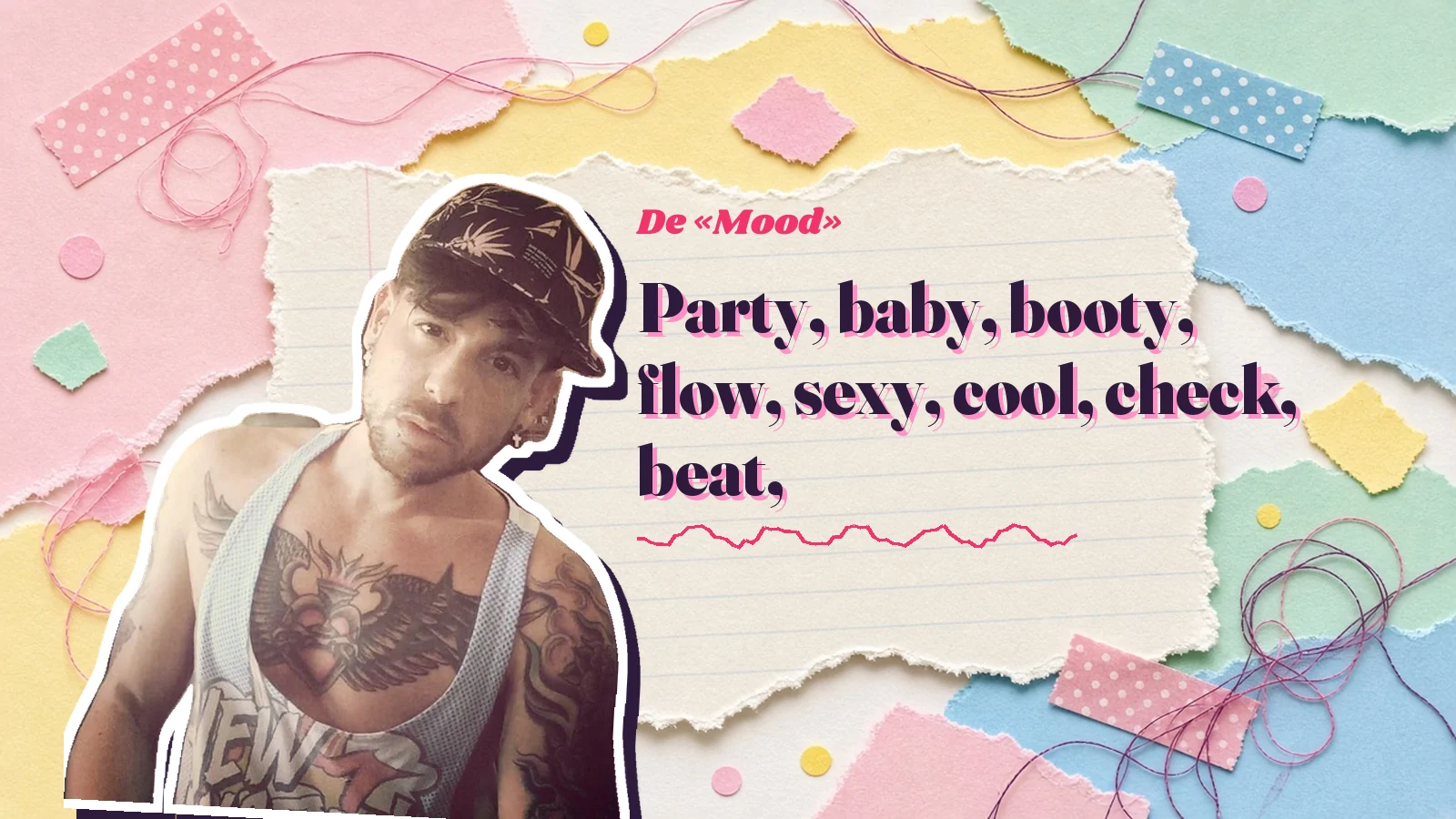
Read the list slowly and you'll see it starts with the most physical. Party, baby, booty. The party, the pull, the arse. It's the first thing that crosses your mind when you think about going out on a Saturday, let's not kid ourselves. Then comes style: flow, sexy, cool. Then music: check, beat. And from there everything blends, the way the night blends when you've been on the dance floor for three hours. Feeling, groovy, style, gangsta, break, cash, club.
Then, in the second batch, words appear that don't belong to partying but to the office. Deal. Feedback. Game. Hit. The words a project manager uses on a Zoom call at nine on a Tuesday. And it tickles me that they're there, mixed in with "booty" and "jam", because that's the life of so many people I know: on Monday they give "feedback" in an office on the Castellana, Madrid's business boulevard, and on Saturday they shout "vibe" on the dance floor. With the same mouth. With the same language-school English.
The list ends like this:
«mood, outfit, show, vibe, wild, track, hype.»
And there's the title word, tucked into the middle of the last line before it leaps into the chorus. Like someone who goes unnoticed at the party and suddenly climbs onto the podium.
The ones that aren't there
Almost as interesting as the list is what's missing from it. Think of English words you hear on a night out in Chueca and a few immediately come to mind that don't appear in «Mood». No "crush". No "random". No "cringe", any teenager's favourite word for their dad dancing at a wedding. No "chill", no "brunch", no "afterwork", no "match", which is what everyone says when they explain how they met their latest disaster on an app.
And the most ours of all aren't there either, the drag vocabulary: "slay", "queen", "tea". That amuses me, because they're exactly what anyone would expect in a song about partying by a queer man.
A list is always a choice, too. What goes in says something, and so does what's left out. «Mood» keeps the words of the dance floor and the office, the ones used equally by the kid from Getafe and his boss on the Castellana. The strictly tribal ones are saved for another song.
The switch
The chorus is MOOD, four times. In capitals in the published lyric, which says a lot already.
I like to think of it as a light switch. Click. You're there. No transition, no bridge, no "and now let's cheer up". Just one word that changes your state, like the click of the bathroom light when you get home at six in the morning and catch your face in the mirror.
"Mood" is a very strange word, when you think about it. It means a state of mind, but in Spain it's used for everything. «Este outfit es muy mood». «Hoy no tengo mood». «Esa foto, mood total». It's even used on its own, as a reply to something you identify with: someone posts a video of a cat sprawled on the sofa and you comment "mood". It's a wildcard word. A sponge of a word that soaks up whatever you throw at it.
That's why it works as a chorus. Because everyone fills it with their own thing. My mood isn't yours. A Friday mood isn't a Sunday mood. The song doesn't tell you what to feel. It tells you to feel something.
The Vespa cover
Look at the cover, because it's beautiful and has nothing to do with what you'd expect from a club track.
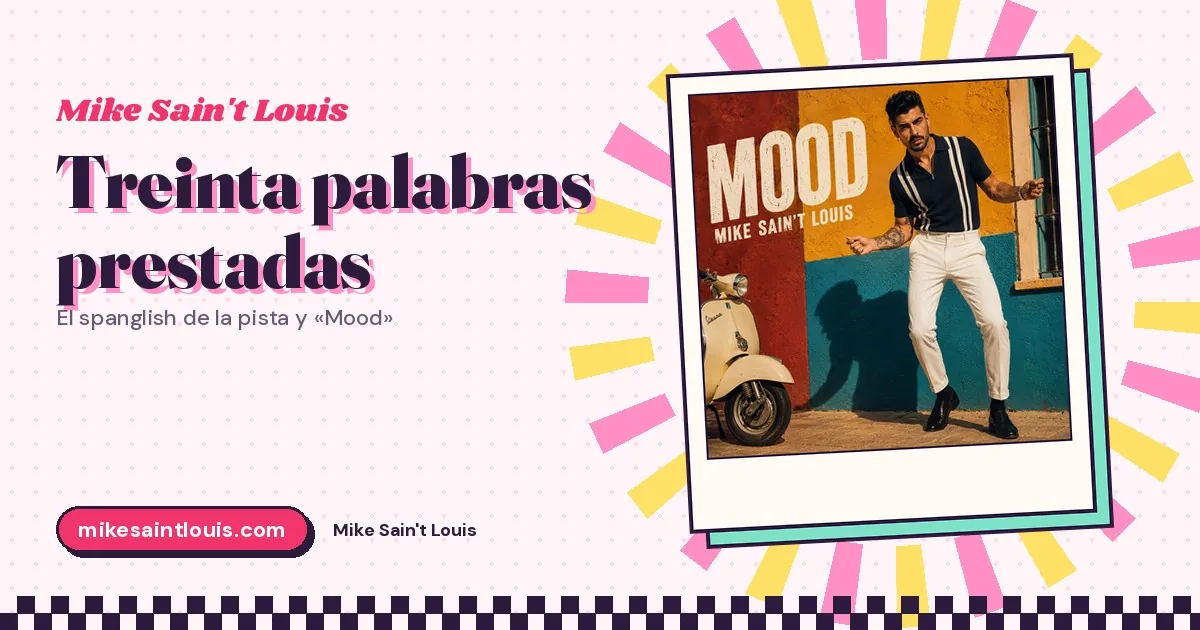
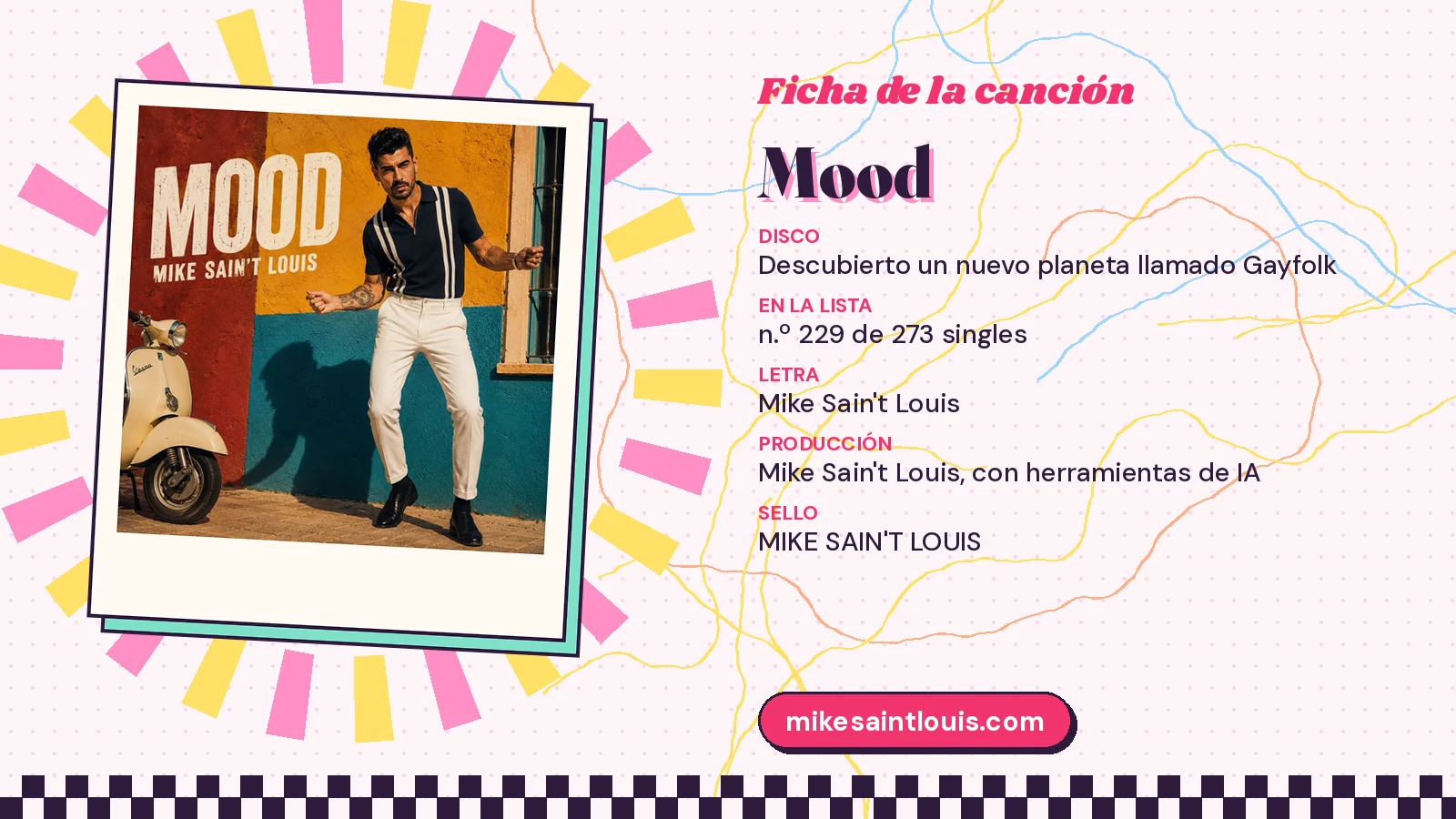
A man dancing in front of a wall painted in three colours, red, mustard yellow and teal, the paint slightly flaking, like a street in southern Italy or a coastal village. He's wearing a navy polo shirt with white stripes, white pleated trousers and shiny black shoes, and he's mid-step, arms open and hips turned. To the left, parked, a cream-coloured Vespa. And at the top, in huge white letters, MOOD.
No disco ball. No lasers. No neon. There's sun, there's street, there's a sixties scooter. And I think that's perfect, because mood isn't in the club. Mood comes before. In the street, in the afternoon, in the moment you catch yourself in a shop window and think "tonight's the night". The club is just where you spend it.
All my covers try to tell something the lyric doesn't. This one tells what happens before the lyric.
From the joke to the empty dance floor
Let me be serious for a moment, because with all these English words I'm getting frivolous and I don't want to.
For many people like us, the dance floor was the first safe place. The first place where you could dance with another man without anyone smashing your face in. When I talk about the language of partying, about those borrowed words, I'm not talking about a fad. I'm talking about a refuge that had to invent its own vocabulary because the vocabulary outside was no use to it, or insulted it.
That's why it bothers me a little when people dismiss dance music as shallow. For decades, the dance floor was the only place where many of us could be who we were for a few hours. I talk about it in what a Pride dance floor asks for. And when the lights come up at six, and the floor empties, and you step out into the street with your ears ringing, you realise that what you just lived through wasn't frivolous at all.
A word like "mood" can sound like nothing. But for someone who spent their adolescence unable to choose their state of mind, unable to be happy in front of anyone, being able to say "I've got mood today" is almost a victory.
That's it. Back to frivolity, which is where I'm most comfortable.
What TikTok taught me
There's one thing I've learned over years of posting on social media: people don't hold on to songs. They hold on to fragments. Ten seconds. A phrase. A word. Whatever can be clipped, laid over a video and shared.
«Tan cateto» spread on TikTok, and not because of its second verse, that's for sure. It spread because of what could be repeated, what stuck after three looped listens while you scrolled on the sofa. I go into detail in what TikTok and Shorts taught me about songs, and if you're curious about the song, it has its own entry.
«Mood» is, in a way, a song made only of fragments. Every word in the list could be a video. Someone putting on their outfit: "outfit". Someone dancing in the kitchen: "groovy". Someone pulling out their card at the bar: "cash". Someone checking themselves in the lift mirror before going out: "look". And at the end, the chorus, which is the comment everyone leaves under the videos they relate to: mood.
I don't know if that's good or bad for music. Probably both. But I do know that the way we listen has changed, and a song that ignores it is a little blind. If you want to see how my songs move in that format, my profile is linked on TikTok.
The panda and the E
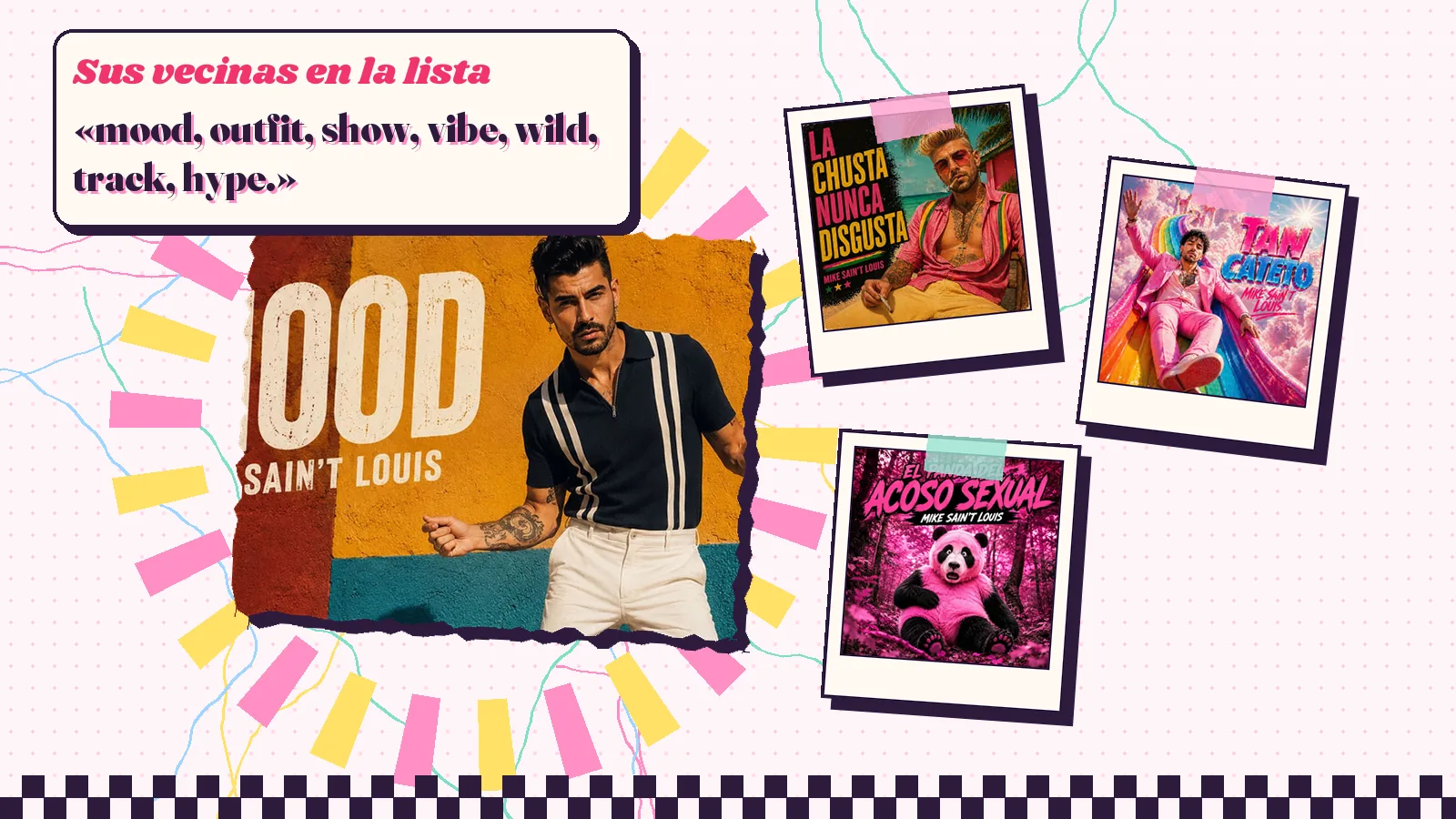
In the complete gayfolkplanet.com catalogue, «Mood» is track 229 of 273. And its neighbours are quite something. Right before it comes «El Panda del acoso sexual» ("The Sexual Harassment Panda"), whose title already warns you this isn't about teddy bears. And right after comes a song called «E». Just that, one letter. A vowel.
It amuses me that «Mood» ends up between the two. On one side, a very long, outrageous title. On the other, a single letter. And in the middle, a song made of loose words. As if the catalogue were playing with the length of things. I didn't plan it that way, as far as I know. But in a catalogue of two hundred and seventy-three singles, coincidences end up looking like intentions.
The song belongs to the first album of the trilogy, Descubierto un nuevo planeta llamado GAYFOLK ("New Planet Called GAYFOLK Discovered"), which is the album about arriving somewhere new and looking at everything wide-eyed. And one of the things you do when you arrive somewhere new is learn the words they use there. The tribe's words. «Mood» is the tribe's pocket dictionary.
Dance or read
I have a piece called writing to be danced to and writing to be read. In it I explain that some songs are made to get people moving and others are made to get people thinking. And that both are equally worthy, even if the second kind gets better press.
«Mood» belongs to the first group, no doubt about it. There's nothing to read. Read the lyric on a sheet of paper and you'll be bored in ten seconds. Hear it on a dance floor, volume up and body loose, and you'll understand why it's written this way.
The lyric is mine, word for word, even though none of the words is mine. The music and vocals are made with artificial-intelligence tools, like the rest of Planeta Gayfolk. I choose which words, in what order, how many times the chorus repeats, what the song is called and what face the cover has. In a thirty-word lyric, every choice shows more.
If anyone asks
If anyone asks how your night was and you don't know what to say, now you have an answer. You don't need a whole sentence. One word will do.
Mood.
And if they want more, hand them the full list, in order, from party to hype. Let them work it out.
Frequently asked questions
Why doesn't «Mood» have a single word of Spanish? Because it gathers English words that are already used every day in Spain without translation, especially in nightlife. It's a list of thirty borrowed words and a chorus with the title word repeated four times.
Which album is it on? On Descubierto un nuevo planeta llamado GAYFOLK, the first album of the GAYFOLK trilogy. In the gayfolkplanet.com catalogue it's track 229 of 273.
Is a list of words a lyric? For me, yes. A lyric is measured by what it does, not by how many words it has. «Mood» is written to put you in a mood, not to tell you a story.
Who wrote it? The lyrics are by Mike Sain't Louis. The music and vocals were made with artificial-intelligence tools, and the single is released on the MIKE SAIN'T LOUIS label.