
By Mike Sain't Louis ·
«Tranquilo, estoy bien»: the impossible crush that only fits inside a song
A coffee nobody asked for. A man in uniform offering it out of courtesy. A face turning the colour of a patrol car's siren. And a sentence that comes out on its own, trembling, with the composure of someone who has just tripped in the street and gets up as if the pavement had shoved him:
Tranquilo, estoy bien («It's fine, I'm OK»)
That's everything. That line is the heart of «Me he enamorado de un policía que es dueño de una lavandería» («I've fallen for a policeman who owns a launderette»), even if people remember the mile-long title, the bombshell wife, the coppers and the police-station ending. What interests me is the stumble. The moment someone treats you kindly and, instead of enjoying it, you shrink.
On the song's own page I've already talked about the absurd combination, the uniform and the laundry basket, and the washing-machine joke with its degrees of passion. Here I want to talk about something else: impossible crushes, why so many queer lyrics are full of men you can't have, and why the only place such a crush can exist without hurting anyone is inside a song.
I did what I shouldn't, again
The song opens with a repeat offender's confession:
Otra vez hice lo que no debía («Once again I did what I shouldn't»)
Once again. Not the first time. The narrator doesn't present himself as the victim of a bolt from the blue but as someone with form, with priors, with a sentimental police record. And that's very funny in a song about a policeman, because the one who ought to have a file is the narrator.
I love starting like that. No excuses. None of the «I don't know what came over me» lie. I know exactly what came over me: I've noticed the wrong man again. Like going into Mercadona, the Spanish supermarket, with a list of five things and coming out with twelve and a bar of chocolate you knew you'd buy the moment you left the house.
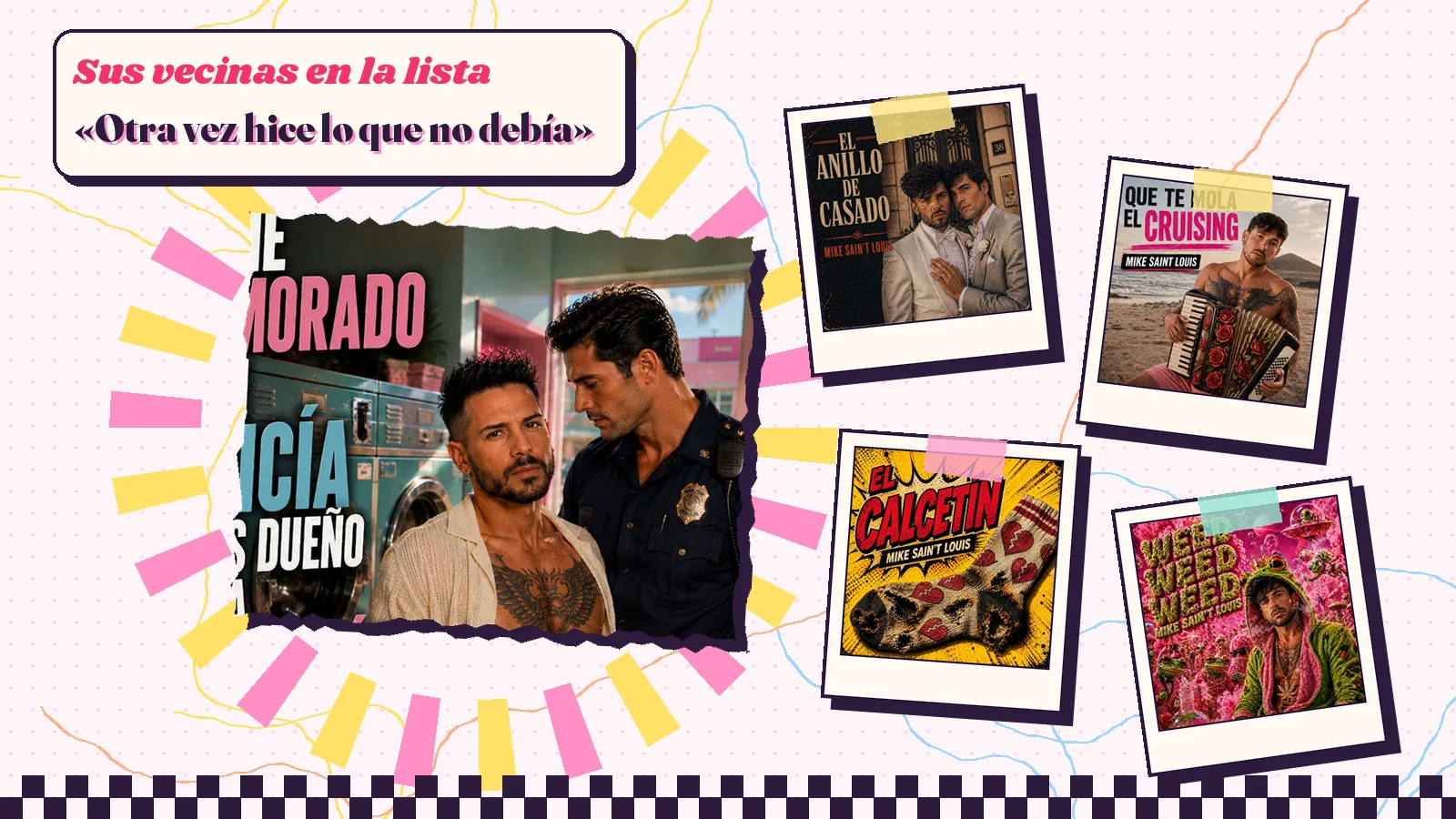
My catalogue has a whole gallery of men who shouldn't be looked at. The one in «El anillo de casado», with his five pints at 100 Montaditos and his wedding ring firmly on. The ones in «Que te mola el cruising», hiding among the trees. And now this one, the neighbourhood cop with his own business and a family out of a cereal advert. All invented, all characters, all of a species every gay man in this country recognises at first sight: the wrong man who looks like the right one.
I drew up a full typology, half in jest, in A small comic typology of exes. The launderette policeman never had time to become an ex. He never even became anything. That's why I love him so much: he's the crush in its purest form, no consequences, no rows, no WhatsApps at three in the morning.
It's fine, I'm OK
Back to the coffee, because it's the scene I find truest in the whole lyric.

A man you fancy offers you something with no ulterior motive. A coffee. Out of courtesy, the song says, and the word is well chosen: courtesy, the kindness you'd show anyone, the kind that means nothing. And the narrator, who carries half a lifetime of learning not to be a bother, turns red and answers like someone waving away an ambulance after a crash.
Why do we do that? Why did so many of us learn to answer kindness with a «no need», with a «don't worry», with an «I'm fine» nobody asked for?
I have a theory, and it's not a psychologist's, it's a bar-stool one. When you grow up knowing your desire is dangerous, you learn to hide it in your face. And your face, which has a mind of its own, takes revenge by going red at the worst moment. So you blurt out the first thing that gets you out of the situation: an «I'm fine» that's really a no-entry sign. Don't look at me. Don't ask. Don't come any closer, it shows.
It's a silly three-word line, and at the same time it's the story of so many of us. Look closely: the boy who fancies the policeman doesn't say «thank you», which would be normal. He tells him not to worry. As if the one who needed calming down were the other man. As if the danger were that the cop might notice.
It's comic. It's sad too.
That's why I wouldn't change a comma. The published lyric leaves it just like that, with its pause and its clumsiness, and to me that clumsiness is worth more than any pretty line. A declaration of love made out of a retreat.
The most unattainable man in Madrid
Now let's do the inventory, because the song does it, and does it with affectionate cruelty.
He's a policeman. He owns a launderette. He has a wife the lyric describes as a bombshell. He has well-mannered children. And on top of that the narrator finds him gorgeous, a revolution. If a scriptwriter for afternoon telly pitched you this character, you'd tell them they'd overdone it. Nobody is that unattainable. Nobody piles up that many padlocks.
But that's the joke: every detail added is one more door closing. Uniform: door. Own business: door. Wife: reinforced door. Well-brought-up kids: door with an alarm wired to the station. The narrator hasn't fallen for a man. He's fallen for a fortress with washing machines.
And here's the self-mockery I like best in the song. Whoever wrote it knows there's no chance at all. It's said in the title. This isn't a hopeful crush, it's a shop-window crush, like the one you have with a Loewe coat you'll never be able to afford and still pop in to stroke every time you pass Calle Serrano.
The thing is, gay life in Spain is full of these shop windows. Men married to women, the colleague who'll never say a word, the gym instructor who smiles at you because he's paid to smile. Desire with no way out is practically a genre. And instead of weeping over it, this song turns it into a neighbourhood farce.
Notice, too, the order of the list, which is anything but innocent. First the job, then the business, then the wife, then the kids. It goes from public to private, like opening Russian dolls and finding in each one another reason to forget the whole thing. And when there are no dolls left to open, when the man's file is complete and perfect and impossible, the narrator signs off by saying he's a stunner. In other words: I know it all, I know it's a no, and I couldn't care less. That's the logic of a crush, which has never read a file in its life.
And there's something of stairwell gossip about it. That way of knowing everything about someone without having spoken to him for more than two minutes: he's got a wife, the kids are ever so polite, the launderette's his. It's the information that runs through a Madrid neighbourhood by word of mouth, the kind the neighbour gives you in the lift without being asked. The lovestruck boy in this song has done his research, as we all do when we fancy someone, and reached the obvious conclusion. He's reached it, and he doesn't care.
A launderette, by the way, is the perfect setting. Nobody goes to a launderette to pull. You go with your bag of pants and your bare-minimum dignity, to wait forty minutes watching your clothes go round. It's the least glamorous place on earth. And right there, between the fabric softener and the coin machine, impossible love turns up. The everyday and the drama in the same square metre.
I can't stand coppers
The second part of the lyric throws in a turn you don't expect in a crush song. The narrator confesses he can't stand the coppers. And he tells us why: the first time, they took the weed he'd hidden somewhere I won't repeat here because my mother reads this blog. Well, she doesn't. But she could.
That memory is a little bomb. Because it puts the narrator in an awkward relationship with the uniform. The policeman stops being merely the handsome boy from the launderette and becomes the institution as well, the one that searches you, takes things off you, eyes you with suspicion. And even so, the heart does as it pleases and decides this particular one is a stunner.
I don't want to get solemn, but I won't play dumb either. For decades in this country, relations between gay men and the police were not exactly coffees out of courtesy. There was a law on «social dangerousness» that lumped us in with criminals, and there were raids, and bars shut down, and people put on file for being who they were. That's history, not anecdote. And I think the narrator's «I can't stand coppers» carries an echo of that inherited mistrust, even if the song says it with a joke and a joint in the middle.
That's why the crush has a delicious whiff of betrayal. Falling precisely for whoever stands for what frightens you. Like the uniform fantasies that have turned up so often in porn and in the gay imagination, where the power that scares you becomes the object of desire. The song doesn't write a treatise on it. It grazes it with a laugh and moves on. But it's there.
What isn't in the lyric is hatred. There's neighbourhood resentment, the memory of a bad experience, and an enormous «but». But this cop is different. And all of human contradiction fits inside that «but». You hate the coppers. Except one. The one with the launderette.
Seventy degrees of passion
The whole song is full of washing machine. And the image that tickles me most is the coin machine:
Me ofrece cambio el policía cañón («The bombshell cop offers me change»)
The cop gives you change. Coins. So you can put your wash on. It's the most prosaic gesture in the world, the one any shop assistant makes for any customer. And the narrator turns it into a seduction scene. The coins, the slot, the seventy-degree programme. It's the eroticism of the tacky, which is the one I'm best at.
I have a soft spot for clothes as a metaphor for love. In «El calcetín» I wrote that self-esteem gets washed, hung out and worn fresh too, and here the launderette works again as a place where matters of the heart happen. Dirty laundry is who we were yesterday. The washing machine is the promise of starting over. And the spin cycle, well, the spin cycle is how you're left when a handsome man offers you a coffee.
The everyday as the setting for desire. I went into it more slowly in Madrid without the postcard, where I explain why my songs don't happen on the Gran Vía of the photos but in the supermarket, the bar, the bus stop. The launderette in this song could be in any neighbourhood. It smells of cheap detergent and other people's clothes. And that makes it far more believable than any penthouse with a view.
I don't think there's any harm in writing this song
This is the line that, for me, explains the whole song:

No creo que pase nada por escribir esta canción («I don't think there's any harm in writing this song»)
It's a request for permission dressed up as a statement. The narrator justifies himself before anyone accuses him. I don't think there's any harm. There isn't, is there? It's only a song. I'm not writing to the cop, I'm not sending him a message, I'm not breaking up any marriage. I'm just putting him in a lyric.
And here's what really interests me. Some desires have no place in real life. Not because they're bad, but because there's no way they can end well. The married man, the colleague, the launderette cop. Take them into real life and someone gets hurt, usually you. But take them into a song and they become something else. A character. A joke. A chorus people can dance to without anyone having to get divorced.
The song as a safe place for the impossible. To me it's one of the oldest jobs writing has. The poets of Spain's Golden Age wrote to ladies they could never touch. The coplas of Rafael de León are full of forbidden loves that existed only on stage. And now, with far less prestige and far more Mercadona, here I am putting into a lyric a policeman with a launderette who, I insist, is an invented character.
There's some shame in all this, and I love it. The shame of admitting you fancy the wrong person. In Second-hand embarrassment as a writing tool I explain why blushing is one of my raw materials. The red-faced boy in the launderette is embarrassment live on air. And what the song does is make it shareable. It's no longer your private shame. It's a song putting on your kitchen radio the same thing that happened to you at the gym.
If you ask me why I write lyrics like this, the answer is in that line. Because there's no harm. Or there is some, but it's the good kind: you laugh at what you used to hide.
A fantasy police station
And then comes the ending, the one everybody remembers and the one that gets me funny looks at family dinners.
The narrator, desperate, decides the only way to be alone with the policeman is to get himself arrested. He considers smoking a joint inside the launderette, on purpose, so the cop will take him to the station. And there, according to the lyric, get up to all sorts of filth. Lots of it. With the kind of repetition children use when they want something very, very much.
It's a fantasy, and as a fantasy it works because it's ridiculous. Nobody with half a brain believes an arrest ends in romance. It's the logic of a low-budget porn film, all uniforms and fluffy handcuffs. And the song carries it through to the end with a perfectly straight face, which is how jokes work best.
That said, and I say it with the same straight face: don't. Not the joint in the launderette, not provoking anyone into arresting you, nothing in that last verse. It's a song. Songs exist to do what in real life would be madness. That's what characters are for: to get things wrong on our behalf. My relationship with weed in lyrics has its own song, by the way, «Weed, weed, weed», and there too it's clear that a lyric is one thing and advice is another.
What I love about this ending is that it dismantles the policeman. All song long he was the fortress, the unattainable, the man of a thousand locked doors. And in the last verse the narrator finds the only crack: the cop has to do his job. If I smoke, he arrests me. If he arrests me, we're alone. It's reasoning straight out of Mortadelo y Filemón, Spain's favourite pair of bungling comic-strip agents. And it's the only plan with any logic that occurs to someone whose heart has just been through the spin cycle.
Track 164, between a coordinator and a punishment
In the singles list of Planeta Gayfolk, this song is track 164 of 273, on the second album of the trilogy, «Ojalá se pudiera viajar a Gayfolk». And its neighbours are hard to forget.

Just before it comes «Asqueroso coordinador», a song of rage with an addressee. Just after, «El castigo más duro», with its words that have spikes and tear things apart. Between a revenge and a wound, this silly crush in a launderette turns up. It feels like a very real-life order to me: between one row and the next, you fall for the wrong man, and it saves your week.
The second album of the trilogy is the album of longing. If only you could go to a planet where things were different. And this song fits there like a washing-up glove: if only you could love this policeman. If only the launderette were something else. If only. Since you can't, you write it.
It amuses me to picture planet Gayfolk with its own police station. Its own neighbourhood launderette. A handsome cop handing out change to every customer alike, with no idea that one of them has written an entire song about his coins.
For anyone who falls in love in the wrong place
Back to the beginning, which is always where the important part is.
A coffee offered out of courtesy. A boy turning red. A «don't worry, I'm fine» that slips out like dropping a stone that was too heavy to carry. Strip away everything else, the uniform, the wife, the kids, the weed, the police station, and the song is just that: someone who doesn't know what to do with his own desire in the face of a kindness that means nothing.
And now the serious bit, no joke: nearly all of us have been there. In the supermarket queue, at the gym, in the doctor's waiting room, in an office under strip lights. Someone smiles at us with no ulterior motive and we build an entire flat on that smile. There's no harm in it. It's human. All I do is write it down, and write it with a red face and a washing machine in the background, because that makes it easier to carry.
This song is for you if you've ever fallen for the wrong place at the wrong time and answered «I'm fine» to someone who was only offering you a coffee. If you recognise yourself, laugh. You've already done the hard part, which is admitting it.
You'll find it with the full lyrics on its page, to play while you wait for the spin cycle. And if you tell me about your own launderette policeman, I promise not to put him in a song. Well. Almost certainly.
If you're curious about how my humour works from the inside, I've explained it in What makes me laugh when I write. Fair warning: there's a lot of washing machine.
Frequently asked questions
Does the policeman in the song exist?
No. He's an invented character, like every name and character in my lyrics. The song plays with the cliché of the unattainable man.
What does «Tranquilo, estoy bien» mean in the lyric?
It's the narrator's clumsy reaction when the policeman invites him for a coffee. He goes red and answers like someone backing away, and to me it's the truest scene in the song.
Does the song recommend smoking so you get arrested?
No. The ending is an absurd comic fantasy. It's a song, not advice.
Who wrote this song?
I wrote the lyrics. I'm a lyricist, composer and music producer. The music and the vocals are made with artificial-intelligence tools such as Suno.
Which album is it on?
It's part of «Ojalá se pudiera viajar a Gayfolk», the second album of the GAYFOLK trilogy, and it's track 164 of the 273 singles.