
By Mike Sain't Louis ·
I have a friend who…: coming out as an adult and the confession in «Toxina coreana»
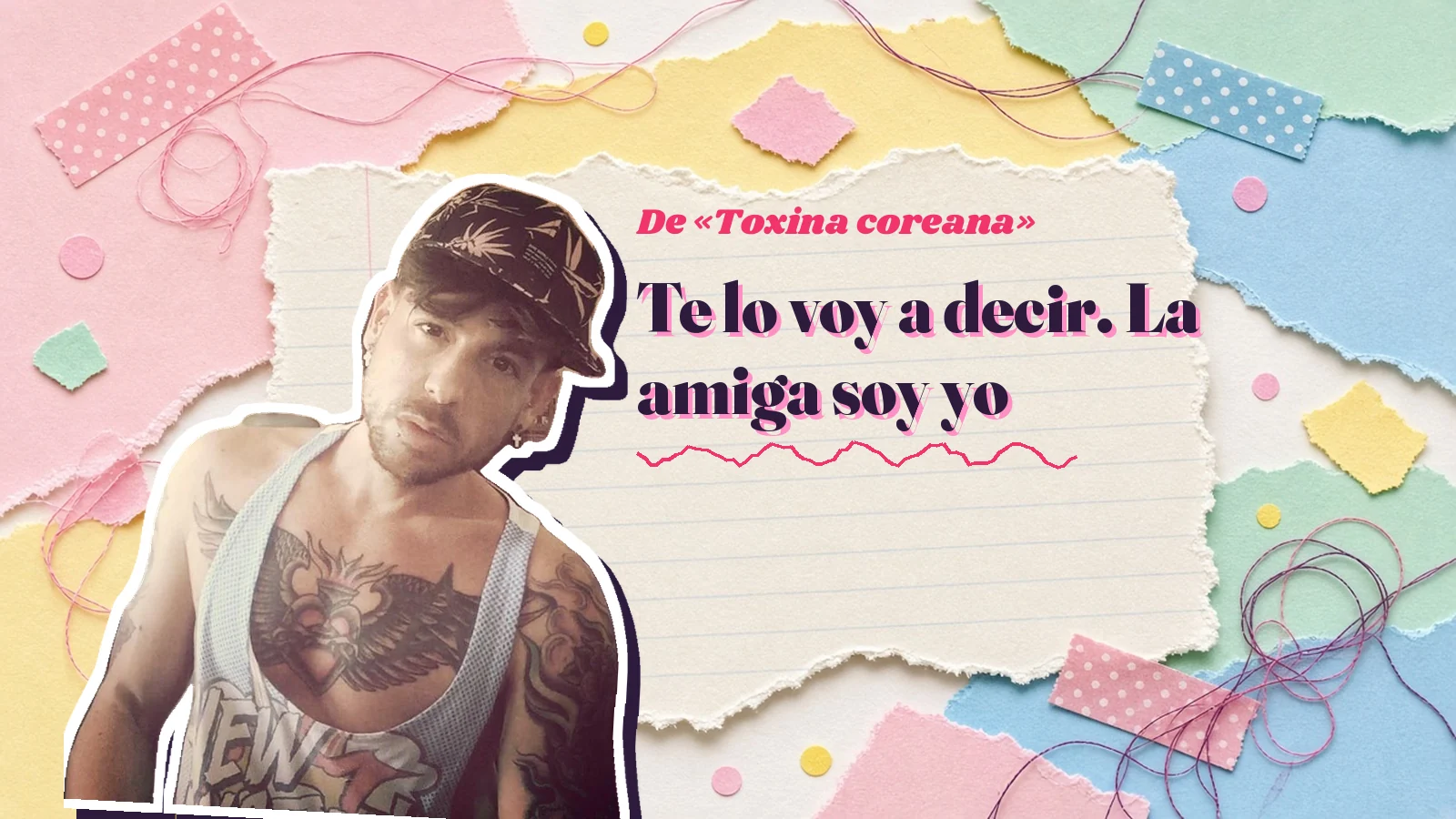
«Te lo voy a decir. La amiga soy yo»
I'll tell you. The friend is me. That's how «Toxina coreana» (Korean toxin) ends, one of the cheekiest songs I've written. For several verses the protagonist listens to her friends discussing someone else's face: the dark circles, the raised eyebrow, the three thousand euros of injections. And at the end, all of a sudden, she confesses that the friend they're all talking about is her. (If you want to read the full lyrics, they're on gayfolkplanet.com.)
When I wrote it I was thinking about cosmetic touch-ups and the complicity between friends who tell each other everything, and I already wrote about that in «La amiga soy yo». But that last line has another reading that any LGBTI person recognises instantly. It's the exact structure of a sentence a huge number of people have said before coming out: «I have a friend who…».
I have a friend who thinks he likes men. I have a friend who's fallen for her flatmate. I know someone in their mid-forties who doesn't know how to tell their kids. And in the end, when they finally dare, the sentence changes grammatical person: the friend is me.
This piece is about that confession when it comes late. Not at sixteen, in secondary school, but at thirty, at forty-five or at sixty-eight. With a life already built, sometimes with a marriage, with children, with a job where everyone thinks they know who you are.
The friend is me: anatomy of a detour
The «friend» line is a very human invention. It lets you test the ground without stepping on it. You tell the story in the third person and watch the face of whoever is listening. If they frown, the friend stays a friend forever. If they smile, maybe next time the friend will have your name.
In the song the detour is a different one, but the mechanism is the same. The friends talk about a third person, laugh, give their opinion, and the protagonist lets the conversation run until she can't take it any more:
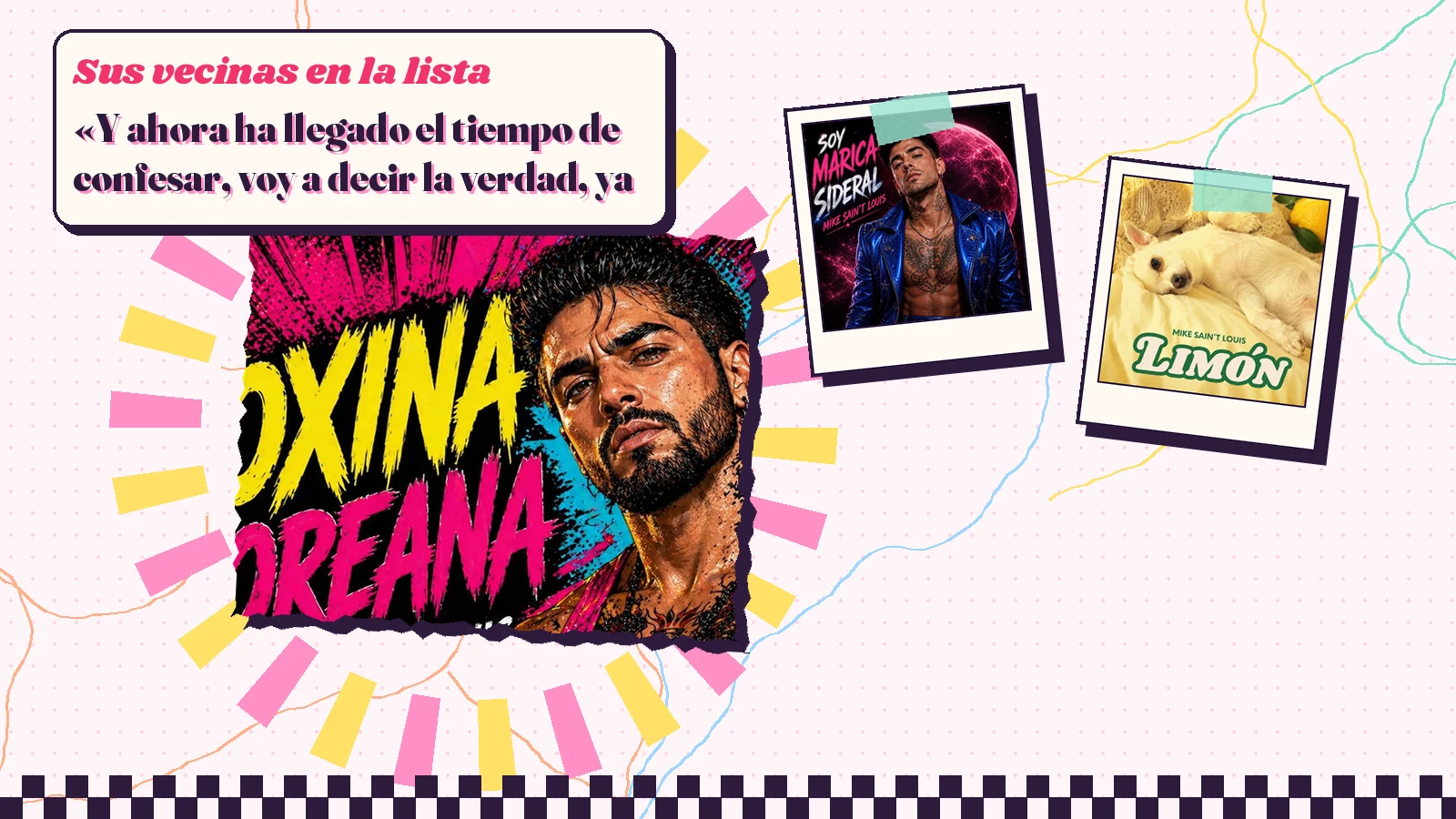
«Y ahora ha llegado el tiempo de confesar, voy a decir la verdad, ya no me callo, yo ya no me callo, ¿para qué desmentir?»
And now the time has come to confess, I'm going to tell the truth, I won't keep quiet any more, why deny it? I really like that «why deny it?». Because it sums up the exhaustion of someone who has spent years correcting small lies: the boyfriend who in office chat becomes a genderless «partner», the Christmas dinner where someone asks «so when's it your turn?», the holiday photo that gets cropped before you show it. There comes a point where keeping up the official version costs more than telling the truth.
And that, which looks like a heroic decision, is often simple arithmetic of exhaustion. It isn't the bravest who come out. It's the ones who can no longer pay the price of staying in.
Why some people come out so late
There's an idea that coming out is a teenage thing. Films almost always tell it that way: a schoolkid, a mother crying in the kitchen, a happy ending with a hug. The data says reality is much longer.

In 2013 the Pew Research Center surveyed 1,197 LGBT adults in the United States and asked them about the three key moments of their journey. The median age at which they first felt they might not be straight was 12. The median age at which they were sure was 17. And the median age at which they first told a close friend or family member was 20.
Behind those medians there are long tails. Some 8% said they weren't sure of their orientation or identity until 30 or later. Among bisexual people, one in four said the subject simply «hadn't come up» with close friends or family. And the survey showed generational differences: gay men and lesbians under 30 had told someone, at the median, at 17, while those aged 50 and over had done so at 21. Each generation comes out a little earlier than the last, but nobody comes out all at once.
In Spain there are very concrete historical reasons why many older people came out late or never did. The Law on Social Danger and Rehabilitation was still in force until the end of 1978. Anyone in their sixties today grew up in a country where being homosexual could end up in a police file. Equal marriage only arrived on 3 July 2005. Many people married someone of the other sex because that was what you did, because the Church demanded it or simply because it never crossed their mind that another option existed. I wrote about that religious weight in «Rezar de rodillas».
There are other, less visible reasons. Some people had no words for what they felt. Others knew but put it in a box, planning to open it «when the kids are older». Others went through therapies that promised to cure them, something I wrote about in «No hay pastilla que cure lo que no es enfermedad». And others grew up in small places where everyone knows everyone, as I told in «El qué dirán».
And there's a factor that's almost never mentioned: dependence. Someone living with their parents because rents are impossible, someone financially dependent on their partner or caring for a sick relative has much more to lose if the conversation goes badly. Waiting, in those cases, isn't cowardice. It's prudence. Before coming out it's worth asking a very practical question: if this person reacts terribly, do I have somewhere to sleep tonight and something to live on next month? If the answer is no, maybe the first step isn't the confession but building a network: a trusted friend, a little savings, an association's number saved in your phone.
None of those reasons is a personal failure. Coming out at fifty doesn't mean having lost thirty years. It means having survived thirty years in conditions nobody chose.
The closet doesn't open just once
There's a misunderstanding worth clearing up: coming out isn't an act, it's a verb you conjugate many times. You come out to your best friend. Months later, to your sister. Later on, to your parents. Then, at a new job, to a new doctor, to the landlord, to the mother of your daughter's classmate.
Every new person who enters your life reopens the question. Do I say it? Do I drop it in? Do I correct them when they assume my partner is of the other sex? For someone coming out as an adult this multiplies, because they have decades of relationships built on the previous version.
The expression «coming out of the closet» is in fact a blend of two metaphors. In English, in the early twentieth century, people said coming out like debutantes presented to society: you «came out» into the gay world, not out of the closet. The historian George Chauncey documented this in Gay New York (1994). The closet, the image of the hiding place, came later, and the two ideas ended up fused into one phrase. I find it lovely to remember that the first version was a presentation, a party, not a confession.
That idea of a party is also at the origin of National Coming Out Day, celebrated every 11 October since 1988. It was launched in the United States by activists Robert Eichberg and Jean O'Leary, who chose the anniversary of the big October 1987 march on Washington for lesbian and gay rights. Years earlier, in 1978, Harvey Milk was already urging people to come out because, he said, it's harder to hate someone you know.
Telling the family when you already have grey hair
When you come out at twenty, your parents tend to be the protagonists of the moment. When you come out at forty-five, maybe your parents are eighty, or no longer here, or the relationship is different. Sometimes the fear is the exact opposite of the teenager's: not of being thrown out, but of upsetting them at this stage of life.
I've often written about blood family and its contradictions, for example in «Familia de sangre». And I'm convinced of one thing: families don't always react the way you rehearsed in your head. There are mothers who have been waiting years for the conversation. There are fathers who take months to call again. There are brothers who say «I knew» and leave you with your prepared speech still in your mouth.
Some ideas that come up again and again in the stories of people who have been through it:
- Start with the safest person, not the most important. Having someone on your side before the difficult conversation changes a lot.
- Pick a moment without waiting for the perfect one. The perfect one never comes. What is worth avoiding are weddings, funerals and Christmas Eve dinners with twenty people.
- Give it time. You've had years to understand yourself; your family has just received the news. Their first reaction doesn't have to be the final one.
- Don't ask for permission. Telling people who you are isn't requesting authorisation. It's informing them.
And sometimes the family that holds you up isn't the blood one but the chosen one: friends who act as siblings, as I told in «Mi gente o mi Patry».
With children, with a partner, with a life already built
The most delicate case is someone who comes out while married to a person of the other sex and with children. There isn't just a closet there: there's a partner who will also go through grief, there are children who need stability and there's often a shared economy.
Several things are worth saying clearly. First: a parent's orientation doesn't harm their children. What harms them is badly handled conflict, shouting, long lies or being used as messengers. Second: young children often take the news with a naturalness that surprises adults, and teenagers sometimes react worse, not because of the orientation itself but out of embarrassment in front of their friends or because of the change in the family. Third: the partner who is left also deserves respect and support, even if it hurts.
In «La supuesta heterosexualidad» I wrote about married men who have relationships with men without labelling themselves, and about bisexuality being erased. Here I want to add something: not everyone who comes out late concludes that they «were always gay». Some realise they're bisexual. Others, that their gender identity isn't the one they were assigned. Others don't have a word yet, and that's fine. Coming out doesn't oblige you to wear a definitive label round your neck.
If there's a separation, in Spain a parent's sexual orientation isn't a valid criterion for deciding custody: what counts is the best interests of the child. And Law 15/2022 on equal treatment expressly prohibits discrimination on grounds of sexual orientation in every sphere.
The office closet at fifty
At work, coming out late has its own complications. You've been with the same colleagues for fifteen years and they've heard about your «partner» without ever knowing who it was. How do you correct that without making a scene?
Most people who have done it say the simplest way is the smallest. A photo on the desk. A name in an ordinary conversation. Saying «my husband» where you used to say «my partner». There's no need for an email to the whole staff. What you do need is to know that if something goes wrong, the law is on your side.
I wrote about this in detail in «El armario de la oficina», so I'll only recall the essentials: Law 15/2022 and Law 4/2023 oblige companies to protect against harassment on grounds of orientation or identity, and companies with more than fifty employees must have specific measures and protocols. Nobody can fire you, demote you or take you off a project for being LGBTI.
What you gain and what can hurt
Coming out isn't a magic wand. There will be awkward conversations, friendships that cool and the odd comment that hurts more than expected. Something almost nobody talks about can also appear: a kind of grief for the years lived halfway. For the parties you didn't go to, for the loves you didn't dare to have, for the adolescence you couldn't live freely.
That grief is normal and deserves attention. Talking about it with someone you trust, or with a psychologist who works with LGBTI people, helps a lot. In «Salud mental sin tabú» I gathered the pieces I've written about asking for help and the resources I know.
But there are also gains that come up in almost every story. The feeling that the body loosens. The energy that used to go into policing every sentence and is now free. The chance to introduce your partner at a wedding. The life that finally matches the one you tell.
In «Soy marica sideral» there's a line I like to think of as the end of that road:
«No me cambio ni me escondo,»
I don't change and I don't hide. It isn't a rebellious teenager's line. It's the line of someone who has tried hiding, has seen what it costs, and has decided it isn't worth it. I wrote about that song in «Soy marica sideral».
The mask that falls
In the GAYFOLK universe there are lots of masks. Characters with double lives, façade smiles, people who say one thing and do another. I talked about some of them in «La doble cara». But it's worth telling apart two kinds of mask that sometimes get confused.
One is the mask of the person who deceives to do harm. The other is the mask of the person who hides to protect themselves. The first deserves a furious song. The second deserves patience. Someone who has lived thirty years in the closet wasn't lying for fun: they were surviving in a world that had made it clear the truth came at a price.
That's why it matters to me that the confession in «Toxina coreana» is comic. The protagonist doesn't cry or apologise. She lets the truth out as casually as someone remarking on the weather:
«¿Para qué desmentir?»
Why deny it? And that's it. What was someone else's gossip for the whole song becomes her own, and the world doesn't end. The friends are still there. The eyebrow is still raised. And the conversation goes on.
I wish every coming out were that light. They aren't, I know. But I like a song reminding us that sometimes the truth, said casually and with a smile, is much less dramatic than we'd imagined for years.
If someone tells you
This piece is also for whoever receives the confession. If a friend, a brother, your father or your colleague tells you they're gay, lesbian, bi or trans after many years, a few things help a lot and others are best avoided.

It helps to say «thank you for telling me». It helps to ask «how are you?» and listen to the whole answer. It helps to keep the secret if they ask you to: telling others without permission is outing and can have serious consequences. It helps to keep inviting them to the things you used to invite them to.
It doesn't help to say «I knew» as if it were an achievement. It doesn't help to ask why they didn't say so before, as if it were a debt. It doesn't help to turn the conversation into your own upset. And it doesn't help to suddenly treat them like a different person: they're exactly who they were yesterday. The only difference is that now you know.
And one more thing, perhaps the hardest: you don't need to understand everything to be a good companion. You can have doubts, you can need time to adjust your picture of that person, you can even get a word wrong. What makes the difference isn't the perfect sentence but the other person feeling that the relationship is still standing. Many people who come out late say what they remember most isn't the first reaction but what happened the following week: whether people called again, whether they were invited for Sunday lunch, whether their partner was welcome at the next family gathering.
Where to find support
If you're thinking about coming out, if you already have and the reaction was hard, or if you simply need to talk to someone who understands, there are free resources:
- FELGTBI+ Línea Arcoíris: anonymous, confidential and free support on 913 604 605 and by WhatsApp on 676 78 58 30.
- COGAM (Madrid): LGBT+ information service on 91 523 00 70, Monday to Friday from 17:00 to 20:00, and WhatsApp on 602 25 22 43.
- 024, the Spanish Ministry of Health's suicide-behaviour helpline: free, confidential and available 24 hours a day, 365 days a year. You don't need to be in an extreme situation to call; it's also for moments of deep distress.
- 112 if there's an emergency or an immediate risk.
- Outside Spain, call the emergency number of the country you're in (112 works throughout the European Union) or look up the local crisis line; many LGBTI associations run listening services.
The friend was me
Back to the beginning. «I have a friend who…» is a sentence I've heard many times and which, I suspect, many people reading this have said at some point. It's a sentence full of fear, but also of hope: if you tell it, it's because part of you wants someone to guess the ending.
In «Toxina coreana» the ending arrives by itself, without anyone guessing it:
«Te lo voy a decir. La amiga soy yo»
There's no age for saying that sentence. At seventeen or at seventy, the day comes when the third person becomes the first. And even if it's dizzying, what usually comes afterwards is enormous relief: no longer having to invent friends.
Frequently asked questions
Is it normal to come out after 40? Yes. Many people do so at 40, at 50 or later. In Pew's 2013 survey, 8% of LGBT people said they weren't sure of their orientation or identity until 30 or later, and in Spain many older people grew up while the Law on Social Danger was in force.
How do I tell my children? Calmly, with words suited to their age and, if possible, in agreement with their other parent. What affects them most isn't their parent's orientation but conflict, long lies or being used as messengers.
Can I be fired for coming out at work? No. Law 15/2022 on equal treatment and Law 4/2023 prohibit discrimination on grounds of sexual orientation and gender identity, and companies with more than fifty employees must have measures and protocols against LGBTI-phobic harassment.
What is National Coming Out Day? It's 11 October. It has been celebrated since 1988, when Robert Eichberg and Jean O'Leary launched it in the United States on the anniversary of the 1987 march on Washington.
What is «Toxina coreana» about? Two friends who comment without a filter on another woman's face, with her raised eyebrow and her three thousand euros of touch-ups, until the protagonist confesses that the friend is her. It's a satire on beauty pressure that ends with the finger pointing inwards.
Who writes these songs? Mike Sain't Louis, lyricist, composer and music producer from Madrid, the first AI songwriter. The vocals on his songs are generated with artificial intelligence.