By Mike Sain't Louis ·
Surviving your own show: «Free Britney» and cages with spotlights
«She was trapped behind the lights.»
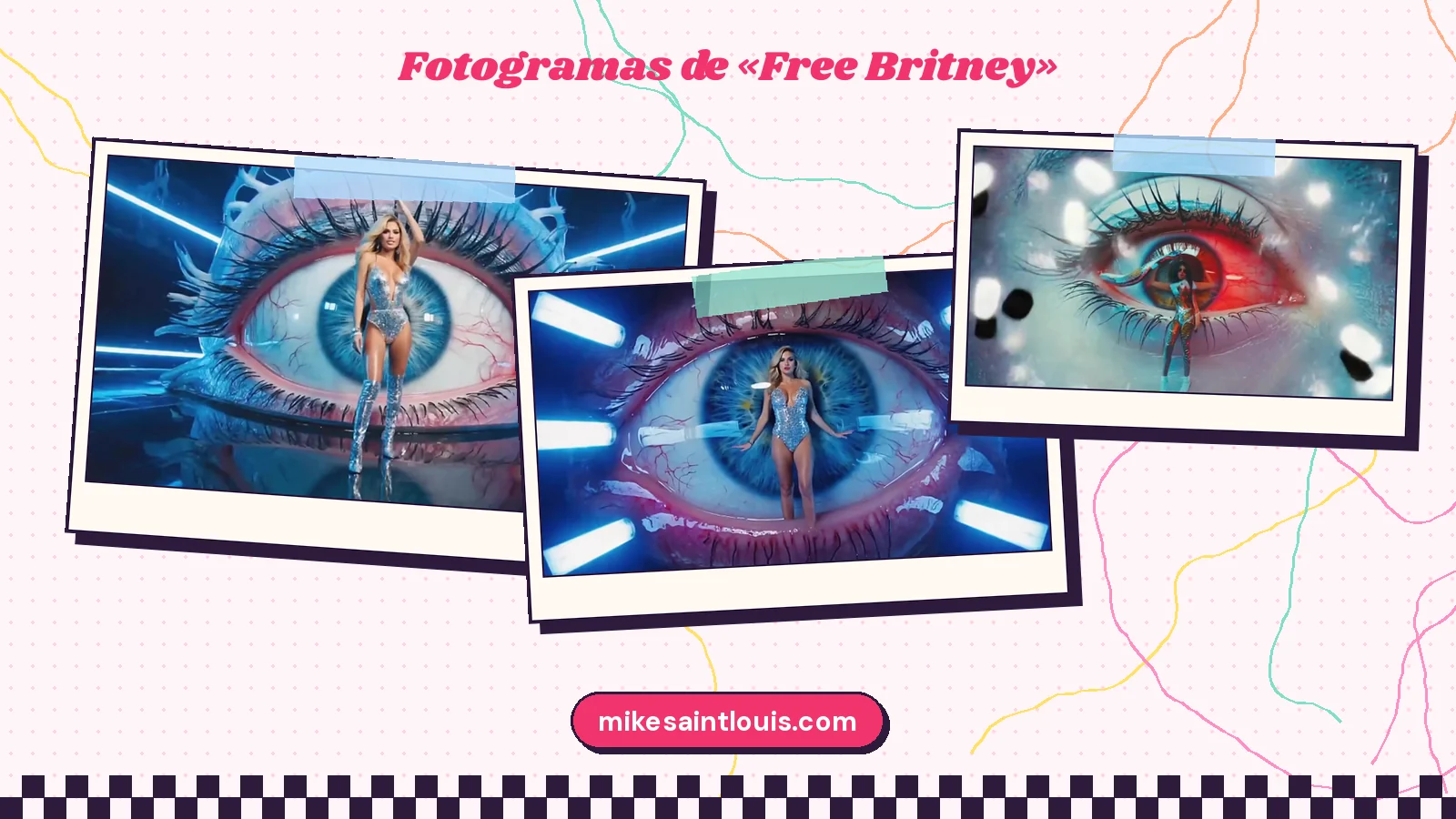
That's the first line of the text that goes with «Free Britney», and I wrote it in English because that's how you say these things when the stage is Las Vegas. What interests me about the line is the preposition. It doesn't say «under the lights», which is where any star stands. It says «behind». The lights weren't lighting her up: they were covering her. They were bars made of light.
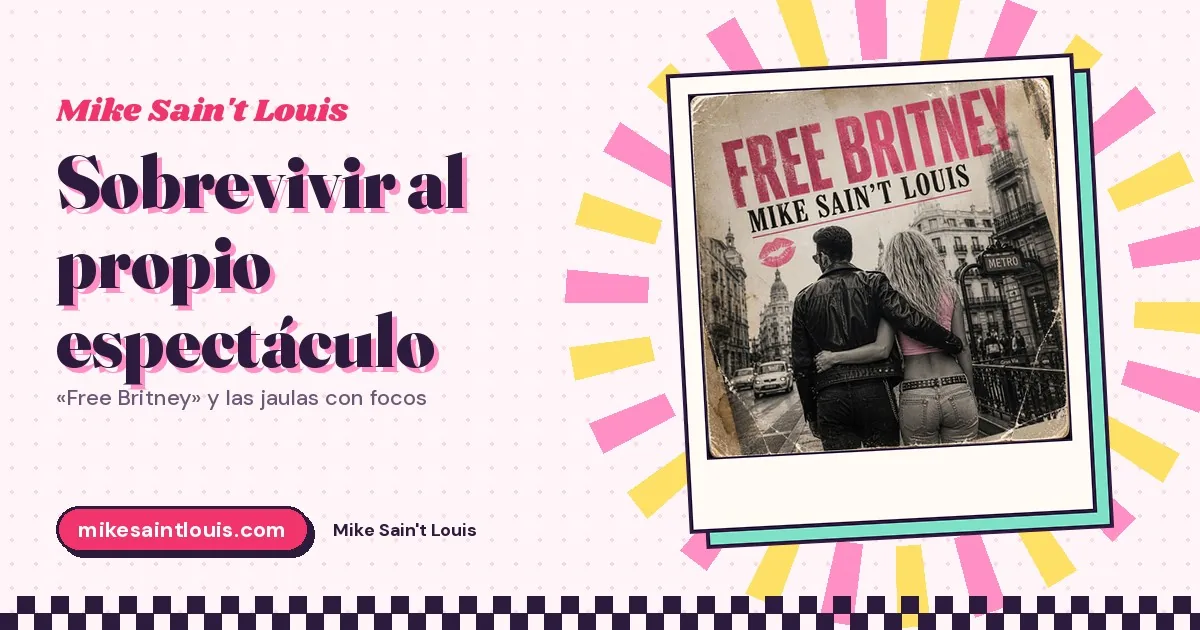
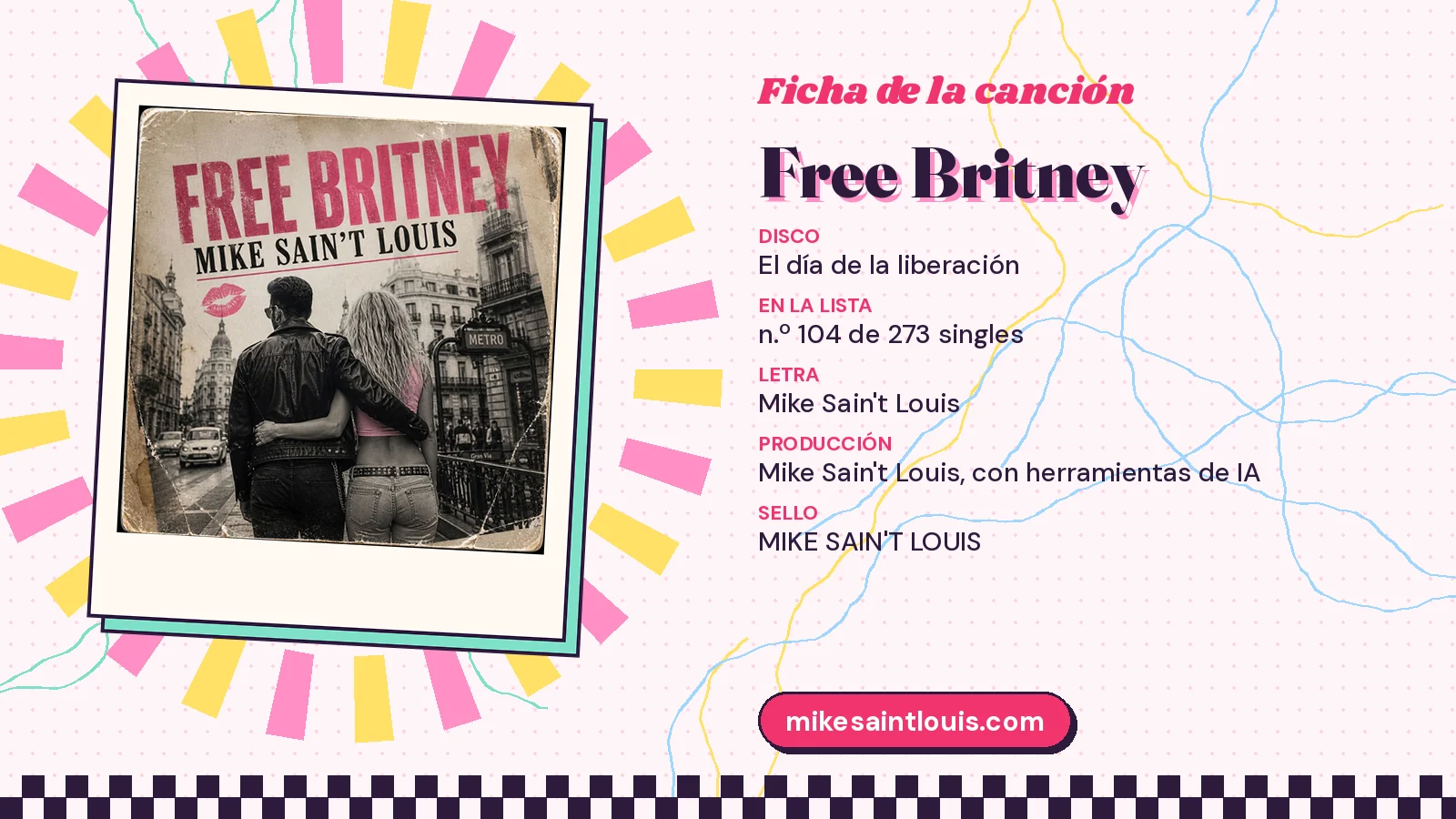
«Free Britney» is a tribute, and the song's page has the basics. Here I want to explain why a song of mine is named after a hashtag, what Britney Spears's story has to do with the rest of Planeta Gayfolk and why I put it on the album called, of all things, «El día de la liberación», Liberation Day.
A title that already existed
I didn't come up with «Free Britney». It was a slogan. A hashtag thousands of fans wrote for years on social media, on placards outside the courthouse in Los Angeles, on T-shirts, in Instagram comments. #FreeBritney.
Using something that already exists as a title is unusual in my catalogue. I normally invent long, absurd titles, full of names from Spanish telly. Here I took a ready-made slogan and put it on the cover as it was.
I did it because the slogan already said everything. There was no improving on it. Two words, an imperative and a name. Free Britney. Any other title would have been a worse paraphrase. And putting the hashtag on the cover was also a way of joining everyone who'd shouted it before me. I'm not the first. I'm one of many.
The conservatorship
For anyone who didn't follow it, a short summary of what happened, which is public and everywhere.
In 2008, after some very hard years, with breakdowns in front of the cameras and paparazzi chasing her day and night, a California court placed Britney Spears under a legal conservatorship. Her father took control of her money, her medical decisions, her career and a good chunk of her personal life. She kept working: albums, tours, a years-long Las Vegas residency, a judge's seat on a TV talent show. She earned millions. And she could decide almost nothing.
That conservatorship lasted thirteen years. In June 2021 she spoke to the judge and described, in her own words, what she was going through. In November that same year, the conservatorship ended.
I'm not a journalist or a lawyer, and I won't go into legal details I don't understand. What interests me is the image: a woman who filled stadiums and who, at the same time, couldn't decide whether to have a coffee or not. The most watched person on the planet, without a voice.
The cage with spotlights
There are a lot of cages in my catalogue. People trapped in relationships with narcissists, in punishing silences, in houses of a thousand corpses. But they're private cages. They happen in a flat in Madrid, on a beach in Benidorm, in a WhatsApp chat. Nobody sees them.
Britney's was the other way round. It was a public cage. With spotlights. With an audience. With paid tickets. Millions of people were looking at her and not seeing her.
That's what strikes me most about her story, and what I wanted to put in the song. That you can be trapped in front of everyone. That the show itself can be the cage. In the text I put it like this: the tribute is for «alguien que sobrevivió al propio espectáculo», someone who survived her own show.
Surviving your own show. I think it's the most precise thing I've written about fame. The show, which is supposed to be what makes you free, rich and admired, can be what eats you. And surviving it isn't winning it. It's getting out alive.
Why Britney is ours
Britney Spears is a gay icon. I'm not the one saying it: any dance floor in Chueca says it at three on a Saturday morning when «Toxic» comes on. Any drag queen says it who's ever done her in the schoolgirl uniform from «...Baby One More Time» or with the snake round her neck from the MTV awards.
Why have we queers identified with her so much? There are plenty of theories and I'm not going to write a PhD. I'll give you mine, which is short.
Because we watched her fall. And we saw ourselves. A girl everyone loved while she was perfect and everyone despised once she broke. Who was a joke on TV when she shaved her head in 2007. Who was on magazine covers for being in a bad way. For a lot of people who were the odd one out at school, the one who breaks, the one who doesn't fit what's expected, that's very recognisable.
And then because she came back. Again and again. With albums, with tours, with routines. Broken and standing. That mix of fragility and resilience is what gets us most. We don't want invincible icons. We want icons who fall over and get back up in heels.
Other people's laughter
In 2007 the whole of Spain laughed at Britney. The TV shows, the magazines, the jokes at the bar. The clippers, the umbrella against the paparazzi's car. People made carnival costumes of her. Hardly anyone escaped laughing at some point, without thinking.
Now we know a bit more about what was behind it. And the laughter has changed sides.
I wrote about that in from other people's laughter to our own. There's a laughter that laughs at someone lying on the ground, and another that laughs with someone who's got back up. The first is cruelty. The second is complicity. Queer culture knows a lot about both, because it's been the victim of the first for centuries and invented the second to defend itself.
«Free Britney» wants to be the second kind. I'm not laughing at her. If I'm laughing at anyone, it's at everyone who laughed.
Silenced for being too human
There's another line in English in the text that I like: «A girl who just wanted to dance, who became the voice of an entire generation, and was silenced for being too human».
Silenced for being too human.
What Britney was punished for wasn't a crime. It was breaking. Crying in public, having a breakdown, shaving her head, picking the wrong husband, eating at a petrol station barefoot. Things plenty of people do. Human things. And the punishment was having control of her life taken away.
This connects with everything I write about narcissism. One of the things a narcissist does is convince you that your emotions are the problem. That you cry too much. That you exaggerate. That you're mad. In «No puedo desenchufar este ventilador que está esparciendo mierda» («I can't unplug this fan that's spraying shit everywhere») there's a line where the other one is ready to write you off «por esquizofrénico desquiciado», as an unhinged schizophrenic, to cover up what he's done. It's the same mechanism, in miniature: turning your pain into proof that you can't make decisions.
They did it to Britney on a grand scale, with judges and lawyers. Plenty of people have it done to them at home, no judge required.
The Britneys back home
When I think about Britney, I immediately think of the Britneys back home. The women of Spanish television the whole country turned into a joke, who have their own song in my catalogue.
Ylenia Padilla, to whom I dedicated «Yo apoyo públicamente a Ylenia Padilla», with a line Britney could sign: «Yo también he sentido alguna vez / que todo el mundo me ha fallado» («I too have felt at times / that everyone has let me down»). Yurena, who in «I Am Yurena» says «Yo no soy Tamara la mala, / tira de hemeroteca» («I'm not Tamara the bad one, / go and check the archives»), reclaiming her name against the one they gave her. Malena Gracia, whom I turned into a candidate in galactic elections in «Vota Malena Gracia».
They're very different women, with very different stories. But they have something in common with Britney: the country laughed at them, a lot, in prime time. They were wheeled out on afternoon shows to be mocked. They were turned into characters and people forgot there was a person underneath.
I'm not saying their stories are the same as Britney's, they aren't, not by a long way. None of them spent thirteen years under a conservatorship. I'm saying the mechanics of the laughter are the same. First you turn a woman into a show. Then you punish her for not behaving the way the show expected. And then, years later, someone apologises in a documentary.
My songs about them are, deep down, Spanish-style «Free Britney» songs. Tackier, more TV-studio, more Telecinco (the channel that lived on this stuff). But with the same idea: free the woman underneath the joke.
Having your words taken away
There's one detail of Britney's story that strikes me as the most terrible of all. For years, when she spoke in public, what she said went through other people. The interviews, the social media, the statements. Her name was everywhere and her own words were nowhere.
In June 2021, when she finally spoke to the judge, many people truly heard her for the first time in over a decade. And what she said looked nothing like what had been said about her.
That's what gets to me most as a lyricist. Because words are my thing. I produce the songs using artificial intelligence as a tool, but the lyrics are mine, always. It's the one thing I don't negotiate, house rule number two: the lyrics are in charge. If someone took that away from me, if someone wrote my lyrics for me and signed them with my name, they'd have taken everything.
Britney had her words taken away for thirteen years. And she got them back in front of a judge. There's no album of hers that impresses me more than that testimony.
Having your words taken away is the worst cage. Worse than the one with spotlights.
In English and in Spanish
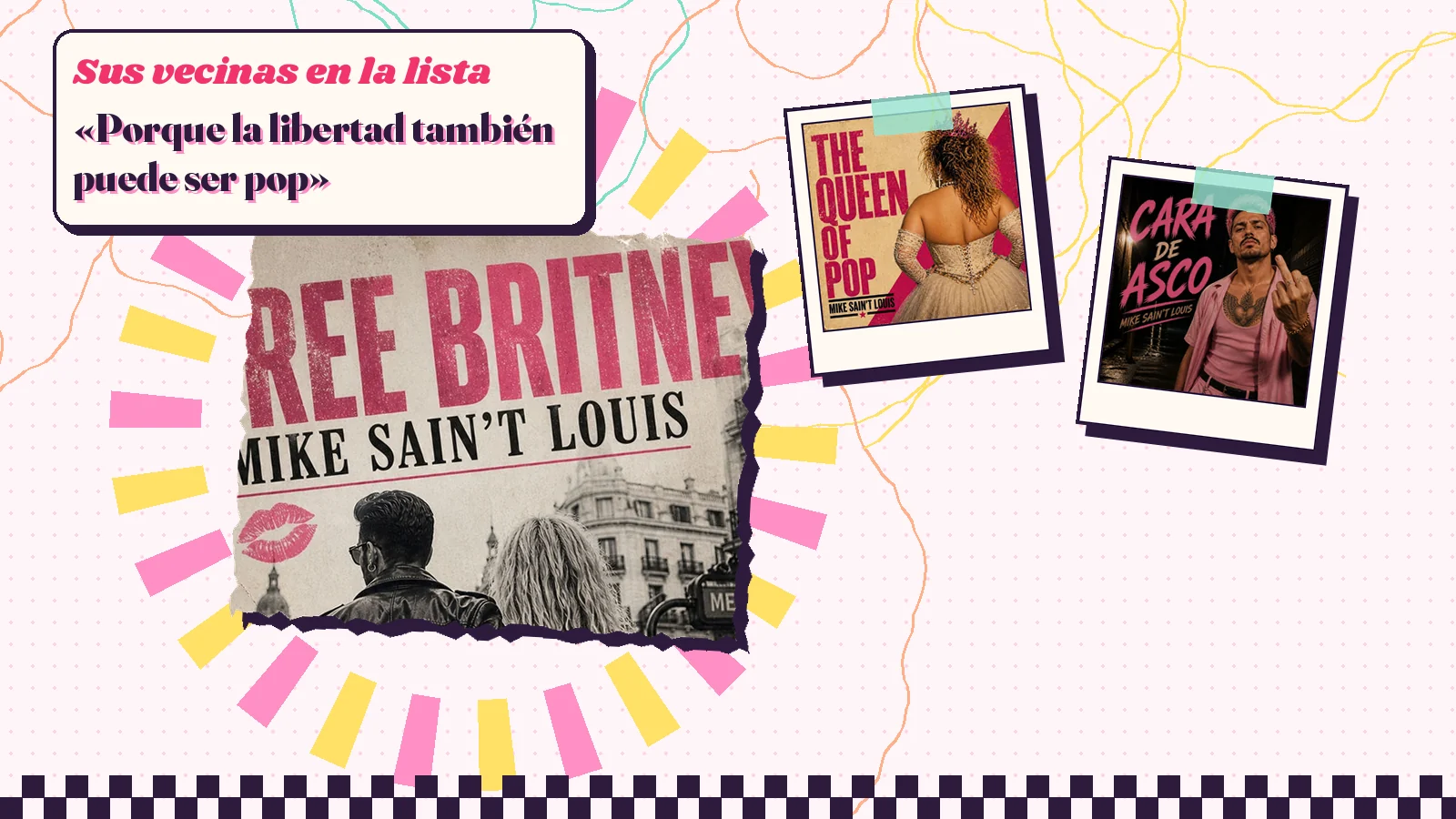
The song's text mixes the two languages. It starts in English and carries on in Spanish. I do the same in other songs, like «The Queen of Pop», my tribute to Madonna, which has its introduction in both languages. Its page is on the blog.
With Britney it made sense. It's an American story, with Los Angeles judges and Las Vegas residencies, and English is the language the hashtag was shouted in. But I'm from Madrid, I write mostly in Spanish, and what I want to say I say better in my own language. So the song goes from one language to the other, like someone crossing the Atlantic.
I talked about why I write in several languages in I write in Spanish: why my website is also in English.
«Freedom can be pop too»
The last line of the text is my favourite: «Porque la libertad también puede ser pop», because freedom can be pop too.
Lots of people think pop is the opposite of freedom. That it's the music of the industry, of millionaire producers, of calculated choreography, of contracts that tie you down for ten years. And they have a point: Britney's story proves it. Pop can be a gilded cage.
But it can also be the opposite. Pop is the music we oddballs dance to in the clubs where we can finally be ourselves. It's «Toxic» at three in the morning with your best friend. It's the chorus you know by heart and yell after a horrible day. It's the song that cheers you up on the bus.
Pop is a cage and a key at the same time. What decides which one it is, is who controls it. When the industry controls it, or a judge, or a father, it can be a cage. When you control it, it's freedom.
That's why I have my own label. That's why nobody decides for me what I release. I say it modestly, because I'm nowhere near Britney, and I have neither her audience nor her money. But I do know what it is to decide. And I wouldn't trade that for anything.
Freeing isn't rescuing
There's a difference that matters to me between freeing and rescuing.
Rescuing is what the prince does in fairy tales: he turns up, gets the princess out of the tower and rides off with her on his horse. The princess does nothing. She's a parcel changing hands. A lot of stories about famous women in trouble work like that, with a saviour who appears and sorts it out.
Freeing is something else. Freeing is removing the obstacle so the other person can walk out on their own two feet. The hashtag said «free», not «save». The fans couldn't get Britney out of anywhere. What they could do was shout, make noise, shine a light on what was happening, so that she could speak. And when she spoke, it was her. Nobody spoke for her.
I like that my song is named with that verb and not the other one. Because in my catalogue nobody rescues anybody. Nobody arrives on a horse. In the narcissism songs, whoever gets out gets out alone, sometimes crawling, like the drag queen in Benidorm. The most someone on the outside can do is open a door, or stop keeping it shut.
Free, not rescue. A one-word difference that changes everything.
On «El día de la liberación»
The song is on the third album of the trilogy, «El día de la liberación». It couldn't have been on any other.
The first album announces the planet. The second longs to travel there. The third is about arriving and being free. And Britney's story, at least the public part we know, ends with a liberation: the conservatorship ended in November 2021.
I'm not saying her life is perfect now, I don't know and it isn't my business to know. I'm saying there was a liberation day. A day when a judge said that's enough. And on that day, millions of people who'd never met her celebrated it as if it were their own.
That's what interests me. That one person's liberation can be many people's. That when someone gets out of a cage, all of us who are in one feel the door open a little.
I told that story in «El día de la liberación» and the day after. Liberation isn't the end of the story. It's the start of another one. And the next day you have to learn to live without bars, which is harder than it looks.
A tribute without imitation
The text says it plainly: «Este homenaje nace desde el respeto, desde el dolor y desde la admiración» («This tribute comes from respect, from pain and from admiration»).
Respect. I didn't want to do a Britney parody, or an impression, or a song that sounded like her. That would be easy and a bit tacky. Take her style, her «oh baby baby», her routines, and make a pastiche. There are a thousand songs like that online.
What I wanted was something else. To talk about what happened to her from my planet. In my own words. From the outside, as a fan, but without dressing up as her.
It's what I do with the other tributes in the catalogue. With Madonna in «The Queen of Pop». With Paco León in «¡Qué polvo tiene Paco León!». With Ylenia Padilla, whom I publicly support in an entire song. With Malena Gracia, candidate in galactic elections. My tributes are fan letters from another planet, not copies.
The figures don't tell it
There's something that strikes me as funny about Britney's story, if anything about that story can be funny. During the conservatorship years, her numbers were spectacular. Albums sold, sold-out shows, streams. If you only looked at the figures, everything was perfect.
And it wasn't perfect.
I remember this every time someone asks me how many streams I've got, as if that said anything about me. I wrote about it in what Spotify doesn't tell you about an artist. Figures tell you how many people listen to you. They don't tell you whether you're free. They don't tell you whether you're OK. They don't tell you whether the person signing your contracts is you.
Britney had record-breaking figures and no freedom. I'd a thousand times rather have the opposite. Few listens and my house keys in my own pocket. So that the day I want to release a song on a Tuesday at three in the afternoon, I release it, without asking anyone's permission.
For the dance floor and for home
«Free Britney» works at a party, on a Pride playlist, in a queer pop set. If you want ideas for that, I have a post on what a Pride dance floor asks for and another on how to build a Spanish-language queer playlist that doesn't sound like the usual one.
But you can also listen to it at home, on your own, thinking about your own cages. Because we all have one. Not with judges, maybe. But with someone who decides for us, or with a version of ourselves that won't let us out.
Free Britney. And while you're at it, free yourselves a little.
What isn't in this post
There's nothing here that isn't public. No speculation about her health, her family or her private life. There was enough speculation for years, and a lot of what was said was cruel and false. I'm not adding to it.
There's no judgement on her father or anyone specific either. The courts did their job, and I write songs, not verdicts.
What there is, is what the song's text says: respect, pain and admiration. And a line I sign in full: freedom can be pop too.
For media who want to talk about this or other tributes in the catalogue, the press material is in the press section.
Frequently asked questions
What is «Free Britney» about? It's a tribute to Britney Spears from Planeta Gayfolk. It's about a star «trapped behind the lights», silenced «for being too human», who «sobrevivió al propio espectáculo», survived her own show.
Why is it named after the hashtag? Because the #FreeBritney slogan already said it all and Mike Sain't Louis wanted to join the people who shouted it during the conservatorship years.
Which album is it on? «El día de la liberación», the third album of Planeta Gayfolk's GAYFOLK trilogy.
Is it an imitation of Britney's style? No. The song's text presents it as a tribute that «comes from respect, from pain and from admiration», not as a parody or a pastiche.
Who wrote the song? Mike Sain't Louis, a lyricist, composer and producer from Madrid. The music and vocals are produced using artificial intelligence as a tool; the lyrics are his.