By Mike Sain't Louis ·
Burning out or lighting up?: «Light It Up», the angel in sunglasses and the night of the bonfires
A match does two things at once, and they can't be separated. It gives light and it uses itself up. There's no way to ask for one without the other. The more it lights, the less of it is left. It's the smallest, most domestic form of an enormous dilemma: all the things that, in order to shine, have to wear themselves out.
When I put up the page for «Light It Up» on my site, I asked myself a question looking at its cover that I still haven't managed to answer: is he burning out or lighting up? This text is an attempt to turn that question over without betraying it.
An angel in sunglasses
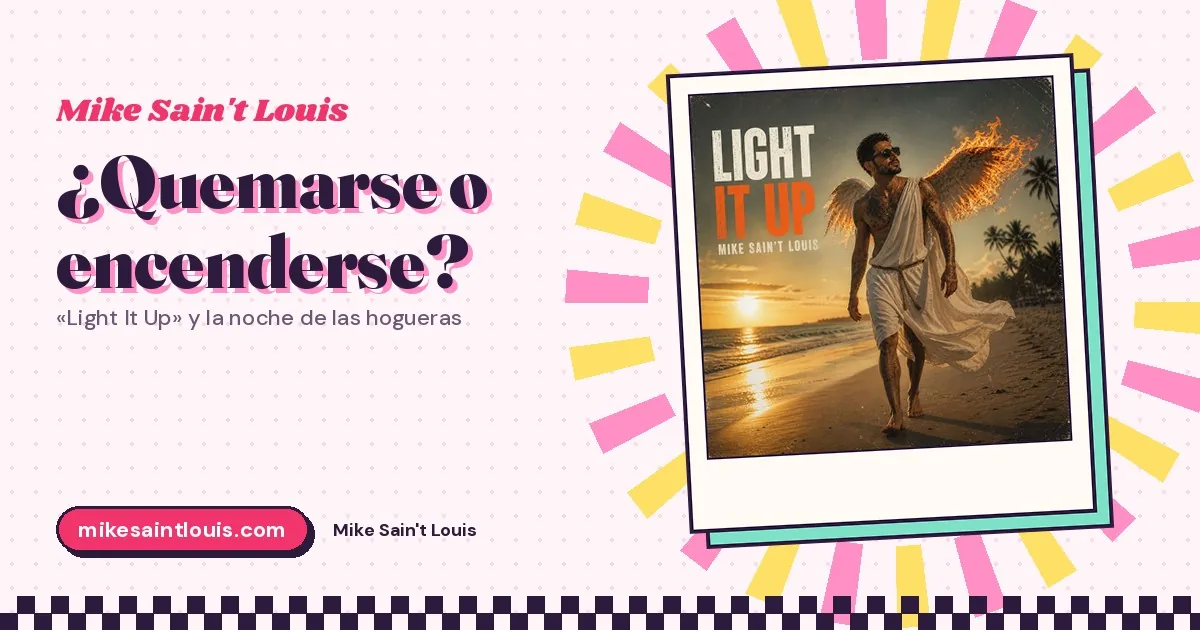
The scene is a beach at the end of the day. The sun is about to touch the sea on the left and lays a golden trail on the water that reaches almost to the shore. On the right, a cluster of palm trees stands dark against the sky, and among them you can make out a low building, like a beach bar or a beach house. The whole image has the finish of an old photograph, with scratches, dust and worn edges, like a record sleeve that has spent many summers on a sunny shelf.
Along the wet sand comes a barefoot man. He wears a white tunic of thin, creased fabric, crossed over one shoulder and tied at the waist with a braided cord hanging down in two tassels. The other shoulder and half his chest are bare, and you can see his body is covered in tattoos: arms, chest, legs, as if his skin were a whole book written by hand. Trimmed beard, short dark hair, a thin chain round his neck and black sunglasses. He's looking to one side, not at the camera, with a half smile.
And on his back, large wings with pale feathers. The left one is intact. The right one is burning at the tips. The flames rise orange and throw off sparks that vanish into the air, but he walks on as if nothing were happening, unhurried, the hem of his tunic floating in the wind.
On the song's page I called him a very unheavenly angel: tattooed, in dark glasses and strolling like someone coming back from a party on the shore. I still think that's the best description.
Before going on
The lyrics of «Light It Up» haven't been published yet. They're not on my lyrics page, and I'm not going to fill the gap with supposed lines or machine transcriptions, which with music underneath get one word in three wrong. When they're ready, they'll appear in the lyrics section, alongside the rest.
What I can use is what's in plain sight. The cover. The title, which means something like «switch it on», «light it up», «set it on fire». The video, posted on my YouTube channel on 12 June 2026. The four genre tags I gave it, mixing indie, alternative pop, queer and camp. The album it lives on. And the paragraph I devoted to it on my website, which ended by recommending you put it on when the sun goes down and the evening still hasn't decided whether it'll be quiet or end in chaos.
With that, and with the question of fire, I have more than enough to write.
Burning out or lighting up
In Spanish we have a beautiful, dangerous word: quemado, burnt. You're burnt out from work, from a relationship, from a city. It means there's no fuel left, that everything that was burning has turned to ash. The curious thing is that you have to have burned a lot to get there. Nobody burns out without having been alight first.
The English term, burnout, was popularised in 1974 by psychologist Herbert Freudenberger, who worked at a free clinic in New York and watched how the most dedicated volunteers ended up exhausted, cynical and empty. Shortly afterwards, psychologist Christina Maslach developed a way of measuring it that is still used. In 2019 the World Health Organization included it in its international classification as a work-related phenomenon, though without considering it an illness in itself.
The cover of «Light It Up» puts those two ideas, burning out and lighting up, in the same image. The flames on one wing could be the beginning of wear, the moment something that carried you starts to be consumed. Or they could be the opposite sign: someone who has finally caught fire. What I find most interesting is that he isn't frightened. He doesn't try to put anything out. He keeps walking. As if he had understood that the fire, for now, is his.
The shortest night
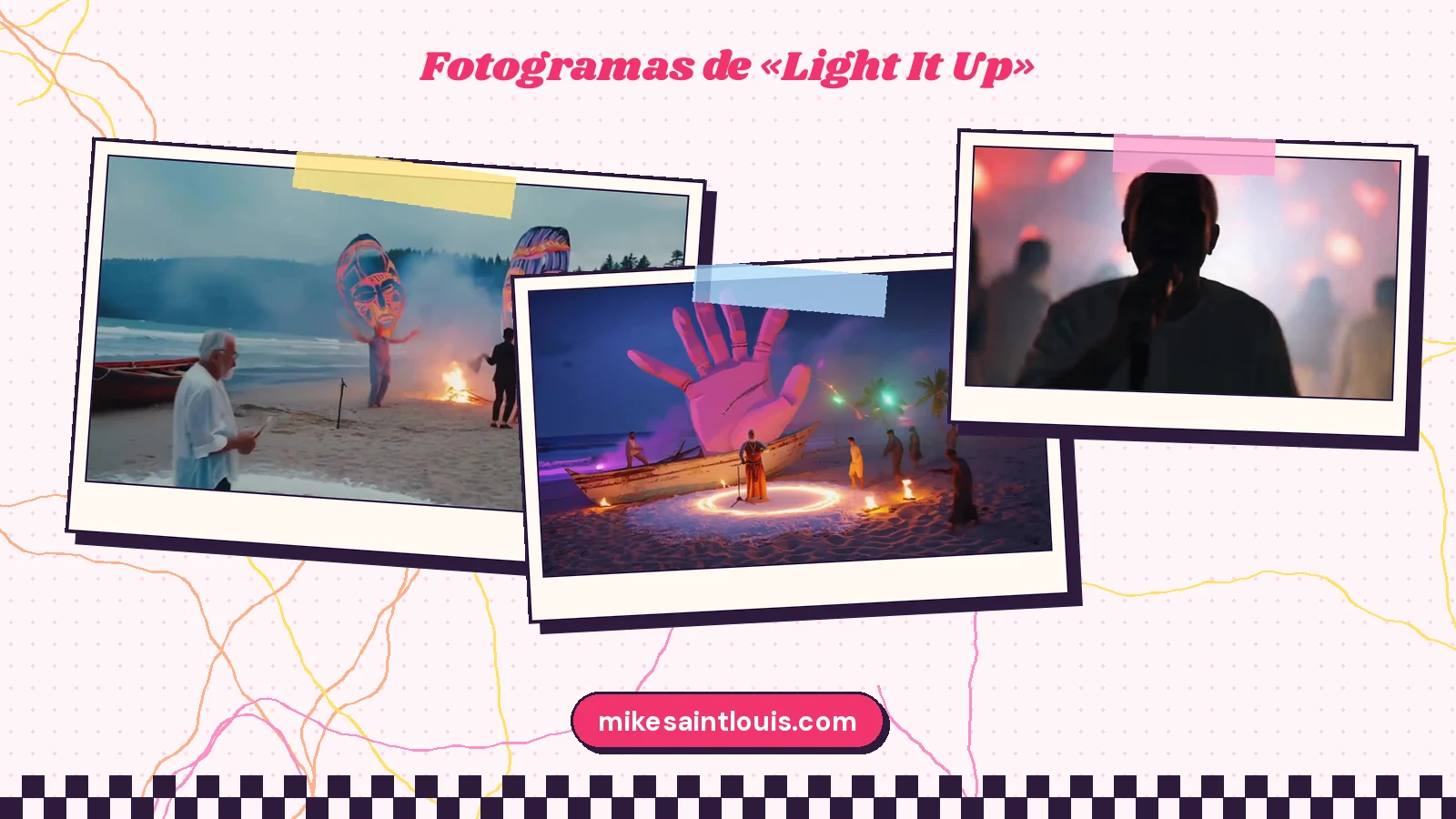
There's one night in Spain when lots of people go down to the beach to do exactly what this cover suggests: light fires on the shore. Saint John's Eve, the night of 23 to 24 June, is celebrated with bonfires on the sand in a great many coastal towns. People jump over the flames, write on scraps of paper what they want to leave behind and burn them, and at midnight they walk into the sea.
In Alicante, the Hogueras de San Juan are one of the big festivals of the year: monuments of cardboard and wood set up in the streets and burned on the night of the cremà. They have been recognised as a Festival of International Tourist Interest since the eighties. In other towns the tradition is simpler: a circle of friends, a pile of wood, some cans and a towel on the sand.
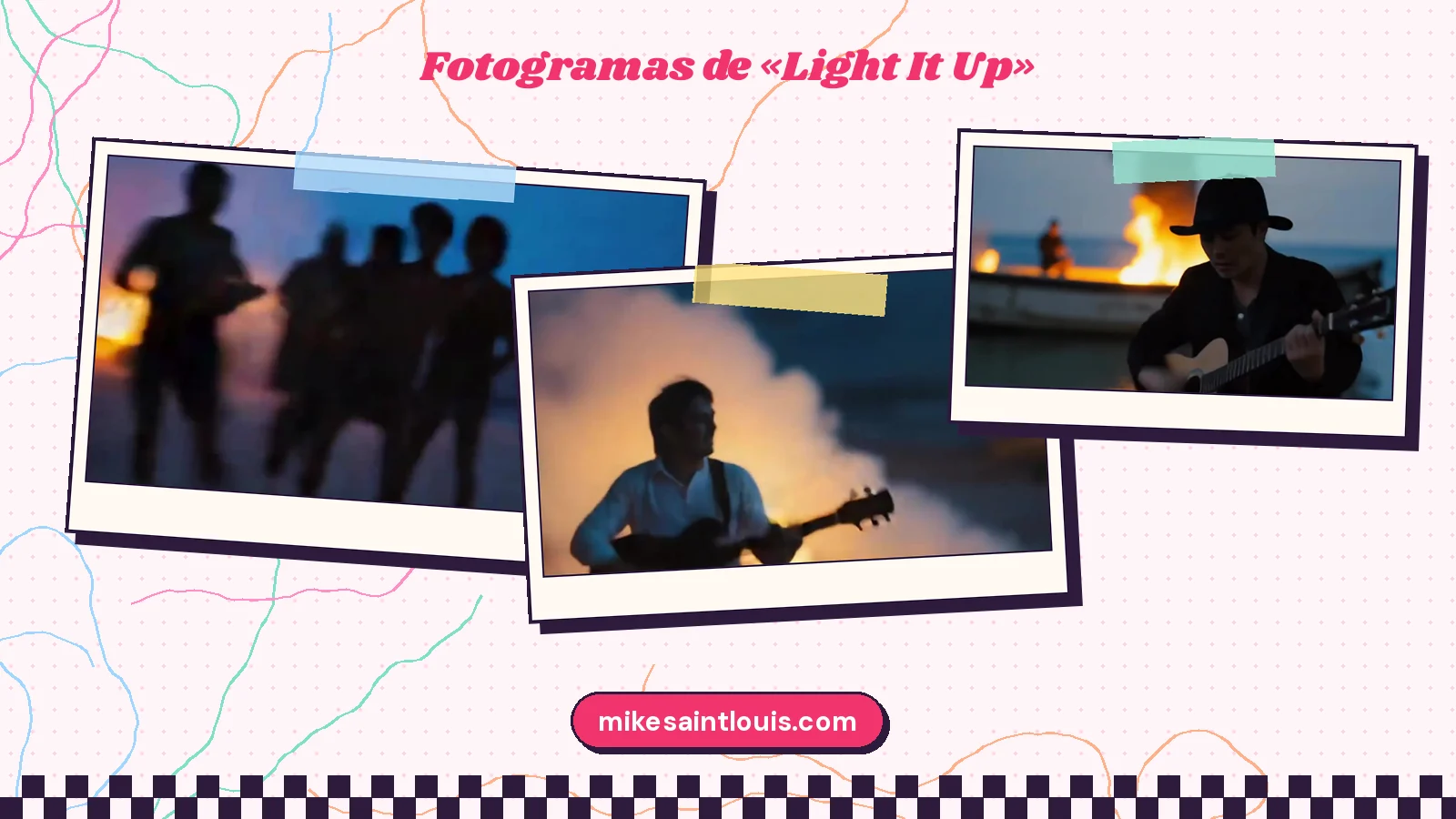
I uploaded the «Light It Up» video to YouTube on 12 June, less than two weeks before that night. I'm not saying the song is about Saint John's Eve, because I don't have the lyrics published to claim it. But the cover, with its beach at sunset and its burning wings, seems made for that time of year when lighting a fire on the shore is almost an obligation. Burning the old to make room.
I especially like the paper-scrap custom. Writing down what you have too much of, watching it burn and staring at the sparks. It's the closest thing we have to a cleansing ritual without needing to believe in anything. And it's exactly what the angel on the cover seems to be doing: strolling while what weighed on him turns into light.
The trail on the water
There's a detail on the cover I'm a bit obsessed with: the sun's reflection on the sea. It isn't a point, it's a path. A golden strip coming from the horizon and reaching almost to the angel's feet, broken into a thousand flashes by the small waves at the water's edge. Anyone who has been on a beach at that hour has seen it, and everyone has had the impression that the path comes straight towards them, wherever they stand.
It's a very simple optical effect. Moving water works like millions of tiny mirrors tilted in every direction, and only those at exactly the right angle send the light back to us. That's why the trail always points at whoever is looking. Take ten steps to the left and the path follows you.
It seems a lovely image for a song called «Light It Up». Light isn't shared out equally. Each of us sees our own golden path, and nobody can see exactly someone else's. On the cover, that path reaches the angel from the left while the fire comes out of his right wing. He's lit from both sides. By the setting sun and by what he himself is burning.
Sunglasses at the last hour
Sunglasses at sunset aren't much use. The sun is already low, the light is soft, and yet the angel is wearing them. That turns them into what they have always really been: a pose. A shield. A way of looking without your eyes being looked at.

Film and pop music have known this for a long time. The Wayfarers, those black-framed sunglasses Ray-Ban launched in 1952, had a second youth after Tom Cruise wore them in «Risky Business» in 1983. The following year, Corey Hart turned a whole song about wearing sunglasses at night into a hit. Putting them on when you don't need them is a statement: here I am, but what I think I keep to myself.
On an angel, the gesture is stranger still. Angels in paintings look straight ahead, with huge eyes that see everything. Mine covers them. Maybe because what comes from the party, or what's burning on his back, isn't told with a look.
A tunic from somewhere else
The angel's clothing isn't that of a holy-card angel. It's a white tunic, crossed and tied with a cord, more ancient Greece than altarpiece. It recalls the chitons seen on painted vases and, above all, what cinema did with them in the twentieth century.
The sword-and-sandal epic, that genre of Romans, gladiators and emperors that filled screens in the fifties and sixties, was also an endless source of exposed male bodies under the excuse of history. Togas, sandals, oiled torsos. In the 1995 documentary «The Celluloid Closet», writer Gore Vidal said he had deliberately introduced a homosexual subtext into the relationship between Judah Ben-Hur and Messala when he worked on the script of the 1959 «Ben-Hur». Charlton Heston, its star, always denied it. Whoever is right, the anecdote proves that there was always more in those tunics than was being told.
The angel on my cover comes from that tradition, but without disguise. He wears the tunic loose, his tattooed skin on show and sunglasses no gladiator would have worn. It's the sword-and-sandal epic turned into a beach party. Very camp, as I'd say, and if anyone doubts what I mean by that word, there's my defence of camp as something serious even if you laugh.
Prometheus and the match
If one fire myth comes to mind with this image, it's Prometheus. The titan who stole fire from the gods and gave it to humans. For that favour, Zeus chained him to a rock, where an eagle ate his liver every day and the liver grew back every night. Eternal punishment for having shared the light.
What I like about the myth is that fire, from the start, is a gift with a price. It let us cook, keep warm, light the night and frighten off wild animals. It also let us burn forests, cities and people. It's the most ambiguous tool in human history.
The angel on the cover hasn't stolen anything. The fire grows out of his wing, as if it had always been his. But he shares with Prometheus the attitude of someone who accepts the price. He knows he's burning and still doesn't hide it. He walks it along the shore for everyone to see.
There's another version of the myth I like even more: that Prometheus didn't just bring fire but shaped the first humans out of clay. In other words, the same figure who made us then gave us the means to light ourselves up. We're clay with a match in our hand. Very little, if you look closely, and yet capable of setting a whole beach alight on the shortest night of the year.
That mix of fragility and power is what I see on the cover. A body of flesh, with tattoos that will one day blur, with feet that leave prints in the wet sand that the next wave will erase. And above that body, wings on fire.
Barefoot along the shore
There's something very meaningful in his walking barefoot. Bare feet are the opposite of a pose. You take your shoes off when you no longer need to impress anyone, when you get home, when you step onto sand. It's a gesture of trust in the ground.
In the history of performance, going barefoot has also been a small provocation. At the start of the twentieth century, Isadora Duncan scandalised theatres around the world by dancing without ballet shoes, in loose Greek-inspired tunics. And in 1967, Britain's Sandie Shaw won Eurovision in Vienna performing barefoot with «Puppet on a String». That such a small gesture could draw so much attention says a lot about how closely bodies on stage have always been watched.
The angel of «Light It Up» wears a Greek tunic like Isadora and goes barefoot like Sandie Shaw. I don't know if it's coincidence or if my covers have a camp memory I don't control. I lean towards the second.
Walking on sand at that hour has something of a reward about it. During the day it burns, and you have to hop across it to your towel. At sunset it has cooled just enough, still warm underneath, and lets itself be walked on slowly. The angel has chosen exactly that moment, when the ground no longer punishes.
Written skin
This angel's tattoos cover almost his whole visible body: both arms entirely, his chest, his legs from the ankles up. You can't make out specific designs, just a web of dark strokes that disappears under the tunic. It's skin that has wanted to say a lot.
I wrote about the flesh that appears in my lyrics, muscled, inked or grey-haired, in another long piece, and about wings in the post on «Fly Away», from the same album. There the wings were black, crow's wings, and the boy flew with his eyes closed. Here the wings are pale and burning, and the angel walks with his feet on the ground and his eyes hidden behind dark glasses. I like how the two covers answer each other. One leaves through the air; the other stays on the shore and lights up.
The fires in my songs
Fire appears in several of my songs, and almost never in the same way. In «Al fuego» the bonfire was for getting rid of what an ex left behind, with all the rage of someone throwing letters and photos into the flames. In «Los fuegos artificiales de Móstoles» fire was a neighbourhood party, gunpowder and a street fair. Two very different fires: one destroys to close a chapter and the other lights up to celebrate.
«Light It Up», by its cover and title, seems to move between the two. Something is burning, the wing, and something is being celebrated, the stroll, the beach, the golden evening. Without the lyrics I can't say which way the song leans, and I'd rather leave it like that. The question I asked on its page stays open on purpose.
Between the rubbish tip and Bob Marley
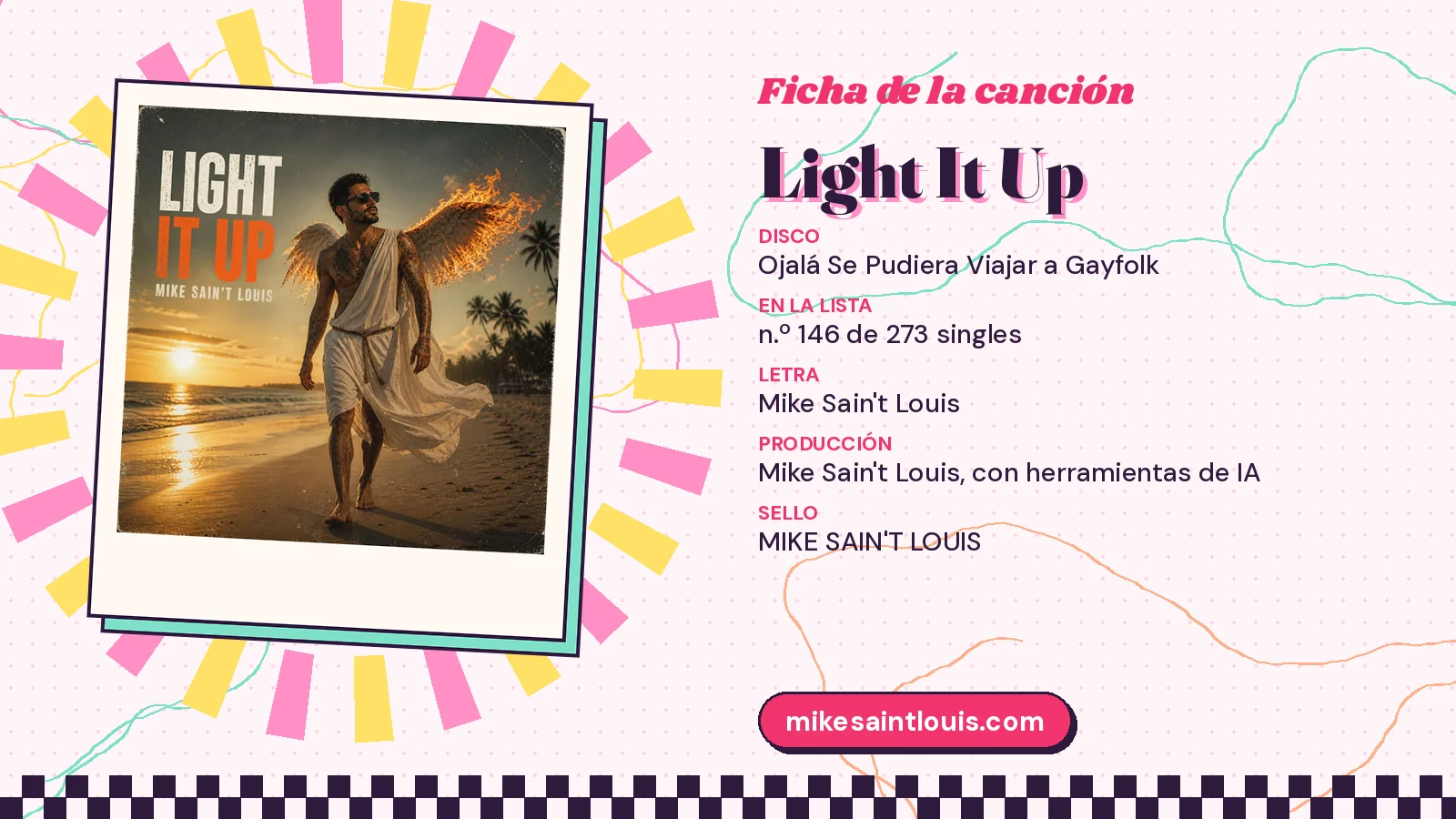
In the ordered discography on gayfolkplanet.com, «Light It Up» sits wedged between two tracks with very little in common. Before it comes «En el basurero» (At the rubbish tip), with its torn pink jacket and discarded objects. After it comes «Bob Marley». I enjoy looking at that order as if it were a whole afternoon. First, what others have thrown away. Then the beach, the sunset and a fire that lights everything. And finally, the reggae of the night.
It may be a whimsical reading, but track lists tell stories too, even when nobody wrote them on purpose. And this is a pretty good story: from rubbish to light.
The evening that hasn't decided
I left it said on its page that I'd put it on when the sun goes down and the evening still hasn't decided whether it'll be quiet or end in chaos. I love that indecision. It's the exact moment when a beach afternoon can turn into a quiet dinner with friends or into one of those nights remembered for years, for better or worse.
I've already written about what comes after those nights in the post about cheap booze and hangovers. «Light It Up» comes before. It's the promise, not the consequence. It's the angel walking along the shore when everything is still possible, when the fire on the wing could still be a torch or a catastrophe.
And at that moment, I think, the best thing to do is what he does: keep walking unhurried, glasses on, looking to one side with a half smile.
When it really burns
I want to give a few lines to the other side of fire. There are people who have been burning for so long, at work, at home, caring for others, that one day they find there's nothing left. That they no longer feel excited about what they used to love. That they wake up exhausted and go to bed worse. That isn't laziness or weakness. It's real wear and it deserves attention.
If you feel like that, talk to someone: your GP, a mental health professional, a person you trust. And if at some point the exhaustion turns into not wanting to be here, call 024 if you're in Spain: it's free, it works day and night and there are people trained to listen on the other end. In immediate danger, 112. If you're outside Spain, contact your local emergency number or find a helpline at findahelpline.com.
I have more phone numbers and resources together in my posts on mental health without taboo. A song about lighting everything up doesn't mean you have to burn to the end.
The middle chapter of the trilogy
The album that holds it is *Ojalá se pudiera viajar a Gayfolk* (If only you could travel to Gayfolk), the middle instalment of my GAYFOLK trilogy. It's an album shot through with the wish to reach somewhere else, to find a place to live without asking permission. On that map, a beach at sunset with a tattooed angel strolling barefoot is almost a postcard from the dream destination.
It's also one of the albums with the most light in the whole trilogy, at least on its covers. Sunsets, beaches, pink skies, palm trees. As if the planet Gayfolk, seen from afar, always had its golden hour switched on.
Who I'd put it on for
For whoever goes down to the beach on Saint John's Eve with a scrap of paper in their pocket. For whoever has skin full of ink and walks in it without apologising. For whoever has burned out at some point and is learning to light up in another way.
For whoever puts on a tunic, or a bedsheet, at a fancy-dress party and feels better-looking than ever. For whoever doesn't yet know whether the evening will be quiet or end in chaos, and is fine with that. And for whoever, like the angel on the cover, has a wing on fire and keeps walking along the shore as if it were the most normal thing in the world.
Frequently asked questions
What is «Light It Up» about?
The lyrics aren't published yet and I'm not summarising or inventing them. The cover shows a tattooed angel in a white tunic and sunglasses walking barefoot along a beach at sunset while one of his wings burns. On its page I wondered whether he's burning out or lighting up, and the title points to the second.
Which album is it on?
It belongs to «Ojalá se pudiera viajar a Gayfolk», the middle album of GAYFOLK. Its video has been on YouTube since 12 June 2026.
Is it about Saint John's Eve?
I can't claim that without the lyrics. This post connects the cover, with its beach and fire, to the Saint John's Eve bonfires because the image invites it, but it's a reading, not an explanation of the song.
What style is it?
On YouTube I tagged it as indie pop and alternative pop, with a queer surname and a good dose of camp.
Who makes the music and the vocals?
Mike Sain't Louis, a lyricist, composer and music producer from Madrid, "the first AI songwriter". He writes, composes and produces; the vocals are made with artificial intelligence.