By Mike Sain't Louis ·
He doesn't ask, doesn't pretend, doesn't demand: «El abrazo de Pitufo» versus the narcissist
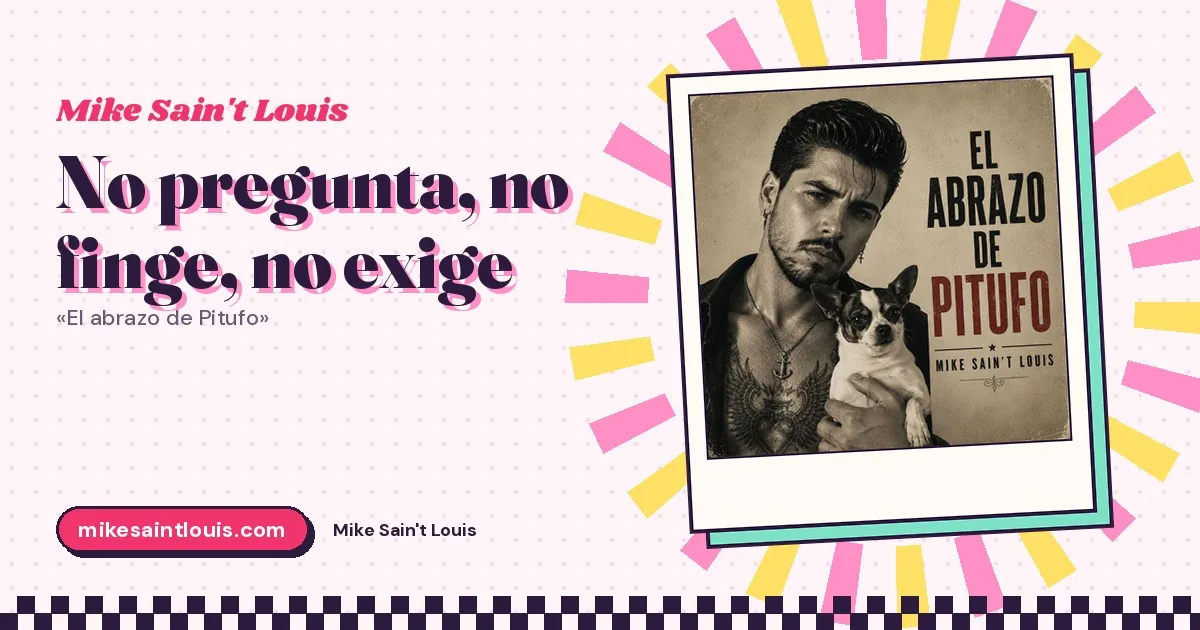
«Pitufo no pregunta, no finge, no exige.» («Pitufo doesn't ask, doesn't pretend, doesn't demand.»)
If someone asked me to sum up the exact opposite of a narcissist in one line, I'd give them that one. Three negated verbs. Three things Pitufo doesn't do. And each of them is precisely what the protagonists of half the Planeta Gayfolk catalogue do do.
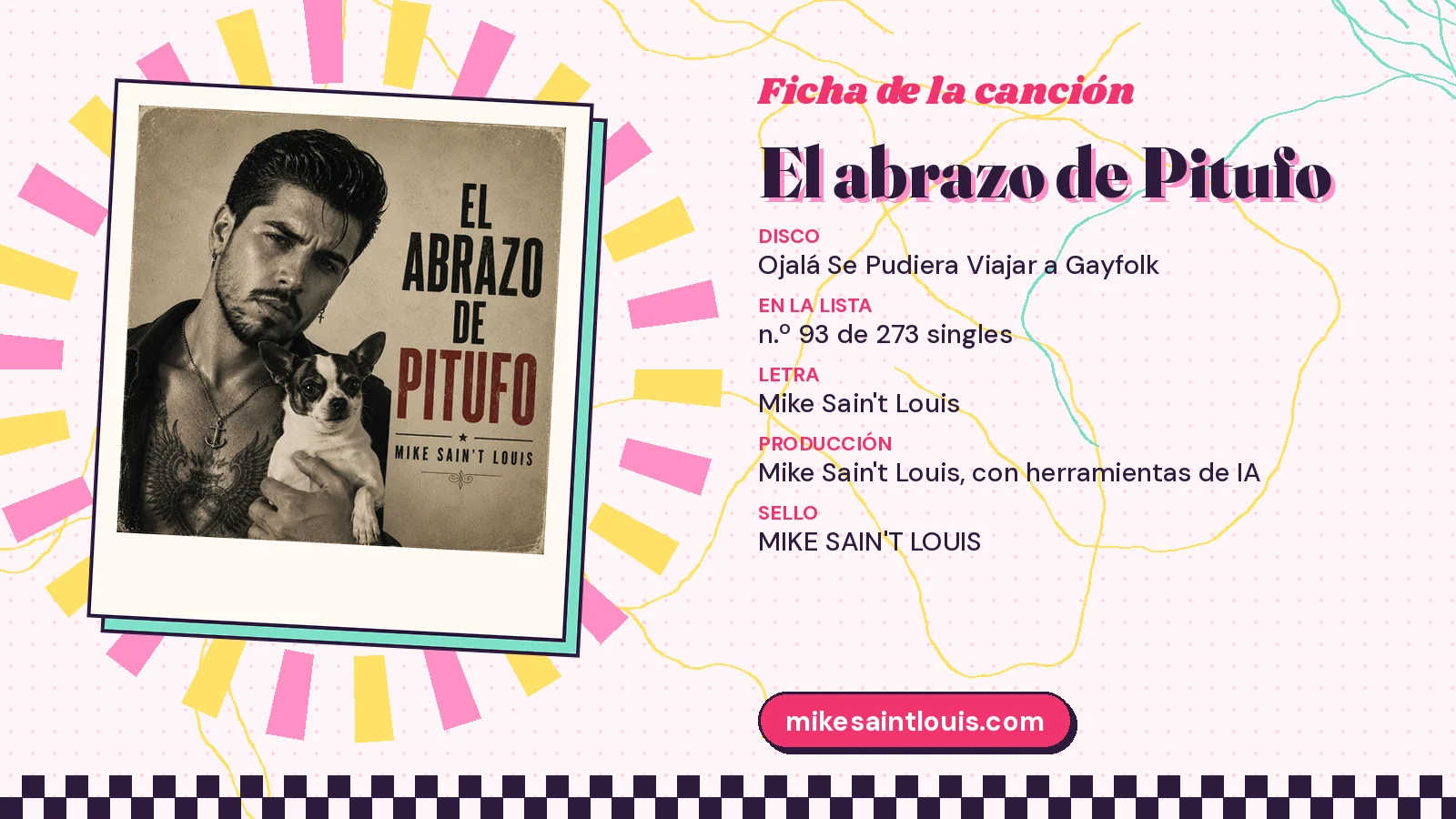
«El abrazo de Pitufo», Pitufo's hug, is by a mile the most tender song I've released. Not one swear word. No ex with a name and a postcode. No concrete block, no neon coffin, no vampire crying under the moon. Just someone who lies down on top of me and calms me down.
The song's page has the summary. Here I want to do something else: read it as what it also is, a reply. Because when you write a lot of songs about people who hurt you, sooner or later you need to write one about someone who doesn't. And that song says a great deal about all the others.
What Pitufo doesn't do
Let's take it in parts, of which there are three.
Pitufo doesn't ask. Sounds like nothing much. But think how many questions you've been asked by the people who've hurt you. «Where were you?» «Who are you talking to?» «Why are you taking so long to reply?» «Do you really love me?», asked in exactly the tone that means no answer will ever be enough. And the most poisonous question of all, the one in «Envejecer»: whether I could picture the two of us old and holding hands, asked while he was cheating on me. Questions can be an interrogation, a trap or a hook.
Pitufo asks nothing. He arrives and he's there. No loaded «how was your day?», no «what's that face for?», no «are you like this again?». Nothing. His way of asking is to lie down beside you, and your body gives the answer by relaxing.
Pitufo doesn't pretend. This is the most important one, and I'll explain why further down. In a catalogue full of masks, of coloured contact lenses, of people who say thirty-five and are fifty-three, of smiles hiding spit, Pitufo is what he looks like. If he's happy, he's happy. If he wants to be with you, he's with you.
Pitufo doesn't demand. He doesn't ask you to change, to lose weight, to drop your friends, to hand over your phone password, to cover the rent this month because things are tight. There's no quid pro quo. No invoice.
Three verbs. And each one is an entire song of mine turned inside out.
«Fake people»
The text's first line makes it clear from the start. Pitufo's hug «me calma y me alegra cualquier día de la gente falsa», calms me and cheers me up on any fake-people day.
«Any fake-people day.» I love that construction because it turns falseness into a type of day. Just as there are rainy days, hot days, hungover days, there are fake-people days. The days when everyone you bump into seems to be wearing a mask. The colleague who smiles at you and then slags you off. The acquaintance who only messages when he needs something. The ex who reappears in your Instagram stories, watching every one, saying nothing.
We all have days like that. And what the song says is that at the end of those days there's a hug that fixes it. It doesn't fix it completely, because the fake people will still be there tomorrow. But it calms. And it cheers.
It strikes me as a very humble, very true idea. The world doesn't need to change. What you need is for someone to lie on top of you when you get home.
He lies down on top of me
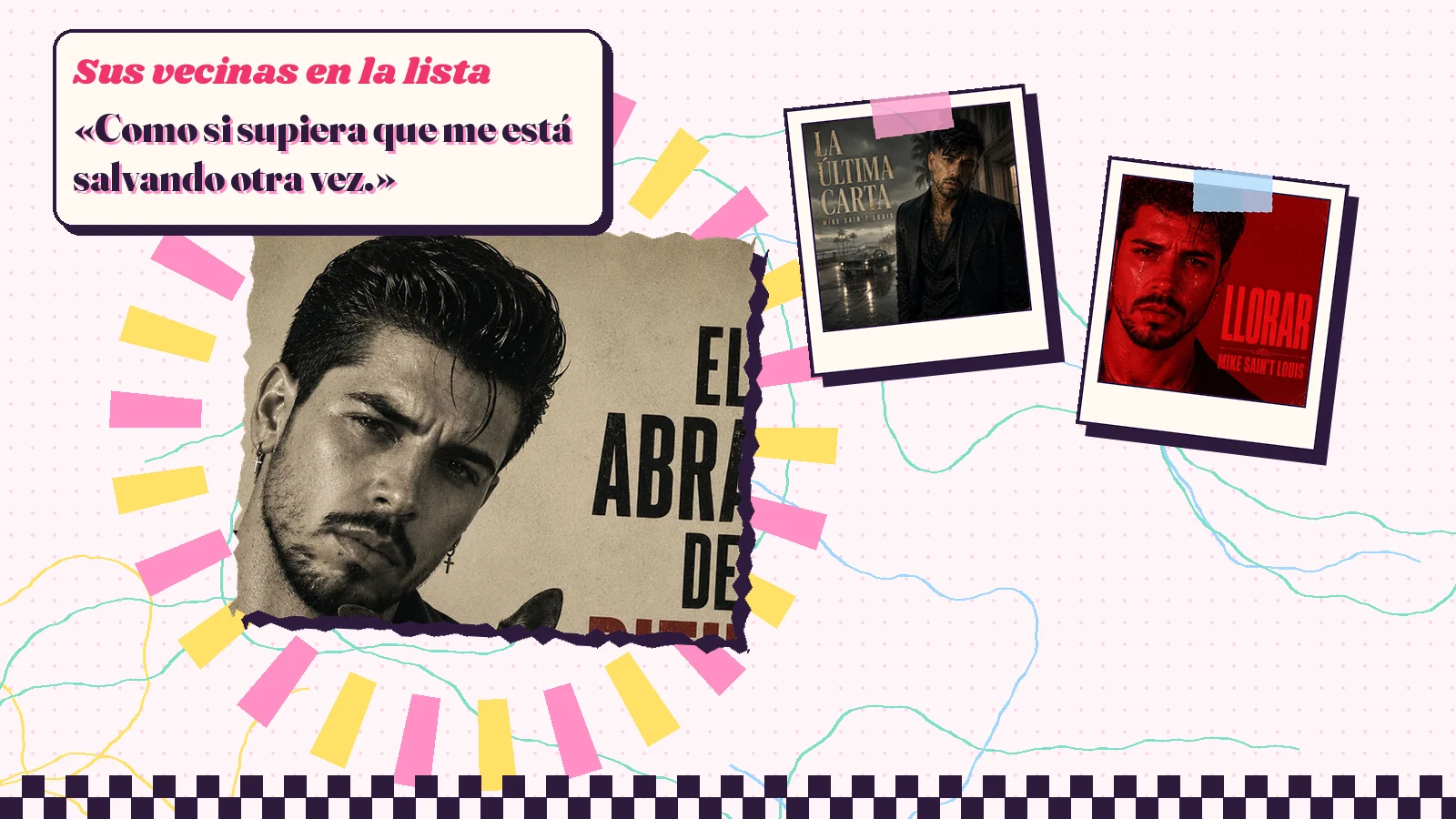
The second sentence of the text is my favourite: Pitufo «solo se acerca, me mira y se tumba encima de mí como si supiera que me está salvando otra vez» («just comes over, looks at me and lies down on top of me as if he knew he was saving me again»).
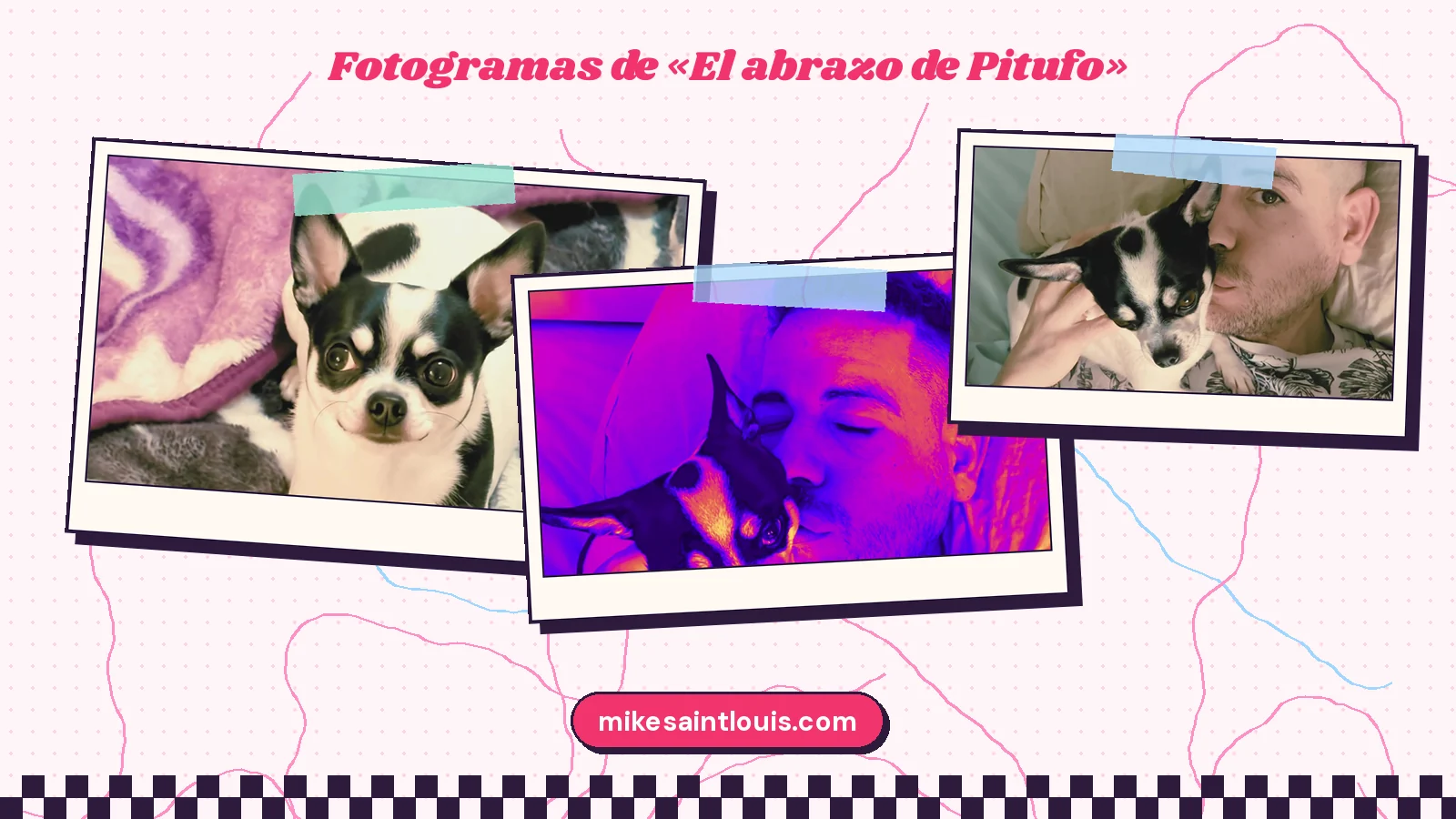
Three more verbs, positive this time. Comes over. Looks. Lies down. It's a physical sequence, very simple, almost choreographed. First the distance shrinks. Then the eye contact. Then the weight.
The weight is what interests me. It isn't an arms hug, the airport kind with pats on the back. It's a weight hug. Someone who lies down on you and stays. It's what those weighted blankets for anxiety do, the ones advertised on Instagram at two in the morning. Weight that settles you. Pitufo does it for free, no advert.
«As if he knew.» That's the tenderest bit. It doesn't say he knows. It says it seems he knows. It's the lovely doubt of someone who gets exactly the right affection at exactly the right moment and can't tell whether it's chance or intuition. I don't know. Neither does the song. It leaves it at «as if».
And «again». He's saving me again. It's not the first time. It's happened before and it'll happen again. Pitufo is a saviour with a season ticket.
Sincerity still exists
The line that gives the whole song its meaning comes almost at the end of the text: «Por recordarme que lo sincero todavía existe» («For reminding me that sincerity still exists»).
Still. That word says it all. Whoever writes that is someone who'd come to doubt it existed. Someone who'd seen so much falseness, so many masks, so much theatre, that he'd started to think sincerity was a myth, like the Loch Ness monster or cheap flats in Madrid.
And Pitufo reminds him. Not with speeches, but with a hug.
This connects with the whole catalogue. If you listen to the narcissism songs one after another, the logical conclusion would be that nobody's sincere. That everyone lies. That behind every smile there's a calculation. That's what a relationship with a narcissist leaves you with: permanent suspicion. You stop trusting even the supermarket cashier when she says good morning.
«El abrazo de Pitufo» is the antidote. A song that says: no, not everyone. Here's someone who doesn't pretend. And if one exists, more can.
The name
Pitufo. It's what the Smurfs are called in Spanish, of course. Those little blue creatures by the Belgian cartoonist Peyo, who lived in mushrooms, wore white hats and spent their days running away from Gargamel and his cat Azrael. Whole generations of us watched them in Spain, the Hanna-Barbera series on the telly and the little plastic figures that came free with yoghurts or that you bought at the stationer's.
A name like that already says a lot. It says small, it says affection, it says something a bit silly and very tender. Nobody calls someone who scares them «Smurf».
I'm not going to say in this post who or what Pitufo is, beyond what the song says. The song describes him by what he does: comes over, looks, lies down, hugs, calms. That's enough for me to talk about him. The rest is his and mine.
A song without swearing
Anyone who knows my catalogue knows I swear easily. I have songs that start with «mi semen», that are called «¡Eso es lefa!» («That's spunk!») or «Que me coma el chumino la jefa de servicio» (I'll spare you that one). Creative insult is practically my signature.
In «El abrazo de Pitufo» there isn't a single one. Not even a relieved «fuck».
It isn't prudishness. It's that any swear word would have dirtied the song. It would have sounded like I was protecting myself. Swearing, in my lyrics, is often a shield: if I'm laughing and blurt out a «maricón», nobody sees I'm crying. Here I didn't want a shield. I wanted to say «I love you, Pitufo» unprotected.
I've already written a defence of the soppy, and this song is that defence put into practice. It's soppy. It's soft. It says «I love you» and «thank you for being my refuge» without irony. And I'm not the least bit embarrassed.
Well, a little. But I'll live.
Three negatives in a row
A note on form, because the central line has a trick to it.
«Pitufo no pregunta, no finge, no exige.» Three verbs with «not» in front, in a row, no conjunction. It's a device I use constantly, the list that piles up blows, although I normally use it for the opposite: listing grievances. «Ni psicólogos, ni amigos, ni hermanos.» Here the same technique lists the absence of grievances.
It's almost a trade joke. The tool I always use to attack, used to say thank you. Same hammer, but for hanging a picture instead of smashing a window.
And notice the three verbs are short, everyday ones. There's no «doesn't manipulate», «doesn't blackmail», «doesn't control», which would be diagnostic words. They're round-the-house verbs. Ask, pretend, demand. What everybody does. What Pitufo doesn't.
A line like that is understood the first time, no dictionary needed. Which is how important things should be.
The verb «to save»
«As if he knew he was saving me again.»
Saving is another word that keeps coming back in my catalogue. There's a song called «La música me está salvando», music is saving me, and a phrase from that song names everything I feel about this trade. There's another called «Mi salvador», my saviour. And here, Pitufo saves me again.
I've sometimes wondered whether I overuse that verb. Whether it's over the top to say a song or a hug saves you. And I don't think it is, I think it's accurate, even if it sounds big. I don't mean saving your life the way a firefighter does. I mean saving the day. Saving the afternoon. Making a night that was going to be horrible merely bad.
Those little rescues are what hold a life up. Nobody saves you once and for all, like in Disney films. You get saved many times, a bit each time. That's why the «again» is the most important part of the line. A saviour with a season ticket, I said earlier. I stand by it.
Hold me
Spanish music is full of hugs. Julio Iglesias had his «Abrázame», hold me, in that seventies-crooner tone, begging for a hug the way you'd beg forgiveness. Coplas are full of arms opening and closing. And any village-fiesta song at three in the morning ends with everyone hugging and murdering the chorus.
And a few years back there was the «free hugs» craze, people with a sign in the street offering hugs to strangers. It started in Australia and spread across half the world, the way everything that fits in an internet video spreads.
Pitufo's hug isn't any of those. It isn't Julio's begged-for hug, or the drunken fiesta hug, or the street-sign hug. It's a hug nobody asked for. It just arrives. And precisely because nobody asked, it's worth more.
Deep down, the difference between a hug you ask for and one that just arrives is the same as the difference between a narcissist's love and the real thing. The narcissist makes you ask, makes you wait, makes you earn it. The real thing turns up without being asked.
The refuge
«Gracias por ser mi refugio.» («Thank you for being my refuge.»)
The word refuge comes up a lot in my writing. In «La Playa del Mal Pas», the beach is «mi refugio secreto en Benidorm», my secret refuge in Benidorm. In the text for «Ojalá se pudiera viajar a GAYFOLK», the planet is «mi refugio». And here, Pitufo.
Three refuges. A place, an imaginary planet and a hug. Put them together and I realise I've written a lot about needing to hide, to have somewhere harm can't reach me. I suppose that's what happens when you've lived through things you needed protecting from.
The lovely thing about Pitufo's refuge is that it's the only one of the three that moves. The beach stays put in Benidorm. The planet is far away, in the imagination. Pitufo comes to you. A refuge with home delivery.
Tenderness is political too
Some people think tender songs are minor. That the serious stuff, the important stuff, the stuff with artistic merit, is rage, protest, pain. Tenderness would be for Hallmark cards and kitten videos.
I disagree.
For someone who's been through relationships where everything was calculation, allowing yourself tenderness is almost an act of rebellion. It's saying: the narcissist didn't take this from me. He took a lot of things, but not the ability to be calmed by a hug. That's still mine.
And besides, in queer culture tenderness has often been the most hidden thing. We could be funny, outrageous, sexual, provocative. What was harder was being tender in public. Camp gets forgiven before tenderness, because tenderness leaves you exposed. That's why I wrote that we need gay love songs that end well. This one isn't exactly about romantic love, but it's about love that turns out well. And there aren't many of those.
A song for doing the washing-up
I like to think «El abrazo de Pitufo» is one of those small songs you put on while doing chores. It isn't for the club or for Pride. It's for a Tuesday afternoon, with the washing out and something in the oven.
I wrote about that kind of song in songs for doing the washing-up. Small life, domestic life, the kind that never makes it into films, deserves songs too. And probably most of the happiness we have happens there, in that small life, and not in the big moments.
A hug on the sofa is small life. And it saves you.
Writing alone, with company
I do the whole journey of every song on my own: the lyrics, the composition, the production, the artwork, the release on my label. That's a lot of time alone in front of a screen, and I wrote about how I cope in the loneliness of creating alone.
This song is partly about the opposite. About never being completely alone. There's someone who comes over, looks at me and lies down on top of me. He doesn't write with me, doesn't give his opinion on the lyrics, doesn't tell me whether the chorus works. But he's there.
And sometimes that's all it takes to keep writing.
AI doesn't hug
I have a post called AI doesn't have exes. It's about how artificial intelligence can produce a song but can't live what the song tells. It doesn't know what it's like to be cheated on, dumped, lied to.
With «El abrazo de Pitufo» it's even clearer. AI doesn't hug. It doesn't know what a weight lying down on you and calming you is. It has nobody to save it again. The music on this song was produced using artificial intelligence as a tool, like all of mine. But what it tells could only be told by someone who's had that hug.
If anyone still doubts which part of my songs is mine, let them read these lyrics. No machine writes «I love you, Pitufo» just because.
On the album of longing
The song is on «Ojalá se pudiera viajar a GAYFOLK», the second album of the trilogy. The album of desire, of the subjunctive, of wanting to escape to a planet where you don't have to explain yourself.
And in the middle of all that longing, a song that longs for nothing. That already has it. Pitufo isn't on another planet. He's right here, on the sofa.
It seems like a lesson to me, if a song can teach lessons. While you long to travel to GAYFOLK, maybe you already have a little bit of GAYFOLK at home. A place where nobody questions you, nobody fakes it with you and nobody makes demands of you. That's exactly what defines the planet. And Pitufo fits the bill.
What nobody asks me
I have a post about the questions nobody asks me. I should have included this one: which song made you happiest to write?
I couldn't answer for certain, because there are lots and memory plays tricks. But this would be a strong contender. Because it's one of the few where there's no fight with anyone. Not with the ex, not with the narcissist, not with the hater, not with myself. There's just a thank-you.
And a thank-you, when it's real, doesn't need decorating.
What this post doesn't say
I'm not saying here when Pitufo turned up, or what he looks like, or what was going on in my life the day I wrote the text. It isn't to be mysterious. It's because the song chose to tell something else: what he does, not what he is. And rereading it now, I think that was exactly the right choice.
If I said what Pitufo looks like, readers would hang on to the image and forget the gesture. They'd think about his colour, his size, his face. And that's not what matters. What matters is that he comes over, looks and lies down. Anyone who loves you can do that. Your mum, your best friend, your partner, the flatmate who brings you soup when you've got a fever, the animal that sleeps at your feet.
By not saying who he is, the song leaves room for everyone to put in their own Pitufo. We all have one, or have had one, or are waiting for one. Someone who doesn't ask, doesn't pretend and doesn't demand.
And if you don't have one right now, the song is for you too. To remind you, as it reminded me, that sincerity still exists. Even if today was a fake-people day.
Read it
The full text is on its lyrics page. It's short. It takes a minute to read. And then, if you have someone like that at home, whoever they are, go and give them a hug. Or better: let them give you one.
No asking. No pretending. No demanding. Just lying down on top of you.
Frequently asked questions
What is «El abrazo de Pitufo» about? About a hug that calms and cheers you up on «cualquier día de la gente falsa», any fake-people day. Pitufo «no pregunta, no finge, no exige» (doesn't ask, doesn't pretend, doesn't demand) and lies down on top of the writer «como si supiera que me está salvando otra vez», as if he knew he was saving him again.
Who is Pitufo? The song describes him by what he does, not by what he is: he comes over, looks, lies down on top of you and hugs. Mike Sain't Louis prefers not to add details the text doesn't give.
Which album is it on? «Ojalá se pudiera viajar a GAYFOLK», the second album of Planeta Gayfolk's GAYFOLK trilogy.
Why is there no swearing, when the rest of the catalogue has plenty? Because, according to Mike, any swear word would have acted as a shield, and in this song he wanted to say «I love you» without hiding behind irony.
Who wrote the song? Mike Sain't Louis, a lyricist, composer and producer from Madrid. The music and vocals are produced using artificial intelligence as a tool; the lyrics are his.