
By Mike Sain't Louis ·
Crying through the streets of Madrid: the city as it turns up in my lyrics
«Y si me ven otra vez llorando por las calles de Madrid» («And if they see me crying through the streets of Madrid again»).
That's the first Madrid that comes to mind when I think about my songs. Not the Puerta del Sol. Not the bear and the strawberry tree. A bloke crying on the pavement on his way home from a night out, with an excuse ready in case anyone asks.
The excuse is in the same song, and it's one of the best I've ever written: don't worry, I've just made myself a salad and I've been chopping onions.
I live and work in Madrid. That's almost the only biographical fact you need to read this. What follows isn't a tourist guide or a love letter to the city. It's a tally. I went through the whole PLANETA GAYFOLK catalogue looking for the word «Madrid», and for the places that are Madrid even when they don't say so, like Chueca. And what comes out is a very specific city. A small one. A city of bars, hostels, offices, pavements and car boots.
It doesn't turn up much. That first. Of the songs with published lyrics, Madrid appears by name in a handful. But when it appears, it isn't scenery. It's always doing something. Or someone is doing something in it they wouldn't do anywhere else.
Chopping onions
I'll start there because it's the song where Madrid carries the most weight per line. In «Un invitado VIP cortando cebolla» the narrator goes back to hell after four years as a VIP guest in heaven. Back to the spirits, the tears, the sauna, everything he'd given up. And the city is the place where people can see him.
That's the key. Madrid, in that lyric, is a place with witnesses.
«Y si me ven otra vez» («And if they see me again»). The problem isn't crying. The problem is being seen. By the neighbour, by the waiter at the bar downstairs, by the guy you had a thing with three years ago who now walks his dog down your street. Madrid is huge, but every neighbourhood is a village with an entryphone. You always bump into someone.
Hence the onions. The white lie you tell the whole city so it won't worry. I love it because nobody believes it. Nobody cries in the street at eight in the morning over a salad. But it's a polite lie, the kind you tell so the other person doesn't have to ask any more. That's very Madrid. Saying «nada, nada, estoy bien» («no, no, I'm fine») with eyes like tomatoes.
There's a lot of humour in that song, and a lot of loneliness too. The loneliness of someone painting butterflies in a notebook, shut in his room, in winter, while out there everyone seems to be getting laid a lot less alone than he is. Madrid does that: it offers you a thousand plans every night and makes you feel like the only idiot without one.
A funeral with a wreath in the boot
The song on the cover is something else. Here Madrid isn't the pavement, it's the bar. And you don't cry alone: you cry in company.
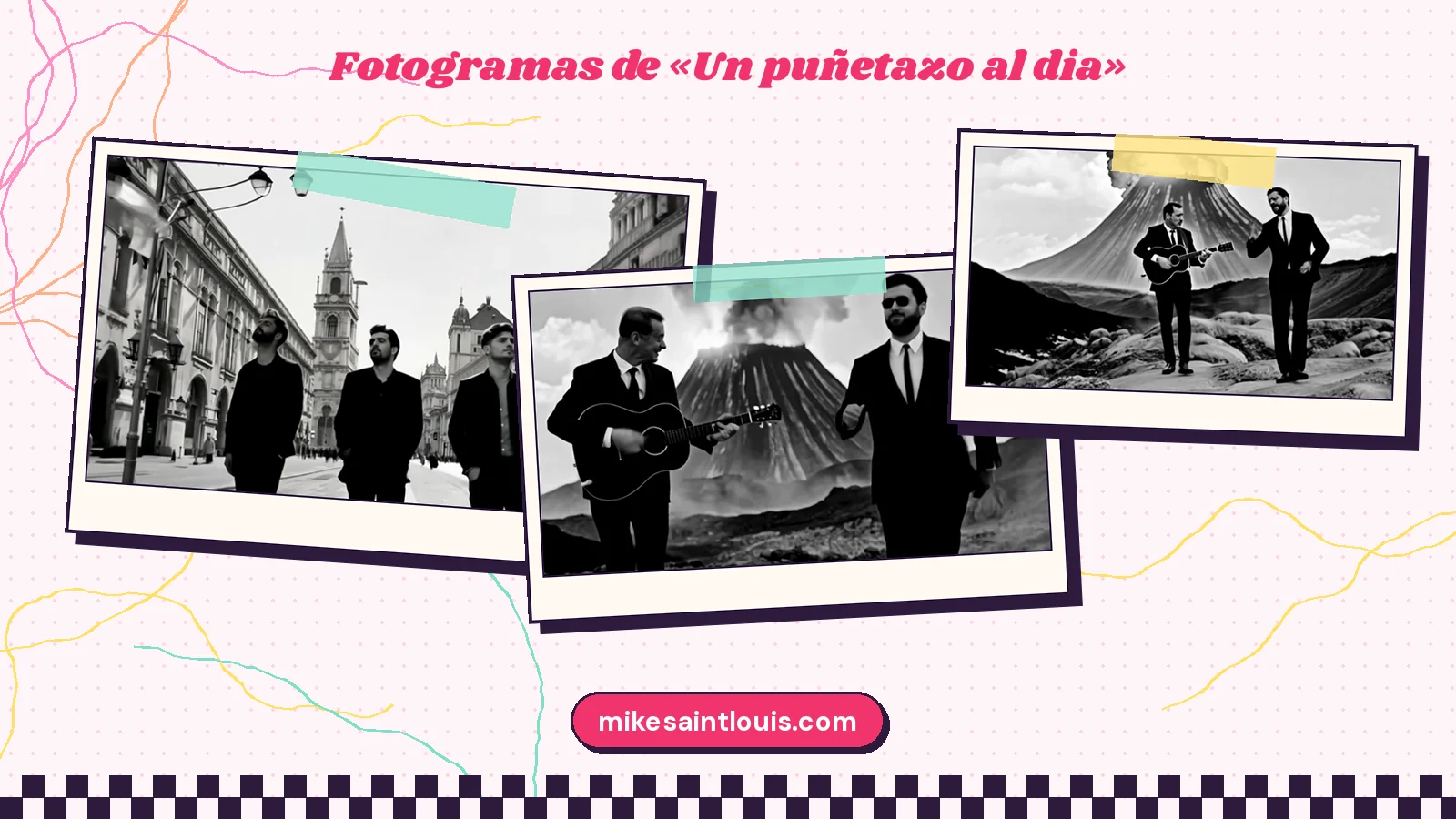
«Hoy estoy celebrando un entierro / en Madrid con mi mejor amigo y casi hermano» («Today I'm celebrating a funeral / in Madrid with my best friend, almost my brother»).
That's how «Un puñetazo al día» opens. A funeral with no corpse. What's being buried is a seven-year marriage and the ex-husband who took those years with him. And it's buried somewhere anyone who's ever gone out in Madrid will recognise: «en ese antro por el que parece que no pasó el tiempo, / y donde siempre hay gente» («in that dive where time seems to have stood still, / and where there are always people»).
Half of Madrid would sign that line. We all have a dive like that. The same chairs for thirty years, the same waiter, the same yellow light, the same cigarette machine that stopped working ages ago. And there are always people. A Tuesday at eleven at night, a Sunday afternoon, in August. Always. Those bars never close, because they're the part of the city that doesn't change while everything else turns into a chain.
It's the perfect place for a mock funeral. Because the dive is memory. You've cried there before. You've been comforted there before. You'll be back.
And then there's the car. The narrator opens the boot and one of his friends quips that it must be a body. Roars of laughter. And no: it's a wreath. To celebrate the funeral of the ex-husband and the years he stole.
I love that moment, because it's completely Madrid in the sense that matters to me. Nobody gets solemn. Someone cracks the joke, everyone laughs, and the pain is still there on the table, next to the pints. Crying and laughing at the same time in a bar that's been there forever. If that isn't Madrid, I don't know what is.
There's something else about that song that strikes me: the narrator cries and celebrates in the same line. «aunque ahora mismo estoy / llooooooooooooraaaaaaandoooooo, / celebrando tu entierro» («even though right now I'm / cryyyyyyyyyyyying, / celebrating your funeral»). It isn't a contradiction. It's what happens at real goodbyes. At village funerals people eat, drink and tell jokes about the deceased. At Madrid ones too, apparently. The difference is that here the deceased is still alive and probably on Grindr.
Five pints at the Cien Montaditos
There's another beer hall in my lyrics. In «El anillo de casado» things kick off with five pints at the 100 Montaditos (a Spanish chain of cheap beer-and-sandwich bars), «entre risas y miradas, bien escondiditos» («between laughs and glances, tucked well out of sight»).
I'm not saying that 100 Montaditos is in Madrid. The lyric doesn't say so. But the song does end in Madrid, and how.
The guy wears a ring. He's married in church, to his wife in pure white, with four hundred guests. And the narrator, who's starting to fall for him and for his «supuesta heterosexualidad» («supposed heterosexuality»), finishes like this: «Y nosotros por Madrid de discretos buscando hostales que no tengan colgado en el telefonillo el cartel de / completos» («And us, round Madrid, being discreet, looking for hostels that don't have the sign hanging on the entryphone saying / full»).
Notice the plural. Hostels. Not one. They go from one to the next. Doorway to doorway. Checking the entryphone before they ring.
That image strikes me as one of the most accurate things I've put in a song about the city. There's a Madrid of hotels with roof terraces that turns up in magazines, and there's a Madrid of hostels on the second floor with no lift, a blue plaque by the door and a little cardboard sign that says «completo». And that second Madrid belongs to the loves that can't be shown off. The married man's. The one who still hasn't come out. The two of them playing it discreet even though it's four in the afternoon and nobody's looking.
The «de discretos» has something of comedy about it, because the more you try to hide, the more it shows. And something sad. Because the narrator doesn't choose discretion. The other man's ring imposes it.
A city you walk like that, looking for a gap, is a city of closed doors. Nothing more needs saying. That last word, «completos», alone on its line, says it all.
I saw you a few times in Chueca
Chueca is Madrid, even when my lyrics don't give it a surname. And it turns up the way it should: as the place where you run into people.

«Te vi varias veces en Chueca / que pena tener pareja» («I saw you a few times in Chueca / shame I've got a boyfriend»). That's from «La dieta del cucurucho», the song in which the narrator writes a declaration to Paco León and puts it away in a drawer. Chueca here is the shop window. The neighbourhood where you see the man you fancy and can't do a thing about it, because you're with someone else. We stared at each other for three seconds, tops, and each went home.
By the end of that song things go epic: «Destino Chueca / Destino Eurovisión» («Next stop Chueca / Next stop Eurovision»). As if Chueca were a metro station and Eurovision the next one down the line. I like putting them side by side, because for a lot of people they're the same thing: the place where everything that didn't fit at home finally fits.
But there's another Chueca in my catalogue. And that one isn't funny at all.
In «La despedida» there's a line written entirely in capitals, the way you write the things you can't say quietly: «CAMELA, LA PRIMERA VEZ QUE FUI YO SOLO CON MIEDO A / CHUECA PENSANDO QUE ME IBAN A PEGAR» («CAMELA, THE FIRST TIME I WENT ON MY OWN, SCARED, TO / CHUECA, THINKING THEY WERE GOING TO BEAT ME UP»).
That's the other face of the neighbourhood. Before it became the place for the party, the flags and the hen dos in sparkly headbands, Chueca was, for a lot of people, the place you went to scared. Alone. Looking over your shoulder. With a Camela song (a Spanish pop duo every Madrid kid of a certain age grew up with) in your head for courage. The lyric doesn't explain any further, and it doesn't need to. Anyone who's walked down those streets for the first time knows exactly what it means.
I like that both Chuecas sit in the same catalogue. The one where you stare at Paco León for three seconds and the one where you walk in thinking you're about to get beaten up. Because they're the same place, at different moments of the same life.
And signed from Madrid
There's a Madrid that isn't about bars or neighbourhoods. It's the Madrid of service counters.
In «3 años de garantía» the narrator buys a dark-haired boyfriend advertised on TV, pays cash on delivery, and after three years, right as the guarantee runs out, the boyfriend starts breaking down night and day. He goes to the consumer office. He fills in a complaint form. And the office replies with an enormously long reference number and a signature: «Y de Madrid lo firma / La comunidad» («And signed, from Madrid, / the Regional Government»).
That signature is one of the most Madrid things I've ever written. Nothing is more local than a service counter. Madrid is the capital of many things, but above all it's the capital of the form. People come here to sort out paperwork. To get an appointment, to wait for their number on the screen, to be told they're missing a photocopy.
And in my song Madrid bureaucracy does what it always does: it replies politely, logs the case and tells you there isn't much it can do. That they've spoken to the accused and he says he's very much in love. That you'll have to buy another dark-haired boyfriend and throw the faulty one in the bin. That a lot of customers have been affected.
Heartbreak processed by the regional administration. Officially stamped. I love writing heartbreak on official paper, with its numbers and its stamps. All I'll add here is that the paper has a return address. And the return address is Madrid.
Praying on my knees in Madrid
There's a long list in «La música me está salvando» of everything that doesn't save you. Psychologists, friends, brothers, psychiatrists, doctors, boyfriends, paediatricians, vets, a TV astrologer. And in the middle of the list, a city: «rezar de rodillas en Madrid El Rosario» («praying on my knees in Madrid, the Rosary»).

I'm not going to explain the line any more than it explains itself. But I do notice that Madrid makes it onto the list of remedies that fail. Praying on your knees here, like someone keeping a vow, like someone begging for something with their forehead on the floor. And that doesn't work either. What works is music.
It's odd how the city almost always turns up at low moments. Crying in the street. Burying a marriage. Hunting for a hostel on the quiet. Complaining about a faulty boyfriend. Praying with no results. Madrid in my lyrics is where you have a rough time. And at the same time it's the only place where, at the end of the night, there's always someone in the dive ready to crack the joke about the body.
Getting drunk watching the fireworks
Madrid doesn't end at the M-30 ring road. Anyone who's caught the last commuter train knows that. And in my catalogue there's a song with a town from the south of the Madrid region in its title: «Los fuegos artificiales de Móstoles».
It's a very strange lyric. It barely has sentences: it has places. A list of spots and neighbourhood memories dropped one after another, with no explanation, like someone showing a photo album to a person who wasn't there. The little hills. The local. PE class. «La monóloga y las fiestas del barrio. La borrachera viendo los fuegos artificiales de Móstoles» («The monologue girl and the neighbourhood festival. Getting drunk watching the Móstoles fireworks»). The nights in the storeroom.
I'm not going to say who it names. The song is full of people, and those people belong to it. What interests me here is the form. Because that's how you remember the outskirts: not by monuments, but by corners that only have names for the people who were there. «El local». Which local? The local. If you were from there, you know.
And the fireworks. The festival of a big town that's now a city, getting drunk looking at the sky, the park, the benches. If central Madrid in my lyrics is a city with witnesses, the south is a city with memory. Nobody there sees you cry, because you were all crying at once, or laughing, or throwing up behind a wheelie bin after the fireworks.
Móstoles also turns up in the description of «El calcetín», as the place where it was recorded, «con toda la ironía y el arte marica que lo empezó todo» («with all the irony and queer artistry that started it all»). I'll say no more, because there's nothing more to say: the phrase does the work. What started it all started there, a few kilometres from the Puerta del Sol, which is where almost everything that later gets told in the centre begins.
From Madrid to Miami
Madrid turns up in English too. Twice, at least.
In «Licenciada en derecho» the protagonist strides through the city in heels, law books in her bag and her head held high: «From Madrid to Miami, style's never sloppy». Don't look at my chest, I've got a law degree. Here Madrid is a starting point, the first stop for someone who's catching flights, not feelings.
And then there's «Madrid to Benidorm», from the third album of the trilogy, «El día de la liberación». It's a Pride song in the most literal sense, all placards and floats. «Let's dance under the rainbow, Madrid to Benidorm.» The heart of Madrid beating loud, «we're here to stay», and a straight line running down from the capital to the beach.
I find it funny that it's in English. That to say «we're staying» with all the solemnity in the world I had to switch languages. I suppose there are phrases that would make me cringe in Spanish and come out as placards in English. I'll leave it there and not analyse it further, because I know myself.
That song wants a dance floor and a flag. If you're curious about what a song asks of a parade, I wrote about it in what a dance floor asks for at Pride.
What doesn't turn up
What doesn't turn up is as interesting as what does.

No Gran Vía. No Retiro. No Bernabéu. No Madrid sky, which they say is the most beautiful thing about the city. No museums, no Royal Palace, no Cibeles fountain with a football scarf on.
It's not a manifesto. I didn't sit down one day and ban myself from monuments. But looking at the whole catalogue, the absence is there and it says something. My songs happen in places where people live, not places people visit. The usual dive. The second-floor hostel. The consumer office. The pavement on the way home. Chueca at three in the morning, not Chueca in the Pride photo.
I've written about this before in Madrid without the postcard, and about why a tool can't make this Madrid up in what AI doesn't know about Madrid. I write the lyrics myself, and the Madrid in them is the one I have to hand. I produce the music with artificial intelligence, but the machine doesn't know where the dive with people always in it is. I do.
A city with witnesses
If I had to sum up the Madrid of my songs in one word, it would be that: witnesses.
In Madrid someone always sees you. They see you crying in the street and you have to make up a salad. They see you in Chueca and you're left wanting. They see you slipping into a hostel on the quiet and you don't care, or you do, depending on the day. The friend who cracks the joke about the body sees you and hugs you at the same time. The civil servant who signs the reply to your complaint sees you. Even God sees you, if you pray on your knees in the right street, though he doesn't do anything about it afterwards.
And that, which could be a nightmare, strikes me as the best part. A city where you can't disappear completely. Where someone always finds out. Where crying in public is a risk and also a way of asking for company.
It happens in this city all the time: there are three million people here and still someone will notice you on exactly the day your face is a mess. The man at the newsstand. The lady on the third floor. The delivery rider who's brought your dinner three times this week and already knows you order for one. Madrid lets you be anonymous for a while, but it won't let you be invisible. And for someone who writes songs with names and neighbourhoods in them, that's almost a stroke of luck. Because the witnesses are also the audience. The people who've seen you crying in the street are the same people who, later, without knowing it, recognise themselves in a lyric.
The full lyrics of the song on the cover are at gayfolkplanet.com/letras/un-punetazo-al-dia. Read the whole thing. It has its friends, its dyed beard, its blue gaze «más falsa aún» («even falser»), and its karma spelt out with every vowel stretched. And above all it has that dive where time seems to have stood still.
Find yours. I'm sure you've got one.
Frequently asked questions
Which Mike Sain't Louis songs mention Madrid?
By name, among others: «Un invitado VIP cortando cebolla», «Un puñetazo al día», «El anillo de casado», «3 años de garantía», «La música me está salvando», «Licenciada en derecho» and «Madrid to Benidorm». Chueca turns up in «La dieta del cucurucho» and «La despedida».
What happens in Madrid in «Un puñetazo al día»?
In a Madrid dive bar, with his best friend and almost-brother, the narrator celebrates the symbolic funeral of his ex-husband after seven years, with a wreath in the boot of the car. The full lyrics are at gayfolkplanet.com/letras/un-punetazo-al-dia.
What does the sign-off «Y de Madrid lo firma la comunidad» mean?
It's the end of the consumer office's reply in «3 años de garantía», the song about a dark-haired boyfriend bought off the telly who starts breaking down just as the guarantee runs out.
Where does Mike Sain't Louis live?
In Madrid, where he lives and works as a lyricist, composer and music producer with his own label, MIKE SAIN'T LOUIS. The music and vocals of his songs are made with artificial intelligence tools; the lyrics are always his.