By Mike Sain't Louis ·
"You cover their eyes like a proper dictator": the kiss that offends in «Tan paleto»
A big hand moves in front of two small eyes. That's all. No shouting, no slur, no stone. Just a hand.
That gesture, a father or mother covering their child's eyes because on the bench opposite two men are kissing, is for me one of the most violent images I know. And I wrote it just like that, unadorned, in «Tan paleto» ("Such a Yokel"):
«Que te molesta que tus hijos vean un beso / Y les tapas los ojos como un buen dictador» ("It bothers you that your kids might see a kiss / so you cover their eyes like a proper dictator")
«Tan paleto» is the sister of «Tan cateto» ("Such a Hick"), the one that spread across TikTok and brought a lot of people into my catalogue. They share lyrics, they share a chorus and they share the same indignant question. I've already written a whole piece on the word «cateto», «Cateto»: from insult to banner, and the «Tan paleto» song page already talks about the spectator and the formal "you".
Here I want to linger on two lines that always get passed over a little. The one about the children with their eyes covered. And the one about the African boyfriend. Because those two lines hold two different kinds of violence that come hand in hand, like the couple in the song, and that rarely get told together.
The hand in front of the eyes
Let's start with the hand.
When someone covers a child's eyes, they're teaching them something. They're not protecting them from anything, because a kiss never hurt anyone. They're teaching them that what's happening on the bench opposite is something you mustn't see. Something dirty. Something shameful. Something to be hidden.
And the child learns. Children learn incredibly fast. They don't understand why, but they understand the gesture. They feel the tension in their father's hand. They understand there's something bad out there. And they file it away.
Now think about this: some of those children, ten years from now, will discover they like boys. Or that they're not a boy. Or that they're not what their parents expected. And when that happens, they'll remember, even if not in words, that hand in front of their eyes. And they'll know, without anyone telling them, that what they are belongs in the category of things that must be covered up.
That's why I wrote "like a proper dictator". It isn't an exaggeration, though it may sound like one. It's a description. Dictators do exactly that: they decide what can and can't be seen. They cover. They censor. And they always do it with the same excuse: it's for your own good. It's to protect the children.
Think of the children
I know that excuse by heart. My whole community knows it. "Think of the children."
It's been used for everything. To keep us off TV. To keep us from being mentioned in schools. To stop us marrying or adopting. To keep books with two dads or two mums out of libraries. To keep kisses out of the nine o'clock shows. Always the children, always innocence, always protection.
And what strikes me as funny, in a very bitter way, is that nobody ever asks about the children who are us. The children we were. The child on the next bench who watched a father cover another child's eyes and understood that he himself was the thing that needed covering.
Who was protecting that child?
Nobody. That's why I write songs.
And I don't say it to pin medals on myself; I've got enough sequins to deal with. I say it because a song has an advantage almost nothing else has: it gets into the house without asking permission. It slips into the headphones of a kid in his room, door shut, without the father with the hand ever knowing. And there, in that room, the kid hears someone asking the man on the bench how he can be such a yokel. And maybe, for the first time, he laughs at the man instead of fearing him.
An African boyfriend
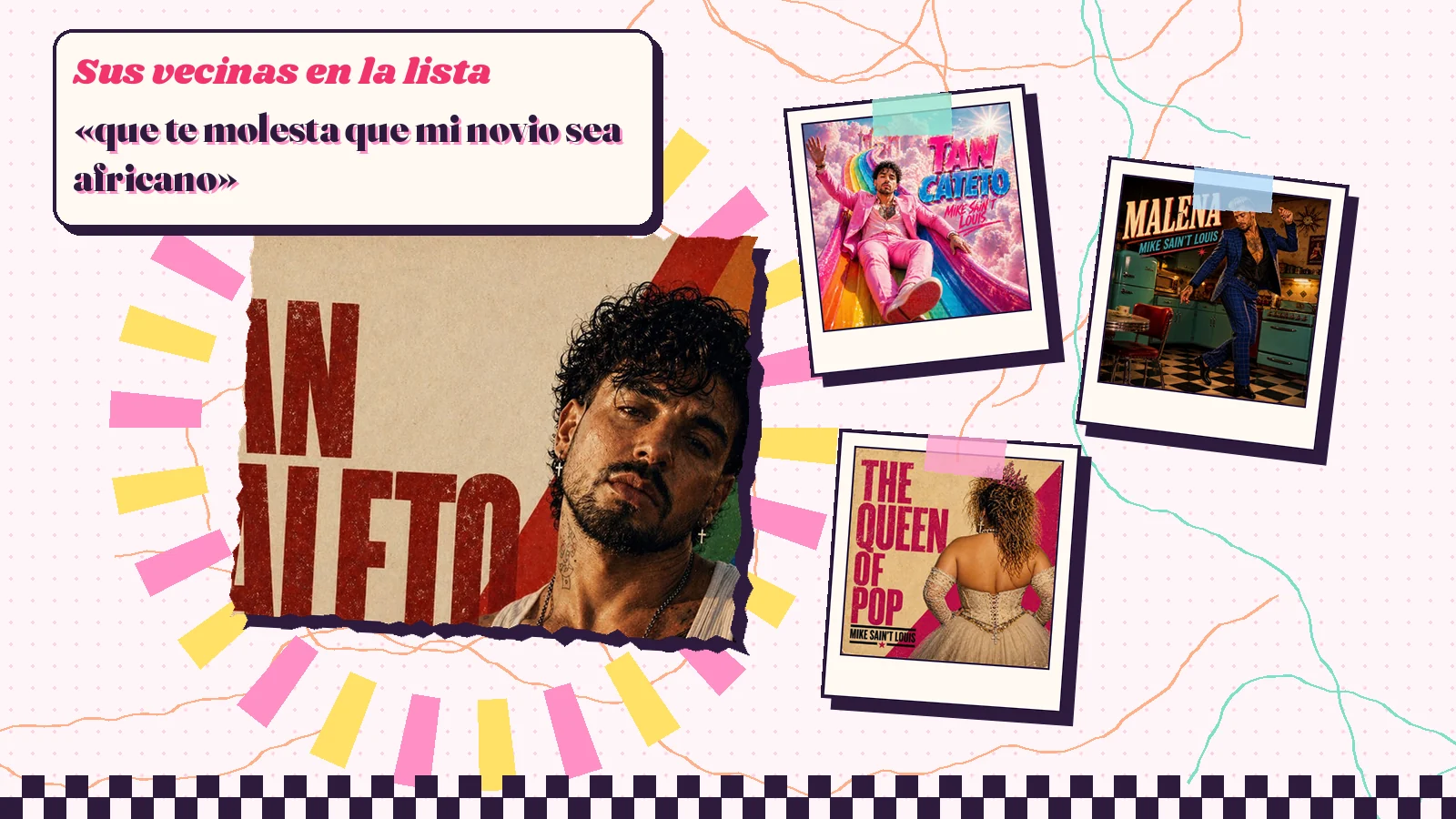
The other line is this one: it bothers you that my boyfriend is African.

I put it in the same verse as "let's walk hand in hand" on purpose. Because often, what bothers people isn't one thing. It's two. And they add up.
There are people who are bothered by two men holding hands. And there are people who are bothered by a Black man holding hands with a white one. And then there are people bothered by both at once, who see that couple and don't quite know where to start being scandalised. The queers? The African? Both? Their prejudice short-circuits.
It felt important to put that detail in the lyric because within my own community we sometimes forget. The gay world isn't free of racism. There are app profiles that say things I wouldn't dare copy here. There are looks in gay bars not so different from the man on the bench's. There are jokes queers tell each other about Black men's bodies that are exactly the same as the jokes others tell about us.
The song doesn't say all that. The song only says "it bothers you that my boyfriend is African". But by putting it next to the hand, next to the kiss, it says something very simple: it's the same irritation. The same accusing judge's finger. The same look from the stands.
The accusing judge's finger
There's an image in the first verse I love for its theatricality: the accusing judge's finger.
I picture an enormous finger, like the one on the old Uncle Sam posters, pointing at you from across the street. A finger in robes. A finger with a gavel. A finger that's already passed sentence before you've opened your mouth.
People who point have one curious thing in common: they always think they're entitled. They don't ask themselves whether it's their place to have an opinion. They don't ask whether anyone wanted it. They simply sit down on the judge's bench, which nobody offered them, and start judging.
And the song answers with a line that's almost a sentence handed right back: I won't take advice from any spectator. You're not in the trial. You're in the stands. You're the audience. And the audience, at most, applauds or leaves.
I won't explain myself any further
Since we're on the lines that stick, here's the whole chorus, the one everyone walks away wearing:
«Pero ¿cómo puede ser usted tan cateto? / No le voy a dar más explicaciones» ("But how can you, sir, be such a hick? / I won't be giving you any more explanations")
Two lines. A question and a refusal. And between them, a whole way of life.
Usted
The song page already mentions it, but I'll insist, because I love it: the chorus addresses the man as usted, the formal "you".
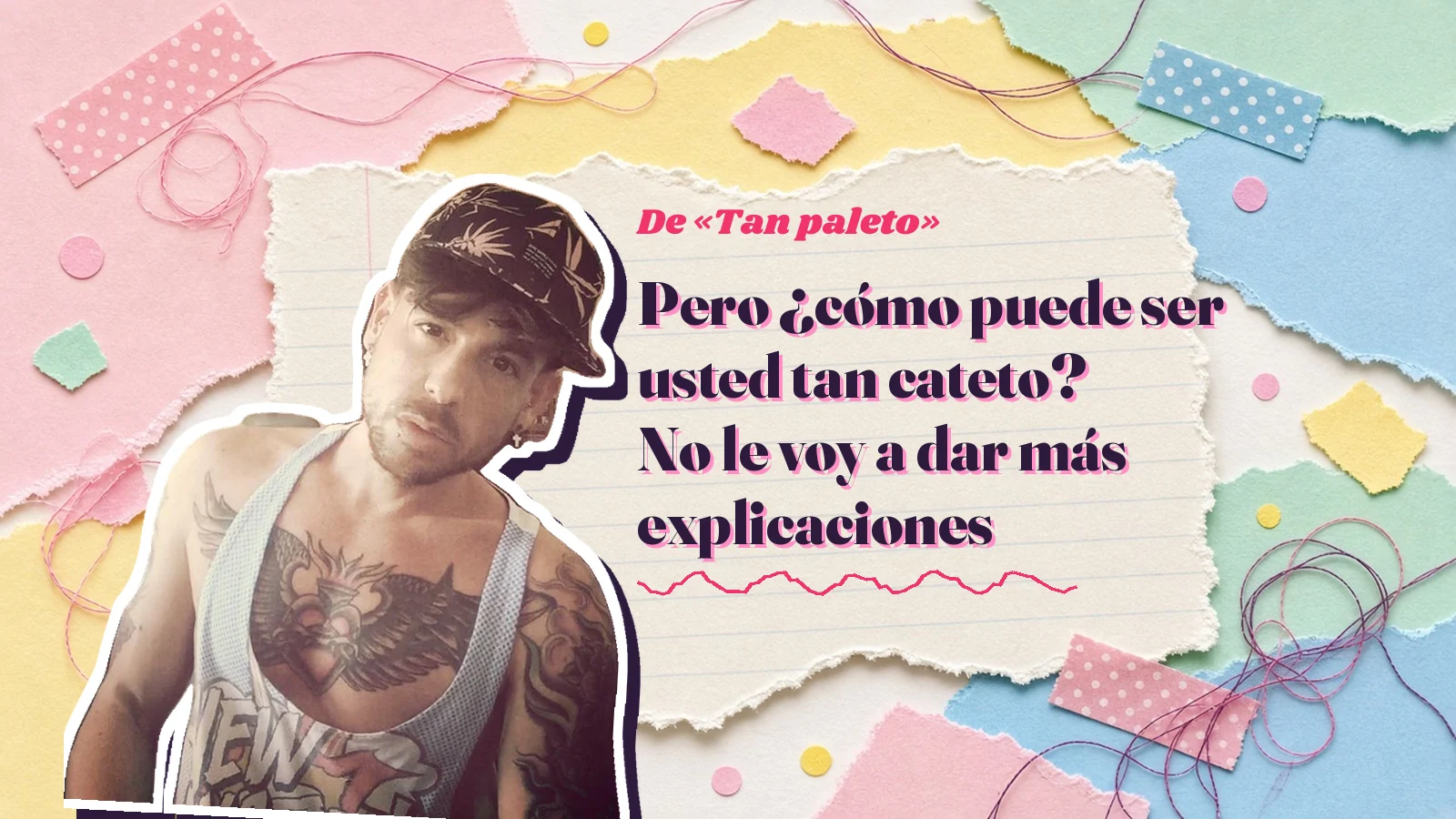
How can you, sir, be such a hick? How can you, sir, be such a yokel?
In Spain, usted is a very fine instrument. You use it with elders, with strangers, with the doctor, with the bank manager turning down your mortgage. And you also use it to put distance between you. To tell someone: you and I aren't family. I'm not on familiar terms with you. And I won't be.
Calling someone "such a yokel" while addressing them as usted is like slapping them with a white glove. The form is impeccable. The content, devastating. It's the technique of old-school Spanish ladies arguing in the fishmonger's queue: «Mire usted, señora, no me haga hablar» ("Look here, madam, don't make me say it").
There's a deliberate imbalance in the chorus, too. In the verses he's addressed informally, as tú: "it bothers you", "you point at me", "you cover their eyes". In the chorus, suddenly, it switches to usted. As if the song, having listed its grievances, stood up, straightened its jacket and said from on high: look here, sir, we're done being familiar.
Paleto, cateto and the geography of an insult
«Paleto» and «cateto» are first cousins. Both mean something like yokel or hick, and both come from the same place: the village. From the idea that villagers are ignorant, closed-minded, backward. In the piece on «cateto» I asked myself whether I had the right to use that word while living in Madrid.
In «Tan paleto» the word does something different. I'm not applying it to myself. I'm applying it to the one pointing at me. And the interesting thing is that the one pointing can be from a village or a city. He can live in a villa in La Moraleja or a flat in Lavapiés. He can have three master's degrees. He can be the councillor for culture. The yokel in the song isn't a yokel by geography. He's a yokel in the head.
I know your mind has its limitations, says the chorus. That's the key. The yokel is the one with the small mind, wherever he lives. And I'm sure there are yokels-in-the-head on Calle Serrano, Madrid's poshest shopping street, who'd make any shepherd from Las Hurdes blush.
I have a piece on all this, on the village, the capital and stereotypes: my boyfriend from Albacete. There I explain why stereotypes amuse me when they're turned inside out, and why the one who thinks he's modern is often the most old-fashioned person in the room.
You want me locked up
There's a line in the second verse that's the darkest in the song, and I don't want to skip it: it bothers you, my face, and you want me locked up.
Locked up. It doesn't say "you want me gone" or "you want me quiet". It says locked up.
And sadly, it's no poetic exaggeration. There are still dozens of countries in the world where being who I am is punishable by prison. In some, by something worse. In Spain, under Franco, we had a law that sent homosexuals to prisons and "rehabilitation" centres, and our grandparents' generation lived through it. It isn't ancient history. It's the memory of people who are still alive.
When someone glares at me in the street for holding another man's hand, I don't think he's going to put me in prison. But I know where that look comes from. I know it's the same look that, in another time and place, did put you in prison. That's why the line says "locked up". Because the look is the seed. And we all know what grows from that seed when it gets watered.
From the joke to the bus queue
I'll be serious for one more moment, no jokes, because this subject deserves it.
Holding hands in the street is something most people do without thinking. You leave the cinema, take your partner's hand and walk. That's it. For many of us, though, that gesture is still a decision. You look around first. You weigh up the street, the time, who's at the bus stop. Sometimes you let go when a group of lads walks past. Sometimes you don't take it at all.
That daily decision, tiny, invisible to everyone else, is exhausting. Utterly exhausting. And the song exists, among other things, so that one day we stop having to make it.
What I won't explain
There's another line in the chorus that's practically a manifesto: I won't be giving you any more explanations.
I love that line because it goes against everything we were taught. For years, queers were asked to explain. To explain why we were like this. To explain that we weren't sick, weren't dangerous, weren't going to convert anyone. To explain that love between two men is the same as any other. We've given so many explanations we could fill a library.
And there comes a moment when you say: enough. I'm not explaining anymore. If after everything that's been said, everything that's been written, every law that's been passed, you still don't get it, sir, the problem isn't my explanation. It's your head.
That's one of the reasons the song doesn't argue. It doesn't try to convince the man. It gives him no data, no arguments. It asks him a rhetorical question and walks off. Which is what you do with someone who won't listen.
A white tank top and a rainbow
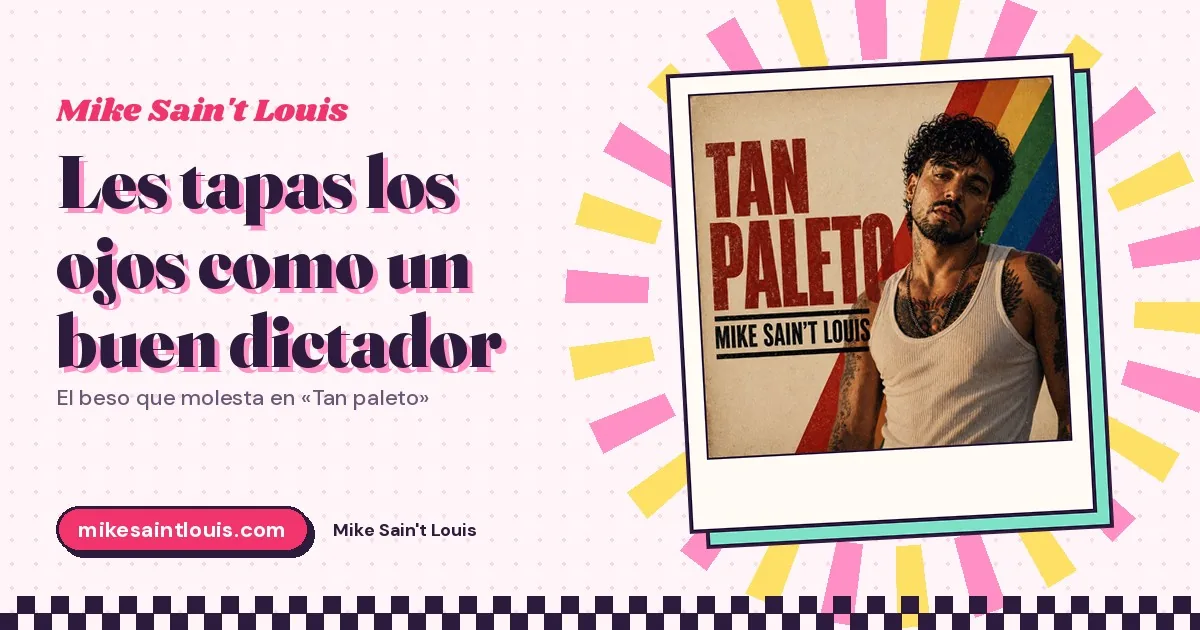
Look at the cover. A background of old, cream-coloured paper, like a seventies poster pasted on a wall. Crossing it diagonally, a band in rainbow colours. And in front, a guy with curly hair and a beard, in a white tank top, chains around his neck and arms and chest covered in tattoos, staring at the camera with a don't-mess-with-me face. Beside him, in worn red letters, TAN PALETO.
What I love about that image is that the guy doesn't smile. He doesn't ask permission. He doesn't strike the pose of an official Pride campaign ad, everyone happy and colourful. He's serious. He's looking at you, the one pointing. And his face says exactly what the chorus says: how can you, sir, be such a yokel?
A sister on the third album
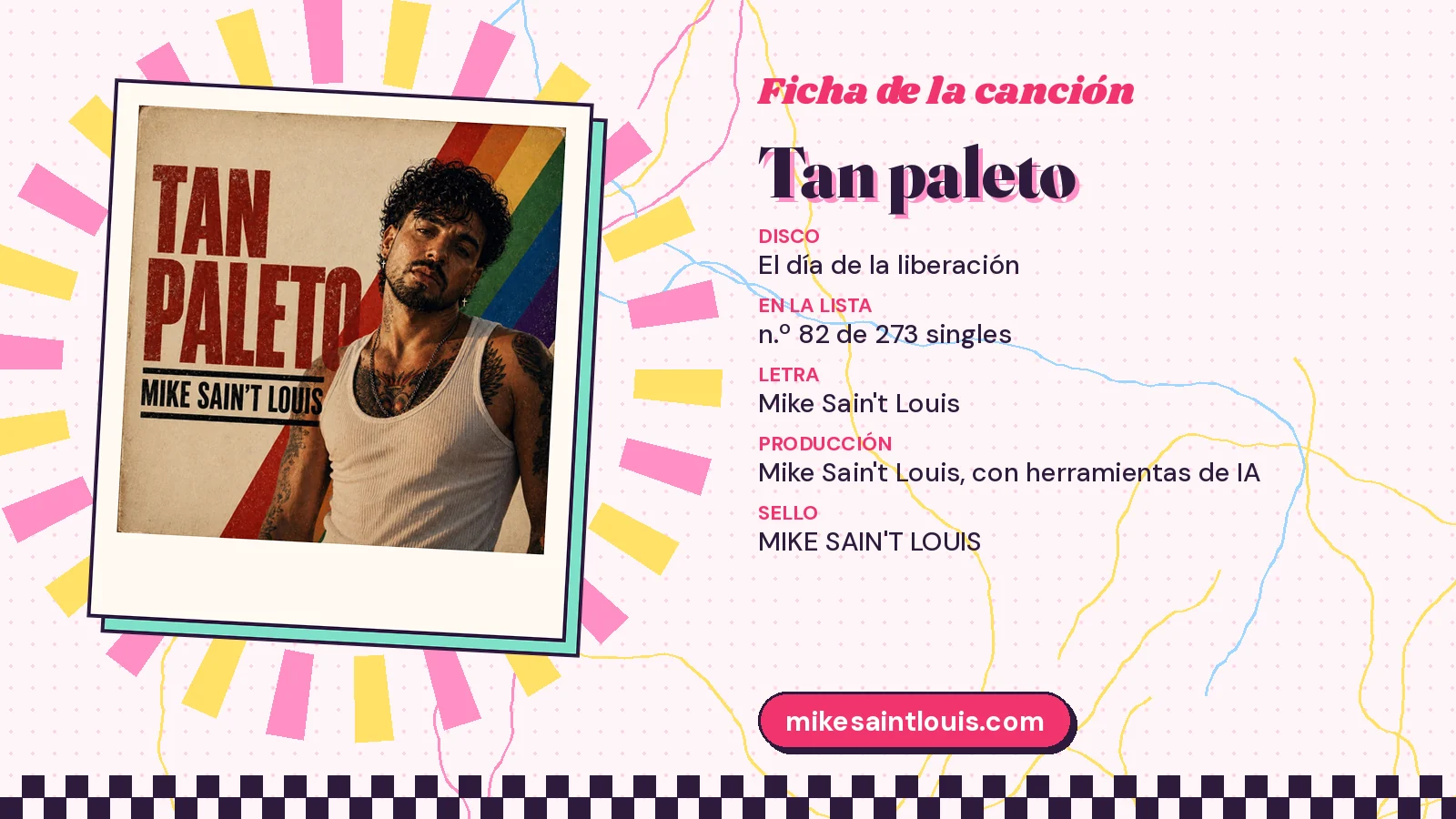
«Tan paleto» is on the third album of the trilogy, El día de la liberación (Liberation Day). Its sister «Tan cateto» is on the second, Ojalá se pudiera viajar a GAYFOLK (If Only You Could Travel to GAYFOLK). In the full gayfolkplanet.com catalogue, «Tan paleto» is track 82 of 273, between «Malena» and «The Queen of Pop».
I like that the version with the changed title is on the liberation album. Because liberation day isn't the day they stop pointing at you. That never fully happens. It's the day you stop caring that they point. The day you look at the accusing judge's finger and, instead of lowering your head, ask out loud, with your usted firmly in place: but how can you, sir, be such a yokel?
To the child with covered eyes
And now, if you'll let me, I want to speak to someone who won't read this. Or who'll read it many years from now, without knowing it's for him.
To the child on the bench. The one whose eyes were covered.
What was behind that hand was nothing bad. It was two men who loved each other, kissing on an ordinary afternoon, maybe after buying bread or before going into the cinema. There was nothing to hide. Nothing dirty. The only strange thing in that scene was your father's hand, trembling with nerves in front of your face.
If one day you discover that you too want to give a kiss like that, on a bench like that, remember the hand wasn't yours. The fear wasn't yours. The shame was borrowed, and you can give it back whenever you like, interest-free.
And if you never discover it, because it's not your story, let me tell you something too: next time you see two men holding hands, there's no need to look away. Or to stare. Just keep walking. That alone will make you better than the hand.
Everyday pride
There's a piece on this blog called Pride on a Tuesday in November, and it has a lot to do with this song. Pride with a capital P is one week a year, with floats, music and Chueca's square packed to bursting. But pride with a small p is every day. It's holding hands on a Tuesday in November down a street in Usera, no float, no music, a Lidl bag in your other hand.
«Tan paleto» is a song of that small pride. The everyday kind. The kind that never makes the news. Nobody will photograph you for holding hands on a Tuesday. But somebody will look at you. And the song is there for that moment, for the exact second you feel the look and decide not to let go.
The whole chorus question fits in ten seconds, which is why it works so well in short videos. If you're curious, the Shorts section shows how my songs move when they're cut to fit a phone screen.
A song that ends well
To finish, an idea that's been on my mind for a while, which I wrote about in we need gay love songs that end well.
Notice that «Tan paleto» has nothing of heartbreak in it. That's rare in my catalogue, which is full of ex-boyfriends. Here the couple is fine. They hold hands. They kiss in public. The boyfriend is African and the narrator thinks that's wonderful. The song's only problem isn't inside the couple. It's outside. It's the man on the bench.
And that in itself is a small political gesture. Telling the story of a couple that works, that loves each other, that has no drama, and putting all the drama on whoever's watching. Turning the camera around. So the odd one, the problematic one, the one who needs explaining, is him.
The lyrics are mine. The music and vocals of Planeta Gayfolk are made with artificial intelligence tools, like the rest of the catalogue, and I always say so. But the kiss, the hand, the boyfriend, the usted and the hand in front of the children's eyes: no machine decided any of that.
Anyone who's ever held hands in the street with the wrong person, according to the man on the bench, has seen it for themselves.
Frequently asked questions
What's the difference between «Tan paleto» and «Tan cateto»? They're sister songs with the same lyrics and the same question in the chorus. «Tan cateto» is on the second album of the GAYFOLK trilogy and spread across TikTok; «Tan paleto» is on the third, El día de la liberación.
What is the song about? About a couple of two men, one of them African, who hold hands and kiss in public, and about the person who watches and judges them, to the point of covering his children's eyes. The chorus asks him, using the formal usted, how he can be such a hick and such a yokel.
Where is it in the catalogue? In the gayfolkplanet.com catalogue it's track 82 of 273, between «Malena» and «The Queen of Pop».
Who wrote it? The lyrics are by Mike Sain't Louis. The music and vocals were made with artificial intelligence tools, and the single is released on the MIKE SAIN'T LOUIS label.