By Mike Sain't Louis ·
Exhibit A: why my heartbreaks always end up in an object
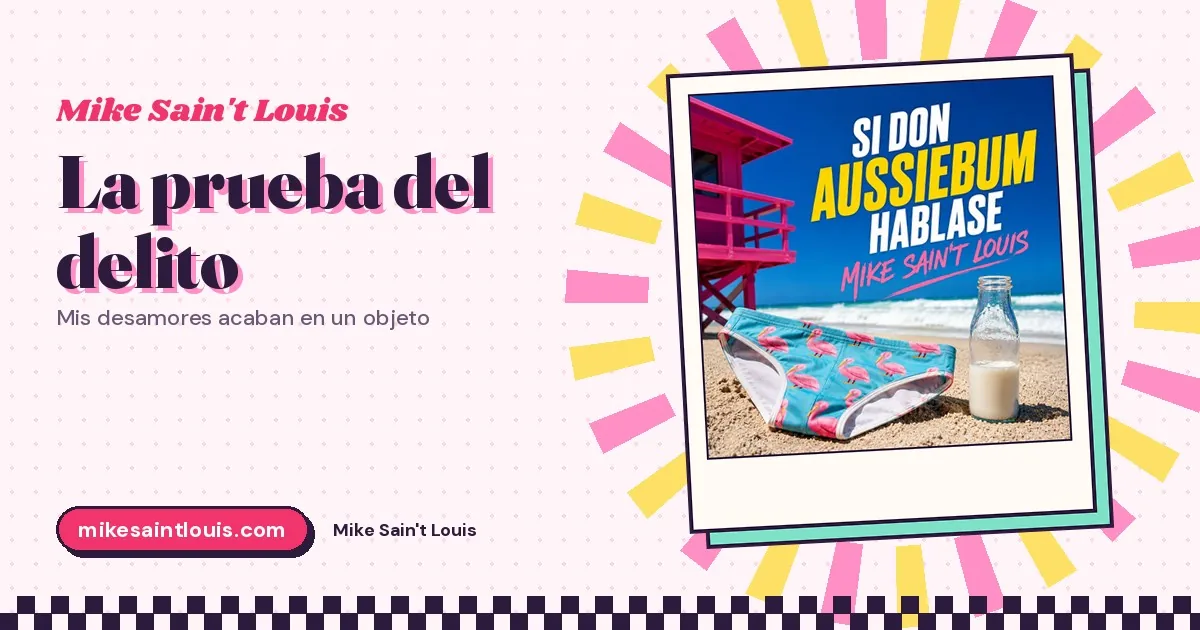
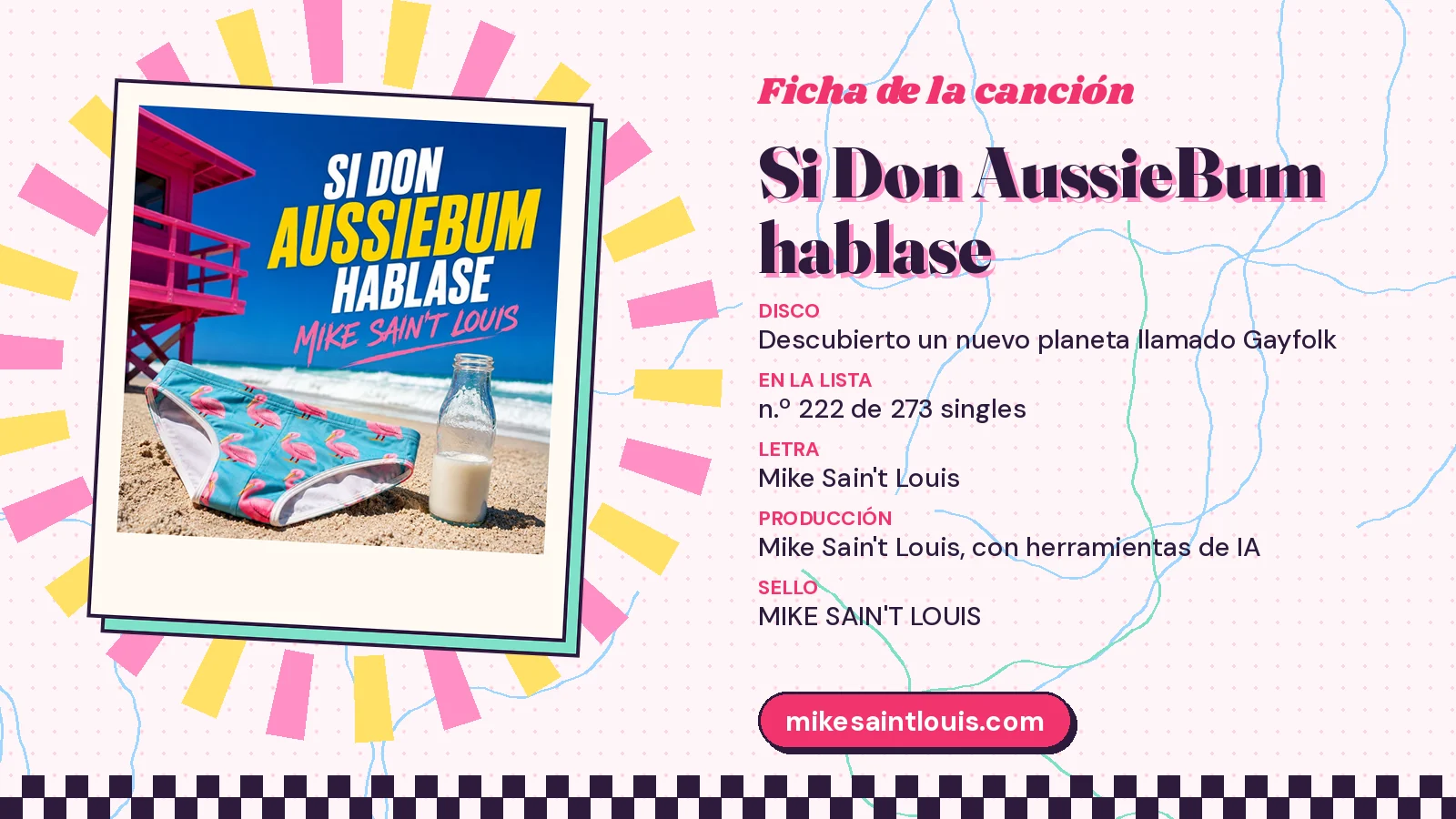
A pair of trunks covered in pink flamingos, dropped on the sand. Beside them, a glass milk bottle, sweating in the sun. In the background, a lifeguard hut painted fuchsia and a sea straight out of a suncream advert. Not a single person in the picture. That's the cover of «Si Don AussieBum hablase» («If Don AussieBum could talk»), and every time I look at it I think it's the most honest image I have of heartbreak.
Because he isn't in it. What he left behind is.
I've been noticing a habit of mine when I write. When a relationship breaks, I don't write about the heart, or the moon, or the wound in the abstract. I write about a sock. About a cushion. About a few pairs of designer trunks. The rage, in my lyrics, always ends up stuck to an object like chewing gum to the sole of a shoe. And this post is about that: why it happens, what I gain and what I spare myself when I make a scrap of Lycra carry the whole load.
The good ones flew
I'll start with the detail that made me write the whole song. It isn't that someone made off with some trunks. It's that he chose which ones.
«Los de Aliexpress bien que los ha dejado» («The AliExpress ones, he made sure to leave those»), the lyric says. The cheap ones, the knock-offs, the ones that fade by the third wash: those stayed in the drawer. The original AussieBums, the ones I'd bought, went without a second thought. There's a complete portrait of a person in that, and nothing needs adding. No adjectives, no diagnoses, no psychologists.
Pettiness fascinates me when it's that precise. A break-up in itself is a drama everyone understands. A break-up in which the other person runs quality control before looting your wardrobe is something else: it's a comedy of manners. And that's where I'm comfortable writing.
The detail also saved me from something I find very tedious, which is textbook self-pity. If I write «you've broken my heart», the listener puts on a sympathetic face. If I write that he took the good ones and left me the AliExpress ones, the listener laughs, gets indignant and, deep down, understands exactly the same thing. There's been abuse. There's been calculation. Only told with a label and a size.
That's the object's first advantage: it tells the truth without begging for pity.
The inventory as a genre
If I go through my lyrics calmly, the inventory turns up everywhere. There are whole songs that could be a removal company's checklist.
There's «El calcetín», which turns the saddest garment in the drawer into a lesson about self-esteem; I've written about it on its blog page. There's «No quiero otro novio cojín», where the entire boyfriend is reduced to a sofa object, soft and decorative, useless when you actually need it. There's this song's big brother, Un falso amore se ha llevado mis bañadores de marca, the same wound from another angle, with the title turned into a court ruling. And I could go on: suitcases, WhatsApp messages, funeral wreaths, iPhone photos.
I didn't plan it. I realised one day while sorting my own archive, something I talk about in how I sort my lyrics from A to Z. Lining up the titles, I saw more things than people. As if my songbook were the lost property office at a bus station, every item waiting for someone to come and claim it.
Nobody comes, obviously.
I think I like the inventory because it's a genre with no tricks. A list of things has no opinion. A list of things just sits there. And yet, if you order it well, the list ends up accusing. I learnt that from the neighbourhood mums who, instead of telling you you're a disaster, list what's lying around your bedroom: the glass, the pants, the charger, the wet towel on the bed, the open bag of sunflower seeds. No insult needed. The list is the insult.
Giving the trunks a title
Then there's the trick that gives the song its title, one of the things I had most fun writing: addressing a pair of trunks as a gentleman.

Don AussieBum. With his «Don», like a small-town notary or the parish priest everyone confesses their sins to. Because that's what the trunks are in the song: the unwitting confessor of a whole crowd of people. If they could talk, says the lyric, we'd all be left without husbands, without partners, without acquaintances. And the list runs riot until it reaches cousin Carmen and the man who plays the saint at church.
I love giving speech to things that have none. It's a children's-story device, the talking teapot, the grumbling clock, but applied to a garment that has been places children's stories don't go. That mix, the sweetness of the device with the filth of the content, is for me the whole fun of the song. As if Disney had made a film in a cruising spot in Maspalomas.
And there's one more thing. When the object talks, I don't have to. If the accuser is Don AussieBum, the narrator stays clean, hands in his pockets, whistling. «I never said a word, the trunks did.» It's the tactic of the nosy neighbour, the one who always starts with «well, I've been told», whom I've already portrayed in the character we all have on our landing. The fiercest gossip always comes from an anonymous source.
In this case, the anonymous source is made of Lycra and has a kangaroo embroidered on it.
What stayed at home
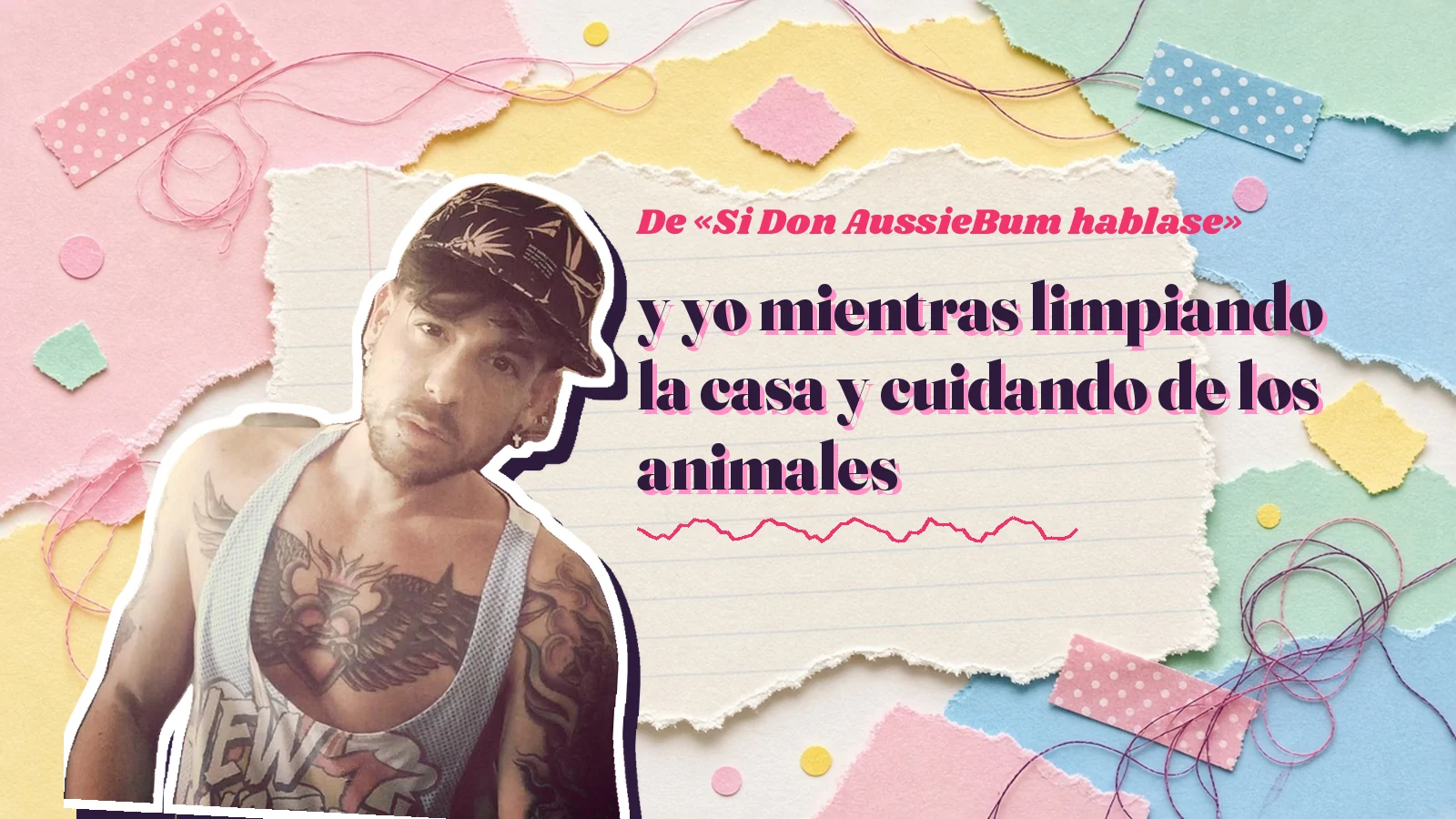
There's a line in the song without a gram of joke in it, and I consider it the centre of gravity of everything else: «y yo mientras limpiando la casa y cuidando de los animales» («and me, meanwhile, cleaning the house and looking after the animals»).
I put it right after the theft of the trunks, no transition, so it would hurt by contrast. While one was strolling the beach with my AussieBums as bait, the other was at home mopping the floor and putting out food and water for the animals. No metaphor. No horror image. A mop and a bowl of pet food.
That's the part of break-ups that never makes it into films. In films there's rain, slammed doors, suitcases on the landing and a soundtrack of violins. In real life there's someone cleaning while the other has fun, who finds out nothing until much later. Housework is invisible precisely because it works: nobody applauds a clean bathroom, nobody thanks the one who remembered to buy the cat litter.
When I write about narcissism, a subject I come back to a lot, that division of labour strikes me as more revealing than any shouting scene. One puts his pretty face on at the shoreline. The other puts his body into the kitchen. And then, when it all blows up, the shoreline one still has the nerve to say the other brought nothing to the table.
That's why the line goes unadorned. There, I didn't want to laugh.
From the joke to the Lycra: why the object protects me
A lot of people ask me, sometimes fondly and sometimes with a bit of spite, why I laugh at my exes so much in my songs. I've tried to explain it in I laugh at my exes because it's the most honest way I have of telling it, and the object is a big part of the answer.
The object protects me from two dangers. The first is unbridled melodrama. If I write directly about what I felt, I risk staying stuck in there, going round like laundry on the spin cycle, and turning a three-minute song into a therapy session nobody asked for. The object forces me to look outwards. To describe. To count how many trunks, what brand, where they were, who took them.
The second danger is uglier: turning the song into a score-settling against one specific person. That doesn't interest me in a song like this. What interests me is that anyone who's lost something in a break-up recognises themselves. Some lost their trunks, others the Thermomix, others the dog, others the gym membership they were going halves on. The object is concrete, but the situation belongs to everyone. That's why it works as a bar joke: everyone pictures their own pair of trunks.
And then there's the silliest advantage, which to me is the most important. A pair of trunks is funny. A wound isn't. If I get the listener laughing at the trunks, I've already slipped the wound under the door.
The empty beach
Back to the cover, because I think it explains all this better than I can.
The photo is a catalogue beach. Deep blue sky, white waves, the bubblegum-pink lifeguard hut on the left. In the foreground, on the sand, a pair of sky-blue briefs covered in pink flamingos, lying open as if someone had just whipped them off in a hurry. And beside them, standing up, a glass milk bottle, half full.
Not a body. Not a towel. Not a footprint.
What I like most about that image is that it's the crime scene after everyone's gone. The trunks lie there like the chalk outline of the body in a police drama. Someone was here. Someone did something. But nobody's left to tell the tale, except the garment. That's why Don AussieBum is the only witness and why the whole song is his statement.
The milk bottle I leave to each person's imagination. Some have told me it's innocence; others, that it's something far less innocent. I'm not going to clear it up. If the song is filthy, the cover can play along too.
I put it next to the cover of «La playa del Mal Pas», my cleanest and most serious song about a beach, and I'm amused by how different they are. There, a little beach watched from afar. Here, an advert beach with an abandoned pair of briefs. Both are mine. Both, in their way, talk about what's left when someone's gone.
The fillet on special offer
The song doesn't hold back on sex, and I'm not going to apologise for that. There's a line that makes me laugh every time I hear it: «hoy tengo de saldo el filete» («today the fillet's on special offer»).
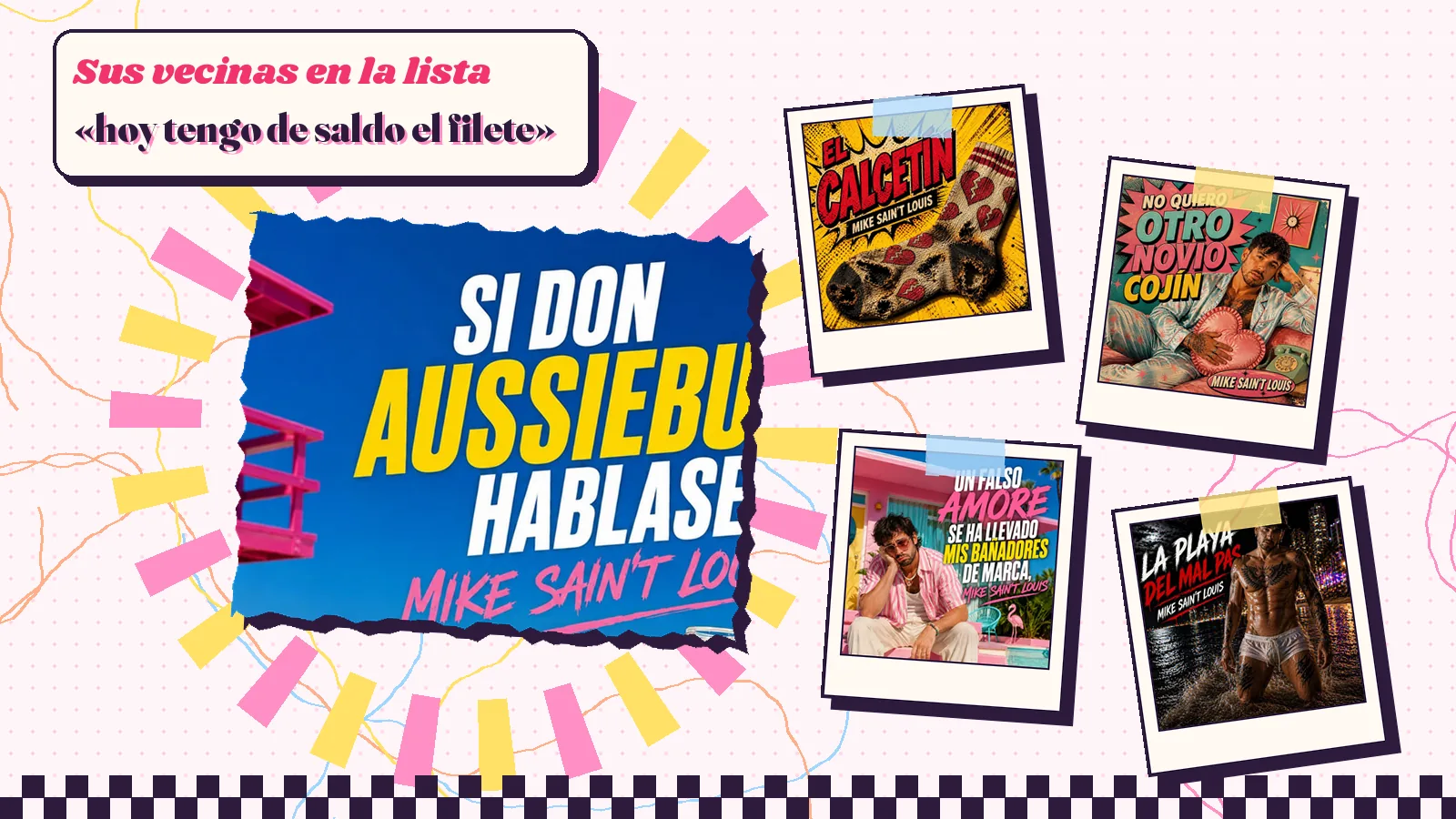
Supermarket vocabulary applied to the body strikes me as one of the most honest things about contemporary gay hook-up culture. The apps have turned people into shop windows. Product shots, measurements, offers, «today only». And designer trunks, in that context, are premium packaging. They're great for promotion, the song says, for the bulge and the back end. It's advertising. It's packaging.
I tell it with humour because it's the only way I can tell it without getting all high and mighty. I don't want to write a sermon about objectification on dating apps. I want to write about a bloke who takes my good trunks to go out hunting and then has the cheek to use them as bait. Someone else can write the sermon.
If you're interested in how I write about the body without covering my face with my hands, I go into it more in writing about the body without apologising. There I explain why I don't use euphemisms. Here I'll just add that flamingo briefs are incompatible with solemnity. I've tried. It can't be done.
Not that you're so important
And I reach the end of the song, where the object steps back and the person writing finally appears.
«Tú me hiciste insignificante» («You made me insignificant»), the lyric admits. It's a brutal sentence, the kind you don't say out loud at dinner with friends. Because that's what a certain kind of partner does: doesn't hit you, doesn't shout at you, just shrinks you. Takes the good trunks and leaves you the knock-offs, and one day you catch yourself feeling like a knock-off too. AliExpress. Pattern faded.
But the song doesn't stop there. Before that line there's a put-down, reminding the other that he's not all that, which is my way of grabbing the mic off the ex just as he was about to start his speech. Then comes the Phoenix, an image I return to a lot, in «Tattoo de Fénix» too. And then comes Isabel Pantoja, Spain's great copla diva, with her famous cry of «¡Dientes, dientes!» («Teeth, teeth!»), the folk star's grin for the photographers while everything around her is collapsing.
I've watched that Pantoja moment on loop more times than I'm going to admit here. A courthouse door, a cloud of microphones, cameras firing their flash a hand's breadth from her face, and her smiling as if she were at the Seville April Fair. Pure theatre. Copla taken out onto the pavement.
To me it's the best survival lesson Spanish celebrity gossip has ever given. You don't need to win. You just need to smile in a way that ruins the other person's day.
That's Planeta Gayfolk for me. An enormous rage that ends in a smile showing every tooth.
What the object can't tell
I have to be honest about one thing. The object trick has a limit, and I know it well.
There are songs of mine where no object saves me. In «Ni con un palo» there are no trunks or socks. There's a dry text about sexual and emotional punishment, and there comedy had no place. Sometimes pain doesn't fit in a garment, and forcing it would be trivialising.
The difference, I think, is timing. When I write from inside the blow, texts like that come out, without jokes. When I write from a bit further away, with some perspective, the objects appear. The object is the sign that I can now look at the crime scene without fainting. That I can now describe the trunks on the sand instead of throwing myself down on the sand to cry.
So, in a way, every object in my lyrics is a little convalescence certificate. If I'm laughing at the briefs, I'm on the mend.
I write it, machines make it sound
A clarification I always make because I'm always asked: the lyrics of «Si Don AussieBum hablase» are mine, written by me without artificial intelligence. The music and vocals are made with AI tools, Suno among them. I'm a lyricist, composer and music producer; I'm not a performer and it isn't my throat on these songs.
I mention it because in this particular track the division of labour shows. The list of trunks, cousin Carmen, the «Don», Pantoja, the fillet on offer: all of that came out of my notebook, with my quirks and my typos. The machine helped me dress it in a beach beat and a «bum bum» chorus that sticks like sand to a wet bum. But the machine doesn't know what it is to have your good AussieBums stolen. I do.
I explain it more calmly in what's mine in a song made with AI, in case anyone wants the full breakdown.
My own evidence cabinet
I've started thinking about which objects I'd put in a display case if I had to set up the museum of my heartbreaks. I come up with far more than fit in a song.
A pair of flamingo trunks, to start with, because they've earned it. An odd sock. A heart-shaped cushion nobody dared throw out. A joke funeral wreath. A Mercadona receipt, the supermarket kind that gets folded and stays in your winter coat pocket until March. A screenshot of twenty statuses viewed and not one «like». A Tupperware that never came back.
Each of those objects could be a song. Some already are, and you can look for them in the list of singles. Others are waiting in the drawer, and you know I believe a song kept in a drawer is no use to anyone, so sooner or later they'll come out.
What I'm sure of is that I won't stop writing like this. The day someone steals my Thermomix, there'll be a song. I've even got the title in my head. I'm not saying it, in case he's reading.
Teeth, teeth
If something like this has ever happened to you, if someone took the good stuff and left you the knock-offs, here's an exercise that worked for me. Make the list. Write down everything he took, with its brand, its colour, its size. Don't write how you felt. Just the things.
When you've finished, read it out loud. I promise that at some point in the list you'll laugh. Maybe at the Thermomix, maybe at the gym membership, maybe at the Tupperware. But you'll laugh. And at that moment you'll have won the first battle, which is to stop being the victim of your own story and become its chronicler.
Then, if you like, play the song on the beach. The bit of beach you know about. Look around. I bet some pair of designer trunks has a history, and its original owner is at home, cleaning and looking after the animals.
And if that owner is you, put the mop down for a moment. The animals can wait five minutes. Put on whatever trunks you've got left, even the AliExpress ones with the faded print, and head down to the water's edge. Nobody looks at the brand when someone walks with their head held high.
Give them a hug from me. And tell them to smile with every tooth.
Frequently asked questions
What is «Si Don AussieBum hablase» about? A break-up told through an object: an ex takes the original designer trunks, leaves the AliExpress ones behind and uses the good ones as bait. The trunks, turned into «Don AussieBum», would know half the world's secrets if they could talk.
Which album is the song on? It belongs to «Descubierto un nuevo planeta llamado GAYFOLK», the first album of the Planeta Gayfolk trilogy. The full lyrics are at gayfolkplanet.com/letras/si-don-aussiebum-hablase.
Who writes and who performs the song? The lyrics are by Mike Sain't Louis, a lyricist, composer and music producer from Madrid, written without AI. The music and vocals are made with artificial intelligence tools such as Suno.
How is it related to «Un falso amore se ha llevado mis bañadores de marca»? They share the line that gives the second its title and the same story of the stolen trunks. They're two takes on the same break-up, one centred on the talking object and the other on the verdict in the title.