
By Mike Sain't Louis ·
Force three on the Beaufort scale: «Breeze», Chagall's lovers, Klein's leap and the Mediterranean evening cool
There's a word Spanish sailors use for the wind that makes flags dance without ripping them off: «bonancible». It sounds old-fashioned, almost like something out of a zarzuela, and yet it still turns up in coastal weather reports. I found out it existed while looking for the Spanish for what English calls a «breeze», and since then it comes to mind every time I put this track on.
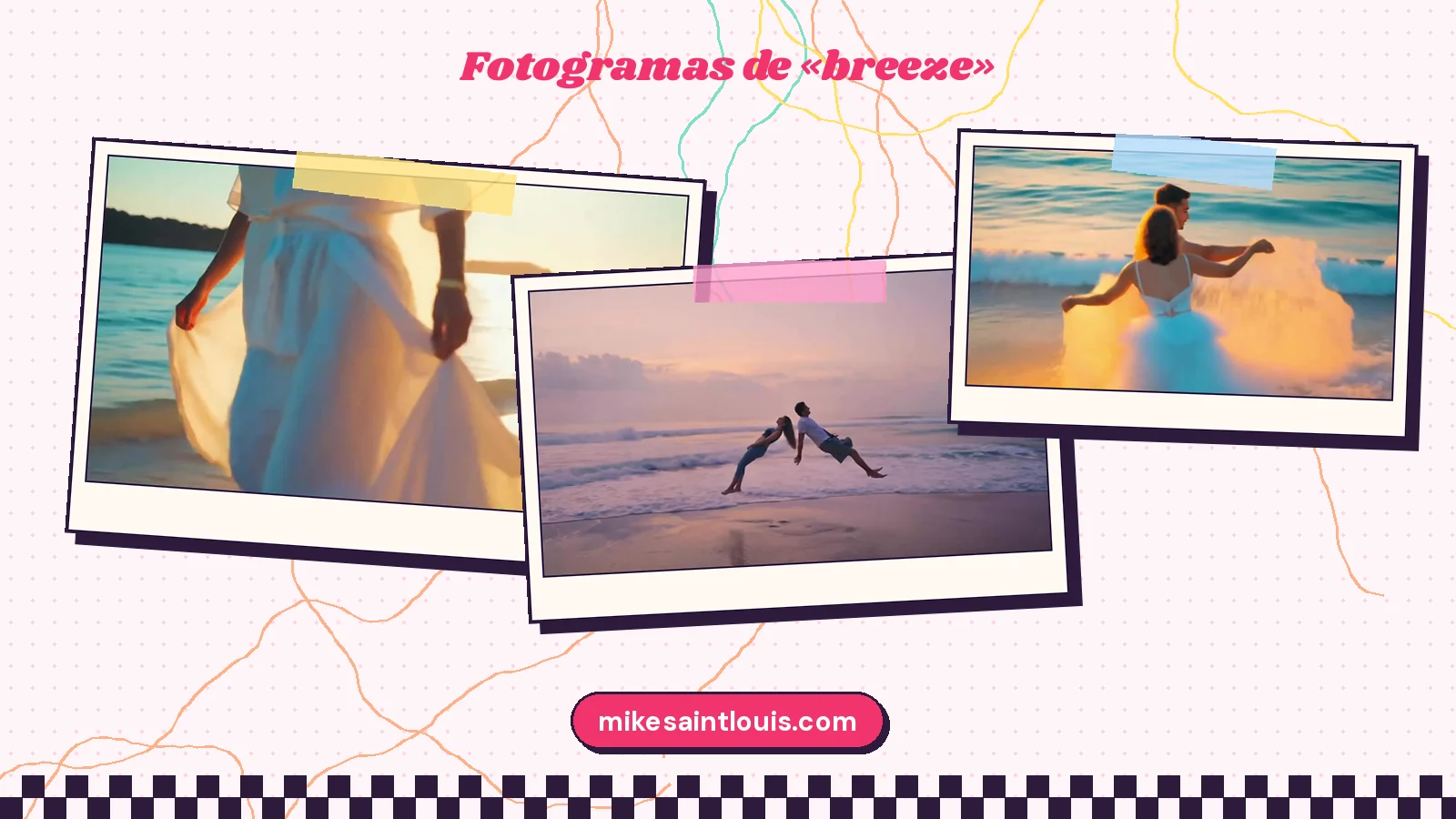
«Breeze» is track 51 of the 273 in my catalogue. It comes after «Stars cibernéticas» and before «Honolulu Sand», and its official music video came out on YouTube on 26 June 2026. It belongs to «El día de la liberación», the last stretch of the Gayfolk trilogy.
Before going on, an honest warning: the lyrics of «Breeze» aren't published yet. I'm not going to quote lines nobody can read anywhere or summarise what they say, because that would be making things up. What I do have is the image that goes with it, the title and everything those two things stir up. That's what this piece is about.
What's in the image
On the cover, a young man is floating. He isn't jumping or falling: he's still in the air, several metres above a coastal village of whitewashed fronts. He's barefoot, in a light shirt left open and linen trousers of the same shade. Below is the sea, the sun is sinking and the sky is full of clouds the light turns golden.
What I like most is that nobody seems frightened. There are no people pointing from the terraces, no alarmed shadows. It's as if in that village it were the most normal thing in the world that, at the hour when it cools down, someone lifts a little off the ground.
The title is handwritten, in pink and orange marker strokes that recall school folders in the eighties. I already talked about that cover on the «Breeze» page. Here I'd rather pull the thread: where the idea of floating comes from, what exactly a breeze is, and why the Mediterranean sunset weighs so much in the memory of so many LGBTQ+ people.
From one to twelve: how a breeze is measured
In 1805, a British Navy officer called Francis Beaufort began noting in his diary a scale to describe wind without instruments, just by watching its effect on a ship's sails. Over the years that scale was adapted to what can be seen at sea and on land, and today it runs from 0, dead calm, to 12, hurricane.
The curious thing is that in English the word «breeze» takes up half the scale. From force 2 to 6 everything is a breeze: light, gentle, moderate, fresh and strong. In Spanish, the State Meteorological Agency uses its own names, which sound like they come from a book of proverbs: flojito, flojo, bonancible, fresquito and fresco.
If I had to place «Breeze» on that scale, I'd leave it at force three, which in the Spanish naming is called «flojo», one step below the bonancible from the beginning. It's the force at which tree leaves move constantly and light flags unfurl. Enough to feel the air is alive, not so much that your hat blows away. The kind of wind that invites you to stay outside a bit longer.
I like the idea that a song can have a Beaufort force too. There are tracks in my catalogue that are a full gale, with heavy seas and waves smashing against the pier. And there are others, like this one, that work like a huge, slow fan.
What English does with the word
In colloquial English, «breeze» has two uses I love. The first is saying something is «a breeze» when it's really easy, like the Spanish «está chupado». The second is «shoot the breeze», which means chatting about anything, with no purpose, for the pleasure of talking.
Both expressions fit the cover. Floating over a white village looks, from outside, like the easiest thing in the world. And the hour it happens is exactly the hour of aimless chat: when the sun stops beating down, people go out into the street and start talking about whatever.
There's also the verb «to breeze in», to walk into a place carelessly, as if it were nothing. Some people walk into parties like that and some have spent years trying to learn how. I'm in the second group, let's be honest.
The lovers flying over the village
The first time I saw the finished cover I thought of Marc Chagall. The painter born in Vitebsk, in today's Belarus, spent half his life painting people who come unstuck from the ground. In «Over the Town», a picture he worked on between 1914 and 1918, he and his wife Bella fly in an embrace above the wooden houses of his home town. In «The Promenade», from the same period, he has his feet on the grass and she floats beside him like a kite, holding his hand.

In Chagall, flying isn't a superpower. It's what happens to the body when it's in love or happy and the emotions no longer fit inside. Nobody asks Bella how she does it. It simply happens, and the town carries on below with its goats, its fences and its roofs.
I like that logic for reading the cover of «Breeze». The young man isn't doing a trick. He's so light that the ground, for a moment, stops claiming him.
Magritte and the men in bowler hats
There's another famous painting with people suspended in the air that works exactly the other way round. In «Golconda», which René Magritte painted in 1953, dozens of identical men in dark coats and bowler hats hang in the sky in front of some buildings. You can't tell whether they're falling, rising or standing still. They don't smile. They don't look at each other.
If Chagall is the levitation of love, Magritte is the levitation of uniformity: all the same, all floating without knowing why, all in the same grey clothes. The cover of «Breeze» is at the opposite pole. There's a single young man, barefoot, shirt open, surrounded by colour.
When I think of the title of the album it belongs to, «El día de la liberación», this comparison comes almost by itself. For years many LGBTQ+ people lived like Magritte's men, coat on and face neutral, floating through a life they hadn't chosen. The cover of «Breeze» is the other possible ending.
Yves Klein's leap into the void
In the autumn of 1960, the French artist Yves Klein circulated a photograph showing him launching himself from a wall towards the street, arms wide, as if about to take flight. The image, known as «Leap into the Void», was credited to the photographers Harry Shunk and János Kender, and in November it appeared in a one-day newspaper that Klein himself put together and distributed to the kiosks of Paris.
For a long time some people believed the leap was real. It wasn't: it's a photomontage. Below there was a tarpaulin held by some of his judo club companions, and the photo of the jump was later combined with another of the empty street. What fascinates me is that the trick takes nothing away from it. Klein wanted to show the gesture of leaping, not prove that you could fly.
Something similar happens with the images for my singles. Nobody is going to think the young man in «Breeze» is really floating over an Andalusian or Greek village. The question isn't whether it's possible. The question is what it feels like to look at it.
Levitating with a pocket camera
In 2011, a Japanese photographer called Natsumi Hayashi became famous online with a series of self-portraits in which she appeared hovering half a metre off the ground in streets, stations and offices in Tokyo. She didn't use editing: she jumped hundreds of times and shot with a very fast shutter speed until she caught the exact instant in which she seemed to float effortlessly.
What made her work special was the face. Instead of a jumping expression, she kept a calm, almost bored look, as if floating were as ordinary as waiting for the bus. That contrast between the impossible and the everyday is the same one the cover of «Breeze» has. The young man isn't posing like a superhero. He's simply up there.
There's a small lesson in those photos. What looks natural almost never is. Behind a light image there are usually many failed attempts.
Mary Poppins arrives on the east wind
Children's literature has plenty of characters who travel through the air, but few as tied to the wind as Mary Poppins. In P. L. Travers's first book, published in 1934, the nanny arrives at the Banks' house carried by the east wind, and promises to stay until the wind changes. In the 1964 Disney film, she comes down from the sky holding on to her umbrella.

I've always found it lovely that someone arrives and leaves according to how the air blows. There are seasons of life like that: people, cities or songs that visit you while a particular wind lasts and then leave without drama.
A few years earlier, in 1904, J. M. Barrie had premiered the play «Peter Pan» in London, with a boy who teaches others to fly. To take off, a happy thought and a little fairy dust were enough. I don't know whether fairy dust exists, but I have seen the happy thought work.
Sorolla's light on the shore
If the cover of «Breeze» had a painted ancestor in Spain, it would be Joaquín Sorolla. The Valencian painter devoted much of his work to the beach, the sea and a white light that almost burns. In «Stroll along the Seashore», from 1909, his wife Clotilde and their eldest daughter walk on the sand dressed in white, their veils and dresses puffed up by the breeze.
What Sorolla does with the wind is astonishing. He doesn't paint it, because wind can't be painted, but you see it in every fold of fabric that lifts. Light fabrics work like sails. The same happens on the cover of «Breeze»: the white shirt and the linen are what tell us there's air moving.
In Madrid, a walk from the centre, there's the Museo Sorolla, in what was his house and studio. It has a small garden, with fountains and tiles, which in July is one of the few corners of the city where some sea breeze seems to arrive. If you've never been, I recommend it on a hot afternoon.
Taking the evening cool
In many Spanish villages there's a custom that's part of my childhood and many other people's: taking chairs out to the front door when the sun goes down and staying to chat with the neighbours until late. It's called «tomar el fresco» or, in some areas, «tomar la fresca». It's the old-fashioned version of shooting the breeze.
In 2021, the town council of Algar de Palancia, a village in the province of Valencia, set out to ask for that custom to be recognised as intangible cultural heritage. The initiative made news around the world, partly because it defended something very simple: that talking without screens and without hurry is culture too.
Those chats have a kind side and a less kind side. On the pavement people share recipes, illnesses, weddings and funerals. They also discuss who comes home late, who with, and why so-and-so doesn't get married. For many LGBTQ+ people who grew up in a village, the doorstep gathering was at once a refuge and a court.
That's why I love that the young man in «Breeze» is suspended above the houses. At that height the doorstep chairs are far away. You can see the whole village, but you can no longer hear the comments.
Why it cools down at sunset
Anyone who has spent summers on the coast knows the physics, even without a name for it. During the day, land heats up faster than water. The hot air over the land rises and leaves a gap that is filled by cooler air coming in from the sea. At night the opposite happens, because the land cools sooner.
I don't want to turn this post into a meteorology lesson, but I find it beautiful to know that the seven o'clock breeze isn't a gift from the sky but a temperature difference seeking balance. It reminds me of the conversations that come when the tension between two people finally evens out.
In summers of extreme heat that breeze is felt less or arrives late. That's when it's worth remembering the basics: drink water even if you're not thirsty, avoid the sun in the middle of the day and keep an eye on older people who live alone, who suffer heatwaves most.
The Balearic sound
If the song had a city, people would put it in Ibiza at sunset. In 1980 Café del Mar opened in Sant Antoni de Portmany, a terrace bar facing west where every evening the sunset gets a round of applause. In the early nineties, DJ José Padilla turned those sessions into a recognisable style, with slow, luminous music made for watching the sun go down, and by the middle of that decade the compilations bearing the bar's name had started to come out.
A little earlier, at the Amnesia club, Argentine DJ Alfredo Fiorito mixed pop, house and all kinds of oddities in sessions that lasted until dawn. In the summer of 1987, four British DJs, among them Paul Oakenfold and Danny Rampling, passed through the island, heard it and took it back to London. What came next ended up being called the second summer of love.
The gay community was present in that club world from the start, and in Ibiza too. For decades the island was one of the few places in Spain where two men could walk hand in hand without anyone turning round. I say it with caution, because I don't want to idealise it: there were also seasonal workers living in the closet while serving free tourists.
The coast that wasn't always free
The image of white villages and a calm sea has, in Spanish LGBTQ+ history, a flip side worth remembering. In 1970 the Law on Social Danger and Rehabilitation was passed, which allowed homosexual people to be locked up simply for being so. And in June 1971, in the Pasaje Begoña in Torremolinos, a large police raid ended with numerous arrests and the closure of the passage's bars.
Torremolinos was then one of those places where, thanks to foreign tourism, there was a little more freedom in the air than in the rest of the country. That night it ended abruptly. Today the Pasaje Begoña is claimed as one of the places of LGBTQ+ memory in Spain, and more and more people know what happened there.
I think about this because the album «Breeze» belongs to is called, precisely, «El día de la liberación» («Liberation Day»). Floating over a coastal village at sunset, barefoot and unafraid, is an image that fifty years ago would have been dangerous. That today it can be just a pretty cover is the result of many people who didn't float but fought with their feet on the ground.
What the album tells
«El día de la liberación» is the album of the trilogy in which the characters start to breathe. There are songs about break-ups, others about parties and others about trips. Several of the ones whose lyrics aren't published yet share a postcard feel: «Float», with its cloud and pink pyjamas; «Fly Away», with crow's wings, or «Drift Away», with a surfboard.
Together they form a kind of small series about lightness: floating, flying, letting the current take you. «Breeze» is the calmest of them all. In «Fly Away» there's a will to leave. In «Breeze» there's no intention at all, just air.
I don't like forcing connections either. Each song has its own story and rhythm. But if someone wants to listen to this block in a row, from «Stars cibernéticas» to «Honolulu Sand» by way of «Breeze», they'll see it makes a little journey: from outer space to a Pacific island with a stop in the Mediterranean.
White, linen and the heat trick
On the Mediterranean coast houses have been whitewashed with lime for centuries. Lime reflects much of the sunlight and helps keep the inside cooler, as well as having a disinfecting effect that was put to use in times of epidemics. That's why so many villages in Andalusia, the Greek islands or North Africa share that look.
Something similar happens with clothes. Light colours reflect more light than dark ones, and linen lets air through because its fibre is stiff and stands away from the skin. That's why it creases so much: it's the price of coolness. Some people iron linen until it's smooth, and some consider a linen shirt without creases to be a shirt that hasn't lived.
On the cover of «Breeze» white is everywhere: on the houses, the shirt, the trousers. Only the sky and the lettering add colour. It's almost a summer palette in its purest form.
Pink and orange, like a school folder
The title is written the way people wrote on notebooks and folders in the eighties: by hand, in marker, in pink and orange. It's an aesthetic I associate with teen magazines, cassette tapes recorded off the radio and the covers of summer records sold at petrol stations.
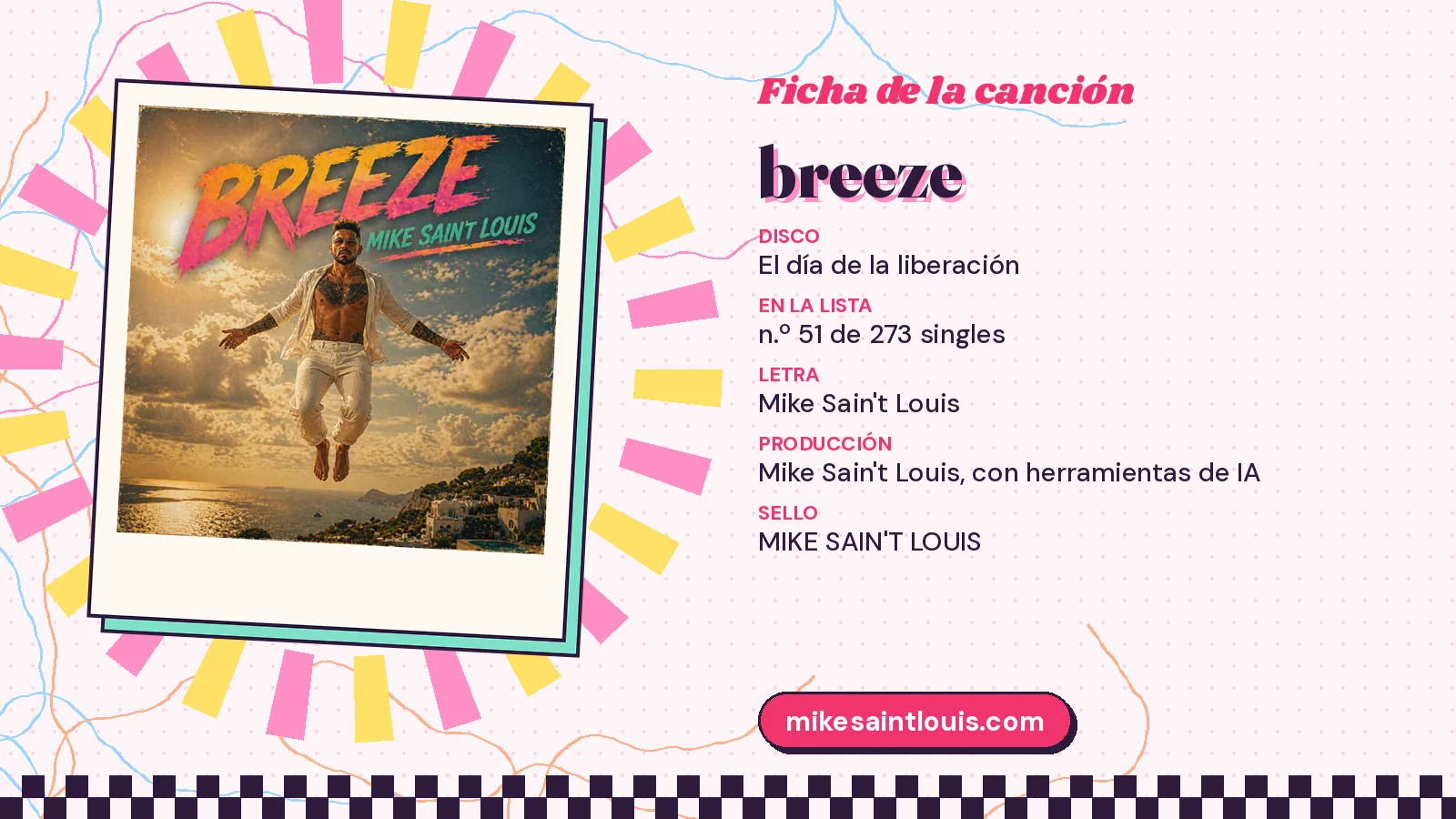
I like that contrast. The background image is almost a classical painting, with its sunset and white village. The letters, by contrast, look like they belong to a fifteen-year-old writing the name of their favourite song on the cover of their folder for everyone to see.
You don't need to have lived through the eighties to feel that nostalgia. Many young people who write to me recognise the aesthetic from TV series, their parents' photos or the revival that has been in fashion for years. It's a way of saying: this is summer and it doesn't pretend to be anything else.
Music for letting go
Research on music and wellbeing has spent decades studying why certain songs calm us down. Some studies link slow tempos and predictable melodies with a drop in heart rate and in the sense of stress. Others insist that what matters most is personal choice: music relaxes when it's the music you chose, not the music imposed on you.
That seems an important idea for a song like «Breeze». I didn't make it to work as a pill, and I don't intend anyone to use it that way. I made it to go with a specific moment: when the heat eases, when you finish the day and sit outside.
If you have a summer playlist, maybe it fits there. I also wrote about how to put together a queer playlist in Spanish that doesn't sound like the usual one, and calm tracks like this are what tend to be missing among so many dance-floor anthems.
Summers then and summers now
I have summer songs of every colour. «Me gusta el verano» is the most direct. «La playa del Mal Pas» is about a specific corner of the coast. «Marica chill» is pure relaxation with attitude. «Breeze» sits somewhere else: it doesn't describe a plan, but a feeling.
There's something about summer that makes it the season of memory. School holidays, the first village romance, the first trip with friends. For many LGBTQ+ people, it was also the time when, far from the neighbourhood, they dared for the first time to be who they were for a few weeks.
That temporary freedom has something of floating about it. For a few days you don't touch the usual ground. Then September comes and you have to come back down. I hope more and more people won't have to come all the way back down.
When the air isn't enough
Not every sunset is light. There are evenings when the silence of a house weighs more than the heat, and there are people who feel lonelier than ever in summer, precisely because everyone seems to be on holiday and happy.
If that happens to you, it isn't silly or an exaggeration. Talking about it with someone you trust or with your GP is a good first step. If at any point thoughts of taking your own life or hurting yourself appear, in Spain there's 024, the suicide-prevention line, free, confidential and available around the clock. If there's immediate danger, call 112. Outside Spain, your country's emergency number or the international directory at findahelpline.com will help you find a line near you.
I've gathered more resources in my mental-health-without-taboo series, with pieces in which I talk plainly about how to ask for help.
An evening to put it on
Put it on at the end of a long day, with the window open and the fan switched off for once. Put it on on a terrace, on the roof, on a small balcony where two chairs barely fit. Put it on driving towards the coast with the window down, when you can already smell the sea.
Put it on in winter too, if you need reminding that summer comes back. Sometimes a song works like a postcard you send yourself.
And if one day you see someone floating half a metre above the pavement, looking like they're waiting for the bus, don't be alarmed. They may just be listening to a force-three breeze.
Frequently asked questions
What is «Breeze» about?
The lyrics aren't published yet, so I can't quote or summarise them. The cover shows a barefoot young man, in a light shirt and trousers, floating over a white coastal village at sunset. This post is about what surrounds that image: the breeze, levitation in art and the Mediterranean summer.
What does «breeze» mean?
It means a gentle wind. On the Beaufort scale, breezes go from force 2 to 6. Colloquially, «a breeze» is also something very easy.
Which album is it on?
«El día de la liberación», the third album of the Gayfolk trilogy. In the catalogue it's track 51 of 273, between «Stars cibernéticas» and «Honolulu Sand».
When did the music video come out?
The official music video was published on YouTube on 26 June 2026.
Who makes the music and the vocals?
Mike Sain't Louis, a lyricist, composer and music producer from Madrid. He writes, composes and produces; the vocals are made with artificial intelligence.