
By Mike Sain't Louis ·
«Eres gordo, eres calvo»: body pressure, femmephobia and eating disorders in the gay scene
«Eres gordo, eres calvo,»
You're fat, you're bald. That's how «Buscando el polvo perfecto» opens, a song from «Descubierto un nuevo planeta llamado Gayfolk», the first album of the GAYFOLK trilogy, and that's also how, with no anaesthetic, the list of defects the narrator throws at every profile he isn't interested in begins. (You can read the full lyrics on gayfolkplanet.com.) The song is a satire. The speaker is an unbearable character who thinks he's a god and blocks anyone who doesn't fit his mould. We laugh at him because we know him. And we laugh a little less when we realise that this inner judge, the catalogue one, lives inside us too.
I've already written about this song from other angles: how the planet was born from a block and why people are not mere objects. Today I want to go somewhere else: to what that pressure does to health. To the men who stop eating, who weigh themselves three times a day, who inject things they shouldn't, who hide their camp side for fear of not being liked. To femmephobia and fatphobia inside the community itself. And to where to find help.
The catalogue
In the lyrics the narrator keeps sorting: fat, bald, ugly, old, under-endowed, camp, effeminate, grandad, not toned. Every defect has its punishment: «Si no contesto y te bloqueo», if I don't answer and I block you. It's a clearance-sale catalogue where people are discarded over a photo.
What the satire does is exaggerate something it doesn't invent. Anyone who has used a dating app between men knows the profiles that, instead of saying what they're looking for, say what they reject. No fats. No fems. No one over such-and-such an age. Masc only. It's so common that one of the big apps had to campaign against it: in September 2018 Grindr launched Kindr, an initiative against sexual racism, transphobia, fat-shaming, femme-shaming and HIV stigma, and tightened its rules against discrimination in profiles. I already talked about racism in the apps in «Doble mirada». Here I'll stay with the body and with camp.
Fatphobia from within
The song's first insult is «gordo», fat, and that's no accident. Fatphobia is probably the most socially accepted form of rejection: it dresses up as concern for health, as well-meant advice, as a joke. In the gay scene, on top of that, it mixes with a very specific ideal of the body: young, slim or muscular, waxed, no belly.
Against that, decades ago, spaces of their own emerged. Bear culture, which became visible in the United States in the eighties, claimed big, hairy, mature bodies as desirable, with its bars, magazines and party weeks. It has its own norms and its own exclusions, like any community, but it proved something important: that the canon isn't natural, it's built, and so it can be built differently.
A fat person doesn't need anyone to remind them of their weight. They know. What they need is for their body not to be a source of mockery, for the doctor's appointment not to be reduced to «lose weight», and for nobody on an app to write to them as if their body were an insult.
I'm a god and you're worn out
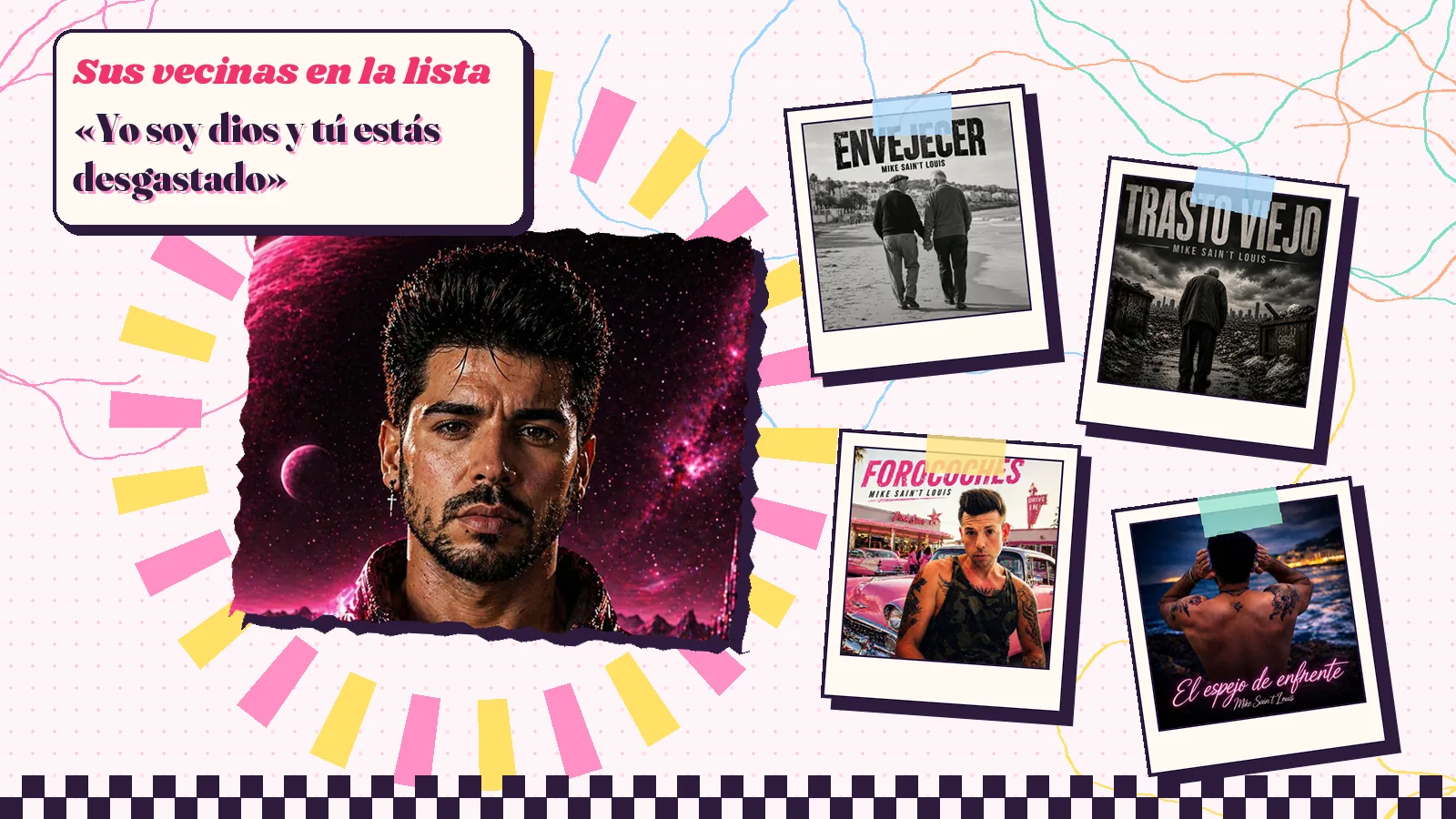
One line sums up the character's arrogance: «Yo soy dios y tú estás desgastado», I'm a god and you're worn out. The other person's body is described as a used object, like a garment that has lost its colour. That word interests me, worn out, because it's the word of a society that treats people as goods with a sell-by date.
The problem isn't having preferences. Everyone has them. The problem is turning them into a public sentence, a filter that humiliates, a hierarchy where some bodies count and others are surplus. And the problem is bigger still when we learn that hierarchy so well that we apply it against ourselves.
You're camp and effeminate
«Tienes pluma y eres afeminado, / Yo soy deportista y un buen macho», you're camp and effeminate, I'm sporty and a real man. Femmephobia fits whole in those two lines. «Pluma», that way of moving, speaking, dressing or gesturing associated with the feminine, is still a reason for rejection inside the gay scene itself. Many men who escaped the closet are still trapped in another one: looking straight.

Femmephobia isn't an aesthetic quirk. It's machismo. It despises camp because it despises the feminine, and that's why it connects with misogyny and transphobia. Many boys learned at school that the quickest insult was the one aimed at their gestures, not at who they slept with. As adults, they find the same insult in new packaging: «discreet», «masculine», «straight-acting». I wrote about the volume of camp in «Exagerada me llamaron a mí», and I'll say it again here: camp isn't something to hide, it's something to celebrate.
Looking for a discreet boyfriend
The chorus repeats that the narrator is looking for «el polvo perfecto», the perfect shag, and at the same time «a un novio discreto», a discreet boyfriend. That word, discreet, has a lot of history. For decades discretion was a survival strategy: not being seen meant not being arrested, not being fired, not being thrown out of home. Today, in a country with marriage equality since 2005, the word still appears in profiles, sometimes out of real need and sometimes as a synonym for «not camp».
I don't judge anyone who needs discretion because their surroundings aren't safe. What worries me is when discretion becomes an aesthetic value, the idea that a man who shows is worth less.
You're a grandad and not toned
The lyrics don't spare age either: «Eres un abuelo y no estás marcado», you're a grandad and you're not toned. In the gay scene youth works as currency, and ageism starts early. Some men feel too old for the party at thirty-five, and men of sixty become invisible in the same bars where they used to be greeted with kisses.
In my catalogue there's a song called «Envejecer», and another that laughs at being a «Trasto viejo», a piece of old junk. Growing old should be a privilege, especially for a generation that watched so many friends die in the eighties and nineties. Punishing a wrinkle with a block says far more about the one blocking than about the one blocked.
Go cry to the surgeon
The cruellest line in the song is this one: «Vete a llorar al cirujano, yo creo», go cry to the surgeon, I reckon. It's the solution the character offers to anyone he doesn't fancy: get surgery. And it's a solution that, sadly, many people take seriously.
Cosmetic surgery, hyaluronic acid, Botox, hair treatments and supplements are personal and legitimate choices when they're made with information and a serious professional. The risk appears when they're chosen not out of one's own desire but out of desperation, when each touch-up asks for another, when people turn to clinics without guarantees or to products bought online. Then we're no longer talking about aesthetics but about health.
What the data says
Eating disorders, such as anorexia, bulimia or binge-eating disorder, are almost always associated with young women. But they aren't only their business. A study by Matthew Feldman and Ilan Meyer, published in 2007 in the International Journal of Eating Disorders with a sample of 516 people in New York, found that more than 15% of gay and bisexual men had at some point had an eating disorder or some of its symptoms, compared with less than 5% of heterosexual men.

What's interesting is what they didn't find. The men most connected to the gay community, or those who went to gay gyms, didn't have more disorders than the rest. The authors concluded that the explanation didn't lie only in the scene's values, but in other factors. I note it because it's easy to blame the scene for everything. Body pressure exists, but so do the stress of belonging to a minority, family rejection, school bullying and loneliness, which weigh on self-esteem long before anyone opens an app.
Anorexia in reverse
There's a disorder that mainly affects men and is rarely discussed: muscle dysmorphia. In 1997 a team of researchers led by Harrison Pope described it as a form of body dysmorphic disorder; before that it had been informally called «reverse anorexia». People who have it see themselves as small and weak even when they're very muscular. They train compulsively, follow extreme diets, get anxious if they skip a session and, in some cases, turn to anabolic steroids. The DSM-5 diagnostic manual, from 2013, includes it as a variant of body dysmorphic disorder.
The song has a line for that too: «Ponte a hacer deporte, ¡Romeo!», go and do some exercise, Romeo! Coming from the character it's contempt. Sport, which should be health and pleasure, becomes penance. And in another song, «Forocoches», it's a psychologist who recommends doing exercise, but to look after yourself, not to be liked. The difference between the two phrases is the difference between health and punishment.
What the photo doesn't show
Profile pictures aren't innocent either. Filters that slim the face, lighting that sculpts the abs, studied angles, photos from five years ago. We compare our real body, the one from a sleepless morning, with edited bodies that don't even exist like that off the screen. It's a competition impossible to win because the rival isn't a person, it's a retouch.
There's also what you don't see behind some bodies that do exist: hours at the gym that eat up social life, diets that leave you with no energy, and sometimes substances. Anabolic steroids used without medical supervision are linked to cardiovascular, liver, hormonal and mental health problems. Getting them is easy; the risks don't appear in any photo. If someone at the gym offers them to you as a shortcut, remember that the shortcut takes its toll.
Not only men
I'm talking mostly about gay and bisexual men because that's the world the song portrays. But body pressure has no orientation. The same Feldman and Meyer study found that lesbian and bisexual women were not protected against eating disorders, as some earlier studies had suggested: their figures were similar to those of heterosexual women and of gay and bisexual men. Trans and non-binary people, moreover, face a gaze on their bodies that is often even harsher. Those researchers' conclusion still holds: these problems need more attention across the whole community, and resources designed for it.
Warning signs
You don't need a diagnosis to ask for help. These signs deserve attention, in you or in someone close:
- Weighing yourself several times a day or feeling that your mood depends on the scales.
- Skipping meals, compensating for what you eat with vomiting, laxatives or extreme exercise.
- Binges with a sense of losing control, followed by guilt.
- Avoiding plans, beaches or photos out of shame about your body.
- Being unable to stop training even when you're injured, exhausted or ill.
- Using steroids or other substances to change your body without medical supervision.
- Looking in the mirror and always seeing something wrong.
In my song «El espejo de enfrente» the mirror judges. When the judging never stops, it's worth talking to someone.
If you don't look after yourself you'll have to lower the bar
At the end of the song a fuck buddy from Toledo gives some sincere and depressing advice: «Y si no te cuidas tendrás que bajar el listón», and if you don't look after yourself you'll have to lower the bar. He says it like someone explaining the rules of the market. The narrator replies that he finds it depressing, and he's right.
That advice is the one we learn without anyone telling us: that love is earned with a body, that there's a scale, that if you're not at the top you have to settle. It's a lie, even if it sometimes looks true. Couples that last aren't chosen by their photo, and neither are the friendships that save you. But to realise it you need to step out of the catalogue, even for a while. Switch off the phone, meet in person, get to know someone in a conversation rather than in a grid of photos. What you lose in efficiency you gain in truth: the whole person, with their laugh, their clumsiness and their way of looking, never fits in a thumbnail.
The body without apologising
I devoted a whole text to the body in my songs: toned, tattooed and grey-haired. The GAYFOLK catalogue has muscular bodies and tired bodies, tattooed skin and white hair, and none is better than another. I like to think a collection of songs can be a small counterweight to the app catalogue: a place where bodies appear without a price tag.
That doesn't mean giving up on looking after yourself. Looking after yourself means eating well, sleeping, moving for pleasure, going to the doctor, dressing up because you feel like it. What we need to let go of is the idea that the body is a permanent exam you pass or fail in every profile picture.
What we can do on the apps
The apps aren't going to disappear, and many people find friendship, sex, a partner or simply company on them. But they can be used differently:
- Write what you're looking for, not what you reject.
- If someone doesn't interest you, there's no need to explain why. A polite silence hurts less than «no fats».
- Report profiles that insult or discriminate; the apps themselves have rules against it.
- If you notice that every session leaves you feeling worse, take breaks, delete the app for a few days, meet up with friends.
- Remember that a photo isn't a person.
Today you cry
The chorus shouts «¡Hoy lloras!», today you cry! In the song it's mockery. Outside it, it's a reality for many people: the one who cries after being blocked, the one who shuts themselves away because they don't like their body, the one who stops going out. Crying isn't exaggerating. It's a sign that something hurts, and what hurts can be looked after.
When the one blocking is you
It's easy to laugh at the song's character as if he were someone else. It's harder to recognise the days when we resemble him. We've all discarded someone over a photo, made a comment about someone else's body in a group of friends, laughed at a camp gesture that reminded us of our own. I don't say it to blame anyone, but because change starts there.
A simple question helps: would I say this to the face of someone I love? If the answer is no, perhaps there's no need to write it in a profile or drop it in a chat either. Cruelty on the apps relies on the distance of the screen. Shortening that distance, remembering that on the other side there's someone having a good or bad day, changes conversations a lot.
Among friends
Friends can be the best antidote to the catalogue or its loudest amplifier. There are groups where every kilo, every wrinkle, every receding hairline is commented on, and groups that celebrate whoever dares to post a swimsuit photo without hiding their tummy. Choosing which kind of group we want to be in, and which kind of friend we want to be, is also a small, everyday form of activism.

If a friend stops eating when you go out, becomes obsessed with the gym or isolates himself because he doesn't like himself, you don't need the perfect words. It's enough to tell him you've noticed, that you care and that you'll go with him to ask for help if he wants. Don't talk to him about his weight; talk to him about him. And if at some point you're truly worried about his health, don't carry it alone: seek guidance from the specialist associations, which also support families and friends.
If you're under 18
Many eating disorders begin in adolescence, sometimes at the same time as someone discovers their orientation. If you're under eighteen and recognise yourself in something I describe, the ANAR Foundation answers on 900 20 20 10, free, at any hour and without anyone having to find out. You can talk about food, about your body, about being LGTBI or about all of it at once.
Where to find help
If you think you have a problem with food or with your body image, talk first to your GP, who can refer you to a unit specialising in eating disorders. The Spanish Federation of Associations for Help and the Fight against Anorexia and Bulimia (FEACAB) has an information line on 976 389 575, and the Association against Anorexia and Bulimia (ACAB), in Barcelona, answers on 93 454 91 09.
If what weighs on you has to do with being LGTBI, FELGTBI+'s Línea Arcoíris is on 91 360 46 05, and in Madrid COGAM offers psychological support on 91 523 00 70. There are more resources in the index of my mental health series.
And if at some point the distress becomes so great that you think about hurting yourself or no longer living, in Spain you can call 024: it's free, confidential and works every day at every hour. If there's immediate danger, call 112. If you're in another country, contact the suicide prevention line there or its emergency number. Naming suicide isn't taboo, it's a way of opening the door to help. I explained it in «Hablemos del suicidio sin tabú».
What the perfect shag isn't
The song is called «Buscando el polvo perfecto», looking for the perfect shag, and the joke is that the narrator never finds it. He can't: he's so busy discarding that he has no time left to really look at anyone. That, I think, is the lesson hidden in the satire.
There's no perfect body, no correct amount of camp, no ideal age. There are people who like each other, who look after themselves, who laugh together at the catalogues. I hope we come to resemble the song's character less and less, and a little more the one who, in the end, dares to say that all this strikes him as depressing.
Frequently asked questions
What is femmephobia? It's the rejection of gay or bisexual men who are camp, that is, whose gestures, way of speaking or dressing are associated with the feminine. It appears even inside the community itself, in phrases like «masc only» or «straight-acting», and it's linked to machismo and misogyny.
Do gay men have more eating disorders? Studies point to a higher risk. A 2007 study by Feldman and Meyer found that more than 15% of gay and bisexual men had had an eating disorder or some of its symptoms, compared with less than 5% of heterosexual men. The causes are varied and can't be reduced to the scene's body pressure.
What is muscle dysmorphia? It's a variant of body dysmorphic disorder in which a person sees themselves as small or weak even though they're muscular. It can lead to compulsive training, extreme diets and steroid use. It was described in 1997 and the DSM-5 has included it since 2013.
Where can I get help for an eating disorder in Spain? The first step is your GP, who can refer you to a specialist unit. You can also call FEACAB on 976 389 575 or ACAB on 93 454 91 09. If there are thoughts of self-harm, 024 answers at any hour, and 112 in an emergency.
What is «Buscando el polvo perfecto» about? It's a satire from the first album of the GAYFOLK trilogy, «Descubierto un nuevo planeta llamado Gayfolk», about a dating app user who thinks he's a god and blocks everyone who doesn't fit his mould for being fat, bald, older or camp.
Who writes these songs? Mike Sain't Louis, a lyricist, composer and music producer from Madrid who introduces himself as the first AI songwriter. The music and vocals of his songs are made with artificial intelligence.