
By Mike Sain't Louis ·
The wine, the cheese and my dignity wrapped in tinfoil: the night of «Hetero»
«Quedamos. Llego. Y ya tiene a otro en la cama.» («We arrange to meet. I arrive. And he's already got another one in bed.»)
Three sentences. Two of them a single word in Spanish. The third, a sledgehammer. That's how «Hetero» starts, and I think it's the fastest opening in my whole catalogue. No introduction, no context, no «that summer night». We arrange. I arrive. And there's the scene, complete, in the time it takes to open a door.
«Hetero» is a song about one specific humiliation. A date. Someone who turns up keen, with little touches, with his bottle. And someone who already has another man in bed and doesn't even bother to hide it. The song's page has the summary. Here I want to take the scene apart piece by piece, because it's built from very few elements and each one weighs a ton.
Two words to get there
«Quedamos. Llego.»
I wanted the start to be that dry because dates that go wrong always begin exactly like dates that go right. With a message. With a «you coming?». With a «ten o'clock at mine». There's no warning sign in «quedamos». It's the most ordinary word in the world. «Llego» too: you arrive, go up, ring the bell.
If I'd used more words, the scene would have filled up with anticipation. «I arrive nervous, keen, thinking about what's going to happen.» That would give the reader time to get suspicious. With two words there's no time. You arrive, and the other one's already in bed. Just like in life: the blow doesn't announce itself.
He doesn't even hide it
Second line: «Ni disimula. Ni le importa.» («He doesn't even hide it. He doesn't even care.»)
This is the part of the scene that hurts most, more than the other man in the bed. Being cheated on is one thing. Them not even bothering to cheat on you properly is another. He doesn't even hide it. No excuse, no «he's a friend who stayed over», no rush to get dressed. He's just there.
«Ni le importa.» And that's the knockout. It isn't that he didn't have time to cover it up. It's that he doesn't care. You don't matter enough for him to pretend.
I've written a lot about people who lie. Narcissists who build elaborate lies, who lead double lives, who ask you about growing old together while they cheat on you. In «Hetero» there's no lie. There's something worse: indifference. It's contempt stripped naked. You don't even merit a lie.
And the «ni... ni» anaphora, so very me, is cut to the bone here. Twice. He doesn't even hide it. He doesn't even care. Normally I string together five or six. Here two were enough. Humiliation doesn't need a long list.
The wine, the cheese
And along comes the line that makes me laugh and cry at once:
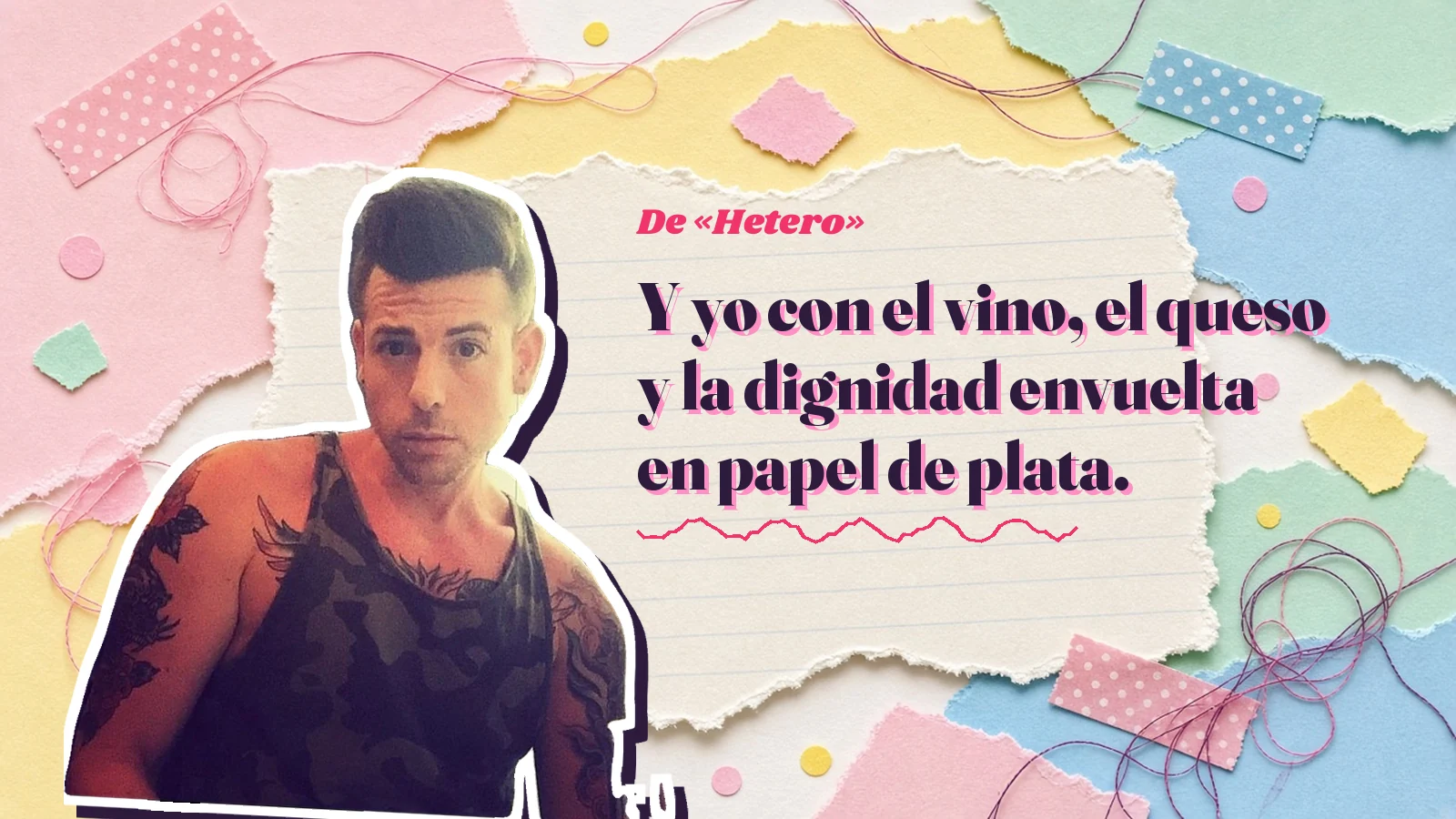
Y yo con el vino, el queso y la dignidad envuelta en papel de plata. (And me with the wine, the cheese and my dignity wrapped in tinfoil.)
That sentence is everything I know how to do as a lyricist packed into one line. The everyday and the tacky. The list. The twist. The self-parody.
The wine and the cheese. The little extras you take on a date when you want to make a good impression. Not champagne and caviar, that would be the movies. It's the five-euro Mercadona wine you spent ten minutes choosing by its label so it wouldn't look too cheap, and the cheese, maybe a vacuum-packed cured Manchego, or a wedge of something that sounds French. They're the gifts of someone who's thought about the evening. Who had plans.
And then, in the same list, without changing tone, «my dignity wrapped in tinfoil».
Dignity is on the shopping list. Next to the cheese. And wrapped in tinfoil, like a packed-lunch sandwich, like the leftovers your mum puts in a Tupperware for you to take home. It's a deeply naff image and a precise one. Your dignity hasn't been lost: you're carrying it, wrapped up, protected, as something that might spoil. And it's going to spoil.
Why tinfoil
People have asked me why tinfoil and not something else.

First, because it's the most domestic thing there is. Everyone has a roll in the kitchen drawer. It's what you wrap sandwiches in, cover dishes in the oven with, keep half a lemon in the fridge in. It's humble. And dignity, in that scene, is humble too.
Second, because tinfoil shines. A tiny bit. It has a pretension to luxury that isn't luxury. It shines the way a tray of canapés shines at a village wedding. Dignity wrapped in tinfoil is a dignity trying to sparkle that is, deep down, a chorizo sandwich.
And third, because tinfoil crumples. Once it's crumpled, there's no way to get it smooth again. However much you flatten it with your hand on the worktop, the creases stay. That's what happens to dignity that night.
None of those three reasons is in the lyrics. But all three are in the tinfoil. That's why one concrete image is worth more than ten adjectives. «I felt humiliated» says nothing. «My dignity wrapped in tinfoil» says it all, and you laugh too.
The question
And then comes the line that gives the song its title:
¿sería más fácil ser hetero o simplemente más fácil no ser yo? (would it be easier to be straight, or just easier not to be me?)
The text introduces it like this: «El instante exacto en el que te preguntas», the exact instant when you ask yourself. It's an instant. Not weeks of reflection. It's what goes through your head at the door, with the wine bag in your hand, while the other one doesn't even hide it.
The question has two parts and it's the second one that kills.
The first, «would it be easier to be straight?», is almost a joke. It's the question every queer man has asked himself after a horrible Grindr night. If I fancied women, would this happen to me? It's a silly question, because straight people have nights like that too, as anyone with a straight female friend whose phone is full of messages from disastrous men knows. But in that moment gay dating seems to have a special cruelty. The speed. The abundance. How easily someone replaces you before you've even arrived.
The second part, «or just easier not to be me», is no joke any more. It's the most serious thing in the song. It isn't about sexual orientation now. It's about your whole identity. Not being me. Being someone else. Someone who doesn't take wine and cheese on a date. Someone without plans. Someone who doesn't get his hopes up.
It's the question of someone starting to think the problem is him. That if these things happen to him, there must be a reason. That maybe he's too naive, too thoughtful, too much himself.
From the joke to the wound
That line is a perfect example of something I do a lot and don't always pull off so cleanly: going from the joke to the wound without warning.
The first half makes you smile. «Would it be easier to be straight?» Ha, yes, of course, as if straight women's phones weren't full of disasters. And before you've finished smiling, the second half smacks you in the face. «Or just easier not to be me.»
There's no transition. No «but deep down». It's the same sentence. The joke and the wound are separated by an «or».
I like working that way because it's how your head works at bad moments. You're not sad the whole time. You're cracking jokes in your head, being ironic, laughing at yourself, and suddenly a dark thought slips in between two gags. And then you go back to the gag, because you can't stay in the dark thought.
«Absurd, tacky, honest»
The text goes on with a description of the scene that might look like a list of three adjectives, the kind I try to avoid: «La escena es absurda, cutre, honesta y jodidamente real» («The scene is absurd, tacky, honest and fucking real»).
Actually there are four, and the fourth breaks the series. Absurd, tacky, honest. And «fucking real». The swear word at the end is what saves it from sounding like a leaflet. If I'd stopped at the first three, it would sound like a film review. With the «fucking», it sounds like me telling a mate at the bar.
Absurd, because it is. Turning up with cheese at a flat where there's already another bloke in bed is pure farce, a door-slamming comedy, a Paco Martínez Soria film (think a Spanish Carry On), a door opening at exactly the wrong moment. If it weren't happening to you, you'd be in stitches.
Tacky, because it is. There's nothing glamorous about that night. No hotels, no dinners, no designer underwear. There's a flat, an occupied bed and a supermarket bag.
Honest, because nobody's lying. It's the scene's one virtue. At least nobody's pretending.
And fucking real, because it's happened to loads of people. If you've used a dating app for more than six months, you know what I'm talking about.
You swallow it
The last line of the text is the one I like best: «La clase de noche que no se explica: se traga» («The kind of night you don't explain: you swallow it»).
The colon passes sentence. Some nights get told, become an anecdote, get explained to your friends in glorious detail at brunch the next day. And some nights don't. They get swallowed. Like a pill without water. Like chewing gum that slips down your throat.
«Se traga» has a double meaning too, which I kept because it made me laugh and because in this song there's no avoiding it. Some things get swallowed on hook-up nights. And humiliation is one of them.
Swallowing a night like that means not telling anyone. Going home with the wine and the cheese. Maybe opening the wine on your own. Maybe eating the cheese standing up in the kitchen by the light of the fridge. Not calling anyone. Swallowing.
And then, months or years later, writing a song. Which is how you spit out what you swallowed.
«No make-up, no poetry and no shame»
The text ends with a line about the project itself: «GayFolk sin maquillaje, sin poesía y sin vergüenza» («GayFolk with no make-up, no poetry and no shame»).
That makes me laugh, because «Hetero» does have poetry. Dignity in tinfoil is a poetic image, even if it's a sandwich one. But I understand what I meant: there's no decoration. No moon or sea metaphor. No bolero melodrama. There's a bed, a bloke, another bloke and a cheese.
«No shame» is the important bit. Telling a humiliation like that means having no shame. Or having it and climbing over it. Because the easy thing would be to hide that night. To tell only the nights that went well, the hook-ups that made you feel gorgeous, the movie-perfect dates. Nobody on Instagram posts a photo of the cheese nobody ate.
I wrote about this in second-hand embarrassment as a writing tool. First-hand embarrassment is a tool too. If you're embarrassed to tell it, it probably deserves a song.
Why the title is «Hetero»
The song could have been called «Papel de plata», «Ya tiene a otro» or «La dignidad». It's called «Hetero», straight.

I chose the title because of the question, obviously. But also because it's the most provocative title possible for a song that has nothing straight about it. A queer man writing a song called «Hetero» sets up an expectation: is it having a go at straight people? Is it a send-up? Is it coming out in reverse?
And it's none of those things. It's the fantasy of a moment. The absurd wish to be something else so it doesn't hurt. By calling the song that, I put that fantasy on the cover. And the fantasy falls apart on its own when you listen and realise it isn't about straight people at all. It's about a bloke with some cheese at a door.
I like the title being a trap. A lot of my titles are. There's a list of seven titles to start listening to me with, and nearly all of them fib a little.
On the album of longing
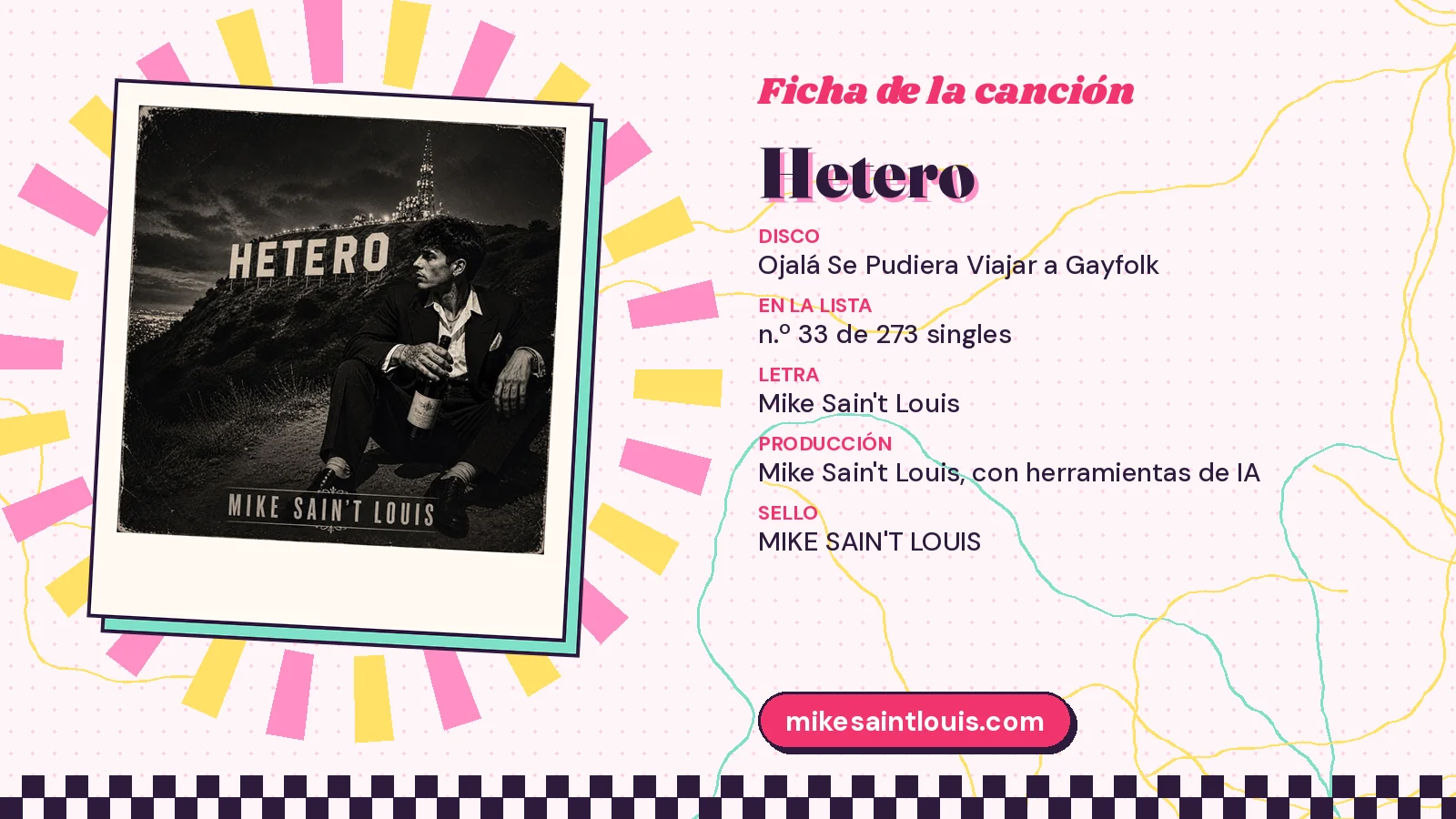
«Hetero» is on «Ojalá se pudiera viajar a GAYFOLK», the second album of the trilogy. The album about longing to escape to a planet where you don't have to explain yourself, defend yourself or pretend.
And the question in «Hetero» is the opposite longing. Not to escape to a better planet, but to turn into someone else so that this planet hurts less. It's the saddest «ojalá», if only, on the album. If only I were straight. If only I weren't me.
I explained it in «Ojalá», the second album, and the grammar of longing: the whole album is written in the mood of wishing. «Hetero» is the twisted wish.
On GAYFOLK that question wouldn't exist. Nobody would want not to be himself. That's why the planet is needed: because here, on Earth, we sometimes wonder whether it wouldn't be better to be someone else. And the right answer, the planet's answer, is no. The problem wasn't you, with your cheese. The problem was the one who didn't even hide it.
Humour without harm, despite everything
One thing that matters to me about this song is that it doesn't attack anyone specific. There's no name. No neighbourhood. No job for the man in the bed. In other songs I put all that in, but here it wasn't needed, and I think the song's better for it.
The butt of the joke, if there is one, is the one who turns up with the cheese. That is, me, or whoever's speaking. I laugh at myself before anyone else. The other one isn't even a character: he's a presence in a bed. He has no lines. He has no face.
I wrote about doing gay humour without doing harm. «Hetero» is a good example of humour that harms nobody but the person telling it. And that harm, oddly enough, heals a little in the telling.
Replaced before you get there
There's something in the scene that's very much of this era, and I don't want to skip it.
«We arrange. I arrive. And he's already got another one in bed.» Between «we arrange» and «I arrive» there's been, at most, the time it takes to cross Madrid on the metro. Forty minutes. An hour. And in that time, the other one has already found a replacement.
Thirty years ago, that was hard. You had to go out, go to a bar, chat someone up in person, persuade them to come back to yours. Now you just open an app. While you're on a Line 1 carriage with your Mercadona bag, he's swiped three times and sorted his night.
I'm not going to give a sermon against Grindr, it's not my place and it'd be hypocritical anyway. The apps have brought loads of good things: people in small towns who had no one to talk to, encounters that would never have happened, couples who've lasted years. But they've also brought this: the feeling that you're interchangeable. That if you take forty minutes, there's already someone else.
And that feeling is what feeds the question at the end. If I'm so easy to replace, what am I worth? Wouldn't it be better to be someone else?
The answer, which the song doesn't give but I'm giving here, is that you weren't the interchangeable one. His plan was. You brought cheese.
The man in the bed, in the typology
I have a comedy post called a little comic typology of exes, where I sort the exes who turn up in my songs. There's the one who lies with coloured contact lenses, the one who punishes you with silence, the street-market coordinator.
The one in «Hetero» would fit a category I've barely explored: the one who can't be bothered. He isn't an elaborate villain. He has no Machiavellian scheme. He doesn't gaslight you. He just doesn't care. He's the laziest ex in the typology.
And maybe that's why he takes up the least space in the song. He has no lines, no name, not even a face. He's in the bed, full stop. The whole song belongs to the one who turns up with the wine. Which is, in the end, a kind of justice: the one who couldn't be bothered doesn't deserve so much as a verse.
If you want to meet the rest of the typology, with their songs, they're all in the lyrics index.
What I did with the cheese
I don't know. The song doesn't say. And I'm not going to make it up just to round the post off nicely.
What I do know is that the image, the bloke at the door with the bag of wine and cheese, is one of the ones that sticks most with people who hear the song. It's universal. We've all taken something somewhere it wasn't expected. A present nobody wanted. Flowers for someone who already had some. A hope wrapped in tinfoil.
And we've all taken it home again.
Exaggerating to tell the truth
In case anyone thinks I exaggerate: yes, I do. Always. It's how I write, and it has a lot to do with how people talk in Spain. «Me muero.» I'm dying. «Me quiero morir.» I want to die. «Qué vergüenza, tierra trágame.» Ground, swallow me up. I wrote about it in the exaggeration of everyday Spanish speech and my lyrics.
But in «Hetero» I barely exaggerate. The scene is exactly as it was. We arrange, I arrive, he's already got another one. The only exaggerated thing is the question at the end, and not even that, because it's what genuinely goes through your head.
Sometimes reality comes exaggerated straight from the factory. You don't need to add a thing.
To read it
The full text is on the «Hetero» lyrics page. It takes half a minute to read. I'd recommend reading it with a glass of wine to hand. The cheap stuff. And a bit of cheese.
And if you've ever been left standing at a door with your dignity wrapped in tinfoil, know that it wasn't you. It was the night. And you swallow the night, but you also spit it out. Even if it takes a while.
Frequently asked questions
What is «Hetero» about? About a date where the one who turns up finds the other with someone in bed, not even hiding it. With «el vino, el queso y la dignidad envuelta en papel de plata» («the wine, the cheese and my dignity wrapped in tinfoil»), he wonders whether it would be easier to be straight or not to be himself.
Is the song against straight people? No. The title comes from the question the protagonist asks himself at the worst moment of the night. The song is about a humiliation, not about sexual orientations.
Which album is «Hetero» on? «Ojalá se pudiera viajar a GAYFOLK», the second album of Planeta Gayfolk's GAYFOLK trilogy.
What does «dignity wrapped in tinfoil» mean? It's an image of dignity as something domestic and fragile, wrapped up like a sandwich, which gets crumpled that night and never lies flat again.
Who wrote «Hetero»? Mike Sain't Louis, a lyricist, composer and producer from Madrid. The music and vocals are produced using artificial intelligence as a tool; the lyrics are his.