By Mike Sain't Louis ·
Mascara has a surname: «Mirror», the white boa, Velázquez and the history of the mirror that shows us our face
In Spanish we say «rímel» without realising we're pronouncing a man's surname. Eugène Rimmel was a French perfumer based in London who, in the nineteenth century, very successfully sold a product for darkening eyelashes. It was so successful that in several languages, ours among them, his surname became the common name for the thing.
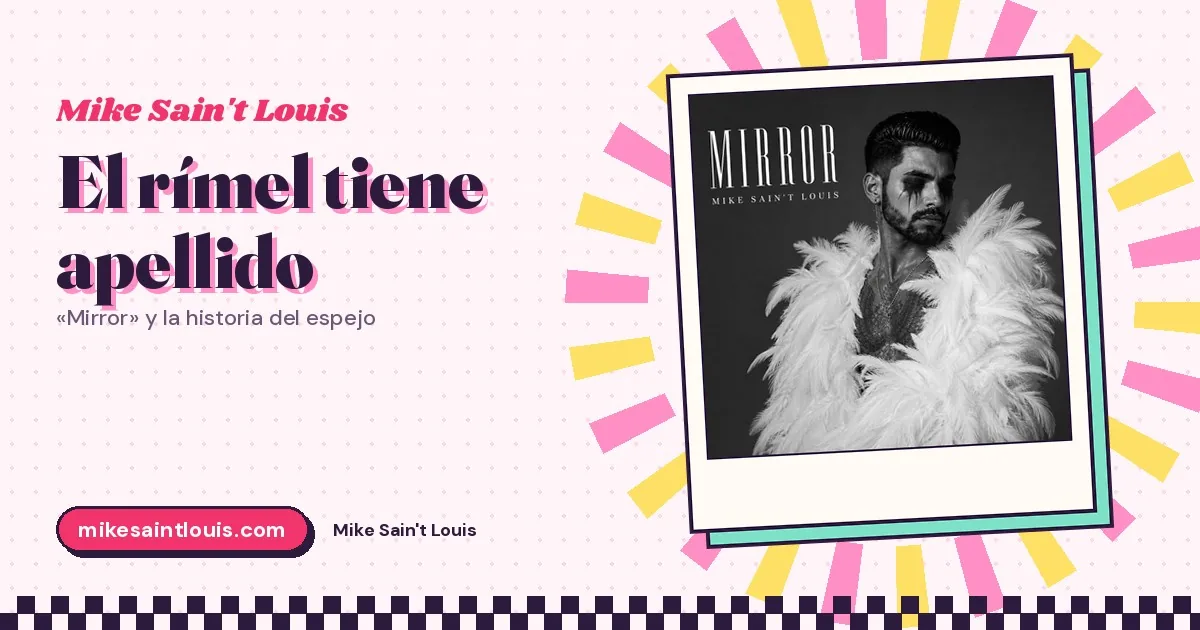
I thought of him looking at the cover of «Mirror», where mascara is precisely the star. Or rather, running mascara. A young man wrapped in a white feather boa looks at the camera with black make-up streaming from his eyes, as if after a very long night or a cry he didn't want to hide.
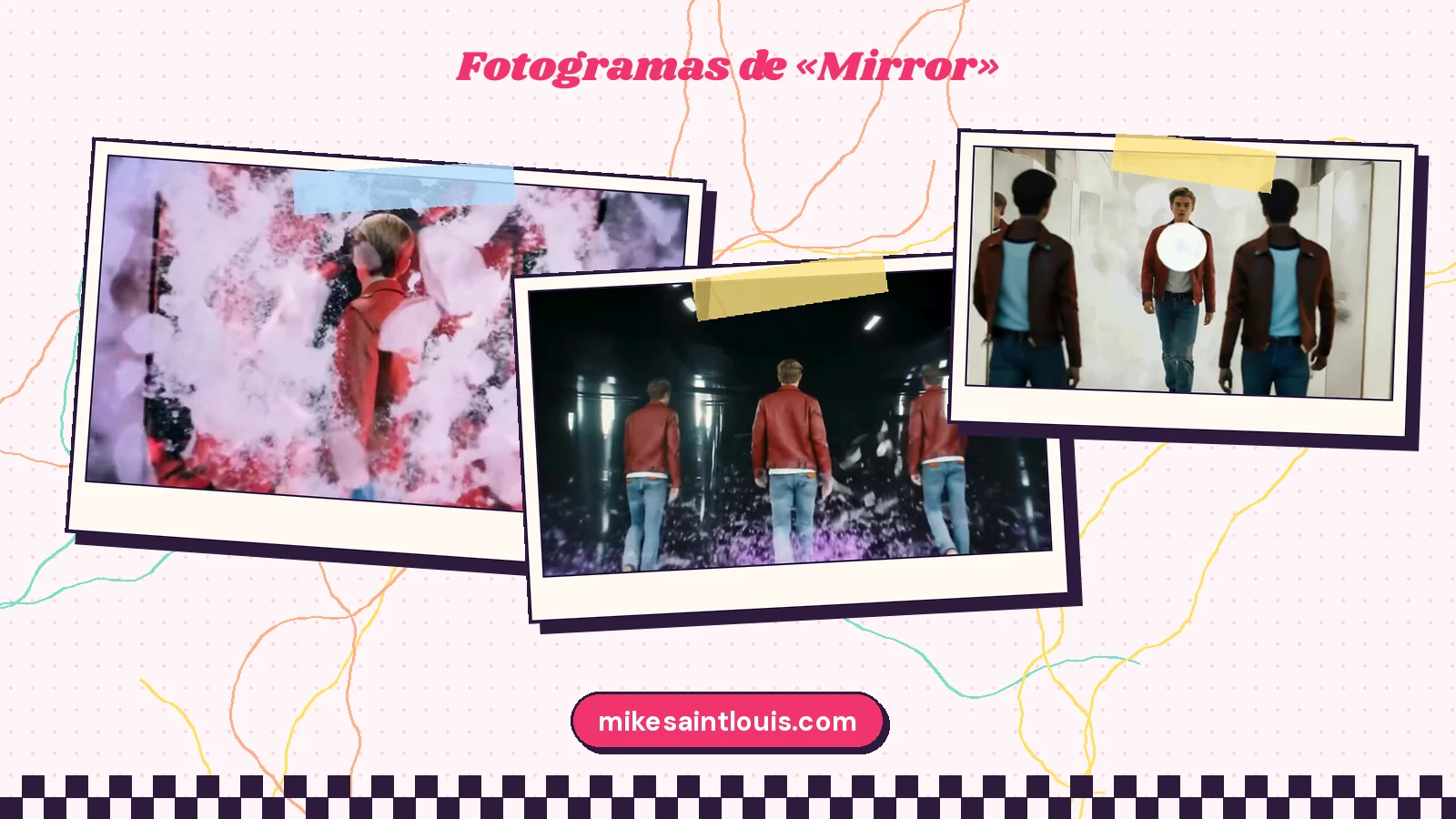
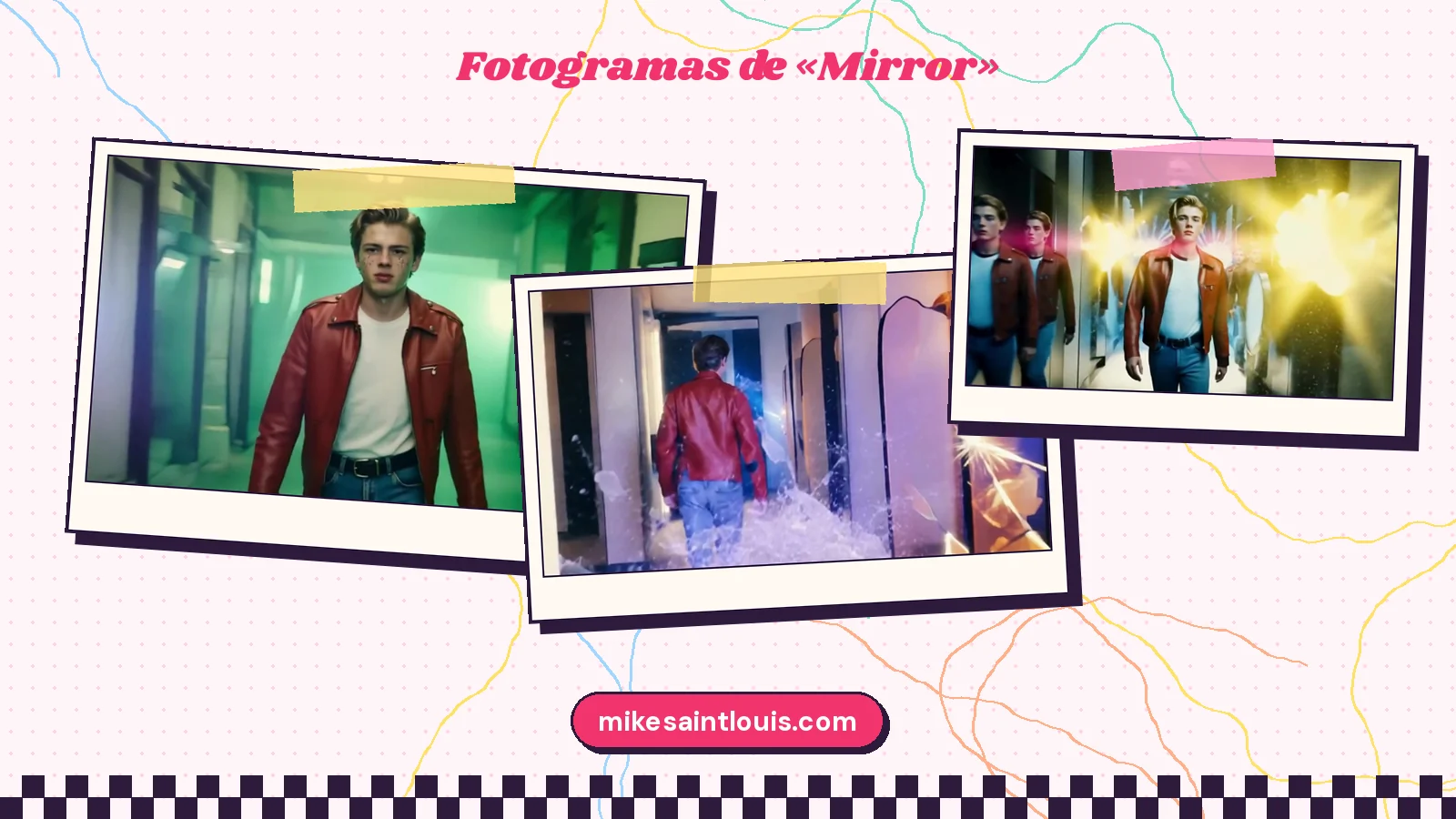
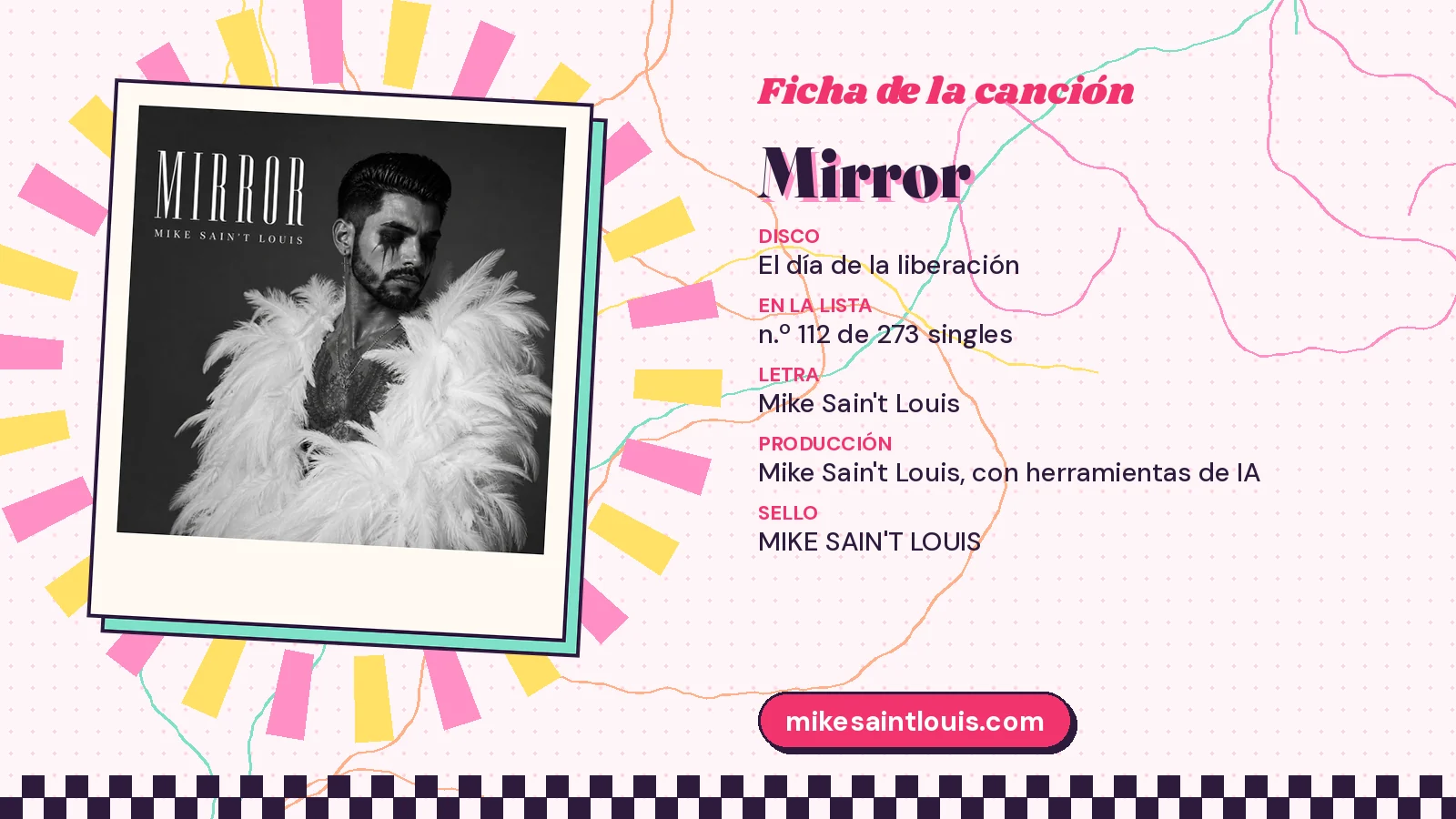
In my catalogue of 273 songs, «Mirror» holds position 112. It comes right after «Sunset Boulevard» and before «Los Javis», it's part of «El día de la liberación» and its official music video reached YouTube on 17 June 2026.
What this post doesn't do
It's worth saying clearly from the start: «Mirror» has no published lyrics yet. Any line I put here would be my own invention today, not the song's, and it wouldn't make sense to tell its story blind either. I'll stick with the title and the cover, which already give plenty to work with.
On the «Mirror» page I already described what I see in the image and how I like to think the mirror is whoever looks at it. Here I want to do something else: tell the history of the object that gives the song its title and that of the make-up running down the cover boy's face. Two human inventions that have spent centuries telling us who we are, or who we think we are.
Before starting, one clarification. The young man on the cover is a character. I'm not going to give him a biography or a reason for crying, because none is written anywhere. There's just an image, and it's powerful on its own.
Mr Rimmel
Eugène Rimmel was born in France at the beginning of the nineteenth century and grew up in London, where his father worked in the perfume business. He followed the trade, opened his own house and became one of the best-known perfumers of the Victorian era, with shops in several cities and products sold by catalogue.
Among those products was a mixture for the eyelashes applied with a small brush. It was by no means the first eye cosmetic in history, but it was one of the first sold on a mass scale and under a brand. Hence in Spanish, Portuguese, Italian or Turkish the word for that product comes from his surname.
English uses «mascara», which comes from Italian and, further back, probably from Arabic, with a meaning close to «mask» or «disguise». I love that double etymology. In some languages the product bears the name of a merchant. In others, that of a mask. Both fit the cover.
Soot lashes
Long before Mr Rimmel, people already painted their eyes. In ancient Egypt, men and women used kohl, a dark paste applied around the eyes which was also believed to protect against the sun and infections.
For centuries in Europe, home methods included soot, charcoal or mixtures with grease. They were unreliable products that ran easily and sometimes irritated the skin. The idea of eye make-up that withstands sweat, tears and water is relatively modern.
That's why the image of running mascara has something inevitable about it. For almost all of history, eye make-up has run. What's strange, really, is that today we expect it to last intact through a whole night out.
A Murano mirror
The mirror in our bathroom is a fairly recent invention compared with human history. For millennia people looked at themselves in still water, polished stone or burnished metal. Mirrors of obsidian, bronze or silver gave back a dark, distorted image that was hard to see.
In the sixteenth century, in Venice, the glassmakers of the island of Murano perfected a technique for making glass mirrors with a layer of tin and mercury on the back. Those mirrors were sharp and bright like nothing seen before, and they became extremely expensive luxury objects. The Venetian republic guarded the secret so jealously that craftsmen were forbidden to leave.
Even so, the secret got out. France lured some of those glassmakers and developed its own industry. The mercury method, incidentally, was extremely dangerous for those who worked with it. In the nineteenth century it was replaced by a much safer chemical silvering technique, and mirrors became affordable for any household.
The Hall of Mirrors
When France wanted to show it no longer needed Venice, it built at Versailles one of the most famous rooms in the world. The Hall of Mirrors was built between 1678 and 1684, with seventeen arches covered in mirrors facing seventeen windows overlooking the garden. In total, hundreds of mirror pieces made in France.
The room was a political statement. King Louis XIV wanted whoever walked through it to see themselves multiplied among the gold, the chandeliers and the light. It was also a place to be seen: courtiers watching each other, and watching themselves, while waiting for the monarch's attention.
Centuries later, in 1919, the Treaty of Versailles was signed in that same hall. The mirror, which began as luxury, ended up as a witness to history. I like to think of the «Mirror» cover as a tiny version of that room: one person alone, surrounded by feathers instead of gold, looking at himself and at whoever looks at him.
Velázquez in front of the mirror
In the Prado Museum there's a painting that makes you think about mirrors. In «Las Meninas», which Diego Velázquez painted in 1656, at the back of the room there's a mirror reflecting King Philip IV and Queen Mariana. They're outside the painting, where we are, watching the scene.
That small reflection turns the viewer into part of the painting. Whoever looks at «Las Meninas» occupies, for a moment, the place of the king and queen. It's a game the «Mirror» cover repeats in its own way: the young man's gaze goes straight out, towards whoever is looking, and you're not quite sure whether you're looking at him or he's looking at you.
Velázquez also painted the «Rokeby Venus», now in the National Gallery in London, with a woman seen from behind contemplating herself in a mirror held by Cupid. In 1914, a suffragette called Mary Richardson attacked the canvas with a knife in protest at the arrest of Emmeline Pankhurst. The painting was restored, but the story stayed forever linked to the image of someone looking at herself.
Through the looking-glass
In 1871, Lewis Carroll published «Through the Looking-Glass», the second part of Alice's adventures. In it, the girl goes through the drawing-room mirror and enters a land where everything is reversed: you have to run to stay still, books read backwards and the rules change without warning.

It's one of literature's most powerful metaphors of the mirror as a door. Not an object that gives back what you already are, but one that invites you to cross into another version of yourself. For many LGBTQ+ people that idea has a very concrete meaning: the moment you look at yourself and decide to try another way of being in the world.
I think of people who put on make-up for the first time in secret, in front of their bedroom mirror, with products they'd borrowed. Of those who tried on a dress or a boa without anyone seeing. The mirror was their first audience.
Drag and the dressing-room mirror
There are few places where the mirror matters as much as in a drag dressing room. Before each performance there are hours of work in front of a glass ringed with bulbs: foundation, contour, glued-down brows, shadows, false lashes and, at the end, a different person looking back.
I wrote about drag as a party and not a disguise, and I still think the same: it isn't hiding, it's amplifying. The white feather boa on the «Mirror» cover has a lot of that aesthetic, even though the image isn't on a stage.
What draws me most is the moment afterwards, the taking-off of the make-up. When the show is over and you're alone with the mirror again, cotton pad in hand and half your face still on. That in-between moment, neither fully character nor fully person, is the one the cover suggests to me.
Feathers and boas
Feather boas came into fashion at the end of the nineteenth century and the beginning of the twentieth, when the ostrich-feather industry boomed. South Africa's ostrich farms exported feathers to half the world for hats, fans and stoles.
The fashion had a terrible cost for many wild birds, hunted for their feathers, and that drove some of the first bird-protection laws and the birth of conservation societies. Today boas are made mostly from farmed feathers or synthetic materials.
In show business, the boa became a symbol of exaggerated glamour, cabaret and divas. I already talked about what «pluma», feather, means in its other Spanish sense, camp flamboyance, in the volume of «pluma» in «Soy marica sideral» and in «Mueve las plumas». The «Mirror» cover plays with both meanings at once.
Who's that in the mirror?
In 1970, the psychologist Gordon Gallup published an experiment that would become famous. He gave some chimpanzees a mirror and, once they were used to it, painted a mark on their faces while they were anaesthetised. On waking and looking at themselves, the chimpanzees touched the mark on their own bodies. They had understood that the animal in the mirror was them.
Since then, the so-called mirror test has been tried with many species. Some great apes pass it, and it's debated whether other animals, such as certain dolphins, elephants or birds, do too. Human babies usually begin to recognise themselves at around eighteen months to two years.
Recognising yourself in a mirror seems simple, but it isn't. It requires understanding that there's a «self» separate from everything else. And in adult life it's sometimes harder than at two. There are periods when you look at yourself and aren't quite sure who that person looking back is.
The judge who lives in the bathroom
There are kind mirrors and cruel mirrors. I wrote about it in the mirror opposite and the judge whose mood changes every morning. There are days when the bathroom mirror feels like a court: look at those dark circles, that belly, that thinning hair.
In the gay community aesthetic pressure can be very harsh. The bodies on apps, filters and retouched photos create a standard almost nobody meets. Looking at yourself every day with those eyes ends up doing harm. If you notice that your relationship with your image is robbing you of peace, that you avoid mirrors or can't stop checking yourself, it's worth telling a professional.
I like that the boy on the «Mirror» cover isn't perfect. His make-up has run, he isn't retouched to look flawless, and still his gaze is steady. It's an image of beauty and disaster at once, and it doesn't apologise for either.
The pocket mirror
Today the most used mirror in the world doesn't hang on a wall: it's in your pocket. The phone's front camera works as a permanent mirror, and with it came filters that smooth skin, enlarge eyes and slim noses in real time.
Some people have grown so used to that retouched version that the real mirror starts to look like a mistake. Several plastic surgeons have said in recent years that they get patients who bring their own filtered face as a reference. Not a celebrity, but themselves, improved by an app.
That's why a cover like «Mirror» seems so brave to me. Instead of hiding what's been ruined, it shows it. The make-up isn't blurred by software: it's run, streaming, imperfect. It's an image that goes against the smooth face of social media.
I don't want to preach either. I use filters, like almost everyone, and there's nothing wrong with playing with them. All I ask is that every now and then we look at ourselves without them and are a little kinder to what we see.
The word that speculates
In Spanish, «espejo» comes from the Latin «speculum», related in turn to the verb «specere», to look. From the same family come words like «speculate», «spectacle» or «spectator». They all have to do with looking.
To speculate, originally, was to watch from on high, like a lookout. In time it came to mean making guesses and, later, buying and selling in the hope of profit. But in all its versions there's someone looking closely at something.
I like that mirror, spectacle and spectator share a root in Latin. The «Mirror» cover is exactly that: a spectacle that becomes a mirror for the spectator. And the boy in the feathers, by looking straight at us, makes us part of the show.
Covered mirrors and vampires
Some traditions cover mirrors when someone dies. In Judaism, during the week of mourning, it's customary to cover the mirrors in the house. It was also done in Victorian England, and in some Spanish villages a similar custom is remembered.
Folklore has more superstitions about mirrors. It's often said that breaking one brings seven years' bad luck. And horror literature popularised the idea that vampires have no reflection: in Bram Stoker's «Dracula», published in 1897, Jonathan Harker notices that the count doesn't appear in his shaving mirror.
There's something funny in thinking that, if the mirror gives us back our image, it's because we're alive. The running mascara on the cover is, in that sense, proof of life. Something has happened, someone has felt, and it shows on the face.
Crying with your make-up on
There's a scene repeated in a thousand films: someone cries with their make-up on and the tears drag the mascara into two black lines. It's used to show despair, heartbreak, a night that went wrong. But it can also be an image of release: no longer holding your face together.
I wrote a whole post about crying as something you needn't apologise for, and another about the single tear in the «Goodbye» portrait. «Mirror» is in another register. Here there's no clean classic-cinema tear, there's a black and glorious mess.
I don't know why the boy on the cover is crying, or whether he's crying at all. It could be sweat from a night of dancing. It could be rain. The image doesn't say. What it does convey is that he doesn't mind it showing.
The liberation album
The third album of the trilogy, «El día de la liberación» («Liberation Day»), is the part of the story where everything breaks loose. It makes sense for «Mirror» to be there: liberation includes no longer hiding what shows on your face.
In the catalogue, the song is surrounded by two weighty pieces: «Sunset Boulevard», with its reference to declining Hollywood, and «Los Javis», with its nod to two very well-known creators of Spanish film and television. Between a diva's twilight and a creative couple's success, a young man looks in the mirror. Not a bad order.
If someone listens to this stretch in a row, they'll get a little story about public image: how it's built, how it falls and how it gets back up.
When the mirror weighs too much
There are nights that end with running make-up and a sadness that doesn't wash off with your face. If that happens to you often, if you look in the mirror and only find reproaches, or if you've been feeling empty for a while, don't let it slide. Tell a friend, your brother or your GP.
And if the idea of suicide or self-harm ever crosses your mind, dial 024: it's free, nobody will know you called and it answers day and night all over Spain. In imminent danger, 112. From another country, use the local emergency number or check findahelpline.com, which lists help lines worldwide.
I gathered more phone numbers and reading in the complete series on mental health, written without drama and without shame.
Which mirror to put it on in front of
Put it on in front of the bathroom mirror at four in the morning while you take off what's left of the night with a cotton pad. Put it on in front of the dressing-room mirror, before or after the show. Put it on in the lift with a mirror where you never know where to look.
Put it on any ordinary day, too, when the mirror seems like a judge. Look at yourself with the same calm the boy on the cover looks at you, feathers and running mascara included.
Put it on, finally, when you're about to go out and can't decide whether to do yourself up a bit more or go as you are. The answer isn't in the song, or the cover, or me. It's in front of the mirror, with you, and it's usually the one that lets you breathe better.
And if someone asks what that is on your lashes, tell them about Mr Rimmel. A Victorian perfumer with a surname half the world pronounces today without knowing it. It's a good way to change the subject, and also to remember that behind every everyday word there's usually a real person, with a shop, catalogues and a knack for selling pretty things.
Frequently asked questions
What is «Mirror» about?
The lyrics aren't published yet, so I can't quote or summarise them. The cover shows a young man wrapped in a white feather boa, with black make-up running from his eyes and his gaze fixed on whoever is looking. This post is about what surrounds that image: the mirror, make-up and the way we look at ourselves.
Where does the Spanish word «rímel» come from?
From the surname of Eugène Rimmel, a French perfumer based in London who in the nineteenth century very successfully sold a product for eyelashes.
Which album is it on?
«El día de la liberación», the third album of the Gayfolk trilogy. It's track 112 of 273 in the catalogue, between «Sunset Boulevard» and «Los Javis».
When did the music video come out?
The official music video was published on YouTube on 17 June 2026.
Who makes the music and the vocals?
Mike Sain't Louis, a lyricist, composer and music producer from Madrid. He writes, composes and produces; the vocals are made with artificial intelligence.