
By Mike Sain't Louis ·
What will people say: growing up LGTBI in a village and the nosy neighbour in my lyrics
«Me he convertido en la vecina cotilla.»
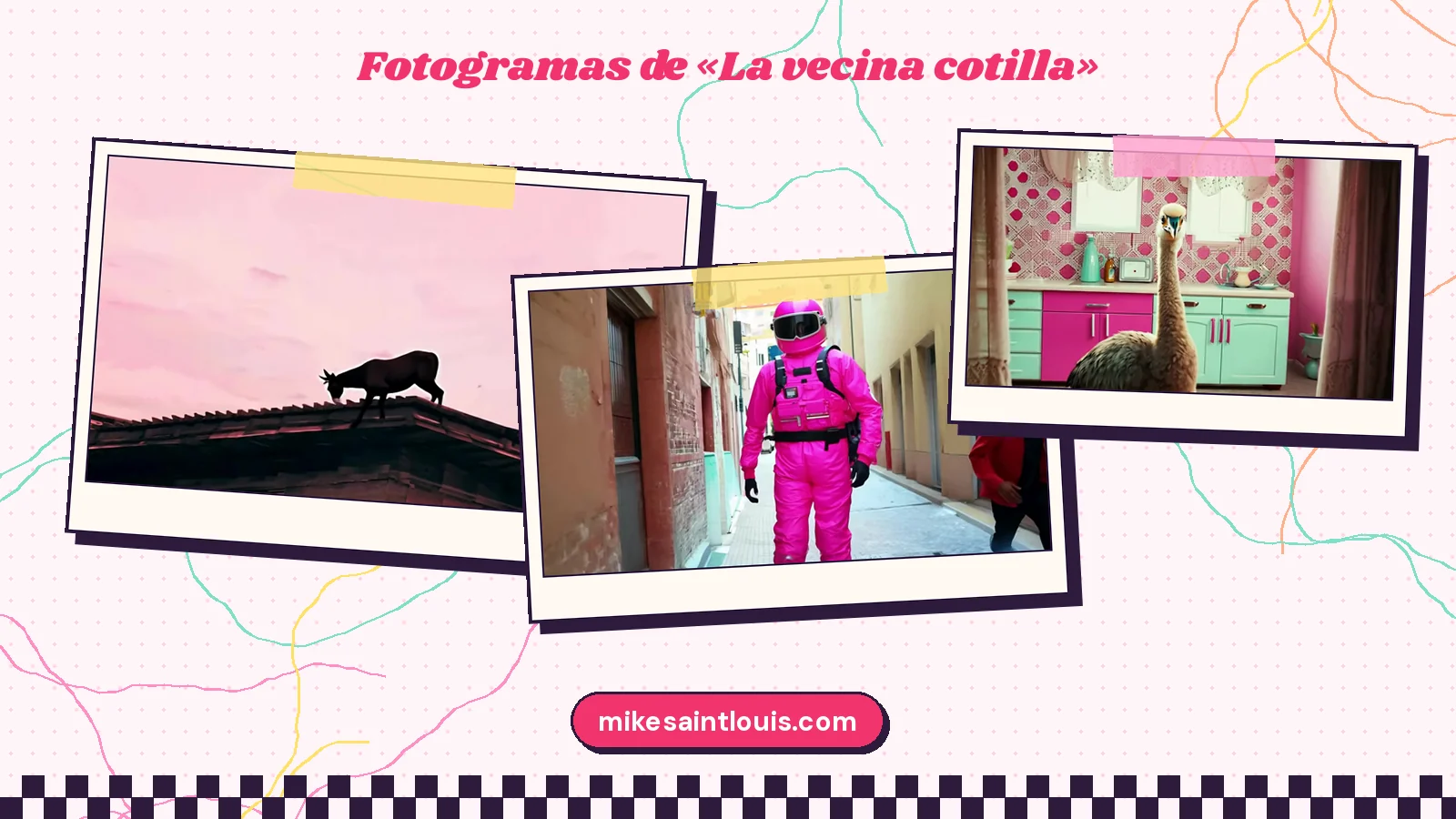
I've turned into the nosy neighbour. I repeat it several times in «La vecina cotilla», a track that opens the way on «Descubierto un nuevo planeta llamado Gayfolk», the album where it all began. (If you want it in front of you while you read, here's the whole lyric.) It's a light song about desire and windows: a neighbour across the street who works out in short shorts and someone who can't stop looking at him. The fun is in the swap of roles. The one who has always been watched, the odd boy, the one people gossiped about, takes over the post of the watcher. He sits behind the net curtain and, for once, he's the one telling the story.
That swap helps me talk about something that isn't funny at all and that many people carry for years: growing up LGTBI in a small place, where everybody knows everybody and where the neighbour's gaze isn't a joke but a form of control. This piece is about villages, the square and the bar, the phrase «qué dirán», what will people say, about leaving for the city or staying, and about what exists today so that nobody has to choose between their home and their life.
The net curtain as an institution
In almost every village in Spain there's a window with a net curtain and someone behind it. No need to invent anybody: we all know what I mean. It's the figure who turns into a character in my song, the one who knows what time everyone goes out, who they come back with, which car is parked outside which house.
In a big city that gaze gets diluted. Too many people, too many doorways, too many lives. In a village of five hundred people, on the other hand, every gesture has witnesses. A lad who doesn't go to football, a girl who doesn't want to wear a dress for the fiestas, two friends who spend too much time together: it all gets noted down, even if nobody writes it.
The curious thing is that almost always the net curtain doesn't act out of malice. It acts out of habit. Knowing about others is part of the fabric of a small place, and sometimes that same fabric is what brings you soup when you're ill. The problem starts when what's being watched is who you are, and when what's told at the bakery is a suspicion about you.
When everybody knows your name
There's something cities forget. In a village you are never anonymous. You're «Puri's boy», «the blacksmith's granddaughter», «the kid from the corner house». You carry your family's history, and your family carries yours.
That's why coming out in a small place isn't a conversation, it's an event. You don't tell your mother: you tell your mother, your grandmother, the aunt who lives two streets down, the group of women who sit outside in the cool of summer evenings, and half the bar. Even if you only say it at home, the village will know. And many young people aren't so much afraid for themselves as for what it will do to their people. That their father gets looks at the bar. That their mother gets stared at in church. That their little brother gets asked about it at school.
That worry for others is a form of love, and it's also a trap. It convinces you that keeping quiet is the generous thing. And keeping quiet for years has a price that isn't paid all at once, but in instalments.
The square, the bar and the church
Villages have few shared spaces and all of them are in plain sight. The square, the bar, the church, the sports hall, the bus stop. Places where you can't be discreet even if you want to.
In the city, someone beginning to understand who they are can go to a neighbourhood where nobody knows them, to a bookshop, to a collective, to a venue. In a small village, the nearest gay bar might be eighty kilometres away, and getting there takes a car, a licence and an excuse. That practical detail, transport, comes up again and again when you talk to LGTBI people who grew up far from the capitals. Mindset matters, of course, but so do buses that come twice a day.
That's why for many generations the way out was the station. And that's why there are so many Spanish songs, novels and films with someone leaving for the capital with a suitcase and no explanations.
Only a little girl would do these things
In the chorus of my song there's a line that makes me laugh and that, read from here, also hurts a little: «Estas cosas sólo las haría una chiquilla», only a little girl would do these things. The narrator is embarrassed and amused at once by what he's doing: spying on a guy from the window, getting his hopes up, counting the hours.
What interests me is the word «chiquilla». In villages, plenty of boys were punished for exactly that, for doing «little girl» things. For crying, for playing the wrong games, for moving a certain way. And plenty of girls for the opposite, for not doing enough little girl things. The song grabs the word with joy, like someone picking an insult up off the floor and pinning it on as a brooch. But we should remember where that brooch comes from, because for many people it was a daily wound in the playground.
At break time in a village school there's nowhere to hide. It's the same children from age three to sixteen. The nickname they give you in primary follows you to secondary. And if the secondary school is in the main town of the district, the nickname rides with you on the school bus, every morning, for years.
Sexile and the numbers I didn't expect
There's a word for that suitcase at the station: sexile. It's used for people who leave the place they live because there they can't be who they are. For a long time it was imagined as a one-way road, from countryside to city.
Reality is more complicated. In 2025 FELGTBI+ published a report on sexile in Spain using data from its Estado LGTBI+ survey, and the numbers surprised me. Among the sexiled people it identified, 43.4% had left a big city, 26.9% another country, 16.3% a smaller Spanish city and only 13.5% a rural area. In other words, people also flee capitals, neighbourhoods, particular families. The village doesn't have a monopoly on the closet.
The same report notes that those who left rural areas were on average somewhat older, around 35. That tells another story: people who held on for a long time, who perhaps tried to stay, and who left late. Leaving isn't always a decision of youth. Sometimes it's the last option after years of trying.
What the village gives too
It would be unfair, and false, to describe villages only as prisons. Some studies insist on that ambivalence. A systematic review presented at UNED on LGTB youth in rural settings concluded that those settings aren't necessarily more harmful to health than urban ones, and pointed to protective factors such as the possibility of close, intimate social ties. It also found very concrete problems: fewer mental and sexual health resources, fewer options and, in some cases, hostile attitudes from health staff themselves.

What the village gives is real. The grandmother who understands nothing but still saves you the best croquette. The neighbour who says something outrageous at the bar and then fixes your bike for free. The network of people who know where you live and come if something happens. In the city, freedom is sometimes paid for with loneliness. In the village, company is sometimes paid for with surveillance. Neither place is paradise.
That's why I don't like the story that you always have to run. For some people leaving is saving themselves. For others, staying and being visible on their own street is the greatest revolution possible. Both decisions deserve respect.
When he leans out of the window
The song has a moment I love: «Cuando se asoma a la ventana ¡yo ya no me ubico!», when he leans out of the window I lose my bearings. The narrator loses his head the second the other man appears. It's a scene of desire, but also a scene of recognition. Someone sees someone.
In a village, the first time an LGTBI kid sees another person like them is often an earthquake. It might be a cousin back from the city for the summer, a supply teacher, a couple of women who buy an old house to restore it. Sometimes that's enough, someone leaning out of the window and proving they exist. That you can live like this, here, in this very place, without apologising.
That's one of the reasons visibility in rural areas matters so much. Not because anyone has to be turned into a flag, but because one visible person changes the mental map of a whole village. It's no longer «that thing on telly» or «that Chueca stuff». It's Mari, it's Javi, it's the woman from the tobacconist's.
The fiestas and the neckerchief
The village fiestas are a chapter of their own. They're the moment of the year when everyone comes back, when the square fills up, when there's a dance, a band and the peñas, the groups of friends with their neckerchiefs. For many LGTBI people they're also the tensest moment. Those who left come back, and so do the usual questions: «Haven't you got a girlfriend?», «When's the wedding?».
But the fiestas are also a space of mixing and excess where things sometimes fit that don't fit the rest of the year. The peña costume, the float, dancing in the square with whoever you like in the small hours. In recent years, what's more, quite a few districts have organised rural Pride activities, talks and gatherings that bring diversity to places where it had never been named in public. In Extremadura, for example, the cooperative Wazo Coop has driven the Rural Pride project, with surveys on how the community is perceived in several districts.
I'm not saying a talk at the civic centre fixes centuries of silence. I'm saying there are more doors today than before, and it's worth knowing they exist.
The wall clock and the waiting
There's a passage in the song with nothing comic about it. The narrator sits listening to the wall clock his ex's father gave him, and waits like a kid for ten o'clock to come round so he can see the neighbour again. It's the waiting of someone with nothing else to do but look out of the window and want.

It reminds me of another wait that many people who grew up in small places know well: waiting to turn eighteen, to finish school, to get a job, to be able to leave. There are whole adolescences lived like a waiting room. You count the time left. You make plans in secret. You imagine a life that starts later, somewhere else.
The problem with living in waiting is that the life going by in the meantime counts too. Those years don't come back. That's why I think it's essential that support exists before adulthood, in the village itself or over the phone, so that nobody has to spend their whole adolescence holding their breath.
Laws that reach the villages too
Something that's sometimes forgotten: rights don't depend on your postcode. The national anti-discrimination law passed in 2022, Ley 15/2022, protects against unequal treatment on grounds of sexual orientation and gender identity in every corner of the country, also in the town hall of a village of two hundred people. And the so-called trans and LGTBI law, Ley 4/2023, sets aside a whole section for villages. Its article 39 requires public administrations to guarantee the visibility of diversity in rural areas and access to LGTBI resources and services on the same terms as in cities, and asks them to keep in mind those facing multiple discrimination, such as minors, young people, older people, people with disabilities, lesbian and bisexual women and trans women. Article 40 provides for adapting the prevention of anti-LGTBI violence to rural settings and for creating, with the Spanish Federation of Municipalities and Provinces, a Network of Municipalities for Equality and Diversity. Article 41 talks about visibility campaigns designed for rural areas.
In practice, of course, a law published in the BOE doesn't stop the guy at the bar from saying whatever he says. But it does mean that if a school doesn't act against bullying, if a public service treats someone worse for being who they are, there's somewhere to complain. And it means town halls and provincial councils can and must provide resources, even if they're far from the capitals.
Going back to the village
There's a phenomenon people talk about less: going back. People who left at twenty and return at forty, sometimes with a partner, sometimes to care for their parents, sometimes because the city has become unaffordable. Remote work and housing prices have pushed many people back to villages over the last decade.
Going back has something of a quiet settling of scores. You're no longer the kid with the nickname. You're an adult with a life, who walks into the bar and orders a coffee, and who sometimes finds the village has changed more than they thought. Other times they see it hasn't changed at all. Either way, the one who comes back visible does a huge favour to the kid who's fourteen today and looking out of the window.
The nosy neighbour inside us
At the start I said the song turns the figure of the neighbour around. I want to come back to that. Because there's something we sometimes find hard to admit: the LGTBI community has its net curtains too. We judge too, we gossip too, we decide who's too camp, who isn't camp enough, who's «from a village» and who's modern.
The boy who arrives from the village in the capital often meets a second gaze, that of an urban scene that laughs at his accent, his clothes, at him not knowing the codes. I've already written about small-town clichés in «Mi novio de Albacete» and about that figure on the landing in «La vecina cotilla, el personaje que todos tenemos en el rellano». Here I want to add a single idea: if being watched has hurt us, the least we can do is not repeat the gaze.
Neighbouring songs
The neighbour isn't alone in my catalogue. In «Tan cateto» someone points a finger at two lads walking hand in hand, and the narrator refuses to give him any explanations. It's the sour flip side of this song: there the outside gaze is a verdict, here it's desire.

«Los fuegos artificiales de Móstoles» is about neighbourhood fiestas, drinking and memories of youth in a town that isn't a village but isn't the centre either. And «Camela» is my tribute to a sound heard in cars and open-air dances all over Spain. Together they draw a geography that isn't on postcards, the one I also wrote about in «Madrid sin postal»: outskirts, rural districts and squares.
What I'd like to tell whoever is looking out of the window
If you're reading me from a village, at fourteen, twenty or fifty, and your secret is still kept in a drawer, there's no hurry at all. Nobody has the right to force you out of the closet or to stop you. Your timing is yours.
You're not obliged to leave either. If you want to stay, stay. If you want to go, go. If you want to try a few months away and come back, do it. None of those decisions makes you any less brave or any less you.
And if you feel completely alone, know that there are people at the other end of the phone, even if your village is two hours from the nearest capital. For that exact moment I left a letter you can read as many times as you need.
Where to find help
If you're not yet eighteen and having a hard time at home, at school or in the village, the ANAR Foundation answers on 900 20 20 10 and 116 111, free and confidential. FELGTBI+'s Línea Arcoíris offers information and support on 91 360 46 05. In the Community of Madrid, the LGTBI Information and Support Programme is on 91 701 07 88, and COGAM offers free psychological counselling on 91 523 00 70. In almost every region there are LGTBI organisations that also work in rural areas; FELGTBI+ can point you to the nearest one.
And one more thing, said plainly because suicide is something we should be able to talk about: if some night your mind takes you towards thoughts of ending things or hurting yourself, call 024. It's a public line, free of charge, it leaves no trace on the bill and it answers at any hour, in the middle of the night too. For danger that can't wait, 112. If you're outside Spain, call your local emergency number. Asking for help from a small village costs twice as much; that's exactly why it's worth it.
Dancing slowly behind the net curtain
The song ends with the narrator imagining a dance: «Y me pongo esta canción imaginando que bailamos despacito», and I put this song on imagining we're dancing slowly. It's a small, domestic fantasy, of someone who still doesn't dare cross the street.
I'll keep that image to close. Many LGTBI people have danced like that for years, on the inside, behind the window, in a village bedroom with the music turned down low. I hope it's needed less and less. I hope the dance spills out into the square, at the fiestas, with the band and with the neighbour watching, and that the neighbour, for once, starts to clap.
Frequently asked questions
What is sexile? It's the movement of LGTBI people who leave the place where they live because there they can't freely express who they are. According to a 2025 FELGTBI+ report, only 13.5% of the sexiled people it identified came from a rural area; most came from big cities or from other countries.
Is it harder to be LGTBI in a village? It depends a lot on the place and the person. Research points to more social control, fewer health resources and fewer spaces of one's own, but also to protective factors like close relationships. There's no single rural experience.
What is «La vecina cotilla» about? About someone who spends the day looking out of the window at the neighbour across the street and ends up, with humour, as the classic nosy neighbour. It's a track from the first album of the GAYFOLK trilogy, «Descubierto un nuevo planeta llamado Gayfolk».
Who can I call if I live in a village and I'm struggling? If you're a minor, the ANAR Foundation (900 20 20 10 or 116 111). FELGTBI+'s Línea Arcoíris is on 91 360 46 05. If you're thinking of hurting yourself, 024, free and open 24 hours, and 112 in an emergency. Outside Spain, your local emergency number.
Who writes these songs? Mike Sain't Louis, a lyricist, composer and music producer from Madrid who introduces himself as the first AI songwriter. The music and vocals of his songs are made with artificial intelligence.