
By Mike Sain't Louis ·
The finger in the air: «Can't Wait», the LED jacket and the art of not being able to wait
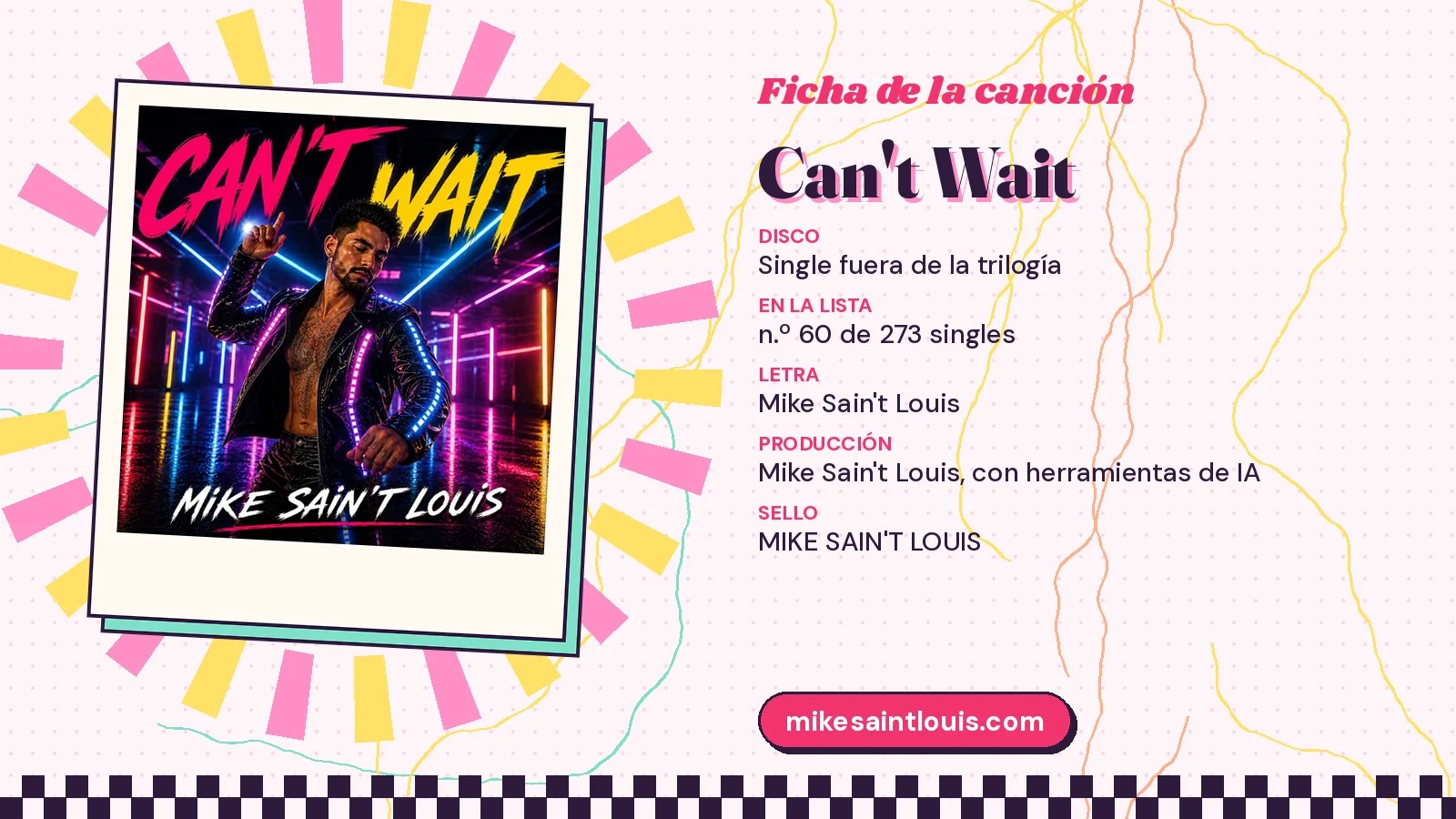
Some gestures need no explanation. An outstretched arm, the index finger pointing at the ceiling, the hip cocked to one side: anyone who has set foot in a club, or seen a seventies film, knows what it means. It's the exact moment the music wins. That's the gesture at the heart of the cover of «Can't Wait», and it couldn't fit better with a title that says «I can't wait».
Something worth clarifying from the start. This single's lines aren't out yet: if you visit its lyrics page on gayfolkplanet.com, you'll see they're announced as coming soon. I won't pull them out of thin air. In this text I hold on to what can be checked: the artwork, the title, its number among my singles and what I've already said in other songs.
A corridor of neon
The setting is a dark industrial space, a kind of huge warehouse or corridor crossed by tubes of coloured light. Pink, electric blue, yellow, violet. Some hang vertically like columns, others cross the ceiling diagonally. The floor is wet, or polished like a mirror, and stretches every line of light downwards, so the image looks twice as bright.
It's a very recognisable aesthetic: the warehouse club, the late-night venue, electronic music videos and eighties science-fiction posters. There's nobody else in the scene. Just him, in the centre, dancing for an empty floor or for a crowd we can't see.
The title runs across the top in quick brushstrokes, as if painted in a hurry: «CAN'T» in hot pink and «WAIT» in yellow. Below, in white and with the same nervous lettering, my name underlined by a pink line. Even the typography seems impatient. No tidy letters or clean margins: just smears of paint that haven't had time to dry.
A jacket that lights up
The protagonist wears a black jacket in a shiny material, like patent leather or vinyl, open over his bare chest. What makes it special are the LED strips sewn along the lapels and sleeves, in pink and blue, which glow like the tubes in the background. It's as if the young man were made of the same stuff as the club. As if the dance floor had dressed up as a person.
Under the jacket you can see the tattoos on his chest and stomach, a thin chain with a cross, an earring. His head is tilted, eyes almost closed, mouth relaxed. He isn't looking at the camera. He's somewhere else, inside the music. With one hand he points at the ceiling; with the other, at hip height, he seems to be keeping the beat.
That detail of the light-up jacket amuses me. For decades, party clothes have tried to shine: sequins, gold lamé, glitter. Today's version no longer reflects light, it produces it. It's a very literal way of saying someone arrives on the floor ready to be the spotlight.
There's something of armour in those clothes too. A jacket that glows protects you in a curious way: people look at the light before the face. Anyone who goes out in something eye-catching knows the outfit speaks first, and that sometimes gives you the nerve to walk into a place where you don't know anyone. The young man on the cover doesn't seem to need nerve. But the jacket keeps him company all the same.
The 1977 gesture
That raised finger has a crystal-clear lineage. In December 1977 «Saturday Night Fever» was released, with John Travolta as Tony Manero, a Brooklyn kid who lives a grey life during the week and is transformed on the dance floor on Saturday. The poster image, with the white suit, the hand to the sky and the cocked hip, became one of the visual icons of its time.
The interesting thing about that gesture is what it says. It isn't a greeting or a threat. It's a way of taking up space upwards: «I'm here, and tonight is mine». Tony Manero can't wait for his life to change. What he does is live to the full the few hours the dance floor allows him. The cover of «Can't Wait» picks up that same energy, swapping the white suit for a jacket that lights up.
The film's soundtrack, led by the Bee Gees, became one of the best-selling albums in history and took disco into millions of homes that had never set foot in a club. It was the genre's crowning moment and, at the same time, the beginning of its fall: what becomes fashionable so fast also wears out fast. Within a few years, the industry went from selling mirror balls to hiding them.
The dance floor was born ours
There's something the film didn't tell and LGBTQ+ culture knows well: disco wasn't born in the clubs of straight Brooklyn boys, but in far more marginal spaces. In New York in the early seventies, clubs such as The Loft, which David Mancuso opened in his own flat in 1970, and later the Paradise Garage, where Larry Levan played between 1977 and 1987, were refuges for gay men, especially Black and Latino men, and for many other people who had no place in mainstream nightlife.
In those clubs the dance floor was more than fun. It was the only place where you could touch, hug or kiss whoever you wanted without fear of the police or the neighbours. That's why disco has that sense of urgency: people danced as if the night could end at any moment, because outside that space life was much harder. In 1978, Sylvester, an openly gay artist with glorious flamboyance, turned «You Make Me Feel (Mighty Real)» into an anthem that still plays at every Pride.
I wrote about that memory in «A las que bailaron cuando no se podía». And I talked about what a dance floor needs today, in the middle of Pride, in «Qué pide una pista de baile en el Orgullo». The cover of «Can't Wait» is heir to all those nights.
The night they burned records
Disco's success also triggered a violent reaction. On 12 July 1979, at Comiskey Park stadium in Chicago, a radio presenter organised the so-called «Disco Demolition Night»: fans could get in for next to nothing if they brought a disco record to be destroyed. Between two baseball games, a crate full of vinyl was blown up in the middle of the field. Thousands of people stormed the pitch and the second game had to be called off.
Over the years, many have pointed out what lay beneath that «disco sucks» slogan. One of the stadium's staff later said that many people simply brought records by Black artists, even if they weren't disco. Behind the hatred of a genre lay rejection of the people who had created it and danced to it: gay people, Black people, Latinos, women who were having too much fun.
I think it's important to remember that when we look at a cover like this. A tattooed young man, with flair, dancing alone under pink neon, isn't just a pretty picture. It's a gesture that for a long time people tried to switch off.
Why the tubes light up
A curious aside, because the artwork's background asks for it. Neon lighting was first shown to the public by French engineer Georges Claude at the Paris Motor Show in December 1910. Neon gas, inside a glass tube with an electric current running through it, glows reddish-orange. The other colours come from other gases, such as argon with a little mercury, or from phosphor coatings inside the tube.
Today almost all the «neon» we see in bars and shop windows is actually LED strips imitating the effect. Like the protagonist's jacket. What hasn't changed is what that light communicates: night, city, something still open when everything else has closed. A neon sign is, in a way, an invitation not to wait until tomorrow. I've already written about another kind of neon, one that traps rather than invites, in «Ataúd de neón».
I can't wait: two meanings
In English, «I can't wait» has two readings, and both fit this cover. The first is the happy one: I'm longing for something to arrive. «I can't wait to see you». It's the thrill of Friday afternoon, of the night before a trip, of the message you're about to receive. The second is more literal and harsher: I'm not able to wait, I can't take any more, I need it to happen now.
From outside, the two look very alike. The racing body, the head running ahead, the difficulty focusing on anything else. What changes is the tone inside. In one case it's excitement. In the other, urgency or overwhelm. And sometimes they're the same night: you start out longing for Saturday and end up unable to sit still because the wait has become unbearable.
In Spanish we have something similar with «estoy que no puedo más», which depending on tone can mean enthusiasm or exhaustion. The title of this single plays on that border. And the gesture on the cover, eyes closed and finger in the air, doesn't quite tell us which side it's on.
In Spanish we also solve it with a very Spanish word: «ganas», a mix of desire and eagerness. «Tengo unas ganas…», we say, and leave the sentence hanging because there's no need to finish it. «Ganas» are impatience with a smile. When they go unfulfilled for a long time, though, they sour and become something else: frustration, anger, discouragement. That's why it's worth listening to them in time.
The brain runs ahead too
Neuroscience has spent decades studying why waiting for something good fires us up so much. In 1997, neuroscientist Wolfram Schultz and his colleagues published a key paper in Science: in experiments with monkeys, dopamine neurons didn't just respond to the reward, they started firing at the signal that announced it. In other words, the brain reacts to the promise of something good almost as much as to the good thing itself.
That explains part of the thrill of waiting. The eve of something you want can feel as intense as the moment itself. But it also explains why waiting can become addictive or distressing: the brain anticipates, speeds up, wants the signal fulfilled now. If it doesn't come, the frustration is stronger.
In 2014, researcher Alison Wood Brooks of Harvard University published a curious study. Before stressful tasks, such as public speaking or a maths test, she asked some participants to tell themselves «I am excited» and others «I am calm». The first group performed better. Her idea was that anxiety and positive excitement share a lot physically, and that it's easier to reinterpret that rush as eagerness than to force it to calm down.
The sweet and the clock
Whenever people talk about knowing how to wait, the famous marshmallow experiment comes up. In the late sixties and early seventies, psychologist Walter Mischel offered young children at a Stanford University nursery a sweet: they could eat it now or wait a few minutes and get two. Years later, his follow-ups seemed to show that the children who waited did better in life.
For a long time it was used as proof that patience is a virtue that predicts success. But in 2018 a team led by Tyler Watts repeated the study with a much larger and more diverse sample, and found the effect shrank considerably once family and economic background were taken into account. A child who has learned that adults' promises aren't always kept has good reasons to eat the sweet straight away.
I like that correction, because it changes the judgement on impatience. Sometimes not being able to wait isn't a character flaw. It's what someone learns after waiting a long time and receiving nothing. I've already written about the promises that leave us waiting in «Me prometiste y he estado esperando».
Waiting for rights
There's a collective wait I know well as an LGBTQ+ person. In Spain, homosexuality was persecuted under the Law on Social Danger and Rehabilitation until the reform of December 1978, which removed homosexual acts from its text. We had to wait until 3 July 2005 for same-sex marriage to come into force. And until 2023 for a national law specifically for trans and LGBTQ+ people.
People who demanded those rights were told many times to wait. That it wasn't the moment. That society wasn't ready. That there were more urgent matters. That patience always demanded of the same people has something of a trap about it. That's why «Can't Wait» also sounds to me like that: not wanting to wait any longer to live normally, to dance, to kiss in the street. That impulse has a political dimension we shouldn't forget.
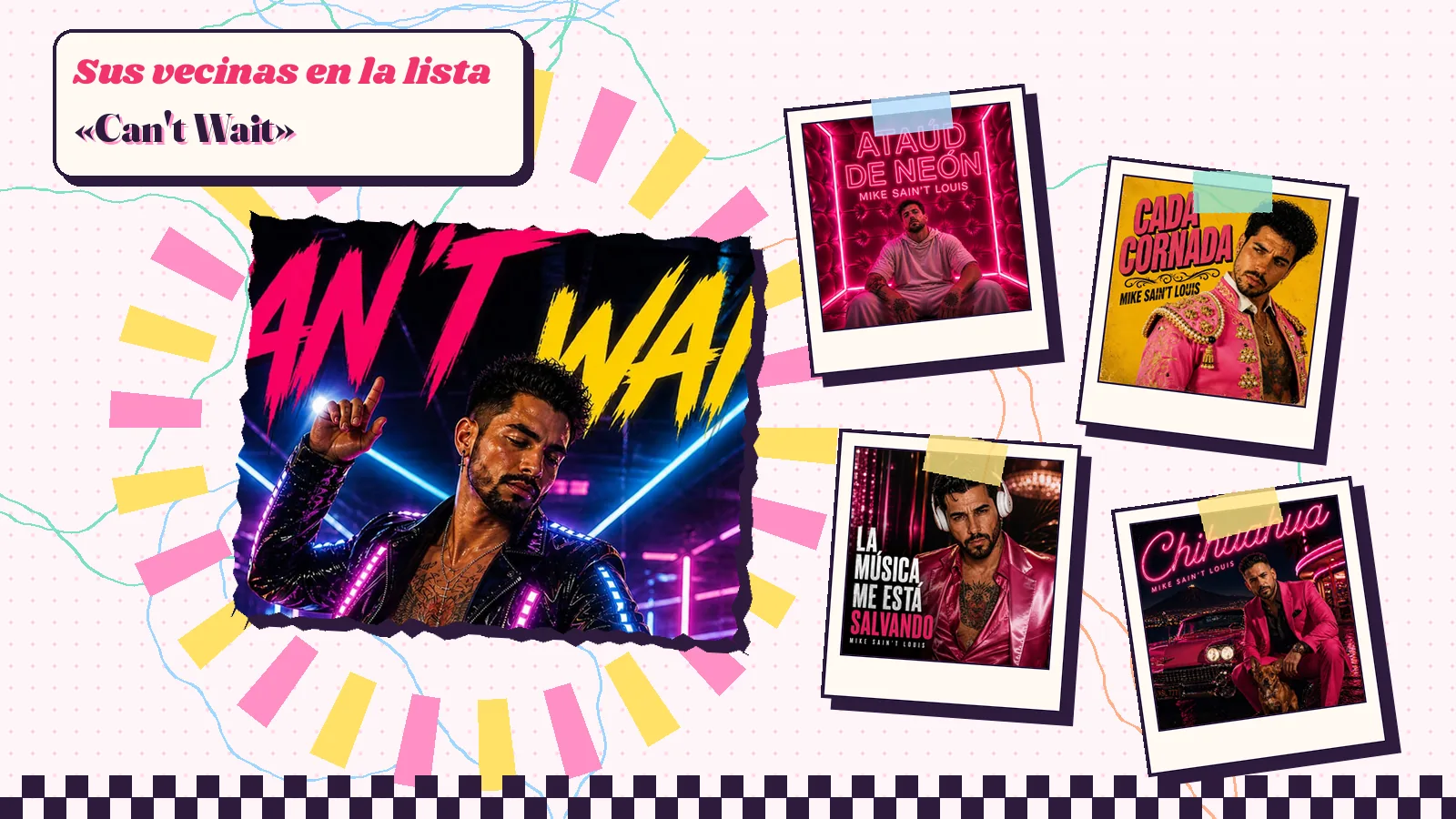
Between «Cada cornada» and «La música me está salvando»
On the singles list, this track is number 60 of 273, and it isn't included on any of the three albums of the trilogy: it was released as a standalone single. Right before it comes «Cada cornada», with its rejection of the violence of the bullring. And right after, «La música me está salvando», one of my most euphoric songs.
That neighbour does have published lyrics, and its chorus is almost a description of the cover of «Can't Wait»:
¡La música me está elevando! ¡La música me está subiendo!
(«Music is lifting me up! Music is raising me!») The finger pointing at the ceiling, the head thrown back, the light running up the jacket. I don't know what the lines of «Can't Wait» will say when they're published, and I won't get ahead of them. But the two songs sit side by side on the list, and the image of one explains very well the feeling the other puts into words.
In those same lyrics there's another phrase I like to remember when impatience bites:
Pues ve improvisando, que las cosas van cambiando.
(«So start improvising, because things are changing».)
Dancing alone in an empty warehouse
Back to the image, because there's a detail I don't want to skip: he's alone. No other dancers, no bar, no audience. A huge warehouse full of lights for a single person. It could be a power fantasy, having the whole club to yourself. It could also be the image of someone who arrived too early, who couldn't wait for people to turn up and is already dancing.
I like to think of both. There's something very liberating about dancing without witnesses, without fear of looking ridiculous, without thinking about how you look. And something a little melancholy about a party that exists for one. In «Chihuahua» I wrote a dance track for two, a young man and his dog, which says:
Under the disco light, we're running free,
There's no dog here, but the disco light and the sense of freedom are the same.
And there's a third sense in that solitude: dancing for yourself because, in that moment, you don't need anyone else. Many people say their best moment of the week is putting music on at home, door closed, and moving with nobody watching. It isn't sadness. It's a small private party, a way of releasing the day's tension without waiting for Saturday or for any venue to open.
When eagerness turns into anxiety
Let's talk about the less shiny side of the title. For some people «I can't wait» isn't a passing emotion but an almost permanent state: constant restlessness, trouble sitting still, needing everything to happen now, irritability when something is delayed. Sometimes it's temperament. Sometimes it's anxiety. Sometimes it's part of undiagnosed ADHD, something many adults discover late.
You don't need a label to ask for help. If impatience hurts you, ruins your sleep, leads you to impulsive decisions you later regret or leaves you exhausted, it's worth talking to your doctor or a mental health professional. There are tools that work, from therapy to simple breathing and organisation techniques.
And if at any point despair grows too big or thoughts of hurting yourself appear, in Spain you can call 024, which answers free of charge at any hour of the day or night. If there's immediate danger, 112. For anyone reading from another country, the best thing is to find the local crisis line or emergency number. I've gathered more resources in «Salud mental sin tabú».
Writing for the dance floor
As a lyricist, dance-floor songs have their own challenge for me. You have to think about the body before the head, about phrases a crowd can chant, about words that fit a bass hit. I explained it in «Escribir para que te bailen y escribir para que te lean»: lyrics you listen to on the sofa aren't the same as lyrics playing at three in the morning with the lights on.
A title like «Can't Wait» is made for the second kind. Two short words you can shout with your fist in the air. And a cover that makes it clear: you don't come here to reflect, you come here to let go. Reflection, if anything, is for the next day.
For whoever is already on the floor before the doors open
For whoever counts the hours until Friday. For whoever gets to the party before anyone else and starts dancing in the empty warehouse. For whoever is tired of being told to wait their turn.
For whoever sometimes mistakes eagerness for nerves, and is learning to tell them apart. For whoever needs a dance floor to feel free and for whoever dances in the kitchen because there's no other. For whoever knows that the raised finger is a way of saying «here I am».
And for whoever still gets a thrill from neon, wet floors and jackets that shine. Until the lyrics see the light, you can play the track on any platform or download it for free, without signing up, from the downloads page. As soon as the lines are published, I'll upload them in full without a single correction.
Frequently asked questions
What is «Can't Wait» about? The lyrics haven't been published yet, so this post doesn't quote any of its lines. The cover shows a young man in a black jacket with LED lights, dancing with his finger pointing at the ceiling in a warehouse full of neon tubes. The post reads the title through impatience, disco and the difference between eagerness and anxiety.
Which album is it on? None of the three albums of the Gayfolk trilogy: it's a standalone single. On the singles list it's number 60 of 273, between «Cada cornada» and «La música me está salvando».
Where does the raised-finger gesture come from? It's a classic disco gesture, popularised by the poster for «Saturday Night Fever» (1977), with John Travolta. Disco itself, however, was born earlier in New York clubs frequented by Black and Latino gay men.
What was Disco Demolition Night? An event held on 12 July 1979 at Comiskey Park stadium in Chicago at which thousands of records were destroyed. Today it's also remembered as a backlash against the gay community and the Black people who had created that music.
What can I do if impatience gives me anxiety? If it affects your sleep, work or relationships, talk to your doctor or a professional. In Spain, 024 answers free at any hour and 112 is there for immediate danger. Outside Spain, look for your country's crisis line.
Who makes this song? Mike Sain't Louis, a lyricist, composer and music producer from Madrid, the first AI songwriter. He writes the lyrics and directs the production; the music and performances are generated with artificial intelligence.