By Mike Sain't Louis ·
The nickname that arrives by message: «Soy la Shakira marica del todo a un euro» and the chosen lockdown
Some songs start with an idea and others start with a notification. «Soy la Shakira marica del todo a un euro» (I'm the queer one-euro-shop Shakira) belongs to the second group, at least inside its lyrics. It opens with an alert, almost with the sound of a phone buzzing on the table: «Me acaba de llamar por twitter, ahora Equis» (He's just called me this on Twitter, now X). Someone, from an account you don't know, has decided to tell you who you are. And what they tell you isn't a clean, old-fashioned insult but a nickname with surnames: Shakira, yes, but a «marica» one, and from the one-euro shop.
The video went up on my YouTube channel on 4 January 2025, with the full lyrics in the description. The song belongs to Descubierto un nuevo planeta llamado Gayfolk, the first album of the trilogy, and it has an older sister worth knowing first: «La Shakira y el Piqué de todo a 1 euro», where a neighbourhood couple share out the roles of the most talked-about break-up in the gossip press. There, the narrator claimed the diva's role. Here, others hand him the role, unasked, by message.
This post won't go through the song line by line. It reads it from the nickname: where nicknames come from, why they hurt and amuse at the same time, what a bargain shop has to do with any of this, and how you get from someone else's mockery to a chorus of your own. And it ends where the lyrics end, in a proverb any Spanish grandmother would have given you for free.
A notification as the first line
The first striking thing is the opening. There's no scene, no night, no bar, no lover. There's a channel: the social network. And there's a correction on the fly, «twitter, ahora Equis», which is exactly what everyone does when talking about that platform since it changed its name in July 2023. We all still say Twitter and we all half-correct ourselves, with a little sigh. That hesitation, placed in the lyrics, feels almost documentary. It dates the song better than any label.
I like that the lyrics don't hide where the nickname comes from, whether the message is real or invented. We often write as if ideas came down from the sky, when in fact they reach us through the most ordinary places: a conversation in the supermarket queue, a comment under a video, a direct message from someone with any old profile picture. The lyrics tell it as it is: they wrote to me, they called me this, and here's what I do with it. As in almost all my songs, the character who writes is fictional; what matters is the gesture.
There's a whole tradition of songs that begin with a message received: letters, telegrams, unanswered phone calls. What has changed is the distance. Before, for someone to give you a nickname, they had to know you, even by sight. Today it's enough for them to find you. The nickname comes from a stranger who has seen your face on a cover or your name on a list and has decided to sum you up in a few words. That's the novelty the song captures, and it captures it without drama, with a «he's just called me» that sounds more like gossip than complaint.
What a nickname does
A nickname is a name you don't choose. It's given to you. It can be affectionate or cruel, it can come from your mother or from the school bully, but the mechanism is always the same: someone looks at you, notices a trait and turns it into a label. In Spanish villages there are whole families who have carried the same nickname for generations, and nobody remembers where it came from. Nicknames outlive people.
What sets a nickname apart from an insult is that it aims to be accurate. An insult is generic: it fits anyone. A nickname says «this is you, specifically». That's why it stings more and why, sometimes, it's also funny. When someone hits the mark with a nickname, even with bad intentions, part of you recognises the aim.
In gay culture, nicknames also have a life of their own. Among friends we constantly rename each other after folk divas, actresses, pop queens. It's a form of complicity: I call you after a diva because I know you'll get it. The trouble starts when the same gesture comes from outside, with another intention. The word is the same, but the tone changes everything. «Shakira» said by your best friend on a terrace isn't the same as «Shakira» written by a stranger on a social network.
The song lives right on that border. We don't know, because the lyrics don't say, whether whoever wrote the message wanted to hurt or to amuse. What we do know is what the narrator does with it: he repeats it, expands it, sets it to music and makes it his own.
The diva as a unit of measurement
Why Shakira? Because she's one of those artists who work as a unit of measurement. Born in Barranquilla in 1977, known in Spain since the nineties, with songs everyone has danced to at some wedding and a football World Cup under her belt, Shakira is a name that needs no explanation. Saying «you're the Shakira of» means «you're the star of», but with hips, a mane of hair and a touch of excess.
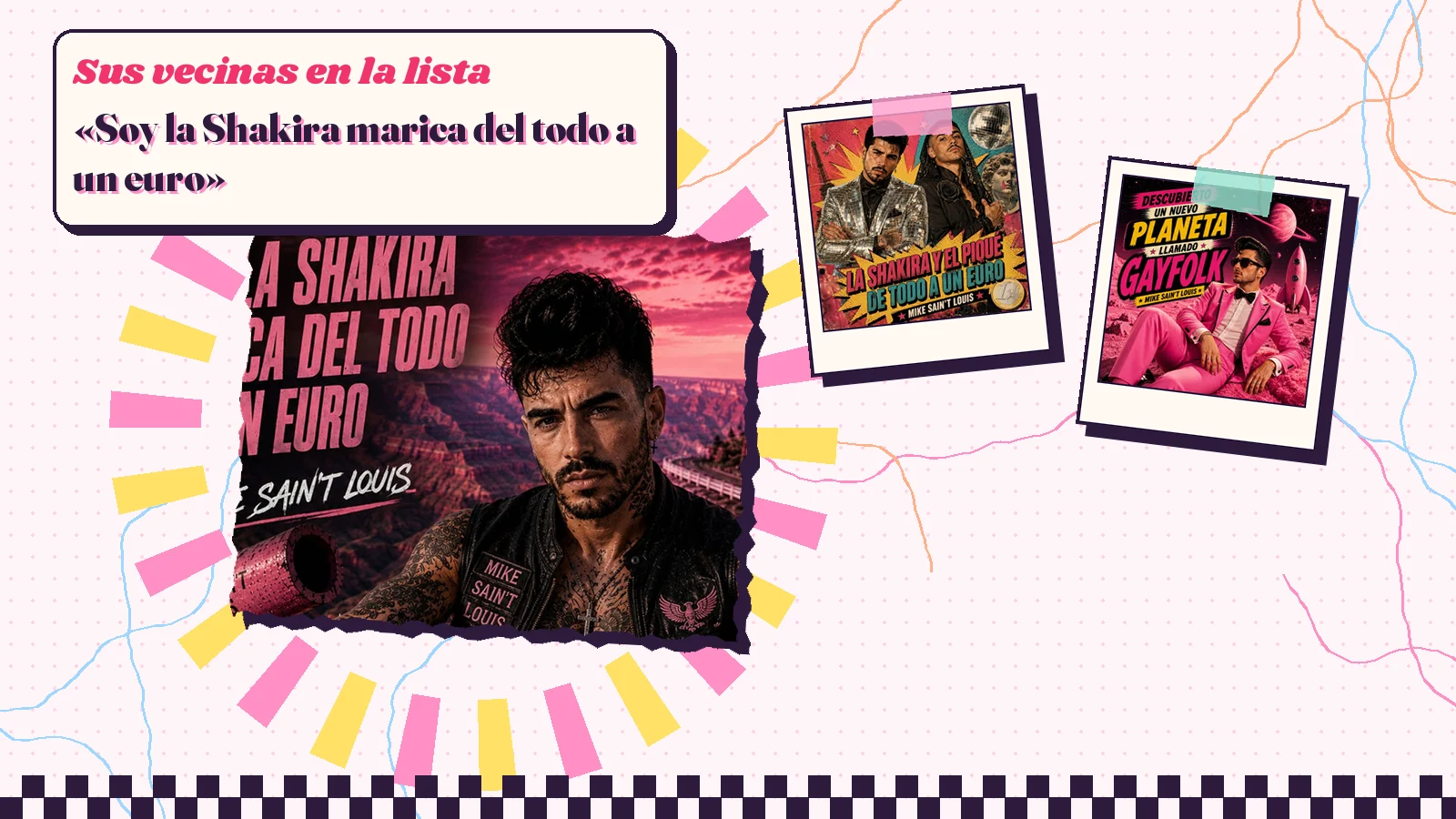
Since January 2023 her name also carries another story: the track with Bizarrap in which she turned a very public break-up into a global hit and left that line, «las mujeres ya no lloran, las mujeres facturan» (women don't cry any more, women cash in). From then on, being «the Shakira» of something also means being the one who turns spite into business, the one who has the last word. This single's sister song, the one with the bargain-shop Piqué, plays openly with that reading.
In «Soy la Shakira marica del todo a un euro» the artist's name works differently. There's no break-up. There's a comparison that comes from outside and keeps stretching: «la Shakira del mundo homosexual» (the Shakira of the homosexual world), «la Shakira gay de la inteligencia artificial» (the gay Shakira of artificial intelligence), «la Shakira del colectivo» (the Shakira of the community). Each version adds a nuance. It's no longer about looking like her, but about taking her place in a smaller, more specific world that is more our own.
That escalation makes me laugh. It's like telling someone they're handsome «for a village boy» or clever «for their age». The compliment comes with small print that cuts it down. Here the small print is huge: of the community, of artificial intelligence, of the one-euro shop. And instead of taking offence, the narrator takes all of it, small print included.
From the hundred-peseta shop to the one-euro shop
The most Spanish part of the nickname is the bargain shop. Anyone who grew up in Spain in the nineties remembers the «todo a cien» shops, where almost everything cost a hundred pesetas: hair clips, photo frames, porcelain figurines, toys that broke in an afternoon. When the euro arrived in 2002, the sign changed and «todo a un euro» appeared, a name still in use even though prices no longer respect it.
Saying something is «from the hundred shop» or «from the one-euro shop» in Spain means it's cheap, imitation, poor quality. It's the domestic version of «low cost». And for many people it's also a happy memory: Sunday afternoons looking at trinkets, the first thing you bought with your pocket money, the carnival costume put together from a few shiny bits.
That's why the nickname works so well. «The one-euro-shop Shakira» is the bargain diva, the knock-off version, the one who imitates glamour with sequins that fall off. It's clear mockery. But it's mockery that, seen through camp culture, can be worn with pride. I explain this more slowly in «El camp no es un chiste aunque te rías»: embracing the tacky, the exaggerated, what serious people call bad taste, is a very old queer tradition. Neighbourhood drag queens, village folk divas, carnival dresses made from curtains. All of that is from the one-euro shop, and all of it has a dignity that luxury doesn't know.
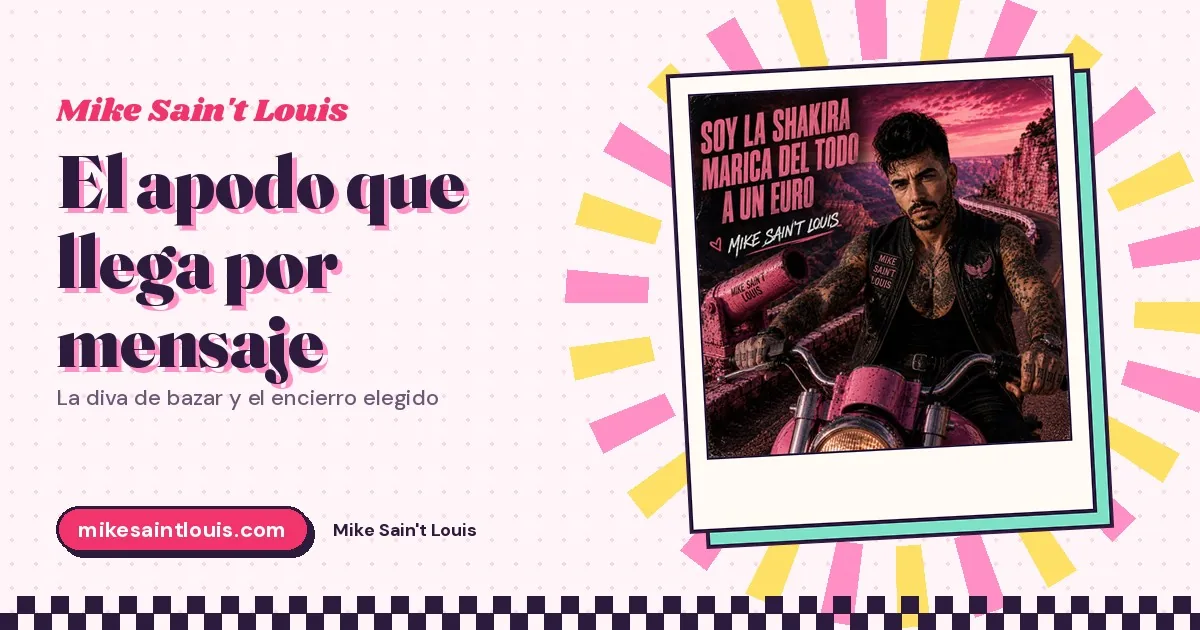
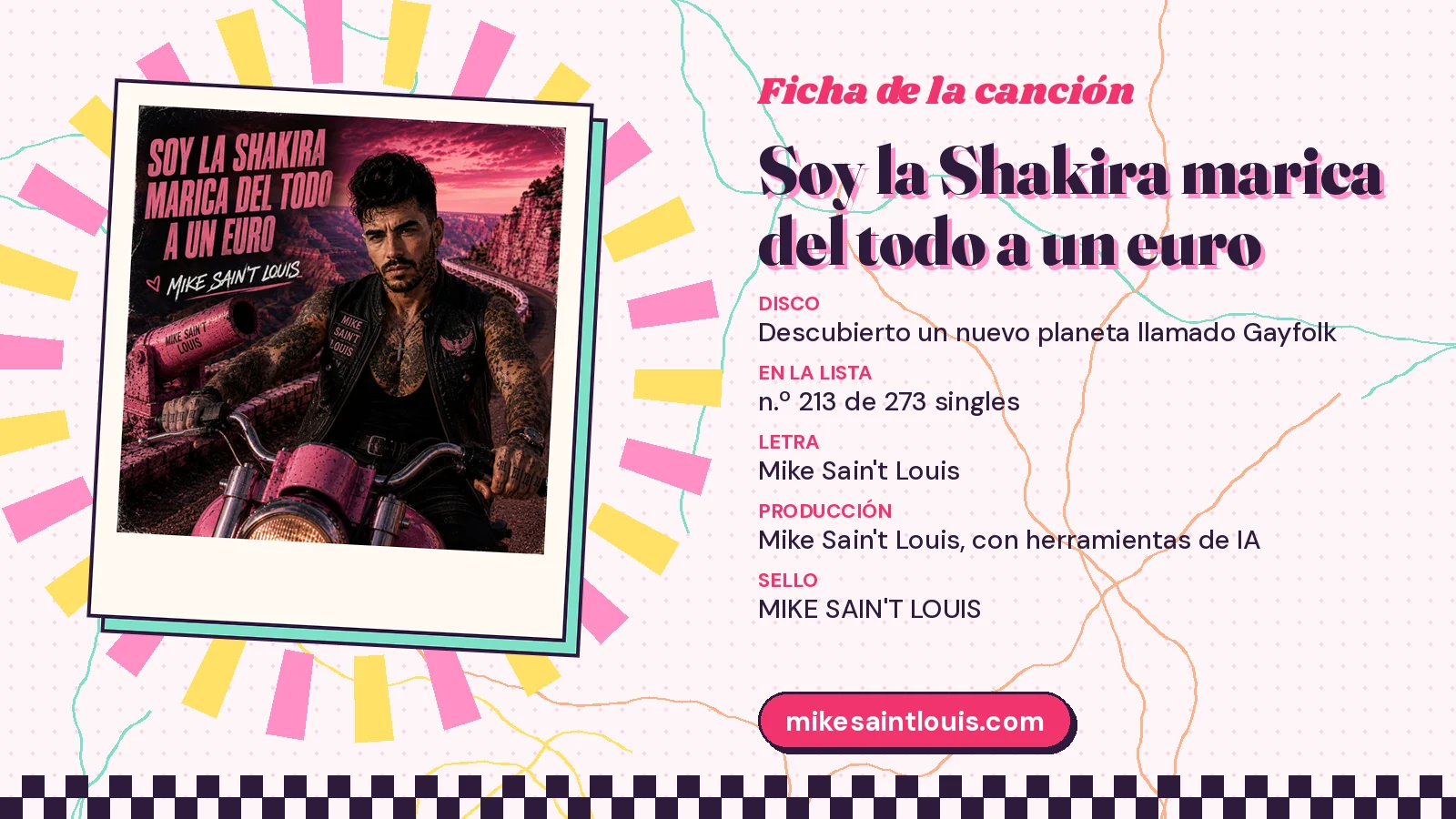
The single's cover understands this perfectly. A pink motorbike, a cannon also in pink with my name painted on it, a mountain road at sunset with rocks tinted fuchsia, a leather waistcoat and tattoos down to the fingers. It's the tough-biker look run through glitter. There's nothing expensive in that pink. It's bargain-shop pink, the pink of girls' toys that many of us were forbidden to touch. And here it is, turned into a vehicle and into artillery.
Marica, said by the one who wears it
In the middle of the nickname sits the heaviest word: «marica». For decades it was the insult par excellence against gay men in Spain, the one shouted in playgrounds and changing rooms, the one written on walls. Many of us heard it before we even knew what we were. That word got there before we did.
For years now, part of the community has picked it up and uses it as a banner. It isn't a new move or one exclusive to Spanish: it happened with «queer» in English, which went from slur to the name of an academic theory and a movement. It has partly happened with «bollera» too. Reclaiming means taking away the insulter's monopoly on the word. If I say it first, in my own tone, you can no longer throw it at me like a stone.
I go into this in more detail in «Cateto, de insulto a bandera», about another word that changed sides. Something similar happens with «marica», with one difference: not everyone can use it the same way. Said among ourselves it's complicity, sometimes tenderness. Said by an outsider, with contempt, it's still what it was. The word hasn't been fully cleaned. What has changed is who gets to decide its tone.
In the song, «marica» is stuck to Shakira and to the one-euro shop, in a compact block repeated like a slogan: «Que soy la Shakira marica del todo a un euro». Notice the «que» at the start. It's the «que» of someone answering back, repeating something they've been told: yes, that's what I am, so what? It's the «que» of the argument on the staircase, of the mother repeating what the neighbour said. It turns the whole phrase into a reply.
«No flipes» as a shield
Among the repetitions comes a very street expression: «No flipes». In colloquial Spanish from Spain, «flipar» means to be amazed, to overreact, to imagine things. «No flipes» is what you say to someone making up a whole film in their head, someone who has got too excited, someone who has jumped to conclusions.
I like that it's there because it defuses the drama. The narrator has just received a nickname with an insult built in, and instead of sinking or starting a fight, he drops a «no flipes». It's a way of saying: don't make so much of it, don't think you're so clever, calm down. It may be aimed at whoever wrote the message, who got carried away comparing him to a world star. It may be aimed at himself, so as not to believe it too much. And it may be aimed at the listener, who perhaps expected a victim's song.
Humour as a shield is one of the oldest tools LGBTI people have. Before someone hurts you with a joke, you make the joke, and a better one. The culture of «locas», of folk divas, of cabaret, is full of that quick comeback. It isn't always healthy; sometimes laughter covers wounds that need something else. But when it works, it works like an umbrella in the middle of a downpour. I talk about that balance in «Lo que aprendí de los comentarios negativos», because getting nicknames and criticism from strangers is part of the job from the day you release your first song.
The Shakira of artificial intelligence
One detail of the nickname isn't random: «la Shakira gay de la inteligencia artificial». Whoever wrote the message knew how I make my music. The lyrics, the composition and the production are mine; the vocals and the music are generated with artificial intelligence, and I've said so openly from the start. That's why I call myself the first AI songwriter, and why I explain what I mean by that in this other post.
In a stranger's hands, that fact becomes ammunition. For many people, AI means fake, manufactured, imitation. Exactly like the one-euro shop. The nickname puts both together: you're a bargain diva and you're not even real. It's a criticism I've heard many times, with more or less politeness.
What's interesting is that the song doesn't argue. It doesn't defend the legitimacy of music made with AI or explain technical processes. It repeats the phrase, puts it in the chorus and moves on. There's a kind of calm in that repetition. As if it said: call me what you like, I know what I'm doing. And what I'm doing, in this case, is turning your message into a song that you'll end up hearing too.
Lyrics written word by word
If you open the video description on YouTube, you'll see the lyrics are written almost one word per line. «Me / acaba / de / llamar». It's a way of writing that forces you to read slowly, like someone spelling out something they can't quite believe. Each word takes its own space, its own beat.
That layout has something of a phone message sent in bursts, those conversations where someone sends one word, then another, then another, and the phone won't stop buzzing. It also has something of a protest banner. Short, isolated phrases read like slogans.
Then, towards the end, the lines get longer and the full phrase appears in one go: «Que soy la Shakira marica del todo a un euro». Repeated four times in a row. It's as if the narrator, after spelling out the nickname in disbelief, had taken it on and could now say it whole, without pauses, without holding back. First you receive it word by word. Then you say it straight through. That's roughly how any process of reclaiming works.
Fit to be locked up
One line repeats at the end of each block and shifts the tone: «Que estoy para el encierro». In Spain, «estar para que te encierren» means being mad, being in a bad way, having lost the plot. It's said of someone who does strange things, talks to himself, has gone too far. And «encierro» has other echoes too: the lockdown we all lived through in 2020, the bull runs at village fiestas, the voluntary seclusion of someone who doesn't want to see anyone.
The narrator says it about himself. After receiving the nickname, after repeating it, after the «no flipes», he concludes he's fit to be locked up. It may be a joke: I'm so mad they should lock me up. It may be tiredness: with all this, I'd better shut myself in. The song doesn't fully say, and much of its charm lies in that ambiguity.
What it does do is go one step further in the last part, where an almost tender answer appears: «no te preocupes / ya estoy encerrado» (don't worry / I'm already locked in). It's what you say to someone who worries about you, or pretends to. Relax, I'm already home. Relax, I'm not going out any more. Relax, I won't bother you. It's ironic, but it also has a domestic truth to it, the truth of someone who has decided to protect himself by staying in.
Better alone than in bad company
And then the proverb arrives. «Más vale estar solo / que mal acompañado» (better to be alone / than in bad company). It's one of those sayings that are part of the air in Spain. We've heard it from grandmothers, aunts, friends after a break-up. It's survival advice condensed into two lines, the kind the proverb tradition passes from generation to generation without anyone knowing who made it up.
In the song, the proverb stretches to the limit: «más vale estar solooooooooooooooooooooo / que mal acompañadooooooooooooooooooooooooooo». The lyrics are written like that, with all those long o's, and the spelling says a lot. It isn't a proverb said in a hurry; it's breathed out, drawn out, almost a copla lament. It's the moment when the nickname, the message, the mockery and the lockdown resolve into a conclusion: I'd rather have my own company than that of someone who writes to call me names.
There's a very healthy reading of that ending. Chosen solitude isn't the same as imposed isolation. Choosing not to be with whoever hurts you, stepping away from accounts that insult you, closing the door on conversations that wear you down, is a form of care. I've written about it in «La soledad de crear solo y cómo la llevo»: working alone has a price, but it also frees you from company that adds nothing.
And there's a more delicate reading that shouldn't be ignored. Shutting yourself in can be a way of protecting yourself and it can be a way of sinking. If one day the lockdown stops being a joke and starts to weigh on you, if solitude is no longer chosen but a room you can't find your way out of, talking to someone helps. In Spain, the 024 line answers free and confidentially, twenty-four hours a day, for anyone going through a bad time, and in an emergency there's 112. Outside Spain, local emergency services or each country's crisis lines do the same job. You don't need to be on the edge of anything to call.
What lies behind answering with a song
Answering mockery with a song is a very old form of gentle revenge. Minstrels did it, carnival couplets still do it, the «chirigotas» of Cádiz have spent decades turning grievances into choruses the crowd joins in with. It's a revenge that does no physical harm to anyone and yet leaves the other person portrayed forever.
In my case, answering with a song is also the most natural way I have of processing things. I write about my exes, my neighbours, my bosses, about what happens to me in the street and online. I explain it in «Me río de mis ex porque es la forma más honesta que tengo de contarlo». Laughter lets me look straight at things that, said seriously, would be harder to bear.
The same happens with this single. In the lyrics, a stranger writes to sum the narrator up in a nickname, and the answer, instead of blocking and forgetting, is a song. It's a gesture full of irony. A message like that, the kind typed in ten seconds, ends up with a music video, a cover, its own page and a place on the platforms. Whoever wanted to stick on a label ends up writing, without knowing it, the title of a song.
Why a pink motorbike
Back to the cover, because I think it answers the nickname with images. If the message said «you're a bargain diva», the cover replies with a tattooed biker in a western landscape. Leather waistcoat, mountain road, fairground cannon. It's the iconography of toughness, of road movies and biker gangs, dyed entirely pink.
That mix of leather and glitter is very recognisable in gay culture. There's a whole tradition of leather aesthetics, of bikers, of exaggerated masculinities that look at themselves with humour. And there's another tradition, of divas, feathers and pink. The cover brings them together. It says: you can be the one-euro-shop Shakira and have tattoos down to your fingers. You can be «marica» and a biker. The labels others give you are always narrower than you are.
The cannon with my name painted on it is also a kind of mock declaration of war. It's fairground artillery, the sort that fires confetti. It hurts nobody. But it takes aim.
A song from the first album
It makes sense that this single is on *Descubierto un nuevo planeta llamado Gayfolk*. The trilogy's first album is the album of arrival, of discovery, of presenting yourself to the world with every label on you. It's the album where planet Gayfolk makes the news and everyone has an opinion about it.
A nickname received on X fits that moment very well. When you've just arrived, everyone defines you before they know you. You're the new one, the odd one, the AI one, the «marica», the bargain Shakira. The first album is about gathering up all those definitions and doing something with them. Dancing them, laughing at them, putting them on a pink cover.
If you'd like to hear the whole trilogy in order and see how each song fits, I left a guide in «Cómo escuchar la trilogía Gayfolk de principio a fin».
Who this song is for
For anyone who has received a nickname they didn't ask for. For whoever has opened their phone to find a message from someone they don't know telling them who they are. For those of us who grew up hearing «marica» as an insult and now say it however we like. For anyone who bought something in a hundred-peseta shop and wore it proudly.
For whoever has decided not to go out that night, not to carry on that conversation, to mute that account. For whoever prefers the company of their records, their sofa and their series to that of someone writing to make them feel small.
And for anyone who knows how to laugh at all of that without forgetting that, sometimes, under the laughter there's something that also deserves attention. The song is a joke, but a joke with its feet on the ground. They call you the one-euro-shop Shakira, you turn it into a chorus, and in the end you're left with a grandmother's proverb that sums it all up.
You can read the full lyrics on gayfolkplanet.com and in my lyrics section, and listen on Spotify.
Frequently asked questions
What is «Soy la Shakira marica del todo a un euro» about?
A nickname that arrives through a message on X, which the narrator picks up, repeats and turns into a chorus. It ends with the proverb «más vale estar solo que mal acompañado» (better alone than in bad company).
Is it related to «La Shakira y el Piqué de todo a 1 euro»?
Yes, they share the world of the bargain shop and the cut-price diva. In that one the narrator claims the role of Shakira in a break-up. In this one the nickname is given to him from outside.
Which album is it on?
On Descubierto un nuevo planeta llamado Gayfolk, the first album of the Planeta Gayfolk trilogy. The music video was published on YouTube on 4 January 2025.
What does «estar para el encierro» mean?
In colloquial Spanish from Spain, being mad or having lost the plot. In the song it also points to the voluntary seclusion of someone who would rather stay home than put up with bad company.
Who makes the music and the vocals?
The lyrics, composition and production are by Mike Sain't Louis, the first AI songwriter. The music and the vocals are generated with artificial intelligence.
Where can I read the full lyrics?
In the music video's description on YouTube and on the lyrics page of gayfolkplanet.com.