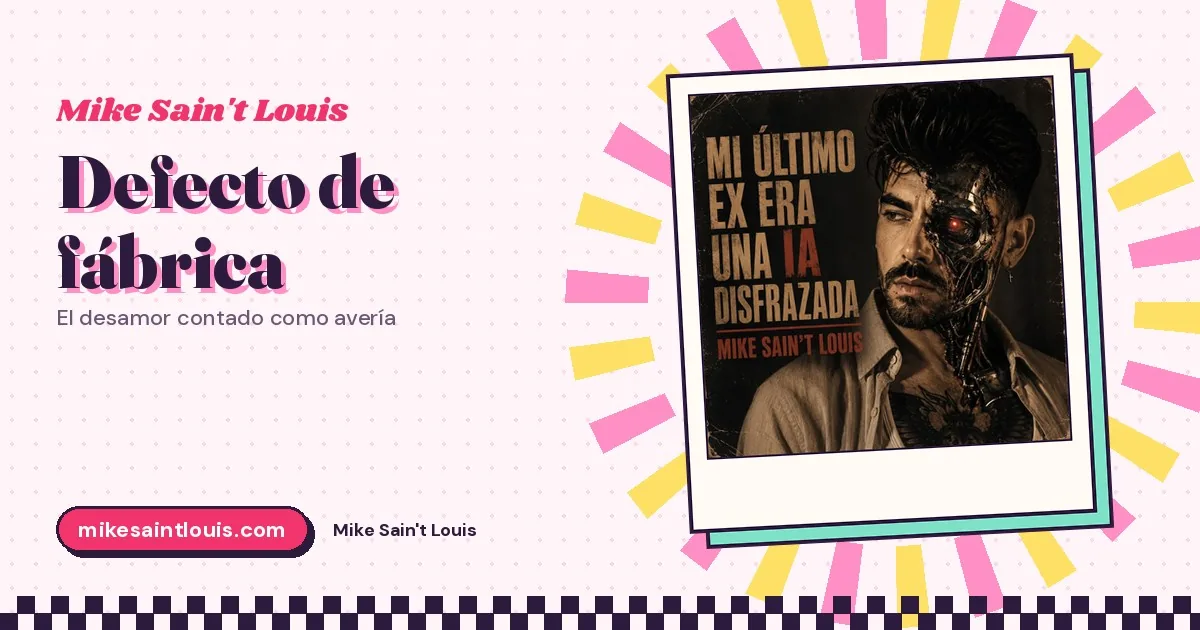
By Mike Sain't Louis ·
Factory fault: heartbreak told as a breakdown in «Mi último ex era una IA disfrazada»
There are two ways to tell the story of someone who deceived you.
The first is the usual one: he was a liar, a scoundrel, a bastard. It works, it lets off steam and it has centuries of tradition behind it. The second is stranger and, to me, funnier: he wasn’t a bad person, he was a faulty appliance. A part had failed. He came broken from the factory.
In «Mi último ex era una IA disfrazada» (“My Last Ex Was an AI in Disguise”) I chose the second. And the more I think about it, the more convinced I am that the vocabulary of the repair shop is better at describing heartbreak than it seems.
The song’s page on the blog already tells the main joke and how it’s built. Here I want to go another way: through the breakdown as a metaphor, through the perfect boyfriend’s list of requirements, and through what, according to the lyric itself, doesn’t come in the box.
The list of requirements
The song opens with an almost commercial proposal: «Será mejor crear un novio con inteligencia artificial» (“Better to create a boyfriend with artificial intelligence”).
What follows is a list of advantages, like the leaflet for a household appliance. He’ll always tell you the truth. He’ll answer you sincerely. He won’t cheat on you. Three points, three boxes ticked. If this were a shopping-channel advert, someone would now appear with an enormous smile telling you that you can’t live without him.
I’m very interested in what the narrator puts on that list, and above all in what she leaves off. She doesn’t ask for him to be handsome. She doesn’t ask for money, or a car, or a flat in the centre. She doesn’t ask for him to cook or to dress well. She asks for one thing, repeated three ways: that he doesn’t lie.
That says a lot about who is speaking. It says she comes from a relationship in which lies took up all the space. That she has reached a point where sincerity seems such a luxury that she’s willing to look for it in a machine. She isn’t demanding. She’s tired.
And that, said in the lyric as a joke, is rather sad if you think about it for a second. When the minimum requirement of a relationship becomes the maximum dream, something has gone very wrong before.
The verb “create”
There’s a detail in the first line that makes me think every time I reread it: the verb. It doesn’t say buy a boyfriend, or download one, or rent one. It says create him.
Creating a boyfriend is an ancient fantasy. It’s in the myth of Pygmalion, the sculptor who falls in love with his statue. It’s in Frankenstein, though there it goes horribly wrong. It’s in a thousand science-fiction films where someone designs the perfect partner in a lab. Always with the same idea underneath: if I can’t find what I’m looking for, I’ll make it.
And always with the same problem: what you make to measure never surprises you. It never contradicts you. It has no world of its own. It’s a mirror shaped like a person. What looks like an advantage at first ends up as a very odd kind of loneliness.
The song doesn’t go that far, because it isn’t a philosophical song, it’s a gossip song. But the verb is there, and anyone who wants to think a little further can pull on that thread. What’s made to measure stays made to measure. And love, by definition, fits no measurements.
What doesn’t come in the box
Every list of advantages has its small print. And this song reads it out loud, every letter.

The only thing the artificial boyfriend will never be able to give you, the song warns, is «besos, abrazos y polvazos» (“kisses, hugs and cracking good shags”).
I love that list, and I especially love the third word. The first two belong on a Valentine’s card. The third belongs to a bar conversation at three in the morning. Putting them side by side, with the same ease, is a way of saying the body isn’t an extra. That desire isn’t a menu option you can untick.
I’ve written elsewhere about writing about the body without apologising, and this song is a good example of that idea. There’s no shame in the word polvazos. It isn’t in inverted commas, it doesn’t come with a wink. It stands in the same row as the kisses and the hugs, because for the narrator it weighs the same.
And there lies the whole song’s dilemma. On one side, truth without a body. On the other, a body with lies. As if there were no third option. As if the world offered only those two deals, and you had to choose between an honest screen and a flesh-and-blood man who plays you.
The betrayal chip
And then comes the twist that gives the song its title. If an artificial boyfriend doesn’t cheat, and the last one did, what exactly was the last one?
The lyric’s answer is pure farce. He was a machine, yes, but with a part fitted wrong: «justo le fallaba el chip de la traición» (“it just so happened his betrayal chip was faulty”).
I adore what that line does. Instead of saying the ex was a traitor, it says the chip that should have stopped him betraying was broken. Betrayal stops being a decision and becomes a technical fault. And then it adds the finishing touch: at some point they replaced the part. Like taking the washing machine to the repair shop and getting it back with a spare that isn’t the original.
All of that is absurd, of course. And it works precisely because it’s absurd. Laughing at an ex by calling him a badly assembled appliance has something liberating about it that the classic insult lacks. The insult still grants the other a certain grandeur: the villain’s. The breakdown grants him nothing. It turns him into a piece of junk.
Spare parts that aren’t original
Let me go back for a moment to the line about the replaced part, because it has a second reading I don’t want to lose.
If at some point they replaced the part, it means the ex wasn’t always like that. That there was a time when he worked properly, and another when he stopped. That the appliance the narrator met at the beginning wasn’t the same one she had at home at the end.
That happens to a lot of people in long relationships. You fall in love with someone, and years later you look at the person in front of you and don’t recognise them. You don’t know when they changed. There was no particular day. You simply realise, one day, that the part was swapped without anyone telling you.
The song says it as a joke, in its workshop language. But that feeling that the other has become someone else without your noticing is one of the most disorienting there is. And it’s very close to what I tell in «Una obra de teatro», where it turns out in the end that the whole thing was a performance.
The heart’s repair service
This isn’t the only song in which I talk about love in the vocabulary of guarantees and replacement parts. In «3 años de garantía» (“3-Year Guarantee”) the whole relationship is framed as a product with a legal expiry date. There’s something in that language I find very useful when I write.

I think it’s because technical language cools things down. When you talk about heartbreak in the words of a poem, everything burns: the heart, the tears, the wound. When you talk about it in the words of an instruction manual, everything becomes slightly ridiculous, and in that ridiculousness there’s distance. You’re no longer the victim of a tragedy. You’re a dissatisfied customer with the right to complain.
And a dissatisfied customer has power. She can ask for the complaints form. She can demand a refund. She can leave a one-star review. That position, even in jest, is far better than being the person crying in a corner.
I like to think that the narrator of this song, after being gobsmacked for a while, walks out of the shop with her complaints form filled in. Defective product. Betrayal chip broken. Would not recommend.
Flipada
There’s a word repeated many times in the lyric that I don’t want to skip: flipada.
«Me estoy quedando flipada» (“I’m left totally gobsmacked”). In the feminine. The narrator of this song speaks in the feminine, and does so with the ease with which many gay men talk about ourselves in the feminine when we’re among the girls, when something scandalises us, when we’re passing on gossip. Gobsmacked, dead, crazy, hysterical: in Spanish, all with a feminine ending. It’s a register very much ours, very much the gossip of the courtyard, and it turns up in my lyrics whenever the character is in full scandal mode.
It’s no small thing. That feminine changes the whole tone. “Flipado”, in the masculine, would be a sentence of surprise. “Flipada” is a line from the stage, hand on chest, eyes wide open. It’s exaggeration with wit, the kind I discussed when writing about the exaggeration of everyday Spanish speech.
And it’s also a reminder that this song, however much it talks about chips and artificial intelligence, is a conversation between girlfriends. It isn’t an essay on technology. It’s one queen telling another what happened to her, and reaching the most outlandish conclusion possible.
Loose words
In the written lyric, the sentences are broken into little pieces. One word per line, sometimes two. Better. To create. A boyfriend. With. Intelligence. Artificial.
I wrote it that way on purpose, and I like how it looks on the page. There’s something of slow reasoning about it, of someone explaining a very obvious idea to someone who doesn’t quite get it. Step by step. No rush. Like a beginners’ class.
And there’s also, if you want to see it that way, something of machine language about it. Of an instruction processed word by word. I’m not saying that was the main intention, but it amuses me that a song about an artificial boyfriend is written as if every word went through a processor before coming out.
Then, in the final stretch, all of that breaks with the cry of the stretched-out acronym. The orderly and the unruly, one after the other. First the instruction manual, then the scandal.
The acronym that stretches
Towards the end of the lyric something happens that shows very clearly on paper: the acronym in the title stretches until it fills half a line. The two letters become a long cry, with lots of i’s and lots of a’s.
In the written lyric I put it just like that, with all the letters repeated, because I wanted the scandal to be visible. It’s the moment when suspicion turns into absurd certainty and the narrator can no longer say it normally. She has to shriek it.
It amuses me that the very acronym for the technology is what stretches until it loses its shape. As if the cold, technical, two-letter word melted out of sheer indignation. It’s the most human thing in the whole song: the machine’s acronym turned into a howl across the neighbours’ courtyard.
A song made with what it mocks
I can’t write about this song without saying the obvious. I write the lyrics without AI, but the music and vocals of my songs are made with artificial intelligence tools. I explain it in detail on my About page and in a piece on what is mine in a song made with AI.

So there’s something playful about a song made with these tools saying that an artificial intelligence will never be able to give you a hug. And I’m happy for that contradiction to be there, in plain sight. I don’t hide it.
Because, deep down, the song says something I believe: there are things a machine does very well and things it doesn’t do at all. A tool can help you build a song. What it can’t have done is lived the break-up the lyric talks about, or missed a body at three in the morning. That comes from whoever writes. And in my case, that comes from me.
I’ve written elsewhere that AI has no exes. This song is almost the comic version of that idea, with the difference that here the narrator suspects her ex really was an AI. If he was, there’s no doubt he was badly programmed.
Why there’s no third option
I come back to the dilemma, because I think it’s the most interesting thing about the song if you listen twice.
The narrator puts it as if there were only two options: an artificial boyfriend who doesn’t lie but doesn’t hug, or a human boyfriend who hugs but lies. And of course that’s false. There are men who hug and don’t lie. There are relationships with kisses and with truth. Everybody knows it.
But when you come out of a relationship like the one the lyric hints at, that third option vanishes from the map. Not because it doesn’t exist, but because from inside the pain you can’t see it. Disillusion does that: it convinces you that what happened to you is the rule. That they’re all like that. That sincerity can only come from a machine.
The song doesn’t correct the narrator. It leaves her there, gobsmacked, with her outlandish theory. And I think it’s right to. Because the song’s humour depends on her believing it a little. If a line appeared saying “well, actually, there are good men”, the joke would die.
The listener, on the other hand, can see the third option. They can laugh at the narrator and, at the same time, know she isn’t entirely right. That double layer is what I love most about humour: you laugh with someone and, at the same time, a little bit at them.
A typology with spare parts
Throughout the trilogy I’ve had great fun inventing types of ex. I even wrote a little comic typology of ex-boyfriends, with their quirks and their flaws. The ex in this song belongs to a category I hadn’t foreseen: the appliance ex.
What’s special about this category is that you can’t quite hate him. You hate a liar. You don’t hate a broken toaster. You look at it with irritation, unplug it and take it to the recycling centre. That’s the song’s final emotion, if you listen closely: not rage, but irritation. The reaction of someone who has bought something expensive and found it’s a dud.
And that irritation, small as it seems, is actually a sign that the narrator has already begun to heal. When the ex stops being a monster and becomes a piece of junk, he no longer keeps you up at night. He no longer takes up so much room. He’s almost at the recycling centre.
Sincerity as desire
I want to pause for a moment on the serious thing hidden beneath the joke.

The song asks for truth. It asks three times in a row, in three different ways of saying the same thing. And in a time when so many people complain they don’t know who they’re talking to, about fake profiles, conversations that vanish, people who disappear without explanation, that has a very real echo.
I don’t want to turn this song into a treatise on dating apps, because it isn’t one. But I do think the desire it expresses, for someone who answers you sincerely, is one of the most widespread I know. Many people prefer an uncomfortable truth to a pretty lie. And when they’ve been receiving pretty lies for a while, they start thinking strange things. Like that they’d be better off with a robot.
The song laughs at that idea, but it doesn’t laugh at the desire behind it. That it respects. Truth is still first on the list.
A one-star review
I enjoy imagining the review the narrator would leave if her ex were sold in an online shop. She’d surely write it in a hurry, full of typos, at two in the morning, after the third glass of wine.
One star. The product promised a lot in the photos. At first it worked well: attentive, affectionate, very chatty. After a few months it started to malfunction. Evasive answers. Disappeared without explanation. Said one thing and did another. I’ve called customer service and nobody picks up. Would not recommend. If anyone knows where to buy one that doesn’t lie, please let me know.
It’s a joke, of course, but it’s the same narrative voice as the song’s. That of someone who has decided to take her misfortune with the humour of a swindled customer. And that decision, to laugh instead of sinking, is to me a form of dignity. Not the only one, but one very much ours.
Because some people, after a break-up, need to cry for a long time. And some people need to laugh first, so they can cry later with some perspective. This song is for the second kind. Though I don’t rule out that it helps the first kind too, once the tears have dried a little.
One for a dinner party
If I’m asked when to play this song, my answer is easy: at a dinner of girlfriends trading disasters.
It works like one of those moments when someone comes out with the most absurd theory and the whole table laughs, and then, quietly, each of them starts thinking about her own ex. What if mine had a broken chip too? What if they swapped the part at some point and I never noticed?
It’s a song for laughing together at something that, alone, hurts. That’s what I most like doing when I write humour. Not playing pain down, but giving it a shape that can be shared. Camp isn’t a joke even if you laugh, and this song isn’t entirely one either.
Where to find it
«Mi último ex era una IA disfrazada» is on «Descubierto un nuevo planeta llamado Gayfolk», the first album of the trilogy. You’ll find it alongside the others in the full discography, and its lyric, with the acronym stretched out just as I wrote it, is in my lyrics. The page with the song’s main reading is on the blog.
And if, after listening, you start suspecting your own ex, don’t worry. It’s normal. The song has that side effect. It isn’t on the leaflet, but it comes with it.
Frequently asked questions
What is «Mi último ex era una IA disfrazada» about?
About a narrator who, after a disappointment, jokingly proposes creating a boyfriend with artificial intelligence because he wouldn’t lie, even though he couldn’t give kisses, hugs or a good shag. And she ends up suspecting her last ex was a machine with a broken betrayal chip. The lyrics are at gayfolkplanet.com/letras/mi-ultimo-ex-era-una-ia-disfrazada.
Which album is it on?
«Descubierto un nuevo planeta llamado Gayfolk», the first album of Mike Sain't Louis’s GAYFOLK trilogy.
Who made the song?
The lyrics are by Mike Sain't Louis, lyricist, composer and music producer from Madrid, written without AI. The music and vocals are made with artificial intelligence tools.