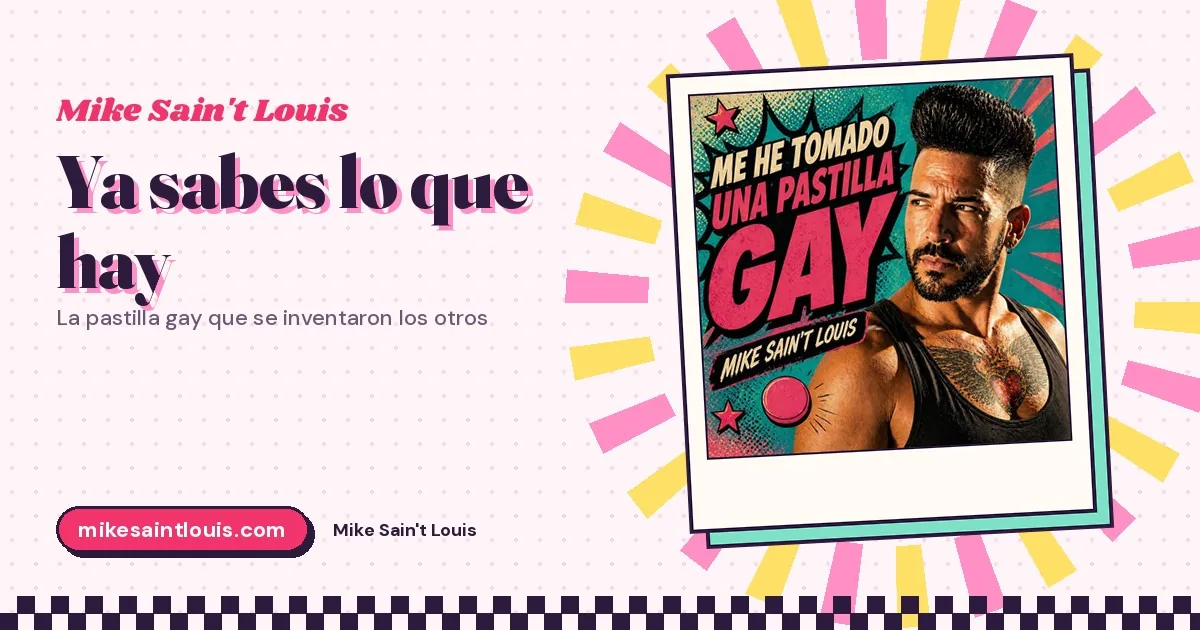
By Mike Sain't Louis ·
«Ya sabes lo que hay»: the gay pill other people invented
A phone held up high. A hand pointing not at the stage but at the audience. And an order that sounds like a housewife at a wedding that's starting to go wrong:
Grábales las caras Juan, las caras («Film their faces, Juan, their faces»)
That's how «Me he tomado una pastilla gay» («I've taken a gay pill») begins. Before anything happens, before any chorus, the song already knows it's going to scandalise somebody and asks for it to be put on record. It's less interested in what's about to be said than in the face of whoever hears it.
On the song's own page I've already talked about the lyric's cheek, the dig about hyaluronic acid and the line about the perfect woman. Here I want to stay with the title, which is where the biggest joke is and also the oldest wound. A gay pill. As if being queer were something you take. As if somebody, somewhere, sold it in capsules.
Well, some people have believed exactly that all their lives. And the song, instead of arguing with them, takes the pill right under their noses.
Film their faces, Juan
I'll start with the phone, because it feels like a very now gesture and a very forever one at the same time.
Filming the reaction is the most-watched genre on the internet. Videos of people hearing something for the first time, grannies trying spicy food, parents watching their son's music video. Someone else's face as entertainment. And this song flips it: it doesn't film the face of someone pleasantly surprised but the face of someone scandalised. The gentleman choking on his vermouth. The aunt who looks at her husband as if to say «did you hear that?».
Juan, by the way, is a character. I don't know who Juan is and the song doesn't explain either. He's the wedding cameraman, the mate with the phone, the one who's always filming. We've all got a Juan.
What I love about this opening is that it changes who the odd one out is. Normally, at a party, the queen is the one making a scene and everyone else watches. Here the camera points the other way. They're the show, the scandalised ones. Their faces are recorded for posterity, as evidence of an age when a song with the word «gay» in its title could still make someone spit out their canapé.
I talk about that turning of the tables more slowly in From laughing at us to laughing ourselves: for decades we were the joke, and now we're the ones telling it. «Film their faces» is exactly that. We're no longer the video. We're the one filming.
Outrage is a performance too
And here's a suspicion I've had for years: the person who's scandalised is performing as well.
Think about it. The lady clutching her chest at the wedding isn't really suffering. She's playing her part. She's seen it on telly a thousand times, on the afternoon talk shows, on the panel debates where someone leaps from their chair in high dudgeon just before the ad break. Outrage is a genre with its own set moves: the snort, the «there are children present!», the eyes raised to heaven, the napkin folded in fury. And whoever does it knows, deep down, that they have an audience.
That's why the song's order is so good. Film their faces. If they're going to do their number, at least let it be recorded. Let it be seen that the real drama wasn't at the microphone but in the chairs. And let someone watch it in twenty years and laugh the way we laugh today at the old news bulletins that talked about us as if we were a plague.
There's a very queer pleasure in returning the gaze. We've been looked at all our lives: in the playground, in the changing room, on the Metro when your shirt was a bit too patterned. For the camera to point the other way, just once, isn't revenge. It's pocket-sized poetic justice, the kind that fits on a phone screen.
The pill they invented
Now, the title. Let's be serious for a moment, because the song deserves it even if it doesn't look like it.

All my life I've heard theories about where we queers come from. It's a fad. It's the telly. It's the mother's fault, she smothered him. It's the wrong crowd. Now with the internet the kids get confused. It's catching, so the boy had better not go round to that friend's house. Some people still say it under their breath at Christmas lunch, between the Jijona nougat and the cava on special offer.
All those theories have one thing in common: they imagine being gay comes from outside. That someone put it into you. That it's a substance, an infection, a pill. And if it comes from outside, it can be removed. Some very ugly things came out of that idea: cures for homosexuality, camps, psychiatrists with electrodes, conversion therapies that are banned by law in Spain today and that nonetheless did a great deal of harm to a great many people.
So I didn't invent the gay pill. They did. It's the homophobe's fantasy: the idea that there's a substance that turns a normal boy into a little poof. All I've done is put it in a song title and take it.
And here's the trick I love. The song doesn't say «that doesn't exist, sir, allow me to explain with data». It doesn't waste its time. It does what those of us who grew up hearing nonsense do: take the nonsense, exaggerate it to the point of absurdity and dance to it. Being gay is a pill? Perfect. I've taken it. And look how well it agrees with me.
Notice the verb, too. It doesn't say «they gave me», or «they made me», or «they turned me». It says «I've taken». First person, present perfect, my own decision. If the pill existed, the song takes it because it feels like it, the way you'd order another beer. It strips the myth of its victim: nobody has corrupted anybody here, here's a man who has chosen to have a good time and says so with his mouth full.
It's a way of defusing the insult that anyone will recognise who has turned maricón into a term of endearment. You take the stone they throw at you and make yourself a necklace.
Mind you, the pill in the song is a metaphor, not advice for a night out. No real pills. The only one I recommend is this one, the imaginary one, which has no side effects except the faces other people pull.
That's how it is
The chorus is short and says everything:
Ya sabes lo que hay / Me he tomado una pastilla gay («You know how it is / I've taken a gay pill»)
«Ya sabes lo que hay». That phrase is bar Spanish, mum Spanish, brother-in-law Spanish. It's what you say when there's nothing left to explain. You know how it is: that's your lot, it is what it is, don't ask me for more.
And it strikes me as the healthiest possible way to come out. No speech. No letter. No family meeting with your heart in your mouth. You know how it is. Full stop.
For a long time coming out was an event. You had to prepare it, choose the moment, rehearse the lines, anticipate the reactions. I wrote about that much more carefully in A letter to anyone who hasn't told a soul yet, because for someone at that point there's nothing funny about it, and I respect that enormously.
But this song imagines something else. It imagines the day when it won't be necessary. The day someone says «I've taken a gay pill» the way they'd say «I've taken an ibuprofen», and the other person replies «fine, do you want some water?». That's planet Gayfolk. A place where the announcement needs no ceremony.
I also like that the phrase is in the second person. You know. You already know. I'm not breaking news, I'm confirming something the other person knew perfectly well and pretended not to. Because that's the truth of so many comings-out in Spain: your mother knew, your grandmother knew, the doorman knew, the man at the newsstand had known since you were nine and bought Superpop, the teen magazine. All that was missing was saying it out loud. And the song says it with the indifference of someone remarking on the weather, which is exactly the indifference something so ordinary deserves.
Until that day comes, the line works as training. Say it in front of the mirror. You know how it is. Let's see what face your aunt pulls.
Neither top nor bottom
There's a question every gay man has heard at some point, sometimes from another gay man on an app, sometimes from a curious straight guy two beers down. So what are you? And they don't mean your star sign.
The lyric answers point-blank:
No soy activo ni pasivo («I'm neither top nor bottom»)
And then it carries on with what it is, which I won't repeat here, because anyone can read it in the full lyric and because my mother, as I've said before, could be reading this.
What interests me is the refusal. The world's need to put us into two drawers, as if sex between men were a badly made copy of sex between a man and a woman, with one role each. Top or bottom. On top or underneath. Him or her. It's a question that, deep down, says far more about the person asking than the person being asked.
And the song laughs at the question with the most effective weapon there is: giving an answer that wasn't on the menu. Neither one nor the other. Something else. And in detail, so there's no doubt.
Talking about the body without apologising is something I take quite seriously, even when I do it with a joke. I explained it in Writing about the body without saying sorry. If someone is shocked by a word about sex in a song and not shocked that people get beaten for holding hands, the problem isn't the song.
Better hyaluronic acid
On the song's page I've already talked about the political dig, that cheap rhyme preferring cosmetic fillers to corruption. Here I just want to add one thing: the hierarchy of scandal.

I'm fascinated by what scandalises people and what doesn't. A song with a crude word for a woman's anatomy in its lyrics provokes more letters to the editor than a councillor caught with an envelope of cash. A man with filled lips gets more talk at the hairdresser's than a politician who's lived off his post for twenty years. And the song puts it in two lines, no moral, with the kind of rhyme you learn first time round.
It's not the only time I go after politics in a lyric. In «Un político español» it goes much deeper. Here it's just a stone thrown in passing, a bar-room remark between one shot and the next. But I think it works precisely because of that. The people shocked by the gay pill are very often the same people who vote without blinking for whoever robs them. Film their faces, Juan.
As for Sonia y Selena, the pop duo, the lyric frames it as an absurd bet with an «if» in front, the kind you make at a bar. I say nothing about them, their faces or their lives. I name them the way you name divas at a party: because they're part of the scenery of a whole generation's song of the summer.
The perfect woman
And we reach the line that sticks in your head most, the final one, the one that turns the song into a dance-floor anthem with its two most emphatic words. The perfect woman, with everything she's got. I won't quote it in full again, because I did on the song's page and because it works better heard than read.
What I do want to say is this. That line is camp, it's exaggeration, it's a dance-floor joke. But it's also a way of saying that bodies don't fit into the boxes they were assigned. That there are women with penises. That there are men without them. That there are people who don't want to be either. And that perfection, if it exists, has nothing to do with fitting the mould.
I don't write it as someone giving a lesson on identity, because it isn't my place to lecture anyone about their identity. I write it the way the song does: from the party, arm in the air, flounce on full display. Trans women have been the front line of our history, from those who risked their lives on the street to those who appeared on television when nobody else dared. A dance-floor line that says «I'm the perfect woman» with the whole body intact strikes me as, at the very least, a small village-fête tribute.
In «Soy marica sideral» there's something similar: the flounce turned all the way up, the volume of identity set to eleven. It's a family of my songs that don't ask permission to take up space.
Humour that doesn't apologise
People sometimes ask me whether songs like this go too far. Whether one ought to be careful. Whether I'm reinforcing stereotypes. And it's a legitimate question, one I ask myself as well.
My short answer is that humour is measured by who it aims at. This song aims at the people who get scandalised, the ones who believe in the pill, the chronically corrupt, the ones who ask if you're a top or a bottom the way they'd ask if you support Real Madrid or Atlético. It doesn't aim at anyone who's already on the floor.
I worked it through calmly in Doing gay humour without doing harm, and my rules are there; I don't always keep them, but I try. The main one: laugh at yourself first, then at the powerful, and never at someone who can't defend themselves.
With this song, I laugh at myself first. I'm the one who's taken the pill, the one bragging about his tastes in bed in front of the whole wedding, the one making a scene. The first fool is me. And that gives me permission for the rest.
And now the serious bit, just once: there are kids who still hear at home today that being gay is a fad, a phase or something that can be cured. For them, a song that takes the pill with a belly laugh might be the first thing that tells them they aren't the problem. I'm not saying the song will save them. I'm saying it might make them laugh on a bad day. Sometimes that's enough.
Track 258, between Ay Chavoro and Holy Stillness
In the singles list of Planeta Gayfolk, this song is track 258 of 273, on the second album of the trilogy, «Ojalá se pudiera viajar a Gayfolk». And its neighbours make me laugh.

Just before it comes «Ay Chavoro». Just after, «Holy Stillness», which, from the title alone, you can tell heads somewhere else entirely: sacred quiet after the pill. I love that contrast. From the scandal at the wedding to the silence of the chapel. Like those nights that start with the music blaring and end with someone staring at the ceiling at six in the morning.
The second album of the trilogy is the album of wanting to be somewhere else. If only you could go to a planet where things were different. And on that planet, I imagine, the gay pill would be sold over the counter and nobody would pull a face asking for it. Or better still: no pill would be needed, because nobody would believe you had to take something to be what you already are.
The part of the party when someone turns it up
Every party has a moment when things change. Someone turns the volume up, someone kicks off their shoes, someone who's been sitting down all night is suddenly in the middle of the floor. This song is for that moment.
It's for Pride, of course. I explained it in What a Pride dance floor asks for: easy choruses, lines to shout with your friends, something you get first time even on Calle Hortaleza with four hundred people around you. «You know how it is» gets understood first time.
But it's also for your cousin's wedding, if you're brave. For the office Christmas do, if you're very brave. For the car with the girls on the way to Benidorm. For anywhere there's someone who could do with seeing your happy face while you watch their shocked one.
And it's for when you're home alone, too. Because sometimes the party you most need is the one you throw on a Tuesday in the living room, volume up and blinds down, after a day when someone looked at you funny at work. Nobody films that party. But it counts just the same.
I know perfectly well I never took it. The pill, I mean. I came this way from the factory. But the song lets me pretend I did, and there's a freedom in that game I really like: the freedom to laugh at the explanation other people invented for me.
And if anyone asks what's happened to you, why you're so cheerful, why you're dancing like that, you know what to answer. You know how it is.
And you, Juan: keep filming.
Frequently asked questions
What is «Me he tomado una pastilla gay» about?
The myth that being gay is catching, chosen or taken. The song grabs that absurd idea and turns it into a party chorus.
Is the song about drugs?
No. The pill is a metaphor for the homophobic fantasy that homosexuality comes from outside. It isn't advice for a night out.
Who is Juan?
A character. He's the friend with the phone who's asked to film the faces of the people who get scandalised.
Who wrote this song?
I wrote the lyrics. I'm a lyricist, composer and music producer. The music and the vocals are made with artificial-intelligence tools such as Suno.
Which album is it on?
It's part of «Ojalá se pudiera viajar a Gayfolk», the second album of the GAYFOLK trilogy, and it's track 258 of the 273 singles.