
By Mike Sain't Louis ·
«Tu mendigo»: mi novio, lo mío and possessives in my lyrics
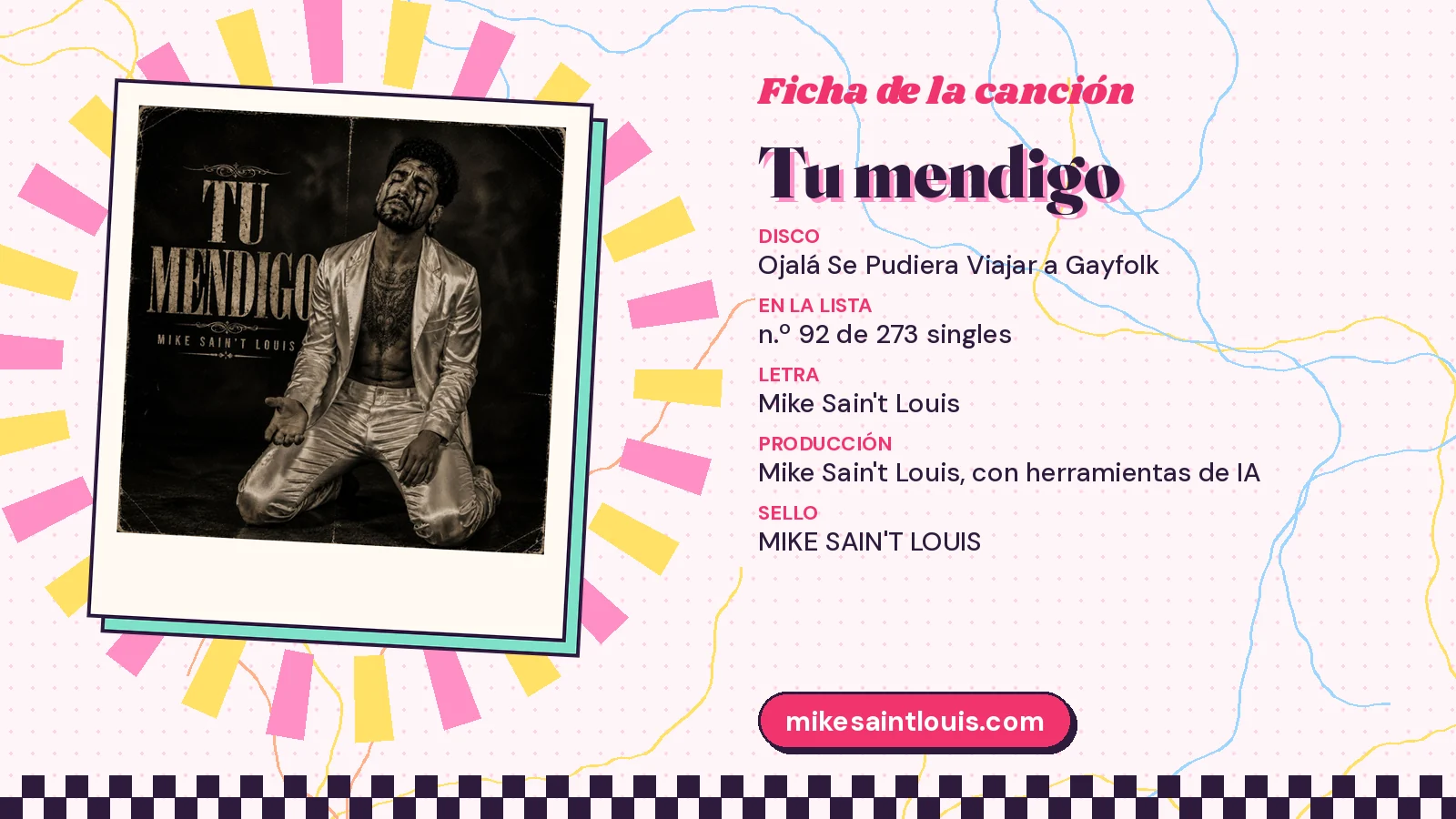
There's a word in «Tu mendigo» that does more work than all the others put together, and it isn't mendigo, beggar. It's tu, your. The chorus repeats «Y tú, tan convencido / De que sigo siendo tu mendigo», and you, so convinced that I'm still your beggar. Take away that possessive and the phrase limps. A beggar is someone who asks. Your beggar is someone who asks you, who depends on you, who in some way belongs to you. (The full lyric is on gayfolkplanet.com.)
I only noticed this late, when the song was already finished. I thought I'd written a lyric about someone who takes advantage of another person, and yes, that's what it's about. But what holds the idea up isn't the image of the beggar, it's the ownership tag hanging from it. The other man doesn't just think the narrator is poor. He thinks he's his.
I've already written about the house in this song, the door opened with a borrowed key and the corner with the stained rug, in «Llave prestada y alfombra manchada». I don't want to walk through those rooms again here. I want to look at a much smaller piece: possessives. Mi, tu, su, mío, tuyo, nuestro, lo mío. Words you hardly see that nevertheless decide who belongs to whom in a sentence.
This piece is about how I use those words in my lyrics, what grammar says about them and that thin line where a possessive stops expressing affection and starts expressing control.
Tu mendigo: a possessive that weighs more than the noun
I'll start with the chorus, because it's built from very little. «Y tú, tan convencido», and you, so convinced, is a phrase with no conjugated verb. It doesn't say you are convinced. It says so convinced, like pointing at someone with your chin. Then comes the subordinate clause, «de que sigo siendo tu mendigo», that I'm still your beggar, where all the weight falls at the end.
What's interesting is that this tu isn't the narrator's. It belongs to the other man. It's how he sees the narrator. Deep down the narrator is quoting someone else's gaze: you think I'm your beggar. That's why the chorus works as mockery. Repeating the other man's possessive so many times is a way of showing how ridiculous it sounds.
There's a huge difference between saying «un mendigo», a beggar, and «tu mendigo», your beggar. The indefinite article talks about any person asking for money in the street. The possessive creates a relationship: someone who gives and someone who receives, someone above and someone below. It's a two-letter word that works like a contract.
And the song ends by tearing up that contract. Later the lyric says «Y hoy te digo que no soy tu saco de boxeo / y mucho menos tu mendigo.», and today I tell you I'm not your punching bag, let alone your beggar. Notice that the possessive stays, but now it's negated. I'm not your punching bag. I'm not your beggar. The narrator can't erase the word tu, because it's the one the other man has been using all along, but he can put a no in front of it.
Mi, tu, su: the words you can barely hear
The possessives that go before the noun, mi, tu, su, my, your, his or her, are unstressed in Spanish. They have no accent of their own in the sentence: they lean on the noun that follows, as if they were part of it. When we say mi casa, my house, the stress falls on casa. The mi tiptoes past.
That's why they're so dangerous in a lyric. They go unnoticed. Nobody stops to think about the mi in mi novio or the tu in tu mendigo, just as nobody thinks about the screws in a chair. But take them out and the chair collapses.
They come from Latin meus, tuus and suus, which in old Castilian gave long forms like mío, tuyo or suyo, and which before a noun were gradually shortened to mi, tu, su. Grammar has a name for that shortening: apocope. It's the same thing that happens with grande and gran, or santo and san.
In medieval Castilian it was normal to put the article before the possessive: la mi casa, el mi señor, the my house, the my lord. Today it sounds like an old ballad, although something similar can still be heard in some speech of the north-west of the peninsula. General Spanish chose to keep only one of the two pieces: either the article or the possessive, never both together.
A spelling detail I still find lovely: mi and tu without an accent are possessives, mí and tú with an accent are personal pronouns. «Y tú, tan convencido / De que sigo siendo tu mendigo» has both in two consecutive lines. The first, with the accent, is the person. The second, without it, is what that person thinks he owns. The difference between someone and what someone claims fits inside an accent mark.
Mío, tuyo, suyo: when the possessive comes after
Then there are the possessives that come after the noun: mío, tuyo, suyo, nuestro. These do carry their own stress, you hear them, they take up room. And they change the tone of the sentence completely.

Saying mi amiga, my friend, isn't the same as amiga mía, friend of mine. The first informs. The second calls out, caresses or, depending on context, mocks. In «Toxina coreana» the chorus goes «Amiga mía, amiga embotada», my friend, my Botoxed friend, and that postponed mía works as an affectionate vocative that immediately turns sour with the adjective that follows. I call you my friend and at the same time I call you Botoxed. The possessive adds the sugar and the adjective adds the salt.
In «Discutiendo con la IA» there's another of these possessives of address: «Hija mía si usar IA es», my daughter, if using AI is. Hija mía has nothing to do with family. It's a formula of exasperation, the one mothers and aunts use when they can't take any more, and which in the queer world friends use to say look, darling, don't make me laugh. The same happens with madre mía, which no longer even refers to a mother: it's an interjection, a sigh with grammar.
In «El señor Garrison» the postponed possessive is loaded with irony: «Hoy te he cazado, querido novio mío,», today I've caught you, my dear boyfriend. Querido novio mío is far too polite for what comes next. It's the formula of an old-fashioned letter used at exactly the moment the deception comes to light. The more affectionate the possessive sounds, the more the poison shows.
I really like this device because it lets you say two things at once. The postponed possessive keeps an air of affection and trust, but when you put it next to a reproach, affection turns into sly irony. It's a very Spanish way of getting angry without losing your manners.
In much of Latin America, by the way, the affectionate vocative is made with the possessive in front and fused: mijo, mija, from mi hijo and mi hija. It's another solution to the same problem: turning a family word into a caress you can give anyone.
Lo mío: the neuter that defends a craft
There's one possessive construction that particularly interests me because it doesn't refer to any concrete thing: lo mío, lo tuyo, lo suyo. That neuter lo before the possessive creates an abstract noun that can mean almost anything. My business, my craft, my problem, my way of being.
In «Discutiendo con la IA» the lyric asks «¿Por qué decías que como lo mío era / IA / no valía?», why did you say that because my thing was AI, it wasn't worth anything? There lo mío is what I do: my songs, my work, the way I make music. It's a way of talking about a craft without naming it, and also of claiming it. What's mine is mine. You can criticise it, but you can't take it away from me.
I find it significant that the debate about artificial intelligence in music ends up going through a possessive. Many people who criticise this kind of music do so precisely by questioning ownership: that isn't yours, a machine made it. And the natural answer, the one that comes out without thinking, is to defend the possessive: lo mío. I write the lyrics, the composition and production are mine, and artificial intelligence is the tool used to make the music and the vocals.
In «Una obra de teatro» the same neuter appears, but in the third person and with a very different meaning: «lo suyo no tiene solución», his thing has no fix. Here lo suyo is no longer a craft, it's a problem, a way of being that can't be mended. Lo suyo is the neuter of the domestic diagnosis, the one we use when talking about someone who won't change. His thing is lying. His thing is not crying. His thing has no fix.
Lo mío also has a romantic use that amuses me: lo nuestro, what we had. Lo nuestro se acabó, our thing is over; lo nuestro no funcionó, our thing didn't work. It's the word many people use for a relationship when they don't want to name it. It isn't dating or marriage or a fling. It's lo nuestro, a shapeless thing that only exists while both people hold it up.
The su that never tells you whose it is
Su is the most ambiguous possessive in Spanish, and sometimes it's a nightmare. It can mean his, her, their, and also your when you address someone as usted or ustedes. If I say su casa with no further context, you don't know whether I mean my neighbour's house, my female neighbour's house or yours, if I'm addressing you formally.

I explained in «Yo a diferencia de usted» that usted takes the third person because it was born from vuestra merced, your grace. That's why su also serves for usted: su merced, su casa, su coche. The possessive drags along the same history as the pronoun.
In «El segundo exacto» there's a list I love precisely because of how it handles su: «20 estados vistos en Whatsapp, mi novio, su madre, mi hermana, mi suegro, mi ex.», 20 WhatsApp statuses viewed, my boyfriend, his mother, my sister, my father-in-law, my ex. It's a list of possessives, almost a family tree in a single line. And in the middle comes that su madre which context resolves on its own: the boyfriend's mother, the man just named. There's no need to say de él. Anyone reading the list understands she's the mother-in-law.
I like that the list is so concrete and so sad at the same time. My boyfriend, his mother, my sister, my father-in-law, my ex. Five close people, five possessives, and every one of them viewed the WhatsApp status without leaving a comment. The possessive says they're mine, my people, and the rest of the line says none of them showed up. The distance between what the possessive says and what people do is the wound.
When su is ambiguous, Spanish has a way to untangle it: add de él, de ella or de usted. Su casa de usted sounds old-fashioned, but la casa de ella or la casa de él is what we say when we need to be clear. In a lyric, though, sometimes you want exactly the opposite: to leave su unresolved so the listener wonders whose each thing is.
Mi novio: the possessive that introduces
Some possessives express introduction rather than ownership. When someone says mi novio, my boyfriend, he isn't saying the boyfriend belongs to him. He's saying who that person is to him. And for gay men, saying my boyfriend without lowering your tone, in front of family, at work or in a bar, carries a weight it doesn't carry for everyone.
In «Mi novio de Albacete» the possessive is in the title and in the chorus: «Vaya desastre con mi novio de Albacete», what a disaster with my boyfriend from Albacete. The mi here is almost descriptive, everyday, with no drama. A man talks about his boyfriend the way anyone would talk about a partner. And that normality is exactly what interests me. For a long time many men like me said my friend, my flatmate or simply nothing, to avoid saying my boyfriend.
In «Tan cateto» the same possessive becomes a challenge: «Que te molesta que mi novio sea africano», so it bothers you that my boyfriend is African. Here my boyfriend doesn't introduce, it stands its ground. It's the line of someone who has already heard the comment and answers by naming what makes the other person uncomfortable. The possessive doesn't hide: it steps forward.
Since Law 13/2005 of 1 July, two men can marry in Spain, and with it came another possessive that for decades sounded impossible: mi marido, my husband. There are still people who freeze for a second when a man says my husband. That second of silence is proof that possessives aren't neutral: they carry the whole history of who has had the right to say what.
A possessive isn't always ownership
Grammar explains this very well, even though we forget it day to day. The «Nueva gramática de la lengua española», by the Real Academia and the Association of Academies, insists that possessives express very varied relationships, and that possession in the strict sense is only one of them.
When I say my mother, I don't own my mother. When I say my city, I don't hold the title deeds to Madrid. When I say my bus, I mean the one I usually take, not one I bought. My team, my neighbourhood, my doctor, my favourite song. They're all possessives of relationship: they indicate a bond, not property.
This matters for understanding why the possessive can slide so easily towards control. The same word serves to say my boyfriend, a relationship between equals, and my car, an object I can use as I please. The language doesn't distinguish between the two. We're the ones who have to.
And that's the problem in many relationships. Someone starts saying my boyfriend in the sense of a relationship and, little by little, starts treating the other person as if he were my boyfriend in the sense of my car. Something used, kept, controlled, that can't leave without permission.
When the possessive becomes a title deed
I come back to «Tu mendigo», because that slide is told very clearly there. The other man says he's offering shelter, that he's looking after him, saving him. But the possessive gives away what lies underneath: your beggar, your punching bag. They're possessives of property disguised as possessives of relationship.

There's a line in the song that reads to me like a list of what the other man can't stand: «Te dolía mi arte, / mi cuerpo, mi suerte.», my art hurt you, my body, my luck. Three first-person possessives in a row. My art, my body, my luck. They're exactly what the narrator keeps as his own, what the other man hasn't managed to take, and that's why it bothers him. Control works like that: what it can't own, it tries to break.
I find it telling that, against the other man's tu, the narrator answers with mi. The other says your beggar. The narrator says my art, my body, my luck. It's a fight between possessives. One person tries to keep the other, and the other tries to keep himself.
In «Te pongo a prueba» I wrote about jealousy, phone control and violence in same-sex couples, and I don't want to repeat here what I said there. I only want to add a clue that has to do with language: when someone talks about their partner with possessives meant for objects, when they say he's theirs in a tone that allows no reply, when it bothers them that he has things of his own, that's a sign too.
If you recognise yourself in that relationship, from either side, you don't have to sort it out alone. In Spain you can call 024, the suicidal-behaviour helpline, which is free, confidential and answers 24 hours a day for anyone going through a hard time. If there's immediate danger, call 112. If you're outside Spain, look for your country's crisis line or emergency number.
Dueño, dueña: from dominus to the dog
There's a word that carries a possessive inside it even if it doesn't look like it: dueño, owner. It comes from Latin dominus, lord of the house, the one in charge of the domus. From the same family come dominar, dominio and doña. Being the owner of something is, etymologically, ruling over it.
In «Limón», a song dedicated to a dog called Limón, the lyric says «Que tu dueño está aquí», your owner is here. And there the word sounds tender. Nobody is offended when someone says they're their dog's owner, although more and more people prefer to talk about family or companion. Between a person and their dog there's care, protection and a dependence accepted as natural.
What in «Limón» is tenderness would be abuse in «Tu mendigo». That's the border. The word owner is acceptable when we talk about an animal that depends on us, and becomes unacceptable when applied to an adult. That's why, when someone treats their partner the way an owner treats an animal, something is very wrong, even if they call it love.
In «Dark Corners» ownership appears in another form: «Con mi sombra, she’s the owner / Of my nights, of my heart», with my shadow, she's the owner of my nights, of my heart. Here the owner isn't a person, it's the shadow, the sadness that rules the nights. I like that the lyric uses owner, the English word, and pairs it with of my nights, of my heart. Sadness keeps the possessives. The narrator is the one who has lost ownership of his own nights.
Nuestro: the plural that breaks
Nuestro, our, is the possessive of the couple, the family, the group. It's the loveliest and the most fragile, because it only works while there's a we. In «La dieta del cucurrucho» the lyric imagines the future with an our: «Así nuestro hijo será», that's how our son will be. It's a possessive of plans, of something that doesn't exist yet but is named as shared.
What strikes me about our is what happens to it when the couple breaks up. Our house becomes my house or your house. Our dog becomes a negotiation. Our friends split into two groups. Our song, the one playing on a particular night, becomes the song I can no longer listen to.
Breaking up is, to a large extent, sharing out possessives. Deciding what was ours and is now mine, what was ours and is now yours, and what was ours and now belongs to nobody. Some things can be split down the middle and some can't. Memories are the second kind.
That's why I like to write our carefully. I don't put it in every love song. I keep it for moments when there really is a shared plan, because I know that when it appears, the listener is already imagining the moment it will stop existing.
Mi amiga del alma: the possessive with a sting
I come back to «Toxina coreana» because it has a use of the possessive that makes me laugh. The song opens with «Mi amiga del alma me dice», my soulmate friend tells me. Del alma, of the soul, is one of those expressions that intensify a relationship: not just any friend, the closest one. And yet what follows is a string of remarks about dark circles and tired faces.
The possessive of the soul works here as a trap. The more intimate the friend, the more freedom she takes to say things nobody else would dare. The possessive grants permission. Then the chorus returns the move with the amiga mía, amiga embotada I mentioned before. I call you mine, but I'm calling you everything.
This happens a lot in real speech. Affectionate possessives soften blows. Cariño mío, that doesn't suit you. Amiga mía, you look terrible. Hijo mío, what a mess. The possessive puts a cushion under the criticism so it doesn't hurt as much, or so that, if it hurts, you can't complain without seeming dramatic.
The body without possessives and other languages
There's a detail of Spanish that always surprises people learning it as a second language: with body parts we almost never use a possessive. We say me duele la cabeza, the head hurts me, not me duele mi cabeza. Me he cortado el dedo, I've cut the finger, not my finger. The pronoun me already tells you whose head it is, and the possessive would be redundant. I touched on this when writing about other pronouns in «Se me ha cruzado un cable», so here I'll just note it.
That's why, when the lyric of «Tu mendigo» says mi cuerpo, my body, that possessive stands out. In normal speech it wouldn't be needed. If it's there, it's because the narrator wants to stress that the body is his, a property he defends. An unnecessary possessive is almost always a possessive with intent.
English does the opposite: it puts possessives almost everywhere. My head hurts, I cut my finger. In «Dark Corners», which mixes both languages, English asks for its possessives naturally: of my nights, of my heart. English also distinguishes his and her by the sex of the possessor, which Spanish su doesn't. French does something else: son and sa agree with the thing possessed, not with the possessor. Each language decides what information to store in the possessive and what to leave to context.
Then there are uses the norm doesn't quite accept. I mentioned in «Por dentro te escupía» that detrás mío or delante suyo, behind mine, in front of his, are very common in speech, although the «Diccionario panhispánico de dudas» recommends detrás de mí or delante de él. I won't repeat that discussion. It only interests me as an example of how alive possessives still are: people use them where grammar doesn't expect them.
How I choose a possessive when I write
Over time I've learned to look at the possessives in my lyrics under a magnifying glass, because they decide far more than it seems. Before calling a lyric finished, I ask myself three very simple questions.
The first is whether the possessive is needed. Often it isn't, and removing it leaves the line cleaner. If I keep it, I want it to be for a reason: because it marks a relationship, because it underlines something the narrator defends or because it gives away how the other person sees things.
The second is whose possessive it is. Not only grammatically, but in terms of point of view. In «Tu mendigo» the tu is the other man's gaze, and that changes everything. When a possessive quotes someone else's way of thinking, the song can mock that way of thinking without explaining it.
The third is whether the possessive is one of relationship or of property. My boyfriend can be a proud introduction or a way of marking territory. My dog is affection. Your beggar is abuse. The three phrases share the same grammar and mean very different things. A lyric's job is to make clear which one it's saying.
In the end, possessives are a way of drawing the map of relationships inside a song. Who belongs to whom, who thinks he owns whom, and who decides, in the last line, that he no longer belongs to anyone but himself.
Frequently asked questions
What's the difference between mi and mío? Mi is the short, unstressed form that goes before the noun, as in mi novio. Mío is the full, stressed form that goes after the noun or on its own, as in novio mío or es mío. Mi comes from mío by apocope, just as gran comes from grande.
Why do mi and tu sometimes have an accent? Because with an accent, mí and tú are personal pronouns, and without one, mi and tu are possessives. In «Y tú, tan convencido / De que sigo siendo tu mendigo», the first tú is the person and the second tu is the possessive.
What do lo mío or lo suyo mean? It's a construction with the neuter lo and a possessive that works as an abstract noun. Depending on context it can refer to a craft, a matter, a way of being or a problem. In «Una obra de teatro» it appears in the line «lo suyo no tiene solución».
Is it correct to say detrás mío? It's very common in speech, but the «Diccionario panhispánico de dudas» recommends detrás de mí in careful usage, and likewise delante de él rather than delante suyo.
Why doesn't Spanish say me duele mi cabeza? Because with body parts the pronoun already shows whose they are, and Spanish prefers the article: me duele la cabeza. The possessive only appears when you want to stress something or when there's no pronoun to show it.
When can a possessive be a sign of control? When someone talks about their partner as if he were an object they own, gets annoyed that he has things of his own or won't accept that he could leave. If this is happening to you, in Spain you can call 024, free and available 24 hours a day, and 112 if there's immediate danger. Outside Spain, look for your country's crisis line or emergency number.
Who writes these songs? Mike Sain't Louis, a lyricist, composer and music producer from Madrid. The music and the vocals of his songs are made with artificial intelligence.