
By Mike Sain't Louis ·
The muse is dying: creating when the person who inspired you leaves
Of all the things lost in a break-up, there's one that only troubles people who write, paint or compose: the muse. The person goes and, with them, the reason to write seems to go too. The songs that used to come on their own stop coming. The notebook stays blank. And you start to wonder whether the inspiration was ever yours, or only on loan.
«Montaña rusa» ("Rollercoaster") says it in the chorus, stretching the vowels as in a copla, the old Spanish torch song:
«Se está muriendo la / muuuuuusaaaaaa». "The muse / is dyyyyyyiiiing".
And then, as if that weren't enough, the punchline:
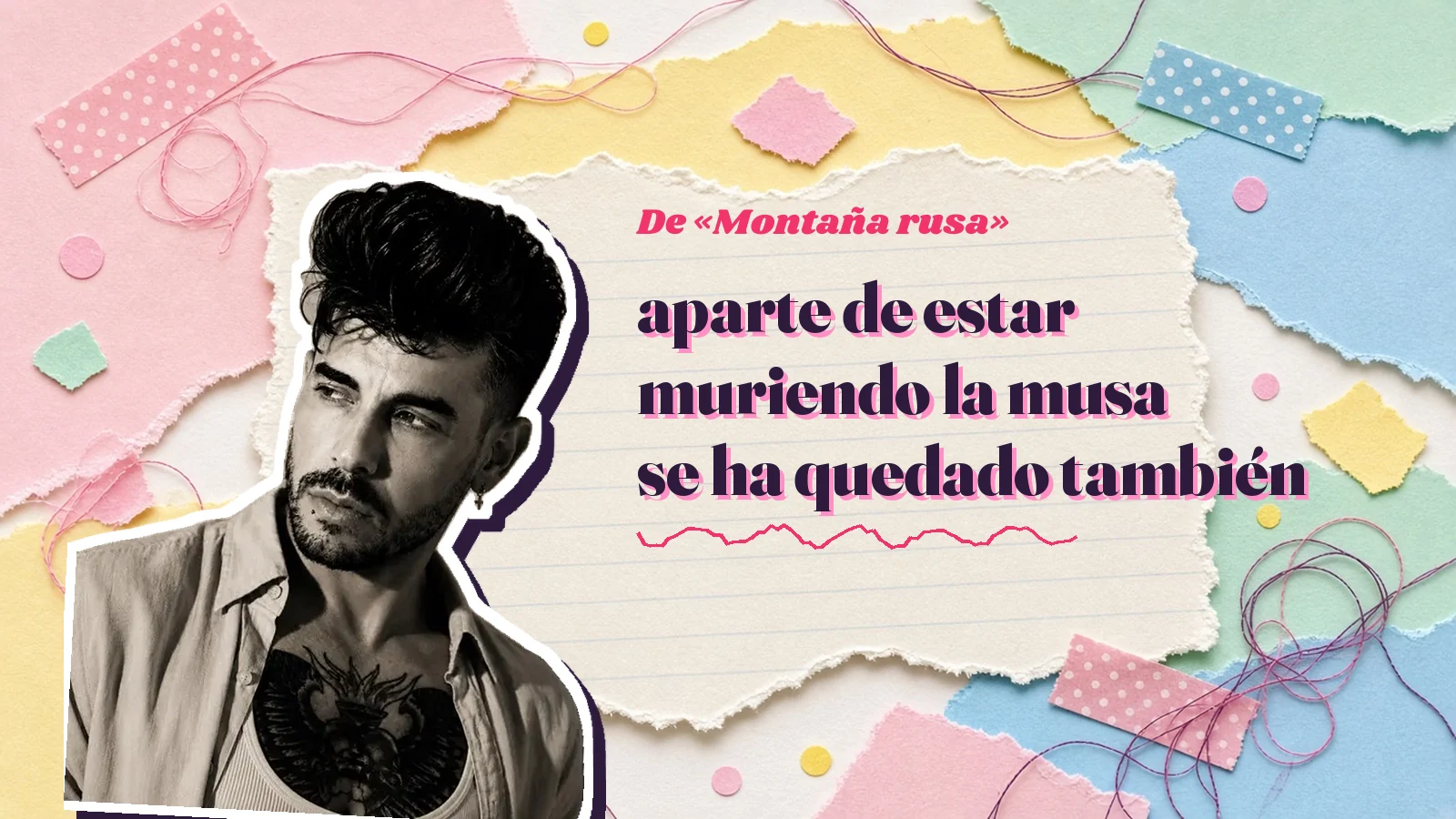
«aparte de estar muriendo la musa / se ha quedado también». "besides the muse dying / she's also gone".
Mute. The muse dies and, on top of that, she's struck dumb. It's one of those lines that makes you laugh and hurts at the same time. The song's page focuses on the formal usted, on "until three days ago" and on the mood swings of a rollercoaster day. Here I want to talk about the muse: what she is, why we fear losing her, and what happens when she really does go.
Nine sisters
The muse is one of the oldest ideas in Western culture. In Greek mythology there were nine, daughters of Zeus and Mnemosyne, the goddess of memory. Each looked after an art: epic poetry, history, love poetry, music, tragedy, hymns, dance, comedy, astronomy. Ancient poets opened their works by invoking them, asking them to speak through them.
I find it lovely that they were daughters of memory. As though inspiration were always born of remembering something. And I find it telling that they were goddesses, beings from outside. The whole idea of the muse is that inspiration doesn't belong to you. It comes from elsewhere, it visits, and it can leave.
Over the centuries the muse came down from Olympus and became flesh and blood. The poet's beloved, the painter's model, the composer's lover. Someone you look at, and from whom the work flows. Art history is full of lists of famous muses, nearly always women in the service of a man's work.
In my song the muse is a man, or so you'd gather, and so is the one who loses him. That already bends the tradition a little. But the fear is the same.
Flesh-and-blood muses
Twentieth-century art history is crowded with muses with full names. Gala, Dalí's wife, was so central to his work that he came to sign paintings with both their names together. Patti Smith told, in «Just Kids», of her bond with Robert Mapplethorpe, two young artists in New York inspiring each other, photographer and poet, lovers first and friends after.
The second model interests me far more than the first. In the tradition, the muse is passive: she poses, inspires, lets herself be looked at, and someone else makes the work. Gala, incidentally, was much more than that, a manager, a partner, the brains behind many decisions, and it's unfair to shrink her to a model. But the myth shrank her. With Smith and Mapplethorpe, on the other hand, inspiration ran both ways. Each was muse and artist at once.
I think in gay couples this often happens quite naturally, because there's no inherited script of roles. Nobody has written down who's the genius and who's the muse. It can be both, or neither. And when the relationship breaks, both lose something.
The writer's fear
The fear is this: that what you write depends on someone. That while they're around the words flow, and when they leave, they dry up.

It's a very understandable fear. When you're in love, everything seems worth telling. The colour of a shirt, a sentence said in the kitchen, a car journey. The whole of reality becomes charged with meaning. And writing is easy, because there's so much to say you don't know where to start.
When the relationship ends, the world discharges. Things go back to being just things. The shirt is a shirt. The kitchen, a kitchen. And you sit in front of the page and think: there's nothing left. The muse is dead.
The odd thing is that the world hasn't changed. The shirt is the same colour, the kitchen has the same light. What has changed is the way you look. And a way of looking can be retrained, however hard it is. You can learn again to see things with interest without anyone beside you to share them. It's slower, and at first it seems impossible, but it can be learnt.
The song catches that moment with a mixture of drama and humour I'm very fond of. The vowels stretched to infinity, the «muuuuusaaaa» that sounds like a hired mourner's wail, are a deliberate exaggeration. It's grief for the muse taken to operatic extremes. And precisely because it's overdone, you can see there's something true underneath.
Dead and dumb
I want to pause on the punchline: besides dying, she's gone mute.
Logically, it's absurd. If the muse is dead, how could she talk? But the line works because it isn't logical, it's emotional. It expresses a double loss. The muse dies, meaning the person leaves. And she goes mute, meaning she no longer says anything. No more messages, no replies, no explanations.
Anyone who's been through a break-up knows the other person's silence is one of the hardest parts. Worse than a row. Worse than a clean goodbye. They stop talking, and you're left with every question unanswered. Why. Since when. Whether it was ever true.
And for someone who writes, the muse's silence has a double meaning. The muse was the one who whispered the songs to you. If she's gone mute, she dictates nothing. You have to come up with the words alone.
The rhyme helps: musa, rusa, muda. Muse, Russian (as in the Russian mountain, Spanish for rollercoaster), mute. Three words that look alike, sound almost the same, and tell the story in three steps. The day is a rollercoaster, the muse dies, the muse goes mute.
Vowels that stretch
There's a formal detail I don't want to skip: how the lyric is written. It doesn't say «musa». It says «muuuuusaaaaaa». It doesn't say «montaña rusa» at the end of the chorus but «montaña ruuuuuuuuusaaaaaaaa». And the muse doesn't go «muda» but «muuuuuuuuuudaaaaaa».
Writing like that is a kind of score. The lyric doesn't only say which words go where, but how they're drawn out. It tells the listener, and anyone reading it on the site, that those vowels aren't pronounced, they're dragged.
In flamenco and copla that has a name: the quejío. That lament stretched over one syllable, neither word nor scream but something in between. The quejío expresses what words can't reach. When grief is too big to say, you lengthen a vowel until the air runs out.
In «Montaña rusa», the quejío sits on words that are, at the same time, a little comic. Stretching «rusa» to infinity is funny. Stretching «muda», which is exactly the word for silence, is funnier still. It's a lament that laughs at itself a bit while it laments. And that, I think, is the song's exact temperature: real grief, told with the volume turned up to excess.
What if the muse was me?
There's another reading of the song I want to note down.
The narrator mourns his muse. But he also says, at the heart of the lyric, that he wanted it and the other didn't. In other words, the love was lopsided. He loved. The other, at most, let himself be loved.
In a relationship like that, who was whose muse? The one who loves a lot tends to be the one who looks, who writes, who's inspired. The one who loves little tends to be the one who poses. So the muse, in this story, was the one who cared less. And perhaps that's why he went mute so quickly: he never had much to say.
That reading comforts me, honestly. Because if the muse was the one who cared less, losing him isn't losing the source of the songs. It's losing a mirror you used to look into. The source was in the one who loved, the one who wrote. And he's still here.
The muse trap
Now I want to say something the song doesn't say, but that follows from it.
The idea that inspiration depends on someone is a trap. A romantic, beautiful, very literary trap, but a trap all the same. Because if your capacity to create depends on another person, that person holds enormous power over you. If they leave, they leave you jobless, wordless, with nothing to say. And that, besides being unfair on you, is an unfair weight on them, who never asked to be the engine of your work.
And besides, it isn't true. The proof is in the song itself. «Montaña rusa» is a song written about the death of the muse. That is: the muse has died, gone mute, and a song came out anyway. The loss itself became material.
This happens constantly in music history. Some of the best love songs were written after the love had ended. Some of the finest albums are break-up albums. The dead muse inspires as much as the living one, or more. Sometimes more, because pain has an intensity happiness lacks.
So the fear of losing your inspiration along with the person is, nearly always, unfounded. What you lose is one kind of inspiration, the infatuated kind. But another arrives, the kind that comes with grief. And later, in time, others still.
Where songs come from
Which brings me to a question I find fascinating: where songs come from.
The romantic answer would be: from muses, from the people we love, from life's great events. The real answer, in my case, is far more varied and far less glamorous. They come from phrases I overhear in the street. From words that tickle me. From news stories, memes, bar conversations. From the nosy neighbour on the landing. From the telly. From rage at something I've read. From boredom. From everything.
I've written songs about a launderette, about the nutritional make-up of an egg, about a fan spraying shit everywhere. None of that has a muse. Or perhaps it does: the muse is ordinary life, which never dies and never goes mute. I talk about where and how I jot all that down in where I write: notebooks, phone and audio memos, and about what I've learnt filling notebooks in my lyric notebook.
When your sources are so many, losing one doesn't leave you dry. It hurts, of course. But you've still got somewhere to drink from.
Craft versus inspiration
There's a line attributed to Picasso that goes something like: inspiration exists, but it has to find you working. I don't know whether he said it exactly that way, because famous quotes travel a lot and change on the road, but the idea strikes me as spot on.

Inspiration, the muse, the magic moment when the words come by themselves, does exist. But you can't depend on it. If you only write when the muse calls, you'll write very little. What sustains a creative life over the long haul is craft: sitting down every day, even when you don't feel like it, even when nothing good comes, even when the muse is dead and dumb.
I've been releasing songs regularly for years, and consistency has taught me more than any muse. I tell that story in two years of releasing singles and music videos. Not every day produces good things. Plenty of days produce things that have to be binned, and I've written about that too, about discarding, in the craft of discarding. But the habit means that when the muse comes back, or a new one turns up, I'm ready.
The rollercoaster
The title and chorus talk about a rollercoaster day. A day of ups and downs, where you wake up fine and by noon you're in tears, where everything's going well until something reminds you.
That image is perfect for grief, and for creating on grieving days too. There are stretches when you write with an ease that startles you, because the pain hands you words. And stretches when you can't even look at the notebook. The rollercoaster gives no warning. It climbs and drops at its own pace.
What I like about the rollercoaster as a metaphor is that, despite the fear, it's a ride. People pay to get on. They scream, grip the bar, shut their eyes, and at the bottom they want another go. There's something in the emotional jolt that, seen from outside, has its charm. And the song treats it that way: as a terrible day that's also almost fun, it's so over the top.
Holding it in all day
Another thing the lyric says is that the narrator tries to hold himself together at all hours. He doesn't want to cry, he tries to avoid it, he bites it back. And he can't.
This has to do with creating too. Some people think writing about a break-up is a way of not holding back, of letting go. And it is, but only partly. Because writing a song demands form, rhythm, rhyme, structure. It demands containing the emotion within a mould. A song isn't a sob. It's a sob with metre.
That's why I think writing helps so much in times of loss. Not because it lets you vent without limit, but because it forces you to give shape to what you feel. And once it has shape, you can look at it from outside. What was chaos becomes a chorus. And a chorus can be repeated, hummed in the shower, murmured on the Tube, until it stops hurting.
On crying and permission to cry I've got a whole song, «Llorar» ("To cry"). «Montaña rusa» is its cousin: here there's crying too, but while trying not to.
*Usted*, the muse
One more detail about the usted, the formal "you", which the song's page already covers but which I want to read from another angle.

The narrator addresses the one who broke his heart as usted. And if that person was his muse, the usted takes on an extra meaning. In the tradition, muses were invoked with respect, with solemnity. Tell me, O Muse. Addressing them formally is, in a sense, putting them back in their place as distant goddesses.
But it's also the opposite: it evicts them from the intimate place. The living muse got the familiar tú; you had her in your bed. The dead muse gets usted, like a stranger. The pronoun marks the distance between what was and what is. And in that distance you can finally write.
Another loss, another tone
In my catalogue there's another song about the end of a long relationship that I like to set beside this one: «París restera gris» ("Paris will stay grey"). Both are about the same thing, what remains when someone who filled everything leaves. But they go about it in opposite tones.
«Montaña rusa» is loud, overblown, all stretched vowels and tears that won't be held. It's grief while it's hot, the first days, when everything climbs and drops. «París restera gris» is the opposite: its own text calls it an elegant sadness, the exact point where love stops hurting but still weighs. It's grief gone cold, long afterwards.
I put them together because I think they tell two phases of the same thing. In the first, the muse dies and you scream. In the second, the muse is long dead and you stroll silently through a city you never visited with him. Both phases make songs. Different ones, but songs.
And that backs up what I said earlier. If such different songs can come from the same loss, then loss doesn't dry up the source. It changes its colour. Red first, then grey. But it keeps flowing.
Muses come back to life
The song's page ends with a line I stand by: muses die a lot, but they also rise again.
Sometimes the same one rises, as a memory, years later, when it no longer hurts and you can write about him tenderly. Sometimes a new one appears, another person, another love, who charges the world with meaning again. And sometimes the resurrected muse isn't a person at all, but a city, a dog, a friend, a cause, a rage.
The important thing is not to confuse the death of a muse with the death of your ability to create. They're different things. The first happens many times in a life. The second, if you keep working, almost never.
A piece of advice, if I may
If you're reading this because the person who inspired you has gone and you've spent weeks not writing, painting or composing, let me tell you what I'd tell myself.
Write about that. About the dead muse. About what won't come. About the blank notebook. About wanting to cry and trying to hold it in. Even if it comes out badly, even if it's overdone, even if you stretch the vowels like a hired mourner. Loss is a subject. And it's yours.
Then, once you've written that, look around. Ordinary life is still there, with its bar-room phrases, its neighbours, its absurd news. Grab anything. Write a song about an egg if you must. The great muse is dead, but the little muses are everywhere, and not one of them goes mute.
Frequently asked questions
What is «Montaña rusa» about? A day of ups and downs after a break-up, when the narrator cries despite himself because, unlike the other man, he really did want it. The full lyric is at gayfolkplanet.com/letras.
What does it mean that the muse dies and goes mute? That inspiration seems to leave along with the loved one, and that the other person also stops talking. It's a double loss told with humour.
Can you keep creating after losing your muse? The song itself proves you can: it's written precisely about that loss.
Who makes the song? Mike Sain't Louis writes the lyric, composes and produces. The music and vocals are made with artificial intelligence.