By Mike Sain't Louis ·
Flames of another colour: «Green Fire», the green bonfire, the night-time western and Wilde's carnation
Anyone who has made a bonfire knows what colour fire is. Orange, yellow, red in the embers, a bit of blue at the base if you look closely. It's one of those facts nobody has to teach: we learn it as children, watching a fireplace or a birthday candle. That's why green fire causes a small short circuit. The brain recognises it as fire and, at the same time, knows something doesn't add up.
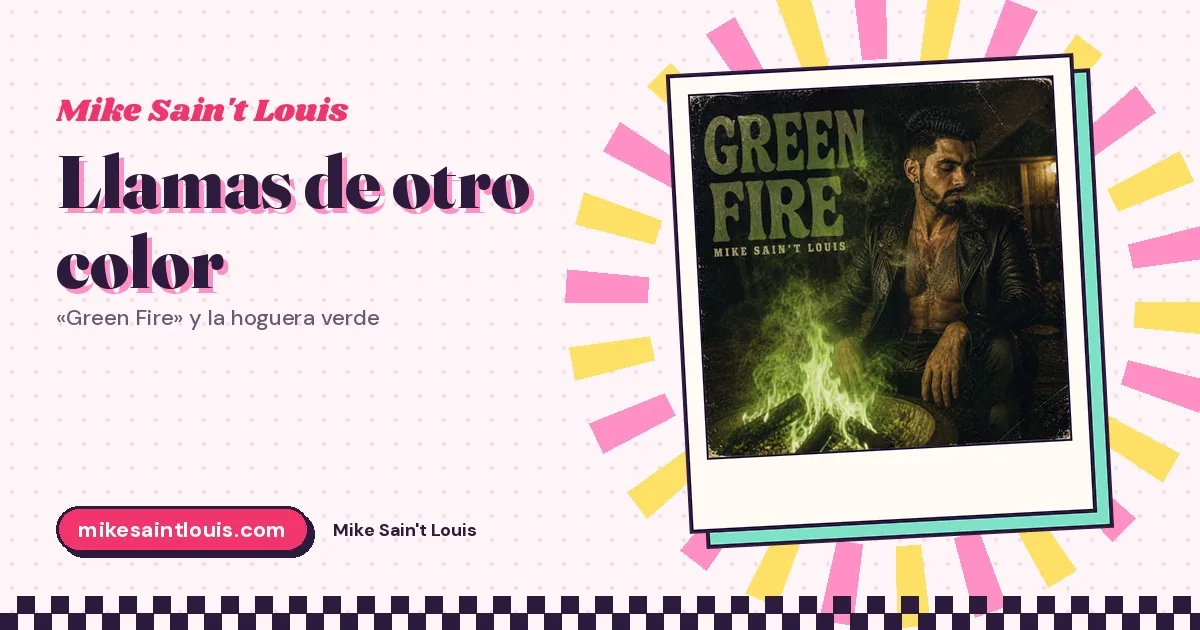
That short circuit is at the heart of the cover of «Green Fire». I wrote it on the song page in a few words I'll repeat here: the flames are green. Not orange, not red. Green.
A cabin, a bonfire and a guy in leather
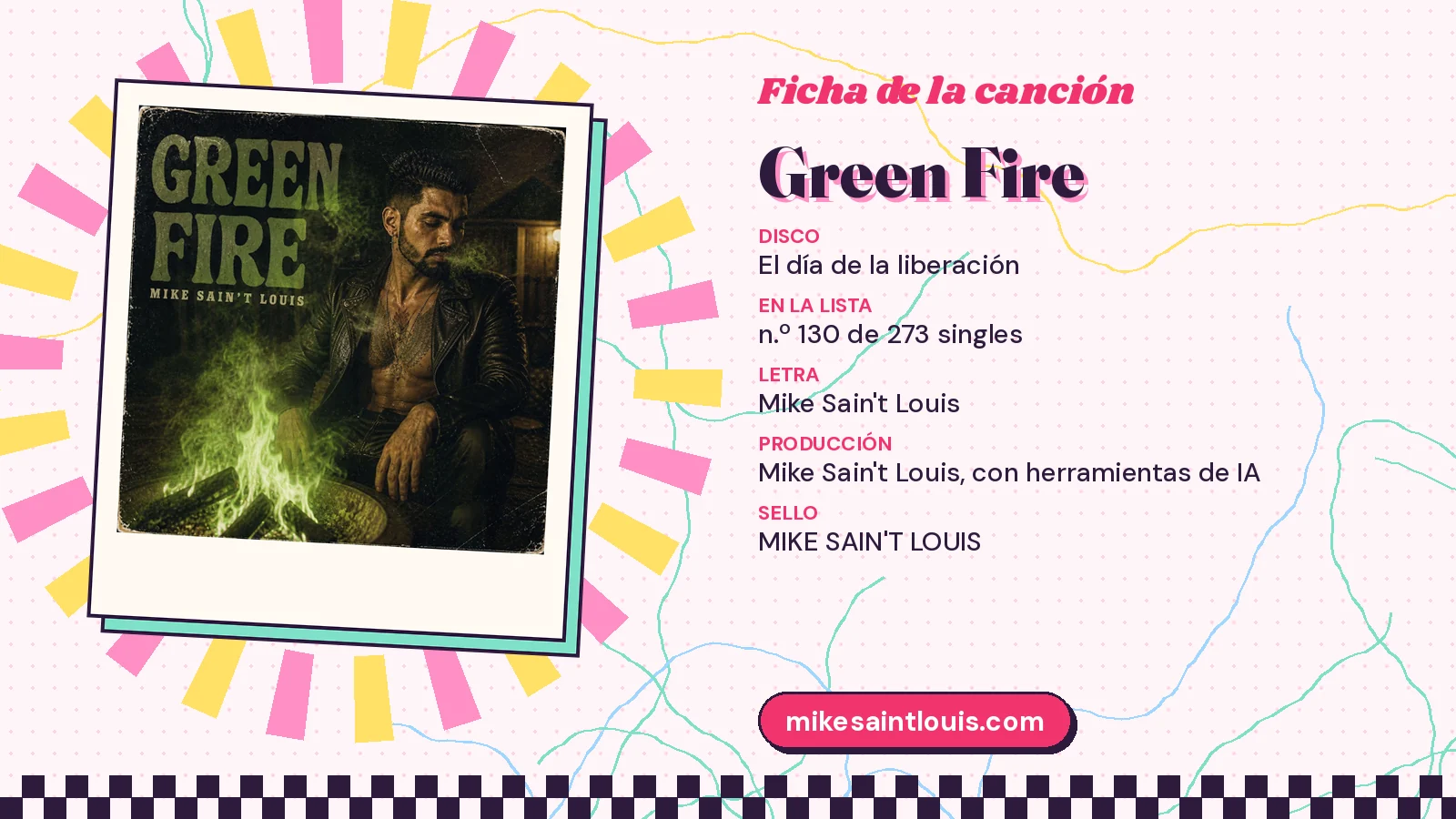
The scene is at night. In the background, on the right, you can make out a wooden cabin with its porch lit by a single warm bulb, the kind left on so whoever comes back can find the way. Behind it, the dark outline of trees. The rest is night.
In the foreground, bottom left, a round metal fire pit with a few thick logs piled up. Out of them come flames of an intense, almost fluorescent green, lighting everything near them from below and giving off a greenish smoke that curls upwards.
Next to the fire, sitting and leaning slightly towards it, is a guy in a black leather jacket open over his bare torso. Short hair with a small quiff, a well-kept beard and several thin necklaces. His chest is covered in tattoos. One hand rests on his knee and the other near the fire pit. His eyes are half closed. And from his mouth comes a puff of white smoke that mixes with the green of the fire.
Top left, the title in thick capitals, a faded green with a worn texture, like an old film poster. Below it, my name. The whole image has scratches and damaged edges, like a photo that has spent decades in a drawer.
What I'm not going to tell
A necessary warning. I haven't published the lyrics to «Green Fire» yet. You won't find them in the lyrics section of this site, and so there are no lines from the song here: not copied, not guessed, not taken from the automatic captions video platforms generate, which cheerfully get things wrong when there's music underneath.
This text stands on what is in plain sight. The cover. A two-word English title. The video, which arrived on my YouTube channel on 12 June 2026. The album it lives on. And what I said on the song page: that the image has something of a night-time western and something of a ritual, that green fire has always been a matter of witchcraft, and that the title can be read as magic, as a plant burning slowly or as a desire that isn't the usual colour. Better that the cover doesn't make clear which, I wrote. I still think so.
Why fire turns green
Chemistry has a very concrete answer. The colour of a flame depends on what's burning and what's in it. Ordinary wood gives that familiar orange because carbon particles, when heated, glow in warm tones. But if certain elements are in the flame, their atoms absorb energy and give it back as light of a very precise colour, like a signature.
It's called a flame test, and it's one of the loveliest experiments in any school lab. Sodium tints fire an intense yellow. Lithium and strontium, red. Potassium, a pale lilac. And green comes above all from copper, which produces a bluish green, from boron, for example as boric acid dissolved in alcohol, which gives a bright green, and from barium, which leans towards yellowish green.
The green fireworks we see at summer fiestas usually contain barium salts. So the bonfire on the cover isn't entirely impossible. It's simply a fire someone has thrown something into. Which, if you think about it, is a very good description of almost any desire.
Will-o'-the-wisps
Long before chemistry explained anything, people were already seeing greenish lights where there shouldn't be any. In marshes, cemeteries and crossroads, at night, small pale flames would sometimes appear, floating above the ground and going out when you got close. In Spanish they were called fuegos fatuos, from the Latin ignis fatuus, foolish or deceptive fire.
Popular tradition took them for souls in torment, spirits leading travellers into danger or signs of buried treasure. Today the most accepted explanation is less romantic: gases produced as organic matter decomposes, such as phosphine and methane, which can ignite on their own on contact with air. Even so, they still aren't fully studied, because they're rare and hard to observe.
I like that the Spanish name is so harsh. Fuego fatuo: the conceited fire, the one that promises and doesn't deliver. Some loves are like that.
Witches, potions and the emerald city
Green has been linked for centuries to what can't be explained. Potions in fairy tales bubble green. Witches in films have green skin. And that last one, by the way, has a date.
The green-skinned witch we all have in our heads was born largely with «The Wizard of Oz», the 1939 film, which used Technicolor to paint the Wicked Witch of the West, played by Margaret Hamilton, green. In L. Frank Baum's book, from 1900, the city was the Emerald City, and its inhabitants wore green spectacles by order of the wizard.
That film also has a very special place in gay culture. Judy Garland, the film's Dorothy, became an icon for generations of gay men, to the point that in the United States the expression «friend of Dorothy» worked for decades as a discreet password to ask whether someone was gay. And in 1995, the writer Gregory Maguire published «Wicked», which told the story from the point of view of the green witch, the one everyone hated for being different. The Broadway musical arrived in 2003 and the films from 2024.
I talked about Oz as one of those places that don't exist yet and look so much like planet Gayfolk in another post.
Oscar Wilde's carnation
But if there's one green that really moves me, it's a carnation's. On 20 February 1892, Oscar Wilde's «Lady Windermere's Fan» opened in London. The story goes that the author asked several friends to come to the premiere with a carnation dyed green in their buttonhole, like the one worn by one of the actors on stage. Nobody really knew what it meant, and that was probably the point.
Two years later, in 1894, Robert Hichens published a satirical novel called precisely «The Green Carnation», with two very recognisable characters inspired by Wilde and his young lover, Lord Alfred Douglas. From then on, that flower was forever tied to men who loved other men in Victorian England. In 1895, Wilde was tried and sentenced to two years' hard labour for gross indecency. He left prison ruined and died in Paris in 1900.
A green carnation, like a green bonfire, is a flower or a fire that isn't the colour it should be. That's why I so enjoyed writing on the song page that the title could be «a desire that isn't the usual colour». There was a time when that desire had to hide behind a dyed flower. I've written about those who risked wearing it in my tribute to queer memory.
Green with envy, green with hope
Green is a colour with many faces. We say someone turns green with envy, and Shakespeare called jealousy «the green-eyed monster» in «Othello», written at the start of the seventeenth century. In Spanish, poner verde someone means badmouthing them behind their back. And yet green is the colour of hope, of the traffic light that lets you through, of spring.
The bonfire in «Green Fire» can be read with any of those faces. A fire of envy, of jealousy burning slowly. A fire of hope, giving light in the middle of the night. Or, as I left open on the song page, something that burns and doesn't need naming.
The rumba on the same album
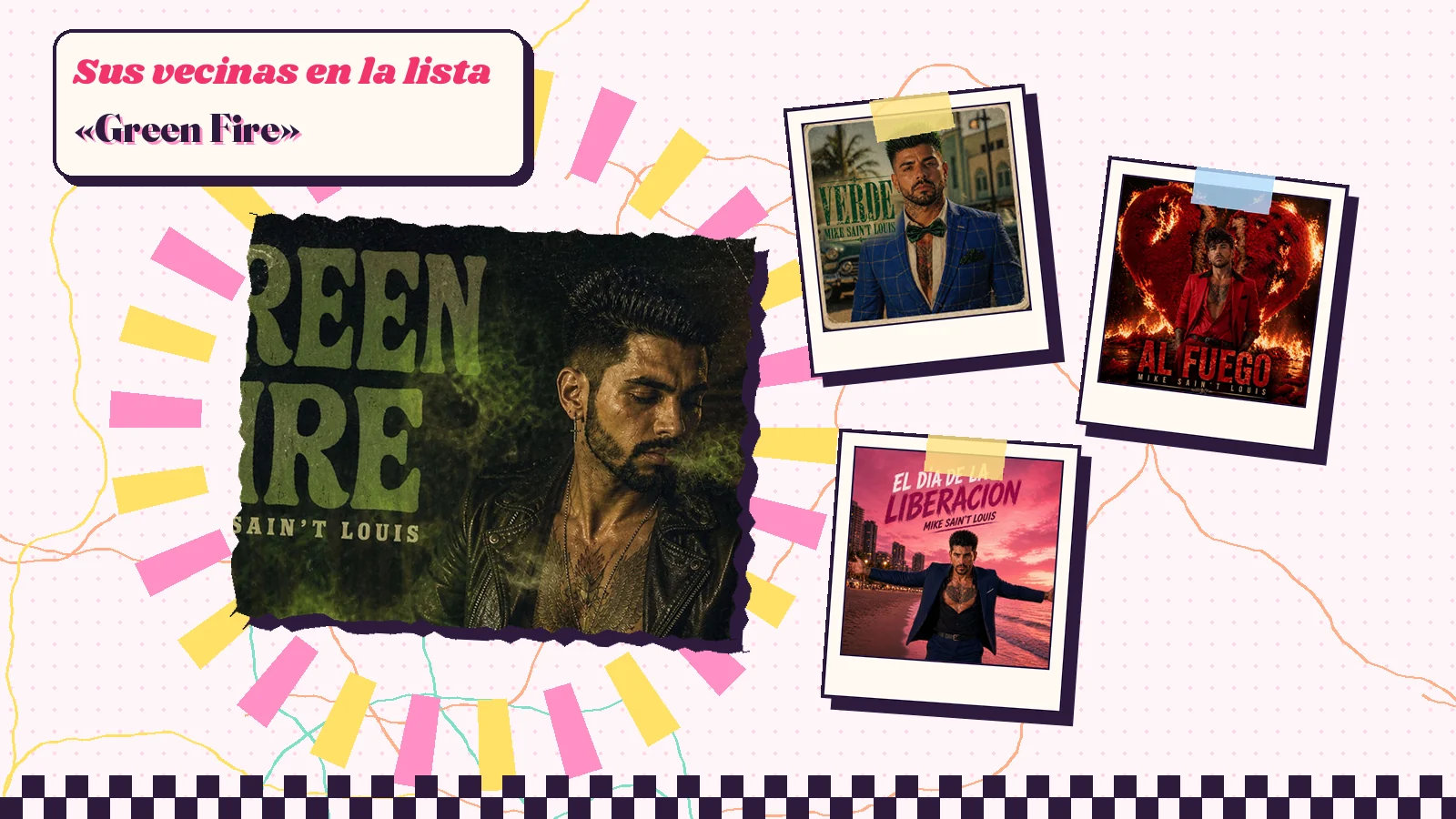
On the same album there's a song that does have published lyrics and is called, simply, «Verde». It's a rumba that borrows Lorca's famous line, «verde que te quiero verde» ("green, how I love you green"), from the «Romance sonámbulo» in his «Romancero gitano» of 1928, and takes it to a town-square party with guitars and clapping. I wrote about how I dared to steal a line from Lorca in a post of its own.
There's a line in those lyrics that could be the caption to this cover, even though it isn't from this song: «Guitarras y cajones, la noche se enciende» ("Guitars and cajóns, the night lights up"). I quote it exactly as published. «Green Fire» is something else, quieter, more countryside than town square. But the two share a colour and share a night.
A western at night
On the song page I said the image had something of a night-time western, and I think it's down to the combination of three things: the wooden cabin, the open fire and a man alone in a leather jacket. They're the ingredients of so many cowboy films in which, as night falls, the characters sit round a fire to talk about what isn't said by day.
It's impossible not to think of «Brokeback Mountain». Annie Proulx's story was published in The New Yorker in October 1997, and Ang Lee's 2005 film won the Golden Lion in Venice and earned its director the Oscar. Ennis and Jack, two shepherds in the mountains of Wyoming, fall in love among campfires, tents and coffee pots on the flames, and spend twenty years unable to live it in daylight.
The campfire, in that story, is the only place where things can be what they are. My cover doesn't tell that story, nor does the song have to. But the fire, the night, the cabin and a guy alone watching the flames have that air.
The porch light
There's a small detail at the back of the cover that's easy to miss and that seems to me almost as important as the bonfire: the bulb lit on the cabin's porch. It's the only light in the image that isn't green. A yellow, warm, homely light.
Leaving a light on for someone is one of the oldest gestures of hospitality. Country houses left one in the window so whoever came back at night could find the way. Lighthouses hold it over the sea so ships don't crash. And an American motel chain turned the idea into an advertising slogan in the mid-eighties, with a radio ad that ended by promising to leave the light on for you.
On the cover, that bulb creates two worlds. On one side, the green fire, strange, nocturnal, a little dangerous. On the other, the house, the place to return to when the embers die. The guy is in between, closer to the fire than to the door. He hasn't decided yet whether to go in.
I like to think that light is on for him. That someone inside is waiting for him, or that he left it that way himself so as not to get lost on the way back. Either is a form of care. And in an image so loaded with mystery, that point of ordinary light is what makes it liveable.
There are nights when you need both things at once: a fire unlike any other and a plain old bulb waiting on the porch.
The leather jacket
The black leather jacket over a bare chest is another code with a lot of history. It became the rebel's uniform in the fifties, with Marlon Brando on a motorbike in «The Wild One», from 1953. Very soon after, gay culture made it its own. The first leather clubs for gay men appeared in the United States that same decade, and the Finnish artist Touko Laaksonen, known as Tom of Finland, turned the muscular man in a leather jacket and cap into one of the most recognisable images of twentieth-century gay desire.
What used to be a tough guy's uniform also became a way of laughing at textbook masculinity, by taking it to excess. The guy on my cover wears it open, no T-shirt, with thin necklaces and tattoos. It's leather, but without stiffness. More countryside bonfire than dark bar.
The puff of smoke
There's a detail that gives a lot to talk about: the puff of smoke coming out of the guy's mouth. It could be breath on a cold night, it could be smoke from the fire itself that he's swallowed by accident, or it could be what everyone imagines. On the song page I didn't hide it: green fire can be the plant burning slowly.
I'm not going to say more than the image says. I'll just recall, as I did in the post on «Feel That High», that the best nights in the countryside need nothing more than the people you share them with. And that if one day you notice you need something to feel calm round a fire, it's worth asking yourself why and talking about it with someone.
Stories round the fire
There's a tradition as old as fire itself: telling stories around it. Anthropologists such as Polly Wiessner, who spent years studying the Ju/'hoansi of the Kalahari Desert, observed that daytime conversations and night-time ones by the fire were very different. By day people talked mostly about practical matters, complaints and gossip. At night, by the fire, stories dominated: tales of absent people, of ancestors, of what happened once. She published it in 2014 in the journal of the US National Academy of Sciences.
I find that a beautiful fact. For thousands of years, the fire has been the place where the things that don't fit in the day get told. Scary stories too, of course, the campfire kind told with a torch under your chin. I wrote about why I talk about heartbreak through horror films in a post about fangs and vampires.
On the song page I recommended «Green Fire» for those nights in the countryside when the group stays round the fire until the embers go out and nobody wants to be the first to go to bed. That's exactly it: the moment for stories.
A fire pit yes, the woods no
A practical note, because this site is also read by people who go camping. In Spain, lighting fires in the countryside is heavily restricted, especially in the hottest season, and each autonomous community has its own rules and ban periods. A badly put-out campfire can become a forest fire in minutes.
So the night round the fire is better in an equipped recreation area, in a fire pit like the one on the cover or in a fireplace. And before going to bed, embers completely out with water and earth. The stories can carry on inside the cabin.
Another fire from the same summer
«Green Fire» isn't the only cover from that 12 June to put fire at the centre. That same day I uploaded «Light It Up», with a tattooed angel walking along a beach at sunset while one wing burns. There the fire was orange, sunset fire, Saint John's Eve fire. Here it's green, forest fire, midnight fire.
And earlier, at another time, I wrote «Al fuego» ("Into the fire"), where the bonfire served to get rid of what an ex had left behind. Three very different fires. One to burn memories, another to light yourself up and another to sit and watch without saying anything.
The last album of the trilogy
«Green Fire» is number 130 of the 273 singles in the gayfolkplanet.com list and belongs to «El día de la liberación» ("Liberation Day"), the third Gayfolk album. It's the album about letting go, breaking with what held you down.
It seems a good place for a bonfire. In many cultures, fire is the element of transformation: whatever goes into it comes out as something else. And a liberation, in the end, is that too. Not going back to being what you were.
When the night gets long
Nights by the fire are usually good, but not every night is. If you spend many of them awake turning things over, if you feel low for weeks or feel nobody would understand you, tell someone: a friend, your doctor or a mental health professional.
And if the thought of taking your life or hurting yourself ever appears, 024 is there for exactly that: it's Spain's suicidal behaviour helpline, free and available twenty-four hours a day. If you're in immediate danger, dial 112. If you live in another country, contact your local emergency services or check findahelpline.com to find a line near you.
I gathered numbers and reading in the mental health without taboo series.
For the last ember
I imagine it playing on a night in the countryside, jacket on because it's getting chilly. For whoever is always the last to go to bed. For whoever has a story they only tell when the fire is low and faces can barely be seen.
For whoever wants something that isn't the usual colour and no longer hides it behind a flower. For whoever has seen «Brokeback Mountain» more times than they admit. And for whoever knows there are fires you don't put out with water, but by talking.
Frequently asked questions
What is «Green Fire» about?
The lyrics aren't published yet, so I don't summarise or invent them. The cover shows a guy in a leather jacket next to a bonfire with green flames, at night, in front of a cabin. On the song page I left several readings of the title open: magic, a plant or a different kind of desire.
Does green fire really exist?
Yes. Flames turn green when they burn with compounds of copper, boron or barium. It's what you see in lab flame tests and in some fireworks.
Which album is it on?
«El día de la liberación», the third album of the Gayfolk trilogy. The video has been on YouTube since 12 June 2026.
What does it have to do with Oscar Wilde?
Nothing in the song that I can state without lyrics. The post recalls the green carnation Wilde and his friends wore in 1892 because it's another green that wasn't the expected colour, like the bonfire on the cover.
Who makes the music and the vocals?
Mike Sain't Louis, a lyricist, composer and music producer from Madrid, the first AI songwriter. He writes, composes and produces; the vocals are created with artificial intelligence.