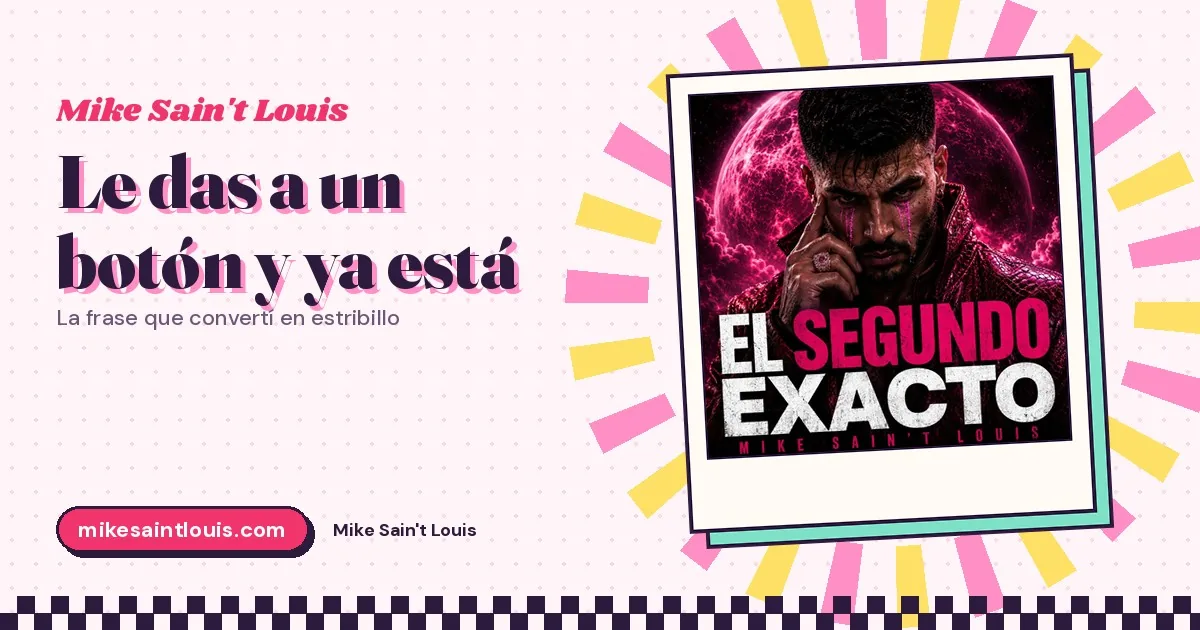
By Mike Sain't Louis ·
«You just press a button and that's it»: the line I turned into a chorus
"That's artificial intelligence, you just press a button and that's it." People have written it under my videos so many times that I know it by heart, and when nobody writes it I repeat it to myself at three in the morning, which is when it stings most. So I did the only sensible thing you can do with a line that haunts you: I paid its rent and moved it into a song.
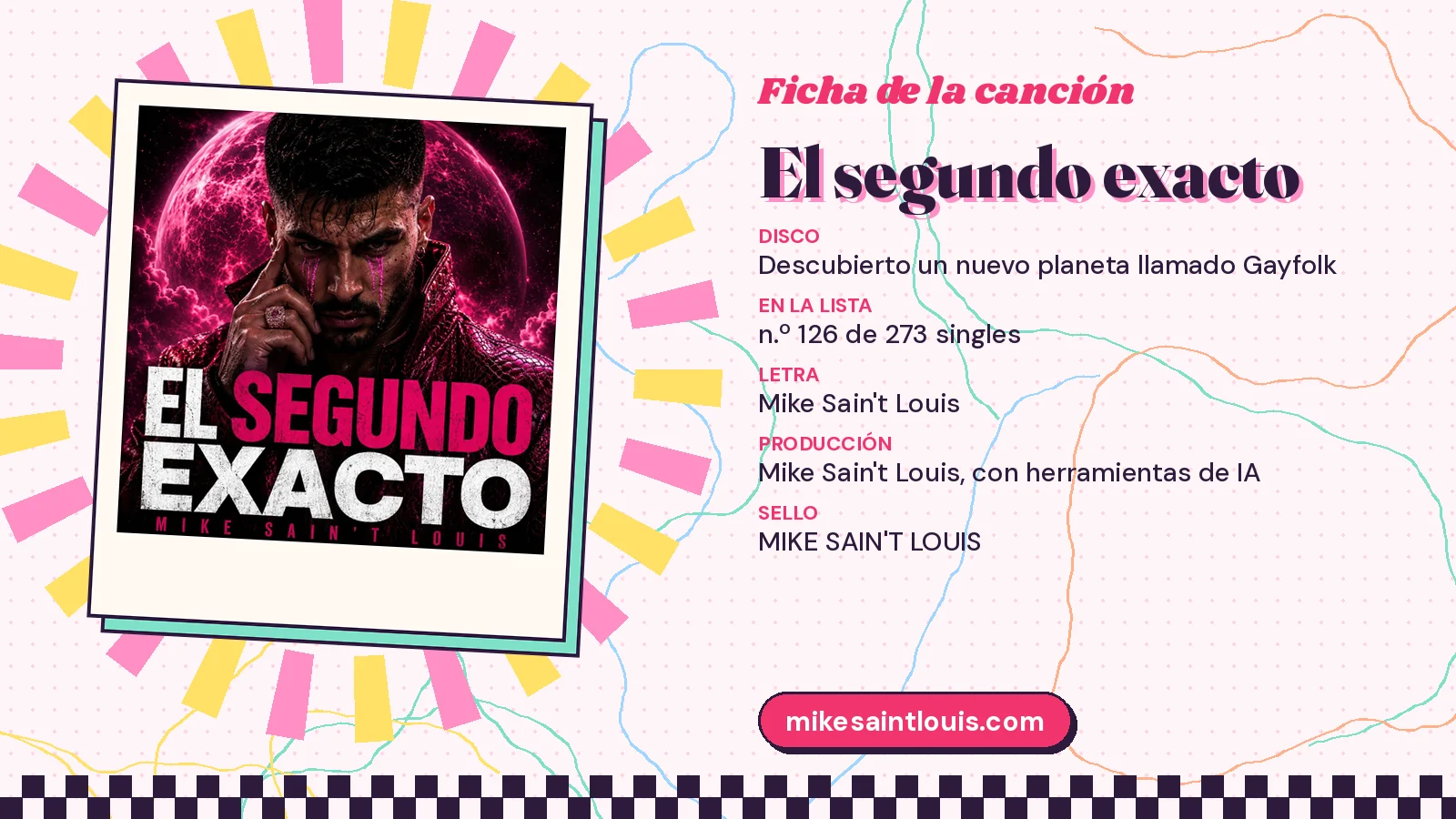
The song is «El segundo exacto» ("The exact second") and it's on the first album of the trilogy, «Descubierto un nuevo planeta llamado GAYFOLK». On the complete Planeta Gayfolk singles list it sits at number 126 of 273. It opens with the other person's mockery, word for word, as if I were the notary of my own haters.
On the song's own page I've already gone through what the lyric says from start to finish. Here I want to do something else, more workshop and more spite: take the button line and dismantle it piece by piece, like someone taking apart an IKEA wardrobe to find where the spare screw was meant to go. Because every word in that sentence has a catch. And every catch gave me a line.
That
I'll start with the smallest word, which is the one that annoys me most.
"That." Not "your song", not "what you do", not even "that music". That. The pronoun you use for the chewing gum stuck under the table, for whatever smells funny in the fridge, for things that don't deserve a name. Whoever says that's artificial intelligence has already decided there's nobody there. No person from Madrid with a notebook, his chihuahuas and enough exes to fill three albums. Just an object.
What makes me laugh, and I mean really laugh, is that the sentence contradicts itself. If "that" has no author, who are they saying it to? Nobody writes a comment to a toaster. They write it to you, with your name and your photo on top. So they do know there's somebody. It just suits them that there isn't.
That's why the lyric repeats the line so many times. I didn't put it in once so I could answer it; I made it the chorus. I let it play out in full, with its question about what I get out of doing that and its parting shot that it doesn't even make me any money, so you could hear it for what it is: a broken record. When a criticism repeats itself identically a thousand times, it stops being an opinion and becomes a tic, and tics, put on a loop, are funny.
I laugh. Sometimes late. But I laugh.
Artificial intelligence
On to the diagnosis. Here the line is right and I've no intention of denying it: the music of Planeta Gayfolk is produced with artificial intelligence. The vocals you hear and the arrangements come from tools such as Suno, which I direct. I say so on the website, I say so in interviews, I say so on my About Mike page, and I introduce myself as "the first AI songwriter", in inverted commas, like someone pinning a badge to their lapel so nobody has to guess.
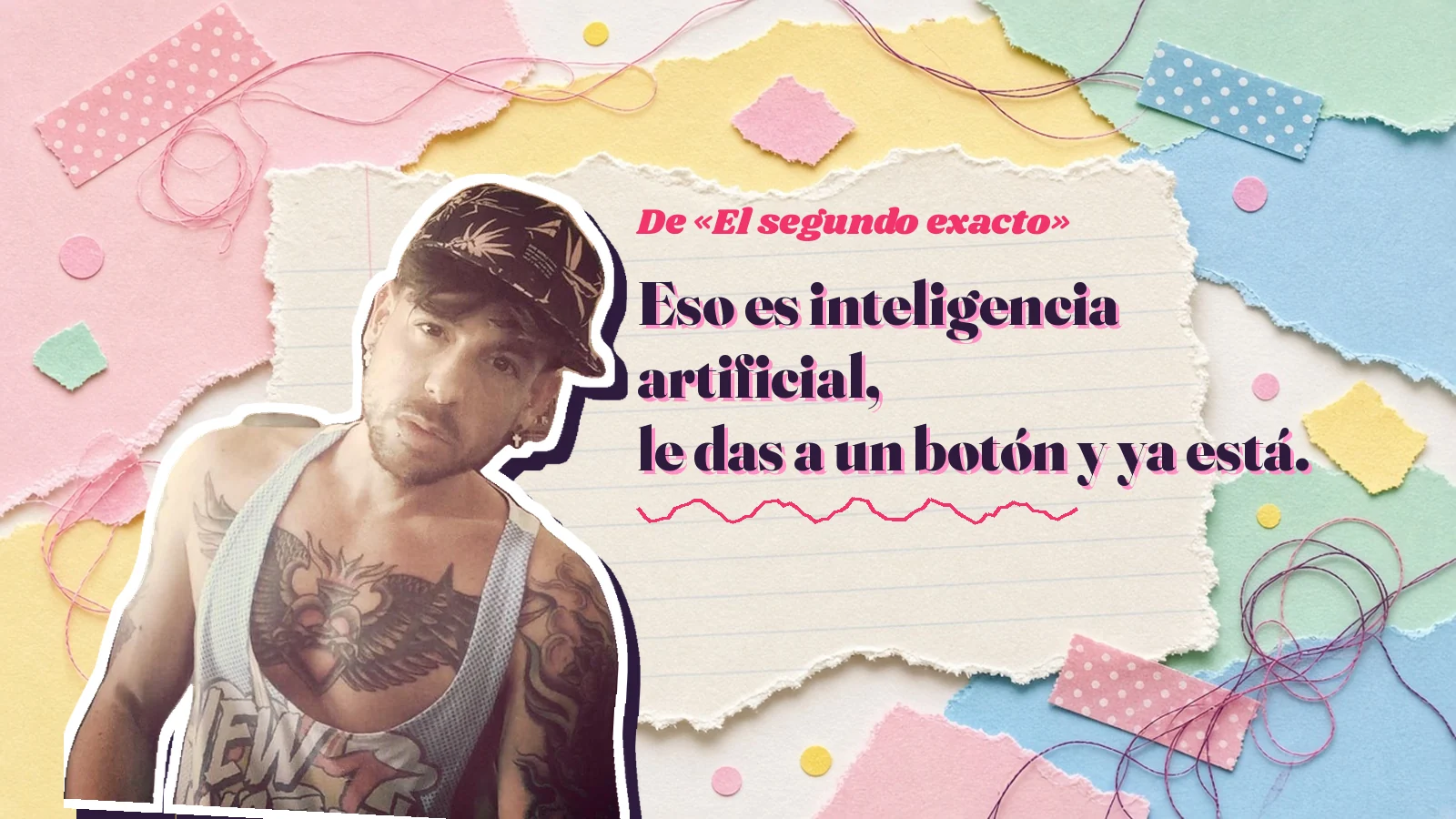
What the line doesn't say is the other part. The lyrics are mine. All of them. No AI. Every «mariposón» and every «cordial saludo» came out of my head and my fingers, spelling mistakes and market-stall rhymes included. In the song itself I wrote it down in a line that's almost a business card: artificial intelligence, yes, and next to it a real heart.
I like that line because it doesn't argue. It doesn't say "liar, it isn't AI". It says: yes, and also. It's like when your mother catches you with a boyfriend she doesn't like and you answer "yes, Mum, and he's from Albacete, too". You don't deny the fact. You add the one that matters.
Some people think admitting the tool means losing the argument. For me it's the other way round. Since I started talking about it shamelessly, the button comment has lost its punch, because it no longer exposes anything. They turn up with their big revelation and find the door wide open and the sign already up. It's like shouting "that's a drag queen!" at a drag gala. Well, of course, darling. Come in and sit down.
You press
This is where my blood starts to boil, so I'll write it slowly so as not to get nasty.
"You press." Second person, a one-gesture verb. Like flicking a light switch or calling a lift. The line takes for granted that the work is a single movement of the index finger and done.
If only. I said it in another article and I'll repeat it with all the irony I can muster: AI doesn't save me work, it moves it somewhere else. Before any version worth keeping exists, there's a lyric I've written, crossed out and rewritten. After that there's a batch of attempts I listen to and throw away. Then another. And another. Some songs stay in the drawer because no version gets the joke, and a joke with the stress in the wrong place is a dead joke. I went into it more calmly in the craft of discarding, which is the part of my job that never makes it into a music video.
And then there's everything around it: the cover, the title, the video, the web page, the order each single comes out in. Two hundred and seventy-three singles in about two years, more than two hundred and eighty music videos. If that's "pressing", let someone come and press with me on a Tuesday; I'll buy them a vending-machine coffee and show them the folder of rejects.
But I don't want to play the martyr, it doesn't suit me at all. Plenty of people who say "you press" don't say it out of hate. They say it because they don't know. It's for them that I wrote the song with humour rather than a treatise: mockery travels further than explanation. Long explanations, I've learnt, nobody reads.
A button
The button. The famous button. I've been hearing about it for two years and I still haven't found it.
I picture it red and huge, like the ones on game shows, the good old TV game shows. You press it and out comes a whole song about your Canarian ex, chorus, rhyme and Carmina Barrios joke included. If anyone finds it, please courier it to me in Madrid. I'll pay the postage.
The button is a very comfortable fantasy, and I understand the appeal. If everything is a button, nobody has to ask themselves why one song makes them laugh and another leaves them cold. No judgement, no taste, no craft: just machine luck. And machine luck doesn't have to be respected.
The trouble is that the button doesn't write a otra cosa mariposa. The button doesn't know that in Madrid «mariposón» is said with a half-smile and a raised eyebrow, or that after an insult like that a cordial greeting to the champ works a treat, like the sign-off of a bank email. That's mine. That swerve from the tacky to the bureaucratic, from the street fiesta to the office, is my way of hitting back. With a flourish.
«A otra cosa mariposa, a otra cosa mariposón, señor de León, recibe un cordial saludo campeón.»
(Moving on, butterfly, moving on, big old queen, Mr de León, kind regards, champ.)
That's my favourite line in the whole lyric, and the one that has least to do with technology. It's pure bar-counter talk. It's what I'd say to someone in the Mercadona queue if they came at me with that story. All I did was put music to it.
And that's it
The last part of the line is the cruellest, because it denies everything that comes after.
And that's it. As if a song ended the moment it exists. As if after the button there were nothing: no uploading it, no standing up for it, no waiting for someone to listen, no checking that nobody has.
And here the lyric turns serious, or rather turns sad without warning, which is what I love doing most when I write. After all the mockery, after the big old queen and the champ, comes the tally:
«20 estados vistos en Whatsapp, mi novio, su madre, mi hermana, mi suegro, mi ex.»
(20 WhatsApp status views, my boyfriend, his mother, my sister, my father-in-law, my ex.)
Five people. Five faces on the list of who viewed a status. The boyfriend, the bare minimum. His mother, which is more than many people can say of their mother-in-law. The sister. The father-in-law, who nobody's quite sure what he's doing there but there he is, regular as a cuckoo clock. And the ex, who looks at everything and comments on nothing, as any self-respecting ex is required to.
Not one "like". Not one comment. And that day, the song says, was my first anniversary on YouTube.
I list them in order because the order is the joke. It's a gossip list straight out of the building's courtyard, the kind the fourth-floor neighbour would draw up with her ear glued to the peephole, and at the same time it's the most accurate portrait I know of what it means to start something with nobody watching. They do watch. They all watch. And nobody says a thing.
That, Mr Button, is also part of "that's it". The part where a song already exists and you sit in front of your phone counting eyes.
One last thing about that list. The ex is on it because he watches the statuses, not because I invited him. He's the only one of the five with no excuse for being there. And that's exactly why he makes me laugh the most. In the end, the one who watches most is the one who claps least.
A real heart, with an invoice
There's something I've learnt writing songs like this: self-pity doesn't sell, but self-parody gets forgiven.
If I'd written "nobody supports me and I'm very lonely" straight, it would be a lament. Unbearable. A 2 a.m. Facebook post. But the lyric says it with the rattle of a weather forecast: no friends, no family, no partner, no shags, nor anything similar. "Nor anything similar." As if after the shags there were some administrative category that had also let me down. Second cousins. Seasonal fuck buddies. The guy at the gym who nods hello.
That silly list saves me from crying in public. I laugh at myself before anyone else can, which is a very old and very queer technique: whoever gets to the joke first gets to keep it. It's not in any manual. You learn it in the playground.
And then, underneath, there's the part that isn't funny. That making songs with no audience is a very particular kind of loneliness. I gave a whole article to the loneliness of the independent artist, so I won't repeat myself. I'll just say that in «El segundo exacto» that loneliness is told with a number. Twenty statuses. And numbers, when they talk about loneliness, scare me more than any adjective.
The only question without a joke
Everything before this is humour, counter-attack, street party. But in the middle of the lyric there's a line with no joke in it at all, and if I were forced to keep just one line from this song, it would be this one:
«¿Será que podrá la inteligencia artificial escoger el segundo exacto donde rompiste a llorar?»
(Could artificial intelligence ever choose the exact second when you burst into tears?)
The song is named after that question. Not after the button, not after the big old queen. After the exact second.
Let me tell you what I read there, since it's my lyric. For me a song has little to do with a heap of well-placed sounds. It's a decision about which moment in a life deserves to be recorded. Which second, of the eighty-six thousand four hundred in a day, was the one when something broke inside. That second isn't chosen by a program. It isn't chosen by a tool, however clever. It's chosen by whoever lived it, or by whoever dares to imagine it in so much detail that it ends up being true.
When I write, what I'm almost always doing is hunting for that second. In «La playa del Mal Pas» it was a small beach in Benidorm. In other songs it's an unanswered WhatsApp status, a box of photos in the bin, a "come here, don't cry" that over time turned into a lie. Once I have the second, the rest is craft. Without the second, there's no song worth having, however much production you throw at it.
I put that question in the middle of the mockery, without changing tone, without announcing it. Like someone laughing at a wedding who suddenly lets a tear slip because they've remembered their grandmother. I love that the song does that. That it catches you off guard.
And I left it as a question on purpose. I don't say "AI can't". I ask. Because I don't know, and because questions age better than answers. In ten years someone will listen to this song and know the answer. For now, all I have is the second.
The cover: pink glitter tears
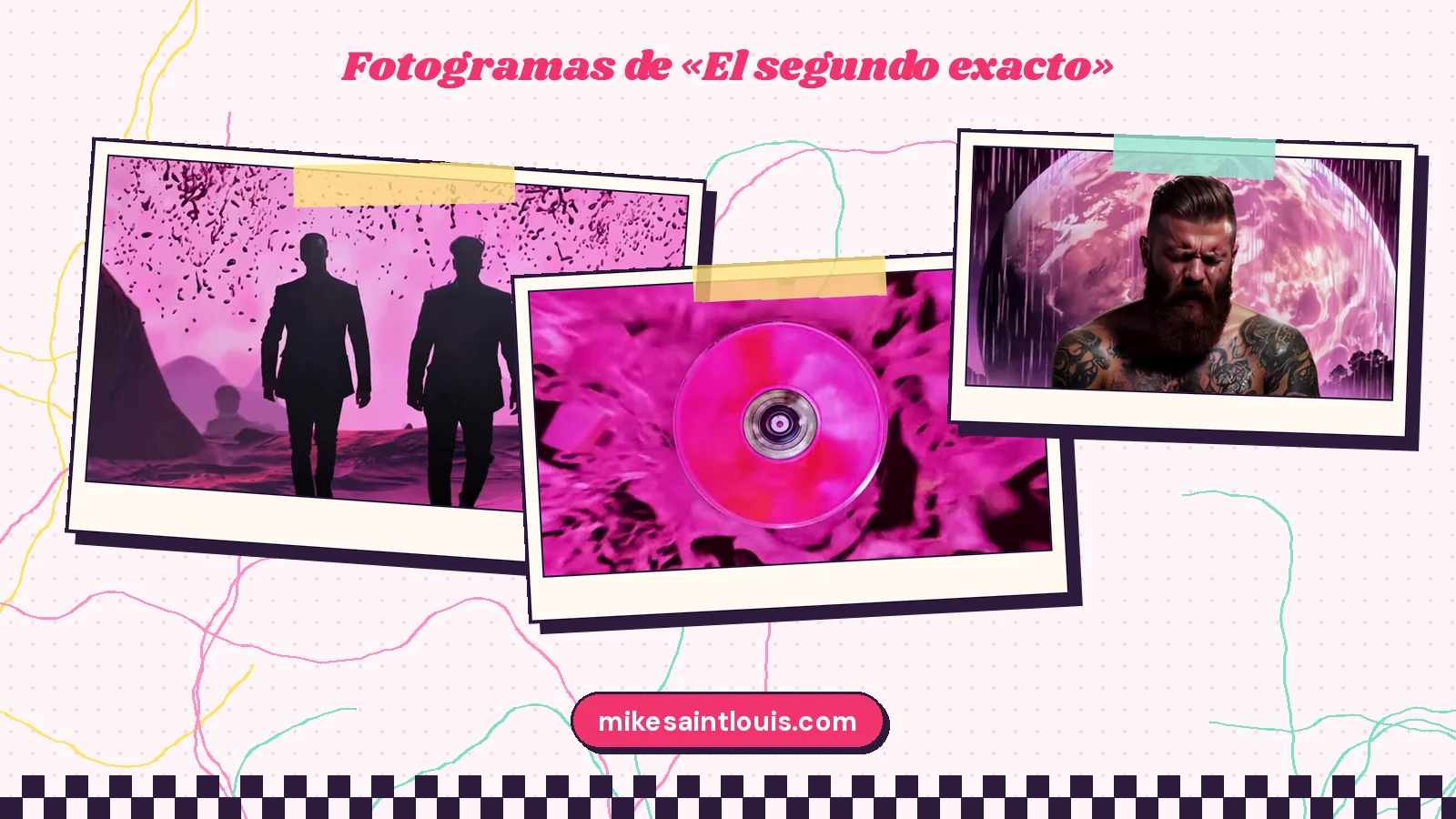
I direct the Planeta Gayfolk covers, and I wanted the one for «El segundo exacto» to be over the top, because the lyric is.
A dark-haired man with three-day stubble and gelled, spiked-up hair looks straight into the camera. He's wearing a red leather jacket with a snakeskin sheen and a huge ring with a pink stone. He points a finger at his temple, as if to say "here, this is where it's at". And from his eyes run two streaks of fuchsia tears, as though he'd cried glitter. Behind him, a huge magenta planet surrounded by clouds of the same colour, the planet of the whole trilogy. The title, in chunky white and pink letters, fills the bottom half.
It's a four-in-the-afternoon telenovela cover, and at the same time it's the whole song in one image. The finger on the temple is the one doing the thinking, the one choosing the second. The pink tears are the second itself, crying turned into an aesthetic, which is what we queers have been doing since the dawn of time: if we're going to suffer, it might as well match the ring.
I'll confess it amuses me to picture the button hater looking at that cover. A very serious gentleman, convinced there's nobody here, and in front of him a bloke with fuchsia tears pointing at his own head. There's somebody, sweetheart. And he's beautifully coordinated.
Where this song lives
On the singles list, «El segundo exacto» sits between «Como a mi chihuahua» and «Mejor que Ben Affleck». Don't ask me why that neighbourhood tickles me so much, but it does: the dogs on one side, a Hollywood actor on the other, and me in the middle, counting WhatsApp statuses. It's practically a summary of my life.
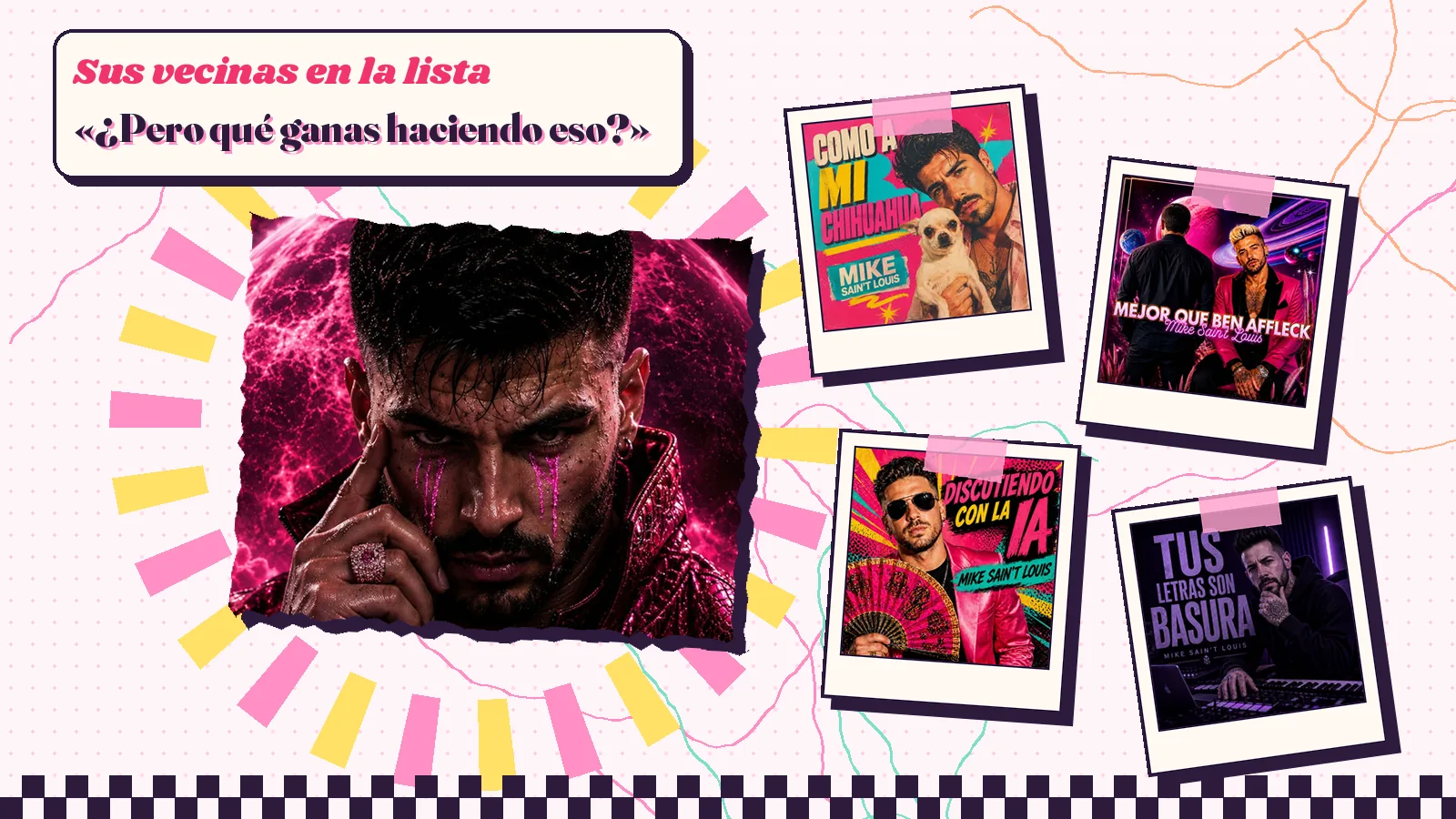
Within the trilogy it belongs to the first album, the one about discovering the planet, the album where I'm still here on Earth with my exes and my haters, before I can escape anywhere. It makes sense for it to be there. It's a pre-launch song. From back when you still care what the person in the Mercadona queue says.
It also has first cousins in the catalogue. In «Discutiendo con la IA» the argument is with the tool itself, and it's the machine that gets it in the neck; the button line comes back there, but flipped round and with much more venom. In «Tus letras son basura» the insult is no longer aimed at the technology but at what I write, which is the part that truly belongs to me and therefore the part that stings most. Play all three back to back and you get a little hater trilogy inside the big trilogy. A Russian doll of hate comments.
What I'd do with the next comment
I don't reply the way I used to. I explained why in what I learnt from negative comments: long replies achieve nothing, and someone who hasn't listened isn't looking to be convinced. They're looking to put it on record.
So let them put it on record. I do too, in my own way. Every time someone writes the button thing, I'm tempted to reply with a link to this song and nothing else. No text. Let them hear their own line turned into a chorus, on a loop, and decide whether they find it funny.
And if they do, welcome. That's one more of us.
One.
Because in the end that's what this is about: finding the people who laugh where I laugh and cry where I cry. I don't need a stadium. The ones who turn up are enough, as I said in the article about a thousand loyal listeners. Better a thousand who know the father-in-law joke than a million who walk straight past.
Twenty statuses later
The song ends on the anniversary. First year on YouTube, not a single "like". I left it there, with no happy ending, no "and then everything changed". Because I don't know whether it changed, and it isn't my place to say so in a lyric.
What I do know is that after that first year came many more singles and many more videos, that the website exists and that you're reading this. The song doesn't say that. I'm saying it, now, with the advantage of writing afterwards.
If someone ever tells you that what you do is just pressing a button, put this song on. Laugh at the big old queen. Count your status views without shame: my boyfriend, his mother, my sister, my father-in-law, my ex. And then go and find your exact second, your own, the one no machine is going to choose for you.
I've already got mine. It's in a song with a pink cover.
Frequently asked questions
What is «El segundo exacto» about? It begins by repeating, word for word, the jibes of people who say making music with AI is "just pressing a button", answers them with humour and ends with a serious question about who chooses the emotional moment of a song, plus the tally of twenty WhatsApp status views without a single "like".
Which album is it on? On «Descubierto un nuevo planeta llamado GAYFOLK», the first album of the GAYFOLK trilogy. On the complete Planeta Gayfolk singles list it's number 126 of 273.
Who writes the lyrics and how is the music made? The lyrics are mine, written without AI. The music and vocals are produced with artificial intelligence tools such as Suno, which I direct, like the rest of Planeta Gayfolk.
Where can I read the full lyrics and listen to it? The lyrics are on the song page and on gayfolkplanet.com. You can listen to it on Spotify.