
By Mike Sain't Louis ·
Downhill into the twilight: «Sunset Boulevard», Norma Desmond and the boy who doesn't brake
Some streets lead to places and some streets lead to films. Sunset Boulevard is one of the second kind. Say those two words and nobody thinks of tarmac, traffic lights or zebra crossings. They think of a mansion with an empty pool, a woman in a turban coming down a staircase, a line about close-ups. The avenue exists, you can drive it and it has petrol stations like any other, but in half the world's imagination it's a film set. That's why I loved giving that name to this song: it drags seventy-five years of cinema behind it and yet, on my cover, there's nothing in black and white.
What there is, is a boy riding a skateboard downhill. Without braking.
A postcard rolling downhill
The cover is one of the brightest I've released. The sky is on fire, somewhere between orange, peach and an almost fuchsia pink. The sun is sinking behind a huge city you can make out in the distance, its grid of lights already on and a line of hills on the horizon. On both sides, towering palm trees, thin as matchsticks, cut out against the sunset. And in the foreground, leaning over the board, a boy dressed in pink from shoulders to ankles.
His shirt is open and flies back in the wind. The trousers, pink as well, look like a fabric with a slight sheen, as if someone had ironed candyfloss cotton. On his feet, black trainers with white soles, the classic skater kind. His arms are held away from his body, finding his balance, and his head is thrown back with his eyes closed. He isn't looking at the street. He trusts it.
Behind him, at a distance, comes an old American car, black and gleaming, with a number plate that reads SAINT. Nobody is driving it in a hurry. It looks more like a witness than a pursuer. Up in the left corner, the title in thick brush strokes: SUNSET in pink, BOULEVARD in black, as if someone had painted it on a wall in a rush before the light went.
In the song's page on my site I summed it up like this: downhill, no brakes and shirt wide open. I still think that's the best way to put it.
What we know and what we don't
Before going on, an honest warning. The lyrics of «Sunset Boulevard» haven't been published yet, and I'm not going to invent lines or copy what an automatic caption thinks it heard. What I have is real and checkable: the title, the cover, the official music video I uploaded to YouTube on 19 June 2026, the album it belongs to and the tags I gave it, which say indie pop, alternative pop, queer pop and camp. I also have what I wrote about it on my website. That's enough for a long walk, and the street it's named after does the rest.
When the lyrics come out they'll be on the lyrics page, like all the others. Until then, this text is a reading of the image and the name, not an explanation of what the song says.
The thirty-five-kilometre avenue
Sunset Boulevard is about thirty-five kilometres long. It starts near downtown Los Angeles and ends by the ocean, at the Pacific Coast Highway, at Pacific Palisades. Along the way it crosses neighbourhoods that look nothing alike: Echo Park, Silver Lake, Hollywood, West Hollywood, Beverly Hills, Bel Air, Brentwood. It's a line that runs from the densest asphalt to curves with sea views, from neon signs to three-metre hedges hiding mansions.
For a short stretch of barely two and a half kilometres, the avenue becomes the Sunset Strip, the stretch of music venues, legendary hotels and giant billboards. That's where the Whisky a Go Go opened in 1964, and a little further up stands the Chateau Marmont, the make-believe castle opened in 1929 where half of Hollywood's history has hidden.
I find it funny that such a long street has ended up meaning just one thing. For almost everyone, Sunset Boulevard isn't an avenue: it's a film. And not just any film.
Norma Desmond doesn't move
In 1950 Billy Wilder released «Sunset Boulevard», which in Spain was called «El crepúsculo de los dioses» (The twilight of the gods), like Wagner's opera. Gloria Swanson plays Norma Desmond, a great silent-film star who lives shut away in a big old house on the avenue, convinced the public is still waiting for her. William Holden is Joe Gillis, a broke screenwriter who takes refuge in that house while running from debt collectors. Erich von Stroheim is Max, the butler, who hides a secret best left unspoiled.
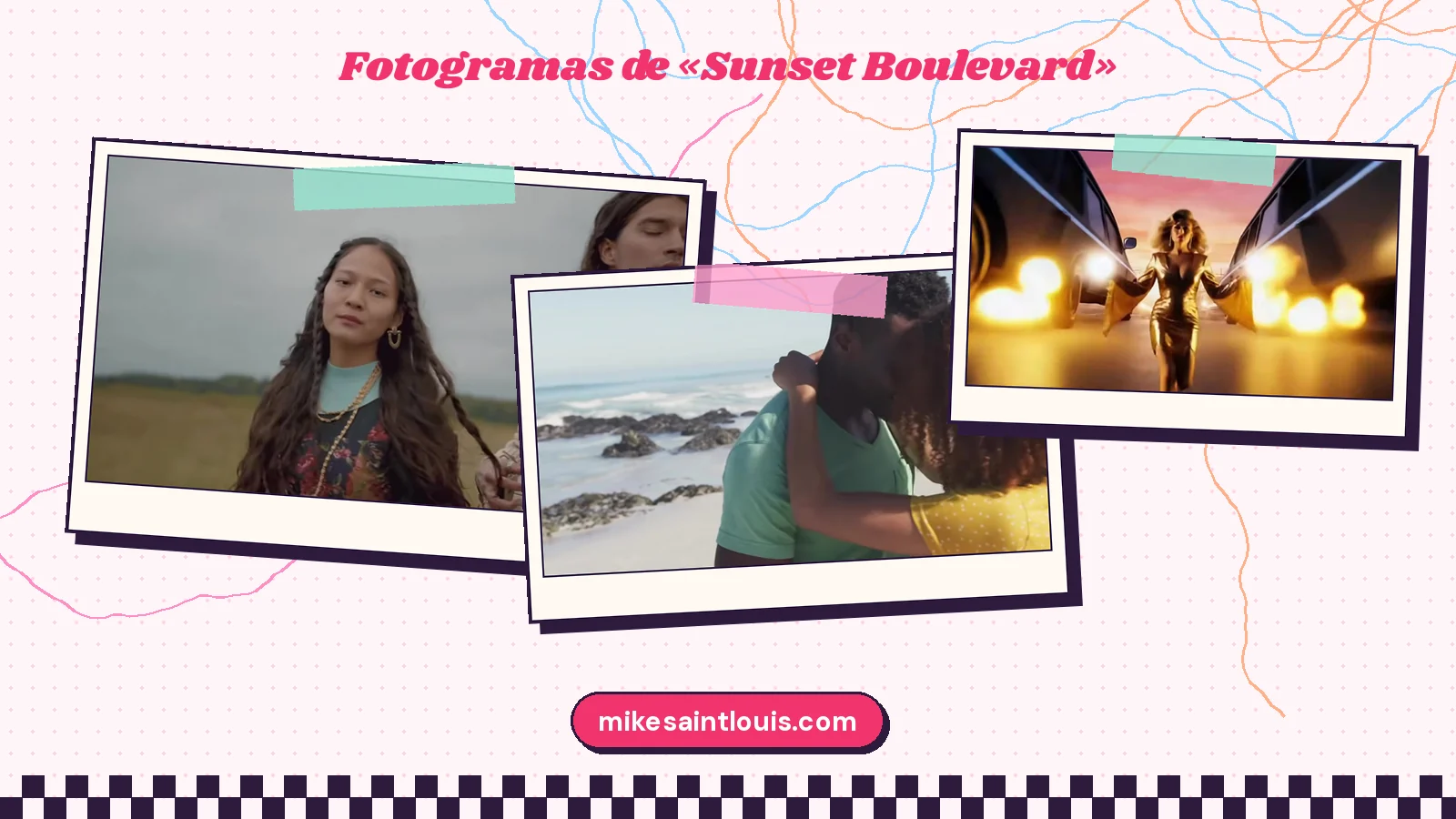
The film opens with a dead man floating face down in a pool and a voice-over telling us how he got there. It has a night-time funeral for a chimpanzee, card games with old silent-era glories, an organ that plays by itself in the wind and a heroine who screens her own films in the living room so she can applaud herself. If that isn't top-strength camp, I don't know what is.
But what interests me most about Norma Desmond, looking at her next to my cover, is that she doesn't move. She lives in a house where time stopped in 1928, with the clocks, portraits and curtains of back then. She writes a script nobody asked for so she can return to the screen. She refuses to accept that the world has kept turning. Her house is a capsule. Her avenue, a museum.
The boy on my cover does exactly the opposite. He rides down the same street, at the same time of day, but he holds on to nothing. He opens his arms, closes his eyes and lets the slope decide. If Norma is the sunset that refuses to end, he is the sunset you enjoy precisely because it's ending.
«Ready for my close-up»
The film left two lines that get repeated wherever there's a diva and an audience. The first is Norma's, when Joe recognises her and remarks that she used to be big: «I am big. It's the pictures that got small». The second comes at the end, when she descends the staircase before the cameras and announces, completely lost in her delusion, that she's ready for her close-up.
Those two lines work like a misread survival manual. The first is pride that won't accept the passing of time. The second is the desperate need to be looked at. Both are very human. Both, too, are very dangerous when they become the only thing left.
The boy in pink also knows he's being watched. On his page I wrote that he has «the pose of someone who knows he's being looked at and enjoys it», and I stand by that. But there's a difference. He doesn't demand the spotlight. He isn't descending a staircase towards cameras that aren't actually filming. He's riding down a real street, with the real sun at his back, and if someone watches him, great, and if not, that's fine too. He shows off without asking permission and without asking for applause. That's the version of exhibitionism I like: the one that doesn't depend on anyone.
From celluloid to the musical
Sunset Boulevard had a second life on stage. Andrew Lloyd Webber turned it into a musical that opened in London in 1993 and reached Broadway the following year, with Glenn Close as Norma. It gave us numbers like «With One Look» and «As If We Never Said Goodbye», which plenty of talent-show divas have chosen to show off with.
Thirty years later, director Jamie Lloyd made a completely different version: an almost bare stage, live cameras, everything in black and white and Nicole Scherzinger as Norma. It moved from London to New York and won the 2025 Tony Awards for best musical revival and best leading actress. In other words, the story of the woman who didn't want the spotlight to go out keeps switching spotlights on.
I like that my song joins, even from a tiny corner, that chain of reinterpretations. Not with nostalgia or a literal tribute, but with an image that flips it around: the trapped diva's avenue turned into the track of a lad who lets go.
Pink from head to toe
Wearing head-to-toe pink isn't neutral. Not in Los Angeles and not in Madrid. For decades pink was the colour snatched out of boys' hands as soon as they picked it up, the colour of mockery, of «that's for girls», of the adjective that came with the insult. It was also the colour of the triangle the Nazis used to mark homosexual men in the camps, and that's why, much later, the LGBTI movement reclaimed it as an emblem.

On the cover, the pink isn't worn with fear. It's worn whole, shirt and trousers, without a single garment toning it down. There's a film number that always makes me smile when I think about this, «Think Pink!» from «Funny Face», 1957, in which a fashion magazine editor decides everyone must wear pink. That scene was a satire of the fashion world; my boy in pink isn't satirising anything. He's simply chosen it.
And he's chosen it to fly down a hill, an activity traditionally linked to another look: baggy T-shirts, muted colours, a certain tough-guy pose. There's something very queer in that mix. The skateboard brings the physical courage; the clothes bring the other kind. And neither apologises.
On four polyurethane wheels
The skateboard was born in California in the fifties, when some surfers realised you could «surf» the tarmac on days without waves. They called it sidewalk surfing. The first boards were crude and the wheels, made of metal or clay, gripped the ground terribly.
The revolution came in the early seventies with polyurethane wheels, which changed everything: more grip, more speed, fewer absurd falls. Shortly afterwards, during the drought California went through in the middle of that decade, a gang of kids from Santa Monica and Venice, the Z-Boys of Dogtown, started sneaking into empty pools in other people's gardens to skate their curved walls. That story was told years later in the documentary «Dogtown and Z-Boys», from 2001, and in the film «Lords of Dogtown», from 2005.
From asphalt to pools and from pools to the Olympic Games: skateboarding made its Olympic debut at Tokyo 2020, which because of the pandemic was held in 2021. An activity born of bored surfers and kids jumping fences ended up with medals.
There's a coincidence I love. Wilder's film opens with a pool and a corpse. The history of modern skateboarding has one of its founding scenes in empty pools. In Los Angeles, it seems, pools are where stories close and open.
The magic hour
In film, the stretch from just before sunset to just after is called the magic hour. Light turns horizontal, warm, soft. Shadows lengthen, skin looks golden and everything photographed in that window looks like a memory.
One of the great masters of that light was from Barcelona: Néstor Almendros. Born in 1930, he went into exile first in Cuba and ended up working in France and the United States. He won the Oscar for best cinematography for «Days of Heaven», by Terrence Malick, a film shot largely during those golden minutes. In 1984 Almendros also co-directed «Improper Conduct», a documentary about the persecution of homosexuals in revolutionary Cuba. It feels right to name him here: a master of sunset light who also stuck his neck out to tell what was happening to men like us.
The cover of «Sunset Boulevard» is bathed in that magic hour. The physics behind it is simple and beautiful. When the sun is low, its light passes through much more atmosphere before reaching our eyes. On the way, the blue tones scatter, a phenomenon described by Lord Rayleigh in the nineteenth century, and what reaches us is mostly reds, oranges and pinks. On the song's page I said it's that orange «that looks fake». It does, but it's pure optics.
Palm trees someone planted
The palm trees of Los Angeles are so much part of its postcard that it's hard to believe most of them aren't from there. The story the city tells most often is that tens of thousands were planted in the early thirties, before the 1932 Olympic Games, as part of a scheme to create jobs in the middle of the Great Depression. The tall, very thin ones that appear in so many photos, like those on my cover, are mostly Mexican fan palms.
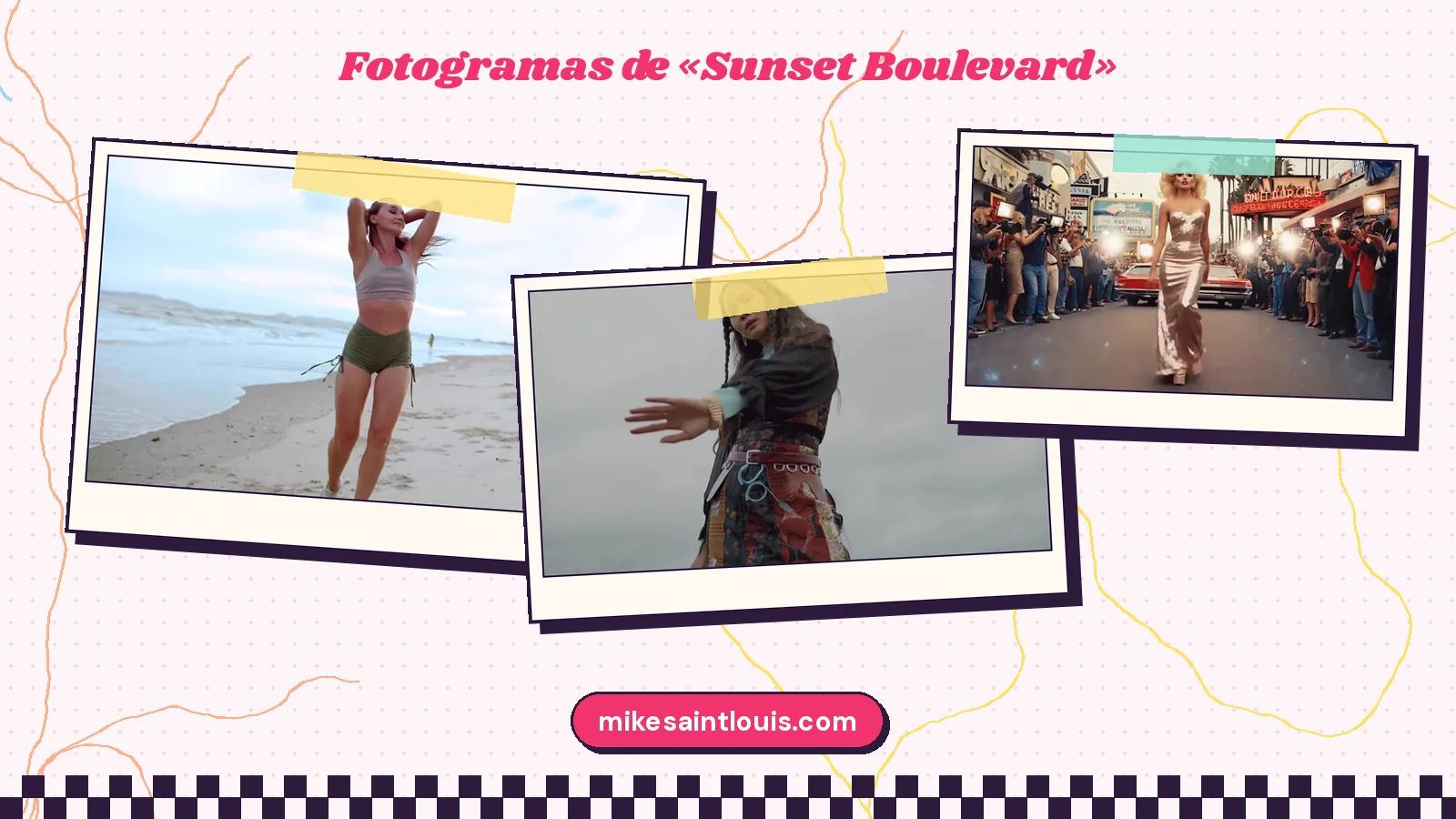
I like that fact because it shows that even the most iconic landscape is partly a set. Someone decided that city would have that skyline, and that skyline became half the planet's dream. Postcards are manufactured. So are myths. That doesn't make them less beautiful, it makes them more human.
On my cover, the palms aren't just background: they frame the street like the columns of a temple. The boy rides down the middle as if through a guard of honour.
The black car following behind
There's a detail many people miss at first: the number plate. The black car coming behind says SAINT. It's an obvious nod to my artist name, but it also works inside the image. That old, heavy, elegant car looks like the older version of the boy. The past following closely, without catching up.
In «Sunset Boulevard», Norma Desmond has an enormous car, an Isotta Fraschini from the twenties with leopard-skin upholstery, which Max drives as if it were a royal carriage. It's a car from another time for a woman living in another time.
I don't know whether people looking at my cover will think of that car, but for me the image puts it right there. An old black vehicle gliding behind, and in front, a young body on a wooden board that needs no engine. Heavy luxury against lightness. The carriage against the board.
A winged heart on his chest
With the shirt open, the tattoo is clearly visible: a heart with outstretched wings in the middle of his chest. It isn't the first time it appears on my covers; on the one for «Zee-Zee», for example, the boy wears it too. It's an image I really like, because it joins two ideas that usually clash: the heart, which tends to stay where it's left, and wings, which tend to leave.
I've already written about skin as a notebook in the post about tattoos and the phoenix, and about the bodies in my lyrics in this look at the buff, the tattooed and the grey-haired. Here the body is moving, sweaty, chest bare, and what's written on it sums up the scene: a heart flying downhill.
Very camp, very summer
On the song's page I wrote that the cover has «that touch of an eighties suntan lotion ad that I love so much». I meant exactly that. There's a kind of advertising image that stuck in the memory of those of us who grew up with magazines and billboards: glistening skin, saturated colours, impossible skies and a promise of endless summer. It was pure exaggeration, and that's why it was wonderful.
Camp, as I explain in this post about why camp isn't a joke, lives right there: in a love of the excessive, the artificial and the theatrical, without cynicism. «Sunset Boulevard» takes that look to the limit. The sky is too orange, the pink is too pink and the boy's pose is too perfect for someone actually riding down a hill. And precisely because everything is too much, it works.
It's also a summer cover, the kind that makes your skin feel warm even if you look at it in January. A while ago I wrote that I like summer, and this song lives on the same map: windows down, a terrace at the end of the afternoon, the last button undone. As I put it on the song's page: put it on, put your sunglasses on and loosen up.
West Hollywood, beside the Strip
There's a fact that makes this avenue closer to home for me. Part of the Sunset Strip runs through West Hollywood, an independent city within the Los Angeles area that incorporated in 1984 and had a strong gay presence on its council from day one. It was one of the first cities in the United States with an LGBTI majority in local government, and for decades it has been a refuge and a showcase for the community.
So this avenue holds two memories. One belongs to the shut-away divas. The other belongs to a place where, for decades, men like the one on my cover have been able to walk around dressed however they wanted. If Norma Desmond stands for the fear of disappearing, West Hollywood stands for the collective decision to become visible.
That tension, between hiding and showing yourself, runs through many of my songs. In the post about Britney and the cages with spotlights I wrote about fame as confinement, and in the one on «I want to be a TikTok star», about wanting to shine even halfway. «Sunset Boulevard» sits at the other end: shining without a cage and without an algorithm, just with the sun in your face.
On the second album
«Sunset Boulevard» is part of *Ojalá se pudiera viajar a Gayfolk* (If only you could travel to Gayfolk), the second album of the GAYFOLK trilogy. If the first was about arriving on a new planet, the second has a lot of longing to escape, of yearning for a place where you can live without asking permission. It makes a lot of sense for that album to include a song named after a Californian avenue with a postcard cover. It's a dream destination, a place that exists but that, in the imagination, works like another planet.
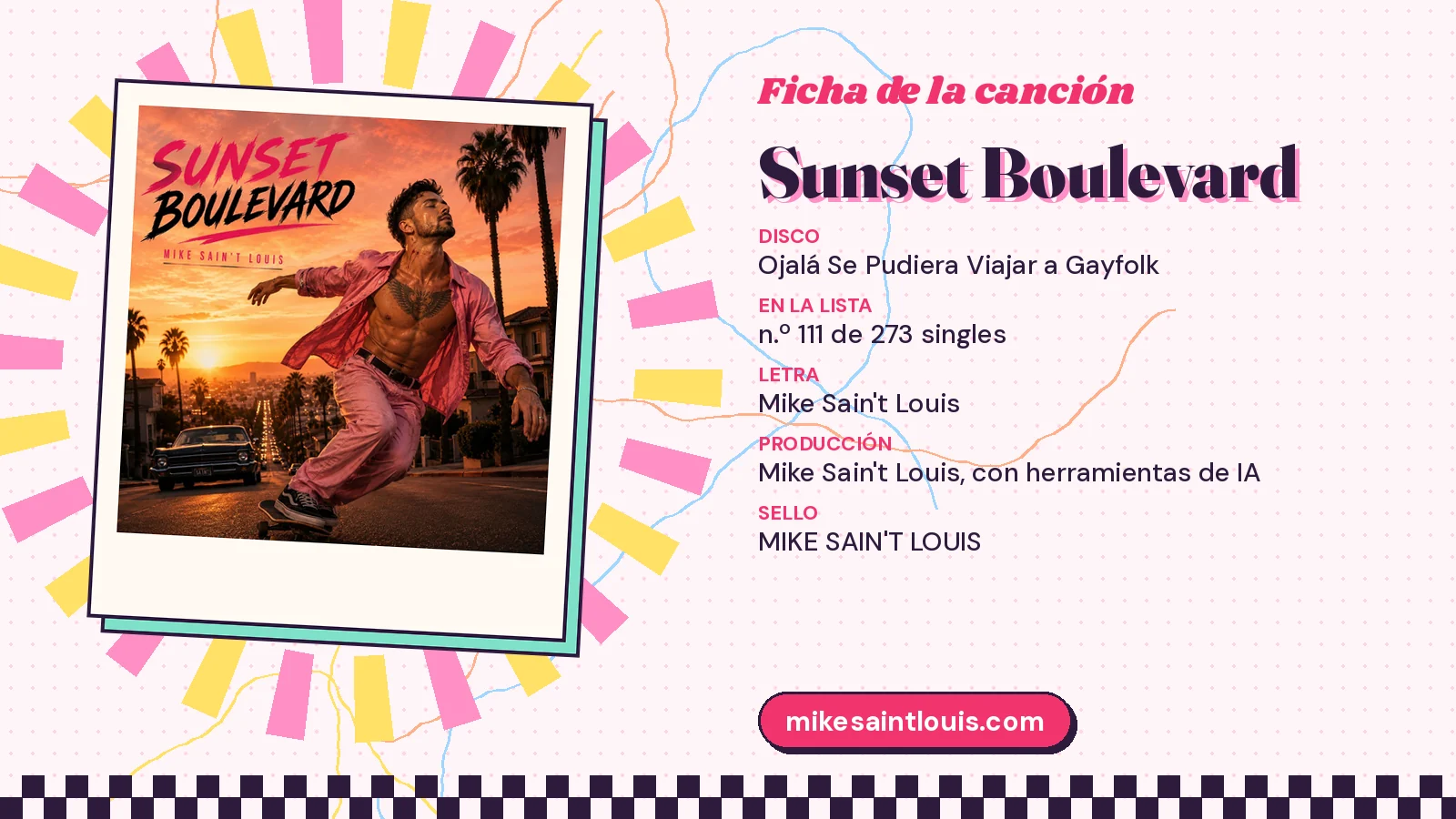
In the singles catalogue on gayfolkplanet.com it sits between «Sonne und Wind» and «Mirror», and I find the order funny: first sun and wind, then the sunset, and then a mirror. As if the afternoon ended with someone looking at themselves after letting go.
When the spotlight goes out
I want to spend a moment on the less luminous side. «Sunset Boulevard» is a black comedy, but it's also the story of a woman left alone, isolated, clinging to what she was. In the film there is a suicide attempt and a violent death. It isn't a story with a happy ending.
Many people live something similar without a mansion or cameras: the feeling that their best moment has passed, that nobody is looking, that the world left without warning. That weighs, and sometimes it weighs enormously. If you recognise yourself there, don't wait until you feel worse. In Spain you can call 024, the free suicide-prevention line, available at any hour. If there's immediate danger, the number is 112. And if you're reading this from another country, call your local emergency services or find a helpline near you at findahelpline.com. Talking to someone isn't a close-up, but it can be the start of another scene.
One of my songs is called «La música me está salvando» (Music is saving me), and I already devoted a whole post to anxiety, sadness and breathing room. That's why I think it matters that the brightest songs live alongside the possibility of asking for help.
A song for letting go
In the end, what I still like about this cover is the way it settles an old conflict. For a long time, many gay men were taught that sunset was a dangerous place: the moment youth, success and other people's gaze come to an end. Norma Desmond is the nightmare of that fear, the one who never learned to step down from the pedestal.
The boy in pink suggests something else. The sun is going, yes. The hill ends somewhere, of course. But while it lasts, you can ride down with your eyes closed, your shirt in the wind and a black car from the past watching from behind without catching you. You don't need to be ready for any close-up. It's enough to be out in the street when the sky turns that colour.
That's why it's a song for people who let go late. For whoever wore their favourite clothes for the first time at forty, for whoever dared to wear pink when nobody expected it any more, for whoever learned to get on something scary just as everyone else was getting off. And also for whoever hasn't dared yet and looks at the cover with longing.
Who this song is for
For whoever drives at sunset with the windows down and the volume higher than advisable. For whoever has watched «Sunset Boulevard» and thought that Norma needed, more than a close-up, a friend to get her out of the house. For whoever has worn head-to-toe pink and taken the stares with a smile.
For those who skated as kids and don't dare any more. For those who never skated and are dying to. For whoever has been through a bad patch and is starting to notice the light change. And for whoever, like me, believes that sunset isn't an ending but the hour when everything looks most beautiful.
Frequently asked questions
What is «Sunset Boulevard» about?
The lyrics haven't been published yet, so I'm not summarising or inventing them. What is clear is the scene on the cover: a boy dressed in pink skateboarding down a palm-lined Los Angeles avenue at sunset. On the song's page I described it as a camp, summery postcard, downhill and with no brakes.
What does it have to do with Billy Wilder's film?
It shares its name with «Sunset Boulevard» (1950), the film about Norma Desmond, a silent-film star shut away in her mansion. This post uses that film as a contrast: she doesn't move; the boy on the cover doesn't stop.
Which album is it on?
On «Ojalá se pudiera viajar a Gayfolk», the second album of the GAYFOLK trilogy. The official music video was uploaded to YouTube on 19 June 2026.
What style is it?
The tags that go with it on YouTube are indie pop, alternative pop, queer pop and camp. The look of the cover, with saturated colours and the air of an eighties suntan lotion ad, follows that line.
Who makes the music and the vocals?
Mike Sain't Louis, a lyricist, composer and music producer from Madrid, "the first AI songwriter". He writes the lyrics, composes and produces, and the vocals are generated with artificial intelligence.