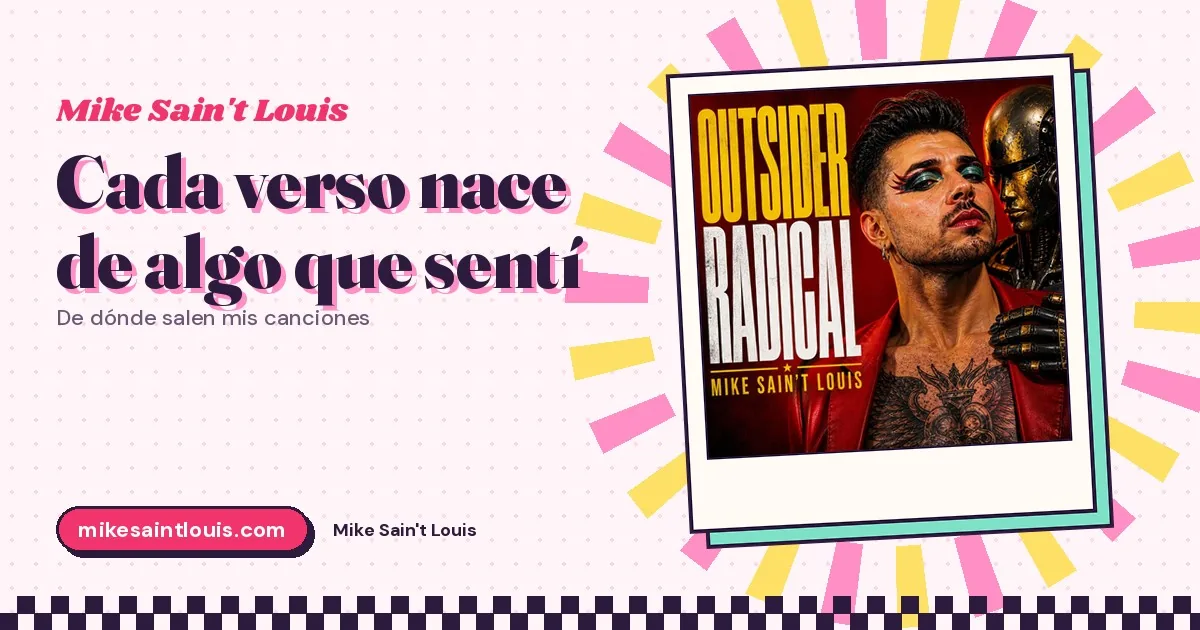
By Mike Sain't Louis ·
Every Line Is Born from Something I Felt: where my songs come from
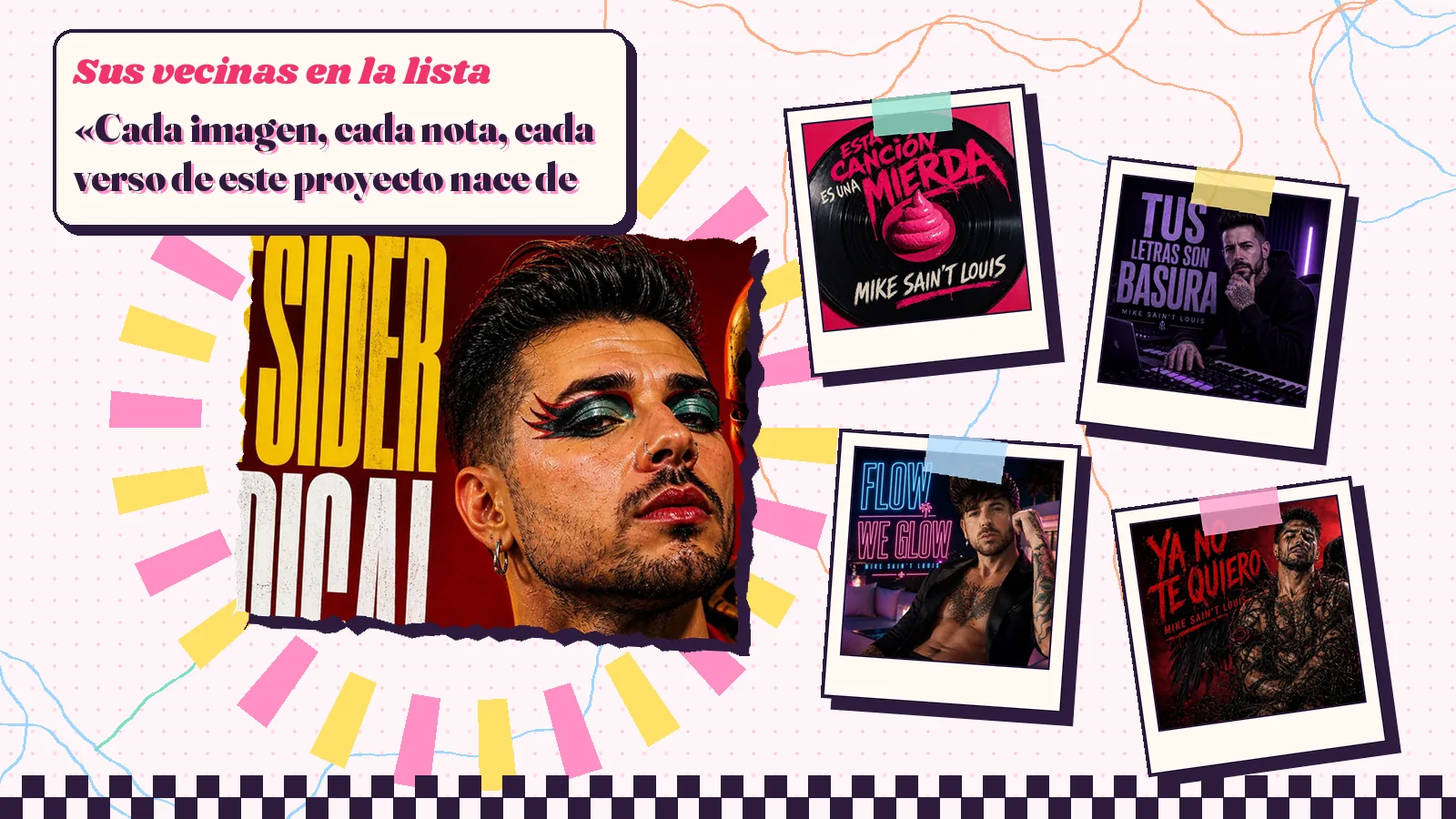
«Cada imagen, cada nota, cada verso de este proyecto nace de algo que sentí antes de escribirlo» («every image, every note, every line of this project is born from something I felt before I wrote it»).
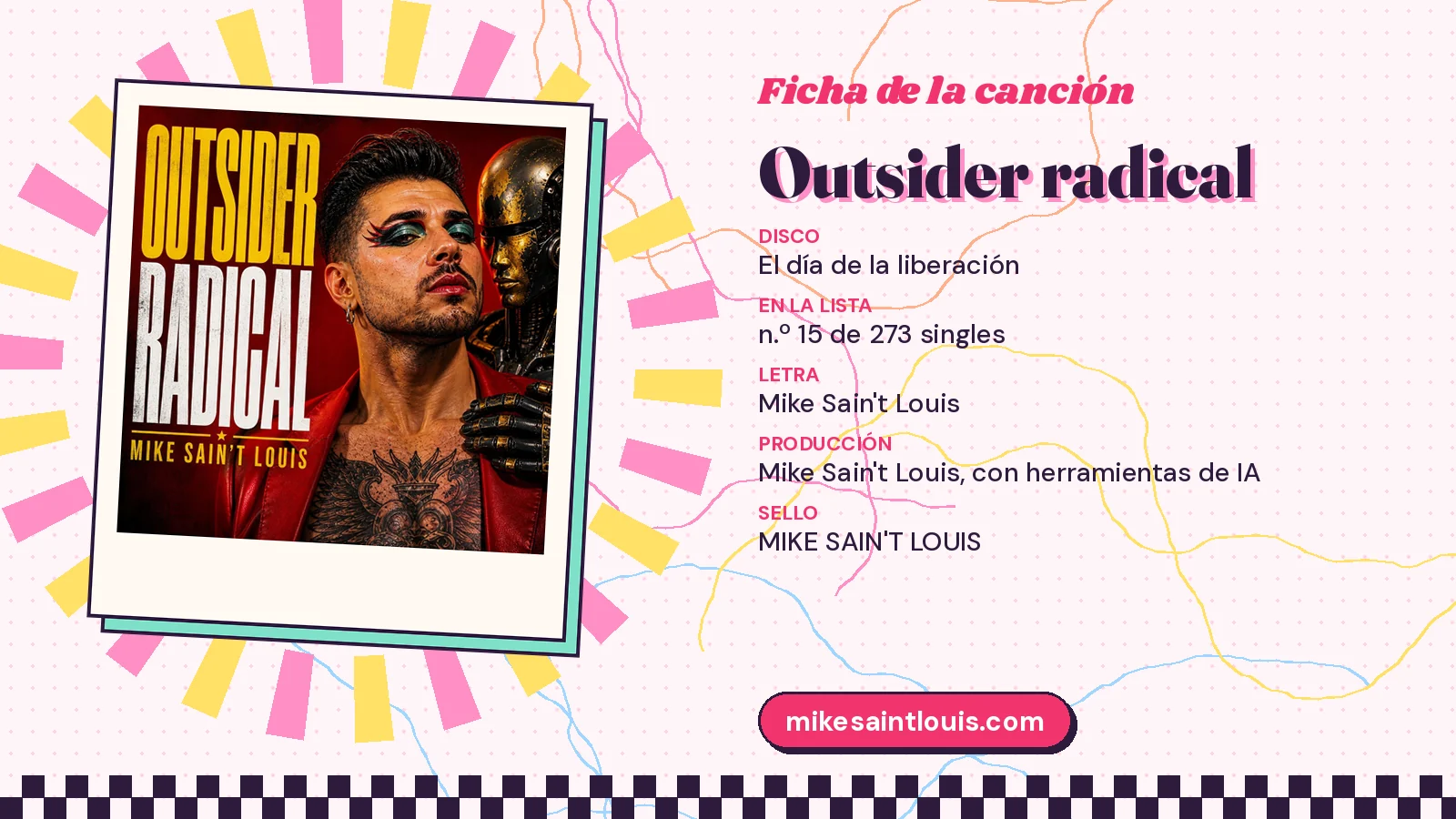
That sentence comes from the text of «Outsider radical». And it goes on with a list: loss, emotional abuse, rage, beauty, madness and hope.
Six things. All of them felt before they were written.
Many of my songs come with a text. Sometimes it's a description, sometimes a manifesto, sometimes a letter. And in quite a few of those texts I say where the song came from. Not with studio details or tales from four in the morning. With something simpler: what I was feeling when I wrote it, why I wrote it, what it was born from.
Read together, those texts draw a fairly clear map of how I write. This piece is that map. I'm not going to add anything that isn't already said in them. I'm just going to lay them side by side.
Before I wrote it
I'll start with the idea that holds everything up: first you feel, then you write.
It sounds obvious, but it isn't quite. Some songs are written the other way round: first you look for a subject that works, a formula, a chorus that sticks, and then you spread a bit of feeling on top. My texts say that with me it's the opposite. Whatever sits behind each line was there before the line.
The list in «Outsider radical» is very honest. It doesn't say my songs are born from love, or inspiration, or the muses. It says they're born from loss, from emotional abuse, from rage. And also from beauty, from madness and from hope. The first three hurt. The last three, not so much. And they all travel together, in the same sentence, the way they travel in life.
The song's page sums it up like this: all of that was felt before it was written. Technique, whatever it is, only helps turn it into a universe.
AI doesn't invent that
Right after that list, the text of «Outsider radical» says two sentences that are probably the clearest thing I've ever written about artificial intelligence: «La IA no inventa eso. / Solo me ayuda a convertirlo en universo» («AI doesn't invent that. / It only helps me turn it into a universe»).
That's the division of labour. What is felt, the loss, the rage, the hope, isn't put there by any machine. I put it there. What the tool does is help me turn it into a song, into sound, into image.
My website says it another way: artificial intelligence is my tool for production and arrangement, just as other generations used the drum machine or the synthesiser. The lyrics always carry my signature.
And «Outsider radical» makes the same comparison, in other words. I've been told many times that using AI isn't art, that what I do doesn't count. But nobody ever says that about a painter who uses brushes, or a musician who uses a synthesiser.
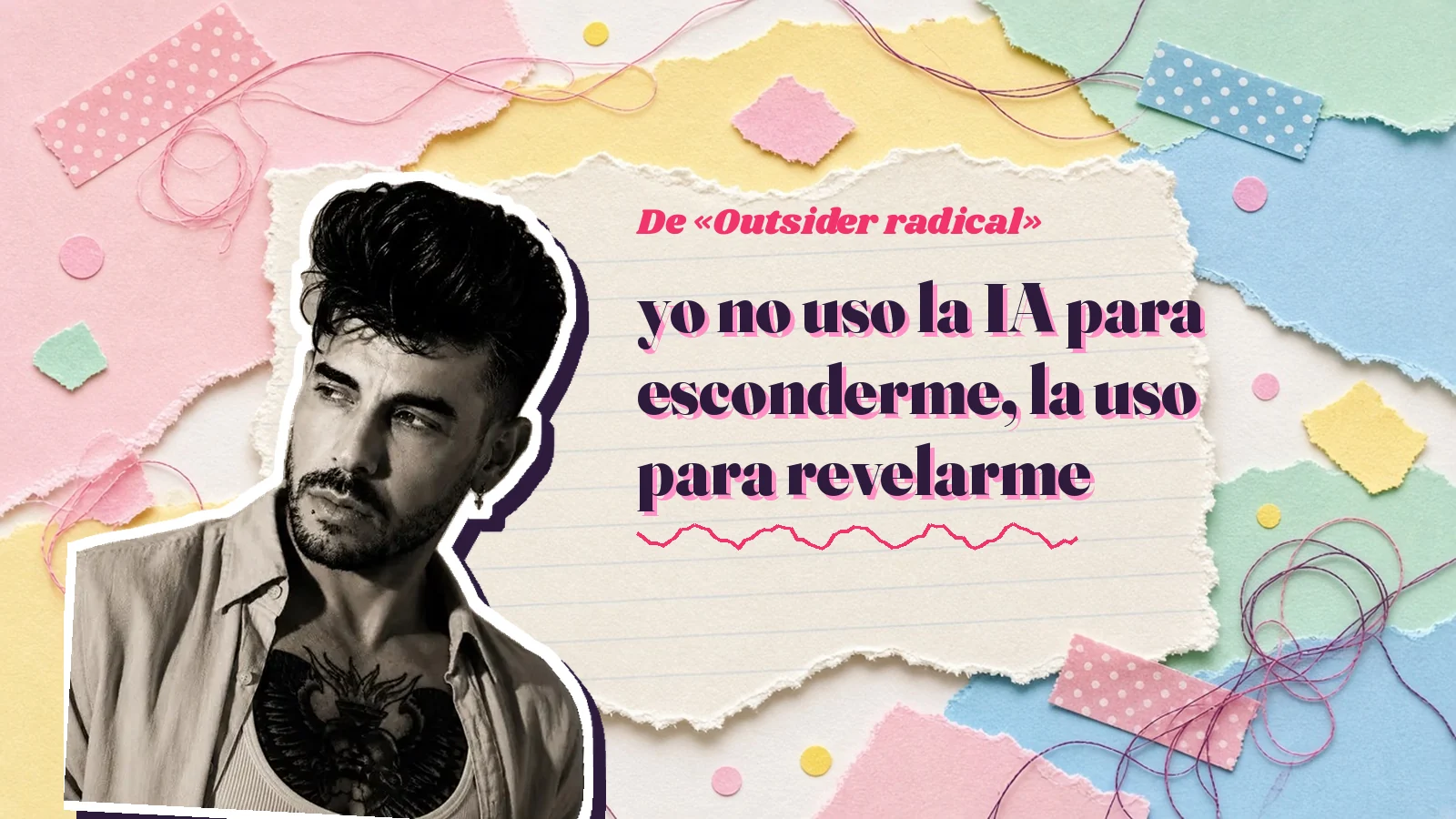
Then it adds a sentence I love: «yo no uso la IA para esconderme, la uso para revelarme» («I don't use AI to hide, I use it to reveal myself»).
To reveal myself. It's the opposite of what a lot of people think. They believe the tool is a mask. For me it's a way of showing what's there. I write the lyrics. The music and vocals are made with AI. And what comes out of that is more mine, not less.
Born of weariness
The text of «Esta canción es una mierda» tells its origin in a single sentence: it was born of weariness, but also of laughter.
I've already written about that sentence when I talked about the rules of my house, so here I'll only look at what it says about how I write. That a song can be born of two things at once, and that those two things can look like opposites. Weariness and laughter. Being fed up and bursting out laughing.
I think a lot of my songs are born that way. From something that wears me out and makes me laugh at the same time. A cruel comment, an ex who thinks he's terribly clever, a sentence someone said to me that was so absurd it ended up being funny. Weariness sets the subject. Laughter sets the tone.
The song's page adds that, more than a song in the usual sense, it's a manifesto. A list of enemies that anyone who has ever made something and shown it on the internet will recognise.
Collecting the comments
Another song tells its process in a very concrete way. «Tus letras son basura».
Its page opens by recalling what I've been told for years: that my lyrics were too strange, too intense, too personal. And then it explains what I do with that: «los recojo, les pongo título en mayúsculas y los convierto en canción» («I collect them, give them a title in capital letters and turn them into a song»).
It's almost a recipe. Collect the insult. Give it a title. Turn it into a song.
The page adds an idea that explains why it works: there is something very freeing about repeating the insult out loud until it loses its force and starts to sound ridiculous in the mouth of whoever said it.
It strikes me as a pretty exact description of part of my work. Not everything I write is born inside me. Sometimes it's born outside, from what people say to me. But even then it passes through me before it comes out. The comment arrives, it hurts or it's funny, and then it becomes something else.
I wrote it when I needed to breathe
Not all my songs are born of conflict. Some are born of the opposite.
The text of «Flow / We Glow» begins like this: it's one of those songs born of calm and of the sea. And then: I wrote it at a moment when all I needed was to breathe, to let go and to flow.
And it adds something I think matters about the process: there's no love story or story of pain behind it, only the feeling of peace when body and mind finally move at the same pace.
It's a song without an anecdote. No ex, no narcissist, no cruel comment. Just a state. And that's a way of writing too: not telling something that happened, but something that is felt. Peace has no plot. But it can be written.
The text also describes it as half in English, half in Spanish, «como yo: entre dos mundos» («like me: between two worlds»).
I wrote it to convince myself
Some songs are born of a very specific need: telling yourself something.
The text of «Ya no te quiero» explains it like this: I wrote it at that point where you know you should let go, but something inside you is still holding on.
And then a sentence that describes the process better than any technical explanation could: «Cada verso nace del deseo de convencerme… y del fracaso inevitable de hacerlo» («every line is born of the wish to convince myself… and of the inevitable failure to do so»).
It's one of the most honest things I've said about how I write. Sometimes I write to convince myself of something. So that saying it makes it true. I don't love you any more, I don't love you any more, I don't love you any more. And every time I write it, I know it isn't true yet.
The song's page puts it like this: the title is a sentence I say so that it becomes true, but that I still don't fully believe. And the text ends with a perfect definition: a truth I don't believe yet.
That's writing as a spell. Not to tell what happened, but to make it happen.
I wrote it because silence is abuse too
Some songs are born of something harder. Of the need to name what has no name.
«Ni con un palo» is about a silent form of violence in relationships with a narcissist: the punishment of withholding the body in order to dominate the other person. Its text is long and very clear. And at one point it says why the song exists: «Lo escribí porque el silencio también es abuso» («I wrote it because silence is abuse too»).
And it adds: because many victims never talk about it, since «nothing happened». But everything happened.
Here the reason for writing isn't to let off steam or to laugh. It's to give a name to something many people have lived through without knowing what to call it. The text describes the song as an emotional autopsy. A mirror that reflects pain without noise.
I think it matters that some songs are born this way. So that someone listening can say: this happened to me, and I didn't know it had a name.
Born of respect
The tributes in my catalogue also say where they come from.
The text of «Free Britney» says that tribute «nace desde el respeto, desde el dolor y desde la admiración por alguien que sobrevivió al propio espectáculo» («is born of respect, of pain and of admiration for someone who survived her own show»).
Respect, pain and admiration. They aren't three random words. When I write about someone real, about an artist or a public figure, what comes first is respect. Then the pain, which is what connects me to her. And then admiration, which is why I choose her.
The text of «Louvre» describes a different, more visual origin: it says the song is born of the wish to mix art, identity and freedom. And it tells something about the process that I find very revealing: when I started imagining the video, I thought about what it would be like to walk into such a solemn place with butterfly wings and turn it into a dance floor.
There the song is born of an image. Not of a sentence or a feeling, but of a scene. It's what the third rule of my house says: the look is thought through at the same time as the lyric.
Before it happened
One text in my catalogue tells something curious about the moment a song was written.
In «Ya no nos gusta La Oreja de Van Gogh», after explaining that the song is on the side of Amaia and Leire and against the domesticated packaging the industry put on them, I say: «Lo curioso es que escribí esta canción antes de que se anunciara la vuelta de Amaia al grupo» («the funny thing is that I wrote this song before Amaia's return to the band was announced»).
And then: it was almost premonitory. As if the GayFolk universe itself sensed that something was about to move.
I don't say it as a boast. I say it because it explains something about how some songs are born: from a hunch. From something that's in the air and hasn't happened yet. Sometimes you write about a collective feeling before it becomes news. And then the news arrives.
Switching language so I can say it
One song's text tells where it comes from and also why it comes in another language. «Tangled Light».
Its page begins like this: I wrote «Tangled Light» in English and even so it's one of the most personal songs I have. Then comes the explanation, which I think is one of the most useful ideas I've ever put in writing about how I write: sometimes switching language helps you say what, in Spanish, still weighs too much.
What follows in that text is a warning. It isn't a love song. It's the echo of twenty years trying to survive someone who believed he could break me, silence me, erase me. And a sentence worth reading slowly: every scar that appears in the song is real.
Here the origin has two layers. The first is what was lived, what was there before the line, as «Outsider radical» says. The second is distance. English works like a glove for touching something that burns. It doesn't change what is told. It changes how close you have to stand to tell it.
I think that explains why my catalogue has songs in English that aren't the lightest ones, but sometimes the most serious. It isn't a market decision. It's a question of weight.
Born of a question
Some songs aren't born of something that happened to me, but of something I wonder about.
The text of «Free Britney» opens by recalling that a whole generation grew up dancing to her songs, and that hardly anyone stopped to think about what lay behind the spotlights. And then it says: «Free Britney» is born of that question.
A question as an origin. It seems to me a very clean way to start writing. You don't have the answer. You have the doubt, and the song is the place where the doubt comes to live. In that case, the doubt is what happens to a person when the show swallows her whole.
Earlier I talked about respect, pain and admiration. Those are the feelings. The question is what sets them in motion.
Born of someone else's stare
Other songs are born of something I see in other people. Or rather, of how other people look at us.
The text of «Tan paleto» opens with a list of tiny things: walking hand in hand down the street, kissing your boyfriend on a bench. Things that, for many people, are still a spectacle worth commenting on. And then: «Tan paleto» is born of that outside stare, the stare of the man who thinks he's the judge of what everyone else does.
I like that the origin isn't the kiss. It's the stare at the kiss. The song isn't born of what we do, but of whoever thinks he has the right to an opinion about it. It's a small shift of focus, but it changes everything. The protagonist is no longer the couple. It's the one staring.
It's close to what I said about «Tus letras son basura»: sometimes the song is born outside. From a comment, a stare, a gesture. But it doesn't stay outside. It turns round and points at whoever provoked it.
Naming the harm
I've already talked about «Ni con un palo» and the idea that silence is abuse too. Another song's text tells a very similar origin, through a different image.
The text of «El abecedario de mi exnovio» first explains the title: an alphabet is how you learn to name things. And when you've lived through an abusive relationship, one of the hardest parts is finding words for what happened to you.
Then it says it outright: the song is born of that need to put a name to the harm. And it makes the intention clear. It isn't meant as revenge on anyone, or to point a finger. It's meant so that whoever listens can recognise what is so often lived in silence, and so that people can talk about it without shame.
I think that clarification matters, because it changes how the song is read. The origin is a wound, yes. But the destination isn't revenge. The destination is vocabulary. Giving someone the words you were missing.
From silence to a roar
One text in my catalogue describes a song's origin as a process, almost as a curve.
It's the one for «Roar Roar». It says the lyric is about transformation: about something born of silence that ends in a scream, a pulse that refuses to go out. And then it sums it up in an idea I think is central to understanding many of my songs: there is no roar without an earlier season of keeping quiet. First you swallow things, and one day they no longer fit inside you.
That's a way of being born too. Not from one precise moment, but from accumulation. The song doesn't appear the day something happens. It appears the day nothing more will fit.
I think many of my hardest lyrics are born like that. Not in the heat of the moment. Afterwards. When everything swallowed is taking up too much room.
A slow exhale
And at the other end of the curve, there are songs born to let the air out, not to scream.
The text of «The Northern Lights» begins by saying that not everything on my planet is drama and revenge, and that it's a song for breathing deeply. Then it tells how it was conceived: I wrote it thinking of a slow exhale, with a reggae heartbeat that glows in the dark like the aurora borealis of the title.
I put it next to «Flow / We Glow» because they belong to the same family. Songs born of a physical sensation, of breathing, of a body that finally settles. They don't tell anything that happened. They tell how it feels when, at last, nothing is happening.
A diary
I'll go back to «Outsider radical», because its text has a definition of my whole project that I find very useful for understanding where the songs come from.
It says the first album of the trilogy, «Descubierto un nuevo planeta llamado GAYFOLK», isn't a digital experiment. «Es una autobiografía conceptual, una travesía entre lo humano y lo tecnológico, / un diario donde la inteligencia artificial se vuelve herramienta de catarsis» («it is a conceptual autobiography, a crossing between the human and the technological, / a diary where artificial intelligence becomes a tool for catharsis»).
A diary. That's the word that explains a lot. A diary doesn't have just one subject. One day you write about an ex, another day about your dog, another about a diva, another about the calm of the sea. One day you're furious and another day you're at peace. And it all fits because it all comes from the same place: from you.
The song's page puts it like this: that definition explains why such different songs live side by side on the planet. The spiteful copla, the camp party, the comedown in English. It all comes from the same place.
The intention
The ending of the «Outsider radical» text holds two ideas I want to leave here, because they are the natural close of this map.
The first: «Ojalá algún día entiendan que el alma no está en la técnica, / sino en la intención» («I hope one day they understand that the soul isn't in the technique, / but in the intention»).
The second: «Y mi intención siempre fue clara: convertir el dolor en belleza, y la soledad en himno» («and my intention was always clear: to turn pain into beauty, and loneliness into an anthem»).
Turning pain into beauty and loneliness into an anthem. If I had to sum up where my songs come from in a single sentence, it would be that one. From pain and from loneliness. Towards beauty and the anthem.
Technique changes. The tool changes every month, as the second rule of my house says. Intention doesn't. And intention is what you feel before you write.
What I don't tell
I want to finish with an honest clarification. This piece doesn't explain how I write in the technical sense. I don't say what time I write, or in which notebook, or how many drafts I make of each lyric. I don't say it because it isn't in the songs' texts, and I don't want to make up anecdotes that sound pretty.
What is in those texts is what matters: what each song is born of. Of loss and rage. Of weariness and laughter. Of the calm of the sea. Of the wish to convince myself. Of a silence that is abuse too. Of respect for someone who survived. Of an image with wings. Of a hunch. Of a question, of someone else's stare, of what no longer fits inside.
And AI doesn't invent any of that. It only helps me turn it into a universe.
The lyrics of «Outsider radical» are at gayfolkplanet.com/letras/outsider-radical. Read them if you've ever been told that what you do doesn't count.
Frequently asked questions
Where do Mike Sain't Louis's songs come from? According to the texts that come with his songs, they are born of something felt before it was written: loss, emotional abuse, rage, beauty, madness and hope, as «Outsider radical» says. Others are born of weariness and laughter, of calm, of the wish to convince himself, of a question or of a tribute.
What role does artificial intelligence play in his process? Mike Sain't Louis writes all his lyrics; the music and vocals are made with artificial intelligence, which he uses as a tool for production and arrangement. In «Outsider radical» he puts it like this: «AI doesn't invent that. / It only helps me turn it into a universe».
What is «Outsider radical»? A first-person manifesto about creating with AI and not asking for permission. It ends with the idea that the soul isn't in the technique but in the intention. The lyrics are at gayfolkplanet.com/letras/outsider-radical.
Who writes these songs? Mike Sain't Louis, lyricist, composer and music producer from Madrid, who presents himself as the first AI songwriter.