By Mike Sain't Louis ·
Postcard sand: «Honolulu Sand», the rainbow hair and the island where the marriage fight began
There are postcards nobody writes. You buy them at a beach kiosk, put them in your suitcase meaning to send them, and they come home at the bottom of a bag, edge bent, a grain of sand stuck to them. Years later they turn up in a drawer and serve the same purpose they would have if you'd sent them: reminding you that once you were somewhere where time moved more slowly.
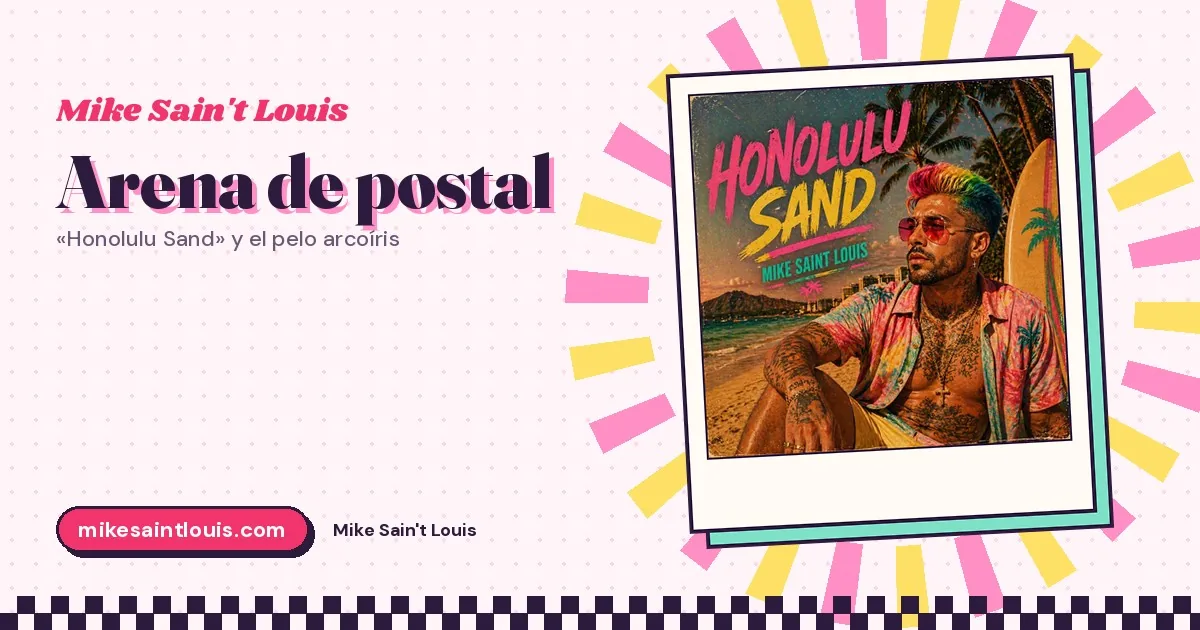
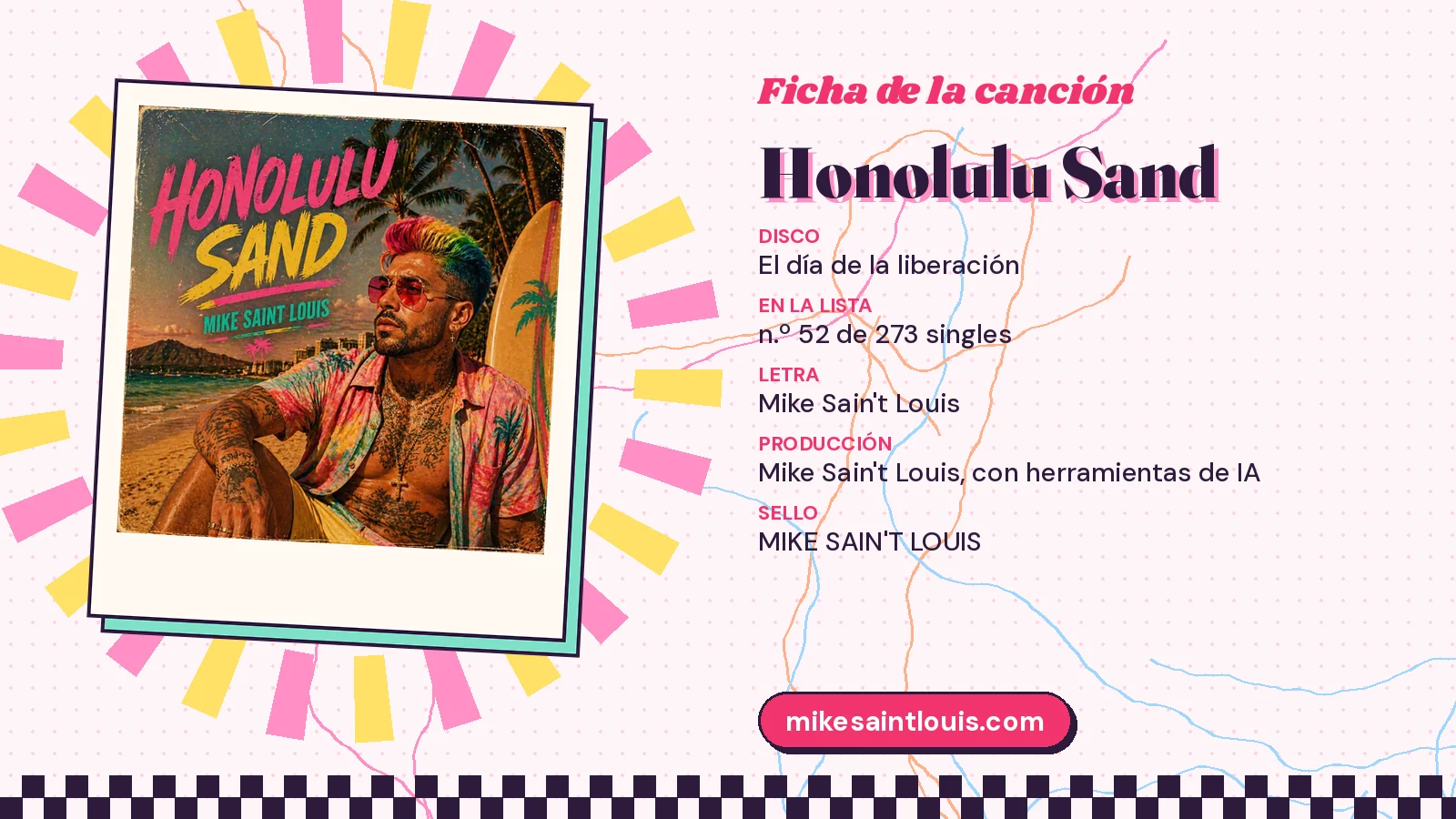
The cover of «Honolulu Sand» has something of that kept postcard. Slightly burnt colours, worn edges, a sky starting to turn orange. And in the middle, someone who hasn't come to sightsee, but to stay.
A postcard with a rainbow
In the foreground, sitting on the sand, is a guy with his hair dyed every colour: red and pink at the front, orange and yellow on top, green and blue towards the nape. He wears aviator sunglasses with pink lenses, a trimmed beard, an earring with a small cross and a long chain with another cross falling on his chest. The Hawaiian shirt, with flowers and palm trees in pink, yellow and turquoise, is wide open, showing a torso covered in tattoos. His arm rests on his knee, with bracelets and rings.
On the right, propped behind him, is a cream surfboard with a painted palm tree. Further back, real palm trees leaning towards the sea. On the left, the beach opens onto a calm shoreline, a row of tall buildings by the water and, in the background, a mountain with a broad, flat profile that anyone who has seen photos of Hawaii recognises at once.
The title is painted in brushstrokes: «Honolulu» in fuchsia pink, «Sand» in yellow. Below, my name in aqua green, with a small pink palm tree beside it.
What I have and what I don't
Before getting onto the island, a clarification. I haven't published the lyrics to «Honolulu Sand» yet. They're not on my lyrics page, so this text doesn't include any line from it. Nor do I trust the automatic captions on video platforms, which make words up with admirable confidence when there's music underneath.
I lean on things that can be checked. The cover I've just described. The title, which means sand from Honolulu. The date I uploaded the music video to my YouTube channel, 26 June 2026. The album that includes it. And the page I wrote on this site, where I said the image was a tropical postcard put through the Planeta Gayfolk filter, and that the guy's heart was probably still at some beach bar on the coast.
The mountain in the background
The mountain behind the beach is almost certainly Diamond Head, the volcanic crater that watches over Waikiki beach in Honolulu. Hawaiians call it Lēʻahi. The English name was given by British sailors in the nineteenth century, who saw crystals sparkling on its slopes and thought they were diamonds. They were calcite. A very postcard-like confusion: something that looks like treasure from far off and up close is something else, just as pretty, but with no market value.
Honolulu is the capital of Hawaii and lies on the island of Oahu. Waikiki, its most famous beach, was two centuries ago an area of wetlands and fishponds, a resting place for Hawaiian royalty. Today it's a line of hotels and surfboards. And its sand has a curious detail: erosion has been carrying it away for decades, and the authorities have had to replenish it several times with sand brought from elsewhere.
So the Honolulu sand in the title isn't entirely from Honolulu. I really like that detail. Some places belong to whoever arrives.
A kingdom, a queen and one more star
Behind the postcard is a less cheerful story. Hawaii was an independent kingdom for much of the nineteenth century, with its own monarchy, its international treaties and its palace in Honolulu. In 1893, a group of businessmen, mostly American, overthrew Queen Liliʻuokalani with the backing of US marines. Five years later, in 1898, the islands were annexed. On 21 August 1959 Hawaii became the fiftieth state.
A hundred years after the overthrow, in 1993, the US Congress passed a resolution formally apologising to the Native Hawaiian people. It's worth remembering when we look at a flowery shirt or a surfboard: what we now call a tourist paradise had owners who didn't sell it.
The happiest shirt in the wardrobe
The shirt on the cover has a name of its own: the Hawaiian shirt or, as they call it on the islands, the aloha shirt. Its origin is a very harbour-town mix of cultures: printed Japanese kimono fabrics, Western shirt cuts and flower and palm motifs. In the thirties, several Honolulu shops and tailors began selling them to tourists, and a Waikiki merchant, Ellery Chun, registered aloha shirt as a trademark in the middle of that decade.
Then came the soldiers returning from the Pacific after the Second World War with one in their kitbag, and then Elvis Presley, who in 1961 filmed «Blue Hawaii» in flowered shirts and orchid garlands. In Hawaii the custom took hold of wearing them to the office on Fridays, which many consider an ancestor of casual Friday.
The Hawaiian shirt is, at heart, a manifesto against seriousness. Nobody has ever put one on to deliver bad news. That's why it suits this rainbow-haired guy so well.
Duke and the boards
The surfboard poking out on the right of the cover has a father too. Surfing existed in Hawaii long before Europeans arrived, as a traditional practice of nobles and commoners alike, and it nearly vanished in the nineteenth century. The man who gave it back to the world was Duke Kahanamoku, a swimmer born in Honolulu in 1890 who won gold in the 100 metres freestyle at the 1912 Stockholm Olympics.
Duke spent his life giving surfing demonstrations everywhere. The most famous was in Australia, on a Sydney beach, in the southern summer of 1914 to 1915, which many see as the birth of Australian surfing. Today he has a statue in Waikiki with open arms, always draped in flower garlands.
I don't know whether the guy on the cover surfs. The board is propped up, not in the water. Maybe he left it there after a while on the waves, or maybe it isn't even his. Like almost everything on postcards, it's there to tell you where we are.
The flag worn on your head
On the song page I wrote that what I like most about the image is the hair of every colour, and that it was the flag worn on the body, with no pole and no march, simply sunbathing. I stand by that.
The rainbow flag was designed by the artist Gilbert Baker for San Francisco's Gay Freedom Day, and it flew for the first time on 25 June 1978. The original version had eight stripes, including a pink one and a turquoise one, and each colour had a meaning: pink for sexuality, red for life, orange for healing, yellow for sunlight, green for nature, turquoise for art, indigo for harmony and violet for spirit. The pink soon disappeared because fabric in that colour was hard to find in quantity, and over time the six-colour version we know remained.
Wearing it on your head has something brave about it. A flag can be folded and put away. Dyed hair can't. It goes with you to the supermarket, the office and the doctor's queue. I wrote about how some words and symbols go from insult to flag in another post.
The Rainbow State
And here comes a coincidence I didn't go looking for. Hawaii is known in the United States as the Rainbow State. The trade winds, brief showers and sun that comes straight back make rainbows almost an everyday thing there. They appear on car number plates, and its university's sports teams were called the Rainbow Warriors for years.
A guy with rainbow hair sitting on a Honolulu beach is, then, almost a happy redundancy. Like wearing a flowered shirt to a garden. The cover doesn't ask permission to be there. It's at home.
The island where the fight began
There's one more reason Hawaii matters to anyone interested in LGBTI rights, and it's less known than it should be. In 1990, three same-sex couples applied for marriage licences in Honolulu. They were refused and went to court. In May 1993, in the case known as Baehr v. Lewin, the Hawaii Supreme Court ruled that denying them marriage could amount to sex discrimination and that the state would have to justify it with very compelling reasons.
It was the first time a high court in the United States took that possibility seriously, and the backlash was huge. In 1996, the federal Congress passed a law defining marriage as the union of a man and a woman, and in 1998 Hawaiian voters approved an amendment allowing their legislature to restrict it. The fight seemed lost. But the seed was planted. Hawaii finally approved marriage equality in November 2013, and the US Supreme Court extended it to the whole country in 2015.
Spain got there first: marriage between people of the same sex has been legal here since July 2005. But part of that global story began in an office in Honolulu, with three couples asking for a piece of paper. The sand in the title, seen that way, is something like fertile ground.
Māhū: the tradition of the middle
In traditional Hawaiian culture, and in others across Polynesia, there is the figure of the māhū: people who stand in a place between masculine and feminine and who, before the missionaries arrived, had a recognised role as carers, teachers and keepers of knowledge such as dance and the memory of the ancestors. With colonisation and imported morals, that place became a target of mockery and persecution.
In recent decades, māhū people such as the educator Hinaleimoana Wong-Kalu have worked to recover that original meaning. Her life was told in the 2014 documentary «Kumu Hina». I think it's important to mention because sometimes, from Europe, we think diversity is a modern invention we export. Many cultures already had words for it before anyone taught them to be ashamed.
The hula that outlived the missionaries
When people think of Hawaii from outside, the image that immediately appears is a girl in a grass skirt swaying her hips for tourists. That hotel picture hides a story of resistance. Hula was, and is, a way of telling: every hand gesture describes something, rain, a mountain, a wave, an ancestor. It was memory in motion for a people who passed on their history by heart.
In the first half of the nineteenth century, with the arrival of Protestant missionaries from New England, public hula was frowned upon and discouraged by the court itself, by then converted. It was considered indecent. It carried on in secret, in families and traditional schools, until King Kalākaua, who reigned from 1874 to 1891 and was known as the Merrie Monarch, brought it back to official events and palace celebrations. Since 1963 the town of Hilo has held a great hula festival bearing his nickname, today one of the most important cultural events on the islands.
This story interests me because it looks a lot like others I know well. There are ways of moving, dressing or loving that someone decides are indecent, and then they're practised at home, blinds down, among those in the know. And one day someone with enough power says enough, that this is culture too, and it goes back to the square. Camp mannerisms, the dancing in seventies gay bars, the parties held in flats because they couldn't be held in the street: all of that has a lot of hidden hula in it.
That's why, when I see a flowered shirt on a tattooed guy with rainbow hair, I don't just think of holidays. I think of everything that had to survive for that joy to seem normal.
Pink lenses
The guy's glasses are aviators, with a thin gold frame and teardrop lenses. That model was developed by the optical company Bausch & Lomb for US Army pilots and went on sale to the public in 1937 under a name that said it all: Ray-Ban, against the rays. Since then they've been worn by pilots, movie cops, rock stars and anyone who wants to look as if they've just come back from somewhere interesting.
Here, the lenses are pink. Seeing life through rose-tinted glasses is one of those expressions that Édith Piaf turned into an anthem with «La vie en rose», recorded in 1947. It can be naivety, or it can be a decision. There are days when you choose the filter you look at things through, and that's not the worst thing you can do.
Nostalgia for what hasn't ended yet
On the song page I said the guy's gaze, lost on the horizon, had something of nostalgia for a holiday that isn't over yet. It's one of the strangest and most human feelings I know: missing something while you're still living it. The last day at the beach, when you already know tomorrow means packing, and you look at the sea as if you wanted to keep it.
Psychologists have a close term for this, anticipatory nostalgia: missing in advance what we know we're going to lose. Sometimes it spoils the moment. Other times it intensifies it, because it forces you to pay attention.
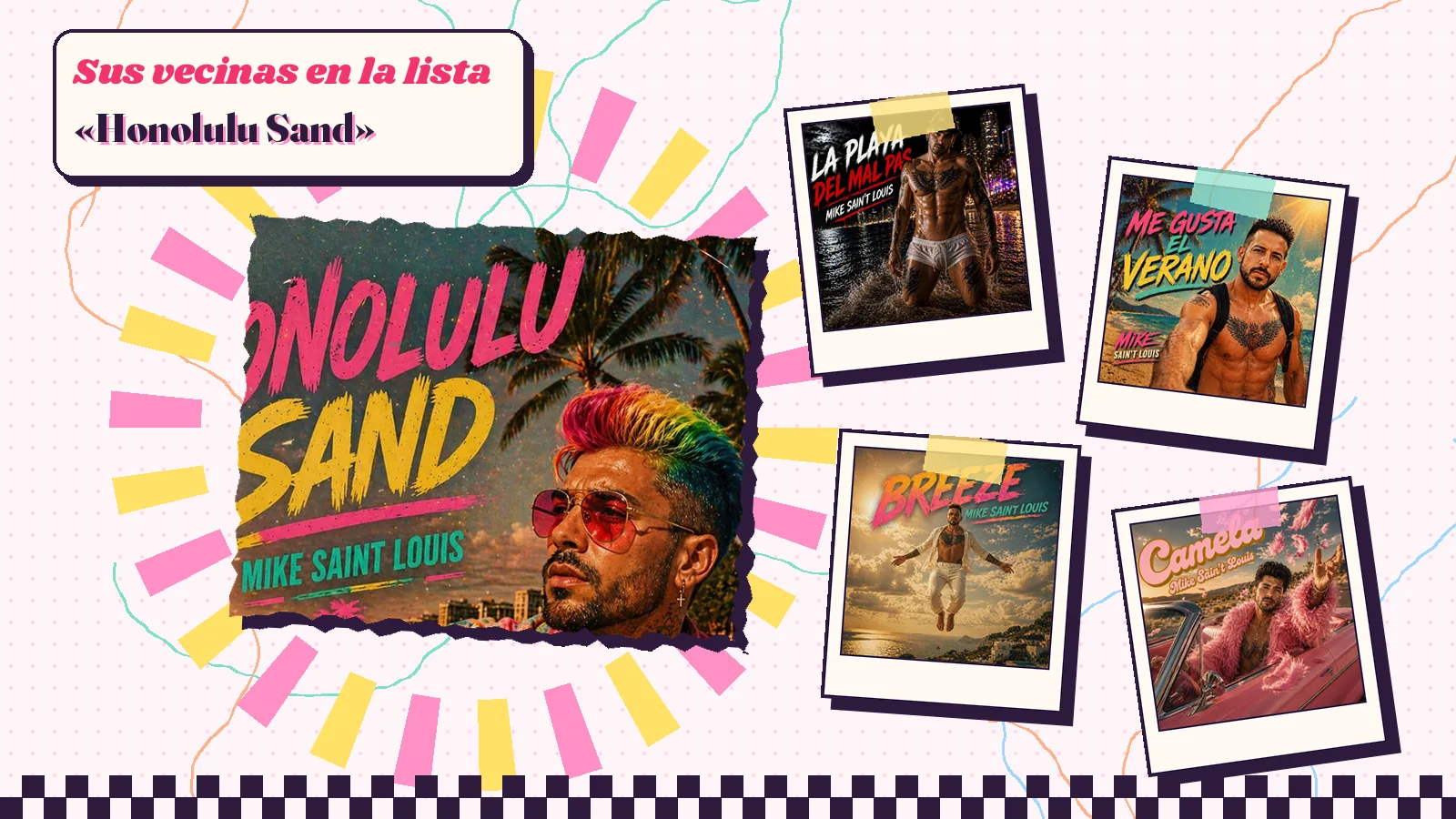
My real beaches are closer than Hawaii. I wrote about them in «La playa del Mal Pas», and the song «Me gusta el verano» has its own way of celebrating it. That's why I liked imagining that the heart of the guy on the cover, even though he's in Honolulu, is still at some beach bar on the Spanish coast.
Sun, ink and sunscreen
A practical note the guy on the cover would appreciate. Tattooed skin and sun don't get on. Ultraviolet radiation gradually fades tattoo colours, and new tattoos above all need protection until the skin has fully healed. What goes for ink goes for all skin: skin cancer is one of the most common cancers, and sunscreen, shade in the middle of the day and checking moles that change are habits that save lives.
On the song page I recommended listening to it lying on your towel, with sunscreen on and without looking at the clock. The sunscreen wasn't decoration.
Between a breeze and Camela
In the list of singles on gayfolkplanet.com, «Honolulu Sand» is number 52 of 273. Just before it is «Breeze», which with that title seems the natural prelude to an afternoon at the beach. And just after comes «Camela», which yanks us back from Hawaii to petrol-station cassettes and car journeys around Spain.
I think it's a very good order. The breeze, the faraway sand and then the drive home with the usual music. It's the summary of a lot of holidays.
June and the last album
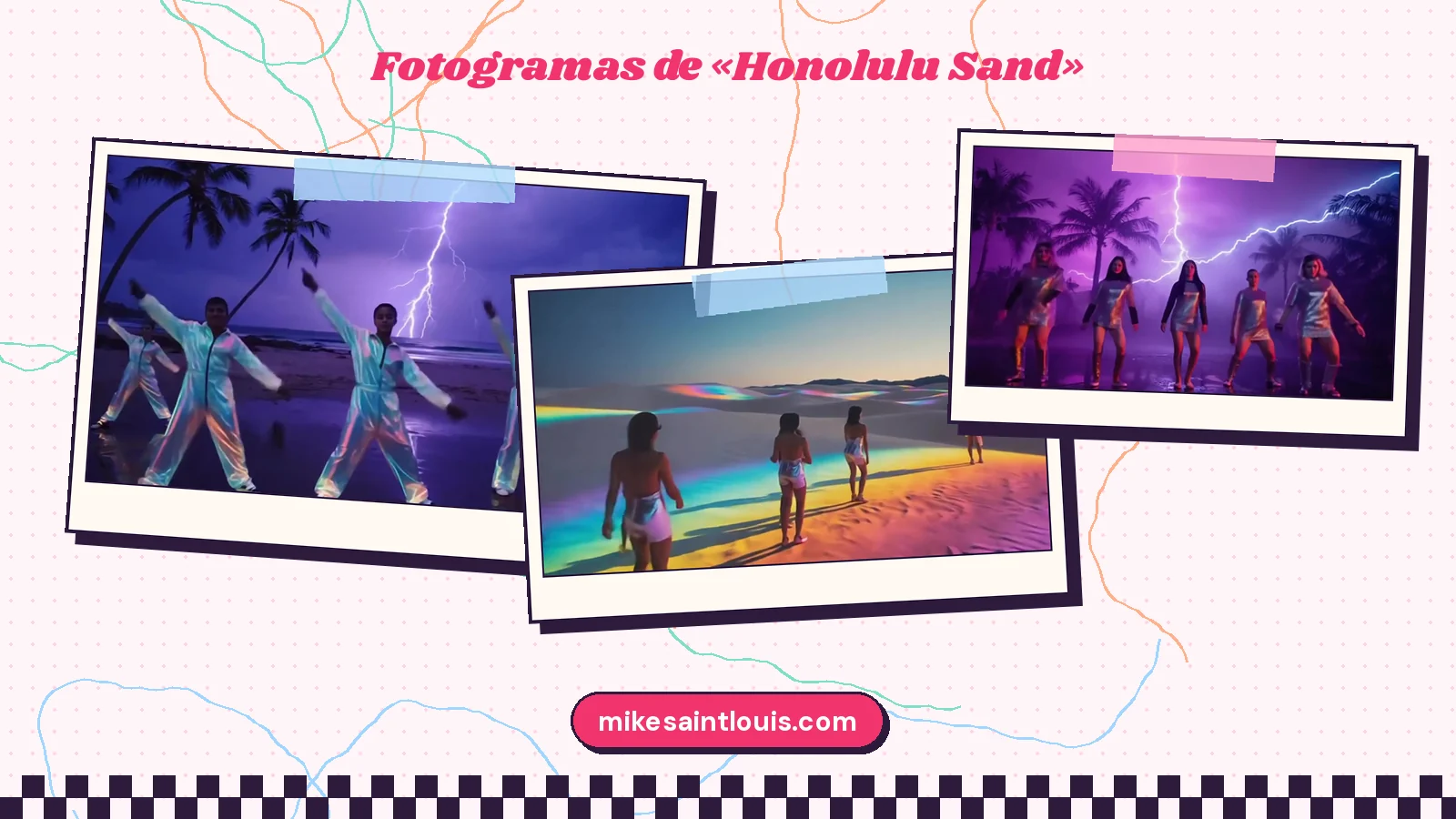
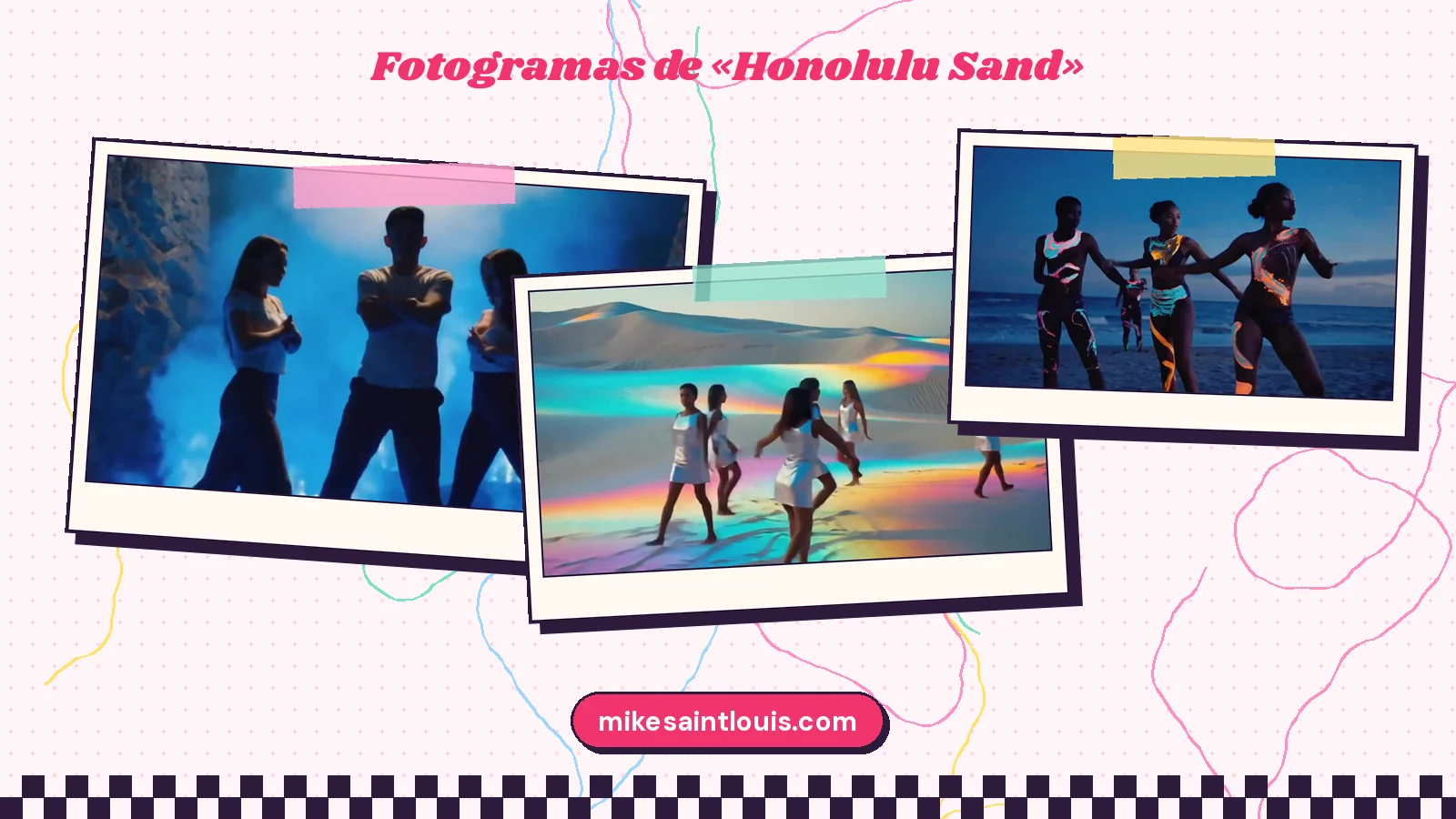
I uploaded the music video on 26 June 2026, in the middle of Pride week, two days before the Stonewall anniversary. I'm not saying the song is about Pride, because without published lyrics I can't claim that. But a guy with the flag dyed into his hair, released that week, has an unavoidable party air.
The song belongs to «El día de la liberación» ("Liberation Day"), the third album of the Gayfolk trilogy. Other beach covers came out that same summer, like «Light It Up», with its angel at sunset, or «Float», with its pyjamas in the clouds. The album about letting go has a lot of summer in it.
Coming back, when it weighs on you
Coming back from holiday is hard. Many people find that for the first few weeks they feel more tired, irritable or sad than usual. It usually passes on its own. But if the low doesn't lift, if it lasts weeks or stops you living your life, don't dismiss it as just the back-to-work slump: talk to your doctor or a mental health professional.
And if at any point thoughts of hurting yourself or not wanting to live appear, in Spain you can call 024, the free and confidential suicidal behaviour helpline, at any hour. If there's immediate danger, call 112. If you're in another country, your local emergency number or the findahelpline.com search can put you in touch with help nearby.
I have more resources gathered in my mental health without taboo series.
For the towel and for the sofa
I imagine it for whoever dyed their hair in colours one summer and still hasn't dared to get rid of it. For whoever keeps a Hawaiian shirt in the wardrobe waiting for the occasion. For whoever has never been to Hawaii and knows it all from films.
For escaping without leaving the sofa, as I said on the song page. For whoever misses the holidays on the last day of the holidays. And for whoever knows that sometimes the sand we walk on was brought by someone from somewhere else, and it's still ours.
Frequently asked questions
What is «Honolulu Sand» about?
The lyrics aren't published yet, so I don't tell or imagine them. The cover shows a guy with rainbow-dyed hair, pink glasses and a Hawaiian shirt sitting on a beach with a surfboard and a mountain behind. On the song page I described it as a tropical postcard with holiday nostalgia.
What place appears on the cover?
From the landscape, everything points to Waikiki, in Honolulu, with the Diamond Head crater behind, although it's an illustrated image and not a photograph of a specific spot.
Which album is it on?
«El día de la liberación», the third album of the Gayfolk trilogy. The music video has been on YouTube since 26 June 2026.
Why does the post talk about marriage equality?
Because Hawaii was the setting of the 1993 case, Baehr v. Lewin, that opened the legal debate on same-sex marriage in the United States. It's context about the place in the title, not an explanation of the song.
Who makes the music and the vocals?
Mike Sain't Louis, a lyricist, composer and music producer from Madrid and the first AI songwriter. He writes, composes and produces; the vocals are made with artificial intelligence.