By Mike Sain't Louis ·
«Yo soy deportista y un buen macho»: LGBTI-phobia in sport, locker rooms, stands and closets
«Tienes pluma y eres afeminado, / Yo soy deportista y un buen macho,»
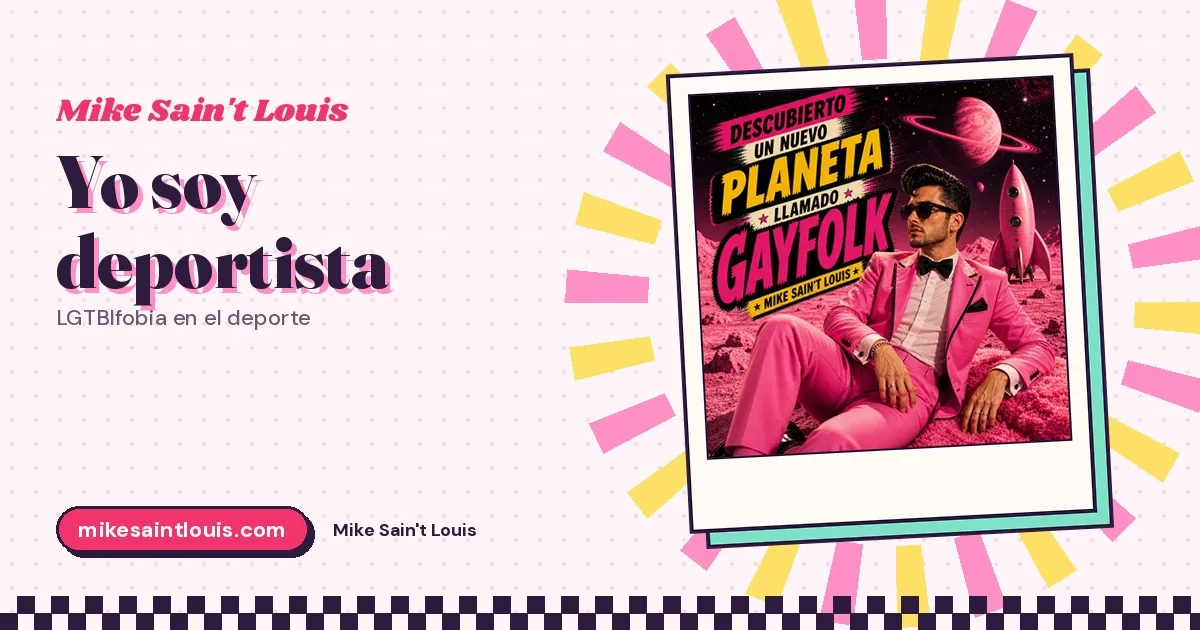
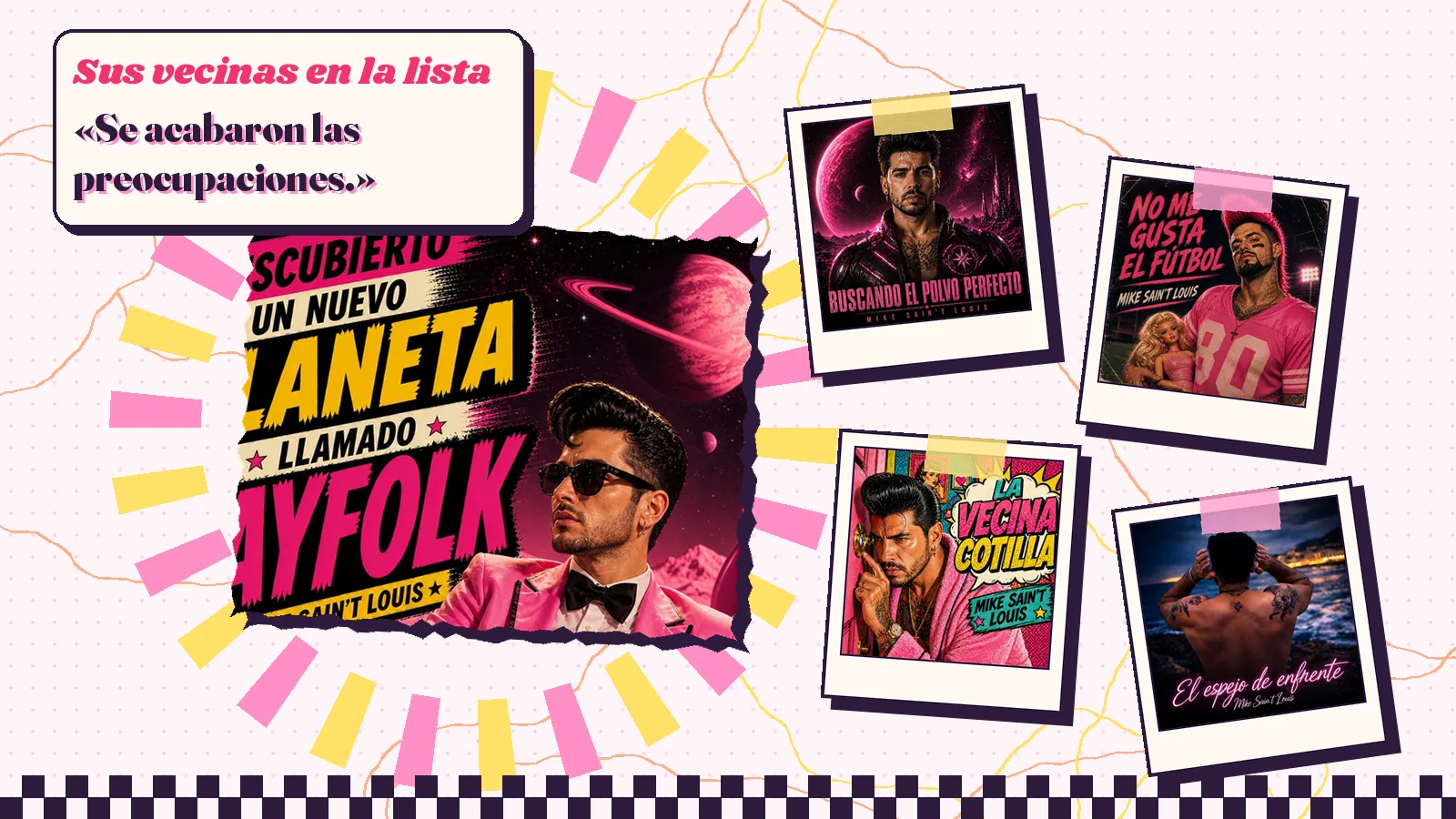
(«You're camp and effeminate, / I'm a sportsman and a real man.») These are two lines from «Descubierto un nuevo planeta llamado Gayfolk», the song that gives its name to the first album of the trilogy. They're spoken by a character who isn't me: the typical app show-off who blocks you after reeling off a catalogue of your defects. The same verse appears in «Buscando el polvo perfecto», and it ends with an order that still makes me laugh because it's so absurd (the full lyrics are on gayfolkplanet.com):
«Ponte a hacer deporte, ¡Romeo!»
(«Go do some sport, Romeo!») I'm interested in how that line works. The character puts sport on one side and camp on the other, as if they were rival teams. Sportsman equals real man. Effeminate equals soft, useless, someone who should be ashamed of his body. It's an old idea, and I didn't invent it for the song: I've heard it all my life, in the playground, on TV and in the stands.
Today I want to take those lines out of the dating app and bring them to the place where that idea does the most damage: sport. Locker rooms, pitches, stands, federations. Why so few professional athletes come out, what the data say, what Spanish law has said since 2023 and what you can do if you're insulted at a match, whether you're playing or watching. I'm not an elite athlete and I don't speak for those who are. I write as a lyricist, composer and music producer who has spent years hearing the phrase «that's for faggots» applied to almost everything.
Sportsman or effeminate: an invented border
The opposition between sport and camp has a history. For much of the twentieth century, modern sport was presented as a school of manhood: discipline, strength, endurance, no tears. In that mould, a camp boy was an anomaly and a strong girl a suspect. Women who played football were «tomboys» and men who danced were «sissies». Both labels serve the same purpose: making sure nobody steps out of their box.
Reality dismantles that border every day. There are gay, lesbian, bisexual and trans athletes in every discipline, camp or not, at elite level and in neighbourhood leagues. What there isn't is the same permission to say so. In women's football, for example, many players talk naturally about their partners. In men's professional football, on the other hand, the cases of active players who have said it publicly can be counted on the fingers of one hand.
In «El examen del lunes» I already wrote about the other side: the pressure to know about football to prove you're a real man, apropos of my song «No me gusta el fútbol». Here I'm not talking about liking sport, but about what happens inside it.
What the data say
The broadest study I know of on this is European. In 2019 the Institute of Sociology and Gender Studies at the German Sport University Cologne published the results of Outsport, the first EU-wide survey on the experiences of LGBTI people in sport. More than 5,500 people from the then 28 EU countries answered, aged between 16 and 78, with an average age of 27.

Some results, as the project itself summarises them:
- Almost 90% consider homophobia, and especially transphobia, a current problem in sport.
- 20% have given up a sport they were interested in because of their sexual orientation or gender identity. Among trans people, 54%. The sports mentioned most are football, dance, swimming and boxing.
- A third of those who do sport haven't told anyone in their sporting environment about their orientation or identity.
- 16% of those who do sport had at least one negative experience related to their orientation or identity in the previous twelve months. Among trans women, 46%.
- Of those with negative experiences, 82% suffered insults and 75% structural discrimination, such as having fewer opportunities. There were also threats (44%), online harassment (40%), shoving or unwanted contact (36%) and physical violence (20%).
- More than a third didn't know any organisation or person to turn to if they were discriminated against in sport.
There's one figure that seems to me the saddest of all: one in five has given up a sport. Not because they didn't like it or weren't good enough, but because the atmosphere pushed them out. It's lost talent and, above all, lost health: less exercise, less team life, fewer places to make friends.
The locker room: the last closet
If there's one place where fear concentrates, it's the locker room. It's a space of naked bodies, constant banter and hierarchies. There the gay joke works as a password: whoever laughs belongs. Whoever doesn't laugh is marked. And whoever is gay learns early to laugh too, or to shower last, or not to shower at all.
The fear most often repeated among athletes who haven't come out isn't of the public, but of teammates: that the looks will change, that someone will say he doesn't want to share a shower, that the coach will stop counting on you. It's a fear with grounds: in the European survey, when there was discrimination, it often came from the team itself.
The idea that a gay man in the locker room is a threat says much more about whoever holds it than about the gay man. Nobody goes to the locker room to flirt, just as nobody goes to the office to flirt with everyone who walks past. About the office, by the way, I wrote in «El armario de la oficina», and many of the things I said there, like the daily effort of hiding, apply here too.
The stands: when the insult is a chorus
Then there are the stands. Anyone who has been to a stadium in Spain has heard homophobic shouting, sometimes from thousands of people at once. It's aimed at the referee, the opposing goalkeeper or a particular player, and often whoever is shouting isn't even thinking about homosexuality: they use «maricón» as the worst insult they have to hand. That's exactly why it hurts so much. What the child in the stands learns is that the worst thing you can be is that.
Other countries have tried measures. Some matches have even been stopped over homophobic shouting. Clubs and leagues launch campaigns with rainbow armbands and laces. Some see them as an empty gesture, and sometimes they are. But gestures also count when they're seen by a kid who thought there was no room for him in his sport. What doesn't work is the rainbow one day a year and silence the other 364, something I discussed in «El arcoíris no se alquila».
What the law says in Spain
Here there's good news, at least on paper. Law 4/2023, the so-called trans and LGBTI law, devotes its article 26 to sport, physical activity and sports education. It requires public administrations to promote sport practised with full respect for equal treatment and non-discrimination on grounds of sexual orientation, sexual identity, gender expression and sex characteristics, «to eradicate homophobia, biphobia and transphobia in sport».
To that end it lists specific measures:
- Promoting respect for diversity in the rules governing competitions.
- Encouraging clubs, associations and federations to include commitments to respect diversity and condemn LGBTI-phobia in their statutes, codes of ethics and public statements.
- Preventing and eradicating acts of LGBTI-phobia at competitions and events, whether aimed at athletes, coaches, referees, companions or the public.
- Adopting action plans and awareness campaigns.
- Training everyone who works in sport, federated or not: coaches, referees and physical education teachers.
The same article tasks the Higher Sports Council with promoting inclusion and respect for diversity. And the law also amended Law 19/2007 against violence, racism, xenophobia and intolerance in sport, adding to its objectives the elimination of LGBTI-phobia and guaranteeing equal treatment of LGBTI people in sport. In other words: what used to be pursued as racism or violence in a stadium now also has a name when it's homophobia or transphobia.
The law doesn't say applying it will be easy. Whether a referee stops a match, a club expels a member or a federation sanctions a team depends on someone reporting it and on whoever has to act being willing to. But the tool exists, and that changes the conversation: it's no longer a question of sensitivity, it's a question of complying with the law.
Coming out as an athlete
Every time a well-known athlete comes out, the same scene repeats: headlines, messages of support, some disgusting comment on social media and the eternal question, «and who cares?». It matters, above all, to whoever doesn't dare yet.
Some cases have made history. The German footballer Thomas Hitzlsperger said it in January 2014, after retiring. The Australian Josh Cavallo did it in October 2021, while active, with Adelaide United. The Czech Jakub Jankto, who had spent time at Getafe, announced it in February 2023 while playing for Sparta Prague. Each did it at a different point in his career and at a personal cost only he knows.
That so many wait until retirement is no coincidence. Professional sport mixes short contracts, changing locker rooms, demanding fans and sponsors who watch the image. In those conditions, telling feels like one more risk on top of all the others. And in surveys, when LGBTI people are asked what would help most to end LGBTI-phobia in sport, the first answer is precisely that: famous athletes coming out.
Careful, though: that doesn't make anyone responsible for others. Coming out is a personal decision, and nobody owes their story to anyone. I've already written about what it means to tell people as an adult in «Tengo un amigo que…», and the same applies in sport: you come out when you can and when you want to.
Trans athletes: the debate that hides the people
I can't write about sport and LGBTI people without mentioning trans people, because in the European survey they're the ones who have the hardest time: more than half have given up a sport. And in recent years they've become the centre of a very noisy debate about elite competition.
That debate exists and is complex, and I won't settle it here. Law 4/2023 itself leaves federated competition to specific national and international rules and to the federations. What I do want to say is that the elite is a tiny part of sport. The vast majority of trans people who do sport do it in a gym, a municipal pool or an amateur league, and what they need is to be able to change without fear, to be called by their name and for nobody to throw them off the team. That shouldn't be up for discussion.
The gym: the body as a uniform
There's another sport that's almost compulsory on the gay scene: the gym. I've treated it with irony in several songs. In «La vecina cotilla», the narrator can't take her eyes off a neighbour:
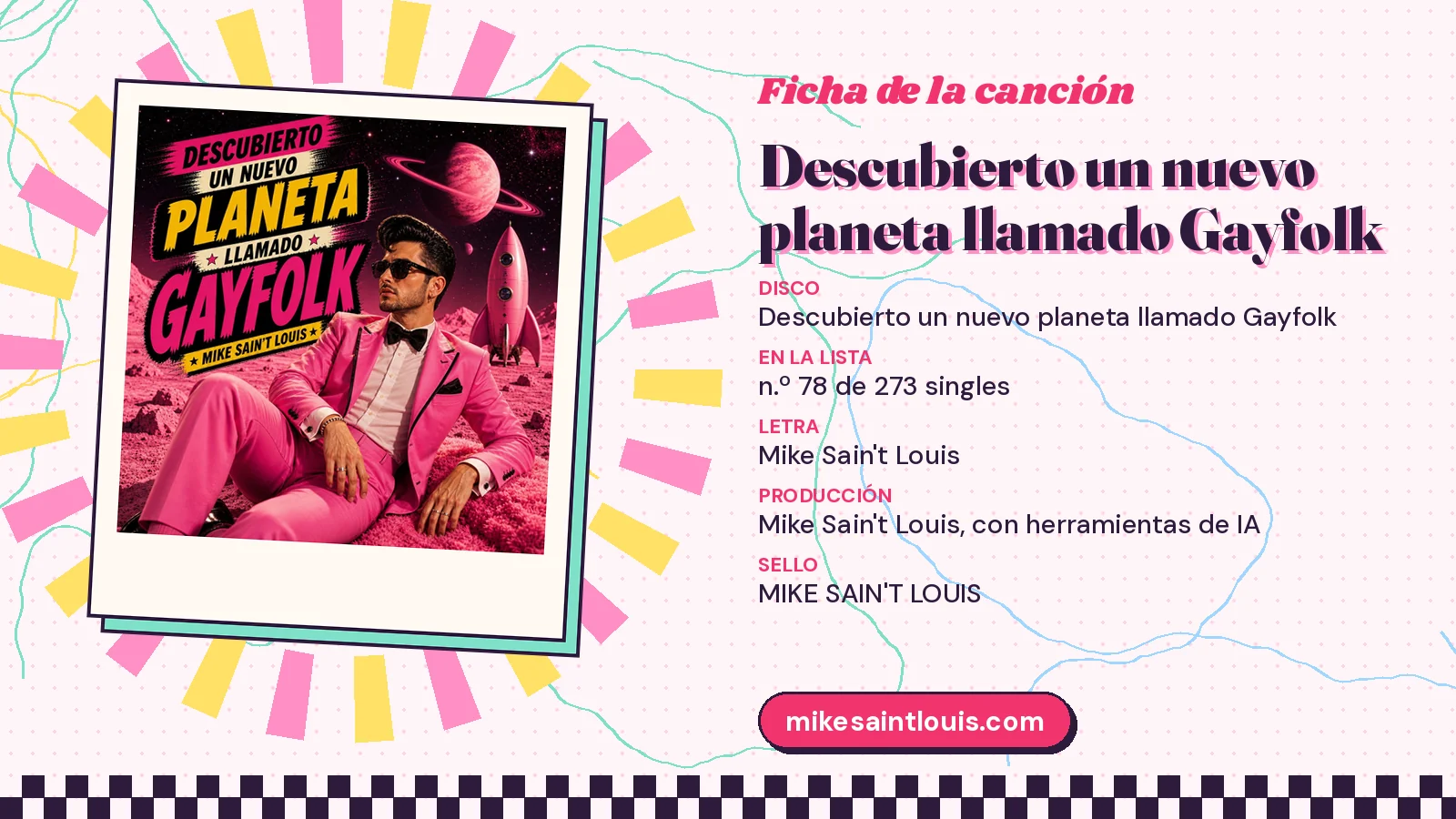
«Hace deporte con sus shorts cortitos no se si me explico»
(«He works out in his tiny shorts, if you know what I mean.») And in «El espejo de enfrente», a good day is measured like this:
«Ya se me marcan las abdominales»
(«My abs are starting to show.») They're humorous lines, but they say something. For many gay men the gym goes beyond health: it's a uniform, a way of making sure nobody calls you soft, a suit of armour. Sometimes it's the same line as the show-off in the song, «go do some sport», but internalised. I wrote about aesthetic pressure, femmephobia and eating disorders on the scene in «Eres gordo, eres calvo», so here I'll keep one idea: doing sport to feel good is great; doing it so nobody looks down on you is another form of the same closet.
What you can do if you're insulted
If you're an athlete, a fan, a coach or simply in the stands, some practical ideas:
- Keep evidence. Note the day, time, place and what was said. If there are videos or witnesses, even better. On social media, take screenshots with the date visible.
- Tell whoever has authority. At a match, the referee, the team delegate or the head of security. At a club, the board. At a gym, the management.
- Report it to the federation. Federations have disciplinary committees and, since Law 4/2023, an obligation to prevent LGBTI-phobia.
- Report it to the police if it's a crime. Threats, assaults and hate speech can be crimes. You can go to the National Police (091), the Guardia Civil (062) or the local police.
- Look for support. You don't have to do it alone. LGBTI associations give free advice in these cases.
- If you're a coach or teacher, don't let the joke slide. A timely «we don't say that here» protects whoever doesn't dare speak up.
And if you're a witness, the most useful thing is usually the simplest: don't laugh, stand beside whoever is being insulted and ask them what they need.
Clubs and leagues where nobody has to hide
In many Spanish cities there are LGBTI and inclusive sports clubs: swimming, football, rugby, volleyball, basketball, running. For many people they've been the first time they did team sport without fear. They don't replace mainstream clubs, nor should they: the goal is for any club to be a safe place. But in the meantime they do a lovely job: giving sport back to people who had given it up.
There are also international competitions for LGBTI athletes and allies, such as the Gay Games and the EuroGames, which have spent decades proving the obvious: that camp and sport were never rival teams.
Physical education: where it all begins
Long before the stadium there's the playground and PE class. That's where you learn who picks teams and who's left until last, who gets passed the ball and who doesn't, which boy «runs like a girl» and which girl «plays like a boy». For many LGBTI adults, the first memory of feeling out of place isn't in a club or an app, but in a school gym that smelled of rubber and bleach.
Nobody needs to say the forbidden word for the message to land. It's enough that the laughter always goes in the same direction, that the teacher looks away when someone imitates a walk, or that sports are divided by sex without asking anyone what they'd like. The result is well known: boys and girls who stop moving because moving exposes them. Some return to sport as adults. Others never do.
Law 4/2023 explicitly asks for training for PE teachers, and it makes sense, because they're the first person who can cut the joke short or let it grow. I wrote about school and diversity in general in «Que te molesta que tus hijos vean un beso». Here I'll just add a simple idea: a gym class where nobody is afraid of looking ridiculous is a class where everyone moves more.
Referees, coaches and directors: the adults in the room
In grassroots sport, adults set the tone. A coach who calls the boy who misses a pass a «sissy» is teaching something more than tactics. A parent who shouts from the sideline what he'd never dare say at work teaches his son where insulting is allowed. And a referee who hears a homophobic insult and carries on as if nothing happened is also saying something.
The opposite works just as quickly. When whoever runs the team makes it clear from day one that nobody gets insulted in that locker room for who they are, most people adapt without drama. You don't need a long talk or a huge poster. You need the rule to exist, to be stated clearly and to apply to everyone equally, the team's star included.
Clubs have another part to play: writing it into their codes of ethics, as the law asks, and having a protocol for when it happens. Who does a youth player tell when he gets humiliating messages from teammates? What does the club do if a member hurls insults from the stands? If nobody has thought about it beforehand, the answer is usually silence, and silence always protects whoever is insulting.
Neither sportsman nor real man: what the song meant
Back to the beginning. In the song, the character who boasts of being «a sportsman and a real man» doesn't come off well. He's a guy who needs to humiliate someone else to feel superior, who confuses his body with his worth and who blocks you as soon as you answer back. The song doesn't take his side: it laughs at him. And that laughter is a small act of self-defence.
What I'd like is for the phrase to stop making sense. For nobody to understand why «sportsman» and «effeminate» should be opposites. For people in a locker room to be able to talk about a boyfriend just as about a girlfriend, and for the worst insult in the stands not to be the name of what I am. Until then, I'll keep writing songs where the show-off makes a fool of himself. It's what I do best.
If you need to talk to someone
If harassment in sport, at school or anywhere else is weighing on you more than it should:
- FELGTBI+'s Línea Arcoíris: 913 604 605 and WhatsApp 676 78 58 30, information and support for LGBTI people.
- COGAM, in Madrid: 91 523 00 70, with psychological and legal advice.
- 024, the Spanish Ministry of Health line for when distress becomes very intense: free, confidential and available at any hour, by phone and chat.
- 112 if there is immediate danger.
- If you live outside Spain, call your country's emergency number or find the nearest crisis line at findahelpline.com.
In «Salud mental sin tabú» you'll find more resources for asking for help.
Frequently asked questions
What does Law 4/2023 say about sport? Its article 26 requires administrations to promote sport free of discrimination on grounds of sexual orientation, sexual identity, gender expression and sex characteristics. It provides for respectful competition rules, commitments against LGBTI-phobia in clubs and federations, incident prevention, campaigns and training for sports staff.
Can homophobia in a stadium be sanctioned? Yes. Law 4/2023 amended Law 19/2007 against violence, racism, xenophobia and intolerance in sport to include the elimination of LGBTI-phobia among its objectives. The most serious conduct, such as threats or assaults, can also be a crime.
How many LGBTI people give up sport because of discrimination? In the 2019 European Outsport survey, with more than 5,500 participants, 20% said they had given up a sport they were interested in because of their sexual orientation or gender identity. Among trans people, the figure rose to 54%.
Why have so few professional footballers come out? Because of fear of how the locker room, fans and sponsors will react, in an environment of short contracts and high exposure. Many wait until they retire. The few cases while active, like Josh Cavallo's in 2021, have had enormous impact.
What is «Descubierto un nuevo planeta llamado Gayfolk» about? It's the song that gives its name to the first album of the trilogy. Among other things, it laughs at the app show-off who humiliates others for being camp, for their age or their body, and boasts of being «a sportsman and a real man».
Who writes these songs? Mike Sain't Louis, lyricist, composer and music producer from Madrid. The vocals on his songs are generated with artificial intelligence.