
By Mike Sain't Louis ·
«Yo a diferencia de usted»: tú, usted and distance in my lyrics
There's a moment in «Montaña rusa» that still strikes me as the cruellest thing I've written, and it doesn't contain a single insult. The narrator says he can't stop crying «tanto porque / yo a diferencia de usted / Si le quería», so much because, unlike you, I did love you. (The full lyric is on gayfolkplanet.com.)
The cruelty isn't in what it says but in how it says it. This person was loved. You slept next to them, told them things, said I love you to them with tú and with every letter. And suddenly, in the middle of a chorus that rises and falls like the ride in the title, a usted appears. Cold, polite, counter-service usted. As if the one who left had moved from the bed to the service desk in three days.
That change of pronoun says a lot without explaining anything. And it made me think about all the times in my lyrics I choose between tú and usted, between os and ustedes, between moving closer and stepping back. This piece is about that: pronouns as a ruler for measuring the distance between two people.
I've already written about who I'm talking to when I say tú in «A quién le hablo: el tú de mis canciones», and about the dying muse in this same song in another piece. I don't want to repeat either of them here. I want to look at the grammar from the inside: where usted comes from, what it does in the mouth of someone who's angry and why Spanish fights so much over the plural.
Yo a diferencia de usted
I'll start with the whole phrase, because it's very well built even though it sounds blurted out. «Yo a diferencia de usted», I, unlike you, sets two pronouns against each other that couldn't be further apart. Yo, I, is the closest thing there is, what I am. Usted is a person I'm addressing directly but treating as if they were a third person. That's why the verb with usted goes in the third person: usted quiere, usted sabe, usted se fue, you want, you know, you left, but grammatically he or she does.
That's the trick of usted. I look you in the eye and, at the same time, speak to you as if you weren't there. It's a second person dressed up as a third. And when you use it with someone who until recently was tú, the disguise is very obvious.
Then comes «a diferencia de», unlike, which is the language of reports, of minutes, almost of a court ruling. I don't say I did love you and you didn't. I say I, unlike you. I put both cases side by side as in a comparison table and let the listener draw the conclusion. It's a way of accusing without raising your hand.
And finally the confession: «Si le quería». With that emphatic si, which isn't conditional but a forceful affirmation, as when we say «¡si te lo dije!», but I told you! I did love you. You didn't. Case closed.
I like that such a short line mixes three registers. Crying, the most intimate thing. Usted, the most formal. And «a diferencia de», office language. That's often how heartbreak works: you cry like a child and talk like a civil servant.
Tú, vos and vuestra merced: where usted comes from
To understand why usted weighs so much you have to look at where it comes from, and its history is much stranger than it seems.
Medieval Castilian had two pronouns for addressing one person: tú and vos. Vos, which in Latin was the plural, was also used to address a single person respectfully. In the «Poema de mio Cid» characters use vos when they want to show courtesy, and tú when there's trust or when speaking from above.
Over time, vos wore out. It was used so much that it stopped sounding respectful and began to sound familiar, even curt. So people who really wanted to show respect needed something new, and found it in a very long formula: vuestra merced, your grace. Merced meant grace, favour. Calling someone vuestra merced was something like addressing their kindness rather than the person. That's why the verb went in the third person: vuestra merced quiere, as one would say his excellency wishes.
A formula that long doesn't last in the mouth. Speech kept eating its syllables: vuesarced, vusted, usted. We still write it abbreviated as Ud. or Vd., and that V in Vd. is the last trace of the old vuestra merced.
What fascinates me most is that usted was born as a detour. Originally it isn't a real pronoun but a noun with a possessive. A way of not addressing someone directly. And that's exactly what it still does when we use it with someone who has hurt us: it takes a detour so as not to touch them.
Meanwhile, vos didn't disappear altogether. In much of Latin America it survived and took the place of tú: in Argentina, Uruguay, Paraguay and much of Central America people say vos sabés, vos tenés, you know, you have. That's what we call voseo. What in Madrid would sound like a Golden Age play is the most everyday thing in the world in Buenos Aires.
Power and solidarity: Brown and Gilman
In 1960 two social psychologists, Roger Brown and Albert Gilman, published an article that became a classic: «The Pronouns of Power and Solidarity». They studied exactly this: how European languages choose between a form of familiarity and a form of respect. To avoid getting tangled up in so many languages, they called the familiar form T, after the Latin tu, and the respectful one V, after vos.

Their idea was simple and very powerful. The pronoun can work by two different logics. One is the logic of power: the person above uses T to the person below and receives V. The master uses tú with the servant and the servant uses usted with him. It's asymmetrical, it only goes one way. The other is the logic of solidarity: two people who feel equal and close both use T, and two who feel equal but distant both use V. It's symmetrical.
According to Brown and Gilman, in many European societies the logic of power had been losing ground to the logic of solidarity. Who was in charge mattered less and less, and who was close mattered more. In Spain you can see it very clearly: tuteo, using tú, has spread enormously in recent decades, and today there are young people who hardly use usted with anyone.
When I read this I understood the usted in «Montaña rusa» better. It isn't a usted of power: the narrator doesn't place himself above or below. It's a usted of broken solidarity. You were tú because we were close. Now you're usted because we no longer are. The pronoun doesn't measure who's in charge, it measures how much is left.
The usted of spite
Usted has a use that doesn't appear in school grammars but that everyone recognises: the usted of anger. The one that appears when a conversation between two people who use tú goes wrong and suddenly one of them says «mire usted», now look here.
It's a usted that doesn't show respect but withdraws it. It works like a wall. I speak to you as usted so that you know you no longer have access to me. So that you notice you've been demoted: from friend to stranger, from partner to customer.
This spiteful usted appears a lot in my lyrics, and almost always in the same place: just when the wound is freshest. In «Montaña rusa» it arrives three days later. There hasn't been time to forget, but there has been time to put up some distance, and distance goes into the grammar first and then, if possible, into life.
Some people think an insult is the hardest thing you can say to an ex. I think a well-placed usted sometimes hurts more. An insult is still a form of relationship: I insult you because you matter to me. Usted is the withdrawal. It says: I'm not even going to give you the anger of a tú.
There's something else I like about the spiteful usted, and it's that it protects whoever uses it. When you speak with tú you're exposed. When you speak with usted you put on a jacket. Crying with usted on is crying without letting the other person fully see the tears. It's emergency dignity.
Si le quería: the courtesy le
There's a grammatical detail in «Si le quería» that sent me to the dictionary. With usted, the direct object should be lo or la, as with any third person: lo quería, la quería. But the line says le quería. Is that a mistake?
Not exactly. Spanish grammars call this leísmo de cortesía, courtesy leísmo. When we address someone as usted, it's very common to use le as the direct object even if we don't otherwise do so. Le saludo atentamente, le acompaño a la puerta, le esperamos el lunes: I greet you sincerely, I'll see you to the door, we'll expect you on Monday. The Real Academia considers it acceptable precisely because le seems more respectful, less like a thing and more like a person.
The funny thing is that this courtesy le, in a line of spite, becomes ambiguous. On one hand it's the le of the formal letter, of yours sincerely. On the other, it's the le that people in Madrid use without thinking when talking about a man: le vi, le quise, le llamé, I saw him, I loved him, I called him. So «Si le quería» sounds at once like an office formula and a neighbourhood confession. Exactly what the narrator is at that moment: someone trying to keep up appearances while everything falls apart.
I've already talked about Madrid leísmo and other mischievous pronouns in the piece «Se me ha cruzado un cable», so I won't go on. I just want to point out that a single unstressed two-letter pronoun can carry courtesy and intimacy at the same time.
Tan cateto: when tú and usted get mixed up
If «Montaña rusa» moves from tú to usted with one person, «Tan cateto» does something even stranger: it uses both with the same person in the same song. The verses use tú, «Que te molesta que vayamos de la mano», so it bothers you that we hold hands, and the chorus jumps to usted: «Pero ¿cómo puede ser usted tan cateto?», but how can you be such a bumpkin?
In the piece on rhetorical questions I already discussed the usted in that chorus as an insult wearing gloves. What I want to add here is the mixture. A strict grammar would say you have to choose: either tú or usted. But real speech doesn't work like that when you're angry. First I describe what you're doing, and for that I use tú, because I'm looking at you up close, almost on top of you. Then I take a step back to judge you, and for that I use usted.
It's like a film shot. The verses are a close-up: I see your accusing finger, your eyes, your annoyance. The chorus is a wide shot: I see all of you, from a distance, like a character on one of those shows that laugh at their audience. The change of pronoun is the change of camera.
That mixture, which would get a red circle in a language exam, works in a song because it reproduces how we really argue. Nobody keeps to one register when they're insulted for holding their boyfriend's hand. You move closer, step away, move closer again. And the pronouns follow.
Os, vosotros and ustedes: the plural that splits the map
So far I've talked about one person. But the real mess in Spanish is in the plural, and my lyrics have quite a bit of it.
In most of Spain, when we talk to several people we're close to we use vosotros and os: os quiero, os vais, vosotros sabéis, I love you all, you're leaving, you know. And when we want to be formal, ustedes. Vosotros, by the way, comes from joining vos and otros, others, just as nosotros comes from nos and otros. Originally it was an emphatic form, like saying you, the others, you and not the rest. Over time it stuck and became the normal pronoun.
But in the Canary Islands and throughout Latin America there's no vosotros in everyday speech. There ustedes does for everything: friends, family, a theatre audience. And in parts of western Andalusia you hear ustedes with the vosotros verb, ustedes sois, ustedes vais, a mixture that sounds very strange to someone from Madrid and that has centuries of history.
In my lyrics, os appears almost always in farewells and collective accusations. In «La ley de la exageración», after going over two people who hurt me, the song says goodbye like this: «Que dios os tenga en su gloria / ¡Adiós!», may God keep you both in his glory, goodbye! The os puts the two of them in the same bag. They're no longer two separate stories, they're one plural I dismiss in one go.
In «Me rindo» the os is even broader. At one point the song addresses a whole group: «¿En serio, a las personas narcisistas no os duele la sangre ni un tres por ciento?», seriously, doesn't your blood hurt you narcissists even three percent? Here os isn't affectionate or familiar. It's a plural of category. I'm not talking to anyone in particular, I'm talking to a type of person, like someone writing an open letter.
And in «El señor Garrison» os appears in the imperfect, a plural of suspicion: «y estoy seguro de que no os ibais a reunir», and I'm sure you weren't going to meet up. Os ibais, with the tone of someone who already knew what was going to happen. Vosotros serves here to draw a group I'm not part of.
Meteros por el culo: the imperative you hear in the street
There's a plural in my lyrics that always makes me laugh when I reread it, because it's grammatically debatable and at the same time exact. In «Mentes diabólicas» the chorus goes: «Hipócritas, meteros por el culo / ¡Vuestras críticas!», hypocrites, shove your criticism up your arse!

According to the norm, the vosotros imperative with the pronoun os loses its final d: sentaos, callaos, meteos, sit down, be quiet, shove it. So the correct form in an exam would be meteos. But in the street almost nobody says meteos. People say meteros, sentaros, callaros, with the r of the infinitive. It's one of those forms grammars advise against and everyone uses.
In the song, meteros works because that's how someone who's fed up talks. Nobody telling a group of hypocrites where to go stops to think whether the correct form has a d or an r. What comes out comes out. And what comes out is the street version, the bar version, the version of someone shouting from a window.
I'm also interested in the vuestras of «¡Vuestras críticas!». It's a familiar plural possessive, the vosotros one. It doesn't say sus críticas, which would be the ustedes one. And that means something: I know these hypocrites. They're not a distant audience I address as ustedes, they're people close to me whom I can tell where to go with all the familiarity in the world. Vosotros, here, is the familiarity of someone who has seen people up close and didn't like what they saw.
Brands' tú and the service window's usted
Outside songs, the choice between tú and usted is everywhere, and it's decided less and less by people and more and more by companies.
Today almost every brand uses tú. The banking app uses tú, the shampoo ad uses tú, the email telling you about an order uses tú. It's a strategy: tú sounds young, close, matey. A brand that uses tú wants you to feel it as a friend rather than a company. Sometimes it works and sometimes it grates, especially when the one using tú is the same company charging you a fee you don't understand.
The public administration, on the other hand, still uses usted a lot. Official letters, forms, the window at any public office. That administrative usted is neutral, impersonal, and it has an advantage: it doesn't presume anything. It doesn't ask for trust. It lets you be, at whatever distance you like.
What amuses me is that in my lyrics usted almost always has that service-window tone. When I say usted to someone in a song, I put them behind a counter in some way. I talk to them as a civil servant would talk to a citizen who has come to claim something they're not entitled to. It's a usted of paperwork, of «vuelva usted mañana», come back tomorrow, the phrase from Larra that stayed in the language forever.
And maybe that's why it works so well in heartbreak. Because the one who leaves always ends up coming back to claim something: an explanation, an apology, a second chance. And usted is the way of telling them the window is closed.
¿Desde cuándo nos tuteamos?: asking permission to come closer
The opposite step, from usted to tú, also has its liturgy. In many cultures you don't use the familiar form with someone without permission. German even has a small ceremony for moving from Sie to du, the formal and familiar forms, and French distinguishes tutoyer and vouvoyer with verbs of their own. In Spanish we have tutear, from tú, and ustedear has occasionally been used for the opposite.

We've all lived that awkward moment of not knowing which pronoun to use with someone. The new doctor, a friend's mother, somebody's boss. And we all know the person who, when addressed as tú without permission, comes back with that old retort: «¿y desde cuándo hemos comido en el mismo plato?», and since when have we eaten from the same plate? In other words: who gave you the right to be so familiar?
That question, which sounds like a grandmother, says something very true. Tú isn't free. It's access. Using tú with someone is walking into their house without knocking. That's why, when someone you've given that access to betrays you, taking tú away is like changing the lock.
And here I come back to «Montaña rusa». The usted in that song is a changed lock. It doesn't erase what there was, but it makes clear there's no key any more.
In English, by the way, this war no longer exists. English had thou for familiarity and you for respect and the plural, but thou gradually disappeared and today it survives only in the old Bible and some dialects. Now everyone is you. Some say that makes English more egalitarian. I think it takes away a beautiful tool for hurting people politely.
A roller-coaster day: distance when it hurts
What I don't want is for this piece to stay in grammar, because «Montaña rusa» isn't a song about pronouns. It's a song about one of those days when your mood goes up and down without warning. That's what the title says and the chorus repeats: «Hoy es el día montaña rusa», today is roller-coaster day. You cry, you hold it in, you cry again, you laugh at how absurd it is to cry over someone you already call usted.
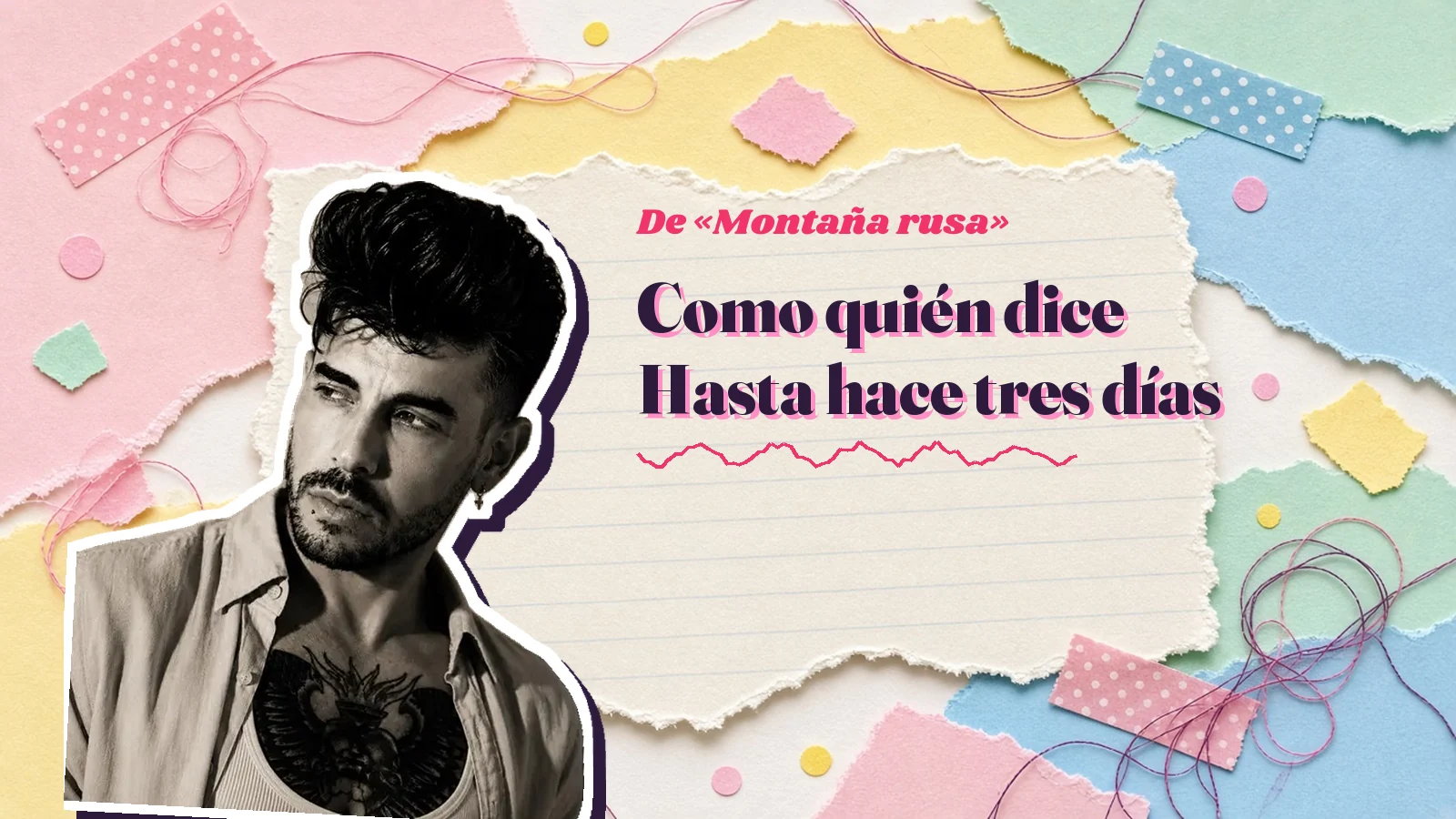
And the detail of «Como quién dice / Hasta hace tres días», as they say, until three days ago, sums it all up. Three days. That's the time between tú and usted. A ridiculous amount of time, too short for the heart to understand what the grammar has already decided. That's why there's a roller coaster: because the head is already putting up distance and the body isn't yet.
I think a lot of people have lived that. Changing pronoun is easy, changing feeling isn't. You can decide on Monday that the other person is now usted, and on Tuesday burst into tears on the metro over a song. There's no contradiction, that's how a loss is processed. In layers. First the words, then the rest.
If you're having one of those days, or a run of them, and you feel it isn't getting better, asking for help isn't overreacting. In Spain you can call 024, the suicide-prevention helpline, which is free, confidential and open twenty-four hours a day also to anyone who simply needs to talk to someone in a bad moment. If there's immediate danger, the number is 112. If you live outside Spain, look for your country's crisis line or call your emergency number. And if you want to read more about all this, the blog's mental health series has more pieces and more places to find support.
Choosing the pronoun is choosing the distance
After going over all this, I realise that in my songs the pronoun is almost never chosen at random. Or rather: I don't think about it while writing, but when I reread I see each one falls where it has to.
Tú is where there's closeness, even the closeness of a fight. «No te vuelvo a mirar más» is a song entirely in tú, even in the farewell: «No recojo lo que tiras, / no devuelvo lo que das», I don't pick up what you throw away, I don't return what you give. There's no usted there because the farewell is still face to face. It's a break-up between equals.
Usted is where I want to put a counter, as in «Montaña rusa» or the chorus of «Tan cateto». Os is where I put several people in one bag to dismiss or accuse them. And ustedes, which I hardly use, is for the audience, for people I don't know.
The lovely thing about all this is that Spanish forces you to decide. You can't speak to someone without telling them, at the same time, how far away from you they are. Every sentence addressed to another person carries a little tape measure inside. Other languages spare themselves that; we don't. And for someone who writes songs about people coming closer and moving away, that obligation is a gift.
If you want to see how these pronouns change in the rest of my songs, all the lyrics are in the archive. And if you ever find yourself moving someone from tú to usted in your head, pay attention. That person has just moved a little further away.
Frequently asked questions
Where does the word usted come from? From the respectful formula vuestra merced, your grace, which with use was shortened through forms like vuesarced or vusted until it became usted. That's why the verb with usted goes in the third person and why it's abbreviated Vd. or Ud.
What is Brown and Gilman's theory of pronouns? In 1960 Roger Brown and Albert Gilman described two logics in the use of familiar and formal pronouns: power, which is asymmetrical, where the one above uses the familiar form and receives the formal one, and solidarity, which is symmetrical, where closeness or distance is shared equally.
Is it correct to say le quería when addressing someone as usted? Yes. It's what's called courtesy leísmo: with usted it's common to use le as the direct object, and the Real Academia considers it acceptable.
Is it meteos or meteros? The norm recommends meteos, without the r, in the vosotros imperative with os. Meteros is very common in colloquial speech, and it's the form that appears in «Mentes diabólicas».
Why isn't vosotros used in the Canary Islands and Latin America? Because in those areas ustedes is used for the plural both familiar and formal. It's a historical feature of those varieties of Spanish, not a mistake.
Which Mike Sain't Louis song says yo a diferencia de usted? «Montaña rusa», from the first album of the trilogy, «Descubierto un nuevo planeta llamado Gayfolk».
Where can I get help if heartbreak is pulling me under? In Spain, call 024, free, confidential and available 24 hours a day. If there's immediate danger, call 112. Outside Spain, contact your country's crisis line or emergency number.
Who writes these songs? Mike Sain't Louis, a lyricist, composer and music producer from Madrid, the first AI songwriter. The music and the vocals of his songs are made with artificial intelligence.