By Mike Sain't Louis ·
«And who are you?»: La Veneno's question that I keep asking myself
«¡Yo soy La Veneno, y tú quién eres, maricón!» («I'm La Veneno, and who the hell are you, maricón!»)
I quote that line in the text for «Kaaa miga», my tribute song to La Veneno, with an «as she would say» in front of it. And every time I read it the same thing happens: I fix on the second half. The first half is a statement. The second is a question. And the question is aimed at you.
This piece is about that question. About why a woman who stood in front of the nineties TV cameras with her body, her accent and her nerve still asks us, from a single line, who we are.
What's already been told
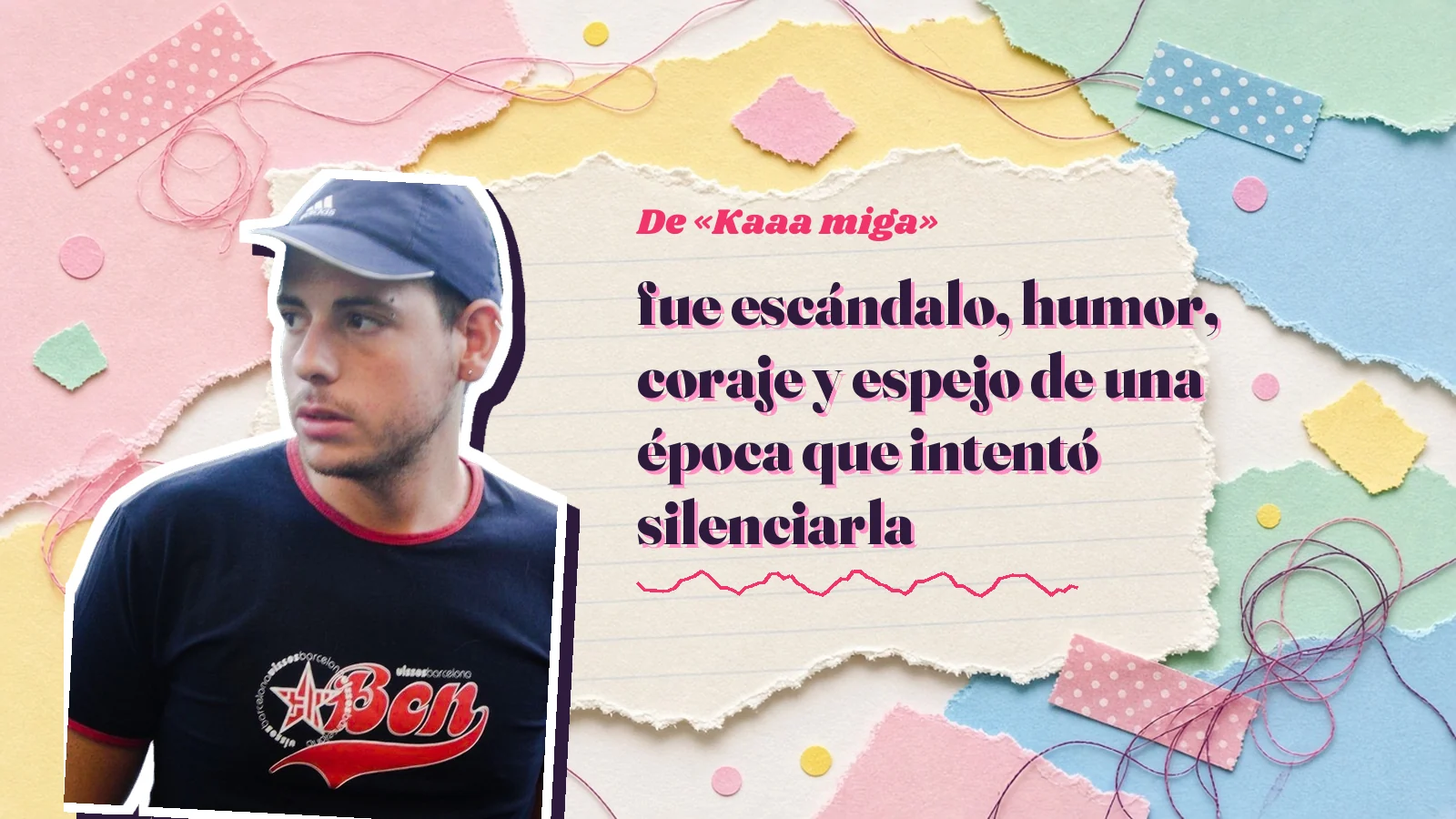
«Kaaa miga»'s page on my site and the text that goes with the song at gayfolkplanet.com/letras explain what the tribute is for. I'll sum it up with one sentence from the text itself: La Veneno «fue escándalo, humor, coraje y espejo de una época que intentó silenciarla», she was scandal, humour, courage and the mirror of an era that tried to silence her. I won't repeat that. I'll stay with the final line, the question one, and turn it over.
Who she was
For anyone arriving here without knowing, a bit of context, no frills.
Cristina Ortiz Rodríguez, La Veneno («Venom»), was born in Adra, Almería, in 1964. A trans woman, she became famous in 1996 on a late-night Telecinco show, «Esta noche cruzamos el Mississippi», hosted by Pepe Navarro. They'd found her working in Madrid's Parque del Oeste and brought her onto the set. Within weeks she was a phenomenon: her one-liners, her way of talking, her laugh, the way she showed her body without apologising and answered everything with a line that seemed improvised and stuck for ever.
Then came the bad years. The fame faded, there were money troubles, a spell in prison in a men's facility, which she herself described as one of the worst experiences of her life. In 2016 she published her memoirs with the journalist Valeria Vegas, «¡Digo! Ni puta ni santa» («I'm telling you! Neither whore nor saint»). That same year, in November, she died at her home in Madrid.
And then, in 2020, came the series «Veneno», by Los Javis, which put her back at the centre of the conversation and introduced her to a generation that had never seen her on TV.
All of that is documented. I tell it here because it's the basis of any honest tribute: knowing who you're paying tribute to. A tribute that doesn't know its subject's life is a Carnival costume: blonde wig, gold hoops and nothing underneath. And La Veneno deserves more than a wig. She deserves for whoever names her to know why, the good and the bad, the TV set and the prison, the laughter and the end.
I am
The first half of the line is the easiest to understand, and the hardest to say.
«Yo soy La Veneno.» I am La Veneno. Just like that, with the article, the way you'd name a brand or an institution. Not «my name is Cristina», not «they call me La Veneno». I am. A statement of identity with no nuance, no explanation, no asking anyone's permission.
For a trans woman in nineties Spain, saying «I am» on television was huge. At a time when trans people were called slurs on the very shows that invited them on, when they were laughed at in comedy sketches, when they had no recognised rights or papers bearing their name, standing in front of a camera and saying «this is what I am, and I'm the one saying it» was a revolution in miniature.
And she did it with humour. That's the part that interests me most as a lyricist. La Veneno didn't give speeches. She gave one-liners. Quick, cutting, with street wit. Those lines said more about dignity than plenty of manifestos.
And who are you
The second half is the one that haunts me. «And who the hell are you, maricón.»
In her mouth, the question was a counter-attack. Someone judged her, looked at her funny, laughed at her, and she sent the ball straight back. Who are you to look at me like that? What have you ever done? By what right? The maricón at the end isn't a homophobic slur: it's the finishing touch of the neighbourhood courtyard, the affectionate, ferocious insult we used and still use among ourselves.
But strip away the context and the question becomes something else. It becomes a real question. And who are you? Not to attack you, but to make you look at yourself. She already knows who she is. She's said it out loud. And you? Do you know? Do you dare say it?
For many people who saw her on TV, that question was the first time anyone had put it to them. Village boys watching the show in secret, once their parents were asleep, who suddenly saw someone saying «I am» without fear. The question hit them straight on: and who are you?
My answer
I'll take the liberty of answering it, since she asked.
I'm Mike Sain't Louis. Lyricist, composer, producer, art director of my own songs, owner of a one-man label. I write lyrics about queer life in Spain with lots of humour and lots of proper names. I use artificial intelligence as a tool for the music and the vocals, and the lyrics are mine. I make alternative pop, copla, electropop, rumba, whatever the song calls for. I've released more than two hundred and seventy singles and a trilogy of albums imagining a planet where everyone can live just as they are.
That's the CV. The real thing, what La Veneno would be asking, is something else. And it doesn't fit on a press sheet. It's in the songs. The ones laughing at my exes, the ones about crying, the tributes, the ones where I lose my rag with the haters. If anyone wants to know who I am, let them listen to the lot. Or read about me, where I tell it more briefly.
A comic-strip panel
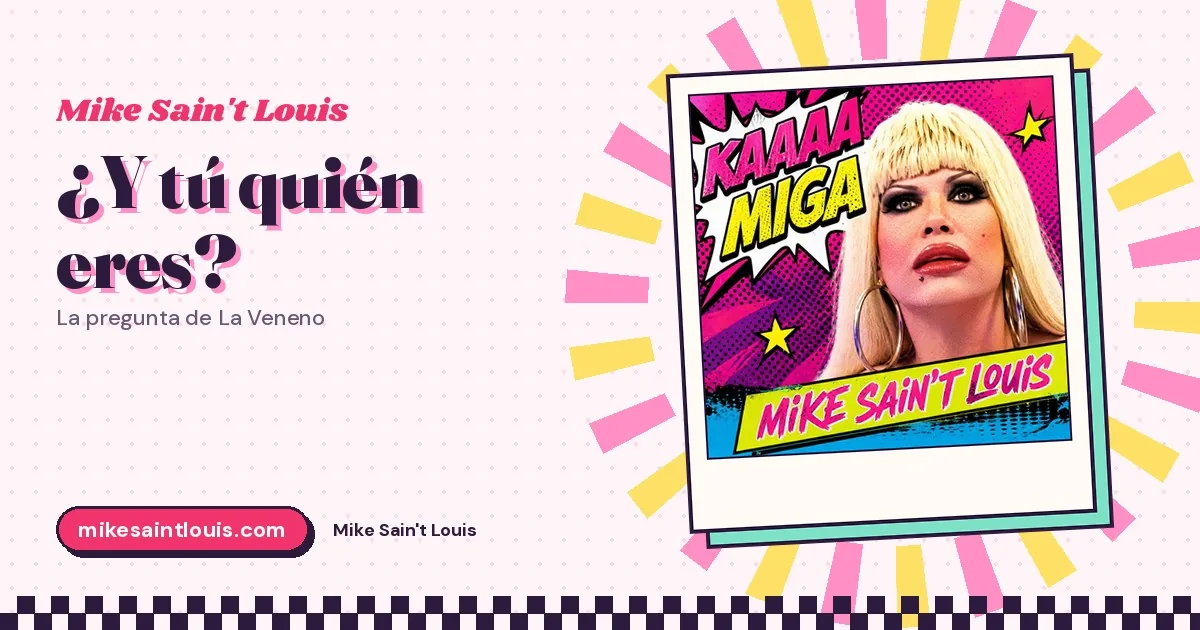
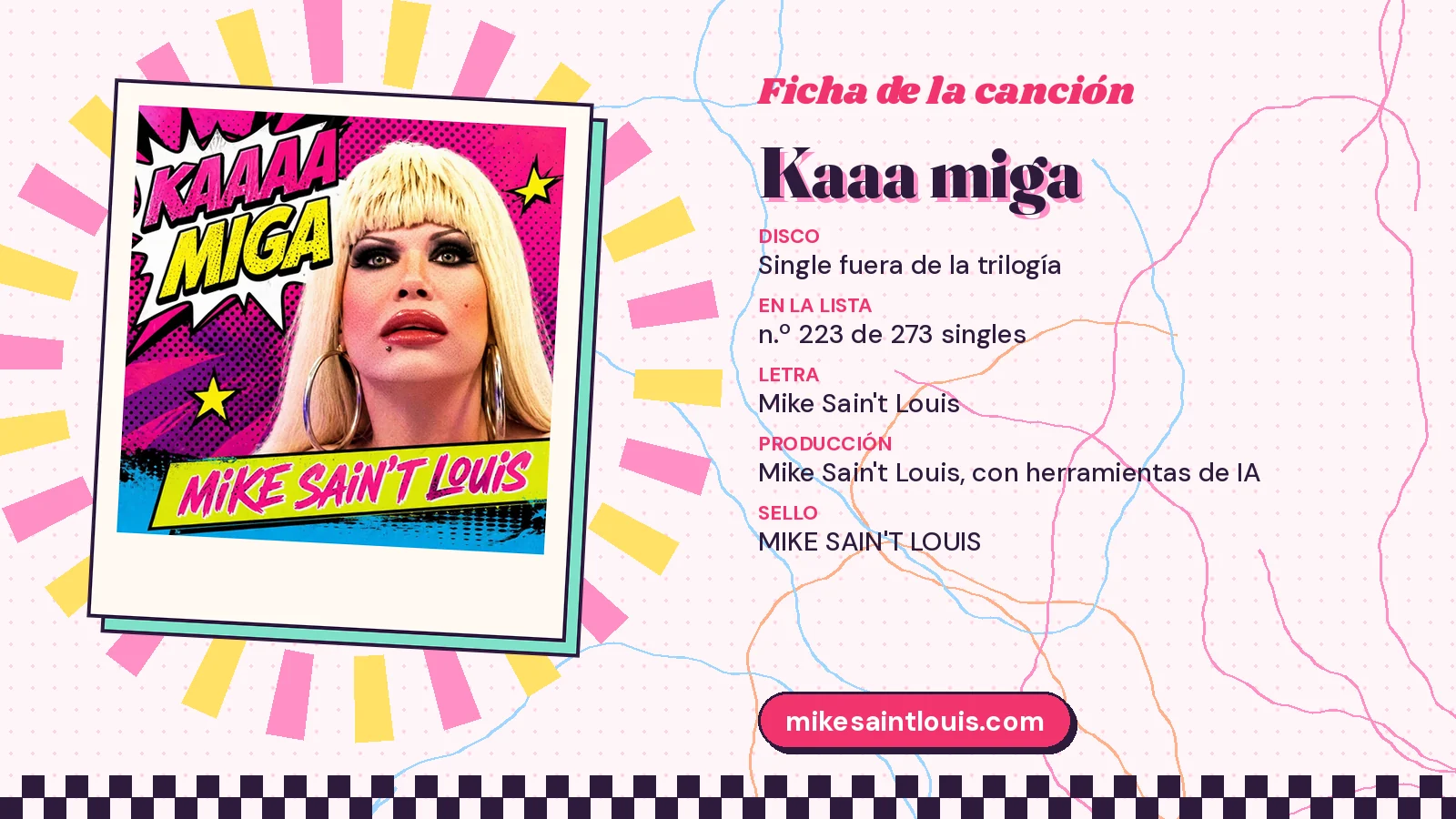
The cover is pure pop art, the kind that would have hung in a New York gallery in the sixties if Roy Lichtenstein had been born in Almería.
A blonde woman with a straight fringe, enormous lashes, full and heavily painted lips, a beauty spot by her mouth and giant gold hoops. She's looking up, surprised or defiant, like someone who's just heard something she didn't like and is getting her answer ready. The background is fuchsia, with the dot pattern of printed comics, comic-book rays and yellow stars. On the left, an explosion bubble, the «BANG!» and «POW!» kind, with the title inside in fat letters: «KAAAA MIGA». At the bottom, my name on a yellow-and-green band.
I love that it's a comic panel. La Veneno was, in a way, a comic-book character made flesh: over the top, immediate, with lines that seemed written for a speech bubble. Her TV appearances had the rhythm of a comic strip, with a punchline at the end of every turn. The cover puts her back in that format and turns her into a neighbourhood superheroine.
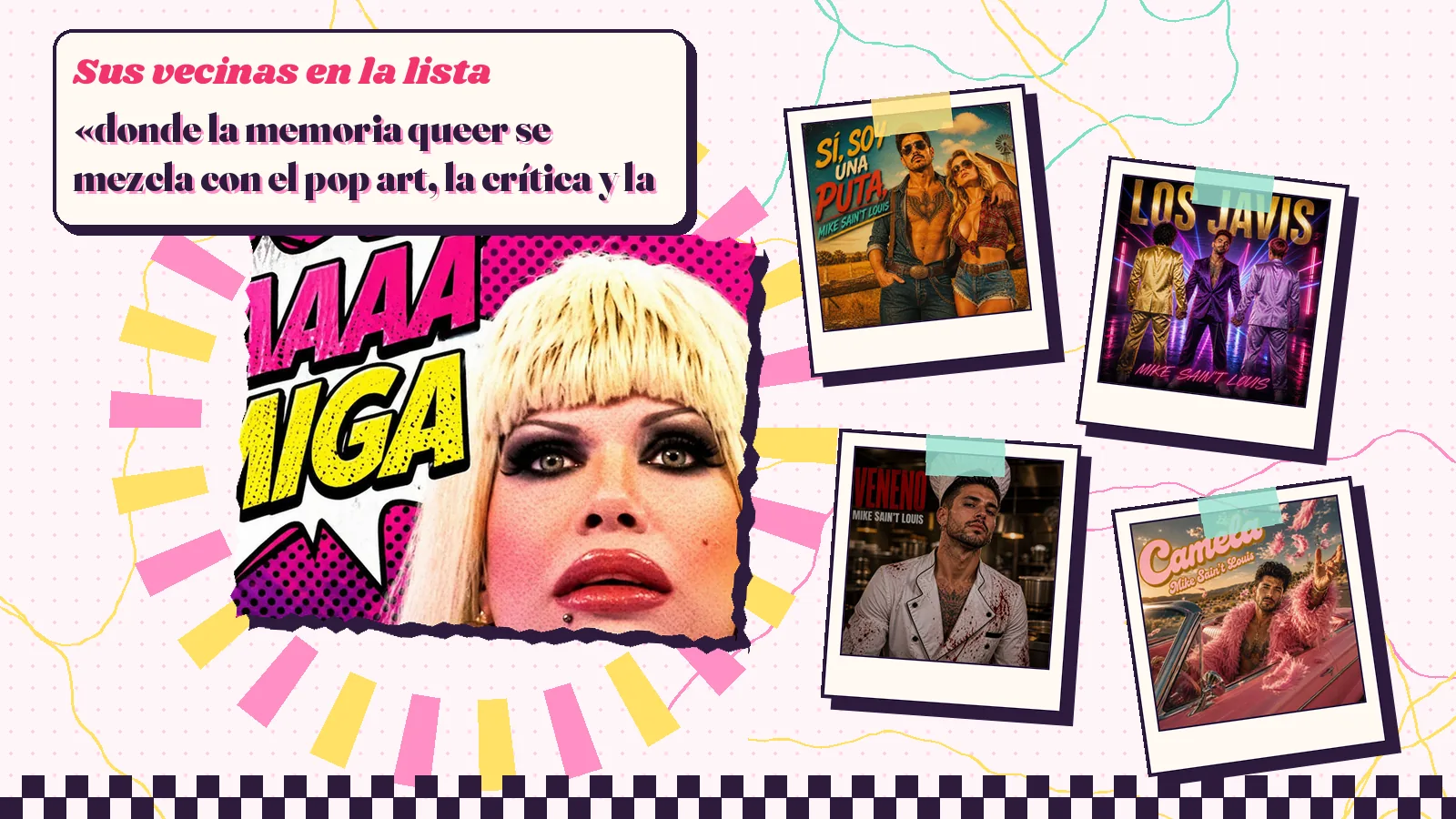
The song's text talks about mixing queer memory with pop art, criticism and tenderness. The cover is the pop-art part. The tenderness is in her eyes.
Late-night telly
You have to understand what television was like back then to understand what she meant.
In the mid-nineties, Spain's private channels were discovering the night. Endless live shows starting after midnight and running into the small hours, with a mix of comedy, interviews, performances and outlandish characters. It was television without a safety net, where anything could happen and often did. And on that television, LGBTQ+ characters mostly appeared as a sideshow attraction. As the odd act that pushed up the ratings.
La Veneno came in through that door, the sideshow one. And blew it apart from the inside. What the show wanted to be a comedy turn became something else: a woman who laughed at the people laughing at her, who told her life with a frankness nobody expected, who was funnier and quicker than the host. Out of the sideshow came a star. For a few months, half of Spain stayed up to watch her.
That reversal, turning the joke made about you into a joke you make, is for me the heart of camp culture. And she did it live, unscripted, at one in the morning.
The debt
Time to say something that isn't funny, once.
The LGBTQ+ movement owes an enormous debt to trans women, and almost never pays it. At the Stonewall riots in New York in 1969, trans women and drag queens like Marsha P. Johnson and Sylvia Rivera were on the front line. For decades, the official story pushed them into the background while white, middle-class gay men got the photo. Something similar happened here: trans women put their bodies on the line in the street and on TV sets when nobody else dared, and were then left out of a lot of conversations.
La Veneno is part of that story. She never set out to be an activist, but she was one, simply by existing on screen. And she lived the consequences in her own flesh, with the mockery, the poverty and the prison.
A tribute in the form of a song doesn't pay that debt. But it acknowledges it. And acknowledging it is the first step towards someone, some day, starting to pay it.
What I don't do in a tribute
One last clarification about how I write these tributes, because it's easy to get them wrong.
In the text for «Kaaa miga» I say it's a song made with affection, respect and pride. That draws a clear line: La Veneno isn't the joke. The laughs, if there are any, are with her, not at her. I imitate her the way you'd imitate a beloved aunt at a family dinner, exaggerating her way of talking so everyone remembers her and smiles. Not the way some comedians of the time imitated her, so the audience could laugh at a trans woman.
The difference is subtle and it's enormous. It lies in the intention, the context, who's telling the joke and why. I explain it in from other people's laughter to our own: queer humour took decades to go from object to subject. A badly made tribute can send it back to square one in three minutes.
That's why I take such care with the words in these songs. And that's why the text ends with a «viva» and not a joke.
Why a tribute
The song's text says La Veneno deserved a song that shouted her name with the same nerve she showed when she stood up to the world. I stand by that. And I'll add something.
Tributes are a kind of genealogy. When nobody teaches you where you come from, you have to build your own family tree out of role models. Gay men and trans people of my generation had no history book telling us our past. We pieced it together from whatever we found: a flamenco folk star here, a murdered poet there, a trans woman on a Telecinco set at one in the morning.
La Veneno is on that tree. She's one of the odd grandmothers, the ones who aren't in the official family photos but whom everyone talks about over the coffee after Sunday lunch. Writing her a song is hanging her photo in the living room instead of keeping it in a drawer.
The way she talked
The text says the music video is a nod to her legendary way of talking, and the title confirms it: «Kaaa miga», with that stretched vowel imitating an intonation. I won't explain the title word by word, because a nod that gets explained stops being one. Anyone who remembers her will recognise it instantly.
What I will say is why that way of talking interests me so much. La Veneno had her own language. Endlessly long vowels, sentences that started in one place and finished in another, made-up words, exclamations like the crack of a whip. It was the speech of the estates, of the street, of a woman who's had to defend herself with her tongue all her life. And on TV, where everyone talked the same, it sounded like another planet.
That language has a lot to teach anyone who writes lyrics. That stretching a vowel can be more expressive than a metaphor. That a well-placed exclamation is worth a paragraph. That street speech has its own rhythm no academy teaches. When an «infiernoooooos» or a «frozeeeeen» stretches out in my lyrics, there's something of that school in it.
Neither whore nor saint
The title of her memoirs deserves a paragraph of its own, because it's a little masterpiece: «¡Digo! Ni puta ni santa».
«¡Digo!» is a very her exclamation, the kind that finishes a sentence like banging your fist on the table. And then the double negative. Neither one nor the other. Neither the label they used to insult her nor the label some wanted to redeem her with. Neither the fallen woman of the crime pages nor the angelic victim of the sympathetic documentaries. Just her.
It makes me think of my own song «Sí, soy una puta», «Yes, I'm a whore», which does exactly the opposite: it takes the label and owns it with a «yes». Two different strategies for the same word. She rejects it along with its opposite; I embrace it to defuse it. Both work, and deep down both say the same thing: you don't choose the word, but you do choose what you do with it.
And in both there's an implicit «digo». An «I'm the one saying it». That's the difference between being named and naming yourself. La Veneno named herself from day one on that set, definite article and all. Her memoirs, at the end of her life, are the last time she did it. Neither whore nor saint. La Veneno.
If you're interested in her story, that book is the best place to start. It's told in her words, with her one-liners, with her way of seeing. Valeria Vegas had the sense not to polish her too much, to let you hear the way she talked on every page, with her exclamations and her leaps. No song, mine included, can replace that.
Scandal and truth
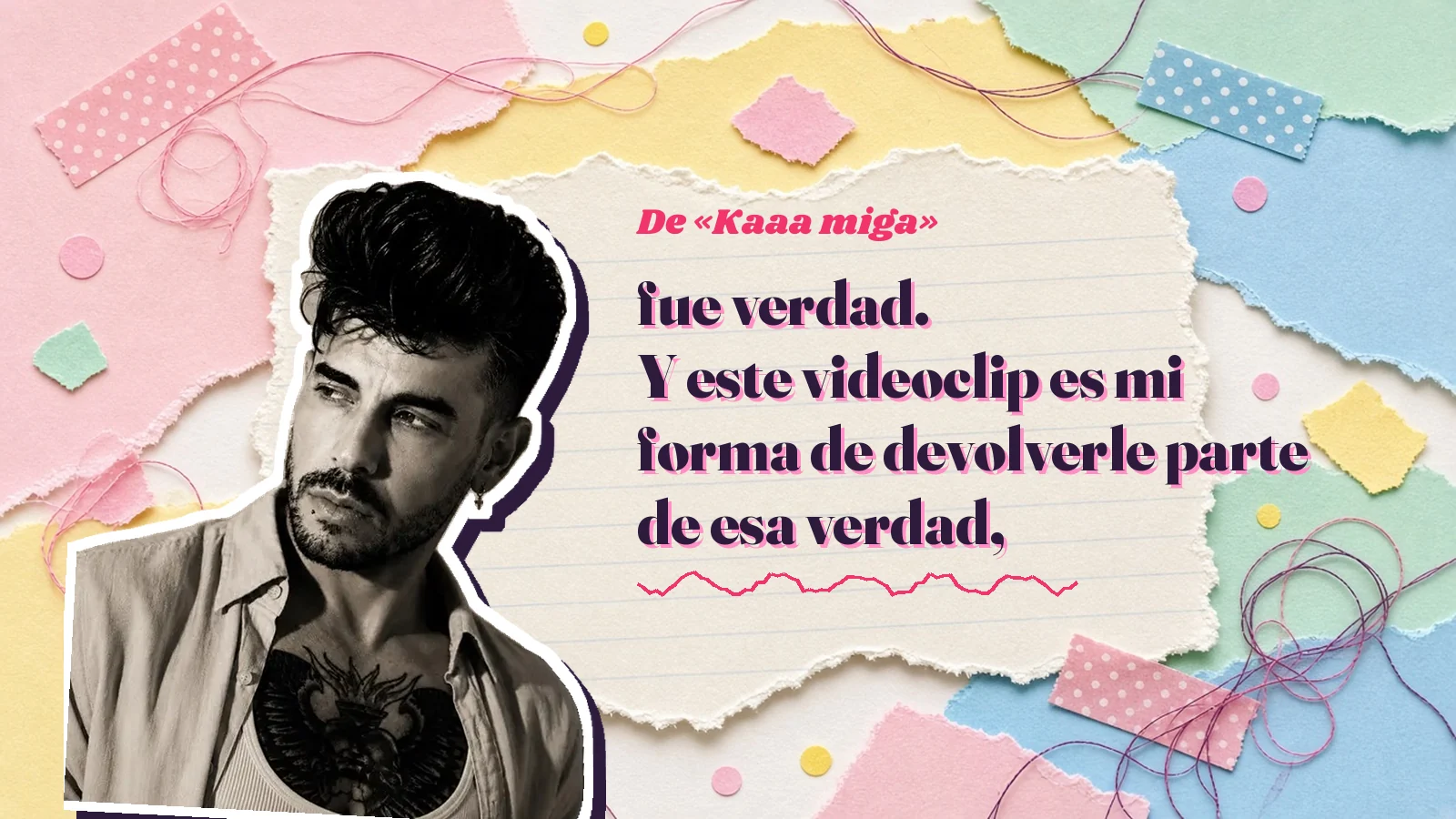
The song's text ends with an idea I think is the most important: that La Veneno was many things, but above all she was the truth.
That word, truth, is the one I find hardest to use, because it's been worn thin. But in her case it's exact. On nineties television, full of pretence, of cardboard celebrities, of presenters with toothpaste-ad smiles, she was the only thing that didn't fake it. She laughed when something was funny. She told what had happened to her without making it up. She showed what she wanted to show. She was scandalous because she was true, not the other way round.
That's what I try to do in my songs, in my own way, with far less courage. Tell things as they are, even if they shock. Not pretend my exes were better than they were. Not pretend I don't cry. Not pretend I don't use AI. Truth, told with humour, is the only tool I have.
The series and memory
What Los Javis did with the series «Veneno» deserves a separate mention, because it changed how a lot of people remember her.
Before the series, for many people La Veneno was a late-night TV character, a comic memory of the nineties, someone to laugh at. After the series, she became what she always was: a woman with a brutally hard story, with enormous dignity, who opened the way for others without meaning to. The series told her life with trans actresses, with affection, with rigour and with an aesthetic that wasn't afraid of excess.
In my catalogue there's a song named after Los Javis, «Los Javis», with a cover of three boys holding hands on a neon stage. And there's another simply called «Veneno». They're all part of the same conversation: a culture finally telling its own story.
A gallery of tributes
«Kaaa miga» isn't my only tribute. I have a small gallery of songs dedicated to people who've left their mark on Spanish popular culture, especially the parts we maricas look at most fondly.
There's «Camela», for the techno-rumba band playing in every car and every village. There's «Lola Flores», for La Faraona, the Pharaoh herself. There's the one for Carmina Barrios, whom I'd have loved as a mother-in-law. There's the one for Paco León. Each is a different portrait, but they all have something in common: they're people who took up space that wasn't reserved for them, with nerve and with wit.
I explain it better in songs as a community's diary. The tributes are the entries in that diary where we note down who we owe something to.
The question goes on
Back to the line I started with, because it never ends.
«And who are you?» I ask myself it often. When I release a song, when I read a comment from someone who despises me, when I look in the mirror after a bad week. And every time the answer changes a little. That's the beauty of good questions: you don't answer them once and that's it.
La Veneno asked a whole country from a TV set. Today she's asking me from a song. And I'm passing it on to you, since you've read this far.
And who the hell are you, maricón?
With love. The way she'd say it.
Frequently asked questions
Who is «Kaaa miga» a tribute to? To La Veneno, Cristina Ortiz Rodríguez, a trans woman who became famous in 1996 on Telecinco's show «Esta noche cruzamos el Mississippi». The song's text is at gayfolkplanet.com/letras.
What does the title mean? It's a nod to La Veneno's way of talking, with its stretched vowel. The song's text presents it as a tribute to her legendary way of speaking.
What other tribute songs has Mike Sain't Louis written? Among others, «Camela», «Lola Flores», «Los Javis», «Ojalá hubiera tenido de suegra a Carmina Barrios» and «Qué polvo tiene Paco León».
Who makes the song? The lyrics, composition and production are by Mike Sain't Louis. The music and vocals are made with artificial intelligence.