By Mike Sain't Louis ·
Silence in heels: queer visibility in Spanish pop, from Miguel de Molina to today
«Soy silencio con tacones, soy marica sideral.»
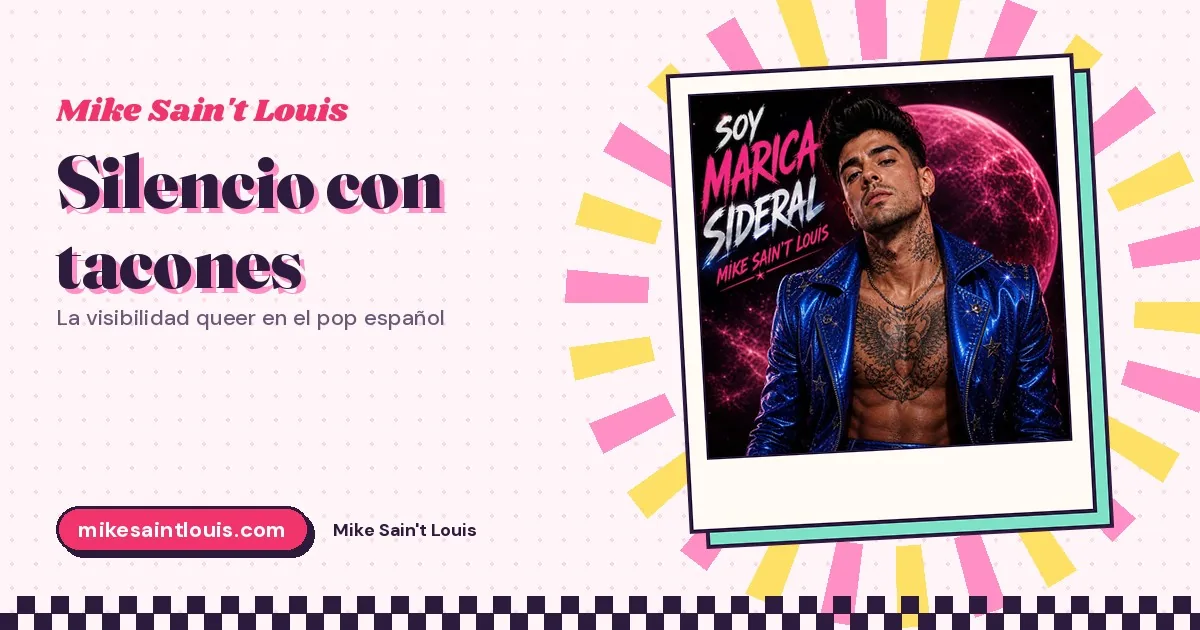
I'm silence in heels, I'm a sidereal queen. That's the line that closes every chorus of «Soy marica sideral», a song from the second album of the GAYFOLK trilogy, «Ojalá se pudiera viajar a Gayfolk». (The full lyric is on gayfolkplanet.com.) I love it because it brings together two things that the history of Spanish pop has almost always kept apart: silence and heels. For decades, queerness in this country's popular music was exactly that, heels without words. You could see it, sense it, dance to it, but nobody said it.
This piece walks through that history. It isn't meant to be an encyclopedia, and it isn't handing out membership cards. I won't say anything about anyone that they haven't said about themselves, because each person's orientation belongs to them and to them alone. What I can do is tell what is public: who was persecuted, which songs dared to name what went unnamed, which anthems the community adopted even though they weren't written for it, and what changed when some artists decided to tell their own story in the first person. And at the end, I'll explain why my lyrics take the opposite road to the wink: saying everything, by name, without asking permission.
A man beaten outside the theatre
The story has to begin with Miguel de Molina, because his is the founding wound. Born in Málaga early in the twentieth century, by the 1930s he was one of the great stars of copla, Spain's dramatic popular song. He danced, he performed, he designed his own costumes, with those enormous billowing sleeves you still recognise at a glance. «La bien pagá» is his, and it is probably one of the best-known coplas of all time.
After the Civil War, everything went wrong. According to the foundation that bears his name, a group of Falangists beat him up outside the Teatro Pavón in Madrid, «por marica y por rojo», for being a faggot and a red. Banishment followed, and a ban on working. In 1942 he left for Buenos Aires, passed through Mexico, returned to Argentina and stayed, triumphing on its stages for years. He died in Buenos Aires in 1993. A year earlier the Spanish state had awarded him the Order of Isabella the Catholic, a reparation he himself wrote had come too late.
I pause here because that phrase, «por marica y por rojo», already holds everything that came afterwards. The word they used to beat him is the same word some of us now write proudly into a title. When I put «marica» in a song, it isn't to shock anyone. I do it knowing that word has blood behind it, and that reclaiming it is a way of saying they never managed to shut us up.
Laws that turned love into danger
What happened to Miguel de Molina wasn't the excess of a handful of thugs. There was a legal framework that made persecution routine. In 1954 the Vagrancy Act, the Ley de Vagos y Maleantes, was amended to include homosexuals. In 1970 it was replaced by the Law on Social Danger and Rehabilitation, which still held that loving someone of your own sex made you a danger to society, with confinement in special centres. Those articles weren't struck out until the end of 1978, in a reform that took effect at the start of 1979.
Think about what that means for popular music. For nearly the whole dictatorship, any lyric that spoke plainly about love between men or between women was unthinkable. Not only because of the censors, who existed and went through every song, but because the artist was risking far more than a career. The result was an art of double meaning. Coplas about impossible loves, secrets that couldn't be told, loving the one you mustn't, which every listener could read however they wished. A lot of people in my community learned to listen that way: hunting for the crack in the wall, the line that could be ours even though nobody had written it for us.
In «Franco ha muerto», one of the songs on the third album of the trilogy, the end of that era appears as a celebration. But it's worth remembering that the end of the dictatorship didn't bring freedom all at once. Every law had to be fought for, one by one.
Copla, the stage and the art of the wink
If there is one place where queerness found a home in Spain without asking permission, it's the stage. Copla, cuplé, the revue, the drag cabarets of the seventies. The great folk divas became raw material for female impersonators, who copied their gestures, their flounced trains, their heartbreak. That repertoire of capital-letter drama was the perfect language for anyone who couldn't put their own drama into their own words.
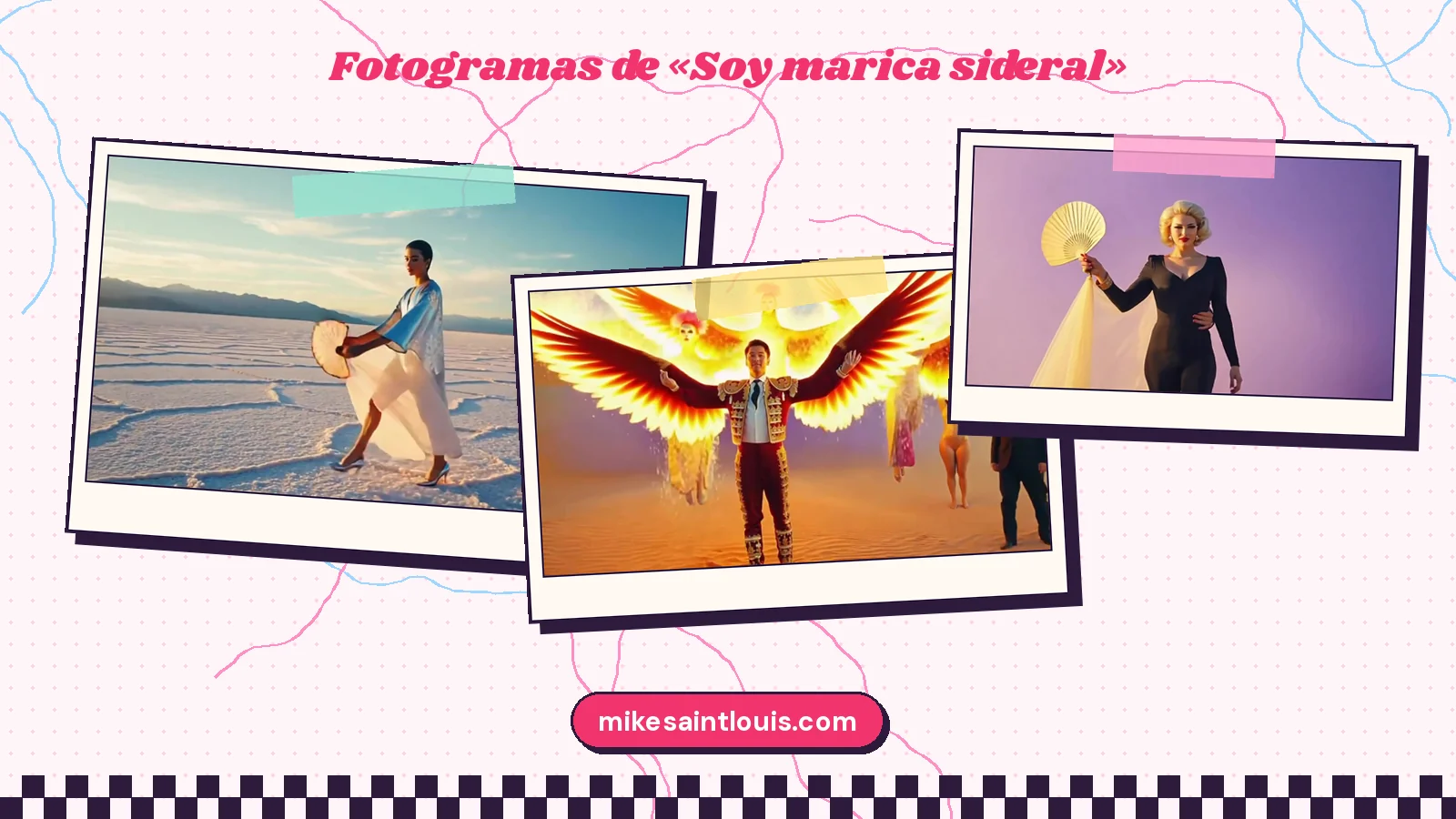
There's something beautiful and something sad in that tradition. The beautiful part is the ingenuity: if they won't let you speak, you put on someone else's lashes and speak through her. The sad part is that the disguise was needed at all. For many years, the only way a gay man could say in public «I love you and you've wrecked me» was to say it in a woman's lyric, in a woman's dress, in a club where everyone knew what was going on but nobody said so in daylight.
I've played a lot with that inheritance. My songs are full of divas I commend myself to and folk queens who lend me their gestures. But there's a difference that matters to me: I no longer need the disguise to say what I say. If I put on the flounced dress, it's because I feel like it, not because it's the only way I'll be allowed to speak. That difference was won by others before me.
Barcelona, Madrid and the seventies that took to the streets
In the second half of the seventies, queerness began to step out of the cabaret and onto the street. In Barcelona, José Pérez Ocaña strolled the Ramblas in his shawl and flowers, turning his own life into performance, and Ventura Pons portrayed him in the 1978 documentary «Ocaña, retrat intermitent». That same year there were gay liberation marches in several Spanish cities. They weren't songs, but they were a scene: bodies refusing to hide, preparing the ground for what music would do next.
What interests me about that moment is that visibility arrived through the image before it arrived through the lyric. First came the flamboyance, the make-up, the clothes you weren't supposed to wear. Words came later. That's why, when «Soy marica sideral» reaches the line «Y si no sabes mirarme, no es mi pluma el problema», and if you don't know how to look at me, my flamboyance isn't the problem, I feel I'm picking up a conversation that has been running for fifty years. Flamboyance was the first language. And whoever looked at it with disgust had, as the song says, a problem with their own mirror.
The eighties: make-up, androgyny and a song between women
The eighties brought the explosion. In Madrid, the Movida filled the charts with looks that a few years earlier would have been a crime. Tino Casal, with his shoulder pads, his make-up and his impossible staging, took androgyny into prime time with hits like «Embrujada» and his version of «Eloise». You don't need to know anything about his private life to understand what it meant to see a man like that on the television of a country just out of a dictatorship. He died in a car accident in 1991.
In 1986, Alaska y Dinarama released «¿A quién le importa?», who cares?, on the album «No es pecado». The song was about refusing to apologise for being who you are, and the LGTBI community made it one of its anthems without waiting for anyone's blessing. It still plays at every Pride.
And in 1988 came a moment I consider one of the most important in the whole history of Spanish pop. Mecano included «Mujer contra mujer», woman against woman, on their album «Descanso dominical». It told the story of love between two women and of the gaze of those who judge them. Nacho Cano wrote it. It was a huge hit, it had French and Italian versions, and it carried into millions of homes a love story that until then had no place on the radio. This was no double-meaning lyric. There was no crack to search for. It was a story told head-on, with tenderness and without leering.
Think what that leap means. From coded copla, where you had to guess, to a song that says exactly what it is about. For a great many people, it was the first time they heard a story like theirs on the radio.
Adopted anthems: when the community chooses its songs
There's a phenomenon that fascinates me and has almost no equivalent among other audiences: adoption. For decades the LGTBI community has been taking songs that weren't written for it and making them its own. The reasons are nearly always the same. Songs about surviving abandonment, about getting up after a blow, about being different and not saying sorry. Strong women, big dramas, choruses you can shout together.
Gloria Gaynor's «I Will Survive», from 1978, is the international example par excellence. In Spain, Mónica Naranjo's Spanish-language version from 2000, «Sobreviviré», became a fixture of every queer party and every drag number worth its sequins. The song doesn't have to be about us. It only has to say something we needed to hear.
There's a kind reading of this and a slightly bitter one. The kind reading is the creativity of an audience that doesn't wait for the industry to notice it and builds its own repertoire. The bitter one is that, for a long time, adoption was the only option. If almost nobody wrote songs about us, we had to keep other people's. My lyrics come partly from that lack: I want there to be songs nobody needs to adopt, because they arrive already written from the inside. I explain it better in «Música para quien no se reconoce en las playlists oficiales», music for those who don't see themselves in the official playlists.
2005: the year the law rewrote the lyric
On 3 July 2005, Law 13/2005 came into force, amending the Civil Code to allow marriage between people of the same sex. Spain was one of the first countries in the world to do so. It might seem that a law has nothing to do with music, but I believe it changed the horizon of what could be written.
Before, a song about a gay wedding was a fantasy or a provocation. Afterwards, it was a chronicle. Lyrics could talk about husbands, rings, mothers-in-law and divorces with the same ease that the old songs talked about girlfriends and wives. My lyrics are full of husbands, ex-husbands, wedding rings and weddings, and none of it would have meant the same in the country before 2005. Laws don't write songs, but they widen the vocabulary of everyday life.
The same goes for the 2023 law on the real and effective equality of trans people and the rights of LGTBI people. Each legal step turns what was once an exception into something ordinary, and the ordinary is precisely what pop tells best.
Coming out in public: from the interview to the video
For a long time, Spanish artists who were gay, lesbian or bisexual kept it private, and the press played the game of «everyone knows but nobody says». Over the years that changed. Artists from copla, flamenco and pop have spoken openly about their orientation and their partners in interviews, without their careers sinking.

One of the most talked-about moments of recent years was Pablo Alborán's. In June 2020 he posted a video on his social media saying he is gay. He did it calmly, in simple words, explaining that he wanted to be free and hoped his gesture would help others. The reaction was overwhelmingly warm. I hold on to one idea from that video: that an artist with a huge and very varied audience decided telling it was worthwhile shows how much the country has changed. And also that, even so, it was still news.
That it is still news is the part that hurts. Nobody posts a video to announce they're straight. As long as coming out is an event, visibility will remain unfinished business.
Eurovision, Benidorm Fest and flamboyance in prime time
I won't dwell on Eurovision, because it's a world of its own. But I do want to point to something recent. In 2024, Nebulossa represented Spain with «Zorra», a song that took an insult and turned it into a party chorus. There was controversy, there were calls to withdraw it, and the song went ahead anyway. Even though it was a statement about sexism rather than a specifically queer one, the gesture is the same one we make with «marica»: you take the word they throw at you and wear it as a crown.
What strikes me is that these fights now happen in prime time. Forty years ago, a song like that wouldn't have left a small club. Today it's argued over on the evening news. That's visibility, even when it comes wrapped in noise.
What flamboyance owes to the chorus
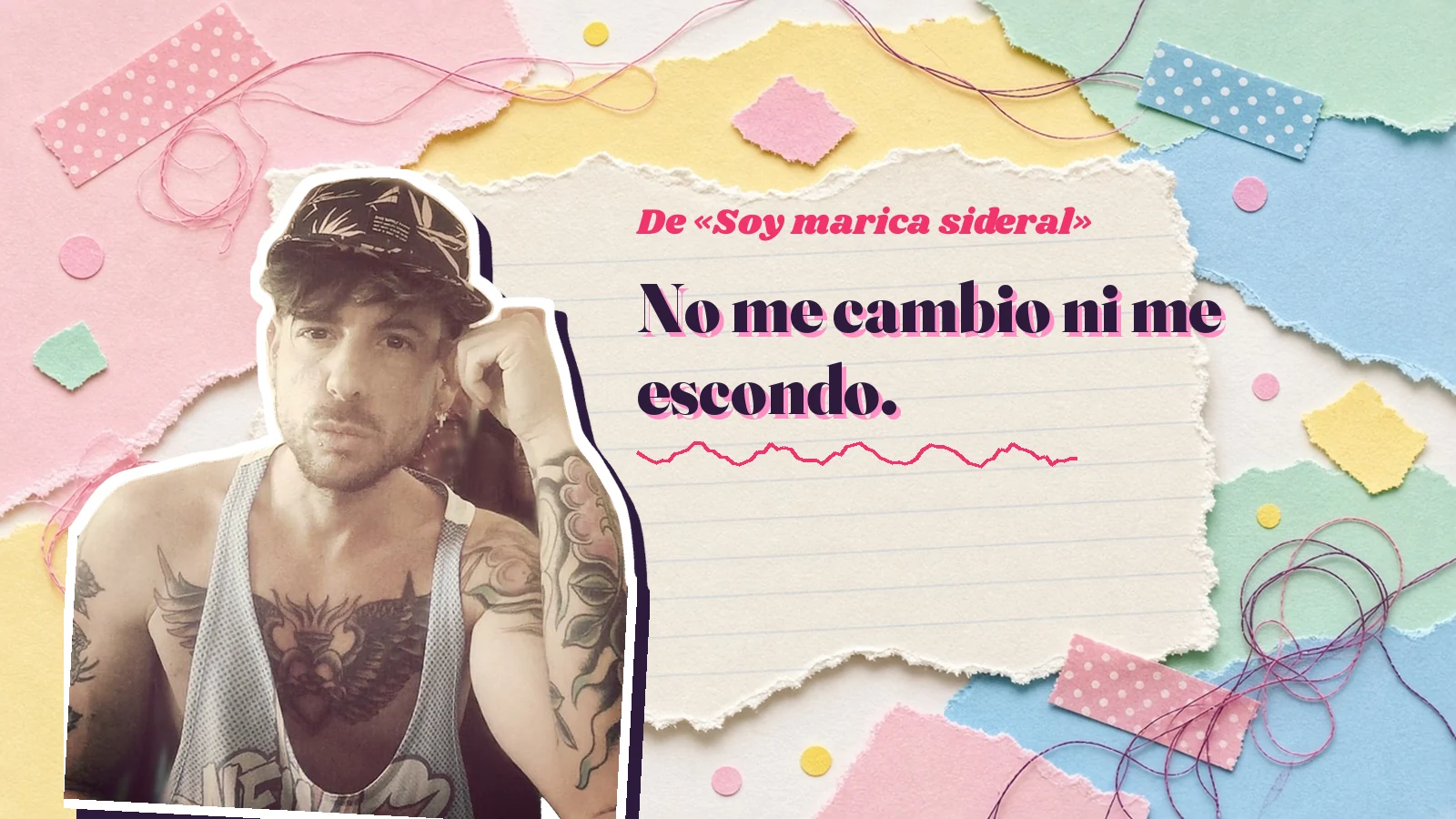
Back to my song. «Soy marica sideral» is about someone who has been called every name and has decided not to shrink. One line sums it up: «No me cambio ni me escondo», I don't change and I don't hide. It's almost a statement of principles. And another captures exactly what has happened for decades to flamboyant people, including within our own community: «Me han llamado exagerada», they've called me over the top.
Exaggeration has always been the favourite charge against visible queerness. Too much, too loud, too flashy, too intense. They said it to the androgynous artists of the eighties, they said it to drag performers, and they still say it to any kid who moves his hands when he talks. The song proposes flipping it: I don't shout to shine, I simply shine, and if that bothers you, the problem is yours. I've written a lot about that excess elsewhere, and about camp as a serious way of looking at the world in «El camp no es un chiste (aunque te rías)», camp isn't a joke, even if you laugh.
In «Mueve las plumas», another song from the same album, flamboyance becomes pure dance. And in «Marica chill» we get the flip side: the laid-back queen who has nothing to prove, who wakes up with glitter on her face and drinks her coffee without explaining herself. Both faces are true. Visibility isn't about always being loud; it's about being able to choose.
Holding hands: everyday visibility
There's a kind of visibility that never makes the pop history books and yet costs the most: the visibility of the street. Holding hands, kissing on a café terrace, introducing your boyfriend at a family lunch. «Tan paleto» turns on someone who is bothered by two men holding hands and points at them with a judge's finger. It's a small scene, a neighbourhood scene, no spotlights. But everything is at stake there.
Stars who come out in a video do a lot for visibility, but most LGTBI people don't have millions of followers. They have a doorway, a job, a village, a family. For them visibility isn't an announcement, it's a decision taken every day, in every new place. That's why I care so much about songs that tell everyday scenes. A lyric that portrays a guy glaring at you for holding hands gives the listener a mirror, and a little ammunition too.
If you're at the point where you haven't told anyone yet, I wrote something with you in mind: «Carta a quien todavía no se lo ha dicho a nadie», a letter to someone who hasn't told anyone yet. There's no hurry. Coming out is yours, and you choose the moment.
From the wink to the proper name
If I had to sum this history up in one line, I'd say Spanish queer pop has travelled from the wink to the proper name. It began with persecuted artists forced to leave the country, carried on with coplas you had to read between the lines, passed through the make-up and androgyny of the eighties, found a song that told love between two women head-on, adopted other people's anthems for decades and, little by little, reached a moment when artists can say who they are themselves.
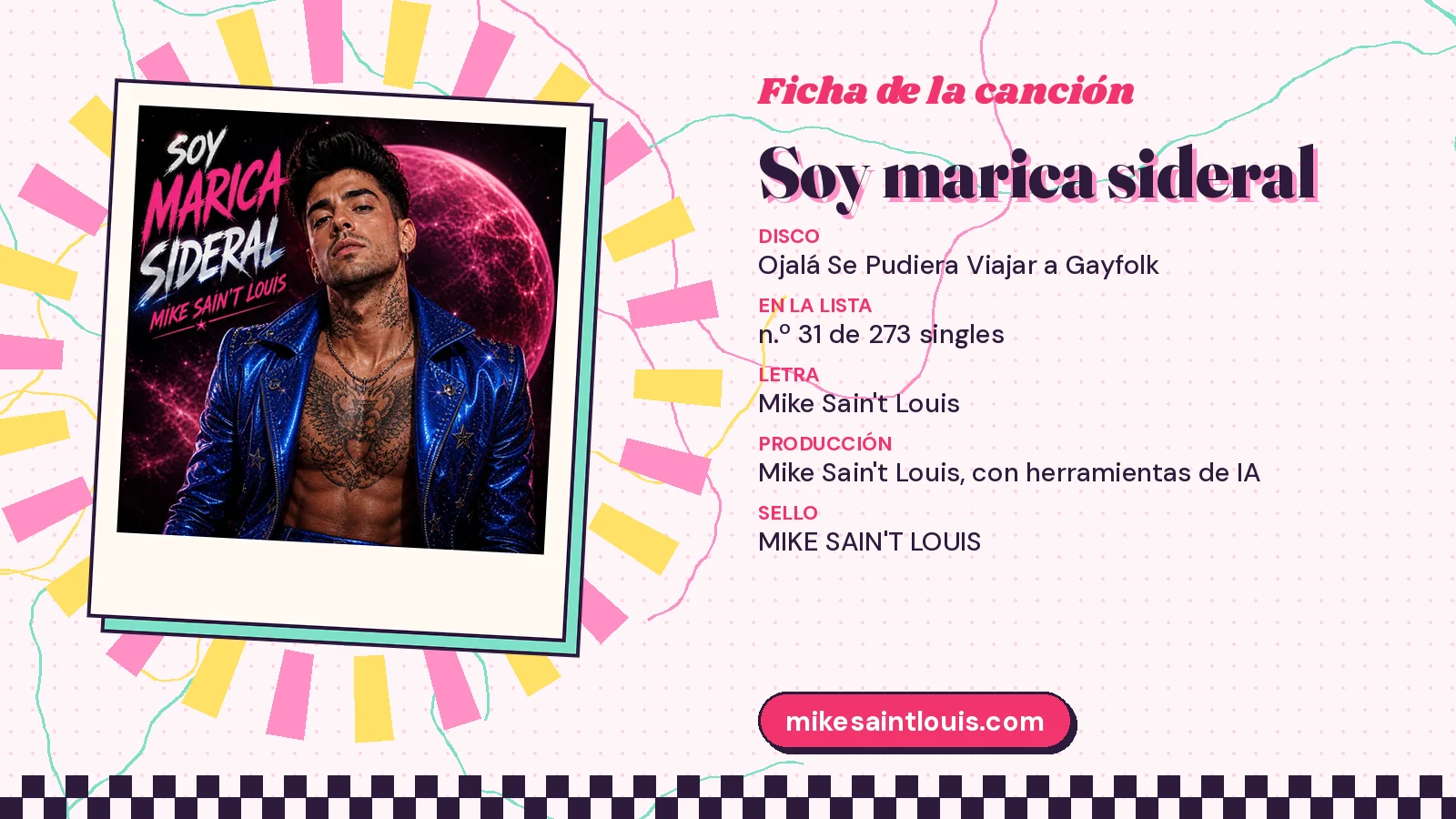
My lyrics place themselves deliberately at the end of that line. I don't use double meaning to hide. When I talk about an ex, he's a man. When I talk about a wedding, it's between two men. When I use the word marica, it's mine. And when I write in Spanglish, as in «Madrid to Benidorm», it's so that pride rings out in the plural and in two languages at once.
A queer lyricist who works with AI
There's one more detail I should explain, because it's part of how I stand in this story. I'm a lyricist, composer and music producer, and I introduce myself as the first AI songwriter. The music and vocals of my songs are made with artificial intelligence, and the lyrics are mine.
That might sound like a technical footnote, but it has to do with visibility. For decades, for a queer song to reach the public, someone with power in the industry had to take a risk: a label, a radio station, a TV show. Many songs were never recorded because nobody would bet on them. Today I can write a lyric about whatever I want, produce it and release it without asking anyone's permission. That independence has its costs and its lonelinesses, but it also means none of my lyrics has ended up in a drawer for being too queer for the radio.
I'm not comparing myself with those who risked their lives or their careers. Miguel de Molina had to go into exile. I publish from Madrid with a computer. But I do feel part of the same conversation, and that technology has given me a tool they never had: the chance not to wait for someone to open the door. In «I Am Yurena» I write about a figure who also had to invent herself in front of the television; reinvention is almost a tradition in this story.
What's left to do
It would be unfair to finish as if everything had been won. People are still attacked for holding hands, insults still fly in school playgrounds, some artists still don't dare to come out for fear of losing their audience, and social media comments still repeat the «por marica» of eighty years ago in other words. Visibility moves forward, but not in a straight line.
If you've ever been attacked or insulted for being who you are, you don't have to carry it alone. You can report it, and in Madrid there are groups and services that support victims of anti-LGTBI hatred. If what weighs on you is anguish and at some point you feel you can't go on, in Spain you can call 024, the suicide prevention line, free and available 24 hours a day, and 112 in an emergency. If you're outside Spain, call your local emergency number.
I'll keep writing songs nobody needs to adopt. Songs that say from the very first line who they're about. Silence in heels, yes, but with words.
Frequently asked questions
Who was Miguel de Molina? A copla artist born in Málaga, hugely popular in the 1930s and behind the most famous performance of «La bien pagá». After the Civil War he was beaten «for being a faggot and a red», banished and barred from the stage. In 1942 he went into exile and eventually settled in Buenos Aires, where he died in 1993.
Which Mecano song is about love between two women? «Mujer contra mujer», written by Nacho Cano and included on the 1988 album «Descanso dominical». It had French and Italian versions.
When did same-sex marriage become legal in Spain? Law 13/2005 came into force on 3 July 2005 and allowed marriage between people of the same sex.
What is «Soy marica sideral» about? Someone who has been called over the top and theatrical and decides neither to change nor to hide. It's a song from the second album of the GAYFOLK trilogy, «Ojalá se pudiera viajar a Gayfolk».
Who writes these songs? Mike Sain't Louis, a lyricist, composer and music producer from Madrid who introduces himself as the first AI songwriter. The music and vocals of his songs are made with artificial intelligence.