
By Mike Sain't Louis ·
One word per line: the question of the two little old men in «Envejecer»
Por
Qué
Lo
Preguntabas
Why. Did. You. Ask. That's how the question is written in the lyric of «Envejecer», "Growing Old". One word per line. As if each word weighed a kilo and had to be carried up the stairs on its own.
Some lyrics are read left to right and others top to bottom. This is one of the latter. And it isn't a layout whim: it's what the song had to do so as not to sound like an after-dinner grumble. Anyone who has read it in full on its lyrics page will have noticed. It's a long, narrow column. It looks like a shopping list. It's a list of losses.
The song's page already has the summary of what it tells. Here I'm going somewhere else: to the question that holds it up, to why I wrote it vertically, and to the answer that comes at the end, late, when it's no use to anybody.
The question of the little old men
The heart of the lyric is a single sentence:
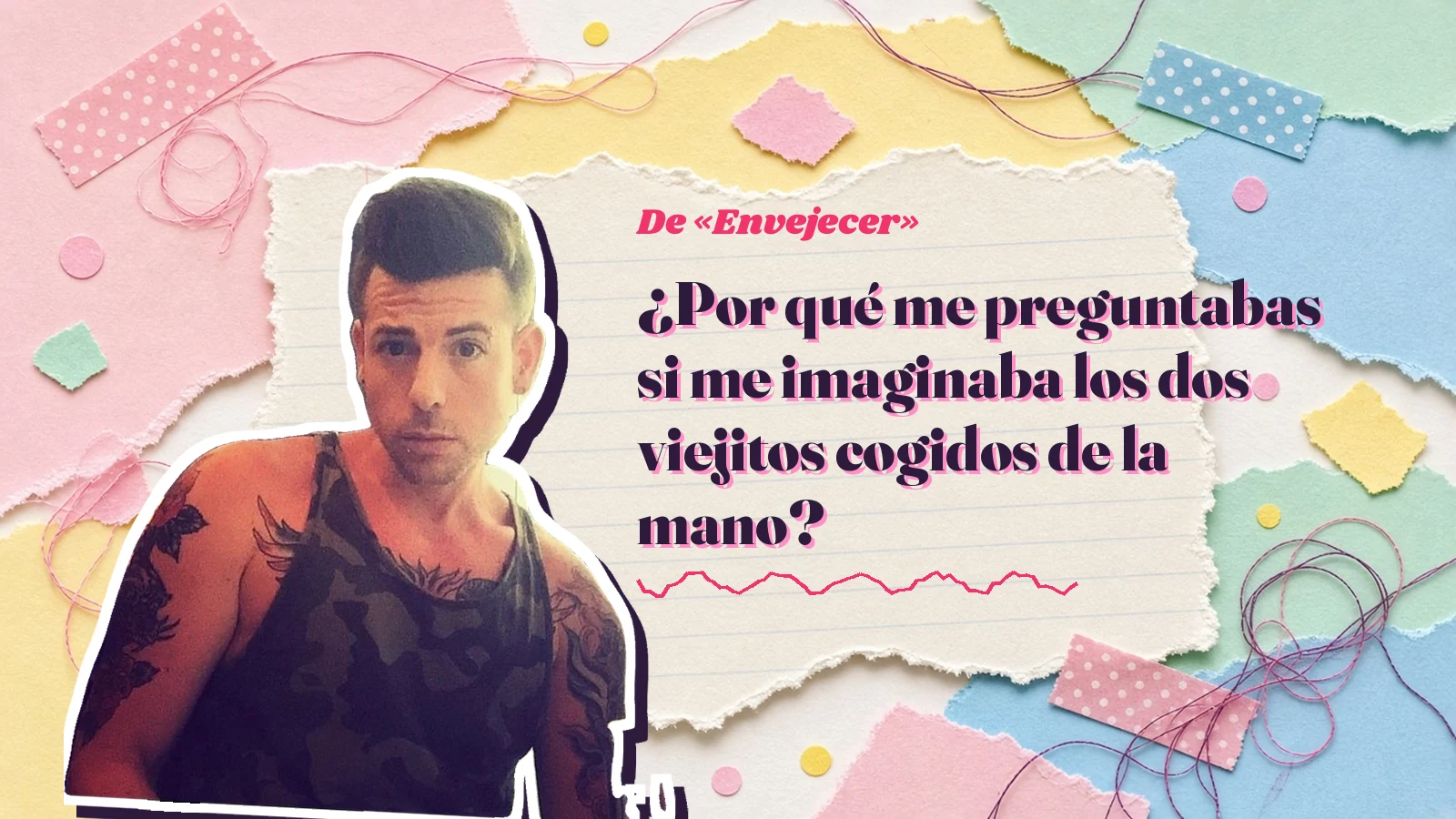
¿Por qué me preguntabas si me imaginaba los dos viejitos cogidos de la mano? Why did you ask me if I could picture the two of us as little old men, holding hands?
This sentence is a trap tied with a gift bow. The question itself is beautiful. It's the one couples ask on the sofa, under the blanket, at eleven at night, after an episode of whatever series. "Can you see us as little old men?" It's the closing scene of a thousand films. It's the opening of Pixar's «Up», that montage of Carl and Ellie that makes people cry who don't even cry at funerals. It's Antonio and Mercedes in «Cuéntame», Spain's longest-running family drama, decades side by side on the same sofa.
All of that fits inside «los dos viejitos cogidos de la mano». Which is why what follows hurts so much.
Mientras a la vez me engañabas While at the same time you were cheating on me
The problem in the song isn't the cheating. There's cheating in half the Planeta Gayfolk catalogue. The problem is the timing. «Mientras», "while". «A la vez», "at the same time". The two expressions together, one after the other, are deliberately redundant. I wanted it crystal clear: not before, not after. At the same time. The tender question and the lie shared a diary.
At the same time. That's what can't be forgiven.
Why vertical
When I write a long lyric full of lists, like the ones I know by heart from writing so many, I write it horizontally. Whole sentences, commas, lists that pile up until they explode in a «¡Patán!». With «Envejecer» it wouldn't come. Every time I wrote the question on one line it sounded like a WhatsApp reproach. "Why did you ask while you were cheating on me." Quick. Flat. Forgettable.
So I broke it up.
Why. Did. You. Ask. While. At. The same time. You cheated.
Broken up like that, the sentence slows down. Each word takes up its own space. The reader has to drop their eyes line by line, like someone going down a staircase in the dark, feeling for each step. And «Me engañabas», "you were cheating on me", arrives at the end, alone, after a fall of eight steps.
On paper it has another reading too. A column of loose words looks like a text falling apart. A sentence that can't stay on its feet and crumbles to pieces. That's what happens to someone who finds out that the loveliest question of their relationship came with another bed attached.
«Nuuuuuuuunca más»
The other half of the lyric is a vow:

Ya no voy a volver a confiar en nadie I'm never going to trust anyone again
Followed by a «Nuuuuuuuunca más», a "neeeeeeever again", with as many u's as will fit.
I stretch vowels when the text reaches its climax. I do it in «El narcisista» with that «frozeeeeeeeeen», I do it in «Un invitado VIP cortando cebolla» with the «infiernoooooooos». It's a device with a lot of exaggeration in it, and in my house exaggeration is a craft with its own laws. But here the long vowel isn't funny. Or it's funny in the sad way of someone who knows they're saying something they won't keep to.
Because "I'll never trust anyone again" is what everyone says and almost nobody does. You say it at twenty, at thirty, at forty. You say it with a mouthful of supermarket ice cream straight from the tub at two in the morning. And then, two months later, you download Grindr again.
I know. I've written it more than once. In «La de la Capilla Sixtina» it comes back almost word for word: «Ya, nunca más, volveré a confiar en alguien que no sea mi gente», "That's it, never again will I trust anyone who isn't my own people". I compare the two on the page for «La de la Capilla Sixtina», if you want to see how the same vow changes when you put a number of past lives behind it.
The «nunca más» of «Envejecer» is younger. Rawer. It's the first night's.
«Estoy tan tristeeeeeeeeeeee»
There's a third piece, and it's the most naked:
Estoy tan triste. I'm so sad. Three times, the final e stretched until it sounds like a dog howling.
I've been told it's the simplest line I've ever written. True. No metaphor, no horror-film image, no vampire, no coffin, no block of concrete. An adjective and an adverb.
I left it like that because in a heartbreak lyric, at some point, you have to call the thing by its name. All the architecture of the column, all the long vowels, the whole question of the little old men, need somewhere to land. And that place is "I'm so sad". No frills.
Had I dressed it up more prettily, I'd have lost. There are days when language won't stretch any further and honesty means admitting it.
The answer that comes too late
Now the part of the song that matters most to me. The part almost nobody mentions.
Te voy a contestar cuando ya es demasiado tarde I'm going to answer you when it's already too late
Look at the tense. «Te voy a contestar», "I'm going to answer you": future, with the everyday "going to" we use for what we're about to do right now. And in the same sentence, «cuando ya es demasiado tarde», "when it's already too late", in the present. The answer is announced for the future and the deadline has already passed in the present. It's a sentence that contradicts itself, and I left it that way because that's exactly what happens: you answer a question nobody is asking you any more, to someone who's no longer on the sofa. If you want to see how many of my lyrics play with answers that come late, they're all in the lyrics index.
Throughout the lyric the question of the little old men repeats without an answer. Four times. "Why did you ask me if I could picture…?" And the song doesn't reply. It stays with the accusation: why did you ask while you were cheating on me.
Until, almost at the end, it replies. And it replies with what nobody expects:
síiiiiiii / sí / lo imaginaba yeeeeees / yes / I could picture it
Yes. I could picture it.
That's the blow. All along the lyric seems to say "how dare you ask me that". And at the end it confesses the question had an answer, and the answer was yes. That the one asking was lying, but the one answering wasn't. That the two little old men holding hands really were in one of the two heads.
When I wrote it, it struck me as the most humiliating part of the song. Admitting you believed it. That you, at least, could see yourself as a little old man. On telly, on reality shows, people who've been cheated on always say "I knew it", "I could smell it coming". Nobody says "I swallowed it whole". Well, this lyric does.
«Estaba tan seguro»
And then the line that gives everything its title:
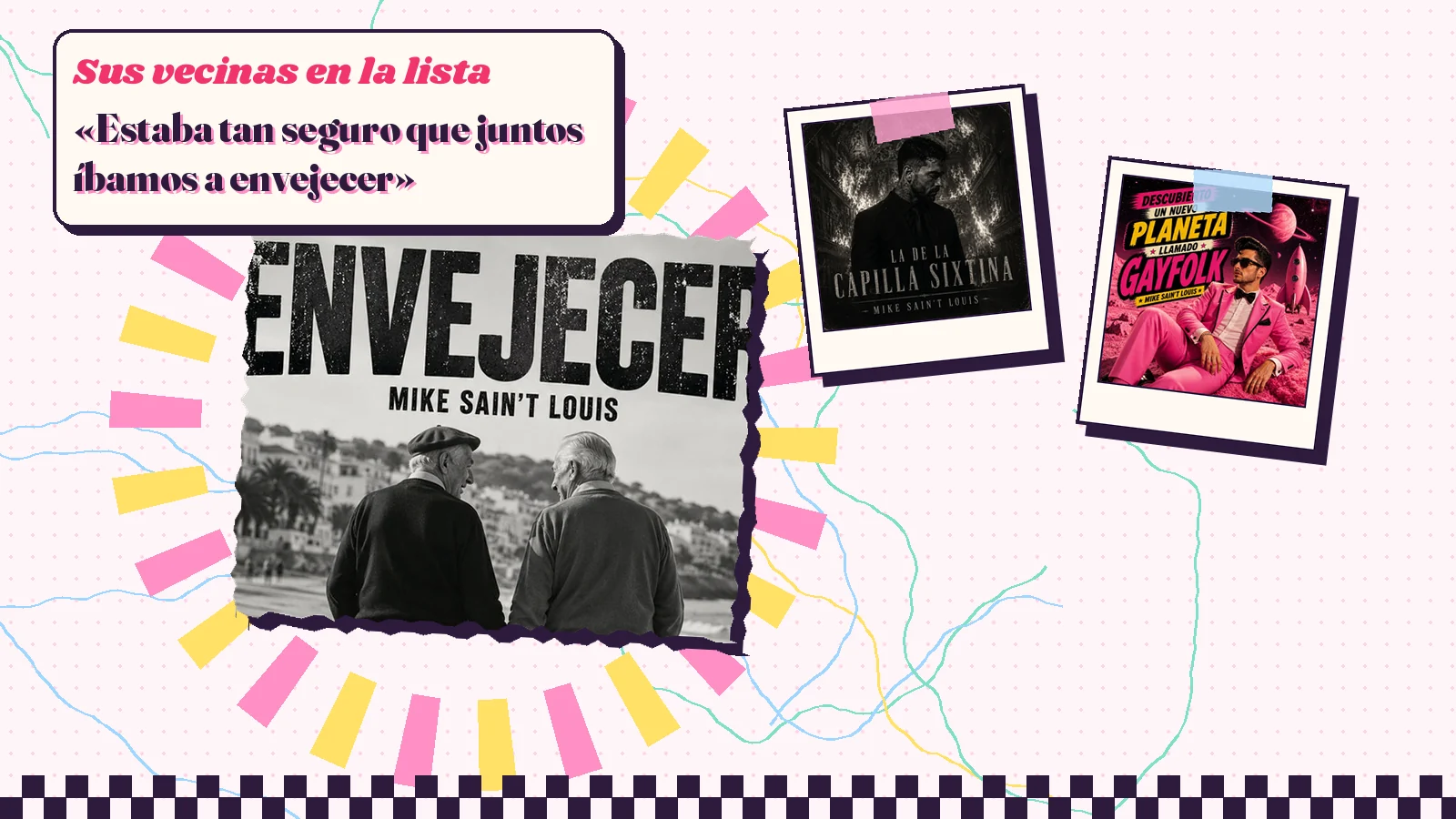
Estaba tan seguro que juntos íbamos a envejecer I was so sure we'd grow old together
Notice the «que» without «de». «Estaba tan seguro que.» Copy-editors would mark it in red: strictly, Spanish grammar wants a «de» there. I left it because that's how people talk in the street, in Madrid and everywhere. When you're in pieces you don't stop to check your prepositions.
«Envejecer» repeats four times at the end, the last e stretched out. A envejeceeeeeeer. The word hangs in the air, as if the song didn't want to let it go.
And the song is called that, «Envejecer», not "Betrayal", or "Liar", or "Never Again". That's what I thought about most. The title isn't the wound. The title is what was lost because of the wound. A future. A shared old age that will no longer exist.
I think it's the saddest title on the album. And the album has one called «Nadie hablará de mí cuando haya muerto», "Nobody will talk about me when I'm dead".
The word «seguro»
Back for a moment to «Estaba tan seguro». Because certainty is what breaks most in this song, more than the heart, which arrives already broken.
Being sure of something is a way of resting. If you're sure you'll grow old with someone, you don't have to keep watch. You don't look at their phone. You don't count how often they're late back from the gym. You don't do sums with Google Maps locations. You sit on the sofa and think about the little old men.
That's why cheating doesn't only take away the future. It takes away the rest. And that's why, straight after, comes "I'm never going to trust anyone again". It isn't a threat against the world. It's someone who's just found out how dearly rest can cost.
There lies the bitter joke, if there is one: the one who was sure was the only one telling the truth. The liar was never sure of anything. Asking was enough for him.
So sure. And so alone.
An album with a newspaper headline
«Envejecer» is on «Descubierto un nuevo planeta llamado GAYFOLK», "New planet called GAYFOLK discovered", the first album of the trilogy. It's an album titled like a news story, and I explained why in why the first GAYFOLK album has a headline for a title. An album of discoveries: the planet, but also what turns up when you open a phone that isn't yours.
On that first album the wounds are fresh. There are lots of songs of rage, of insult, of black laughter. «Envejecer» is one of the few that doesn't laugh. That's why I think it matters that it's there: so the album isn't just a collection of outrageous lines. Between one guffaw and the next, someone sits staring at the wall.
The diminutive
«Viejitos.» Not «ancianos», the elderly, not «mayores», senior citizens, not "two gentlemen in their seventies". Viejitos: little old ones.
The diminutive changes everything. «Ancianos» is a news-bulletin word, a care-home word, a Ministry of Health report word. «Viejitos» is a word of affection. It's how you'd talk about the grandads on the park bench, those two who sit in the same corner of the Retiro every morning with their baguette. With «viejitos» the image turns tender, a little cartoonish, a little Christmas card.
That's precisely why I chose it. The more tender the image, the more sickening it is to know what it was used for. Had the question been "can you see yourself with me at seventy?", it would sound like a pension plan. With the little old men holding hands, it sounds like a promise. And a promise used as cover is worse than a plain lie.
When people quote the lyric back to me, they nearly always quote that word. Viejitos. It sticks.
Two old men holding hands
There's something more in the image and I don't want to skip past it.
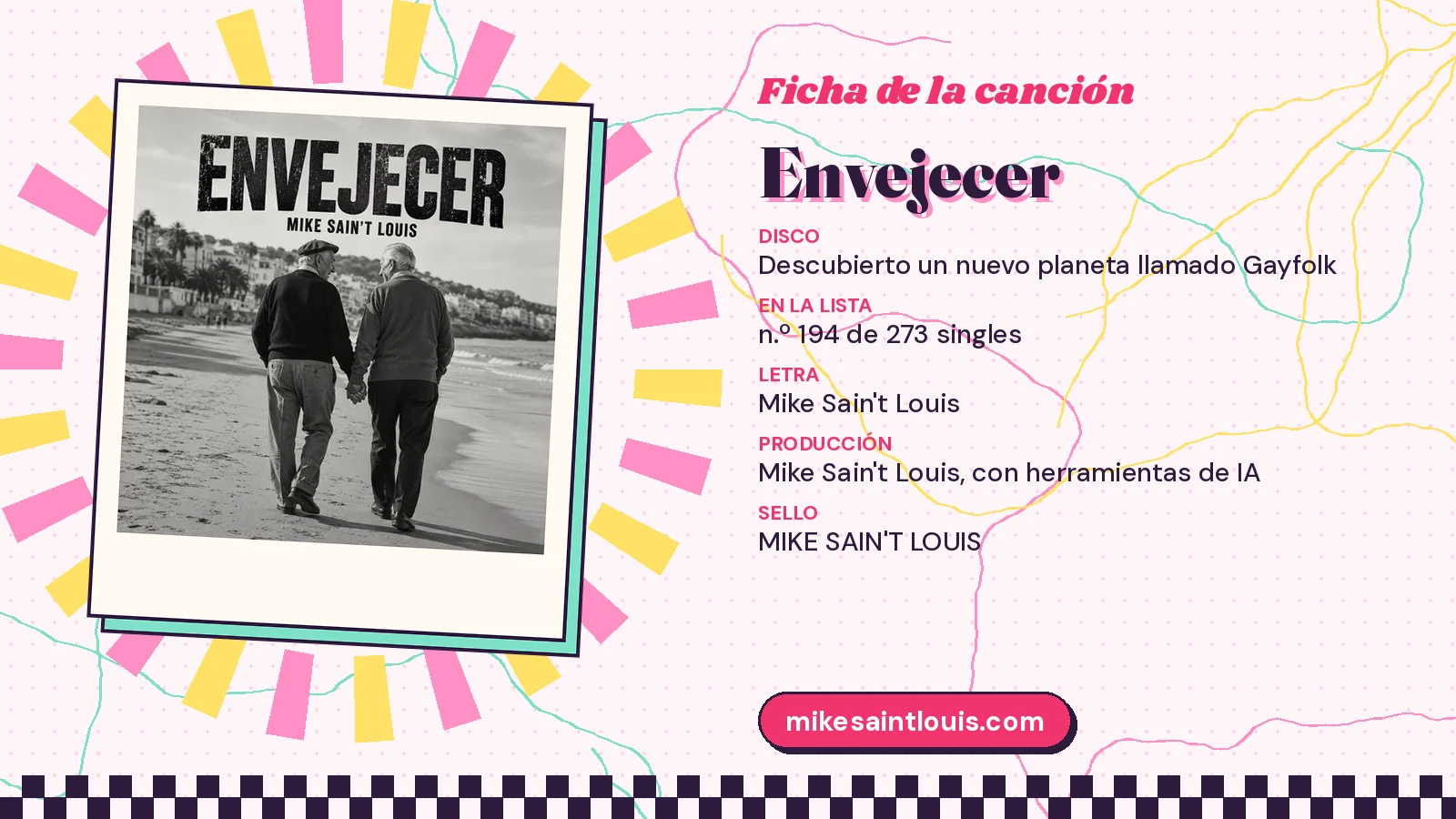
Two little old men holding hands, as a couple, isn't an image that has always been available. In Spain same-sex marriage has been legal since 2005. Before that, two men could love each other, of course, but imagining an old age together, with papers, inheritance, hospital visits without anyone asking "and what are you to the patient?", was a good deal harder. And seeing them stroll hand in hand down the high street of any village, even today, isn't the commonest sight in the world.
So when two men ask each other whether they can see themselves as little old men, the question carries a weight other couples' doesn't. It's also a way of saying: we have a right to that future, we've earned it, we'll get there. In Chueca there are plenty of young couples holding hands. Little old ones, fewer. The question imagines the ones still to come.
And that makes the lie uglier still. It didn't just misuse a couple's promise. It misused one of the hardest promises for people like us to win. Used it the way you'd use an expired discount voucher.
I didn't put this in the lyric. The lyric says nothing about laws or rights. But when I reread it, I think it. And I believe anyone listening from the same place thinks it too, even if nobody says it out loud.
A map of the lyric
For anyone who wants to read it slowly, this is the order of the pieces as they appear in the published lyric:
- The vow: «Ya no voy a volver a confiar en nadie», with its «nunca más».
- The question of the little old men, in full.
- The accusation broken into a column: why did you ask while at the same time you were cheating on me.
- Back to the vow.
- Back to the question and the accusation.
- Sadness, stated without frills.
- More rounds, with small variations.
- The late answer: «sí, lo imaginaba».
- The title, repeated until it fades out.
The curious thing is that the song starts at the emotional ending. The vow never to trust again is what you say once it's all over. Then it goes backwards: to the question, the accusation, the sadness. And only at the very end, in the last stretch, does it reach the confession that explains everything.
It's an interrogation in reverse. First the verdict. Then the evidence. And the witness statement last of all, when the trial is over and nothing can change.
Too late. The lyric says so itself.
What isn't in the lyric
Old age isn't the subject. Neither for nor against. No wrinkles, no care homes, no walking sticks. The «viejitos» are an image, not a theme.
Nor is it against couples who ask each other that question. Let them ask, it's lovely. The problem isn't the question. It's who asks it and what they're doing with the other hand while they do.
And there's no moral. It doesn't say "never trust anyone who talks about the future". That would be false and sad. Some people ask about the little old men and mean it, and then grow old side by side. I wish there were more songs about those couples, which is why I wrote about gay love songs that end well. But this isn't one of them.
Repetition as a wound
Read the whole lyric and you'll see it repeats a great deal. The question of the little old men comes four times. The «nunca más», heaps of times. The «tan triste», two rounds of three.
Some think repetition is lazy. That a good lyric doesn't repeat itself. I think it depends. In a party song, repetition is there so people learn it and shout it. In this one, repetition is something else: it's what your head does when something like this happens to it. It goes round and round. It comes back to the same question at four in the morning. Why did you ask. Why. Again. Again.
Repetition here isn't a chorus. It's insomnia.
And there's a small variation I'm very fond of. In one round, instead of «Por / Qué / Lo / Preguntabas», the lyric says «Por / Qué / Ok / Preguntabas». In another, «Por / Qué / me / Preguntabas». Tiny changes, almost typos, and I kept them. When you repeat a question that hurts, you don't repeat it the same way every time. It warps. An "ok" slips out, from someone who no longer knows what they're saying.
Writing vertically on a phone
A note on craft, for anyone who writes.
Many of my lyrics start on my phone, in the notes app, as I explained in where I write: notebooks, phone and audio notes. The phone has one advantage for a lyric like this: the screen is narrow. Type a word, hit return, and the column appears by itself. Writing vertically on a vertical screen is the most natural thing in the world.
But that same ease carries a danger. Breaking every sentence into single words can become a tic. I see it in a lot of Instagram poetry, which breaks lines for the sake of it, to look profound. And an empty sentence spread over six lines is still empty.
That's why «Envejecer» isn't all vertical. The question of the little old men goes in whole, on one long line. What gets broken is what follows: the "why did you ask while you were cheating on me". The beautiful part stays whole. The painful part comes in pieces. That's the rule I set myself, and if anyone wants to borrow it, be my guest.
The music around it
Once the lyric is written, the song is produced in the studio with artificial intelligence as a tool for production and arrangement. I always say so because it's the truth and I've nothing to hide: I made that clear in why I say openly that I use AI.
With a lyric like this, the production challenge is to respect the column. To make the loose words sound loose. To let the «nunca más» stretch. To give the final answer, the «sí, lo imaginaba», enough air that it lands as a confession and not one more repetition. That's where you can tell who's in charge. The machine supplies the sound. The pauses, the order and the weight of every word are my decisions.
And if it's happened to you
I won't give relationship advice; I'm no good at it. Just one thing, from a lyricist to whoever needs it.
If someone asked you about the little old men while lying to you, the question was never yours. It was theirs, and they were using it for something else. The answer, though, was yours. If you said yes, you could picture it, you didn't make a fool of yourself. You did the only decent thing in that whole conversation.
The fool was the other one.
Frequently asked questions
What is «Envejecer» about? Someone who discovers that their partner was asking whether they could picture a future as "two little old men holding hands" at the very same time as cheating on them. At the end they confess that yes, they could picture it.
Why is the lyric written one word per line? So the question and the accusation are read slowly, line by line. Mike Sain't Louis broke up only the sentences that hurt and kept the question of the little old men whole.
Which album is «Envejecer» on? «Descubierto un nuevo planeta llamado GAYFOLK», the first album of Planeta Gayfolk's GAYFOLK trilogy.
Who writes the Planeta Gayfolk lyrics? Mike Sain't Louis, lyricist, composer and producer from Madrid, the first AI songwriter. The music and vocals are produced using artificial intelligence as a tool.
Is there another song with the same «nunca más»? Yes. «La de la Capilla Sixtina» repeats almost the same vow: «Ya, nunca más, volveré a confiar en alguien que no sea mi gente», "That's it, never again will I trust anyone who isn't my own people".