By Mike Sain't Louis ·
A roof of my own: housing, LGTBI youth and the houses in my lyrics
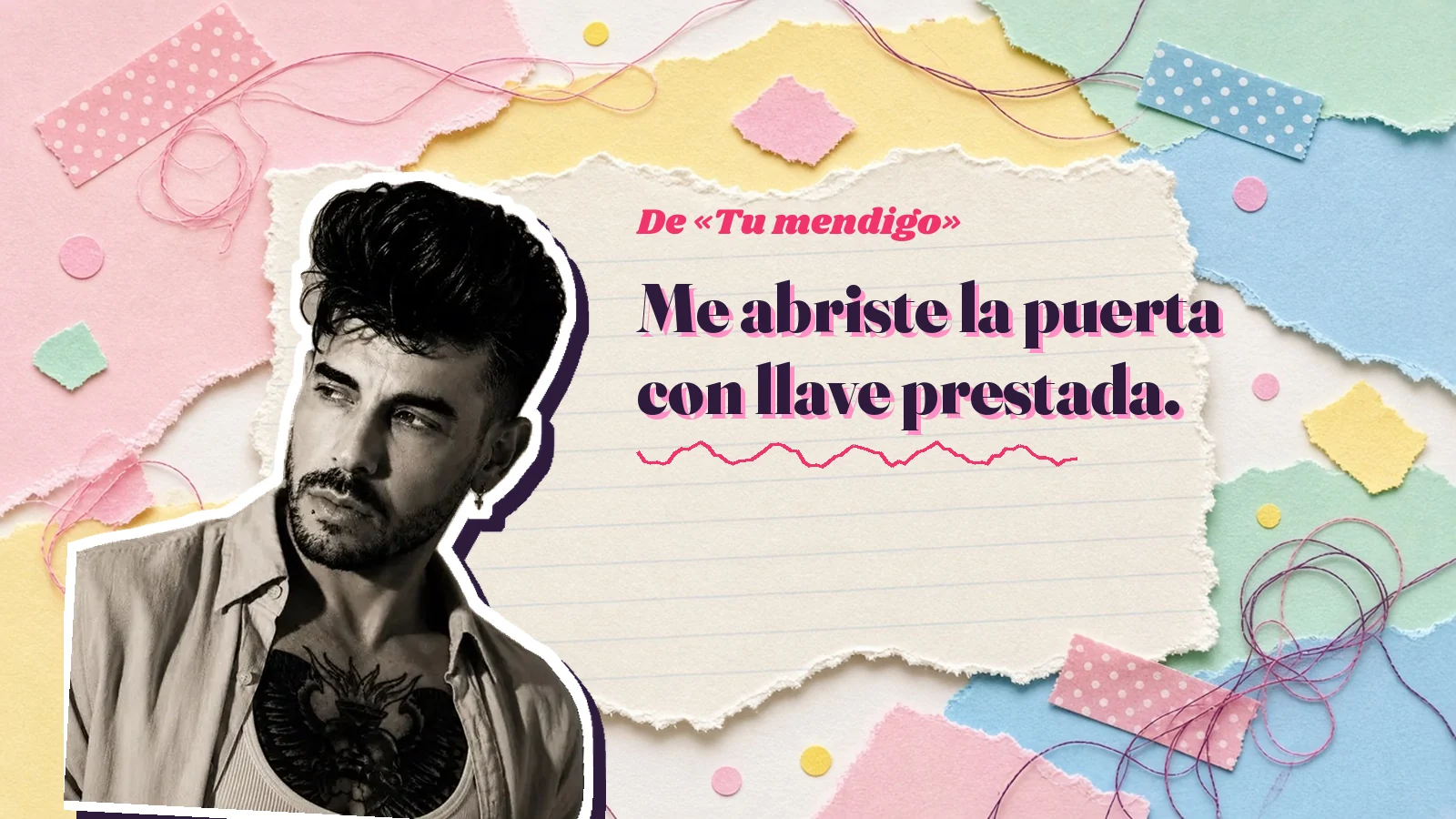
«Me abriste la puerta con llave prestada.»
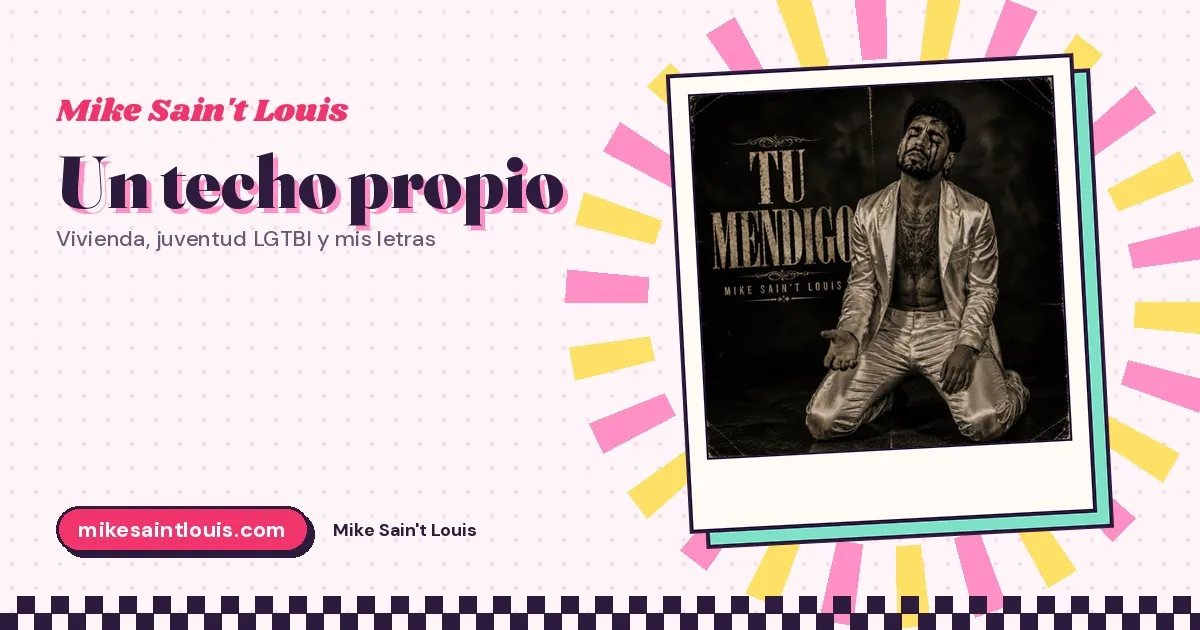
You opened the door for me with a borrowed key. It's a line from «Tu mendigo», your beggar, a song from the second album of the GAYFOLK trilogy, «Ojalá se pudiera viajar a Gayfolk». (The full lyric is on gayfolkplanet.com.) The song is about someone who offers shelter and gives something else entirely. Two lines later comes the image that weighs most in the whole lyric: what looked like a refuge «era una celda alquilada», was a rented cell.
This piece isn't about that relationship. It's about the image. About what a home means, who holds the key, who can throw you out, and why for many LGTBI people housing is a question of freedom as well as money. I write about how late people leave home in Spain, about young people forced out early because their family won't accept them, about flatshares where the closet creeps back, and about the houses that appear again and again in my songs.
The key as a question
There's a question I find more revealing than any statistic: whose key is it, on the door you sleep behind?
If the key is yours, you can lock it. You can invite whoever you like, kiss whoever you like, hang whatever you please on the wall. If the key belongs to someone else, all of that is up in the air. You live by permission. And living by permission, when you're LGTBI, carries an extra cost: the permission can be withdrawn precisely for being who you are.
In «Tu mendigo» the borrowed key is a form of power. Whoever lends it can take it back, and knows it, and you know it too. That's why the song keeps returning to sitting down «donde no había sitio», where there was no room, and to being kicked «por no pedir permiso», for not asking permission. It's the portrait of someone living in a space that isn't theirs and paying for the lodging with their freedom. It interests me because plenty of people who have never been in a relationship like that know the same feeling, from having lived in a house where they couldn't fully be themselves.
Thirty years in the same old bedroom
Let's start with the general picture, the one that affects a whole generation. According to Eurostat, in 2024 young people in Spain left their parents' home at an average age of 30. The European Union average was 26.2. Spain is among the European countries where people leave home latest, and the reasons are always the same: rents, low wages, temporary contracts.
Thirty years in the same old bedroom. For anyone, that has consequences. For an LGTBI person, it has a few more. It means that, very often, the stage of life when you get to know yourself, fall in love for the first time, have your first partners and start to build a public identity unfolds under your parents' roof. If those parents accept you, wonderful. If not, those years become a long wait with the closet locked from the inside.
Coming out with your own key in your pocket is not the same as coming out knowing you depend on the very person you're telling. Many people put off that moment not out of fear of the reaction itself, but of its material consequences: losing a home, food, a safety net.
When you leave too soon
And then there's the opposite case, the hardest: those who can't wait. Young people who come out, or are outed, and whose family responds by throwing them out or making life so impossible that they leave. Organisations working with homeless young people in several countries have been pointing out for years that LGTBI kids make up a far larger share of them than they should. Family rejection is one of the doorways into homelessness.
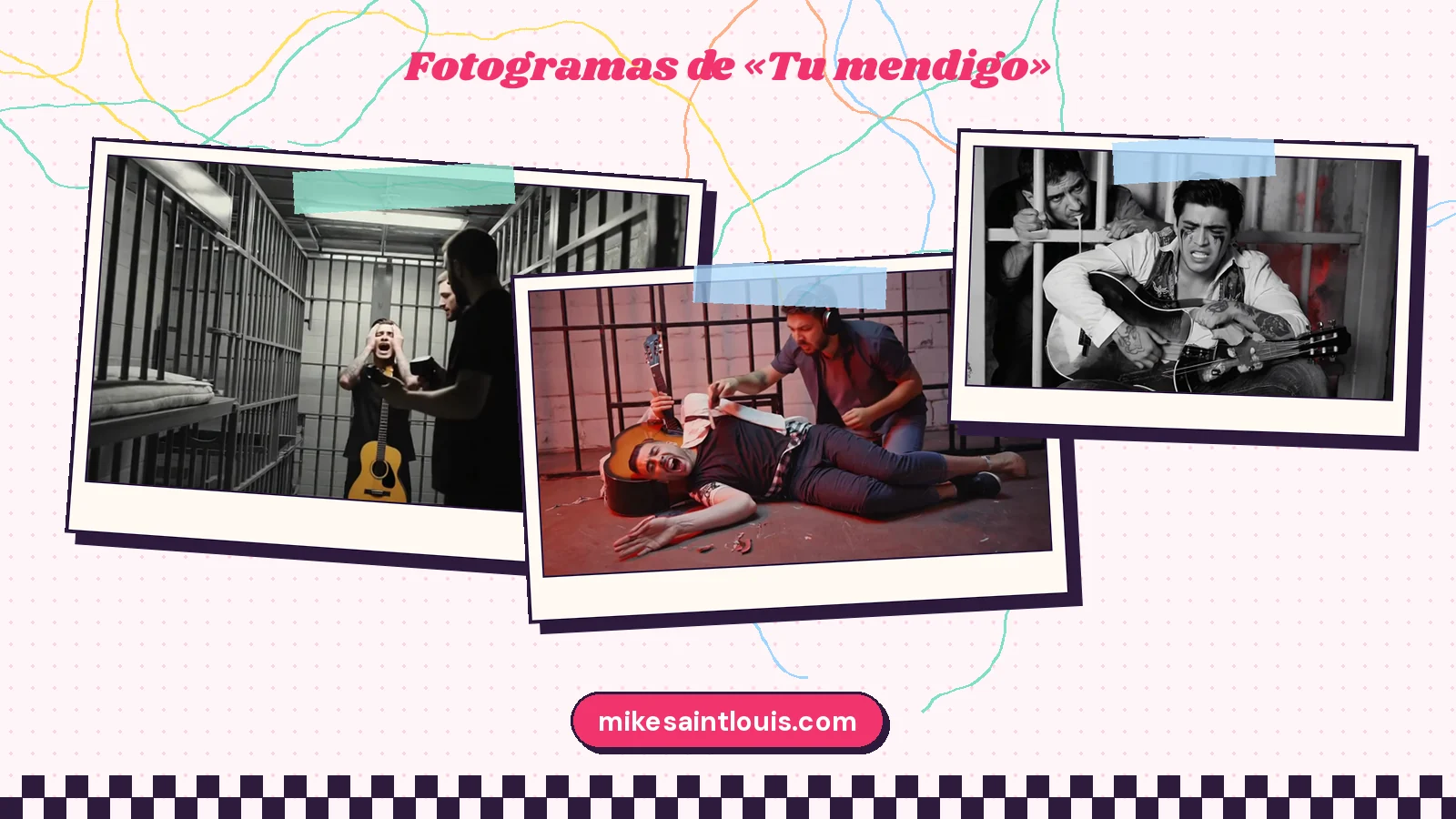
In Spain this is rarely talked about, and I think it needs talking about more. It doesn't always mean sleeping rough. Sometimes it's sofa after sofa, friend after friend. Sometimes it's accepting a room in terrible conditions, or staying with a partner you wouldn't be with if you had any alternative. That's where the song's «rented cell» stops being a metaphor.
If you're under 18 and in that situation, the ANAR Foundation runs a free helpline for children and teenagers, 900 20 20 10, open around the clock. If you're an adult and have lost a safe place to sleep, your local council's social services are the first door; in Madrid, the Samur Social also responds to social emergencies. And your city's LGTBI associations can guide you and stay by your side. You don't have to sort it out alone.
Back in the closet in the flatshare
There's a third situation that applies to a huge number of people in Madrid: the shared flat. When you finally leave home but your wages won't stretch to living alone, you end up sharing with strangers. And then the first-day calculation returns: do I tell my flatmates? Can I bring someone back on a Saturday? What if the guy in the next room doesn't like it?
Most of the time nothing happens, and the flatshare ends up as a little family. But when something does, it's very hard to escape. You can't just leave, because you've signed a contract, paid a deposit, and there's no other room at that price. You stay, and you shrink. The closet you thought you'd left at your parents' place has moved in with you.
In «Antisocial» there's a line that captures that kind of defence perfectly: silence as a castle, the body as armour with no key. Some people live like that inside their own flat. They shut themselves in their room, avoid the shared spaces, eat at odd hours so as not to bump into anyone. It isn't shyness. It's protecting yourself in a place where you don't feel safe.
The neighbour on the landing
The houses in my songs aren't alone. They have landings, light wells, neighbours. In «La vecina cotilla», the nosy neighbour, the narrator no longer leaves the house because all he wants is to see one guy, and the neighbour watches everything. It's a comic song, but it points to something true: in a home, it isn't only who lives inside that counts, but who's watching from outside.
For a long time the neighbour on the landing was the moral police of the neighbourhood. She knew who came in, at what time, with whom. For a couple of two men or two women, that meant privacy had a limit that ended at the peephole. Things have changed a great deal, especially in cities. But anyone who grew up in a village or a small neighbourhood knows the peephole still exists, only now it sometimes takes the form of a WhatsApp group.
The funny thing is that the song's joke runs the opposite way to what you'd expect. Here the one shut up at home is the narrator, glued to the window, and surveillance turns into desire. I find that reversal very telling: for decades LGTBI people were watched from the landing, and now they're the ones looking, choosing, deciding whom to let in. A home of your own is that too, the right to be the one in charge of the peephole.
Imagined houses
Set against the houses that confine, my lyrics also have dream houses. In «La dieta del cucurrucho» there's a house with a view of the Supernova, which is a very me way of saying that happiness had a postal address on another planet. The whole GAYFOLK trilogy, in fact, can be read as the search for a home. A planet where you can live without asking permission. The second album is literally called «Ojalá se pudiera viajar a Gayfolk», if only you could travel to Gayfolk.
It's no accident. When you have no safe place on Earth, you imagine one elsewhere. Many LGTBI people grew up like that: designing in their heads the house they'd have one day, the city they'd move to, the people they'd live with. That fantasy isn't a pointless escape. It's a blueprint. And sometimes, with time and luck, the blueprint gets built.
From the village to the capital
A big part of Spain's LGTBI history is a history of moving house. From the village to the capital, from the provinces to Madrid or Barcelona, looking for somewhere nobody knew you as a child. I've written about the clichés of village and city in «Mi novio de Albacete: el pueblo, la capital y por qué los tópicos me hacen gracia», my boyfriend from Albacete, and I laugh a lot there. But behind the joke is something serious: for decades, for many people, being free meant changing postcode.
Today that move is ever more expensive. The cities that have traditionally served as refuges are exactly the ones with the highest rents. The kid from a Castilian village who dreams of living in Madrid finds that a room in a shared flat costs a large slice of his wages. The refuge is still there, but the door is narrower. And that has consequences: some people stay where they're not well because leaving is out of reach.
Flat-hunting under your own name
There's a moment in flat-hunting that many LGTBI people know and almost nobody talks about: viewing the flat with your partner. Two men, or two women, in front of a landlord who asks «and who's going to live here?». Most of the time nothing happens. But sometimes there's a pause, a look, a call that never comes. And you'll never know if it was the wages, the dog or the two of you.
It's worth knowing the law doesn't allow that either. Law 15/2022 on equal treatment and non-discrimination includes access to housing among the areas where discrimination is forbidden, and sexual orientation, sexual identity and gender expression are among the protected grounds. Proving it is another matter, of course. So if you ever feel you've been turned down for who you are, keep the messages, note the dates, write down what was said. LGTBI associations can help you judge whether it's worth complaining.
For trans people, the search can get one step harder, especially when their documents don't yet match the name they use. A payslip with one name, an ID card with another, a landlord who doesn't understand. Since the 2023 law, changing the registered sex is a much simpler procedure than before, but until it's done, every errand can turn into an explanation nobody should have to give.
Living with your chosen family
There's a very queer kind of housing that deserves its own section: the home shared with your chosen family. Groups of friends who, when blood family fails or is far away, decide to live together, split the bills and look after one another. It isn't a trend. It's an old tradition in the community, born of necessity, and in expensive cities like Madrid it makes a lot of sense again.

In those homes the rules are different. Nobody has to hide anybody. Sunday lunch is shared, so is the fridge, and when someone has a bad day there's always a door that opens. I've written about chosen family in other songs and pieces, and I think it's one of the loveliest answers the community has come up with to the question of where to live. If the key can't be yours alone, let it at least belong to people who love you.
It has its practical side too. Sharing with trusted friends lets you leave home sooner, save money and have a network close by if something goes wrong. For a kid who has just arrived in the city knowing nobody, finding a flat like that can be the difference between a first chapter of loneliness and a first chapter of community. LGTBI associations, youth groups and even flat-hunting forums with flatmate filters are good places to start.
Chueca, the neighbourhood that was home
You can't talk about homes and Madrid without mentioning Chueca. For years it was a run-down area that the LGTBI community turned into a collective home: bars, bookshops, associations, flats where people lived who couldn't have lived anywhere else. For many, that neighbourhood was the first address where they felt they belonged.
Chueca is something else now. Many of those who built it up can no longer afford to live there, and the area has filled with tourist flats and rents few can pay. This isn't a nostalgic complaint; cities change and it's fine that they do. But I think it's fair to remember that the neighbourhoods that took the community in did so when nobody else wanted them, and now that everyone wants them, the community risks being left outside. I write more about the real city, the one not on the postcards, in «Madrid sin postal», Madrid without the postcard.
Growing old without a home of your own
Housing isn't only young people's problem either. There's a whole generation of older LGTBI people who lived through the era of the Social Danger Law, who couldn't marry until 2005, who often had no children or family network, and who reach old age renting or living alone. When a lifelong couple wasn't married because they weren't allowed to be, one partner's death could leave the other with no right to their shared home.
Care homes aren't always safe places either. Some older LGTBI people, on moving into one, hide who they are again for fear of how they'll be treated. After a whole life fighting to come out, ending up back in the closet in the last home you'll ever have is one of the saddest things I can think of. In «Nadie hablará de mí cuando haya muerto», nobody will talk about me when I'm dead, I wrote about the fear of disappearing without anyone telling your story. That fear has a lot to do with having no place of your own.
What a home makes possible
I want to stop for a moment on the positive side, because it would be unfair to tell only what's missing. A home of your own, or at least a safe one, makes possible things that look small and are enormous. Playing music loud and dancing in the living room. Introducing your boyfriend to your friends at your own table. Crying without anyone asking why. Leaving your make-up out in plain sight. Having a dog, or two, who are your family.
In «Canciones para fregar los platos», songs for doing the dishes, I wrote about domestic pop, the songs that keep small lives company. That small life only exists if there's somewhere to live it. Freedom, very often, isn't fought for at a march but in a kitchen, on a Tuesday night, with the door shut and the key in your pocket.
There's a quieter freedom too: not having to explain yourself. Coming home at four in the morning without anyone waiting up with a judging face. Spending a whole Sunday in your pyjamas. Deciding you don't want to see anyone tonight. Anyone who has lived for years in a house where every gesture was commented on knows what a door nobody else opens is worth. Many LGTBI people remember their first home of their own, even a tiny damp studio, as the first place they could fully breathe.
What outsiders can do
Parents, landlords and neighbours may read this too, so here's a simple thought for them. If you have an LGTBI son or daughter, the home you give them is probably the most important thing you'll ever do for them. You don't have to understand everything at once. It's enough to keep the door open while you do.
If you let a flat, look at the wages, look at the contract, and look at nothing else. If you're a neighbour, say hello on the landing the way you would to anyone. These seem like tiny things, and they are. But tiny things like these are what make the difference between a home that's a refuge and a home that's a cell.
Asking for help isn't begging
Back to the song's title. «Tu mendigo» is about someone who refuses to go on being treated like a person asking for alms. And I think that gesture matters for anyone going through a housing crisis. Asking for help doesn't make you a beggar. Turning to social services, an association or a friend isn't failure. It's using the resources that exist precisely for that.
If you're in a home where you can't be who you are, start by finding one trusted person outside it. If you're young and your family doesn't accept you, talk to an LGTBI association near you, to your school counsellor or, if you're under 18, to the ANAR Foundation. If you've lost a safe place to stay, go to social services. And if it all feels like it's crashing down and at some point you think about harming yourself, call 024, Spain's suicide prevention line, free and open 24 hours a day, or 112 in an emergency. If you're outside Spain, call your local emergency number.
And if you haven't told anyone yet because you depend on the person who would have to hear it, you don't have to do it now. You can wait until you have your own key. I left you a few words in «Carta a quien todavía no se lo ha dicho a nadie», a letter to someone who hasn't told anyone yet.
A key that's yours
The song ends, like so many of mine, with a refusal: I'm not your punchbag, I'm not your beggar. I like to think that refusal can also be read as a statement about housing. Nobody should have to pay for a roof with their freedom. Nobody should have to choose between being who they are and having somewhere to sleep.
I hope that one day every key we use is our own. Meanwhile, I'll keep writing houses into my songs: the ones that confine, so they can be named, and the dreamed ones, so that someone staring at the ceiling of a room that isn't theirs knows there are other blueprints.
Frequently asked questions
At what age do young people leave home in Spain? According to Eurostat, in 2024 young people in Spain left their parents' home at an average age of 30, against an EU average of 26.2.
Where can a young LGTBI person who's been thrown out get help? If under 18, from the ANAR Foundation helpline, 900 20 20 10, free of charge. If an adult, from their local council's social services (in Madrid, also the Samur Social) and from LGTBI associations in their city. In an emergency, 112.
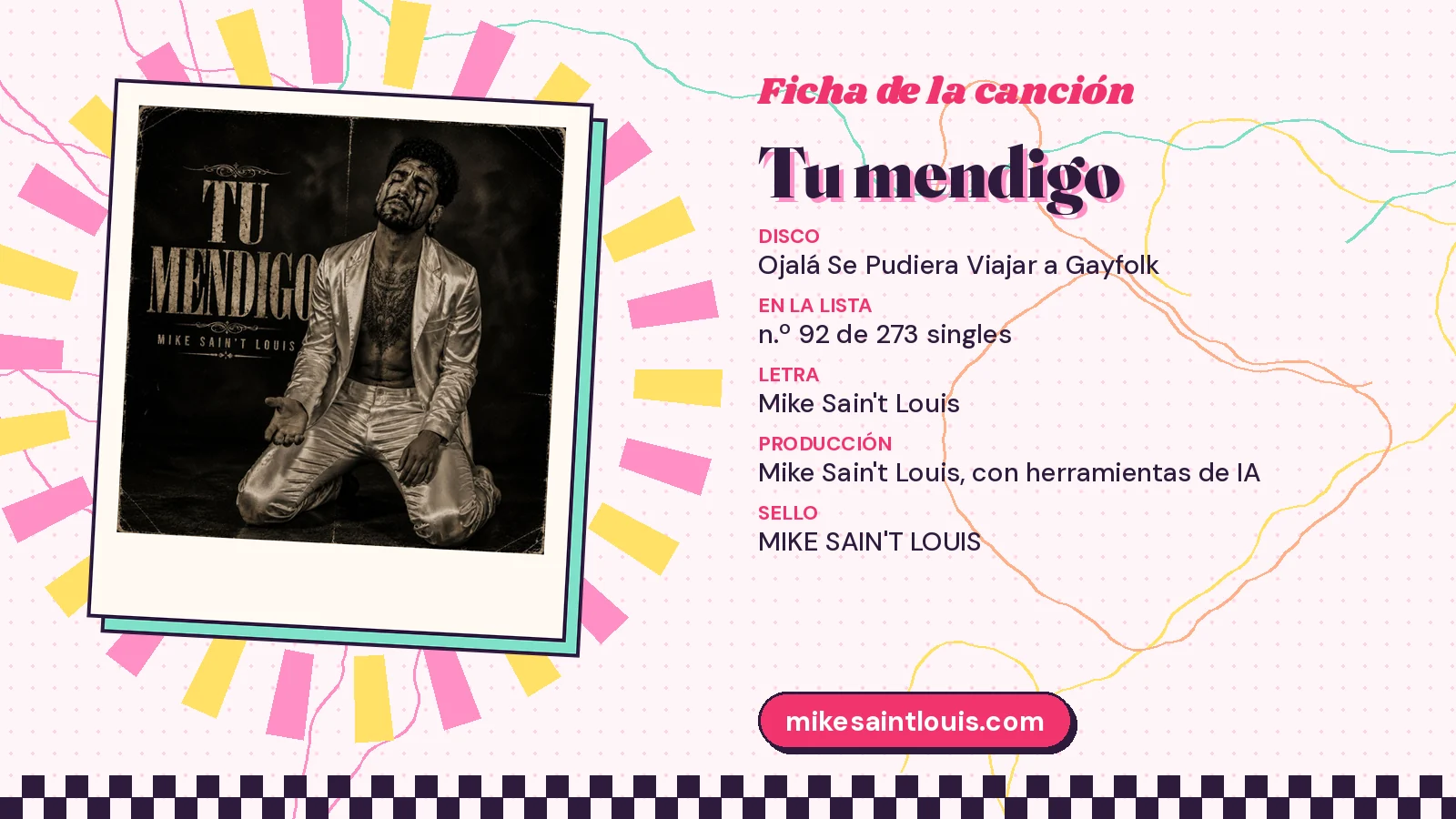
What is «Tu mendigo» about? Someone who offers a refuge that is really a cell, and the person who decides to stop being treated like a beggar. It's a song from the second album of the GAYFOLK trilogy, «Ojalá se pudiera viajar a Gayfolk».
Is there a helpline if things become too much? In Spain, 024, the suicide prevention line, free and open 24 hours a day. In an emergency, 112. Outside Spain, your local emergency number.
Who writes these songs? Mike Sain't Louis, a lyricist, composer and music producer from Madrid who introduces himself as the first AI songwriter. The music and vocals of his songs are made with artificial intelligence.