By Mike Sain't Louis ·
A place that doesn't exist yet: Oz, Fire Island and Planet Gayfolk
«Dicen que hay un límite en el mundo» («They say there's an edge to the world»).
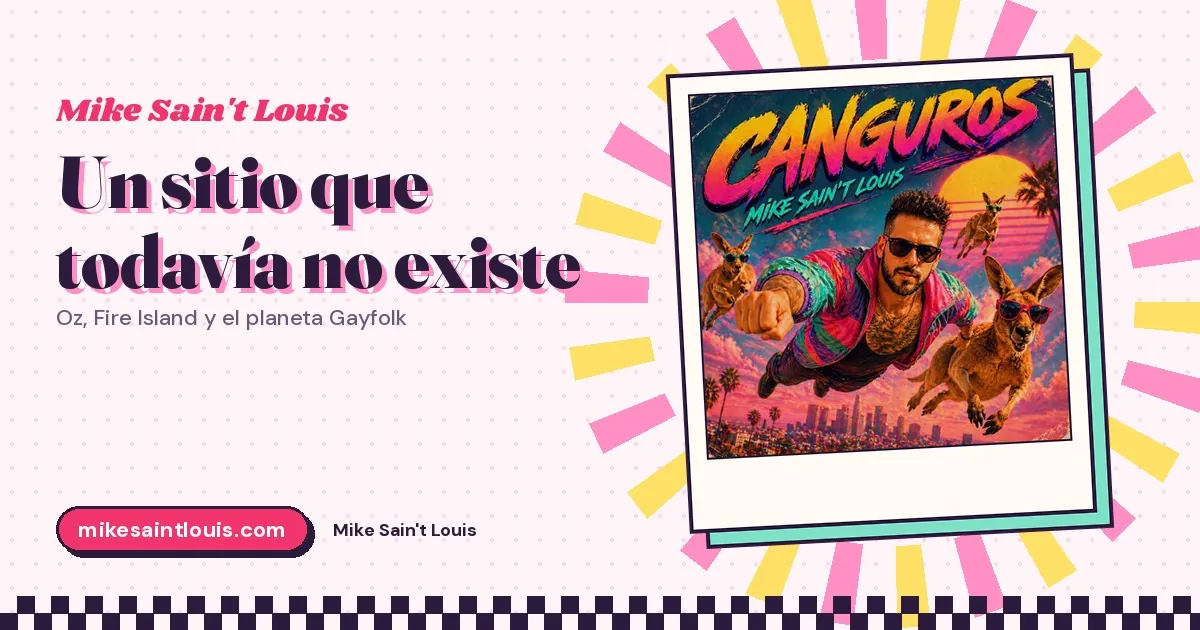
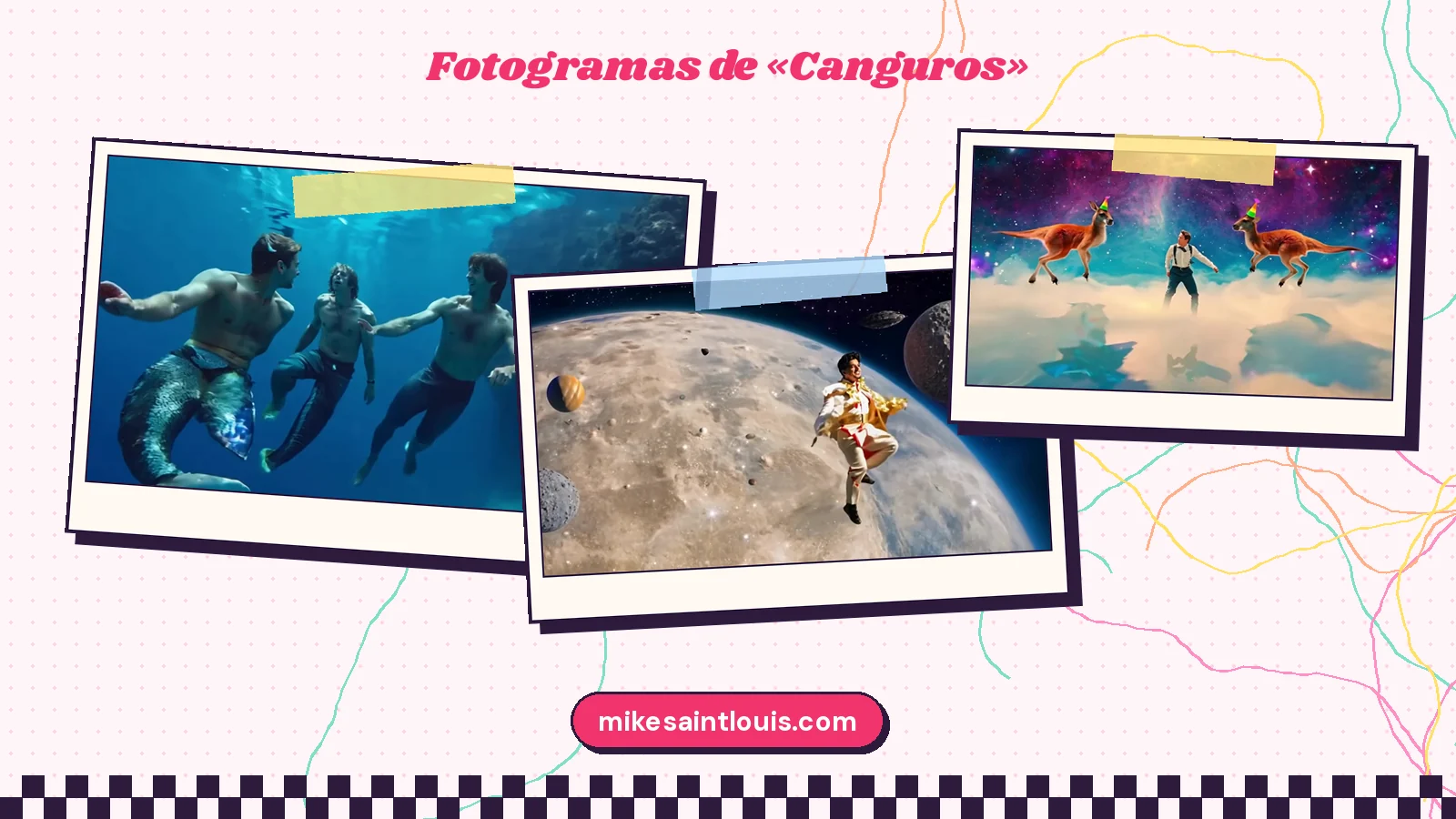
That's how «Canguros» begins, a song from the second album of the GAYFOLK trilogy. What follows is a string of rumours: a lighthouse on the bay, a star that, if you follow it, will leave you on a wooden boat, mermaids and mermen, kangaroos bounding across the moon. Everything starts with «they say». Nobody has seen it. But everybody has heard it told. (The full lyric of «Canguros» is on gayfolkplanet.com.)
I love that song because it sums up something very old in queer culture: the habit of imagining a place beyond the edge of the map. A place spoken of in whispers, like a rumour, reached by following a star, where at last nobody asks you to explain yourself.
I've already written about space in the trilogy, about rockets and stars and why the planet is called Gayfolk. This piece is about something else. It doesn't look up, at the sky of my songs, but back, into history. Because Planet Gayfolk isn't the first dreamed-of place in queer culture. It has ancestors: a country behind the rainbow, an island off New York, a stretch of Spanish Mediterranean coast, and one beautiful academic idea which says that queerness is, precisely, a place that hasn't arrived yet.
Somewhere over the rainbow
The first ancestor wears ruby slippers.
«The Wizard of Oz», the 1939 film, tells the story of Dorothy, a Kansas girl whisked by a tornado into a technicolour land of good and wicked witches, a cowardly lion, a tin man without a heart and a scarecrow without a brain. Before she leaves home, Judy Garland gives us «Over the Rainbow»: a song about a place beyond the rainbow where dreams come true.
Few films have weighed so heavily in gay culture. For decades in the United States, «friend of Dorothy» was a discreet way of saying someone was gay, a password that let people recognise each other without saying it outright. The phrase's exact origin is debated, but the idea is clear: people who dreamed of somewhere else saw themselves in the girl who woke up in one.
And then there's the rainbow itself. Gilbert Baker designed the rainbow flag in 1978 for San Francisco Pride. Some link the symbol to the song from Oz and some don't, but it's hard not to think of them together. A place beyond the rainbow and a flag made of one.
In my lyrics, the rainbow appears in English, in «Madrid to Benidorm», with an invitation to dance under the rainbow all the way from Madrid to Benidorm. What strikes me is that there the rainbow is no longer on the far side of anything. You don't have to cross it to reach a magic kingdom. It hangs over the motorway, between two cities that are perfectly real. The dreamed-of place has become a route.
Fire Island: an island with a ferry home
The second ancestor is a real island.
Fire Island is a long, thin barrier island off the coast of Long Island, near New York. Two of its communities, Cherry Grove and The Pines, became in the mid-twentieth century some of the first summer refuges for gay men and lesbians in the United States. There were no cars. You arrived by boat. And for a few days you could live in a way that was impossible in the city.
One of the island's most famous traditions was born in 1976. Every Fourth of July, a flotilla of drag queens from Cherry Grove sails to The Pines in what's known as the Invasion of the Pines. It began as a response to a snub and became a party repeated every year. In other words, even inside the refuge there were borders, and someone had to cross them in a frock.
I love Fire Island as an image because it's a utopia with a return ferry. You arrived, you were free all summer, and then you went back to the city, the office, the family. Paradise ran to a timetable.
My lyrics have a boat bound for paradise that never gets there. In «Croquetas en el crucero», someone books a Mediterranean cruise dreaming of beaches, sunshine and maybe an Italian, and finds a buffet of croquettes and bad cheese, an evacuation alarm, and the nagging question of whether this was a cruise or a funeral parlour on the high seas. It's Fire Island in reverse: the boat promises an island of freedom and drops you into a comedy of errors. And yet the song has a whale of a time telling it.
Torremolinos, Sitges and Benidorm
The third ancestor is much closer to home.
In the 1960s, while Spain was still a dictatorship, mass tourism opened a few cracks along the coast. Torremolinos filled up with foreigners, bars and a nightlife unseen anywhere else in the country. There was the Pasaje Begoña, an alley of bars where gay people gathered. In June 1971, police raided the alley and the surrounding streets: they identified more than three hundred people and arrested 114. Today it's remembered as one of the places where the story of LGBTQ rights in Spain began.
Sitges, on the coast near Barcelona, became in those years and the decades after another of the great gay destinations of the Mediterranean, with its carnival, its beaches and its bars. And Benidorm, with its skyscrapers and its unapologetic holiday mood, has its own place in the mythology of the Spanish coast.
What these places share is that they were seasonal utopias. Because they were tourist zones, what wasn't tolerated in the village or the capital was tolerated there. A half-freedom, watched over, that could end in a raid. But freedom, all the same.
Benidorm turns up several times in my songs. In «Madrid to Benidorm», as the destination of a dance. And in «La playa del Mal Pas», a little beach between the harbour and the old town, which the song's introduction describes as a secret refuge you keep returning to, even if only in memory. That idea of a refuge seen from afar feels very Spanish-coast to me: the summer paradise that, come winter, exists only in remembering.
Utopia means no place
Before going on, a pause on the word itself.
«Utopia» was coined by Thomas More in 1516 as the title of a book about an imaginary island with a perfect society. The word plays on Greek: it can be read as «no place» or as «good place». The good place is, by definition, a place that doesn't exist.
I find it delicious that the term was born with that trap already built in. From the start, utopia is a place described in loving detail precisely because you can't visit it. More describes the streets, the houses, the laws and the customs of his island. He just doesn't give the address.
Planet Gayfolk works the same way. My songs and their introductions are full of detail: what the people are like there, what's missing, what you're allowed to do. But the second album's title already warns you about the address. It isn't «Travel to Gayfolk». It's «Ojalá se pudiera viajar a Gayfolk»: if only you could travel to Gayfolk. Ojalá. In other words, you can't, not yet. It's a utopia in Thomas More's exact sense: a good place that is, at the same time, no place.
Queerness is not yet here
The fourth ancestor isn't a place but an idea.

In 2009 the Cuban-American theorist José Esteban Muñoz published «Cruising Utopia», a book that has become a classic of queer studies. Its argument opens with one of the loveliest sentences ever written on the subject: queerness is not yet here. For Muñoz, queerness isn't something we already possess but a horizon. A way of feeling that the present isn't enough, and of imagining that another world is possible.
Muñoz argued that this feeling isn't a weakness but a strength. That hope, the longing for something better, nostalgia for a future that hasn't come, are ways of resisting a present that tells you this is all there is. And he looked for that hope in small places: a performance in a bar, a poem, a photograph, a gesture.
Reading Muñoz, I think of the introduction to «Ojalá se pudiera viajar a Gayfolk», which speaks of a place where love doesn't hurt and identity isn't up for negotiation. That's a horizon in Muñoz's sense. It doesn't describe somewhere you could go tomorrow. It describes somewhere you miss without ever having been. And the «ojalá» of the title is the perfect Spanish word for that feeling: a word that names a wish while knowing it hasn't come true. Spanish borrowed it, centuries ago, from an Arabic phrase meaning «if God wills», and it still carries that sense of something in other hands.
They say there are kangaroos on the moon
Back to «Canguros», because I think it's the song in the catalogue that understands this idea best.
The whole lyric is built on «they say». They say there's an edge to the world. They say there's a lighthouse on the bay. They say if you follow that star you'll end up on a wooden boat. They say there are mermaids and mermen. They say the loveliest thing in the world is someone telling you they love you. They say I'll find you again.
It's a song of rumours, and rumour is the native tongue of utopias. Nobody has been to Oz, yet everyone has heard of it. For decades, plenty of people heard about Fire Island or Torremolinos long before they could go, the way you hear about a faraway country. Dreamed-of places travel by word of mouth.
Before going on, one small detail I adore: «Dicen que hay sirenas y sirenos», they say there are mermaids and mermen. The lyric isn't content with the usual mermaids of fairy tales and sailors' yarns. It adds mermen. It doubles the myth so everyone fits. It's a tiny gesture, a single word, but it does what every queer utopia does: it takes an imaginary place that already existed and opens the door to whoever had been left outside. If there are mermaids at the bottom of the sea, why on earth wouldn't there be mermen?
And there's another detail in «Canguros» that strikes me as key. In the middle of all those «they say»s comes a line that isn't a rumour but a reaction: «Mírame a los ojos», look me in the eye, and then: I don't believe you. It's the listener who hears all these promises and stays wary. Utopia needs someone to believe in it, but it also needs someone to doubt. Otherwise it turns into propaganda.
I love that the song refuses to choose. It ends with someone waiting and a promise to meet again. We don't know whether the kangaroos on the moon exist. We know someone is waiting.
The planet as refuge and as dancefloor
There are two ways to imagine a dreamed-of place, and queer culture has used both.

The first is the refuge: somewhere to hide, to be safe, where nobody can find you. It's the Fire Island cottage in winter, the bar with no sign, the shared flat with the door shut. It's a place that shields you from the world.
The second is the dancefloor: somewhere where, instead of hiding, you're seen. Where you can be over the top, sparkle and wear heels. It's the Invasion of the Pines, Pride, the Sitges carnival. It's a place that shows you to the world.
Both appear in my lyrics. «Boys Like Us» is full of dancefloor images: shining, rising, never hiding, standing tall in heels. But in the middle there's a refuge line: he holds my hand where no one sees. It's a pride anthem that still keeps a secret corner.
And «Soy marica sideral» blends the two in its first line: no vine a salvar tu mood, vine a tomar mi space, I didn't come to save your mood, I came to take my space. That «space» has a double meaning. It's outer space, because the queen is sidereal. But it's also my space, my spot. Utopia is no longer on another planet. It's the square metre someone occupies without asking permission.
Paris, the getaway that never happened
Not every dreamed-of place is a collective paradise. Some are small, intimate, for two.
«Paris restera gris», according to its introduction, is about the end of a long gay relationship and a trip to Paris planned a thousand times and never taken. About suitcases that never left the wardrobe and hotels browsed on the map in your phone. And the introduction has a line that feels like the best possible definition of a broken utopia: memories that stay living in the places we never got to.
It's the opposite of Fire Island. You reached Fire Island by boat. Paris, in this song, is never set foot in. But it shares something with every queer utopia: it's a place that exists mainly in the imagination of whoever longs for it. And when the couple breaks up, the dreamed-of city stays grey, as the French title says.
I like that the trilogy holds both an entire invented planet and a real city that turns imaginary. They're two forms of the same thing: places that exist only because someone dreamed them with another person.
The Louvre with butterfly wings
There's another kind of utopia that isn't about going somewhere new but about taking over somewhere old.
«Louvre», according to its introduction, was born from imagining what it would be like to walk into a place that solemn wearing butterfly wings and turn it into a dancefloor. The text says the video wasn't shot in Paris but looks as if it were, and that the Louvre there isn't a museum but a symbol.
It's a very different utopia from Oz. No need to travel beyond the rainbow. You just walk into the museum and change what it's for. It's the idea that the dreamed-of place might lie inside the real world, if you dare to dance where you're supposed to keep quiet.
That way of imagining feels very close to what the drag queens of Cherry Grove did when they sailed into The Pines. They weren't looking for a new island. They landed on the one that was already there and turned it into their party.
The first crewed flight
One song on the second album carries utopia into the news: «Elon Musk ha anunciado», Elon Musk has announced.

The lyric opens on a grey routine: waking up alone, empty looks, a nameless street, faceless people, a routine without laughter. Everything repeats, nothing surprises. And then the news that gives the song its title arrives, with its exclamation-marked «¡hoy!», today!: the announcement of «El primer viaje tripulado», the first crewed voyage.
What interests me in that song isn't the tycoon in the title, who appears only as the one making the announcement, but the structure. First the unbearable present. Then the promise of a way out. It's exactly the structure of «Over the Rainbow»: the grey Kansas farm and the dream of a place where troubles melt like lemon drops. And it's the structure Muñoz described: a present that isn't enough and a horizon opening up.
The difference is that in my song the way out is announced on the evening news. The twenty-first-century utopia no longer arrives by tornado, but by press conference. And that's half joke and half heartbreak, because we know those tickets aren't meant for whoever wakes up alone on a nameless street.
The Great Depression and the place that wasn't there
Not every dreamed-of place in queer history was an island or a beach. Sometimes the only possible place was the night, the bedroom, or a look between two people.
«The Great Depression», from the third album, tells of love between men in the 1930s, in the depths of America's economic collapse. The lyric opens in October, with figures read in a fraying coat and men holding their hats the way they held their pride. It's a time before Fire Island had become a refuge, before the rainbow flag, before the Pasaje Begoña.
For those men, the dreamed-of place was much smaller than a planet. It was a corner where nobody could see them. And I think it matters to remember that when we talk about queer utopias: before the great destinations, before the parties and the parades, there were whole generations for whom the only possible place was the one two people could build between them, in secret.
Not yet, and yet already
I'll finish with Muñoz's idea, which is also the idea of «ojalá».
Queerness is not yet here. Planet Gayfolk can't be visited yet. The rainbow of Oz is still a little further on. Fire Island has a ferry home. Paris stayed grey.
But each of those places, simply by being imagined, changed something in the real world. The song from Oz became a password. Fire Island became a model. Torremolinos became memory and a rallying cry. And an academic idea about the future became a book read in universities across half the world.
And the trilogy itself says it through its titles. The first album announces a discovery, like a newspaper headline. The second sighs «ojalá». The third is called «El día de la liberación», liberation day, and its title track opens with a resounding «today». It's the full arc of a utopia: first someone says it exists, then someone longs to get there, and finally someone decides that the day is today, even if the place still appears on no map. Liberation doesn't come when you find the planet. It comes when you stop waiting for permission to live as though you were already there.
That's why it doesn't seem sad to me that Planet Gayfolk is a place that doesn't exist yet. It seems exactly what it ought to be. A horizon. A rumour, as in «Canguros». Something they say lies beyond the edge of the world, and that someone, somewhere, is waiting to find.
Frequently asked questions
What is Planet Gayfolk? It's the imaginary universe of Mike Sain't Louis's trilogy: «Descubierto un nuevo planeta llamado GAYFOLK», «Ojalá se pudiera viajar a GAYFOLK» and «El día de la liberación». Its songs and introductions describe it as a dreamed-of place, a refuge you can't yet reach.
What does «friend of Dorothy» mean? It was a discreet expression used in the United States for much of the twentieth century to say someone was gay. It's linked to «The Wizard of Oz» and its heroine, Dorothy, though its exact origin is debated.
Who was José Esteban Muñoz? A Cuban-American queer theorist, author of «Cruising Utopia» (2009), which argues that queerness is a horizon, something not yet here that can be glimpsed in small gestures of the present.
Who writes these songs? Mike Sain't Louis, lyricist, composer and music producer from Madrid, who presents himself as the first AI songwriter. The music and vocals of his songs are made with artificial intelligence.