
By Mike Sain't Louis ·
Six lines and five spins: repetition as argument in «Discutiendo con la IA»
Six lines. One question. A chorus that spins. And then the same again. And again. And again. Five full spins, like the washing machine in a student flat that never knew when to stop on the spin cycle.
That's «Discutiendo con la IA», arguing with the AI, from the inside. Printed out, it takes a page and a half. Take out the repeats and it fits on one of those yellow Post-its you stick on the fridge. And yet it's probably the song of mine that says most clearly what I think about the subject that's had me arguing most in recent years: whether what I do counts or not because I use artificial intelligence for the music.
This piece is about that form. About why, for the longest-running subject, I wrote the shortest lyric, and repeated it till you're dizzy.
The Post-it
I'll start with what fits on the Post-it, so we know what we're talking about.
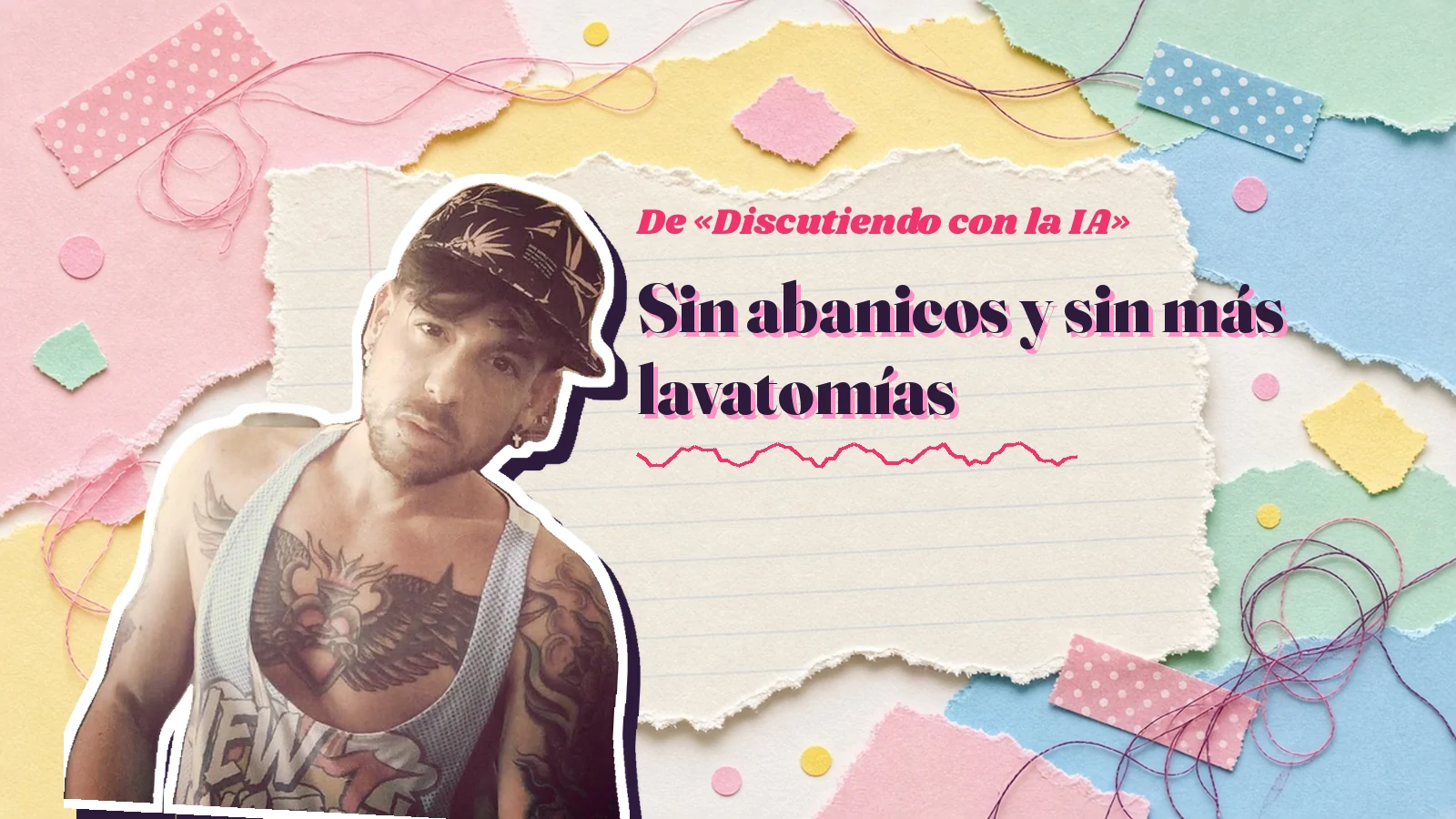
The lyric opens with a line that sounds like a fairground tongue-twister: «Sin abanicos y sin más lavatomías» (roughly "No fans and no more brainwashotomies"). Then comes the punch, the reply to everyone who's told me the same thing: «Hija mía si usar IA es / dar a un botón / hazlo tú maricón» ("Darling, if using AI is / pressing a button / you do it then, sweetie"). After that, a portrait of the critic, who plays the artist, hands out kisses and gushing hellos, and has never opened a book in his life. Then the question. And then the chorus, which is a scene: someone arguing round the clock with the AI while Locomía plays.
That's it. There's nothing more. No second verse with new arguments, no bridge where it turns philosophical, no grand finale with a key change. What there is, is that, five times.
When I wrote it I knew it was very little. What I didn't know was that this little would be the most effective thing I've written on the matter.
Lavatomías
Before the repetition, a word I'm asked about a lot. «Lavatomías».
It's not in the dictionary. You won't find it in the Royal Spanish Academy's, or on WordReference, or in your phone's spellchecker, which underlines it in red and offers «lobotomías» with a pitying face. It's a word of mine, the kind that comes out when you write fast and spitefully, a mix of «lavado de cerebro», brainwashing, of lobotomy and a bit of «lavativa», an enema, which has its own toilet humour.
I like to leave it that way. My lyrics have typos and invented words I don't correct, because they're part of how I talk and how I write when I'm cross. If I changed it to «lobotomías», the line would be cleaner and less mine. And it would lose the joke, which is that the critic comes to wash your brain so you'll think your work's worthless, and you tell him no more washing, thanks, you've already showered at home.
And the fans, of course. «Sin abanicos», no fans. That's for Locomía, who appear in the chorus, and for the whole imagery of giant fans, shoulder pads and multicoloured jackets etched into those of us who grew up watching eighties and nineties TV. Putting the fans away at the start is saying: I haven't come to do the routine. I've come to talk.
And then, of course, I do the routine for five spins.
You do it then
The song's central line is an invitation. Not a polite one, but an invitation.

«Hazlo tú.» You do it. If it's that easy, if it really is pressing a button, you do it. Sit down, open the software, press the button and show me your song. Show me your lyric. Show me your cover, your video, your song page, your two hundred and seventy-three songs organised into a trilogy with its own invented planet and map.
That line was in my head long before I wrote it. It's what I think every time I read one of those comments I know by heart, the same ones I put word for word into another song, «El segundo exacto». There I let them speak, in their own words, and answered with mockery. Here I don't let them speak. I send them off to do it.
And I finish it with «maricón», which from me is nearly always affection and almost never an insult, but here has a bit of both. «Hija mía, maricón», darling, sweetie. It's how a friend would say it at the bar of the Black and White at four in the morning, drink in hand, rolling her eyes. A way of saying: I love you, but you're talking rubbish.
The artist of kisses
In the critic's portrait there's a detail that makes me laugh and that I think everyone recognises.
The one who plays the artist and greets everybody as «tías», girls, telling them he loves them so much. In the lyric it comes with its exclamation mark and quotation marks, because that's how he says it: walking into the party arms wide, kissing everyone, calling whoever's in front of him «tía», posing for photos with all and sundry. That person exists in every artistic scene I know. In Madrid's, on Instagram, on TikTok. The person who talks most about art and makes the least.
I won't say who inspired that figure, because the lyric doesn't, and because it isn't a person: it's a type. I've seen it in so many versions I no longer know if it's one or two hundred.
And then comes the punchline, the song's subtlest dig, or so I think. That he's never read a book in his life. I wrote it bluntly, with its swear word in the middle. But what I mean is fairly serious: that someone without the most basic habit of anyone who writes should lecture me, with my notebooks and notebooks of lyrics, on what creating is, strikes me as such a nerve that it can only be answered with humour.
Darling
Before the question, I want to stop on how I talk to the critic, because there's a lot of me in it.
I call him «hija mía», my daughter, darling. I call him «maricón». And I put a «tías» in his mouth. Three ways of addressing someone that are really the same: the playground feminine, queen-to-queen talk, the language spoken in drag dressing rooms, in the loos of Chueca clubs and in gay friends' WhatsApp groups named after glitter emojis.
That language has a rule I love. You can tell someone the harshest thing in the world if you say it in the feminine and with affection. Darling, you're a state. Oh, sweetie, you're tragic. It sounds like an insult and is almost a caress. Or sounds like a caress and is a dagger. It depends on the tone, the eyebrow, how long you stretch the vowel.
In this song I use it like a silk glove with a stone inside. I don't hate him. I talk to him like a tiresome friend spouting nonsense at New Year's Eve dinner. And that, I think, annoys him more than a real insult would. Because an insult would give him importance. «Hija mía» puts him in his place, which is someone you needn't take seriously.
It's also a way of laughing at myself. Because I talk like that. All the time. And if the song talks to the critic like that, it's also portraying me, eyebrows raised and hands in the air, arguing with a machine in the small hours.
The question
In the middle of it all there's a question. It's the only part of the lyric that isn't a statement or an insult.
«¿Por qué decías que como lo mío era / IA / no valía?» ("Why did you say that since mine was / AI / it didn't count?")
Look at the line breaks. «IA», AI, sits alone on its line. Isolated, as if it were something you could pick up with tweezers and hold to the light. I did that so you'd notice how the critics use it: as a label, a stain, a "not fit for purpose" stamp. Mine was AI. Full stop. No need to listen, no need to read the lyric, no need to look at the cover. It was AI, therefore it didn't count.
And the question hangs there. I don't answer it in the song. The chorus answers it, and the chorus isn't an argument: it's a scene.
Arguing
This is the centre of it all, which is why it repeats so much.
«Si estoy a todas horas discutiendo con la / IA / mientras escucho a Locomía» ("When I'm arguing round the clock with the / AI / while I listen to Locomía").
The chosen word is «discutiendo», arguing. Not working, not creating, not composing. Arguing. Because it's the closest thing to what really happens when you make music with these tools, at least the way I do it.
I've explained it in what I'm sure of and what I'm not about artificial intelligence and authorship and in the piece on the craft of discarding: the machine proposes and you say no. You say no many times. You say not that, not that either, that melody is the same old one, that tempo has nothing to do with the lyric, that version has changed a word and so it's no good. It's a conversation with someone very stubborn who answers everything with enthusiasm and never tires. And you do tire.
That's why it's an argument. Because it has something of a fight about it, of stubbornness, of refusing to back down. People who think it's pressing a button imagine a vending machine: coin in, can out. But it's more like arguing with your mother about how to make a tortilla. In the end the tortilla comes out, yes. But after how long.
Locomía in the background
And why Locomía? People have asked, and the answer is less deep than it seems.
Because it's what's playing. Because while you argue with the machine at two in the morning, cold coffee beside the keyboard, you need something to lift your spirits, and few things lift them like a group of lads with enormous fans and coloured shoulder pads dancing as if there were no tomorrow. Locomía are pure TV-studio joy, the glitter of old-school telly, a way of being excessive that's taught me more than many books on aesthetics.
And because the scene amused me. Someone very serious, fighting with an artificial intelligence over whether a bar should be faster or slower, with Locomía in the background. It's a sitcom image. It could be a scene from «La que se avecina», a series I quote more than I should.
And because Locomía also had their share of the are-they-authentic-or-not, was-it-all-image, was-there-more-or-less-behind-it business. I won't go into that story because I don't know it in depth and don't want to make anything up, but I like the idea that the patron saint of my chorus is a group people also looked down on.
Five spins
And now the form. Why five times.

I could have written two different verses. I could have added arguments: that photography was criticised when it appeared, synthesisers too, drum machines too. All true, and I've written it in prose, in the piece on AI as an instrument. But in the song I didn't want arguments. I wanted a mantra.
Some arguments aren't won with reasons. They're won with persistence. When someone's told you twenty times your work doesn't count, you won't convince him with reason number twenty-one. You'll wear him out. You'll repeat your line until it sounds like a slogan, a protest chant, a football chant at the old Calderón. And there comes a point where repetition becomes an argument in itself. If I say it five times, I really mean it.
Repetition is also a very subtle revenge on those who say the machine does everything. Because the machine, if you let it, repeats things senselessly. And here the repetition makes complete sense. I chose it. I counted it. Five spins, not four or six.
The washing machine
Back to the opening image, the student-flat washing machine.
Heard in full, the song has something of a household appliance about it. It goes round. It makes noise. It pulls you in. At first each spin seems the same as the last, but it isn't, because you're not the same person who heard it the first time. The first time you laugh at the "you do it then". The second you notice the bit about books. The third you start humming the Locomía line. The fourth, all the repetition gets on your nerves a bit. By the fifth you're inside, and sorry it's ending.
Long arguments work that way too. The ones you have with someone for years about the same thing. And the ones you have with a machine for hours about a song.
What gets washed
There's something I didn't say at the start, when I was talking about «lavatomías», that I think fits now.
What the critic wants is to brainwash you. To make you think your work doesn't count, feel ashamed, hide it. Many musicians who use these tools do just that, secretly, without saying, for fear of what they'll be called. I decided the opposite, and I explained it in why I say openly that I use AI.
The song is that, belted out by the machine itself. You're not washing anything of mine. I wear the AI stamp on my forehead and I'm not taking it off. My lyrics are mine, I make the music with artificial intelligence tools, and I decide what stays. And if that bothers you, the button's right there. You press it.
There's one more thing I like, even if it's a bit twisted. The song itself, its vocals and music, was made by AI, following my decisions. So the machine, in a way, is defending itself with my words. Or defending me with its sound. I've never quite known which.
The Post-it and the hours
Back to the yellow Post-it, because there's a paradox that tickles me and that I want written down.

The lyric fits on a Post-it. The song doesn't. Between that Post-it and what you hear there are hours. Hours of trying, discarding, trying again, hearing the same line with twenty different backings until one fits the tone I had in my head when I wrote it. That's what the critic doesn't see. He sees the result, which lasts as long as it lasts, and assumes the road was just as short.
It happens with everything, doesn't it? It happens with your aunt's potato tortilla, which looks easy until you try it and end up with a mush. It happens with drag queens' hair, which looks natural until you see the empty can of hairspray in the dressing room. It happens with stand-up, which seems improvised and takes months of rehearsal. Nobody tells a drag queen that all she does is press the hairspray button.
With music made with AI there's a huge temptation to believe the road doesn't exist. That the Post-it and the song are the same thing. And that's why the chorus doesn't talk about the lyric, or the result. It talks about the road. Arguing. Round the clock. It's the only word in the song that describes the work, and I repeat it so much because it's the one nobody wants to hear.
If you ever wonder what a song of mine costs, don't look at how long it lasts. Look at how many times the word «discutiendo» appears in the lyric. That's roughly the bill.
The third album
«Discutiendo con la IA» is on the trilogy's third album, «El día de la liberación», liberation day. And I don't think it's chance that it's there and not on the first.
On the first, «Descubierto un nuevo planeta llamado GAYFOLK», I was still defending myself with mockery and with a certain wound. «El segundo exacto» is from that album, and it has a question with no joke in the middle that still knots my stomach. On the third there's no wound left in this subject. There's weariness and lots of humour. It's the album of when you've freed yourself from what people thought of you, and you celebrate by repeating five times that you couldn't care less.
In the full Planeta Gayfolk singles list it's number 212. If you want to hear it alongside its sisters, they're all in the singles list.
Who does what
I'll make it clear as in all my pieces. The lyrics of «Discutiendo con la IA» are mine, no AI, «lavatomía» included. I don't perform the songs: I'm the lyricist, composer and music producer. The music and vocals are made with artificial intelligence tools, Suno among them, and what you hear is what I decided you'd hear after a great deal of arguing.
And this time the argument is literal. It's the title.
Next time
If anyone ever tells you your work doesn't count because you did it differently from them, don't answer with a treatise. Don't send links, don't quote anyone, don't explain the history of photography.
Repeat your line. Five times, if need be. With Locomía in the background, if you have it handy.
And when he tires, which he will, get the fan out. That's what you put it away for at the start.
Frequently asked questions
What is «Discutiendo con la IA» about? It's a reply to those who say music made with artificial intelligence doesn't count because it's "pressing a button". The lyric invites the critic to do it himself and describes the reality of the work: arguing round the clock with the machine while Locomía plays.
Why does the lyric repeat so much? Because it's a mantra. Six lines, a question and a chorus that make five complete spins. The repetition works as an argument: some arguments aren't won with reasons but with persistence.
What does «lavatomías» mean? It's an invented word, a blend of brainwashing and lobotomy, that appears in the first line. It was left as it is because it's part of the lyric's way of talking.
Which album is it on? «El día de la liberación», the third album of the GAYFOLK trilogy. In the full Planeta Gayfolk singles list it's number 212.
Who writes the lyrics and how is the music made? The lyrics are by Mike Sain't Louis, a Madrid lyricist, composer and music producer, written without AI. The music and vocals are made with artificial intelligence tools such as Suno. The full lyrics are at gayfolkplanet.com/letras/discutiendo-con-la-ia.