
By Mike Sain't Louis ·
«Se me ha cruzado un cable»: the pronouns that hand out blame in my lyrics
In Spanish almost nobody breaks a glass. The glass falls on someone.
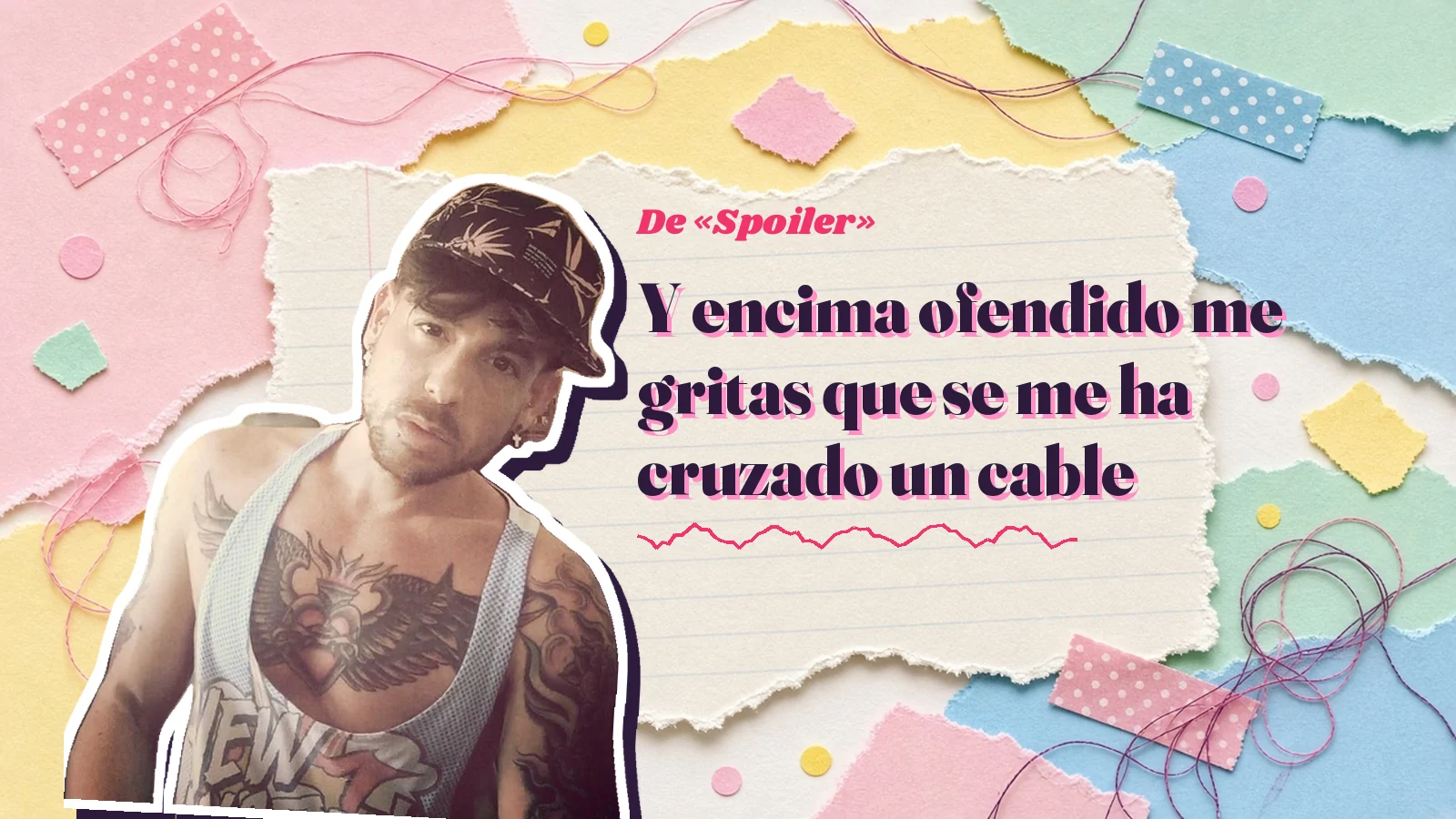
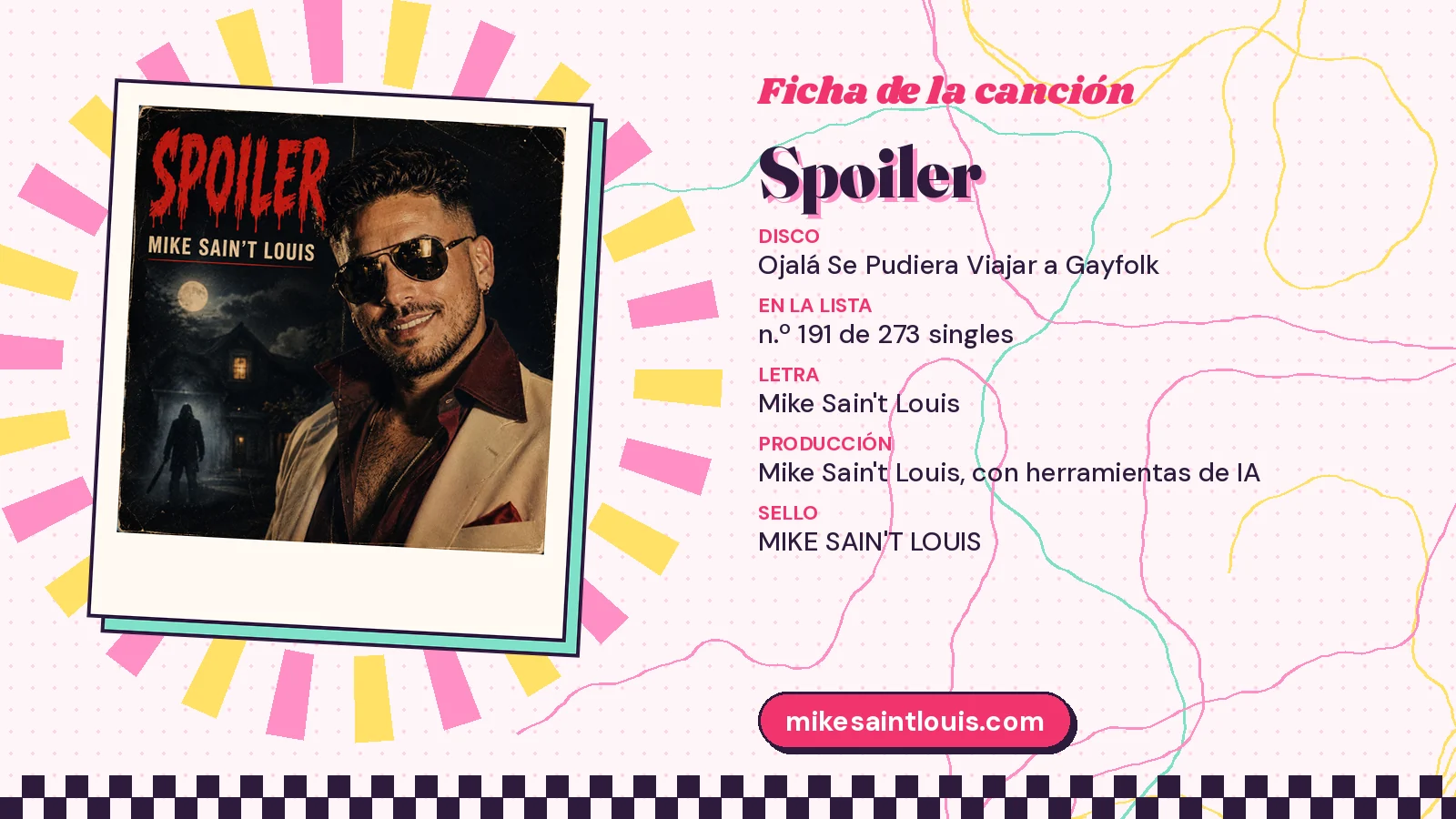
I thought about it rereading «Spoiler», from the album «Ojalá se pudiera viajar a Gayfolk». The song tells of a flirtation on social media that keeps escalating, from likes on Madonna photos to hearts in the comments, and in the middle of the scene there's a line that makes me laugh now that I look at it closely: «Y encima ofendido me gritas que se me ha cruzado un cable», and on top of that, offended, you shout at me that I've blown a fuse. (The full lyric is on gayfolkplanet.com.)
Se me ha cruzado un cable, literally «a cable has crossed on me». Look at the construction. The cable crosses by itself, as if it had a will of its own, and I appear in a small pronoun, me, that turns me into the place where the fault happened. I'm not the one who crossed the cable. I'm the broken appliance. And the person telling me so is, on top of it all, offended.
A little earlier, the same song offers another gem of blame-sharing: «y lo que surja es totalmente involuntario», and whatever comes up is totally involuntary. Here there isn't even a personal pronoun. Whatever comes up, comes up. Nobody causes it. It's time, the algorithm, fate.
This piece is about those little pronouns, me, te, se, le, which do an enormous job in Spanish without anyone looking at them. About how they share out responsibility, affection and, above all, blame. And about why, in a fight, grammar takes sides too.
Se me ha cruzado un cable: the cable that crosses by itself
The expression se me ha cruzado un cable, or se me cruzaron los cables, means losing your head for a moment, doing or saying something without thinking. It's a very modern electrical metaphor: the brain as wiring, and momentary madness as a short circuit.
The interesting part isn't the metaphor but the grammar. Instead of saying I crossed a cable, with a subject who acts, Spanish prefers to say the cable crossed and I was the one affected. Grammars describe it as a construction with se and a dative, and in Spanish classes for foreigners it's often called the accidental se or the se of involuntariness. It's the difference between tiré el vaso, I threw the glass, and se me cayó el vaso, the glass fell on me. Between rompí el móvil and se me rompió el móvil.
In «Spoiler» that construction is in the mouth of the other person, the accuser. In other words, he blames me using a form that, in principle, exists to remove blame. He's telling me I've lost it, but with the grammar of an accident, as if my anger were a technical fault and not a reaction to what I've seen in his stories.
I find it a very subtle way of defusing a complaint. If I've blown a fuse, the problem is my wiring, not what's happening on his phone.
Lo que surja: blame without a subject
The line «lo que surja es totalmente involuntario» is even more radical. Here there's simply nobody. Surgir, to come up, is a verb that needs no one to push it: things come up, like mushrooms or problems.
When I wrote it I was imitating a way of talking I know very well: someone who's doing something and describes it as if it were happening to them. I'm not flirting, it just came up. I didn't start anything, it just sort of happened. In the song the line is sarcastic, of course. The totalmente in front of involuntario gives it away. Nobody who really did nothing needs to swear it was involuntary.
English has a famous formula for this. Mistakes were made. Ronald Reagan used it in his 1987 State of the Union address to talk about the Iran-Contra scandal, and ever since it's been quoted as an example of how the passive lets you admit something without saying who did it. Mistakes were made. By themselves. Like cables that cross.
Spanish has even more tools than English for erasing the person responsible. Which, for someone who writes heartbreak lyrics, is a gold mine.
Se me olvidaba: the slip as a device
I don't always use this construction to accuse someone. Sometimes I use it for myself, very deliberately. In «Un puñetazo al día» there's an «Ah, se me olvidaba», oh, I nearly forgot, that works like a plot twist. I pretend I've forgotten something, when really I've saved it for the end.

It's a very stand-up trick. The important thing is presented as an oversight. The audience knows perfectly well I hadn't forgotten anything, and that shared knowledge is what makes it funny.
The difference from olvidé, I forgot, is huge. Olvidé sounds like a confession. Se me olvidaba sounds like a wink. The first puts the subject at the centre, responsible for the slip. The second makes the forgetting something that happens to me, almost an unexpected visitor, and lets me go back without apologising.
I think that elasticity is one of the loveliest things about Spanish. With the same verb I can blame myself, excuse myself or make a joke, just by changing where I put the pronoun.
The same goes for other everyday slips. Se me ha pasado la hora, the time got away from me. Se me ha ido el santo al cielo, the saint went up to heaven on me, meaning my mind went blank. Se me ha quemado la tortilla, the omelette burned on me. In all those sentences the time, the saint or the frying pan have more initiative than I do. And nobody finds it strange, because the language has taught us to think that much of what happens to us isn't entirely our doing, but something that happens along the way, while we were busy with something else.
Se te marcan las ojeras: the body in the dative
Another family of sentences uses these pronouns to talk about the body. In Spanish we don't say my head hurts me, but me duele la cabeza, the head hurts me. We don't say your eye bags show, but se te marcan las ojeras, the eye bags show on you. The body is named with an article and the owner appears in the pronoun.
Grammarians call it the possessive or sympathetic dative. In «Toxina coreana» there's a perfect example: «Oye tía las ojeras se te marcan», hey girl, your eye bags are showing. The friend doesn't comment on your eye bags as if they were an object. She tells you they're showing on you, happening to you, affecting you. It's beauty criticism with the grammar of a medical report.
And in «El espejo de enfrente» the same construction does the opposite, it marks a small victory: «Ya se me marcan las abdominales», my abs are finally showing. The abs appear by themselves, as if they'd decided to peek out, and I'm the lucky one they happen to. The line doesn't say I've managed to get abs, with all the gym effort. It says they're showing on me, like someone receiving a gift.
I find it funny that in that song even the mirror has its own behaviour: today it's behaving well, today it's behaving terribly. It isn't me who looks better or worse. It's the mirror that behaves. It's another way of shedding responsibility, though here with a less funny undertone, because it's about how cruel you can be to yourself in front of a reflection.
No me vengas: the dative that complains
Then there's the pronoun you don't need and that, precisely for that reason, says everything. No me vengas con tus rollos, don't come at me with your nonsense. No me llores, don't cry on me. Se me ha puesto malo el niño, the kid has got sick on me. In those sentences the me isn't the object of anything. Nobody comes to me or cries me. The pronoun is there to say that what happens affects me, that I live it as something of mine.
Grammars call it the ethical dative, or dative of interest. It's one of my favourite devices because it turns any order into a personal complaint. In «Dientes, dientes» there's «No me vengas con tu falsedad barata», don't come at me with your cheap fakery. Without the me, the sentence would be a neutral order. With the me, it becomes don't do this to me, I've had enough.
In «Licenciada en derecho» the protagonist says «No me mires el pecho, que soy licenciada en derecho», don't look at my chest, I've got a law degree. Here the pronoun is both possessive and ethical. The chest is hers, and on top of that the stare bothers her, personally. One syllable carries the whole weight of the protest.
The beauty of this dative is that it doesn't translate well into other languages. In English don't look at my chest loses that double layer. The Spanish me doesn't only say whose body it is; it says who's hurt by the lack of respect.
La vergüenza no se me da: saying it the other way round
In «Marica chill» there's a line I love for how it twists a familiar construction: «Porque la vergüenza no se me da», because shame just isn't my thing. Normally we say something se me da bien o mal, comes easily or badly to me: languages come easily to me, cooking comes terribly to me. It's another way of shedding merit or blame, because talent seems like something that happens to you, not something you work at.
Applying it to shame gives it a twist. It's not that I'm shameless, which would sound like an insult. It's that shame doesn't come to me, the way maths doesn't. It's an almost likeable inability, a gift I'm missing.
For a song about going through life with glitter on your face and heels on the beach, it seemed the perfect way to say it. Shame becomes a subject I never passed, and I couldn't care less. I wrote more about that pride in the word in «Marica con todas las letras».
El chollo se te ha terminado: when the pronoun is a threat
The same mechanism that sheds blame also shuts doors. In «No quiero otro novio cojín» there's «El chollo se te ha terminado», the free ride is over for you. I don't say I've taken away your free ride, which would make me responsible for revenge. I say the free ride has ended by itself, and you're the one affected.
It's almost a grammatical cruelty, and I like it for that. The sentence presents itself as a weather report, like someone announcing it's stopped raining. There's no anger on the surface. But the te slipped in there points a finger at whoever loses out.
I've found that many of my harshest lines have that shape. I don't threaten what I'm going to do; I state what has ended. It's more elegant and, above all, harder to argue with. You can argue against a threat. Against a done deal, not much.
Se alquila, se vende, se comenta: nobody's se
There's a se with no dative that doesn't point at anyone either. It's the one on signs: se alquila, for rent, se vende, for sale, se busca, wanted. And the one in rumours: se dice, se comenta, se rumorea, it's said, people are saying. Grammars distinguish between the impersonal se, as in se vive bien aquí, life is good here, and the reflexive passive, as in se venden pisos, flats for sale, but for a lyricist the difference matters less than the effect: in both, the doer disappears.

In the gay scene that se is everywhere. It's being said you two are together. People say you were seen with someone else. Nobody says it, but everybody knows. It's the pronoun of the neighbour watching from her balcony, the one who in «Marica chill» shows up in English saying that boy's too much.
I think that's why I like writing in the first person and with invented names so much. It's a way of rebelling against nobody's se. If someone says something in my songs, they have to show their face, even if they're a fictional character. I reflected on the «you» I'm always talking to in «¿A quién le hablo?».
La dije que viniera: the laísmo of my neighbourhood
I can't write about pronouns from Madrid without talking about laísmo. In much of Castile, and very markedly in Madrid, many people say la dije que viniera instead of le dije que viniera, I told her to come. That is, they use la, which in the standard is the feminine direct-object pronoun, for the indirect object.
The Royal Spanish Academy considers it incorrect in educated usage, and I try to avoid it when I write. But I hear it every day on the metro, at the market, in the bread queue, and it's part of the music of my city's Spanish. Leísmo, saying le vi for a man, I saw him, is another matter: the Academy accepts it for a masculine singular person, though it recommends lo vi.
I mention it because pronouns aren't just grammar, they're also identity. If a character in a song says la dije, I already know where they're from, roughly how old they might be and which neighbourhood they walk. In a lyric, a laísta pronoun is worth as much as a set. I haven't used it as a character trait yet, but I'm making a note.
And while I'm on street pronouns, there's another feature I hear a lot in kids and some adults: me se ha caído instead of se me ha caído, it fell on me. The standard order puts se first, and me se sounds like the school playground. I find it endearing precisely because of that, because it gives away someone who's just broken something and is telling you quickly, before they get told off.
There's even a story hidden in the everyday se lo. When we say se lo dije, I told him so, that se isn't reflexive or impersonal. It's a le in disguise. In medieval Castilian people said gelo, as in gelo dio, he gave it to him, and that ge came from Latin. Over the centuries ge got confused with se, and today we say se lo dije a ella without thinking that this se is really a le that changed shape so it wouldn't clash with lo. Little pronouns have a very eventful secret life.
All this reminds me that, when I write, grammar isn't a rulebook but a landscape. Every pronoun I choose says something about who's speaking, how much they care about what they're telling and how far they're willing to own it.
Turning blame around: when se is a trap
Back to «Spoiler», because the cable line has a more serious reading. «Y encima ofendido me gritas que se me ha cruzado un cable» describes a scene many people recognise. Someone sees signs their partner is flirting with others, says so, and the answer isn't an explanation but an accusation: you're crazy, you've lost it, you're imagining things.
In 1997 the American psychologist Jennifer Freyd described a pattern she called DARVO: deny, attack, and reverse victim and offender. Not every couple's fight is that, far from it, and flirting online isn't abuse. But when the answer to a complaint is systematically to make you feel the problem is your head, it's worth paying attention. The grammar of the crossed cable, repeated many times, can be a way of making you stop trusting what you see.
There's another bias studied by social psychology that has a lot to do with these pronouns. In 1971 Edward Jones and Richard Nisbett described the actor-observer asymmetry: we tend to explain our own mistakes by circumstances and other people's by their character. The glass fell on me; you're clumsy. Spanish pronouns seem tailor-made for that bias.
If in your relationship you feel that everything that worries you turns into proof that something's wrong with you, or if there's fear, control or humiliation, you're not exaggerating by asking for help. In Spain you can call 024, free, confidential and available 24 hours a day, if you're having a hard time, and 112 if there's immediate danger. If you're outside Spain, call your country's emergency number or look for your local crisis line.
What happens to me and what I do
Writing songs has taught me to watch these little pronouns almost more closely than adjectives. Because the same scene changes completely depending on who appears as subject and who as the affected party. Rompí la relación, I broke off the relationship, and se me rompió la relación, the relationship broke on me, are two different stories. In the first I decide. In the second I'm the victim of an accident.
I want my lyrics to have both. Sometimes I want the «I» of the song to own what he does, so I use verbs with a clear subject: I've decided, I've thrown out, I've left. I talked about that when writing about the imperative in «Agárrame de la cintura», where orders always have someone behind them. And other times I want to show how the other person slips away, and for that there's nothing better than letting him talk with his se.
«Spoiler» ends with a promise to myself: «pero esta vez soy inmune, no me va a doler», but this time I'm immune, it won't hurt me. Look at the ending. No me va a doler. Pain is still something that happens to me, that comes from outside. But soy inmune, with its crystal-clear subject, is a decision. I've already written about that immunity and that B-movie in «Conocer el final antes de tiempo».
The size of a syllable
If I had to keep just one idea from this piece, it would be that in Spanish blame fits into a syllable. Se, me, te, le. Pronouns that weigh almost nothing on the page, but that decide who's responsible, who suffers and who gets off scot-free.
I've used them in my lyrics to accuse and to apologise, to make jokes and to shut doors. And I've learned to be a little wary of sentences in which things break, end and cross all by themselves. Because almost always, behind a crossed cable, there's someone who doesn't want to say who touched it.
Next time someone tells you you've lost your head, listen carefully to the sentence. Maybe your head is right where it should be and what's moved is something else.
Frequently asked questions
What is the accidental se in Spanish? It's a construction with se and a dative pronoun that presents an event as involuntary, as in se me cayó el vaso, the glass fell on me, or se me ha cruzado un cable, I've blown a fuse. The speaker appears as the one affected, not the cause.
What is the ethical dative? It's a pronoun with no object function that shows the person is emotionally involved in what happens, like the me in no me vengas con tus rollos, don't come at me with your nonsense, or no me llores.
What is laísmo? It's using la and las as indirect objects, as in la dije que viniera instead of le dije. It's common in Madrid and parts of Castile, and the Royal Spanish Academy considers it incorrect in educated usage.
Which Mike Sain't Louis song says «se me ha cruzado un cable»? «Spoiler», from the album «Ojalá se pudiera viajar a Gayfolk», about a flirtation on social media that keeps escalating and a partner who defends himself by accusing.
Where can I get help if a relationship makes me doubt myself? In Spain, call 024, free, confidential and available 24 hours a day. If there's immediate danger, call 112. Outside Spain, call your local emergency number or your country's crisis line.
Who writes these songs? Mike Sain't Louis, a lyricist, composer and music producer from Madrid, the first AI songwriter. The music and the vocals of his songs are made with artificial intelligence.