By Mike Sain't Louis ·
Invisible blood: «Como en la matanza de Texas» and why nobody believes the one asking for help
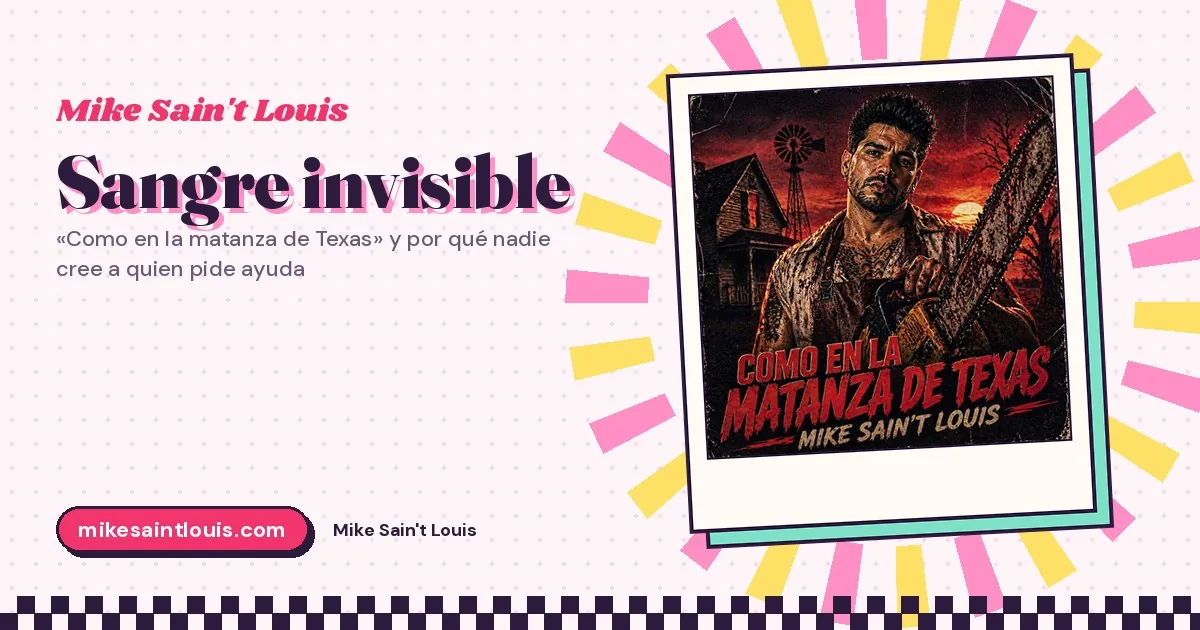
A guy with slicked-back black hair, several days of stubble and his eyes locked on the camera rests a chainsaw on his shoulder. His shirt hangs open, he’s wearing a butcher’s apron covered in stains, and his skin is spattered with red. Behind him there’s an old wooden house with a crooked porch, a ranch windmill, dead trees and a red sky with the sun sinking into the horizon. The title is lettered in blood red, with the look of a video-shop horror poster you’d rent behind your parents’ backs.
That’s the cover of «Como en la matanza de Texas», «like in The Texas Chain Saw Massacre». And it’s a trick. Because as soon as you hear the song, you realise the person speaking isn’t the one with the chainsaw. They’re the victim. The monster in the lyric carries no chainsaw, no apron, nothing you can see. And that is exactly the idea I want to talk about here.
The song is on «Descubierto un nuevo planeta llamado Gayfolk», the first album of the trilogy. The song’s own page on the blog already sketches the emotional vampire at its centre, and in another piece on the blog I’ve explained why I so often talk about heartbreak through horror films. Here I want to focus on something else, on what happens at the end of the song: the moment the victim asks for help and nobody believes them. Or worse, they’re believed for a while, and then they aren’t.
The monster you can’t see
In seventies horror films, you can see the monster. He wears a mask, wields a chainsaw, carries a huge knife. You know who he is from the first scene. The fear comes from not knowing when he’ll show up, never from not knowing who he is.
The song works the other way round. The emotional vampire walks into the bar dragging chains and wearing a forced smile, yes, but nobody sees those chains except the person telling the story. To everyone else he’s a friendly guy saying hello. The lyric puts it plainly: he wears a mask of innocence, hard to suspect. No fangs. No cape. Just charm.
And that is far more terrifying than any chainsaw. Because you can point at the man with the chainsaw. You can’t point at the other one. When you try to explain what he’s doing to you, people look at the nice guy at the bar and think you’re exaggerating. The cover, with its blood-spattered butcher, is the easy version of the monster. The lyric is the hard version.
Chains in the bar
Back to the first line, because that opening scene has more to it than meets the eye. The vampire drags his chains through the bar. And chains, in films and fairy tales, belong to ghosts. The spectre wandering the castle hauling iron, the dead man who can’t rest.
I love that the song blends the two creatures. He’s a vampire because he drains you, but he walks in like a ghost, chains rattling, smile forced. And the place he haunts isn’t a castle, it’s a bar. For a lot of queer people, the bar is where you socialise, where you pull, where you find your people. Having the monster prowl right there makes him so much closer to home.
You don’t need to go to Transylvania. The vampire is propping up the bar at your local, ordering another round, saying hi to everyone. And you’re the only one who hears the chains, while everyone else laughs at his jokes and buys him the next drink.
He bites without drawing blood
There’s a line near the start that sums it all up. «Muerdes sin sangrar, pero dejas cicatriz». You bite without drawing blood, but you leave a scar. To me it’s one of the most precise lines in my catalogue for describing a certain kind of harm.
A bite that doesn’t bleed can’t be shown to anyone. No open wound, no bandage, no mark you can photograph for a report. And yet the scar stays. You feel it every time someone speaks to you in a similar tone, every time you walk back into that bar, every time someone new smiles at you and you catch yourself not trusting them.
That’s the kind of harm that’s hardest to talk about. If someone hits you, you have a bruise. If someone manipulates you for months, what you have is a feeling. And feelings, however heavy, can always be argued with. There’s always someone ready to tell you you’ve got it wrong, he’s not like that, maybe it’s you.
Evidence of the crime
Further on, the lyric comes back to the same idea with an even clearer image. It speaks of invisible blood and says «no hay prueba del delito ni un charco que limpiar»: no evidence of the crime, not even a puddle to mop up. And just before that, dripping with irony, the victim lets out a «what fun, I’m easy to catch».
I love that irony because it belongs to someone who’s had enough. It’s the sarcasm of someone who has tried to explain many times and always met the same sceptical face. What fun. Oh, sure. The friendliest guy in the bar has caught me and, on top of that, I’ve got no proof.
The missing puddle is the key to the whole song. In a horror film the crime scene is soaked in blood, the police arrive, look around, and understand. Here there’s no crime scene. The victim has to convince everyone of something nobody can see. And that, as the song knows, is a battle you almost always lose.
Hope turned to salt
There’s an image in the long chorus that I find one of the loveliest in the lyric, despite what it describes. The vampire feeds on hope and turns it into salt. And every stolen tear is one more trophy.
Salt is what’s left when water evaporates. It’s what dries on your face after crying. It’s also what gets rubbed into wounds to make them sting. Turning hope into salt is exactly that: taking the best someone has, their eagerness, their dreams, whatever they still hope for from the relationship, and boiling it down to a bitter residue that burns.
And then there are the trophies. Tears as a collection. It’s such a predator’s image, the hunter mounting heads on the wall. Hurting people isn’t enough for the vampire; he needs to keep it, display it, count it. The song doesn’t put it this way, but I picture a shelf lined with little bottles of tears, each with a name on the label. And it scares me more than any chainsaw.
Running, screaming, and nobody answers
Then comes the final scene, the one that gives the song its title. The lyric turns into a screenplay. The victim runs, screaming, looking for help, like in The Texas Chain Saw Massacre. And nobody answers.
Anyone who has seen the original 1974 film remembers that feeling. The girl who manages to escape runs through the fields at night, screaming, banging on doors, and help never comes. Or worse, it comes and isn’t what it seems. In the film, when she finally finds someone at a petrol station, the man who takes her in turns out to belong to the killers’ family.
The song takes that structure and moves it into a story of manipulation. You run around telling people what’s happening to you, your friends, your family, anyone who’ll listen. And often nobody answers. Not because they’re bad people, but because they don’t understand. Because what you’re describing leaves no puddle. Because the one who hurt you is someone they like.
Someone finally opens the door
But the song doesn’t stop there. It gives the victim a brief moment of hope. Someone finally opens the door. The victim tells their story, raw as it is, and clears up every doubt. And that someone listens. Says I’m so sorry, lad. And the good man goes to call the police.
That stretch moves me because it describes something very specific: the relief of being believed. After all that running with no reply, here is a person who listens, who doesn’t doubt, who says sorry. Sometimes that’s all someone who has been through this needs. Not for anyone to fix anything. Just to be believed.
And the lyric gives that person a lovely name: the good man. Not a hero, not a saviour, not a cop. A good man. An ordinary person who opens the door and listens. I find it a beautiful figure, which is why what comes next hurts so much.
And then the vampire walks in behind
Because, as the lyric says, what always happens in films happens, especially in horror films. The emotional vampire turns up behind. And drains the good man’s energy too.
For me this is the most terrible scene in the song, even though it’s written almost as comedy. The vampire doesn’t need to attack the victim again. All he has to do is show up and win over the one who was helping. With his charm, his smile, his version of events. And the good man, who a minute ago was saying I’m so sorry, is now running on empty too.
Anyone who has lived through something similar knows this happens. You tell someone what a person did to you, you finally find someone who listens, and a week later they’re out for drinks with him. Or they tell you maybe you should talk it through calmly. Or that he told them something different. The vampire doesn’t just feed on you. He feeds on your support network.
The police are no use at all
And then the cry. «¡De nada sirve la policía!». The police are no use at all. It sounds like a gag, a B-movie ending, and at the same time it’s bitter as anything.
I don’t read it as a line against the police in particular. I read it as a line against the idea that there’s always someone in authority who’ll come and set things right. In horror films the police arrive late or not at all. And something similar happens in stories of manipulation: there’s no institution that can repair harm nobody can see. There’s no report you can file for being hollowed out from the inside.
That doesn’t mean you shouldn’t ask for help. Quite the opposite. But the song is honest about something hardly anyone says out loud: sometimes you ask for help and the help isn’t enough. And that isn’t your fault.
What irony
The song ends on an image that’s almost a poster: «él con cara de alegría y yo en plena agonía», him looking delighted and me in utter agony, with that cheap rhyme that makes it even crueller. And then one last «I’ve told you so many times, you’re an emotional vampire».
I love that rhyme because it is exactly the injustice the whole song is about. The one who does the harm walks away happy. The one who takes it is left in pieces. And on top of that, people see one man’s cheerful face and the other’s agony and draw their own conclusions. The calm one looks sensible. The one falling apart looks hysterical.
That’s why the ending isn’t a victory. It’s a statement of fact. I’ve told you so many times. It’s what someone says when they no longer expect to be listened to, but refuse to shut up. And to me that’s a form of resistance. Even if nobody believes you, you keep saying what is.
The promise of justice
There’s a part of the song that goes in another direction, and I don’t want to forget it. Halfway through, the victim announces that every cycle comes to an end, that the vampire will drown in his own game, that the shadows he summons will devour him and his empire of pain is about to blow.
It’s the part of the lyric closest to a curse. And I’m glad it’s there, because it balances the ending. The scene with the house and the police is bleak: nobody saves you. But this verse says something else: maybe nobody saves you, but this won’t last forever. The vampire gets his ending too.
I don’t know whether that’s true in real life. The song doesn’t know either; it only wishes it. But in a story where everyone doubts the victim, the victim being sure that the cycle will end is already something. It’s what you tell yourself to keep going. This guy won’t last forever. And I will.
Picking the weakest
There’s a line that flies past but explains a lot. The vampire picks out the weakest and starts the attack. He doesn’t choose at random. He chooses.
And here the song touches something I think matters to a lot of queer people. Manipulators have a finely tuned nose for people who are alone, who’ve just arrived in a new city, who haven’t come out to their family yet, whose self-esteem is on the floor after a break-up. They look for whoever has the fewest people around to check things with. Whoever is easiest to isolate.
I don’t say this to blame anyone for falling for it. I say it for the opposite reason. If it happened to you, it isn’t because you were stupid. It’s because someone chose you precisely when you were most exposed. And by including that line, the song lifts the blame off the victim and hands it back to the one it belongs to.
The man with the chainsaw isn’t the villain
Back to the cover to close the circle. The chainsaw guy, with his stained apron and the ranch house behind him. At first he looks like the villain. But the more you listen, the clearer it is that he isn’t. The real villain would never appear on a cover like that. He’d be smiling in a bar, drink in hand.

There’s another reading I like even more. Maybe the man with the chainsaw is the victim, fed up, at the very end. The one who ran screaming, who banged on doors, who watched the vampire take even the good man. And who now stares at the camera spattered in red, with the face of someone with nothing left to lose. Not as a threat, but as a picture of what a story like that does to you: it leaves you a total wreck.
I love that ambiguity. In horror films, the last girl left alive usually ends up covered in blood. She isn’t the killer. She’s the survivor. And maybe that’s what the cover is showing.
Camp horror to say something serious
The song tells all this in a tone that is anything but solemn. There are exclamations, easy rhymes, irony, a «what a let-down» that could come from an afternoon soap. It’s camp horror. And as I’ve said before, camp isn’t a joke even when you laugh.
I think some things can only be told this way. If I wrote a serious, sad song about not being believed when you’re being manipulated, maybe nobody would listen. Or they’d listen with the poker face people wear for a sermon. Dress it up as a chainsaw film, though, with its petrol station, its good man and its vampire, and people laugh. And while they’re laughing, the idea gets in.
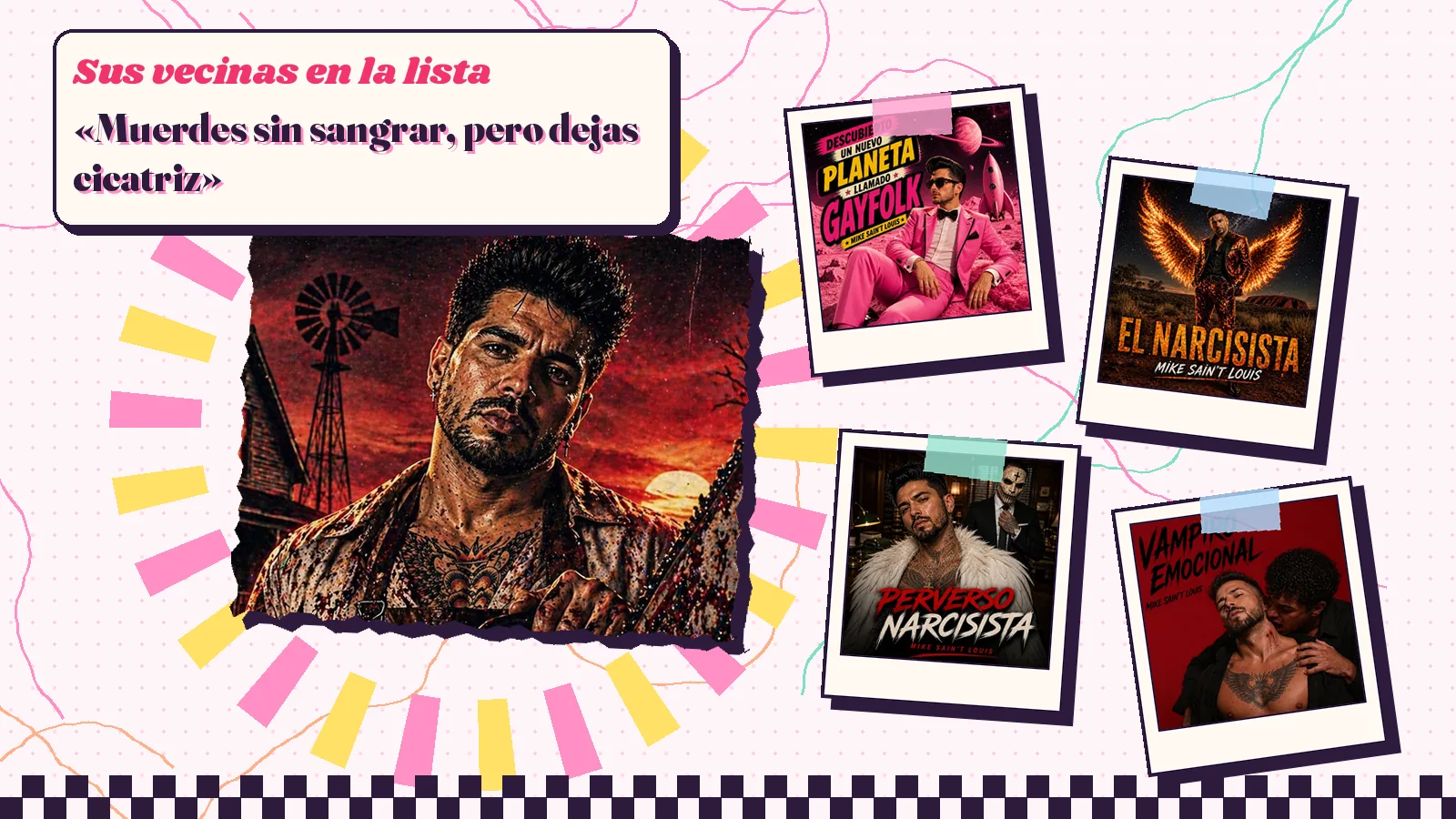
My catalogue is full of people like this, the kind who drain others dry. There’s the one in «El narcisista», the one in «Perverso narcisista», and the song simply called «Vampiro emocional». If you’re after the funnier side of the gallery, I have a short comic taxonomy of exes. And if what you need is the aftermath, there’s liberation day and the day after.
For anyone who wasn’t believed
«Como en la matanza de Texas» is for anyone who once told someone what happened and wasn’t believed. For anyone who watched the person who hurt them win over their friends. For anyone who finally found a good man who listened, and then lost him too. For anyone with scars from bites that never bled.
It’s also for the good men. For anyone who has ever opened the door to someone running and screaming. Take it as a warning: when the charming one turns up behind, with his smile and his version, remember the face of the one who got there first.
And it’s for anyone who is still inside it. For whoever reads this and recognises the nice guy at the bar, the chains only they can hear, the hope turned to salt. I don’t know whether a song can get anyone out of there. Probably not. But maybe it can do something smaller and more useful: let that person know they aren’t making it up. That what’s happening to them has a name, that it has happened to others, and that someone has told it with chainsaws and silly rhymes so it can be understood. Sometimes the first thing you need before you can ask for help is to know that what you’re living is real. And if nobody else tells you, let a song tell you.
And of course, it’s for listening to with the lights on.
As a lyricist, this is one of the songs from my early days I’m proudest of. I call myself «the first AI songwriter» because I make the music and the vocals with artificial intelligence, but the decision to put a horror-film petrol station into a song about manipulation is mine. And I think it’s one of the good ones.
Frequently asked questions
Which album is «Como en la matanza de Texas» on? It’s on «Descubierto un nuevo planeta llamado Gayfolk», the first album of Mike Sain't Louis’s GAYFOLK trilogy.
What is «Como en la matanza de Texas» about? About an emotional vampire, someone who manipulates and drains other people without leaving any evidence. The final section tells, like a horror film, how the victim asks for help, nobody answers and, when someone finally believes them, the vampire turns up behind and wins that person over too.
Why is it called that? Because of the final scene, where the victim runs screaming for help like in the film The Texas Chain Saw Massacre, and nobody answers.
What’s on the cover? A man spattered in red, wearing a butcher’s apron and resting a chainsaw on his shoulder, in front of an old wooden house, a windmill and a red sky, styled like a horror-film poster.
Who made the song? The lyrics are by Mike Sain't Louis, lyricist, composer and music producer from Madrid. The music and vocals were made with artificial intelligence tools.